set CHEVROLET KODIAK 2007 Repair Manual
[x] Cancel search | Manufacturer: CHEVROLET, Model Year: 2007, Model line: KODIAK, Model: CHEVROLET KODIAK 2007Pages: 430, PDF Size: 6.06 MB
Page 295 of 430
Power Steering Fluid
SeeScheduled Maintenance on page 363to
determine when to check your power steering fluid.
How To Check Power Steering Fluid
Check your power steering fluid only when the
engine is warm. If the engine is not warm, you
probably will not get an accurate reading.
If the fluid level is between the MIN (Minimum) and
MAX (Maximum) marks, you have enough. If you
need fluid, add only enough of the proper fluid to
bring it in between the MIN and MAX marks.
If your power steering fluid level is low, this can
cause the brake or service brakes soon warning
lights to come on. In addition, the steering
effort and emergency brake distance could
increase.If either light remains on after you have added
power steering fluid to the proper level, then shut
off the engine for 10 seconds. This should
reset the brake warning lights. If one or both lights
stay on, see “Hydraulic Brake System Warning
Lights” underBrake System Warning Light
on page 169for more information.
What to Use
To determine what kind of fluid to use, see
Part C: Recommended Fluids and Lubricants on
page 397.
Notice:When adding power steering uid or
making a complete uid change, always
use the proper uid. Failure to use the proper
uid can cause leaks and damage hoses
and seals.
295
Page 299 of 430
Four-Wheel Disc Brakes
(Hydraulic Only)
Your vehicle has four-wheel disc brakes.
Some driving conditions or climates may cause a
brake squeal when the brakes are first applied
or lightly applied. This does not mean something
is wrong with the brakes.
Brake linings should always be replaced as
complete axle sets.
Four-Wheel and Six-Wheel Drum
Brakes (Air Only)
The brake drums should be removed and
inspected each time the tires are removed for
rotation or changing. When you have the
front brakes replaced, have the rear brakes
inspected, too.
Brake linings should always be replaced as
complete axle sets.
Brake Pedal Travel
See your dealer if the brake pedal does not return
to normal height, or if there is a rapid increase in
pedal travel. This could be a sign that brake service
is needed.
Brake Adjustment
Every time you make a brake stop, the brakes
adjust for wear.
Brake Adjustment on Air Braked
Vehicles
Your vehicle has automatic slack adjusters.
Every time you make a brake stop, the brakes
automatically adjust for wear. Slack adjusters
should never be manually adjusted to correct
excessive brake chamber pushrod stroke.
Excessive brake chamber pushrod stroke means
that the brake system needs to be serviced by
a qualified service technician.
Notice:Do not manually adjust automatic slack
adjusters. Manual adjustment of the automatic
slack adjusters can result in a degradation of
the slack adjuster performance over time.
If the brake chamber pushrod stroke is out of
adjustment, the brake system needs to be
serviced by a qualied service technician.
299
Page 306 of 430
Notice:Ignoring these steps could result in
costly damage to your vehicle that would
not be covered by your warranty.
Trying to start your vehicle by pushing or
pulling it will not work, and it could damage
your vehicle.
1. Check the other vehicle. It must have a
12-volt battery (or batteries) with a negative
ground system.
Notice:If the other vehicle’s system is not a
12-volt system with a negative ground,
both vehicles can be damaged. Only use
vehicles with 12-volt systems with negative
grounds to jump start your vehicle.
If you have a diesel engine vehicle with
two batteries (or more), you should know
before you begin that, especially in cold
weather, you may not be able to get enough
power from a single battery in another
vehicle to start your diesel engine.
If your vehicle has more than one battery, use
the one closest to the starter — this will
reduce electrical resistance.2. Get the vehicles close enough so the jumper
cables can reach, but be sure the vehicles are
not touching each other. If they are, it could
cause a ground connection you do not
want. You would not be able to start your
vehicle, and the bad grounding could damage
the electrical systems.
To avoid the possibility of the vehicles rolling,
set the parking brake firmly on both vehicles
involved in the jump start procedure. Put
an automatic transmission in PARK (P) or a
manual transmission in NEUTRAL before
setting the parking brake. If you have a
four-wheel-drive vehicle, be sure the transfer
case is in a drive gear, not in NEUTRAL.
Notice:If you leave your radio or other
accessories on during the jump starting
procedure, they could be damaged. The repairs
would not be covered by your warranty.
Always turn off your radio and other
accessories when jump starting your vehicle.
3. Turn off the ignition on both vehicles. Unplug
unnecessary accessories plugged into the
cigarette lighter or accessory power outlets.
306
Page 324 of 430
When It Is Time for New Tires
Replace your tires when the tread depth is down
to 1/8 of an inch (3.2 mm) for the front tires,
or 1/16 of an inch (1.6 mm) for a rear tire. Also,
you need a new tire if:
•You can see cord or fabric showing through
the tire’s rubber.
•The tread or sidewall is cracked, cut or
snagged deep enough to show cord or fabric.
•The tire has a bump, bulge or split.
•The tire has a puncture, cut or other damage
that cannot be repaired well because of the
size or location of the damage.
{CAUTION:
Mixing tires could cause you to lose
control while driving. If you mix tires of
different types — like radial and
bias-belted tires — the vehicle may not
handle properly, and you could have a
crash. Be sure to use the same type of
tires all around.When you replace tires, make sure they are the
same size, load range, speed rating and
construction type (bias, bias-belted or radial) as
your original tires.
If your vehicle has four-wheel drive, the axle
differentials, propshafts and transfer case may be
damaged if tires of different sizes, brands or
tread types are installed on the front and rear
axles. That damage would not be covered under
your warranty.
Wheel Alignment and Tire Balance
The wheels on your vehicle were aligned at
the factory to give you the longest tire life and
best overall performance.
Proper front wheel alignment must be maintained
in order to ensure efficient steering, good
directional stability, and prevent abnormal tire
wear. If you notice unusual tire wear or your
vehicle is pulling one way or the other, the
alignment may need to be reset. If you notice your
vehicle vibrating when driving on a smooth
road, your wheels may need to be balanced.
324
Page 328 of 430
How Often to Check
Wheel tightness is so important you should have a
technician check nut tightness on all wheels with a
torque wrench after your first 100 miles (160 km),
and then 1,000 miles (1 600 km) after that. Be sure
to repeat this service whenever you have a tire
removed or serviced. SeeScheduled Maintenance
on page 363for further information.
Wheel Replacement
Replace any wheel that is bent, cracked or badly
rusted or corroded. If wheel nuts keep coming
loose, replace the wheel. If the wheel leaks
air, replace it.
Your dealer will know the kind of wheel you need.
Each new wheel should have the same
load-carrying capacity, diameter, width, offset and
be mounted the same way as the one it replaces.If you need to replace any of your wheels, wheel
bolts or wheel nuts, replace them only with
new GM original equipment parts. This way, you
will be sure to have the right wheel, wheel
bolts and wheel nuts for your vehicle.
{CAUTION:
A leaking wheel could fail without warning.
A wheel designed for tubeless tires could
be leaking because it is damaged. Do not
use an inner tube or some other thing to try
to stop the leaking. Get a new wheel of the
proper type.
328
Page 329 of 430
{CAUTION:
Without the correct wheel, you may not be
able to stop properly, and you could have
other problems like a tire air-out. You
could have a collision. If you do not go to
your dealer to get a new wheel, be sure
you get the correct one. Each new wheel
should match the original wheel in
load-carrying capacity, ination pressure
capacity, diameter, width, offset and
mounting conguration.
Using wheels and tires with higher load-carrying
limits than the original wheels and tires does
not change the Gross Axle Weight Rating (GAWR)
or the Gross Vehicle Weight Rating (GVWR) of
your vehicle. SeeLoading Your Vehicle on
page 238for more information.Notice:The wrong wheel can cause trouble in
bearing life, brake cooling,
speedometer/odometer calibration, headlamp
aim, bumper height, vehicle ground clearance,
stopping distance and tire clearance to the
body and chassis. You could also have other
problems like a tire air-out.
Used Replacement Wheels
{CAUTION:
Putting a used wheel on your vehicle is
dangerous. You cannot know how it has
been used or how far it has been driven. It
could fail suddenly and cause a crash. If
you have to replace a wheel, use a new
GM original equipment wheel.
329
Page 331 of 430
Your truck, when new, did not include tire changing
equipment or a place to store a tire in the
vehicle. Few drivers of these vehicles have the
necessary equipment aboard to be able to change
a flat tire safely. For example, you would need
a truck jack that can lift several thousand pounds
and a torque wrench that can generate several
hundred foot-pounds (
Y) of twisting force.
{CAUTION:
If you try to put air back into a tire that
has run at, even a tire that was extremely
low on air, the tire can have a sudden
air-out. This could cause you to lose
control of the vehicle and have a serious
crash. Do not rell a at or very low tire
with air without rst having the tire taken
off the wheel and checked for damage.
So if you are stopped somewhere by a flat or
damaged tire or wheel, you should get expert help.
SeeRoadside Assistance Program on page 408.
Appearance Care
Cleaning the Inside of Your Vehicle
Your vehicle’s interior will continue to look its
best if it is cleaned often. Although not always
visible, dust and dirt can accumulate on your
upholstery. Dirt can damage carpet, fabric, leather,
and plastic surfaces. Regular vacuuming is
recommended to remove particles from your
upholstery. It is important to keep your upholstery
from becoming and remaining heavily soiled.
Soils should be removed as quickly as possible.
Your vehicle’s interior may experience extremes of
heat that could cause stains to set rapidly.
Lighter colored interiors may require more frequent
cleaning. Use care because newspapers and
garments that transfer color to your home
furnishings may also transfer color to your
vehicle’s interior.
331
Page 364 of 430
7,500 Miles (12 000 km)
❑Gasoline Engine Only: Check engine oil life
system. If engine oil and filter are changed,
reset system. See “Engine Oil (Gasoline
Engine)” in the Index.(2) (8)
❑Check fluid levels (or every 3 months,
whichever occurs first).(1) (5)
❑Chassis lubrication service (or every 6 months,
whichever occurs first).(11)
❑Spring-to-axle U-bolts and shackle bolts
service.(15)
❑Wheels and tires service.(14)
❑Hydraulic brake service (or every 6 months,
whichever occurs first).(6) (36)
❑Parking brake service (or every 6 months,
whichever occurs first).(21)
❑Air brake service (or every 6 months, whichever
occurs first).(32)
❑Air brake automatic slack adjuster service (or
every 500 hours, whichever occurs first).(33)
❑Check air brake relay valve operation and check
for leaks (or every month, or every 300 hours,
whichever occurs first).❑Clean air brake application valve (or every
3 months, or every 300 hours, whichever occurs
first). Lubricate linkage.
❑Air brake chamber service (or every 2 months,
whichever occurs first).(34)
12,000 Miles (20 000 km)
❑Isuzu 6H Diesel Without Engine Oil Life System
Only: Change engine oil and filter (or every
12 months, or every 600 hours of engine
operation, whichever occurs first).(2)
❑Isuzu 6H Diesel With Engine Oil Life System
Only: Check oil life system (or every 12 months,
or every 600 hours of engine operation,
whichever occurs first). If engine oil and filter
are changed, reset system. See “Engine Oil
(DURAMAX
®/Isuzu Diesel)” in the Index.(2) (7)
364
Page 365 of 430
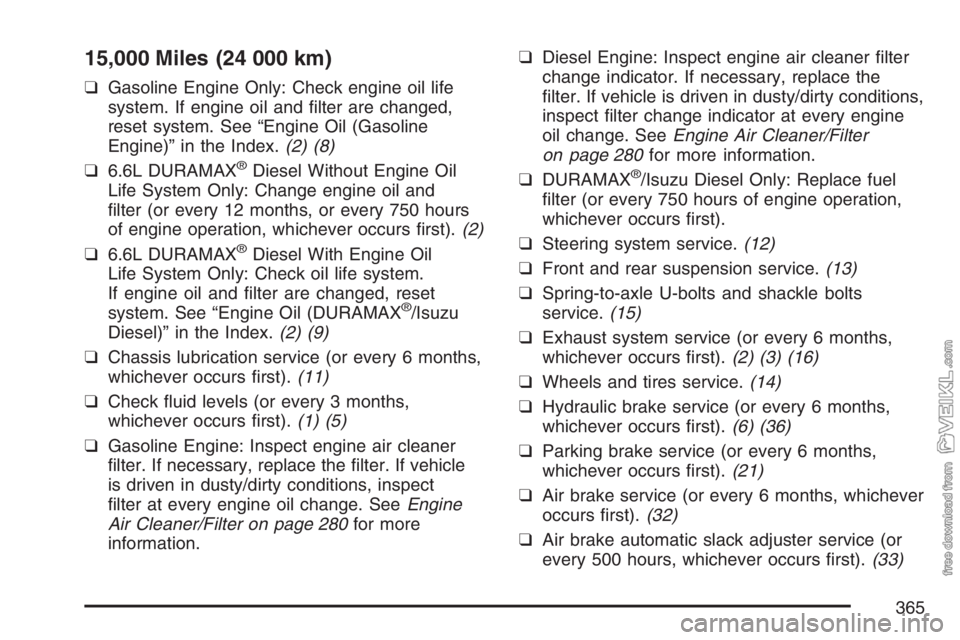
15,000 Miles (24 000 km)
❑Gasoline Engine Only: Check engine oil life
system. If engine oil and filter are changed,
reset system. See “Engine Oil (Gasoline
Engine)” in the Index.(2) (8)
❑6.6L DURAMAX
®Diesel Without Engine Oil
Life System Only: Change engine oil and
filter (or every 12 months, or every 750 hours
of engine operation, whichever occurs first).(2)
❑6.6L DURAMAX
®Diesel With Engine Oil
Life System Only: Check oil life system.
If engine oil and filter are changed, reset
system. See “Engine Oil (DURAMAX
®/Isuzu
Diesel)” in the Index.(2) (9)
❑Chassis lubrication service (or every 6 months,
whichever occurs first).(11)
❑Check fluid levels (or every 3 months,
whichever occurs first).(1) (5)
❑Gasoline Engine: Inspect engine air cleaner
filter. If necessary, replace the filter. If vehicle
is driven in dusty/dirty conditions, inspect
filter at every engine oil change. SeeEngine
Air Cleaner/Filter on page 280for more
information.❑Diesel Engine: Inspect engine air cleaner filter
change indicator. If necessary, replace the
filter. If vehicle is driven in dusty/dirty conditions,
inspect filter change indicator at every engine
oil change. SeeEngine Air Cleaner/Filter
on page 280for more information.
❑DURAMAX
®/Isuzu Diesel Only: Replace fuel
filter (or every 750 hours of engine operation,
whichever occurs first).
❑Steering system service.(12)
❑Front and rear suspension service.(13)
❑Spring-to-axle U-bolts and shackle bolts
service.(15)
❑Exhaust system service (or every 6 months,
whichever occurs first).(2) (3) (16)
❑Wheels and tires service.(14)
❑Hydraulic brake service (or every 6 months,
whichever occurs first).(6) (36)
❑Parking brake service (or every 6 months,
whichever occurs first).(21)
❑Air brake service (or every 6 months, whichever
occurs first).(32)
❑Air brake automatic slack adjuster service (or
every 500 hours, whichever occurs first).(33)
365
Page 366 of 430
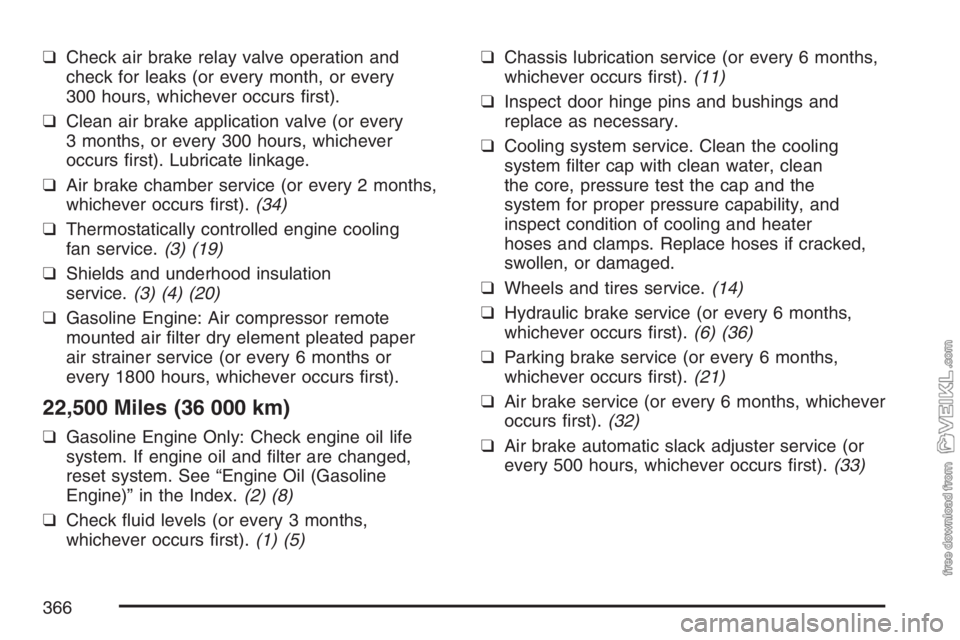
❑Check air brake relay valve operation and
check for leaks (or every month, or every
300 hours, whichever occurs first).
❑Clean air brake application valve (or every
3 months, or every 300 hours, whichever
occurs first). Lubricate linkage.
❑Air brake chamber service (or every 2 months,
whichever occurs first).(34)
❑Thermostatically controlled engine cooling
fan service.(3) (19)
❑Shields and underhood insulation
service.(3) (4) (20)
❑Gasoline Engine: Air compressor remote
mounted air filter dry element pleated paper
air strainer service (or every 6 months or
every 1800 hours, whichever occurs first).
22,500 Miles (36 000 km)
❑Gasoline Engine Only: Check engine oil life
system. If engine oil and filter are changed,
reset system. See “Engine Oil (Gasoline
Engine)” in the Index.(2) (8)
❑Check fluid levels (or every 3 months,
whichever occurs first).(1) (5)❑Chassis lubrication service (or every 6 months,
whichever occurs first).(11)
❑Inspect door hinge pins and bushings and
replace as necessary.
❑Cooling system service. Clean the cooling
system filter cap with clean water, clean
the core, pressure test the cap and the
system for proper pressure capability, and
inspect condition of cooling and heater
hoses and clamps. Replace hoses if cracked,
swollen, or damaged.
❑Wheels and tires service.(14)
❑Hydraulic brake service (or every 6 months,
whichever occurs first).(6) (36)
❑Parking brake service (or every 6 months,
whichever occurs first).(21)
❑Air brake service (or every 6 months, whichever
occurs first).(32)
❑Air brake automatic slack adjuster service (or
every 500 hours, whichever occurs first).(33)
366