alarm CHEVROLET KODIAK 2007 Owners Manual
[x] Cancel search | Manufacturer: CHEVROLET, Model Year: 2007, Model line: KODIAK, Model: CHEVROLET KODIAK 2007Pages: 430, PDF Size: 6.06 MB
Page 85 of 430
Keys.............................................................. 86
Remote Keyless Entry (RKE) System.......... 87
Remote Keyless Entry (RKE)
System Operation.................................... 88
Doors and Locks.......................................... 91
Door Locks................................................. 91
Power Door Locks....................................... 92
Windows....................................................... 93
Manual Windows......................................... 93
Power Windows.......................................... 94
Sliding Rear Window................................... 94
Sun Visors.................................................. 95
Starting and Operating Your Vehicle........... 95
New Vehicle Break-In.................................. 95
Ignition Positions......................................... 96
Engine Starter Over-Crank Protection.......... 97
Starting the Gasoline Engine....................... 97
Starting the Diesel Engine......................... 100
Engine Alarm and Automatic Shutdown..... 104
High Idle System....................................... 106
Exhaust Restrictor (Engine Warm-Up)........ 108
Engine Checks Before Operating............... 109
Engine Coolant Heater.............................. 111
Diesel Engine Exhaust Brake.................... 112Two-Speed Rear Axle Electric
Shift Control........................................... 113
Air Shift Control (Automatic
Transmission)......................................... 114
Automatic Transmission Operation............. 115
Manual Transmission Operation................. 116
Power Take-Off (PTO)............................... 118
Four-Wheel Drive...................................... 119
Parking...................................................... 125
Parking Brake (With Hydraulic Brakes)...... 125
Parking Brake (with Air Brakes)................. 126
Parking Brake Burnish Procedure.............. 128
Air Suspension.......................................... 129
Parking Over Things That Burn................. 130
Engine Exhaust......................................... 131
Running the Engine While Parked............. 132
Mirrors......................................................... 133
Manual Rearview Mirror............................. 133
Outside Manual Mirrors............................. 133
Outside Power Mirrors............................... 133
Outside Convex Mirrors............................. 134
Outside Heated Mirrors............................. 134
Storage Areas............................................. 135
Center Console Storage Area.................... 135
Section 2 Features and Controls
85
Page 104 of 430
If the light does not come on when the engine is
cold, your vehicle needs service.
If your batteries do not have enough charge to
start your engine, seeBattery on page 304.
Be sure you have the right oil for your engine, and
that you have changed the oil at the proper
times. If you use the wrong oil, your engine may
be harder to start.
Be sure you are using the proper fuel for existing
weather conditions. SeeWhat Fuel to Use on
page 253.
If the engine starts, runs a short time, then stops,
your vehicle needs service.
{CAUTION:
Do not use gasoline or starting aids, such
as ether, in the air intake. They could
damage your engine. There could also be
a re, which could cause serious personal
injury.
Engine Alarm and Automatic
Shutdown
Your check gages warning light will come on if the
system senses high engine temperature or low
engine oil pressure. If high engine temperature or
low engine oil pressure is detected, you will
also hear a tone alarm at two beats per second.
The alarm and the light will remain on until
the condition is fixed. If the engine temperature or
oil pressure condition worsens, the tone alarm
will go to five beats per second.
If the system senses low engine coolant, the
five beat per second alarm and the low coolant
warning light will come on.
The five beats per second tone alarm means that
your engine will shut down in about 25 to
30 seconds. There is also an engine shutdown
light to indicate that the engine will shut down. See
Engine Shutdown Warning Light on page 177.
104
Page 105 of 430
Pull off the road and shut off the engine. Do
not start it until the reason for the problem is
known, and the problem is fixed. If the engine
shuts down when you are still in traffic, you can
restart the engine and get another 25 to
30 seconds of operation. Do this only if you have
to, since there is a problem that can harm the
engine if it is not fixed. Engine automatic
shutdown, for gasoline engines, requires activation
by your dealer.
Notice:If you try to operate the vehicle after
the engine automatically shuts down, you
may damage the vehicle. Have your vehicle
repaired as soon as possible.Ambulance, Fire, and Rescue Packages
Your check gages warning light will come on if
the system senses high engine temperature or low
engine oil pressure. If high engine temperature
or low engine oil pressure is detected, you will also
hear a tone alarm at two beats per second. The
alarm and the light will remain on until the
condition is fixed. If the engine temperature or oil
pressure condition worsens, the tone alarm
will go to five beats per second.
If the system senses low engine coolant, the
five beat per second alarm and the low coolant
warning light will come on.
The engine will not shutdown, but you should
have the vehicle checked as soon as you can.
105
Page 110 of 430
•If the engine coolant temperature gage needle
goes into the hot area on the gage, stop the
engine and find the cause of the overheating.
SeeEngine Coolant Temperature Gage on
page 173for more information.
•If you have air brakes, the dual-needle air
pressure gage should read at least 115 psi
(790 kPa) for both service systems before you
try to move the vehicle. When air pressure
is below 60 psi (420 kPa), the LOW AIR light
will come on and you will hear a tone
alarm. SeeBrake System Warning Light on
page 169for more information. If the pressure
does not build up or drops during warm-up,
stop the engine and find the cause before you
try to move the vehicle. Recommended air
pressure before driving is 120 psi (830 kPa).
SeeAir Pressure Gage on page 183for
more information.
•The charging system light should come on
when the ignition key is turned to RUN or
START and should go out when the engine is
running above idle. If the light does not go
out or comes back on during normal engine
operation, have the charging system checked
right away. (This light tells you if thegenerator is not charging; it does not reflect
the condition of the battery.) SeeCharging
System Light on page 167for more
information.
•The voltmeter charge indicator gage tells you
the condition of your battery’s charge. The
gage should be in the center area during
engine operation. The red area on the
left indicates an undercharge condition; the
red area on the right indicates an overcharge.
If the gage is in either red area, have the
battery and charging system checked
right away. SeeVoltmeter Gage on page 168
for more information.
Notice:Do not allow the engine to operate at
low idle for more than ve minutes. This
can cause low engine operating temperatures
which can affect engine operation and
reduce engine life. Engine idle speed should
be increased to 1200 rpm whenever extended
idle is required. Once started, the engine
should be placed under load to allow the
engine coolant temperature to reach 150°F
(66°C) before shutting off the engine.
110
Page 161 of 430
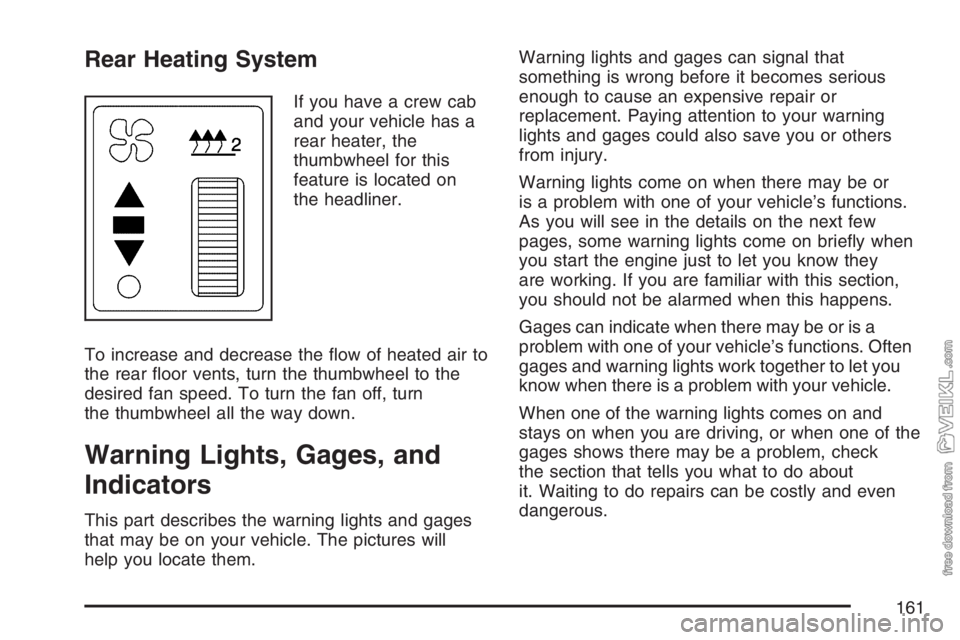
Rear Heating System
If you have a crew cab
and your vehicle has a
rear heater, the
thumbwheel for this
feature is located on
the headliner.
To increase and decrease the flow of heated air to
the rear floor vents, turn the thumbwheel to the
desired fan speed. To turn the fan off, turn
the thumbwheel all the way down.
Warning Lights, Gages, and
Indicators
This part describes the warning lights and gages
that may be on your vehicle. The pictures will
help you locate them.Warning lights and gages can signal that
something is wrong before it becomes serious
enough to cause an expensive repair or
replacement. Paying attention to your warning
lights and gages could also save you or others
from injury.
Warning lights come on when there may be or
is a problem with one of your vehicle’s functions.
As you will see in the details on the next few
pages, some warning lights come on briefly when
you start the engine just to let you know they
are working. If you are familiar with this section,
you should not be alarmed when this happens.
Gages can indicate when there may be or is a
problem with one of your vehicle’s functions. Often
gages and warning lights work together to let you
know when there is a problem with your vehicle.
When one of the warning lights comes on and
stays on when you are driving, or when one of the
gages shows there may be a problem, check
the section that tells you what to do about
it. Waiting to do repairs can be costly and even
dangerous.
161
Page 173 of 430
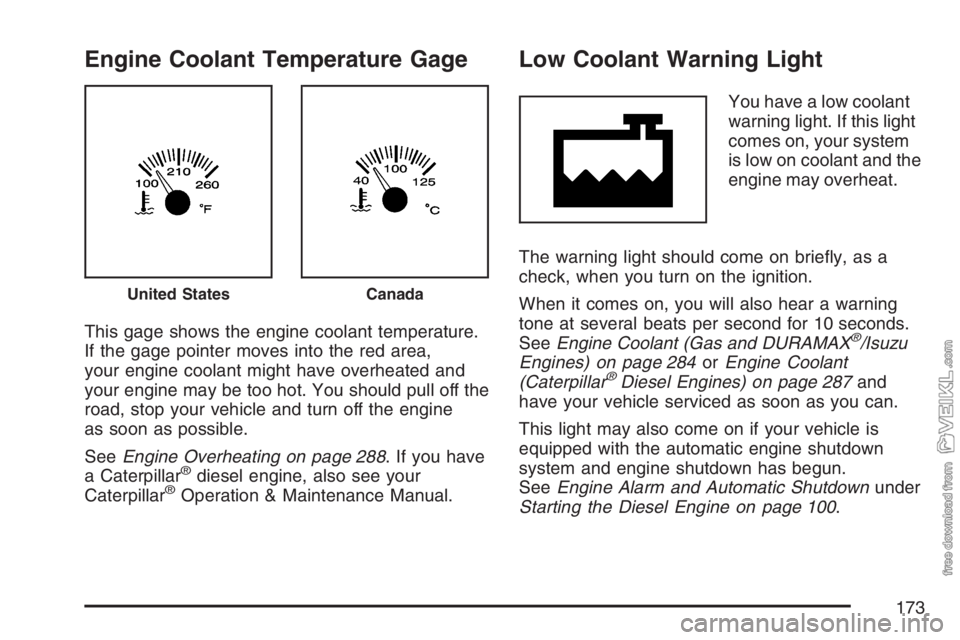
Engine Coolant Temperature Gage
This gage shows the engine coolant temperature.
If the gage pointer moves into the red area,
your engine coolant might have overheated and
your engine may be too hot. You should pull off the
road, stop your vehicle and turn off the engine
as soon as possible.
SeeEngine Overheating on page 288. If you have
a Caterpillar
®diesel engine, also see your
Caterpillar®Operation & Maintenance Manual.
Low Coolant Warning Light
You have a low coolant
warning light. If this light
comes on, your system
is low on coolant and the
engine may overheat.
The warning light should come on briefly, as a
check, when you turn on the ignition.
When it comes on, you will also hear a warning
tone at several beats per second for 10 seconds.
SeeEngine Coolant (Gas and DURAMAX
®/Isuzu
Engines) on page 284orEngine Coolant
(Caterpillar
®Diesel Engines) on page 287and
have your vehicle serviced as soon as you can.
This light may also come on if your vehicle is
equipped with the automatic engine shutdown
system and engine shutdown has begun.
SeeEngine Alarm and Automatic Shutdownunder
Starting the Diesel Engine on page 100.
United StatesCanada
173
Page 177 of 430
For additional information on when to change
engine oil for gasoline engines or DURAMAX®
diesel engines, seeEngine Oil (Caterpillar®Diesel
Engine) on page 268orEngine Oil (Gasoline
Engine) on page 268orEngine Oil (DURAMAX
®/
Isuzu Diesel Engine) on page 272andScheduled
Maintenance on page 363. To reset the change
engine oil light, seeEngine Oil Life System
(Gasoline Engine) on page 276orEngine Oil Life
System (DURAMAX
®Diesel) on page 278or
Engine Oil Life System (Caterpillar®Diesel Engine)
on page 279.
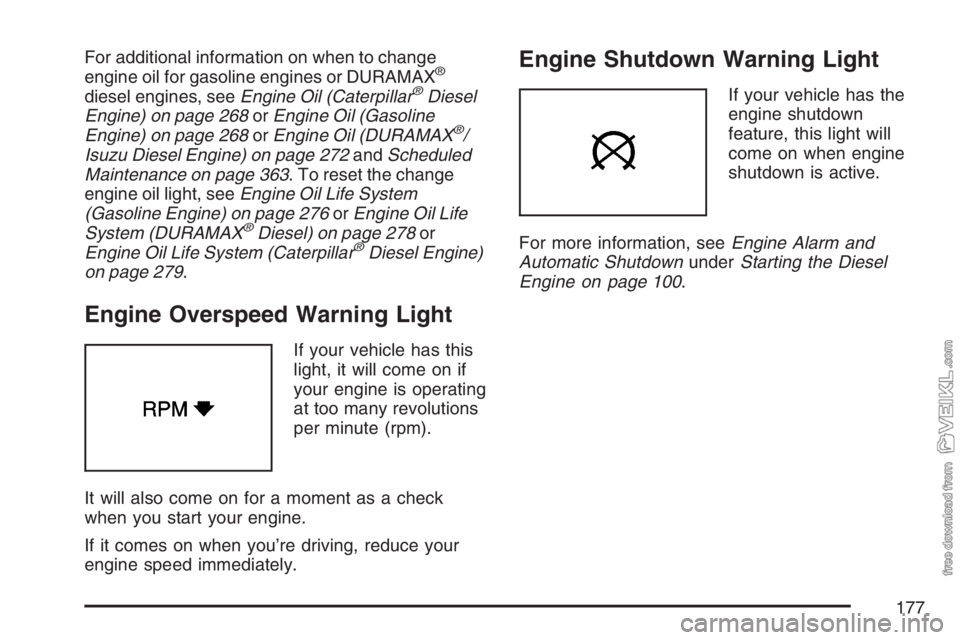
Engine Overspeed Warning Light
If your vehicle has this
light, it will come on if
your engine is operating
at too many revolutions
per minute (rpm).
It will also come on for a moment as a check
when you start your engine.
If it comes on when you’re driving, reduce your
engine speed immediately.
Engine Shutdown Warning Light
If your vehicle has the
engine shutdown
feature, this light will
come on when engine
shutdown is active.
For more information, seeEngine Alarm and
Automatic ShutdownunderStarting the Diesel
Engine on page 100.
177
Page 180 of 430
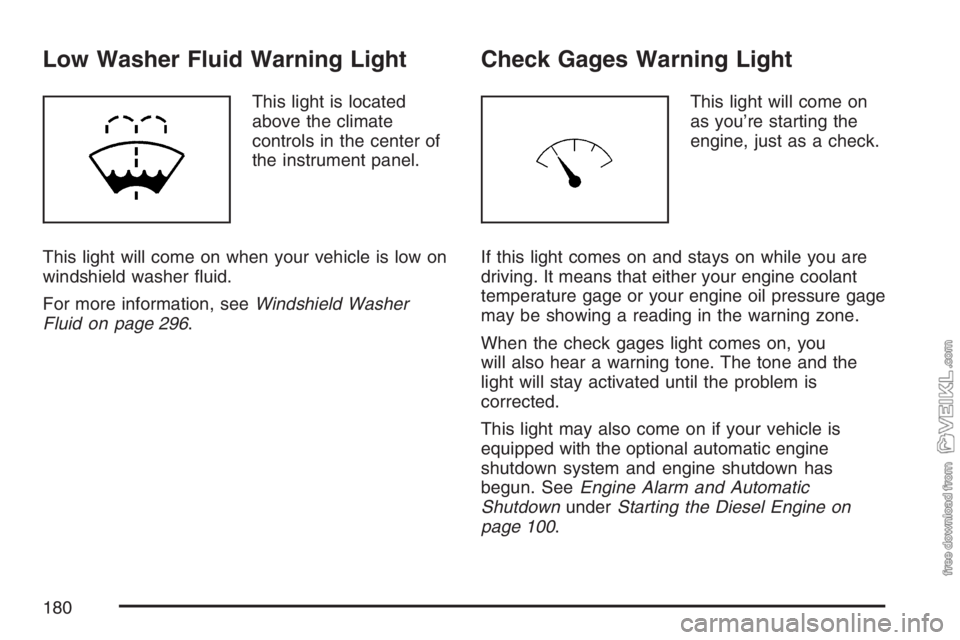
Low Washer Fluid Warning Light
This light is located
above the climate
controls in the center of
the instrument panel.
This light will come on when your vehicle is low on
windshield washer fluid.
For more information, seeWindshield Washer
Fluid on page 296.
Check Gages Warning Light
This light will come on
as you’re starting the
engine, just as a check.
If this light comes on and stays on while you are
driving. It means that either your engine coolant
temperature gage or your engine oil pressure gage
may be showing a reading in the warning zone.
When the check gages light comes on, you
will also hear a warning tone. The tone and the
light will stay activated until the problem is
corrected.
This light may also come on if your vehicle is
equipped with the optional automatic engine
shutdown system and engine shutdown has
begun. SeeEngine Alarm and Automatic
ShutdownunderStarting the Diesel Engine on
page 100.
180
Page 183 of 430
Air Pressure Gage
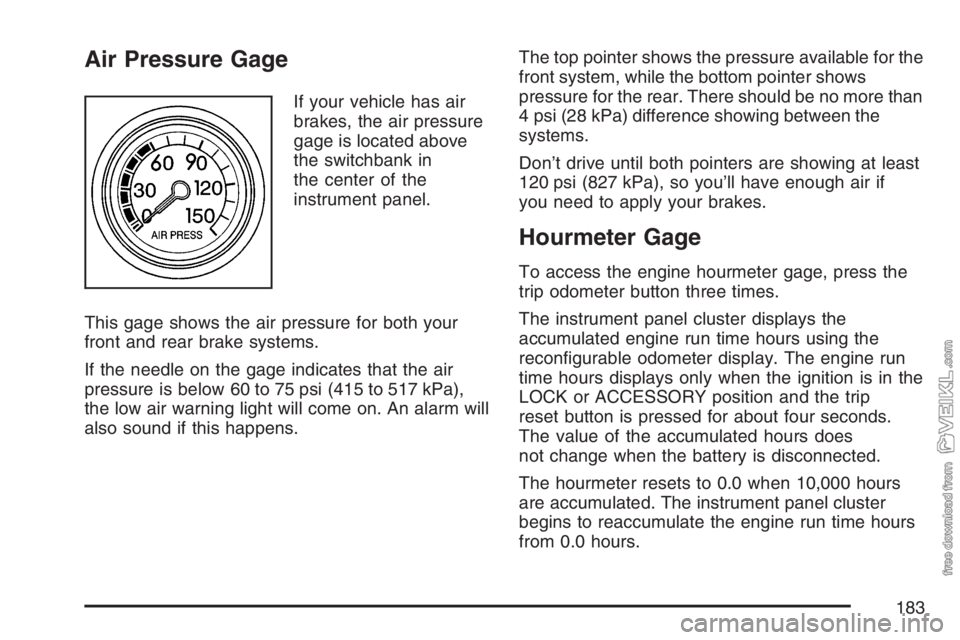
If your vehicle has air
brakes, the air pressure
gage is located above
the switchbank in
the center of the
instrument panel.
This gage shows the air pressure for both your
front and rear brake systems.
If the needle on the gage indicates that the air
pressure is below 60 to 75 psi (415 to 517 kPa),
the low air warning light will come on. An alarm will
also sound if this happens.The top pointer shows the pressure available for the
front system, while the bottom pointer shows
pressure for the rear. There should be no more than
4 psi (28 kPa) difference showing between the
systems.
Don’t drive until both pointers are showing at least
120 psi (827 kPa), so you’ll have enough air if
you need to apply your brakes.
Hourmeter Gage
To access the engine hourmeter gage, press the
trip odometer button three times.
The instrument panel cluster displays the
accumulated engine run time hours using the
reconfigurable odometer display. The engine run
time hours displays only when the ignition is in the
LOCK or ACCESSORY position and the trip
reset button is pressed for about four seconds.
The value of the accumulated hours does
not change when the battery is disconnected.
The hourmeter resets to 0.0 when 10,000 hours
are accumulated. The instrument panel cluster
begins to reaccumulate the engine run time hours
from 0.0 hours.
183
Page 393 of 430
Starter Switch Check
{CAUTION:
When you are doing this inspection, the
vehicle could move suddenly. If the vehicle
moves, you or others could be injured.
1. Before you start, be sure you have enough
room around the vehicle.
2. Firmly apply both the parking brake and the
regular brakes.
Do not use the accelerator pedal, and be ready
to turn off the engine immediately if it starts.
3. On automatic transmission vehicles, try to
start the engine in each gear. The starter
should work only in PARK (P), if equipped,
or NEUTRAL (N). If the starter works in
any other position, your vehicle needs service.
On manual transmission vehicles, the starter
should work only when the clutch pedal is
all the way down.
Automatic Transmission Shift
Indicator Check
Check that the indicator points to the gear chosen.
Steering Check
Be alert for any changes in steering action,
abnormal front tire wear or steering wheel position.
An inspection or service is needed when the
steering wheel is harder to turn or has too much
free play, or if there are strange sounds when
turning or parking.
Brake System Check
Be alert to illumination of the low air warning lamp
or for the tone alarm, or changes in braking
action, such as repeated pulling to one side,
unusual sounds when braking or increased
brake pedal travel. Make sure air brake system
reservoirs are drained daily with full system
air pressure, and check system for leaks.
Any of these conditions could indicate the need
for brake system inspection and/or service.
393