seats CHEVROLET KODIAK 2007 Owners Manual
[x] Cancel search | Manufacturer: CHEVROLET, Model Year: 2007, Model line: KODIAK, Model: CHEVROLET KODIAK 2007Pages: 430, PDF Size: 6.06 MB
Page 1 of 430
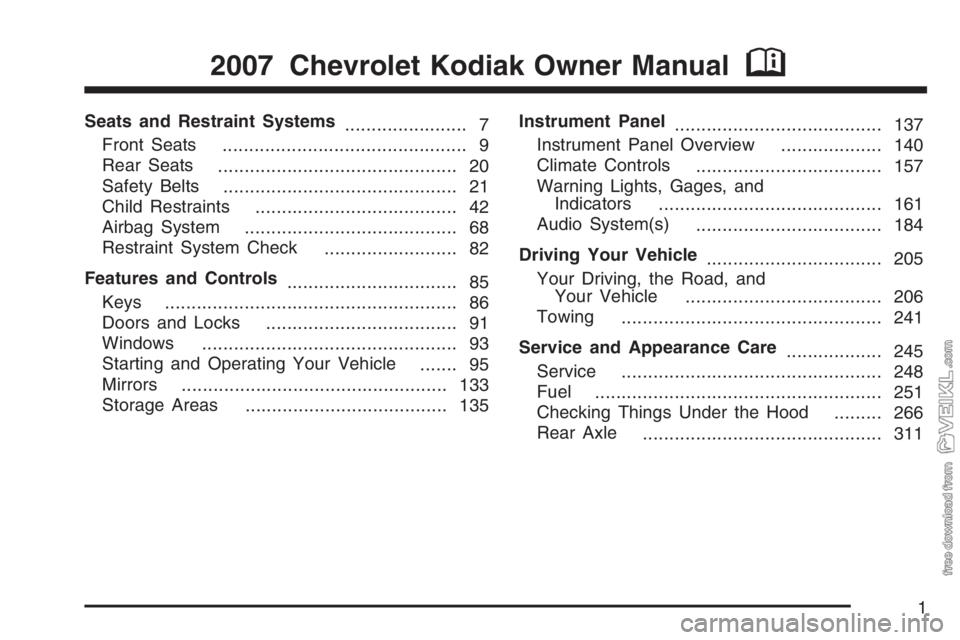
Seats and Restraint Systems
....................... 7
Front Seats
.............................................. 9
Rear Seats
............................................. 20
Safety Belts
............................................ 21
Child Restraints
...................................... 42
Airbag System
........................................ 68
Restraint System Check
......................... 82
Features and Controls
................................ 85
Keys
....................................................... 86
Doors and Locks
.................................... 91
Windows
................................................ 93
Starting and Operating Your Vehicle
....... 95
Mirrors
.................................................. 133
Storage Areas
...................................... 135Instrument Panel
....................................... 137
Instrument Panel Overview
................... 140
Climate Controls
................................... 157
Warning Lights, Gages, and
Indicators
.......................................... 161
Audio System(s)
................................... 184
Driving Your Vehicle
................................. 205
Your Driving, the Road, and
Your Vehicle
..................................... 206
Towing
................................................. 241
Service and Appearance Care
.................. 245
Service
................................................. 248
Fuel
...................................................... 251
Checking Things Under the Hood
......... 266
Rear Axle
............................................. 311
2007 Chevrolet Kodiak Owner ManualM
1
Page 3 of 430
GENERAL MOTORS, GM, the GM Emblem,
CHEVROLET, the CHEVROLET Emblem, and
the name KODIAK are registered trademarks
of General Motors Corporation.
This manual includes the latest information at
the time it was printed. We reserve the right
to make changes after that time without further
notice. For vehicles first sold in Canada, substitute
the name “General Motors of Canada Limited”
for GM Medium Duty Truck Division when it
appears in this manual.This manual describes features that may be
available in this model, but your vehicle may not
have all of them. For example, more than one
entertainment system may be offered or your
vehicle may have been ordered without a front
passenger or rear seats.
Keep this manual in the vehicle, so it will be there
if it is needed while you are on the road. If the
vehicle is sold, leave this manual in the vehicle.
Canadian Owners
A French language copy of this manual can be
obtained from your dealer or from:
Helm, Incorporated
P.O. Box 07130
Detroit, MI 48207
Litho in U.S.A.
Part No. 15862455 A First Printing
©2006 General Motors Corporation. All Rights Reserved.
3
Page 5 of 430
Vehicle Damage Warnings
Also, in this manual you will find these notices:
Notice:These mean there is something
that could damage your vehicle.
A notice tells about something that can damage
the vehicle. Many times, this damage would not be
covered by your vehicle’s warranty, and it could
be costly. But the notice will tell what to do to help
avoid the damage.
When you read other manuals, you might see
CAUTION and NOTICE warnings in different colors
or in different words.
There are also warning labels on the vehicle.
They use the same words, CAUTION or NOTICE.
Vehicle Symbols
The vehicle has components and labels that use
symbols instead of text. Symbols are shown along
with the text describing the operation or information
relating to a specific component, control, message,
gage, or indicator.
If you need help figuring out a specific name of
a component, gage, or indicator, reference
the following topics:
•Seats and Restraint Systems in Section 1
•Features and Controls in Section 2
•Instrument Panel Overview in Section 3
•Climate Controls in Section 3
•Warning Lights, Gages, and Indicators
in Section 3
•Audio System(s) in Section 3
•Engine Compartment Overview in Section 5
5
Page 7 of 430
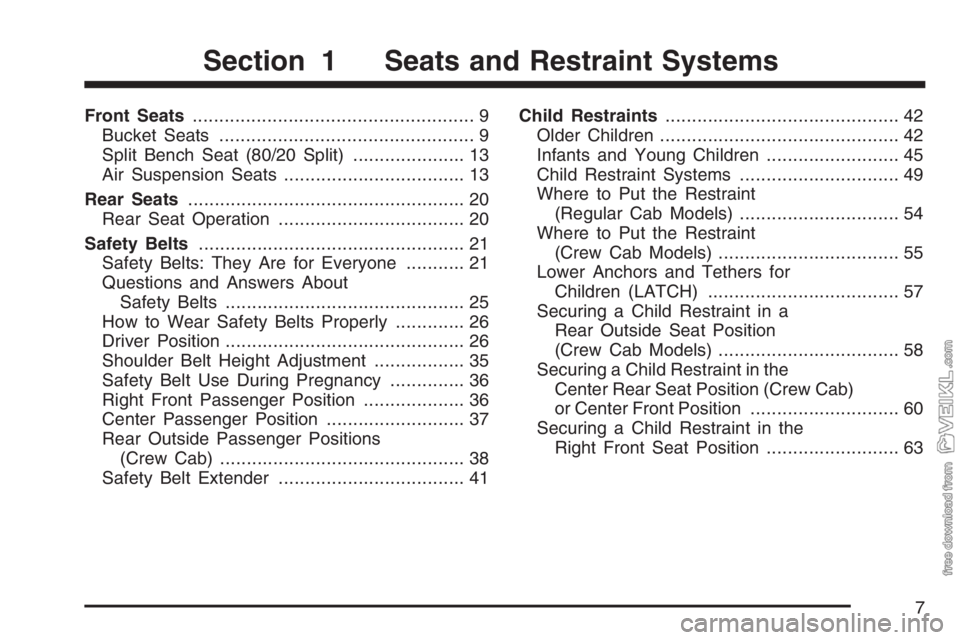
Front Seats..................................................... 9
Bucket Seats................................................ 9
Split Bench Seat (80/20 Split)..................... 13
Air Suspension Seats.................................. 13
Rear Seats.................................................... 20
Rear Seat Operation................................... 20
Safety Belts.................................................. 21
Safety Belts: They Are for Everyone........... 21
Questions and Answers About
Safety Belts............................................. 25
How to Wear Safety Belts Properly............. 26
Driver Position............................................. 26
Shoulder Belt Height Adjustment................. 35
Safety Belt Use During Pregnancy.............. 36
Right Front Passenger Position................... 36
Center Passenger Position.......................... 37
Rear Outside Passenger Positions
(Crew Cab).............................................. 38
Safety Belt Extender................................... 41Child Restraints............................................ 42
Older Children............................................. 42
Infants and Young Children......................... 45
Child Restraint Systems.............................. 49
Where to Put the Restraint
(Regular Cab Models).............................. 54
Where to Put the Restraint
(Crew Cab Models).................................. 55
Lower Anchors and Tethers for
Children (LATCH).................................... 57
Securing a Child Restraint in a
Rear Outside Seat Position
(Crew Cab Models).................................. 58
Securing a Child Restraint in the
Center Rear Seat Position (Crew Cab)
or Center Front Position............................ 60
Securing a Child Restraint in the
Right Front Seat Position......................... 63
Section 1 Seats and Restraint Systems
7
Page 8 of 430
Airbag System.............................................. 68
Where Are the Airbags?.............................. 70
When Should an Airbag Inflate?.................. 72
What Makes an Airbag Inflate?................... 73
How Does an Airbag Restrain?................... 73
What Will You See After an
Airbag Inflates?........................................ 74
Airbag Off Switch........................................ 76Servicing Your Airbag-Equipped Vehicle...... 80
Adding Equipment to Your
Airbag-Equipped Vehicle.......................... 81
Restraint System Check............................... 82
Checking the Restraint Systems.................. 82
Replacing Restraint System Parts
After a Crash........................................... 83
Section 1 Seats and Restraint Systems
8
Page 9 of 430
Front Seats
Bucket Seats
If your vehicle has bucket seats, you can adjust
the seats several different ways.
Fore-and-Aft Adjustment
{CAUTION:
You can lose control of the vehicle if you
try to adjust the seat while the vehicle is
moving. The sudden movement could
startle and confuse you, or make you
push a pedal when you do not want to.
Adjust the driver’s seat only when the
vehicle is not moving.You can adjust the seat forward or rearward with
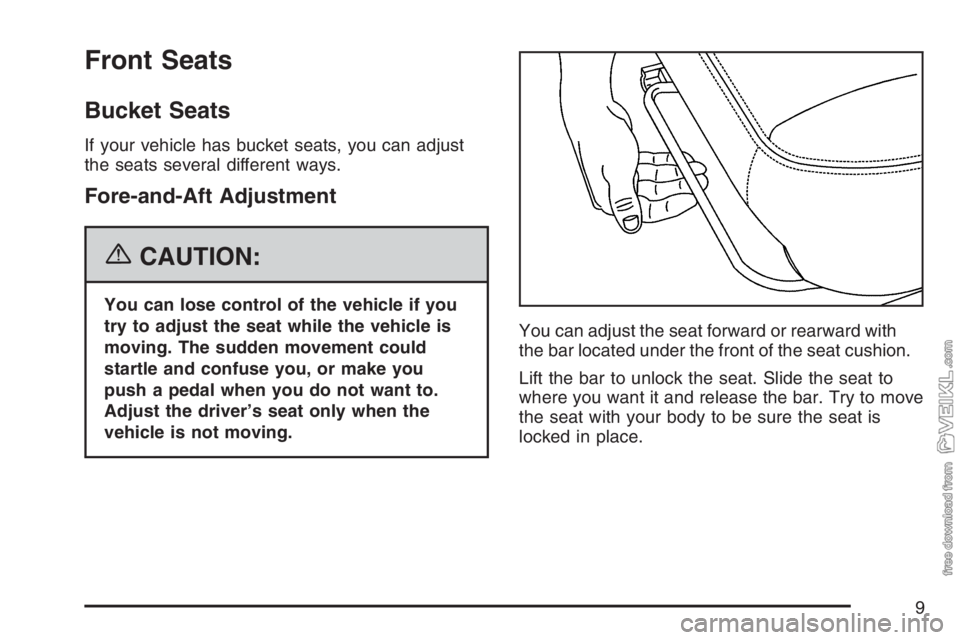
the bar located under the front of the seat cushion.
Lift the bar to unlock the seat. Slide the seat to
where you want it and release the bar. Try to move
the seat with your body to be sure the seat is
locked in place.
9
Page 10 of 430
Lumbar Adjustment
Your seats may have this feature.
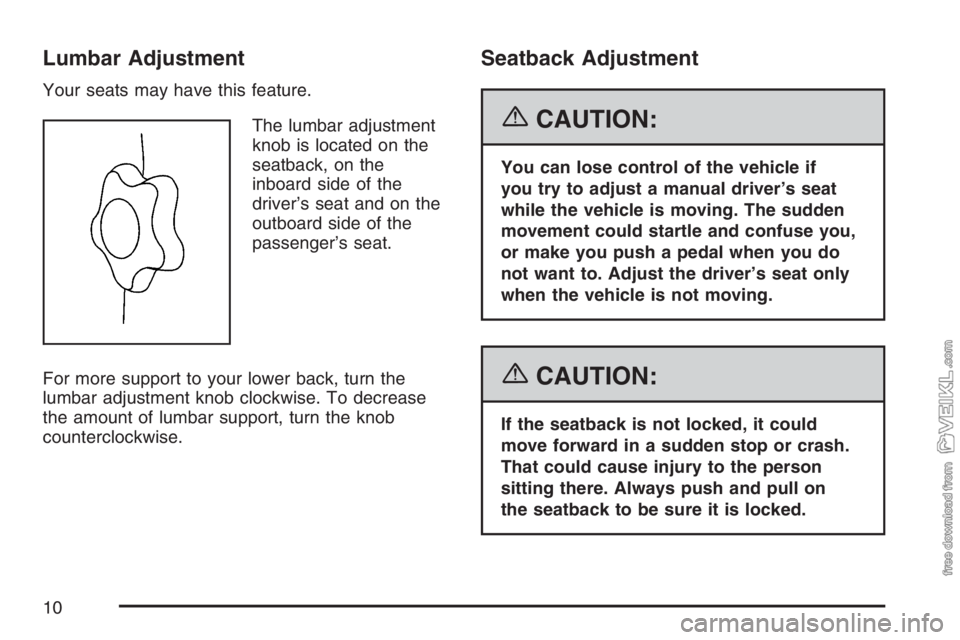
The lumbar adjustment
knob is located on the
seatback, on the
inboard side of the
driver’s seat and on the
outboard side of the
passenger’s seat.
For more support to your lower back, turn the
lumbar adjustment knob clockwise. To decrease
the amount of lumbar support, turn the knob
counterclockwise.
Seatback Adjustment
{CAUTION:
You can lose control of the vehicle if
you try to adjust a manual driver’s seat
while the vehicle is moving. The sudden
movement could startle and confuse you,
or make you push a pedal when you do
not want to. Adjust the driver’s seat only
when the vehicle is not moving.
{CAUTION:
If the seatback is not locked, it could
move forward in a sudden stop or crash.
That could cause injury to the person
sitting there. Always push and pull on
the seatback to be sure it is locked.
10
Page 13 of 430
Split Bench Seat (80/20 Split)
If your vehicle has a split bench seat, the
passenger seat is not adjustable.
There is a storage area underneath the seat
cushion. SeeStorage Areas on page 135.
Air Suspension Seats
Your vehicle may have a low-back or high-back
air suspension seat. There are several ways
to adjust the seat.
Fore-and-Aft Adjustment
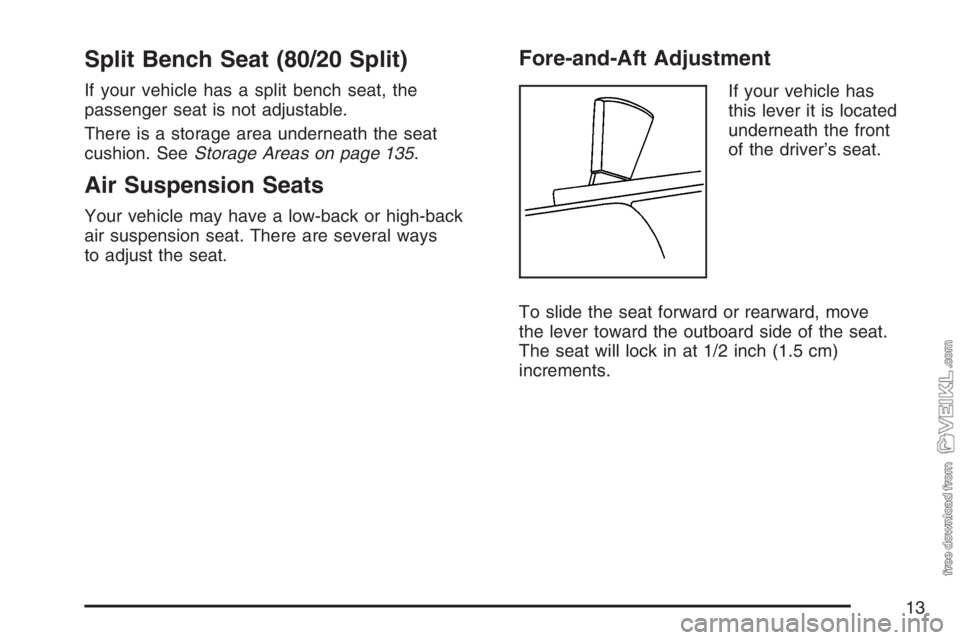
If your vehicle has
this lever it is located
underneath the front
of the driver’s seat.
To slide the seat forward or rearward, move
the lever toward the outboard side of the seat.
The seat will lock in at 1/2 inch (1.5 cm)
increments.
13
Page 19 of 430
{CAUTION:
Sitting in a reclined position when your
vehicle is in motion can be dangerous.
Even if you buckle up, your safety belts
cannot do their job when you are reclined
like this.
The shoulder belt cannot do its job. In a
crash, you could go into it, receiving neck
or other injuries.
The lap belt cannot do its job either. In a
crash the belt could go up over your
abdomen. The belt forces would be there,
not at your pelvic bones. This could
cause serious internal injuries.
For proper protection when the vehicle
is in motion, have the seatback upright.
Then sit well back in the seat and wear
your safety belt properly.
Chugger-Snubber Lock-Out Feature
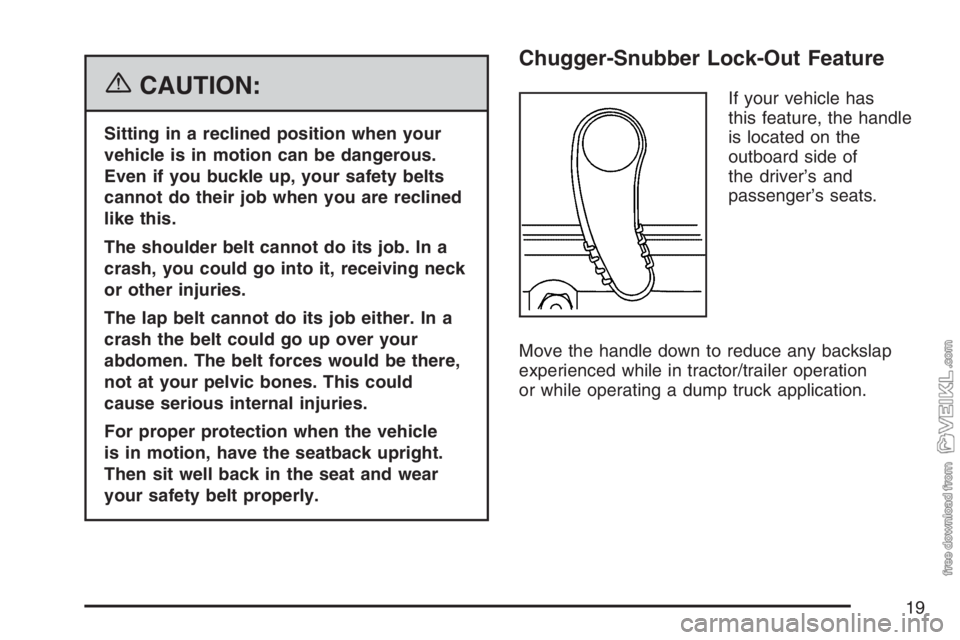
If your vehicle has
this feature, the handle
is located on the
outboard side of
the driver’s and
passenger’s seats.
Move the handle down to reduce any backslap
experienced while in tractor/trailer operation
or while operating a dump truck application.
19
Page 20 of 430
Rear Seats
Rear Seat Operation
Folding the Rear Seat (Crew Cab)
{CAUTION:
A safety belt that is improperly routed,
not properly attached, or twisted will not
provide the protection needed in a crash.
The person wearing the belt could be
seriously injured. After raising the rear
seatback, always check to be sure that
the safety belts are properly routed and
attached, and are not twisted.
Notice:Folding a rear seat with the safety
belts still fastened may cause damage to the
seat or the safety belts. Always unbuckle
the safety belts and return them to their normal
stowed position before folding a rear seat.
The rear bench seat on the crew cab can be folded
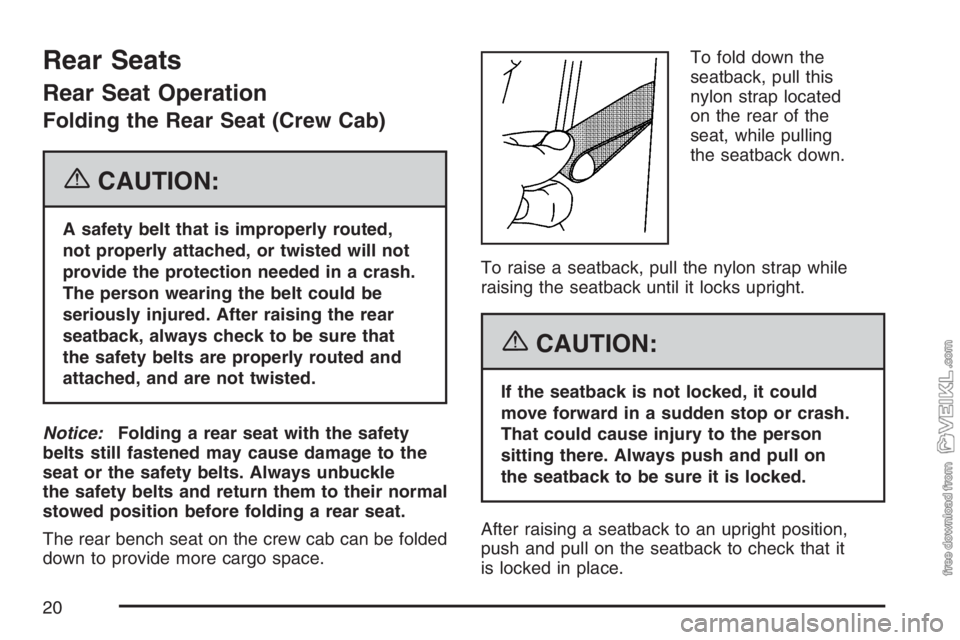
down to provide more cargo space.To fold down the
seatback, pull this
nylon strap located
on the rear of the
seat, while pulling
the seatback down.
To raise a seatback, pull the nylon strap while
raising the seatback until it locks upright.
{CAUTION:
If the seatback is not locked, it could
move forward in a sudden stop or crash.
That could cause injury to the person
sitting there. Always push and pull on
the seatback to be sure it is locked.
After raising a seatback to an upright position,
push and pull on the seatback to check that it
is locked in place.
20