set CHEVROLET KODIAK 2007 Owners Manual
[x] Cancel search | Manufacturer: CHEVROLET, Model Year: 2007, Model line: KODIAK, Model: CHEVROLET KODIAK 2007Pages: 430, PDF Size: 6.06 MB
Page 15 of 430
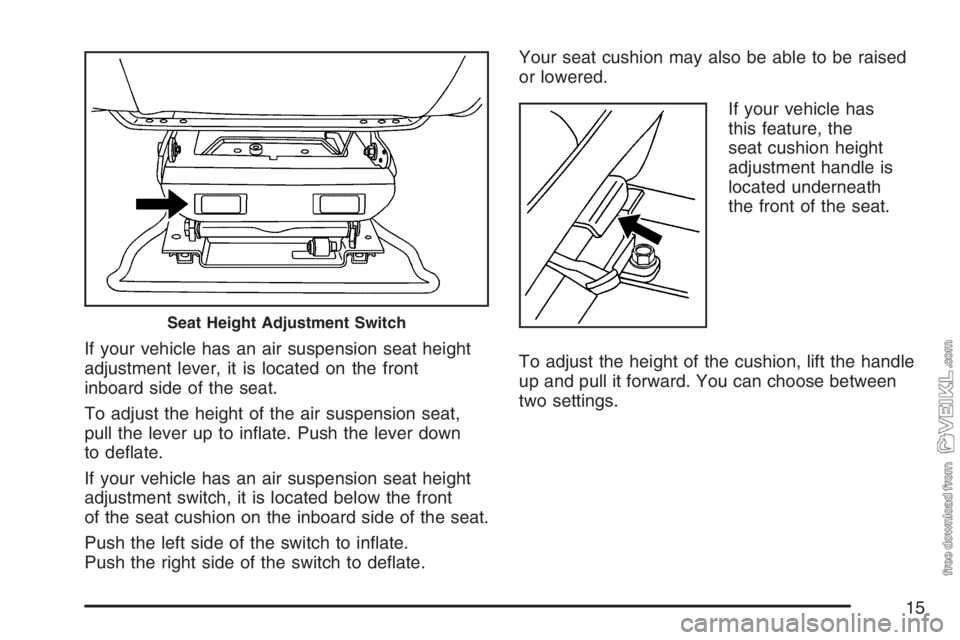
If your vehicle has an air suspension seat height
adjustment lever, it is located on the front
inboard side of the seat.
To adjust the height of the air suspension seat,
pull the lever up to inflate. Push the lever down
to deflate.
If your vehicle has an air suspension seat height
adjustment switch, it is located below the front
of the seat cushion on the inboard side of the seat.
Push the left side of the switch to inflate.
Push the right side of the switch to deflate.Your seat cushion may also be able to be raised
or lowered.
If your vehicle has
this feature, the
seat cushion height
adjustment handle is
located underneath
the front of the seat.
To adjust the height of the cushion, lift the handle
up and pull it forward. You can choose between
two settings.
Seat Height Adjustment Switch
15
Page 48 of 430
Q:What are the different types of add-on
child restraints?
A:Add-on child restraints, which are purchased by
the vehicle’s owner, are available in four basic
types. Selection of a particular restraint should
take into consideration not only the child’s
weight, height, and age but also whether or not
the restraint will be compatible with the motor
vehicle in which it will be used.
For most basic types of child restraints, there
are many different models available. When
purchasing a child restraint, be sure it is
designed to be used in a motor vehicle. If it is,
the restraint will have a label saying that it
meets federal motor vehicle safety standards.
The restraint manufacturer’s instructions
that come with the restraint state the weight
and height limitations for a particular child
restraint. In addition, there are many kinds
of restraints available for children with
special needs.
{CAUTION:
Newborn infants need complete support,
including support for the head and neck.
This is necessary because a newborn
infant’s neck is weak and its head weighs
so much compared with the rest of its
body. In a crash, an infant in a rear-facing
seat settles into the restraint, so the
crash forces can be distributed across
the strongest part of an infant’s body,
the back and shoulders. Infants always
should be secured in appropriate infant
restraints.
48
Page 49 of 430
{CAUTION:
The body structure of a young child is
quite unlike that of an adult or older child,
for whom the safety belts are designed.
A young child’s hip bones are still so
small that the vehicle’s regular safety belt
may not remain low on the hip bones, as
it should. Instead, it may settle up around
the child’s abdomen. In a crash, the belt
would apply force on a body area that
is unprotected by any bony structure.
This alone could cause serious or fatal
injuries. Young children always should be
secured in appropriate child restraints.
We know securing a child can present real
problems in a medium-duty vehicle like yours.
If your vehicle is a regular cab model with
an air-suspension seat in the right front
passenger’s position, there is no place in your
vehicle to secure a child restraint.The only answer is to have smaller children make
the trip in another vehicle, where they can get
the protection they need.Child Restraint Systems
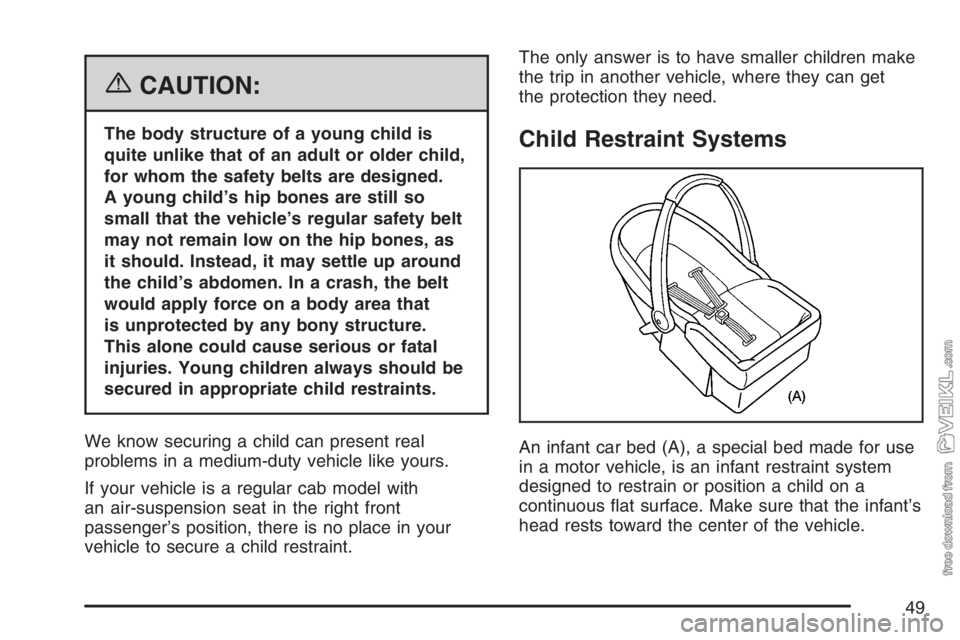
An infant car bed (A), a special bed made for use
in a motor vehicle, is an infant restraint system
designed to restrain or position a child on a
continuous flat surface. Make sure that the infant’s
head rests toward the center of the vehicle.
49
Page 59 of 430
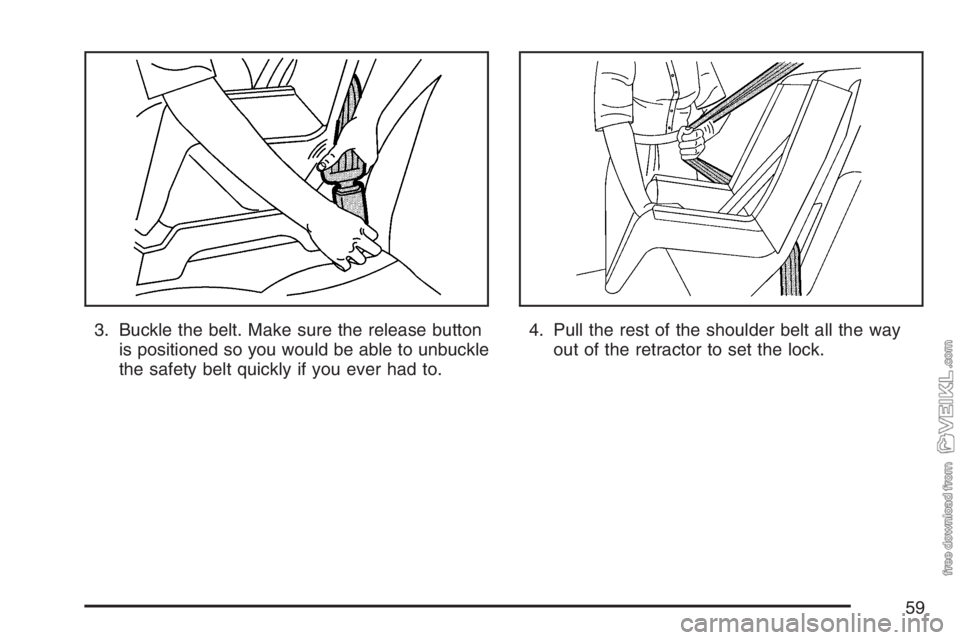
3. Buckle the belt. Make sure the release button
is positioned so you would be able to unbuckle
the safety belt quickly if you ever had to.4. Pull the rest of the shoulder belt all the way
out of the retractor to set the lock.
59
Page 66 of 430
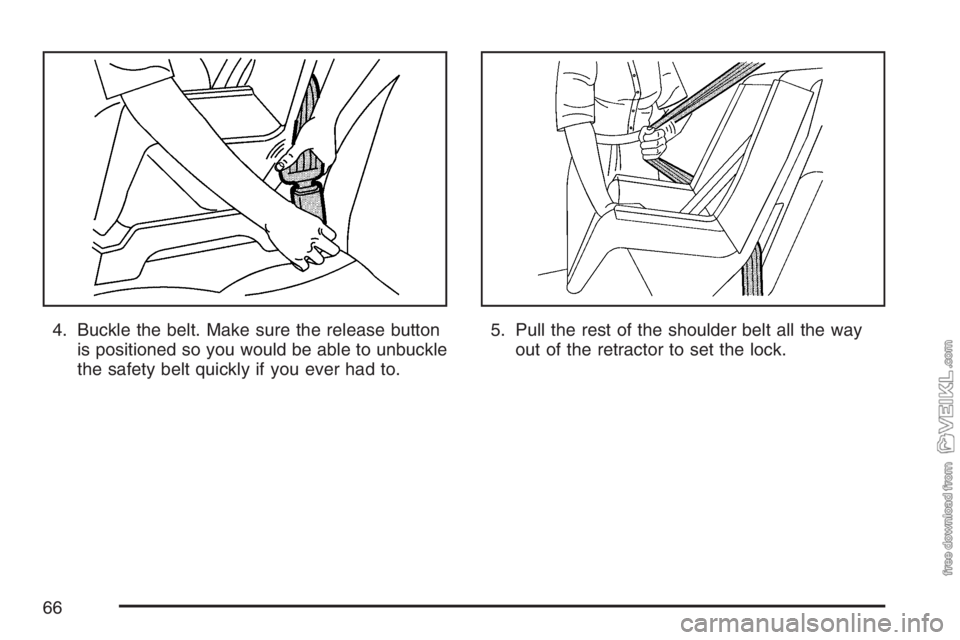
4. Buckle the belt. Make sure the release button
is positioned so you would be able to unbuckle
the safety belt quickly if you ever had to.5. Pull the rest of the shoulder belt all the way
out of the retractor to set the lock.
66
Page 97 of 430
Key In the Ignition
Never leave your vehicle with the keys inside, as it
is an easy target for joy riders or thieves. If you
leave the key in the ignition and park your vehicle,
a chime will sound, when you open the driver’s
door. Always remember to remove your key from
the ignition and take it with you. This will lock
your ignition and transaxle. Also, always remember
to lock the doors.
The battery could be drained if you leave the
key in the ignition while your vehicle is parked.
You may not be able to start your vehicle after it has
been parked for an extended period of time.
Engine Starter Over-Crank
Protection
Your vehicle may have an engine starter
over-crank protection system. If the starter motor
overheats and shuts off due to over-cranking,
the motor must cool down before it will reset and
allow starter operation. It can take up to
six minutes before the starter will work again.
Starting the Gasoline Engine
The 8th digit of your Vehicle Identification
Number (VIN) shows the code letter for your
engine. Use this number to verify the type of
engine in your vehicle. SeeVehicle Identication
Number (VIN) on page 340. Follow the proper steps
to start the engine.
To start a diesel engine, seeStarting the Diesel
Engine on page 100.
Automatic Transmission
Set the parking brake and move your shift lever to
NEUTRAL (N) or PARK (P), if so equipped. Your
engine will not start in any other position — that is a
safety feature.
Manual Transmission
Set the parking brake, shift to neutral NEUTRAL (N)
and hold the clutch pedal to the floor while starting
the engine.
97
Page 99 of 430
Gasoline Engine Warm-Up
When you have started your engine, let it run for
20 or 30 seconds to warm up before you put a
load on the engine.
Drive at moderate speeds for the first 2 to 3 miles
(3.2 to 4.8 km), especially in cold weather. See
High Idle System on page 106.
Restarting the Gasoline Engine While
Moving (Automatic Transmission)
If you have to restart the engine while the
vehicle is moving, you will first have to shift to
NEUTRAL (N). This safety feature prevents
starting the engine when the transmission is in a
drive gear.
Stopping the Gasoline Engine
Let your engine idle for a few seconds before
turning it off after you have finished driving your
vehicle.
If you shift to NEUTRAL (N) or PARK (P), set the
parking brake.
If your vehicle has a two-speed axle, put the
range selector in low. To be sure the axle has
shifted into low, engage the clutch and
transmission; the vehicle may move slightly
when you do this.
While your engine is idling and before you turn it
off, you can make a list of any operational or
handling concerns to give to responsible
maintenance personnel so they can handle them
right away.
Moisture will condense in a fuel tank that is almost
empty if the engine has not run for a while,
even just overnight under some conditions. So, it
is always best to refuel your vehicle at the end
of each run.
99
Page 103 of 430
Stopping the Diesel Engine
1. Set the parking brake and shift to
NEUTRAL (N) or PARK (P).
2. Turn the ignition key to OFF.
If your vehicle has a two-speed axle, see
Two-Speed Rear Axle Electric Shift Control on
page 113.
If you have a Caterpillar
®diesel engine, see your
Caterpillar®Diesel Engine Operation &
Maintenance Manual for additional information.
Diesel Engine Warm-Up
Several factors affect how quickly your diesel
engine warms up. These can include outside
temperature, engine load, idle time and your
vehicle’s option content. Your vehicle may be
equipped with some features that can help
the engine reach operating temperature sooner.
Some of these features are discussed below.Also, remember that an automatic transmission
adds heat to the cooling system through the heat
exchanger in the radiator. Because of this,
vehicles equipped with automatic transmissions
are often able to retain engine coolant heat better
than manual transmission vehicles.
See your Caterpillar
®Operation & Maintenance
manual for additional diesel engine warm-up
information.
If Your Diesel Engine Will Not Start
If you have run out of fuel, seeRunning Out of
Fuel on page 262.
If you are not out of fuel, and your engine will not
start, do this:
Turn your ignition key to RUN. Immediately after
the wait to start light goes off, turn the ignition key
to START.
If the light does not go off, wait a few seconds, then
try starting your engine again. And, see your dealer
as soon as you can for a starting system check.
If the light comes on and then goes off and you
know your batteries are charged, but your engine
still will not start, your vehicle needs service.
103
Page 106 of 430
High Idle System
High Idle System with Switch
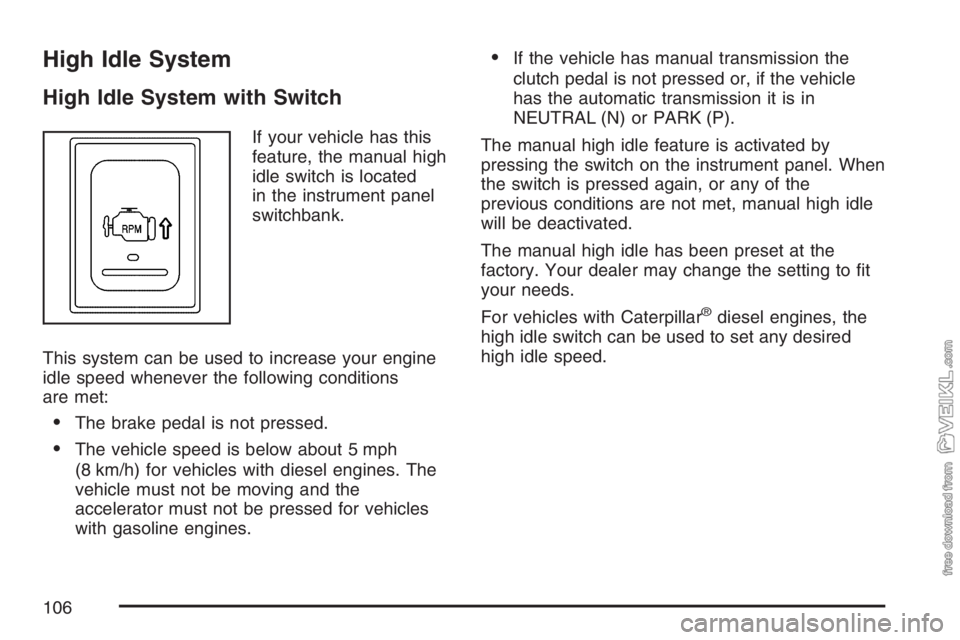
If your vehicle has this
feature, the manual high
idle switch is located
in the instrument panel
switchbank.
This system can be used to increase your engine
idle speed whenever the following conditions
are met:
•The brake pedal is not pressed.
•The vehicle speed is below about 5 mph
(8 km/h) for vehicles with diesel engines. The
vehicle must not be moving and the
accelerator must not be pressed for vehicles
with gasoline engines.
•If the vehicle has manual transmission the
clutch pedal is not pressed or, if the vehicle
has the automatic transmission it is in
NEUTRAL (N) or PARK (P).
The manual high idle feature is activated by
pressing the switch on the instrument panel. When
the switch is pressed again, or any of the
previous conditions are not met, manual high idle
will be deactivated.
The manual high idle has been preset at the
factory. Your dealer may change the setting to fit
your needs.
For vehicles with Caterpillar
®diesel engines, the
high idle switch can be used to set any desired
high idle speed.
106
Page 107 of 430
To set a new temporary engine idle speed do the
following:
1. Make sure all of the previously described
conditions are met.
2. Press the accelerator pedal to the desired
engine speed.
3. Momentarily press the manual high idle
switch.
The temporary high idle speed will be set. This
new high idle rpm level will be remembered by the
system until either the ignition is turned to OFF
or a new high idle speed is set.
Automatic High Idle System
The automatic high idle feature will engage
whenever you start your vehicle and the engine is
below the preset operating temperature. This
will help decrease engine warm-up time.On vehicles that have the Caterpillar
®diesel
engine you may have an exhaust restrictor that
will operate in High Idle mode. The exhaust brake
switch must be on for this feature to operate.
SeeDiesel Engine Exhaust Brake on page 112for
more information.
Idle speed will then return to normal under any of
the following conditions:
•The engine reaches the preset operating
temperature or has been operating for at least
10 minutes.
•The brake pedal is pressed.
•The manual transmission clutch pedal is
pressed or, if the vehicle has automatic
transmission, it is shifted from NEUTRAL (N)
or PARK (P).
•The vehicle speed exceeds about 5 mph
(8 km/h).
•The throttle is pressed.
107