heater CHEVROLET KODIAK 2008 User Guide
[x] Cancel search | Manufacturer: CHEVROLET, Model Year: 2008, Model line: KODIAK, Model: CHEVROLET KODIAK 2008Pages: 384, PDF Size: 5.4 MB
Page 249 of 384
What to Use
Use a mixture of one-half clean, drinkable water and
one-half DEX-COOL®coolant which will not damage
aluminum parts. If you use this coolant mixture, you do
not need to add anything else.
{CAUTION:
Adding only plain water to your cooling
system can be dangerous. Plain water, or
some other liquid such as alcohol, can boil
before the proper coolant mixture will. Your
vehicle’s coolant warning system is set for the
proper coolant mixture. With plain water or the
wrong mixture, your engine could get too hot
but you would not get the overheat warning.
Your engine could catch re and you or others
could be burned. Use a 50/50 mixture of clean,
drinkable water and DEX-COOL
®coolant.Notice:If you use an improper coolant mixture,
your engine could overheat and be badly damaged.
The repair cost would not be covered by your
warranty. Too much water in the mixture can freeze
and crack the engine, radiator, heater core, and
other parts.
If you have to add coolant more than four times a year,
have your dealer/retailer check your cooling system.
Notice:If you use extra inhibitors and/or additives
in your vehicle’s cooling system, you could
damage your vehicle. Use only the proper mixture
of the engine coolant listed in this manual for
the cooling system. SeePart C: Recommended
Fluids and Lubricants on page 6-31for more
information.
5-45
Page 253 of 384
If No Steam Is Coming From Your
Engine
An overheat warning, along with a low coolant light, can
indicate a serious problem. SeeLow Coolant Warning
Light on page 3-35for more information.
If you get an engine overheat warning with no low
coolant light, but see or hear no steam, the problem may
not be too serious. Sometimes the engine can get a
little too hot when you:
•Climb a long hill on a hot day.
•Stop after high-speed driving.
•Idle for long periods in traffic.
If you get the overheat warning with no sign of steam,
try this for a minute or so:
1. In heavy traffic, let the engine idle in NEUTRAL
while stopped. If it is safe to do so, pull off the
road, shift to PARK (P) or NEUTRAL and let the
engine idle.
2. Turn on your heater to full hot at the highest fan
speed and open the windows as necessary.
3. If climbing a hill, downshift to raise engine and fan
speeds.If you no longer have the overheat warning, you can
drive. Just to be safe, drive slower for about 10 minutes.
If the warning does not come back on, you can drive
normally.
If the warning continues and you have not stopped, pull
over, stop, and park your vehicle right away.
If there is still no sign of steam, you can push down the
accelerator until the engine speed is about twice as
fast as normal idle speed for at least three minutes while
you are parked. If you still have the warning, turn off the
engine and get everyone out of the vehicle until it
cools down.
You may decide not to lift the hood but to get service
help right away.
5-49
Page 254 of 384
Cooling System
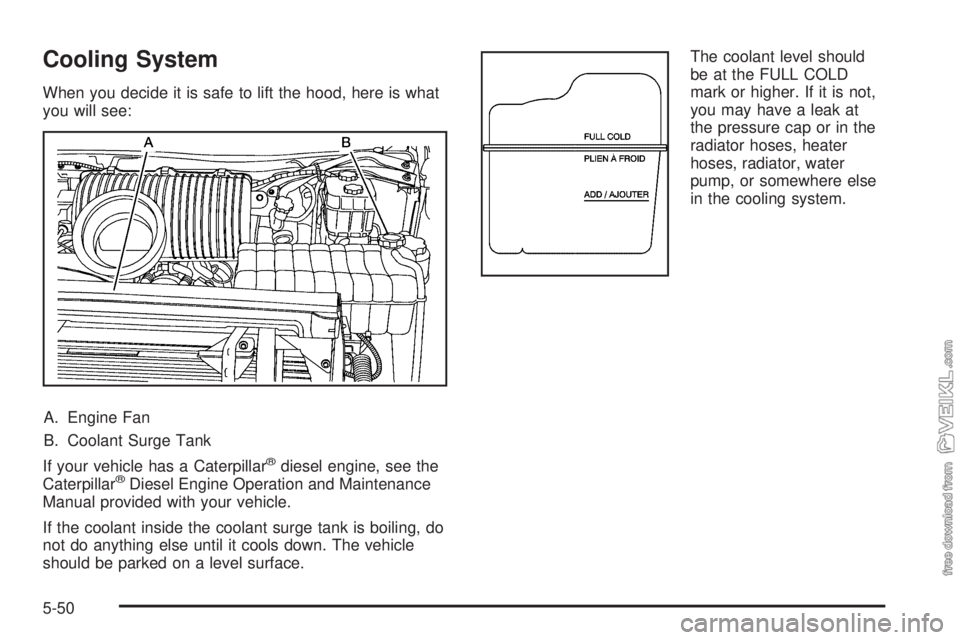
When you decide it is safe to lift the hood, here is what
you will see:
A. Engine Fan
B. Coolant Surge Tank
If your vehicle has a Caterpillar
®diesel engine, see the
Caterpillar®Diesel Engine Operation and Maintenance
Manual provided with your vehicle.
If the coolant inside the coolant surge tank is boiling, do
not do anything else until it cools down. The vehicle
should be parked on a level surface.The coolant level should
be at the FULL COLD
mark or higher. If it is not,
you may have a leak at
the pressure cap or in the
radiator hoses, heater
hoses, radiator, water
pump, or somewhere else
in the cooling system.
5-50
Page 255 of 384
{CAUTION:
Heater and radiator hoses, and other engine
parts, can be very hot. Do not touch them.
If you do, you can be burned.
Do not run the engine if there is a leak. If you
run the engine, it could lose all coolant. That
could cause an engine re, and you could be
burned. Get any leak xed before you drive the
vehicle.
If there seems to be no leak, start the engine again.
The engine cooling fan speed should increase when idle
speed is doubled by pushing the accelerator pedal
down. If it does not, your vehicle needs service. Turn off
the engine.Notice:Engine damage from running the engine
without coolant is not covered by the warranty.
Notice:Using coolant other than DEX-COOL
®may
cause premature engine, heater core or radiator
corrosion. In addition, the engine coolant may
require changing sooner, at 30,000 miles (50 000 km)
or 24 months, whichever occurs rst. Any repairs
would not be covered by your warranty. Always use
DEX-COOL
®(silicate-free) coolant in your vehicle.
5-51
Page 257 of 384
Notice:In cold weather, water can freeze and crack
the engine, radiator, heater core and other parts.
Use the recommended coolant and the proper
coolant mixture.
{CAUTION:
You can be burned if you spill coolant on hot
engine parts. Coolant contains ethylene glycol
and it will burn if the engine parts are hot
enough. Do not spill coolant on a hot engine.
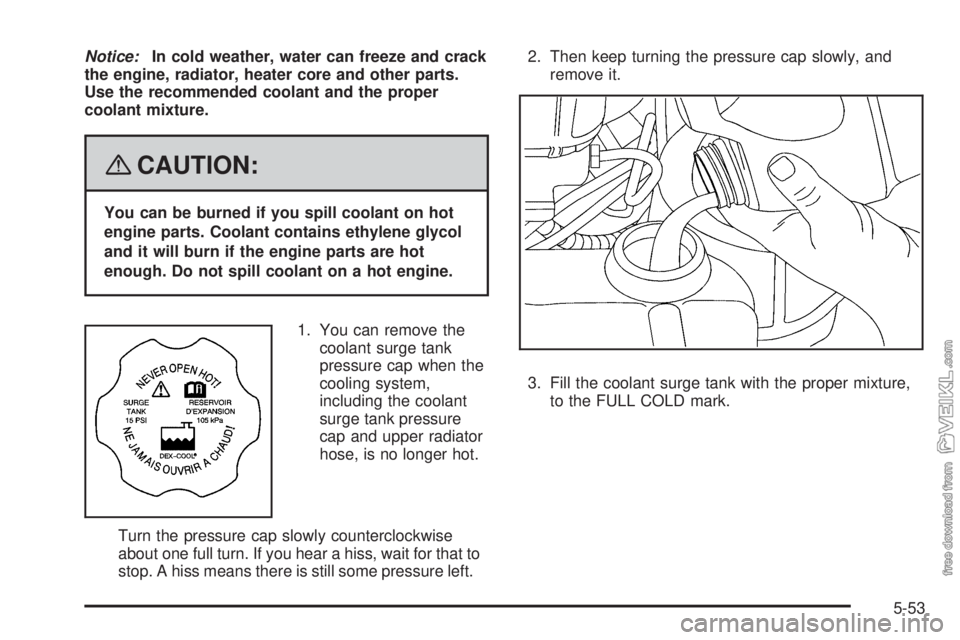
1. You can remove the
coolant surge tank
pressure cap when the
cooling system,
including the coolant
surge tank pressure
cap and upper radiator
hose, is no longer hot.
Turn the pressure cap slowly counterclockwise
about one full turn. If you hear a hiss, wait for that to
stop. A hiss means there is still some pressure left.2. Then keep turning the pressure cap slowly, and
remove it.
3. Fill the coolant surge tank with the proper mixture,
to the FULL COLD mark.
5-53
Page 283 of 384
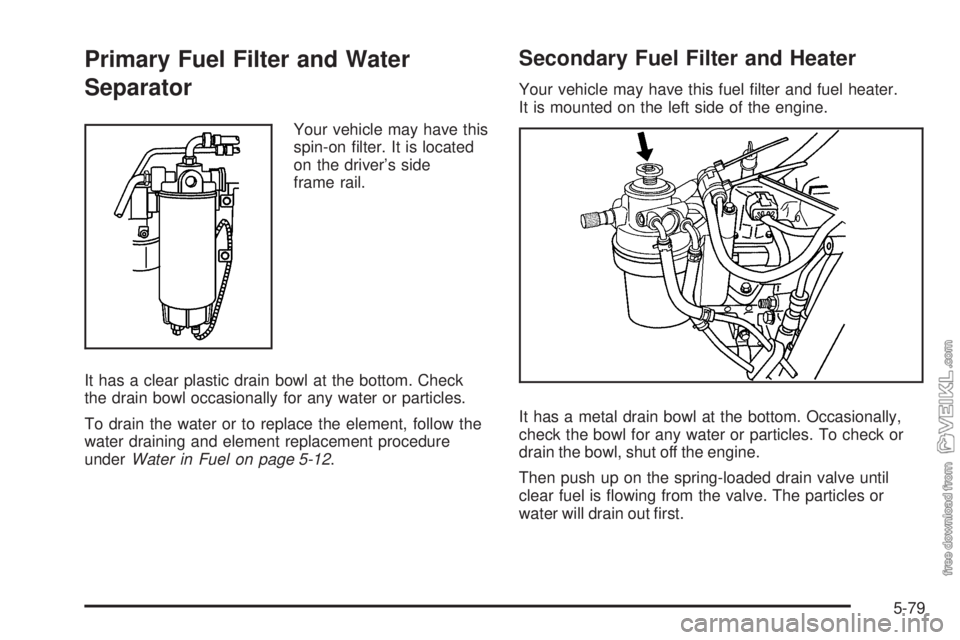
Primary Fuel Filter and Water
Separator
Your vehicle may have this
spin-on filter. It is located
on the driver’s side
frame rail.
It has a clear plastic drain bowl at the bottom. Check
the drain bowl occasionally for any water or particles.
To drain the water or to replace the element, follow the
water draining and element replacement procedure
underWater in Fuel on page 5-12.
Secondary Fuel Filter and Heater
Your vehicle may have this fuel filter and fuel heater.
It is mounted on the left side of the engine.
It has a metal drain bowl at the bottom. Occasionally,
check the bowl for any water or particles. To check or
drain the bowl, shut off the engine.
Then push up on the spring-loaded drain valve until
clear fuel is flowing from the valve. The particles or
water will drain out first.
5-79
Page 284 of 384
Secondary Fuel Filter and Water
Separator/Heater
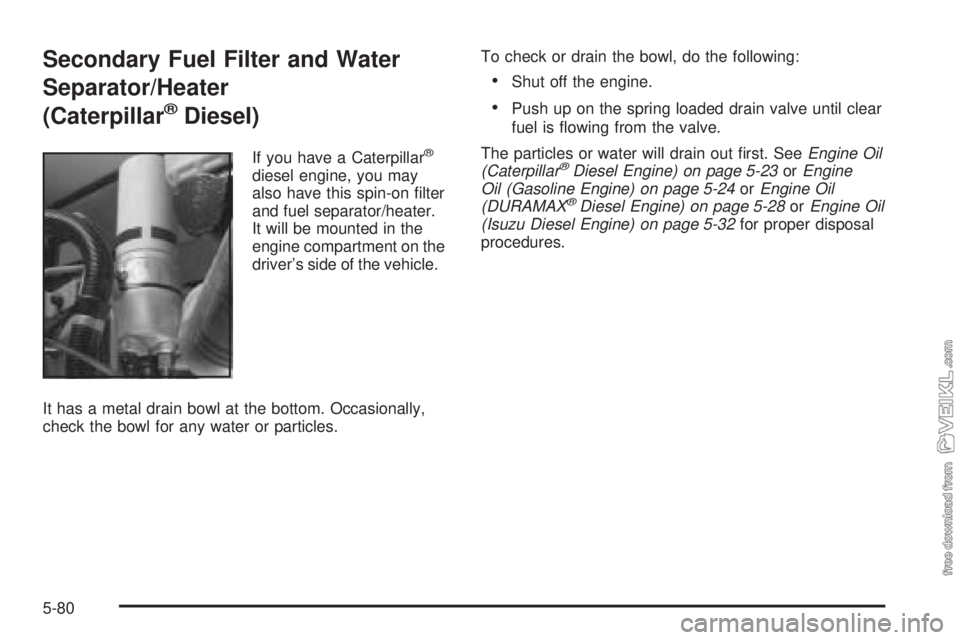
(Caterpillar
®Diesel)
If you have a Caterpillar®
diesel engine, you may
also have this spin-on filter
and fuel separator/heater.
It will be mounted in the
engine compartment on the
driver’s side of the vehicle.
It has a metal drain bowl at the bottom. Occasionally,
check the bowl for any water or particles.To check or drain the bowl, do the following:
•Shut off the engine.
•Push up on the spring loaded drain valve until clear
fuel is flowing from the valve.
The particles or water will drain out first. SeeEngine Oil
(Caterpillar
®Diesel Engine) on page 5-23orEngine
Oil (Gasoline Engine) on page 5-24orEngine Oil
(DURAMAX
®Diesel Engine) on page 5-28orEngine Oil
(Isuzu Diesel Engine) on page 5-32for proper disposal
procedures.
5-80
Page 307 of 384
Fusible Links
A fusible link is a short piece of wire several gauge
sizes smaller than the circuit it protects. It will melt in an
overload situation, opening the circuit.
Your starter and other circuits have these fusible links.
The size is printed on the insulation. If the insulation
is burned beyond recognition, consult your dealer for the
proper size. Replace a fusible link with one of the same
size and insulation type. Fusible link insulation is a
special purpose high-temperature material.
Some examples of circuits with fusible links are the
hydraulic brake booster motor feed circuit, the generator
output circuit, and the intake heater feed circuit in
vehicles with a diesel engine.
Power Windows and Other Power
Options
Circuit breakers in the fuse panel protect the power
windows and other power accessories. When the current
load is too heavy, the circuit breaker opens. This
protects the circuit until the current load returns to normal
or the problem is fixed.
Fuses and Circuit Breakers
The wiring circuits in your vehicle are protected from
short circuits by a combination of fuses, circuit breakers,
maxi-fuses and fusible links. This greatly reduces the
chance of a fire caused by an electrical problem. There
may be a fuse taped to the wiring harness near the
hydraulic brake booster.
Instrument Panel Fuse Block
There are two instrument panel fuse blocks located
behind the instrument panel on the passenger side of
the vehicle.
Be sure to replace fuses with fuses of the same rating.
Do not use fuses of higher amperage than those
indicated on the fuse block.
5-103
Page 308 of 384
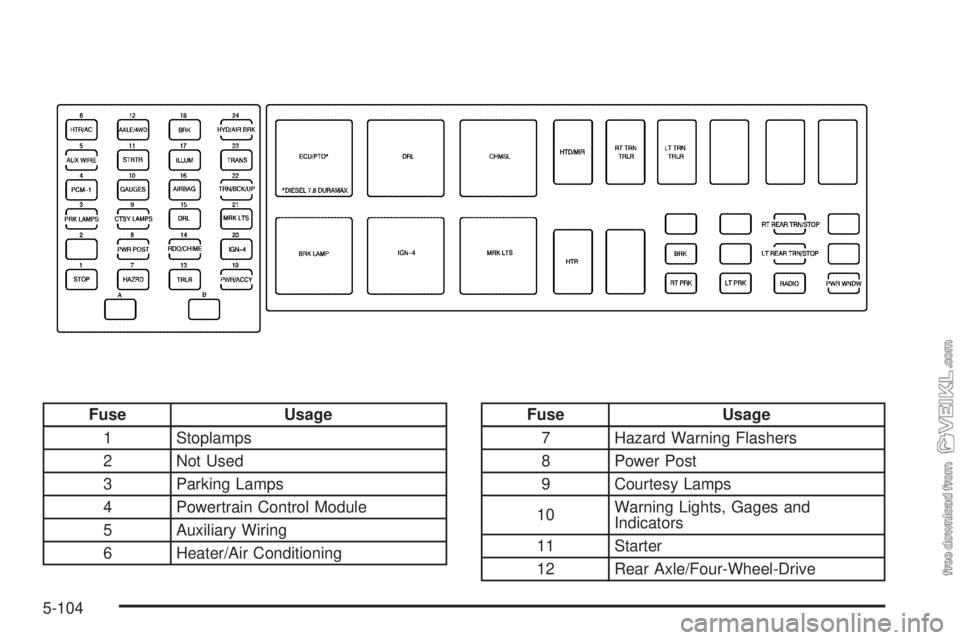
Fuse Usage
1 Stoplamps
2 Not Used
3 Parking Lamps
4 Powertrain Control Module
5 Auxiliary Wiring
6 Heater/Air ConditioningFuse Usage
7 Hazard Warning Flashers
8 Power Post
9 Courtesy Lamps
10Warning Lights, Gages and
Indicators
11 Starter
12 Rear Axle/Four-Wheel-Drive
5-104
Page 331 of 384
❑Clean air brake application valve (or every 3 months,
or every 300 hours, whichever occurs first). Lubricate
linkage.
❑Air brake chamber service (or every 2 months,
whichever occurs first).(34)
❑Air compressor dry element pleated paper air strainer
service (or every 2 months, or every 800 hours,
whichever occurs first).
❑Thermostatically controlled engine cooling fan
service.(3) (19)
❑Shields and underhood insulation service.(3) (4) (20)
❑Gasoline Engine: Air compressor remote mounted air
filter dry element pleated paper air strainer service (or
every 6 months or every 1800 hours, whichever
occurs first).
22,500 Miles (36 000 km)
❑Gasoline Engine Only: Check engine oil life system.
If engine oil and filter are changed, reset system.
See “Engine Oil (Gasoline Engine)” in the
Index.(2) (8)
❑Check fluid levels (or every 3 months, whichever
occurs first).(1) (5)
❑Chassis lubrication service (or every 6 months,
whichever occurs first).(11)
❑Inspect door hinge pins and bushings and replace as
necessary.❑Cooling system service. Clean the cooling system
filter cap with clean water, clean the core, pressure
test the cap and the system for proper pressure
capability, and inspect condition of cooling and heater
hoses and clamps. Replace hoses if cracked,
swollen, or damaged.
❑Wheels and tires service.(14)
❑Hydraulic brake service (or every 6 months,
whichever occurs first).(6) (36)
❑Parking brake service (or every 6 months, whichever
occurs first).(21)
❑Air brake service (or every 6 months, whichever
occurs first).(32)
❑Air brake automatic slack adjuster service (or every
500 hours, whichever occurs first).(33)
❑Check air brake relay valve operation and check for
leaks (or every month, or every 300 hours, whichever
occurs first).
❑Clean air brake application valve (or every 3 months,
or every 300 hours, whichever occurs first). Lubricate
linkage.
❑Air brake chamber service (or every 2 months,
whichever occurs first).(34)
❑Air brake system valve service (or every 3 months,
or every 900 hours, whichever occurs first).(37)
❑Air intake system service (or every 24 months,
whichever occurs first).(3) (4) (23)
6-7