heater CHEVROLET KODIAK 2008 Owners Manual
[x] Cancel search | Manufacturer: CHEVROLET, Model Year: 2008, Model line: KODIAK, Model: CHEVROLET KODIAK 2008Pages: 384, PDF Size: 5.4 MB
Page 67 of 384
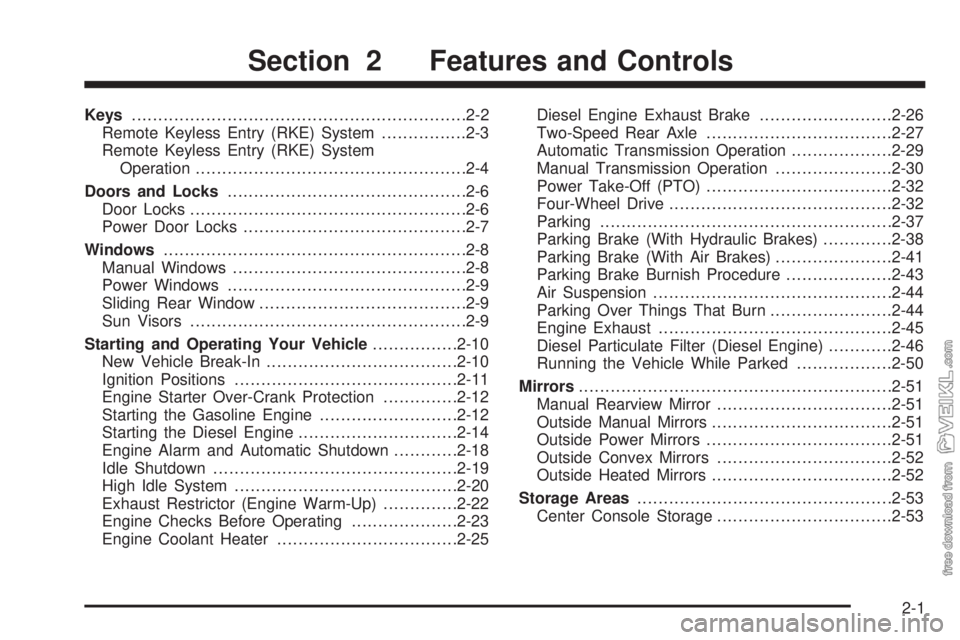
Keys...............................................................2-2
Remote Keyless Entry (RKE) System................2-3
Remote Keyless Entry (RKE) System
Operation...................................................2-4
Doors and Locks.............................................2-6
Door Locks....................................................2-6
Power Door Locks..........................................2-7
Windows.........................................................2-8
Manual Windows............................................2-8
Power Windows.............................................2-9
Sliding Rear Window.......................................2-9
Sun Visors....................................................2-9
Starting and Operating Your Vehicle................2-10
New Vehicle Break-In....................................2-10
Ignition Positions..........................................2-11
Engine Starter Over-Crank Protection..............2-12
Starting the Gasoline Engine..........................2-12
Starting the Diesel Engine..............................2-14
Engine Alarm and Automatic Shutdown............2-18
Idle Shutdown..............................................2-19
High Idle System..........................................2-20
Exhaust Restrictor (Engine Warm-Up)..............2-22
Engine Checks Before Operating....................2-23
Engine Coolant Heater..................................2-25Diesel Engine Exhaust Brake.........................2-26
Two-Speed Rear Axle...................................2-27
Automatic Transmission Operation...................2-29
Manual Transmission Operation......................2-30
Power Take-Off (PTO)...................................2-32
Four-Wheel Drive..........................................2-32
Parking.......................................................2-37
Parking Brake (With Hydraulic Brakes).............2-38
Parking Brake (With Air Brakes)......................2-41
Parking Brake Burnish Procedure....................2-43
Air Suspension.............................................2-44
Parking Over Things That Burn.......................2-44
Engine Exhaust............................................2-45
Diesel Particulate Filter (Diesel Engine)............2-46
Running the Vehicle While Parked..................2-50
Mirrors...........................................................2-51
Manual Rearview Mirror.................................2-51
Outside Manual Mirrors..................................2-51
Outside Power Mirrors...................................2-51
Outside Convex Mirrors.................................2-52
Outside Heated Mirrors..................................2-52
Storage Areas................................................2-53
Center Console Storage.................................2-53
Section 2 Features and Controls
2-1
Page 82 of 384
Cold Weather Starting
If your vehicle has the 6.6L DURAMAX®Diesel Engine
and the Isuzu 6H Diesel Engine, the following notice
applies:
Notice:Your diesel engine has an electric air
intake heater system which reduces white smoke
and helps start the engine in cold weather. Do
not spray starting uid into the air intake where it
can contact the heater elements.
If you do not have the GM Automatic Ether Injection
System, do not use starting uid or you could
damage your engine. If you have the GM system,
use only GM approved starting uid that has
been tested to establish compatibility with the air
inlet heater system.
The following tips will help you get good starting in cold
weather.
•Use the recommended engine oil when the outside
temperature drops below freezing. SeeEngine Oil
(Caterpillar
®Diesel Engine) on page 5-23or
Engine Oil (Gasoline Engine) on page 5-24or
Engine Oil (DURAMAX
®Diesel Engine) on
page 5-28orEngine Oil (Isuzu Diesel Engine) on
page 5-32. When the outside temperature drops
below 0°F (−18°C), use of the optional engine
coolant block heater is recommended.
•If you experience longer cranking times, notice an
unusual amount of exhaust smoke or are at
higher altitudes (over 7,000 ft. or 2 135 m), you may
use your optional engine coolant block heater.
SeeEngine Coolant Heater on page 2-25.
•SeeWhat Fuel to Use on page 5-9for information
on what fuel to use in cold weather.
Cold Weather Starting (Caterpillar®
Diesel)
Because the diesel engine uses compression ignition, it
is harder to start in cold weather than a gasoline
engine. The air intake heater and use of the proper
engine oil, optional engine coolant heaters and optional
ether injection systems help cold weather starting.
See the Caterpillar
®Diesel Engine Operation &
Maintenance Manual for more information.
Restarting the Diesel Engine While
Moving (Automatic Transmission)
If you have to restart the engine while the vehicle is
moving, you will first have to shift to NEUTRAL (N). This
safety feature prevents starting the engine when the
transmission is in a drive gear for more information.
2-16
Page 88 of 384
Exhaust Restrictor (Engine
Warm-Up)
Exhaust Restrictor
If your vehicle has a Isuzu 6H Diesel Engine, it may
have a feature called an Exhaust Restrictor (NPE),
which uses an air actuated valve in the exhaust system
to restrict exhaust gas flow which enhances the
engine and heater warm-up.
Automatic Quick Warm-Up
If your vehicle has a DURAMAX®6600 engine, it has a
feature called an Automatic Quick Warm-Up, which
uses the turbocharger to restrict the exhaust gas flow
which enhances the engine and heater warm-up.
In both systems, exhaust restrictor or automatic quick
warm-up, the cold temperature high idle feature elevates
the engines idle speed, up to 1500 rpm, and restricts
the exhaust gas flow, when outside temperatures
are below 50°F (10°C), and the engine coolant
temperature is below certain levels. This feature
enhances heater performance by raising the engine
coolant temperature faster.For all engines this feature is already turned on. The
automatic quick warm-up on the DURAMAX
®engine
can be turned off and on by doing the following
procedure:
1. Turn the ignition to RUN, with the vehicle off.
2. Press the accelerator pedal to the floor and hold it
while quickly pressing and fully releasing the brake
pedal three times in less than eight seconds.
3. Release the accelerator pedal and start the engine.
The green exhaust brake/restrictor light below the
radio controls will be lit for 10 seconds.
If this feature is turned off, by doing the procedure
described previously, and then the engine is
started, the exhaust brake/restrictor light will flash
for 10 seconds and then it will turn off.
When the engine is started, it will slowly increase to the
high idle speed after a delay of a few seconds; up to
about two minutes. For this method to work properly
there must be no throttle or brake pedal faults, and the
throttle pedal must not fall below 75 percent of wide
open throttle while pressing the brake pedal.
2-22
Page 91 of 384
Engine Coolant Heater
The engine coolant heater, if available, can help in cold
weather conditions at or below 0°F (−18°C) for easier
starting and better fuel economy during engine warm-up.
Plug in the coolant heater at least four hours before
starting your vehicle.
To Use the Engine Coolant Heater
1. Turn off the engine.
2. Find the plug-in outlet located under the
driver’s door.
3. Plug it into a normal, grounded 110-volt AC outlet.
{CAUTION:
Plugging the cord into an ungrounded outlet
could cause an electrical shock. Also, the
wrong kind of extension cord could overheat
and cause a re. You could be seriously
injured. Plug the cord into a properly grounded
three-prong 110-volt AC outlet. If the cord will
not reach, use a heavy-duty three-prong
extension cord rated for at least 15 amps.
4. Before starting the engine, be sure to unplug and
store the cord as it was before to keep it away
from moving engine parts. If you do not, it could be
damaged.
How long should you keep the coolant heater plugged
in? The answer depends on the outside temperature, the
kind of oil you have, and some other things. Instead
of trying to list everything here, we ask that you contact
your dealer/retailer in the area where you will be
parking your vehicle. The dealer/retailer can give you
the best advice for that particular area.
2-25
Page 143 of 384
Rear Window Defogger
For vehicles with a rear window defogger, a warming
grid is used to remove fog or frost from the rear window.
Be sure to clear as much snow from the rear window
as possible.
Press this button located
near the fan control to turn
the rear window defogger
on or off.
An indicator light in the button comes on when the rear
window defogger is working.
The rear window defogger will only work when the
ignition is in RUN.
The rear window defogger turns off several minutes
after the button is pressed. The defogger can also be
turned off by pressing the button again or by turning off
the engine.
Notice:Do not use anything sharp on the inside of
the rear window. If you do, you could cut or
damage the warming grid, and the repairs would not
be covered by your warranty. Do not attach a
temporary vehicle license, tape, a decal or anything
similar to the defogger grid.
Outlet Adjustment
Your vehicle has air outlets on the instrument panel that
allow you to adjust the direction and amount of airflow
inside the vehicle.
Move the lever on the outlet up or down to direct the
airflow. Increase or reduce the amount of airflow
by opening and closing the louvers. The outlets can be
moved side-to-side to direct the airflow.
Operation Tips
•
Keep the hood and front air inlets free of ice, snow,
or any other obstruction (such as leaves). The
heater and defroster will work far better, reducing
the chance of fogging the inside of your windows.
•Keep the air path under the front seats clear
of objects. This helps air to circulate throughout
your vehicle.
•Adding outside equipment to the front of your
vehicle, such as hood-air deflectors, may affect the
performance of the heating and air conditioning
system. Check with your dealer before adding
equipment to the outside of your vehicle.
3-23
Page 144 of 384
Rear Heating System
If you have a crew cab
and your vehicle has
a rear heater,
the thumbwheel for
this feature is located
on the headliner.
To increase and decrease the flow of heated air to the
rear floor vents, turn the thumbwheel to the desired
fan speed. To turn the fan off, turn the thumbwheel all
the way down.
Warning Lights, Gages, and
Indicators
This part describes the warning lights and gages that may
be on your vehicle. The pictures will help you locate them.
Warning lights and gages can signal that something is
wrong before it becomes serious enough to cause
an expensive repair or replacement. Paying attention to
your warning lights and gages could also save you
or others from injury.
Warning lights come on when there may be or is a
problem with one of your vehicle’s functions. As you will
see in the details on the next few pages, some warning
lights come on briefly when you start the engine just to let
you know they are working. If you are familiar with this
section, you should not be alarmed when this happens.
Gages can indicate when there may be or is a problem
with one of your vehicle’s functions. Often gages and
warning lights work together to let you know when there
is a problem with your vehicle.
When one of the warning lights comes on and stays on
when you are driving, or when one of the gages shows
there may be a problem, check the section that tells
you what to do about it. Waiting to do repairs can
be costly and even dangerous.
3-24
Page 156 of 384
Wait to Start Indicator
If your vehicle has the DURAMAX®6.6L diesel engine,
it will have glow plugs and an air intake heater.
If your vehicle has the Isuzu 6H diesel engine, it will
have glow plugs and an inlet heater. If your vehicle has
a Caterpillar
®engine, it will have an inlet heater.
The light in the center of
the instrument panel will
come on when the
inlet heater or glow plugs
are on and the ignition
key is in RUN.
Wait until the indicator light goes off before turning the
ignition key to START.
Malfunction Indicator Lamp
Service Engine Soon Light
If this light comes on or
flashes while you are
driving, two things
can happen.
First, you will not notice any difference in engine
performance, but the tail pipe emissions might increase.
Second, the engine might not run properly or could stall
without warning. If either of these things happen, drive or
tow your vehicle to your dealer/retailer for service.
This light should come on when the ignition is on, but the
engine is not running, as a check to show you it is
working. If it does not come on at all, have it repaired.
Notice:If you keep driving your vehicle with this
light on, after a while, the emission controls
might not work as well, your vehicle’s fuel economy
might not be as good, and the engine might not
run as smoothly. This could lead to costly repairs
that might not be covered by your warranty.
3-36
Page 197 of 384
Run your engine only as long as you must. This saves
fuel. When you run the engine, make it go a little
faster than just idle. That is, push the accelerator
slightly. This uses less fuel for the heat that you get and
it keeps the battery (or batteries) charged. You will
need a well-charged battery (or batteries) to restart the
vehicle, and possibly for signaling later on with the
headlamps. Let the heater run for a while.
If you have a diesel engine, you may have to run it at a
higher speed to get enough heat.
Then, shut the engine off and close the window almost
all the way to preserve the heat. Start the engine
again and repeat this only when you feel really
uncomfortable from the cold. But do it as little as
possible. Preserve the fuel as long as you can. To help
keep warm, you can get out of the vehicle and do
some fairly vigorous exercises every half hour or so until
help comes.If Your Vehicle is Stuck in Sand,
Mud, Ice, or Snow
Slowly and cautiously spin the wheels to free your
vehicle when stuck in sand, mud, ice, or snow. See
Rocking Your Vehicle to Get It Out on page 4-20.
If your vehicle has a traction system, it can often help to
free a stuck vehicle. Refer to your vehicle’s traction
system in the Index. If the stuck condition is too severe
for the traction system to free the vehicle, turn the
traction system off and use the rocking method.
{CAUTION:
If you let your vehicle’s tires spin at high
speed, they can explode, and you or others
could be injured. The vehicle can overheat,
causing an engine compartment re or other
damage. Spin the wheels as little as possible
and avoid going above 35 mph (55 km/h) as
shown on the speedometer.
4-19
Page 206 of 384
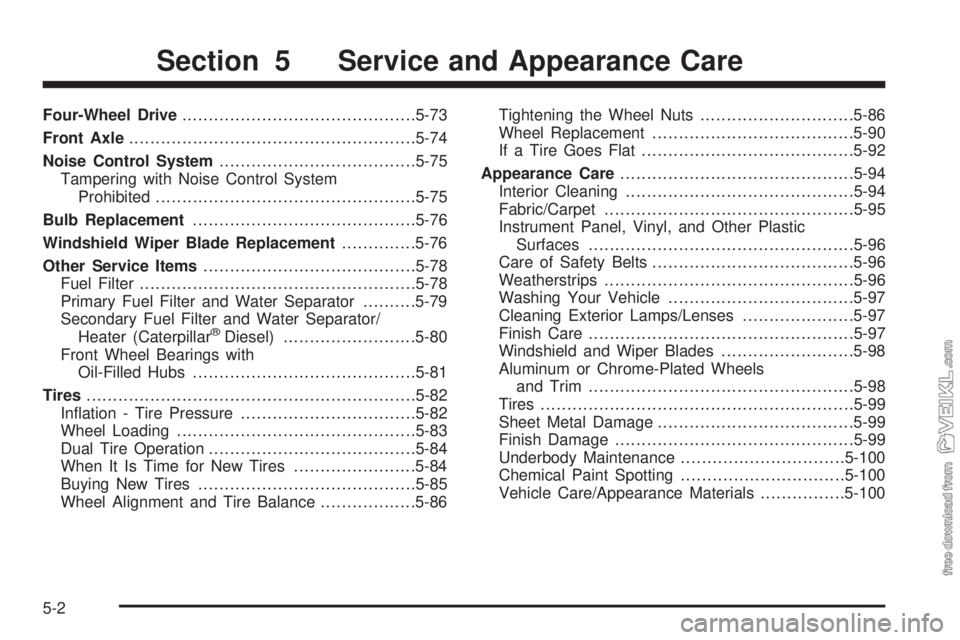
Four-Wheel Drive............................................5-73
Front Axle......................................................5-74
Noise Control System.....................................5-75
Tampering with Noise Control System
Prohibited.................................................5-75
Bulb Replacement..........................................5-76
Windshield Wiper Blade Replacement..............5-76
Other Service Items........................................5-78
Fuel Filter....................................................5-78
Primary Fuel Filter and Water Separator..........5-79
Secondary Fuel Filter and Water Separator/
Heater (Caterpillar
®Diesel).........................5-80
Front Wheel Bearings with
Oil-Filled Hubs..........................................5-81
Tires..............................................................5-82
Inflation - Tire Pressure.................................5-82
Wheel Loading.............................................5-83
Dual Tire Operation.......................................5-84
When It Is Time for New Tires.......................5-84
Buying New Tires.........................................5-85
Wheel Alignment and Tire Balance..................5-86Tightening the Wheel Nuts.............................5-86
Wheel Replacement......................................5-90
If a Tire Goes Flat........................................5-92
Appearance Care............................................5-94
Interior Cleaning...........................................5-94
Fabric/Carpet...............................................5-95
Instrument Panel, Vinyl, and Other Plastic
Surfaces..................................................5-96
Care of Safety Belts......................................5-96
Weatherstrips...............................................5-96
Washing Your Vehicle...................................5-97
Cleaning Exterior Lamps/Lenses.....................5-97
Finish Care..................................................5-97
Windshield and Wiper Blades.........................5-98
Aluminum or Chrome-Plated Wheels
and Trim..................................................5-98
Tires...........................................................5-99
Sheet Metal Damage.....................................5-99
Finish Damage.............................................5-99
Underbody Maintenance...............................5-100
Chemical Paint Spotting...............................5-100
Vehicle Care/Appearance Materials................5-100
Section 5 Service and Appearance Care
5-2
Page 248 of 384
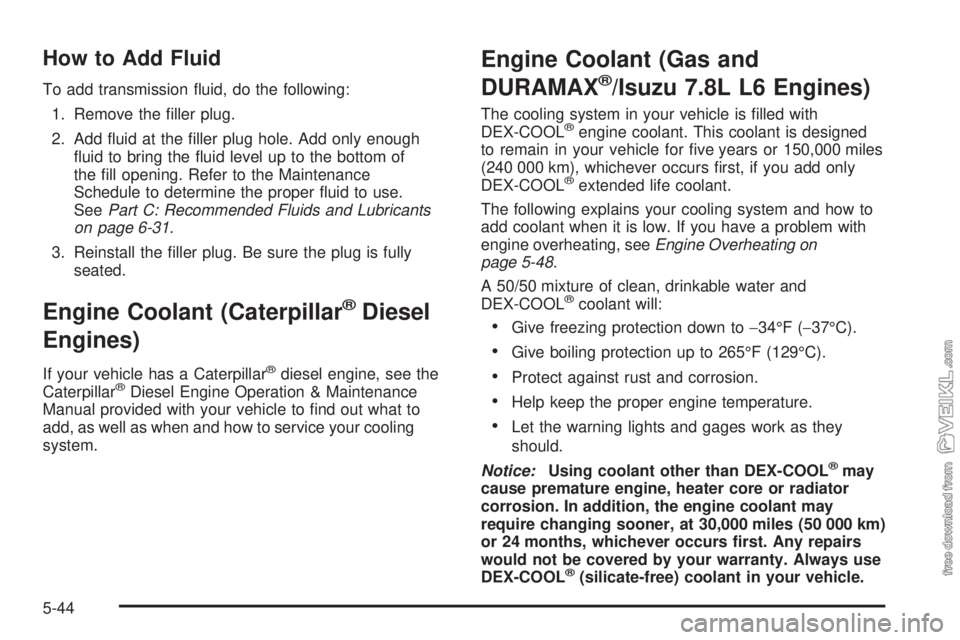
How to Add Fluid
To add transmission fluid, do the following:
1. Remove the filler plug.
2. Add fluid at the filler plug hole. Add only enough
fluid to bring the fluid level up to the bottom of
the fill opening. Refer to the Maintenance
Schedule to determine the proper fluid to use.
SeePart C: Recommended Fluids and Lubricants
on page 6-31.
3. Reinstall the filler plug. Be sure the plug is fully
seated.
Engine Coolant (Caterpillar®Diesel
Engines)
If your vehicle has a Caterpillar®diesel engine, see the
Caterpillar®Diesel Engine Operation & Maintenance
Manual provided with your vehicle to find out what to
add, as well as when and how to service your cooling
system.
Engine Coolant (Gas and
DURAMAX
®/Isuzu 7.8L L6 Engines)
The cooling system in your vehicle is filled with
DEX-COOL®engine coolant. This coolant is designed
to remain in your vehicle for five years or 150,000 miles
(240 000 km), whichever occurs first, if you add only
DEX-COOL
®extended life coolant.
The following explains your cooling system and how to
add coolant when it is low. If you have a problem with
engine overheating, seeEngine Overheating on
page 5-48.
A 50/50 mixture of clean, drinkable water and
DEX-COOL
®coolant will:
•Give freezing protection down to−34°F (−37°C).
•Give boiling protection up to 265°F (129°C).
•Protect against rust and corrosion.
•Help keep the proper engine temperature.
•Let the warning lights and gages work as they
should.
Notice:Using coolant other than DEX-COOL
®may
cause premature engine, heater core or radiator
corrosion. In addition, the engine coolant may
require changing sooner, at 30,000 miles (50 000 km)
or 24 months, whichever occurs rst. Any repairs
would not be covered by your warranty. Always use
DEX-COOL
®(silicate-free) coolant in your vehicle.
5-44