transmission CHEVROLET KODIAK 2008 Service Manual
[x] Cancel search | Manufacturer: CHEVROLET, Model Year: 2008, Model line: KODIAK, Model: CHEVROLET KODIAK 2008Pages: 384, PDF Size: 5.4 MB
Page 213 of 384
Diesel Engine Fuel
For the Caterpillar®diesel, see the Caterpillar®
Operation & Maintenance Manual for information
concerning fuel usage.
Notice:Diesel fuel or fuel additives not
recommended in this manual could damage the fuel
system and engine. Your warranty would not
cover this damage. And:
Diesel fuel that has been mixed with engine oil
or automatic transmission uid could damage
the engine and emission controls.
We do not test aftermarket diesel fuel additives.
Some additives, particularly those which
contain alcohol or water emulsiers, could
damage the fuel system. If you believe that
unique circumstances call for a fuel additive to
be used, consult your dealer/retailer for
advice.
If you ever run out of diesel fuel, it can be
difficult to restart the engine. To avoid this,
never let the tank get empty.
If gasoline is ever accidentally added to the fuel
tank, to avoid severe engine damage, do not run the
engine until the fuel tank can be drained.
If you run out of fuel,Running Out of Fuel on page 5-17
tells you how to restart the engine.
What Fuel to Use
Notice:Use of diesel fuel other than Ultra Low
Sulfur Diesel (15 ppm sulfur maximum) or engine oil
other than low ash CJ-4 oil will cause permanent
damage to the DPF and related components. This
damage would not be covered by your warranty.
The emission control system requires the use of diesel
fuel with ultra low-sulfur (0.0015% by weight, or 15 ppm,
maximum) content. Both Ultra Low Sulfur Diesel and Low
Sulfur Diesel fuels are available in the United States and
Ultra Low Sulfur Diesel fuel is available in Canada.
However, only higher sulfur diesel fuel is available
in Mexico.
At a minimum, the diesel fuel you use should meet the
latest version of ASTM specification D 975 (Grades
No. 2-D or No. 1-D S15 commonly known as Ultra Low
Sulfur diesel) in the United States. In addition, the
Engine Manufacturers Association (EMA) has identified
properties of an improved diesel fuel for better engine
performance and durability. Diesel fuels corresponding
to the EMA Recommended Guideline on Premium
Diesel Fuel (FQP-1A) could provide better starting, less
noise, and better vehicle performance. If there are
questions about the fuel you are using, contact your fuel
supplier.
5-9
Page 247 of 384
Automatic Transmission Fluid
When to Check
A good time to check your automatic transmission fluid
level is when the engine oil is checked. See your
Allison Automatic Transmission Operator’s Manual to
find out when to change your transmission fluid
and filters.
How to Check and What to Use
The Allison Automatic Transmission Operator’s Manual
that came with the vehicle shows how to check the
automatic transmission fluid and what fluid to use.
Automatic Transmission External Filter
Your automatic transmission filter requires periodic
replacement.
Consult the Allison Automatic Transmission Operator’s
Manual that came with the vehicle for proper change
intervals.
Manual Transmission Fluid
When to Check
A good time to have it checked is when the engine oil is
checked. Refer to the Maintenance Schedule to find
out when to check and change your manual
transmission fluid. SeeScheduled Maintenance on
page 6-5.
How to Check and What to Use
Check the fluid level only when your engine is off, the
vehicle is parked on a level place, and the transmission
is cool enough for you to rest your fingers on the
transmission case.
To check the transmission fluid level, do the following:
1. Remove the filler plug.
2. Check to be sure that the lubricant level is up to the
bottom of the fill opening. On heavy duty
transmissions, an inch of oil level equals about one
gallon of fluid.
3. If the fluid level is good, reinstall the plug and be
sure it is fully seated. If the fluid level is low, add
more fluid as described in the next steps. Refer to
the Maintenance Schedule to determine what kind
of fluid to use. SeePart C: Recommended Fluids and
Lubricants on page 6-31.
5-43
Page 248 of 384
How to Add Fluid
To add transmission fluid, do the following:
1. Remove the filler plug.
2. Add fluid at the filler plug hole. Add only enough
fluid to bring the fluid level up to the bottom of
the fill opening. Refer to the Maintenance
Schedule to determine the proper fluid to use.
SeePart C: Recommended Fluids and Lubricants
on page 6-31.
3. Reinstall the filler plug. Be sure the plug is fully
seated.
Engine Coolant (Caterpillar®Diesel
Engines)
If your vehicle has a Caterpillar®diesel engine, see the
Caterpillar®Diesel Engine Operation & Maintenance
Manual provided with your vehicle to find out what to
add, as well as when and how to service your cooling
system.
Engine Coolant (Gas and
DURAMAX
®/Isuzu 7.8L L6 Engines)
The cooling system in your vehicle is filled with
DEX-COOL®engine coolant. This coolant is designed
to remain in your vehicle for five years or 150,000 miles
(240 000 km), whichever occurs first, if you add only
DEX-COOL
®extended life coolant.
The following explains your cooling system and how to
add coolant when it is low. If you have a problem with
engine overheating, seeEngine Overheating on
page 5-48.
A 50/50 mixture of clean, drinkable water and
DEX-COOL
®coolant will:
•Give freezing protection down to−34°F (−37°C).
•Give boiling protection up to 265°F (129°C).
•Protect against rust and corrosion.
•Help keep the proper engine temperature.
•Let the warning lights and gages work as they
should.
Notice:Using coolant other than DEX-COOL
®may
cause premature engine, heater core or radiator
corrosion. In addition, the engine coolant may
require changing sooner, at 30,000 miles (50 000 km)
or 24 months, whichever occurs rst. Any repairs
would not be covered by your warranty. Always use
DEX-COOL
®(silicate-free) coolant in your vehicle.
5-44
Page 258 of 384
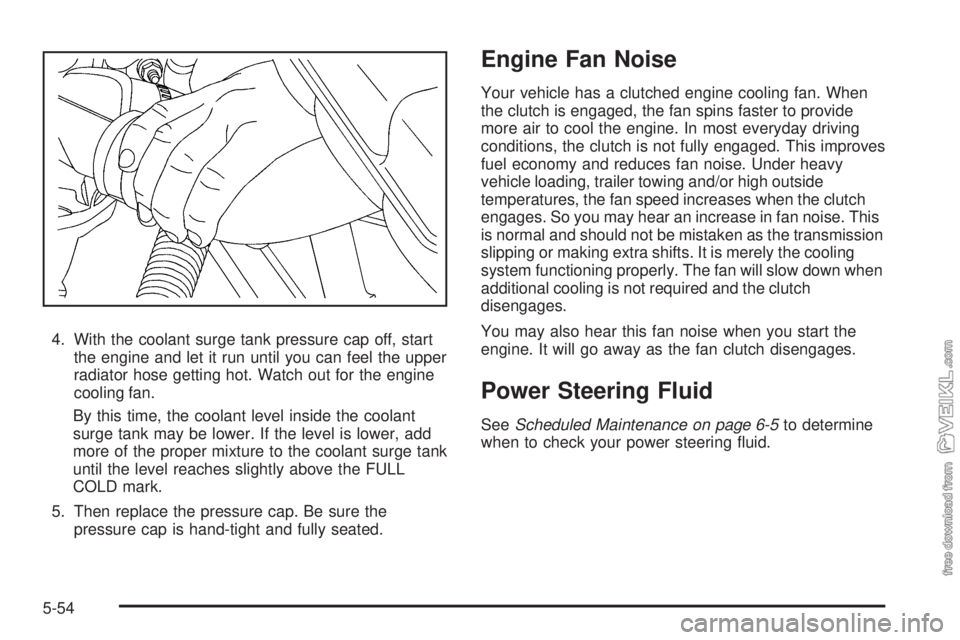
4. With the coolant surge tank pressure cap off, start
the engine and let it run until you can feel the upper
radiator hose getting hot. Watch out for the engine
cooling fan.
By this time, the coolant level inside the coolant
surge tank may be lower. If the level is lower, add
more of the proper mixture to the coolant surge tank
until the level reaches slightly above the FULL
COLD mark.
5. Then replace the pressure cap. Be sure the
pressure cap is hand-tight and fully seated.
Engine Fan Noise
Your vehicle has a clutched engine cooling fan. When
the clutch is engaged, the fan spins faster to provide
more air to cool the engine. In most everyday driving
conditions, the clutch is not fully engaged. This improves
fuel economy and reduces fan noise. Under heavy
vehicle loading, trailer towing and/or high outside
temperatures, the fan speed increases when the clutch
engages. So you may hear an increase in fan noise. This
is normal and should not be mistaken as the transmission
slipping or making extra shifts. It is merely the cooling
system functioning properly. The fan will slow down when
additional cooling is not required and the clutch
disengages.
You may also hear this fan noise when you start the
engine. It will go away as the fan clutch disengages.
Power Steering Fluid
SeeScheduled Maintenance on page 6-5to determine
when to check your power steering fluid.
5-54
Page 265 of 384
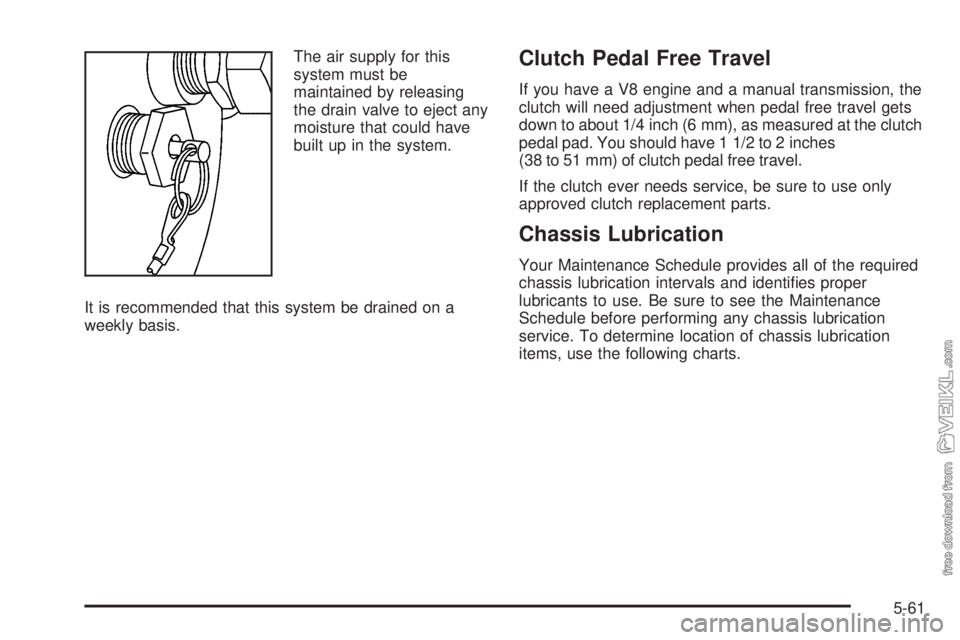
The air supply for this
system must be
maintained by releasing
the drain valve to eject any
moisture that could have
built up in the system.
It is recommended that this system be drained on a
weekly basis.Clutch Pedal Free Travel
If you have a V8 engine and a manual transmission, the
clutch will need adjustment when pedal free travel gets
down to about 1/4 inch (6 mm), as measured at the clutch
pedal pad. You should have 1 1/2 to 2 inches
(38 to 51 mm) of clutch pedal free travel.
If the clutch ever needs service, be sure to use only
approved clutch replacement parts.
Chassis Lubrication
Your Maintenance Schedule provides all of the required
chassis lubrication intervals and identifies proper
lubricants to use. Be sure to see the Maintenance
Schedule before performing any chassis lubrication
service. To determine location of chassis lubrication
items, use the following charts.
5-61
Page 267 of 384
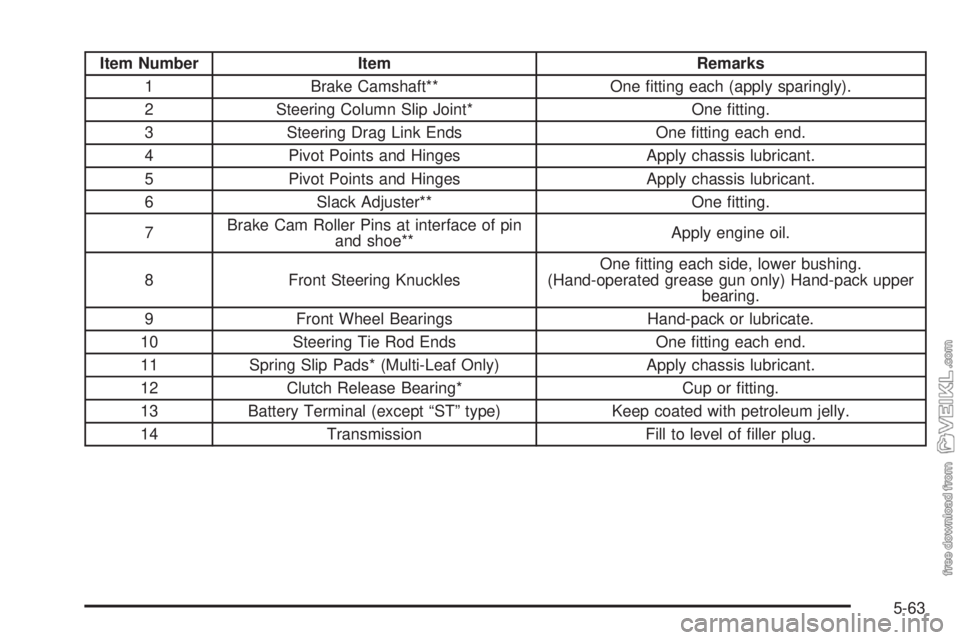
Item Number Item Remarks
1 Brake Camshaft** One fitting each (apply sparingly).
2 Steering Column Slip Joint* One fitting.
3 Steering Drag Link Ends One fitting each end.
4 Pivot Points and Hinges Apply chassis lubricant.
5 Pivot Points and Hinges Apply chassis lubricant.
6 Slack Adjuster** One fitting.
7Brake Cam Roller Pins at interface of pin
and shoe**Apply engine oil.
8 Front Steering KnucklesOne fitting each side, lower bushing.
(Hand-operated grease gun only) Hand-pack upper
bearing.
9 Front Wheel Bearings Hand-pack or lubricate.
10 Steering Tie Rod Ends One fitting each end.
11 Spring Slip Pads* (Multi-Leaf Only) Apply chassis lubricant.
12 Clutch Release Bearing* Cup or fitting.
13 Battery Terminal (except “ST” type) Keep coated with petroleum jelly.
14 Transmission Fill to level of filler plug.
5-63
Page 271 of 384
Jump Starting
If your vehicle’s battery (or batteries) has run down, you
may want to use another vehicle and some jumper
cables to start your vehicle. Be sure to use the following
steps to do it safely.
{CAUTION:
Batteries can hurt you. They can be dangerous
because:
They contain acid that can burn you.
They contain gas that can explode or
ignite.
They contain enough electricity to
burn you.
If you do not follow these steps exactly, some
or all of these things can hurt you.
Notice:Ignoring these steps could result in costly
damage to your vehicle that would not be covered
by your warranty.Trying to start your vehicle by pushing or pulling it
will not work, and it could damage your vehicle.
1. Check the other vehicle. It must have a 12-volt
battery (or batteries) with a negative ground system.
Notice:If the other vehicle’s system is not a 12-volt
system with a negative ground, both vehicles can
be damaged. Only use vehicles with 12-volt systems
with negative grounds to jump start your vehicle.
If you have a diesel engine vehicle with
two batteries (or more), you should know before
you begin that, especially in cold weather, you may
not be able to get enough power from a single
battery in another vehicle to start your diesel engine.
If your vehicle has more than one battery, use the
one closest to the starter — this will reduce electrical
resistance.
2. Get the vehicles close enough so the jumper cables
can reach, but be sure the vehicles are not touching
each other. If they are, it could cause a ground
connection you do not want. You would not be able
to start your vehicle, and the bad grounding could
damage the electrical systems.
To avoid the possibility of the vehicles rolling, set
the parking brake firmly on both vehicles involved in
the jump start procedure. Put an automatic
transmission in PARK (P) or a manual transmission
in NEUTRAL before setting the parking brake.
If you have a four-wheel-drive vehicle, be sure the
transfer case is in a drive gear, not in NEUTRAL.
5-67
Page 309 of 384
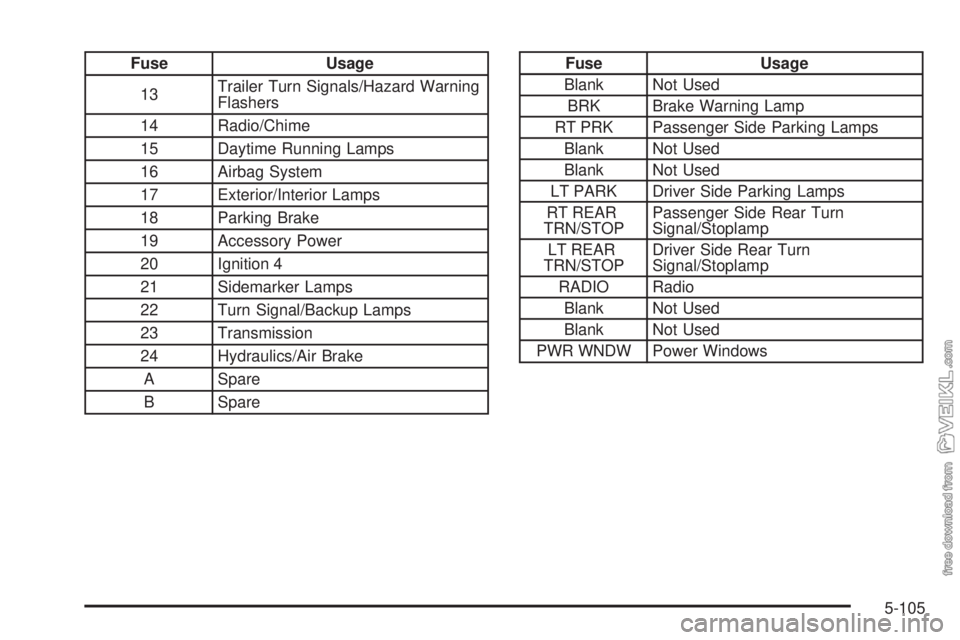
Fuse Usage
13Trailer Turn Signals/Hazard Warning
Flashers
14 Radio/Chime
15 Daytime Running Lamps
16 Airbag System
17 Exterior/Interior Lamps
18 Parking Brake
19 Accessory Power
20 Ignition 4
21 Sidemarker Lamps
22 Turn Signal/Backup Lamps
23 Transmission
24 Hydraulics/Air Brake
A Spare
B SpareFuse Usage
Blank Not Used
BRK Brake Warning Lamp
RT PRK Passenger Side Parking Lamps
Blank Not Used
Blank Not Used
LT PARK Driver Side Parking Lamps
RT REAR
TRN/STOPPassenger Side Rear Turn
Signal/Stoplamp
LT REAR
TRN/STOPDriver Side Rear Turn
Signal/Stoplamp
RADIO Radio
Blank Not Used
Blank Not Used
PWR WNDW Power Windows
5-105
Page 311 of 384
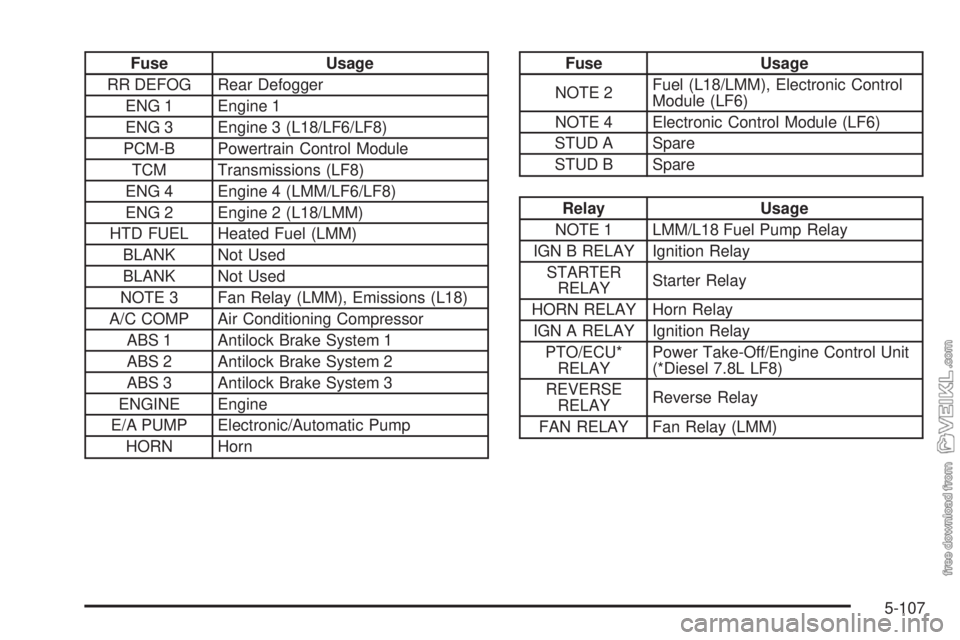
Fuse Usage
RR DEFOG Rear Defogger
ENG 1 Engine 1
ENG 3 Engine 3 (L18/LF6/LF8)
PCM-B Powertrain Control Module
TCM Transmissions (LF8)
ENG 4 Engine 4 (LMM/LF6/LF8)
ENG 2 Engine 2 (L18/LMM)
HTD FUEL Heated Fuel (LMM)
BLANK Not Used
BLANK Not Used
NOTE 3 Fan Relay (LMM), Emissions (L18)
A/C COMP Air Conditioning Compressor
ABS 1 Antilock Brake System 1
ABS 2 Antilock Brake System 2
ABS 3 Antilock Brake System 3
ENGINE Engine
E/A PUMP Electronic/Automatic Pump
HORN HornFuse Usage
NOTE 2Fuel (L18/LMM), Electronic Control
Module (LF6)
NOTE 4 Electronic Control Module (LF6)
STUD A Spare
STUD B Spare
Relay Usage
NOTE 1 LMM/L18 Fuel Pump Relay
IGN B RELAY Ignition Relay
STARTER
RELAYStarter Relay
HORN RELAY Horn Relay
IGN A RELAY Ignition Relay
PTO/ECU*
RELAYPower Take-Off/Engine Control Unit
(*Diesel 7.8L LF8)
REVERSE
RELAYReverse Relay
FAN RELAY Fan Relay (LMM)
5-107
Page 313 of 384
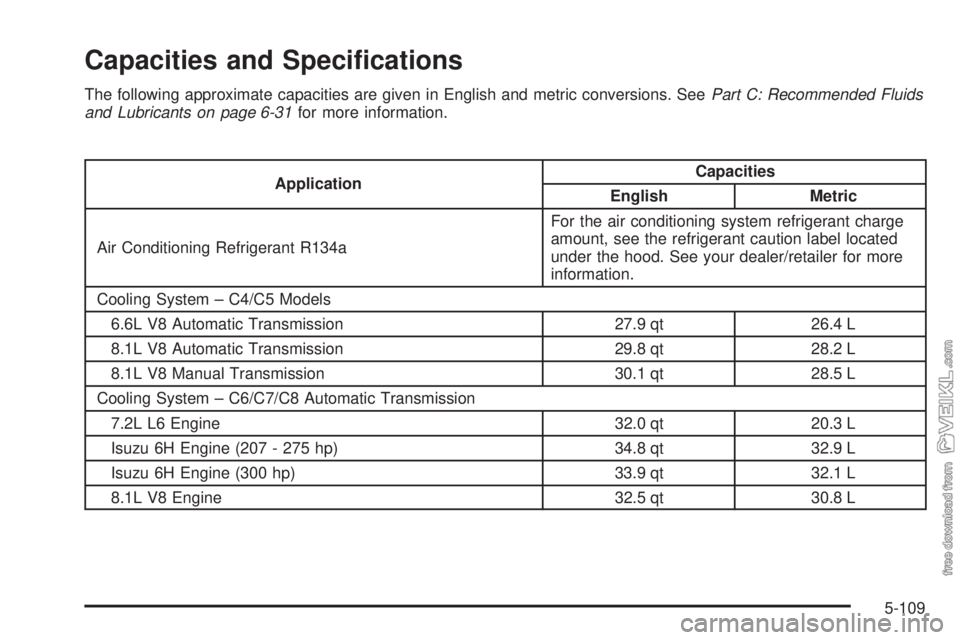
Capacities and Specications
The following approximate capacities are given in English and metric conversions. SeePart C: Recommended Fluids
and Lubricants on page 6-31for more information.
ApplicationCapacities
English Metric
Air Conditioning Refrigerant R134aFor the air conditioning system refrigerant charge
amount, see the refrigerant caution label located
under the hood. See your dealer/retailer for more
information.
Cooling System – C4/C5 Models
6.6L V8 Automatic Transmission 27.9 qt 26.4 L
8.1L V8 Automatic Transmission 29.8 qt 28.2 L
8.1L V8 Manual Transmission 30.1 qt 28.5 L
Cooling System – C6/C7/C8 Automatic Transmission
7.2L L6 Engine 32.0 qt 20.3 L
Isuzu 6H Engine (207 - 275 hp) 34.8 qt 32.9 L
Isuzu 6H Engine (300 hp) 33.9 qt 32.1 L
8.1L V8 Engine 32.5 qt 30.8 L
5-109