light CHEVROLET KODIAK 2008 Manual PDF
[x] Cancel search | Manufacturer: CHEVROLET, Model Year: 2008, Model line: KODIAK, Model: CHEVROLET KODIAK 2008Pages: 384, PDF Size: 5.4 MB
Page 191 of 384
If you have the Antilock Brake System (ABS),
remember: It helps avoid only the braking skid. If you do
not have ABS, then in a braking skid, where the
wheels are no longer rolling, release enough pressure
on the brakes to get the wheels rolling again. This
restores steering control. Push the brake pedal down
steadily when you have to stop suddenly. As long as the
wheels are rolling, you will have steering control.
Driving at Night
Night driving is more dangerous than day driving
because some drivers are likely to be impaired — by
alcohol or drugs, with night vision problems, or by
fatigue.
Night driving tips include:
•Drive defensively.
•Do not drink and drive.
•Reduce headlamp glare by adjusting the inside
rearview mirror.
•Slow down and keep more space between you and
other vehicles because your headlamps can only
light up so much road ahead.
•Watch for animals.
•When tired, pull off the road.
•Do not wear sunglasses.
•Avoid staring directly into approaching headlamps.
•Keep the windshield and all glass on your vehicle
clean — inside and out.
•Keep your eyes moving, especially during turns or
curves.
No one can see as well at night as in the daytime.
But, as we get older, these differences increase.
A 50-year-old driver might need at least twice as much
light to see the same thing at night as a 20-year-old.
4-13
Page 192 of 384
Driving in Rain and on Wet Roads
Rain and wet roads can reduce vehicle traction
and affect your ability to stop and accelerate. Always
drive slower in these types of driving conditions
and avoid driving through large puddles and
deep-standing or flowing water.
{CAUTION:
Wet brakes can cause crashes. They might not
work as well in a quick stop and could cause
pulling to one side. You could lose control of
the vehicle.
After driving through a large puddle of water
or a car/vehicle wash, lightly apply the brake
pedal until the brakes work normally.
Flowing or rushing water creates strong
forces. Driving through owing water could
cause your vehicle to be carried away. If this
happens, you and other vehicle occupants
could drown. Do not ignore police warnings
and be very cautious about trying to drive
through owing water.
Hydroplaning
Hydroplaning is dangerous. Water can build up under
your vehicle’s tires so they actually ride on the
water. This can happen if the road is wet enough and
you are going fast enough. When your vehicle is
hydroplaning, it has little or no contact with the road.
There is no hard and fast rule about hydroplaning. The
best advice is to slow down when the road is wet.
Other Rainy Weather Tips
Besides slowing down, other wet weather driving tips
include:
•Allow extra following distance.
•Pass with caution.
•Keep windshield wiping equipment in good shape.
•Keep the windshield washer fluid reservoir filled.
•Have good tires with proper tread depth. SeeTires
on page 5-82.
4-14
Page 194 of 384
•Stay in your own lane. Do not swing wide or cut
across the center of the road. Drive at speeds
that let you stay in your own lane.
•Top of hills: Be alert — something could be in your
lane (stalled car, accident).
•Pay attention to special road signs (falling rocks
area, winding roads, long grades, passing or
no-passing zones) and take appropriate action.
Winter Driving
Here are some tips for winter driving:
•Be sure the vehicle is in good shape for winter.
•You might want to put winter emergency supplies in
your vehicle.
Include an ice scraper, a small brush or broom, a
supply of windshield washer fluid, a rag, some winter
outer clothing, a small shovel, a flashlight, a red
cloth, and reflective warning triangles. And, if you will be
driving under severe conditions, include a small bag
of sand, a piece of old carpet, or a couple of burlap bags
to help provide traction. Be sure you properly secure
these items in your vehicle.
Also seeTires on page 5-82.
Driving on Snow or Ice
Most of the time, those places where the tires meet the
road probably have good traction.
However, if there is snow or ice between the tires and
the road, you can have a very slippery situation.
You have a lot less traction, or grip, and need to be
very careful.
What is the worst time for this? Wet ice. Very cold snow
or ice can be slick and hard to drive on. But wet ice
can be even more trouble because it can offer the least
traction of all. You can get wet ice when it is about
freezing, 32°F (0°C), and freezing rain begins to fall. Try
to avoid driving on wet ice until salt and sand crews
can get there.
Whatever the condition — smooth ice, packed, blowing,
or loose snow — drive with caution.
If you have a four-wheel-drive vehicle, shift into 4HI.
SeeFour-Wheel Drive on page 2-32.
4-16
Page 197 of 384
Run your engine only as long as you must. This saves
fuel. When you run the engine, make it go a little
faster than just idle. That is, push the accelerator
slightly. This uses less fuel for the heat that you get and
it keeps the battery (or batteries) charged. You will
need a well-charged battery (or batteries) to restart the
vehicle, and possibly for signaling later on with the
headlamps. Let the heater run for a while.
If you have a diesel engine, you may have to run it at a
higher speed to get enough heat.
Then, shut the engine off and close the window almost
all the way to preserve the heat. Start the engine
again and repeat this only when you feel really
uncomfortable from the cold. But do it as little as
possible. Preserve the fuel as long as you can. To help
keep warm, you can get out of the vehicle and do
some fairly vigorous exercises every half hour or so until
help comes.If Your Vehicle is Stuck in Sand,
Mud, Ice, or Snow
Slowly and cautiously spin the wheels to free your
vehicle when stuck in sand, mud, ice, or snow. See
Rocking Your Vehicle to Get It Out on page 4-20.
If your vehicle has a traction system, it can often help to
free a stuck vehicle. Refer to your vehicle’s traction
system in the Index. If the stuck condition is too severe
for the traction system to free the vehicle, turn the
traction system off and use the rocking method.
{CAUTION:
If you let your vehicle’s tires spin at high
speed, they can explode, and you or others
could be injured. The vehicle can overheat,
causing an engine compartment re or other
damage. Spin the wheels as little as possible
and avoid going above 35 mph (55 km/h) as
shown on the speedometer.
4-19
Page 198 of 384
Rocking Your Vehicle to Get It Out
First, turn the steering wheel left and right to clear
the area around the front wheels. For four-wheel-drive
vehicles, shift into 4HI. SeeFour-Wheel Drive on
page 2-32. Turn off any traction system. SeeTraction
Control System (TCS) on page 4-8. Then shift back and
forth between REVERSE (R) and a forward gear, or
with a manual transmission, between FIRST (1)
or SECOND (2) and REVERSE (R), spinning the wheels
as little as possible. To prevent transmission wear,
wait until the wheels stop spinning before shifting gears.
Release the accelerator pedal while you shift, and
press lightly on the accelerator pedal when the
transmission is in gear. By slowly spinning the wheels in
the forward and reverse directions, you will cause a
rocking motion that could free your vehicle. If that does
not get your vehicle out after a few tries, it might
need to be towed out. If your vehicle does need to be
towed out, seeTowing Your Vehicle on page 4-24.
Tow Hooks
{CAUTION:
These hooks, when used, are under a lot of
force. Always pull the vehicle straight out.
Never pull on the hooks at a sideways angle.
The hooks could break off and you or others
could be injured from the chain or cable
snapping back.
Notice:Never use tow hooks to tow the vehicle.
Your vehicle could be damaged and it would not be
covered by warranty.
4-20
Page 204 of 384
Trailer Connections
Heavy-Duty Trailer Wiring Package
Your vehicle may be equipped with an eight-wire trailer
towing harness. This harness, with a seven-pin
universal heavy-duty trailer connector, is attached to a
bracket on the platform hitch.
The Center High-Mounted Stoplamp (CHMSL) wire is
tied next to the trailer wiring harness for use with a
trailer.
The eight-wire harness contains the following trailer
circuits:
•Yellow: Left Stop/Turn Signal
•Dark Green: Right Stop/Turn Signal
•Brown: Taillamps
•White: Ground
•Light Green: Back-up Lamps
•Light Blue: CHMSL
•Red: Battery Feed
•Dark Blue: Trailer Brake
Trailer Connections
(C7/C8 Models Only)
If your vehicle has these trailer connections, they are
located at the rear of the cab for a tractor and at the rear
of the chassis when towing a trailer. There will be an
air connection and an electrical connection.
Be sure that the couplings to the trailer are made
correctly.
Air Connections
If you are not connecting the trailer air line connections
to another piece of equipment, be sure to replace
their protective caps.
Electrical Connections
This system is a seven-wire cable that will connect to
the trailer, supplying power to the trailer’s lighting
system. When not in use, it is stored in the trailer
air-hose storage bracket.
4-26
Page 216 of 384
Very Cold Weather Operation
Follow the instructions listed previously under the
heading “What Fuel to Use.”
Notice:Never use home heating oil or gasoline in
your vehicle’s diesel engine. They can cause
engine damage.
In cold weather, the fuel filter could become clogged
(waxed). To unclog it, move the vehicle to a warm
garage area and warm the filter to between 32°F and
50°F (0°C to 10°C). You will not need to replace it.
Additional information on the fuel filter follows.
Water in Fuel
{CAUTION:
Diesel fuel containing water is still ammable.
You could be burned. If you ever try to drain
water from your fuel, keep sparks, ames and
smoking materials away from the mixture.Notice:If there is water in your diesel fuel and the
weather is warm or humid, fungus and bacteria
can grow in the fuel. They can damage your
fuel system. A diesel fuel biocide can be used to
sterilize your fuel system. However, your fuel system
may still need to be cleaned. Your dealer/retailer
can advise you of the appropriate solution.
If your fuel tank needs to be purged to remove
water, see your dealer/retailer or a qualied
technician. Improper purging can damage your fuel
system.
Sometimes, water can be pumped into your fuel tank
along with your diesel fuel. This can happen if a service
station does not regularly inspect and clean its fuel
tanks, or if it gets contaminated fuel from its suppliers.
If this happens, the
water-in-fuel light, if
equipped, will come on in
the instrument panel. If it
does, the water must be
drained. Your dealer/
retailer can show you how
to do this.
If the light comes on, use this chart to determine what
action to take.
5-12
Page 217 of 384
Water In Fuel Light
Problem Recommended Action
Light comes on
intermittently.Drain water from the fuel
filter.
Light stays on at
temperatures above
freezing.Drain the fuel filter
immediately. If no water
can be drained and the
light stays on, see your
dealer/retailer for
assistance.
Light stays on at
temperatures below
freezing.Drain the fuel filter
immediately. If no water
can be drained, water
may be frozen in the
water drain system, or in
the fuel lines. Move the
vehicle to a warm location
to thaw out, and then
drain the filter system.
Light stays on
immediately after
refueling, and a large
amount of water was
possibly pumped into the
fuel tank.Fuel tank purging is
required. See your
dealer/retailer for
assistance.Notice:If you drive when this warning indicator is
on, you can damage your fuel injection system
and your engine. If the indicator comes on right after
you refuel, it means water was pumped into your
fuel tank. Turn off your engine immediately.
Then, have the water drained at once.
To drain water, do the following:
1. Stop and park the vehicle in a safe place. Turn off
the engine and apply the parking brake.
2. Remove the fuel cap.
3. Place a fuel-resistant container under the fuel filter.
The filter drain valve is located on the bottom of the
fuel filter.
If your vehicle has the 6.6L engine, the fuel filter is
located in the engine compartment on the driver’s
side of the vehicle. If your vehicle has either the
7.2L or 7.8L engine, the fuel filters are located in the
engine compartment on the driver’s side of the
vehicle, and on the driver’s side frame rail in front of
the fuel tank.
5-13
Page 218 of 384
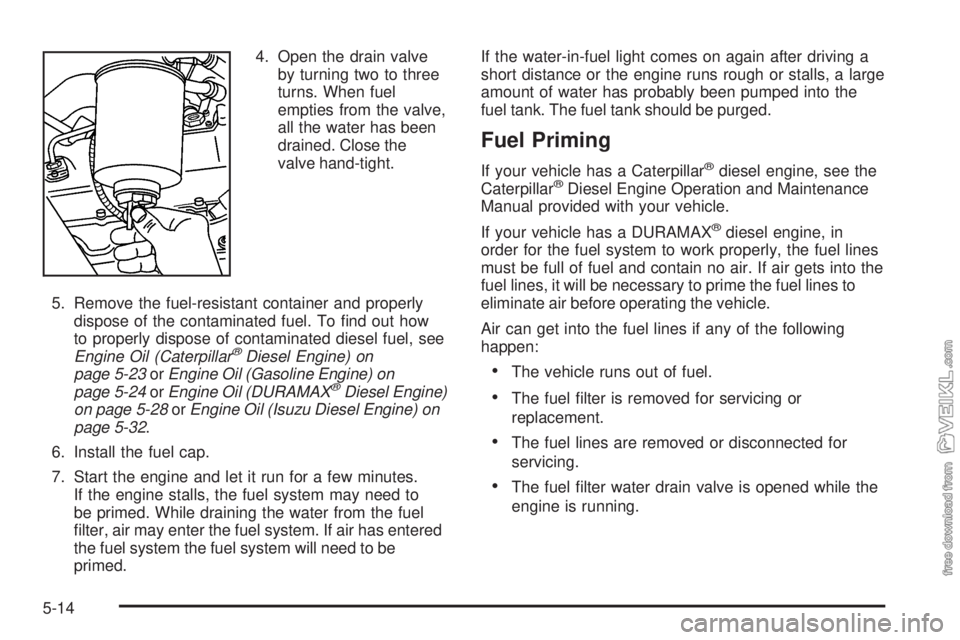
4. Open the drain valve
by turning two to three
turns. When fuel
empties from the valve,
all the water has been
drained. Close the
valve hand-tight.
5. Remove the fuel-resistant container and properly
dispose of the contaminated fuel. To find out how
to properly dispose of contaminated diesel fuel, see
Engine Oil (Caterpillar
®Diesel Engine) on
page 5-23orEngine Oil (Gasoline Engine) on
page 5-24orEngine Oil (DURAMAX
®Diesel Engine)
on page 5-28orEngine Oil (Isuzu Diesel Engine) on
page 5-32.
6. Install the fuel cap.
7. Start the engine and let it run for a few minutes.
If the engine stalls, the fuel system may need to
be primed. While draining the water from the fuel
filter, air may enter the fuel system. If air has entered
the fuel system the fuel system will need to be
primed.If the water-in-fuel light comes on again after driving a
short distance or the engine runs rough or stalls, a large
amount of water has probably been pumped into the
fuel tank. The fuel tank should be purged.
Fuel Priming
If your vehicle has a Caterpillar®diesel engine, see the
Caterpillar®Diesel Engine Operation and Maintenance
Manual provided with your vehicle.
If your vehicle has a DURAMAX
®diesel engine, in
order for the fuel system to work properly, the fuel lines
must be full of fuel and contain no air. If air gets into the
fuel lines, it will be necessary to prime the fuel lines to
eliminate air before operating the vehicle.
Air can get into the fuel lines if any of the following
happen:
•The vehicle runs out of fuel.
•The fuel filter is removed for servicing or
replacement.
•The fuel lines are removed or disconnected for
servicing.
•The fuel filter water drain valve is opened while the
engine is running.
5-14
Page 222 of 384
4. Turn the ignition key to START for 10 to 15 seconds
at a time until your engine starts. If the engine tries
to run, but does not run smoothly, increase the rpm
a little using the accelerator pedal. This will help
force air through the system.
Your service engine soon light may come on if the
vehicle has run out of fuel. This light may stay on for a
few drive cycles after the condition is corrected, but
will eventually clear itself.
Fuel Filter Replacement
If you want to change the diesel engine fuel filter
yourself, here is how to do it:
{CAUTION:
Diesel fuel is ammable. It could start a re if
something ignites it, and you could be burned.
Do not let it get on hot engine parts, and keep
matches or other ignition sources away.
First, drain any water from the filter by following the
water draining procedure earlier in this section.
Your vehicle’s engine should be off until the end of this
procedure.If your vehicle has the 6.6L engine, the fuel filter is
located in the engine compartment on the driver’s side
of the vehicle. If your vehicle has either the 7.2L or
7.8L engine, the fuel filters are located in the engine
compartment on the driver’s side of the vehicle, and on
the driver’s side frame rail in front of the fuel tank.
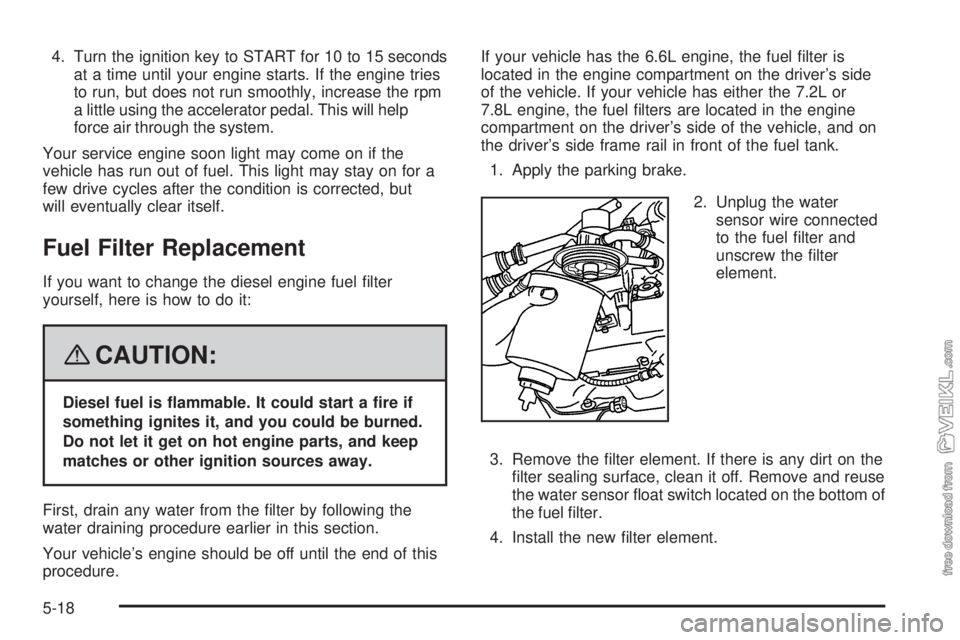
1. Apply the parking brake.
2. Unplug the water
sensor wire connected
to the fuel filter and
unscrew the filter
element.
3. Remove the filter element. If there is any dirt on the
filter sealing surface, clean it off. Remove and reuse
the water sensor float switch located on the bottom of
the fuel filter.
4. Install the new filter element.
5-18