cooling CHEVROLET KODIAK 2009 Owners Manual
[x] Cancel search | Manufacturer: CHEVROLET, Model Year: 2009, Model line: KODIAK, Model: CHEVROLET KODIAK 2009Pages: 376, PDF Size: 5.39 MB
Page 80 of 376
Cold Weather Starting (Caterpillar®
Diesel)
Because the diesel engine uses compression ignition, it
is harder to start in cold weather than a gasoline engine.
The air intake heater, use of the proper engine oil,
optional engine coolant heater and optional ether
injection system help cold weather starting. See the
Caterpillar
®Diesel Engine Operation & Maintenance
Manual for more information.
Restarting the Diesel Engine While
Moving (Automatic Transmission)
If you have to restart the engine while the vehicle is
moving, shift to N (Neutral).
Stopping the Diesel Engine
1. Apply the parking brake. SeeParking Brake (With
Hydraulic Brakes) on page 2-38orParking Brake
(With Air Brakes) on page 2-41for parking
brake apply procedure.
2. Shift into N (Neutral) for a manual transmission or
P (Park) for an automatic transmission.3. Turn the ignition key to OFF.
If the vehicle has a two-speed axle, seeTwo-Speed
Rear Axle on page 2-36.
If you have a Caterpillar
®diesel engine, see the
Caterpillar®Diesel Engine Operation & Maintenance
Manual for additional information.
Diesel Engine Warm-Up
Several factors affect how quickly the diesel engine
warms up. These can include outside temperature,
engine load, idle time and the vehicle’s option content.
The vehicle may be equipped with some features
that can help the engine reach operating temperature
sooner. Some of these features are discussed below.
Also, remember that an automatic transmission
adds heat to the cooling system through the heat
exchanger in the radiator. Because of this, vehicles
equipped with automatic transmissions are often able to
retain engine coolant heat better than manual
transmission vehicles.
See the Caterpillar
®Operation & Maintenance manual
for additional diesel engine warm-up information.
2-16
Page 138 of 376
Climate Controls
Climate Control System
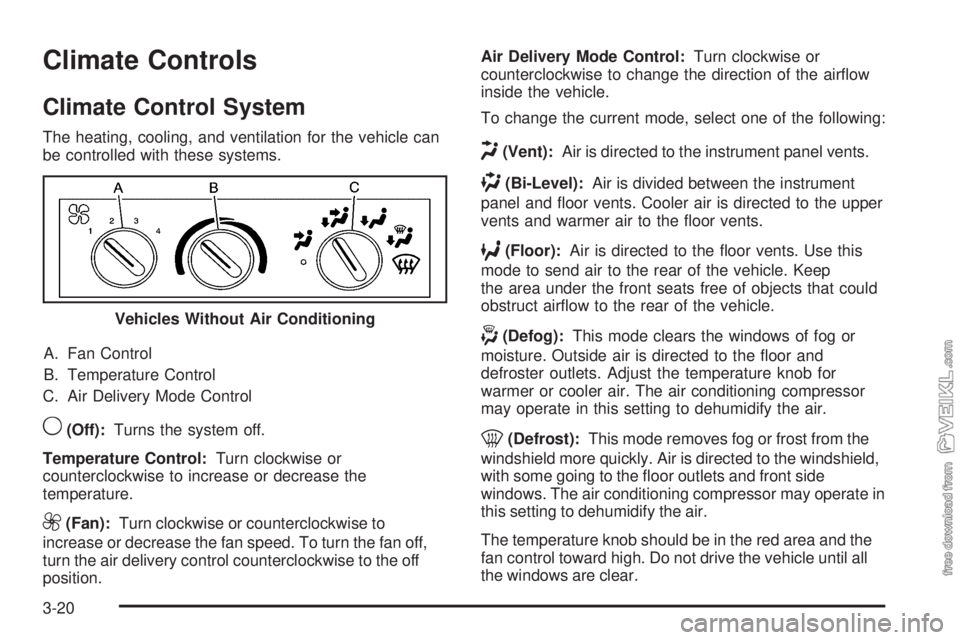
The heating, cooling, and ventilation for the vehicle can
be controlled with these systems.
A. Fan Control
B. Temperature Control
C. Air Delivery Mode Control
9(Off):Turns the system off.
Temperature Control:Turn clockwise or
counterclockwise to increase or decrease the
temperature.
9(Fan):Turn clockwise or counterclockwise to
increase or decrease the fan speed. To turn the fan off,
turn the air delivery control counterclockwise to the off
position.Air Delivery Mode Control:Turn clockwise or
counterclockwise to change the direction of the airflow
inside the vehicle.
To change the current mode, select one of the following:
H(Vent):Air is directed to the instrument panel vents.
)(Bi-Level):Air is divided between the instrument
panel and floor vents. Cooler air is directed to the upper
vents and warmer air to the floor vents.
6(Floor):Air is directed to the floor vents. Use this
mode to send air to the rear of the vehicle. Keep
the area under the front seats free of objects that could
obstruct airflow to the rear of the vehicle.
-(Defog):This mode clears the windows of fog or
moisture. Outside air is directed to the floor and
defroster outlets. Adjust the temperature knob for
warmer or cooler air. The air conditioning compressor
may operate in this setting to dehumidify the air.
0(Defrost):This mode removes fog or frost from the
windshield more quickly. Air is directed to the windshield,
with some going to the floor outlets and front side
windows. The air conditioning compressor may operate in
this setting to dehumidify the air.
The temperature knob should be in the red area and the
fan control toward high. Do not drive the vehicle until all
the windows are clear. Vehicles Without Air Conditioning
3-20
Page 139 of 376
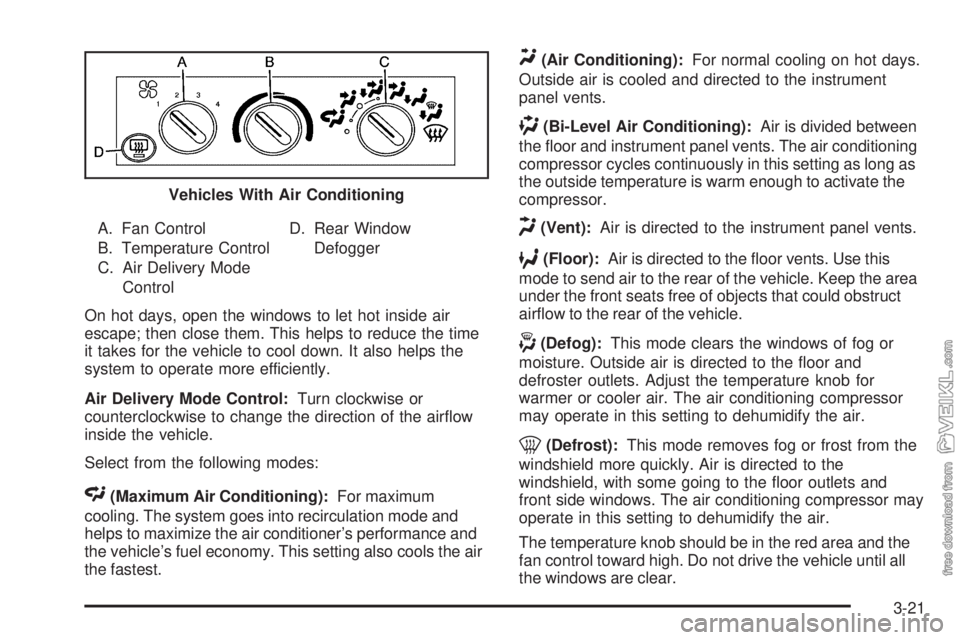
A. Fan Control
B. Temperature Control
C. Air Delivery Mode
ControlD. Rear Window
Defogger
On hot days, open the windows to let hot inside air
escape; then close them. This helps to reduce the time
it takes for the vehicle to cool down. It also helps the
system to operate more efficiently.
Air Delivery Mode Control:Turn clockwise or
counterclockwise to change the direction of the airflow
inside the vehicle.
Select from the following modes:
<(Maximum Air Conditioning):For maximum
cooling. The system goes into recirculation mode and
helps to maximize the air conditioner’s performance and
the vehicle’s fuel economy. This setting also cools the air
the fastest.
Y(Air Conditioning):For normal cooling on hot days.
Outside air is cooled and directed to the instrument
panel vents.
)(Bi-Level Air Conditioning):Air is divided between
the floor and instrument panel vents. The air conditioning
compressor cycles continuously in this setting as long as
the outside temperature is warm enough to activate the
compressor.
H(Vent):Air is directed to the instrument panel vents.
6(Floor):Air is directed to the floor vents. Use this
mode to send air to the rear of the vehicle. Keep the area
under the front seats free of objects that could obstruct
airflow to the rear of the vehicle.
-(Defog):This mode clears the windows of fog or
moisture. Outside air is directed to the floor and
defroster outlets. Adjust the temperature knob for
warmer or cooler air. The air conditioning compressor
may operate in this setting to dehumidify the air.
0(Defrost):This mode removes fog or frost from the
windshield more quickly. Air is directed to the
windshield, with some going to the floor outlets and
front side windows. The air conditioning compressor may
operate in this setting to dehumidify the air.
The temperature knob should be in the red area and the
fan control toward high. Do not drive the vehicle until all
the windows are clear. Vehicles With Air Conditioning
3-21
Page 192 of 376
Hill and Mountain Roads
Driving on steep hills or through mountains is different
than driving on flat or rolling terrain. Tips for driving
in these conditions include:
•Keep the vehicle serviced and in good shape.
•Check all fluid levels and brakes, tires, cooling
system, and transmission.
•Going down steep or long hills, shift to a
lower gear.
{CAUTION:
If you do not shift down, the brakes could get so
hot that they would not work well. You would then
have poor braking or even none going down a hill.
You could crash. Shift down to let the engine
assist the brakes on a steep downhill slope.
{CAUTION:
Coasting downhill in N (Neutral) or with the ignition
off is dangerous. The brakes will have to do all the
work of slowing down and they could get so hot
that they would not work well. You would then
have poor braking or even none going down a hill.
You could crash. Always have the engine running
and the vehicle in gear when going downhill.
•Stay in your own lane. Do not swing wide or cut
across the center of the road. Drive at speeds
that let you stay in your own lane.
•Top of hills: Be alert — something could be in your
lane (stalled car, accident).
•Pay attention to special road signs (falling rocks
area, winding roads, long grades, passing or
no-passing zones) and take appropriate action.
4-16
Page 203 of 376
Service............................................................5-3
Accessories and Modifications..........................5-3
California Proposition 65 Warning.....................5-4
California Perchlorate Materials Requirements.....5-4
Doing Your Own Service Work.........................5-5
Engine Fan Breakage.....................................5-6
Fuel................................................................5-6
Gasoline Octane............................................5-6
Gasoline Specifications....................................5-7
Additives.......................................................5-7
Diesel Engine Fuel.........................................5-8
What Fuel to Use...........................................5-8
Very Cold Weather Operation.........................5-11
Water in Fuel...............................................5-11
Running Out of Fuel.....................................5-17
Fuel Filter Replacement.................................5-18
Fuels in Foreign Countries.............................5-19
Filling the Tank............................................5-20
Filling a Portable Fuel Container.....................5-22
Checking Things Under the Hood....................5-22
Hood Latches...............................................5-23
Engine Oil (DURAMAX Diesel Engine).............5-24
Engine Oil (Caterpillar Diesel Engine)..............5-27
Engine Oil (Isuzu Diesel Engine).....................5-28
Engine Oil (Gasoline Engine)..........................5-32
Engine Oil Life System (Gasoline Engine)........5-35Engine Oil Life System (DURAMAX/Isuzu
Diesel Engines).........................................5-36
Engine Oil Life System (Caterpillar
Diesel Engine)..........................................5-38
Engine Air Cleaner/Filter................................5-38
Automatic Transmission Fluid.........................5-42
Manual Transmission Fluid.............................5-42
Cooling System............................................5-43
Engine Coolant (Caterpillar Diesel Engines)......5-47
Coolant Surge Tank Pressure Cap..................5-47
Engine Overheating.......................................5-48
Engine Fan Noise.........................................5-49
Power Steering Fluid.....................................5-49
Windshield Washer Fluid................................5-50
Brakes........................................................5-52
Battery........................................................5-61
Jump Starting...............................................5-62
Rear Axle.......................................................5-67
Rear Axle Shift Motor....................................5-68
Four-Wheel Drive............................................5-68
Front Axle......................................................5-69
Noise Control System.....................................5-70
Tampering with Noise Control System
Prohibited.................................................5-70
Bulb Replacement..........................................5-71
Section 5 Service and Appearance Care
5-1
Page 245 of 376
How to Add Fluid
To add transmission fluid, do the following:
1. Remove the filler plug.
2. Add fluid at the filler plug hole. Add only enough
fluid to bring the fluid level up to the bottom of the
fill opening. Refer to the Maintenance Schedule
to determine the proper fluid to use. SeePart
C: Recommended Fluids and Lubricants on
page 6-31.
3. Reinstall the filler plug. Be sure the plug is fully
seated.
Cooling System
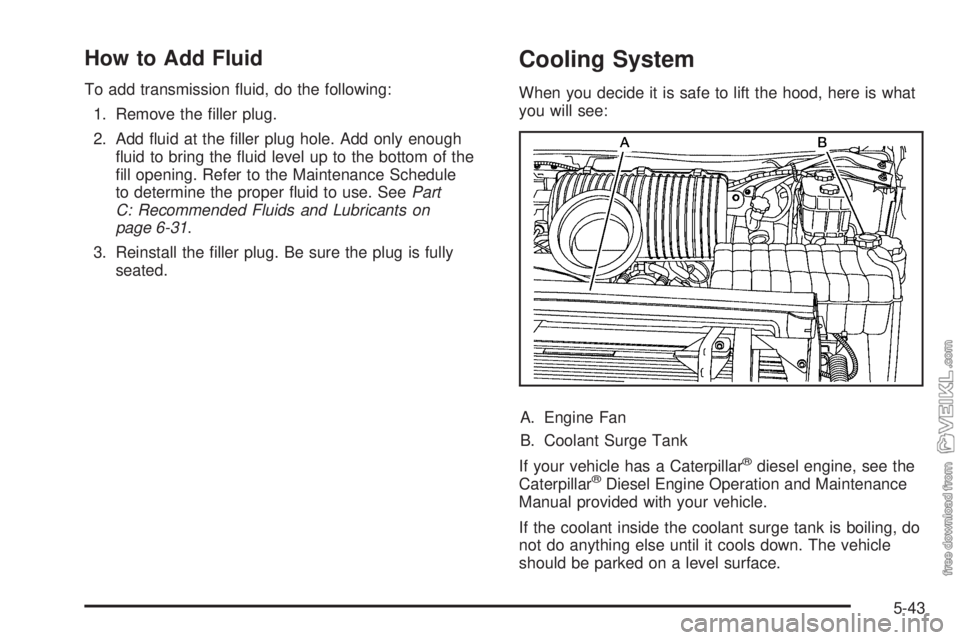
When you decide it is safe to lift the hood, here is what
you will see:
A. Engine Fan
B. Coolant Surge Tank
If your vehicle has a Caterpillar
®diesel engine, see the
Caterpillar®Diesel Engine Operation and Maintenance
Manual provided with your vehicle.
If the coolant inside the coolant surge tank is boiling, do
not do anything else until it cools down. The vehicle
should be parked on a level surface.
5-43
Page 246 of 376
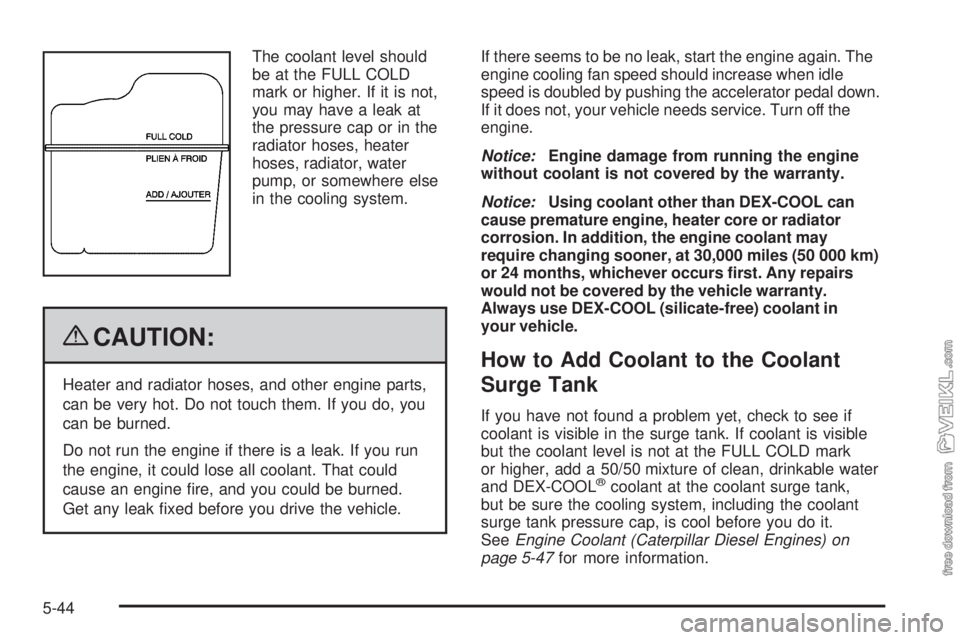
The coolant level should
be at the FULL COLD
mark or higher. If it is not,
you may have a leak at
the pressure cap or in the
radiator hoses, heater
hoses, radiator, water
pump, or somewhere else
in the cooling system.
{CAUTION:
Heater and radiator hoses, and other engine parts,
can be very hot. Do not touch them. If you do, you
can be burned.
Do not run the engine if there is a leak. If you run
the engine, it could lose all coolant. That could
cause an engine fire, and you could be burned.
Get any leak fixed before you drive the vehicle.If there seems to be no leak, start the engine again. The
engine cooling fan speed should increase when idle
speed is doubled by pushing the accelerator pedal down.
If it does not, your vehicle needs service. Turn off the
engine.
Notice:Engine damage from running the engine
without coolant is not covered by the warranty.
Notice:Using coolant other than DEX-COOL can
cause premature engine, heater core or radiator
corrosion. In addition, the engine coolant may
require changing sooner, at 30,000 miles (50 000 km)
or 24 months, whichever occurs first. Any repairs
would not be covered by the vehicle warranty.
Always use DEX-COOL (silicate-free) coolant in
your vehicle.
How to Add Coolant to the Coolant
Surge Tank
If you have not found a problem yet, check to see if
coolant is visible in the surge tank. If coolant is visible
but the coolant level is not at the FULL COLD mark
or higher, add a 50/50 mixture of clean, drinkable water
and DEX-COOL
®coolant at the coolant surge tank,
but be sure the cooling system, including the coolant
surge tank pressure cap, is cool before you do it.
SeeEngine Coolant (Caterpillar Diesel Engines) on
page 5-47for more information.
5-44
Page 247 of 376
If no coolant is visible in the surge tank, add coolant as
follows:
{CAUTION:
Steam and scalding liquids from a hot cooling
system can blow out and burn you badly. They are
under pressure, and if you turn the coolant surge
tank pressure cap — even a little — they can
come out at high speed. Never turn the cap when
the cooling system, including the coolant surge
tank pressure cap, is hot. Wait for the cooling
system and coolant surge tank pressure cap to
cool if you ever have to turn the pressure cap.
{CAUTION:
Adding only plain water to the cooling system can
be dangerous. Plain water, or some other liquid
such as alcohol, can boil before the proper coolant
mixture will. The vehicle’s coolant warning system
is set for the proper coolant mixture. With plain
water or the wrong mixture, the engine could get
too hot but you would not get the overheat
warning. The engine could catch fire and you or
others could be burned. Use a 50/50 mixture of
clean, drinkable water and DEX-COOL
®coolant.
Notice:In cold weather, water can freeze and crack
the engine, radiator, heater core and other parts.
Use the recommended coolant and the proper
coolant mixture.
5-45
Page 248 of 376
{CAUTION:
You can be burned if you spill coolant on hot
engine parts. Coolant contains ethylene glycol and
it will burn if the engine parts are hot enough. Do
not spill coolant on a hot engine.
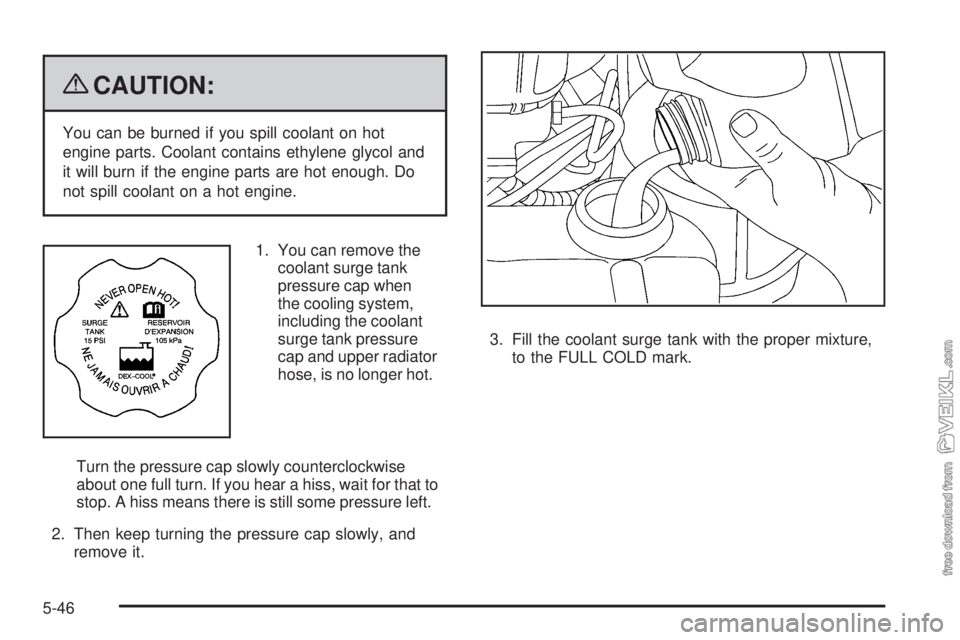
1. You can remove the
coolant surge tank
pressure cap when
the cooling system,
including the coolant
surge tank pressure
cap and upper radiator
hose, is no longer hot.
Turn the pressure cap slowly counterclockwise
about one full turn. If you hear a hiss, wait for that to
stop. A hiss means there is still some pressure left.
2. Then keep turning the pressure cap slowly, and
remove it.3. Fill the coolant surge tank with the proper mixture,
to the FULL COLD mark.
5-46
Page 249 of 376
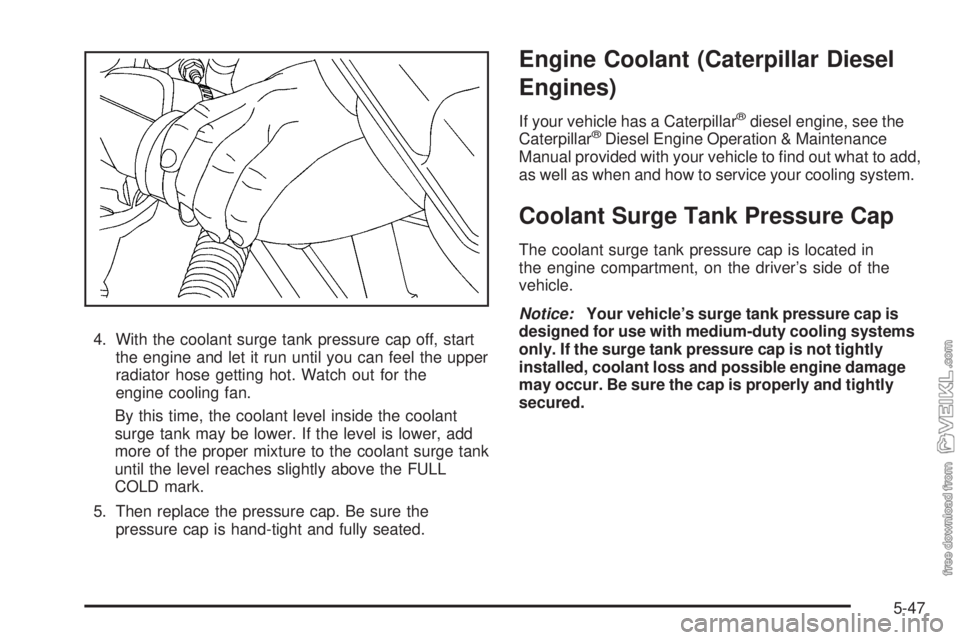
4. With the coolant surge tank pressure cap off, start
the engine and let it run until you can feel the upper
radiator hose getting hot. Watch out for the
engine cooling fan.
By this time, the coolant level inside the coolant
surge tank may be lower. If the level is lower, add
more of the proper mixture to the coolant surge tank
until the level reaches slightly above the FULL
COLD mark.
5. Then replace the pressure cap. Be sure the
pressure cap is hand-tight and fully seated.
Engine Coolant (Caterpillar Diesel
Engines)
If your vehicle has a Caterpillar®diesel engine, see the
Caterpillar®Diesel Engine Operation & Maintenance
Manual provided with your vehicle to find out what to add,
as well as when and how to service your cooling system.
Coolant Surge Tank Pressure Cap
The coolant surge tank pressure cap is located in
the engine compartment, on the driver’s side of the
vehicle.
Notice:Your vehicle’s surge tank pressure cap is
designed for use with medium-duty cooling systems
only. If the surge tank pressure cap is not tightly
installed, coolant loss and possible engine damage
may occur. Be sure the cap is properly and tightly
secured.
5-47