ESP CHEVROLET KODIAK 2009 User Guide
[x] Cancel search | Manufacturer: CHEVROLET, Model Year: 2009, Model line: KODIAK, Model: CHEVROLET KODIAK 2009Pages: 376, PDF Size: 5.39 MB
Page 188 of 376
Loss of Control
Let us review what driving experts say about what
happens when the three control systems — brakes,
steering, and acceleration — do not have enough friction
where the tires meet the road to do what the driver has
asked.
In any emergency, do not give up. Keep trying to steer
and constantly seek an escape route or area of less
danger.
Skidding
In a skid, a driver can lose control of the vehicle.
Defensive drivers avoid most skids by taking reasonable
care suited to existing conditions, and by not overdriving
those conditions. But skids are always possible.
The three types of skids correspond to the vehicle’s three
control systems. In the braking skid, the wheels are not
rolling. In the steering or cornering skid, too much speed
or steering in a curve causes tires to slip and lose
cornering force. And in the acceleration skid, too much
throttle causes the driving wheels to spin.
If the vehicle has the Traction Control System (TCS),
remember: It helps avoid only the acceleration skid.
SeeTraction Control System (TCS) on page 4-8.Ifthe
vehicle does not have this system, or if the system
is off, then an acceleration skid is best handled
by easing your foot off the accelerator pedal.Of course, traction is reduced when water, snow, ice,
gravel, or other material is on the road. For safety, slow
down and adjust your driving to these conditions. It is
important to slow down on slippery surfaces because
stopping distance will be longer and vehicle control more
limited.
While driving on a surface with reduced traction, try
your best to avoid sudden steering, acceleration, or
braking, including reducing vehicle speed by shifting to
a lower gear. Any sudden changes could cause the tires
to slide. You may not realize the surface is slippery until
the vehicle is skidding. Learn to recognize warning
clues — such as enough water, ice, or packed snow on
the road to make a mirrored surface — and slow down
when you have any doubt.
If the vehicle has the Antilock Brake System (ABS),
remember: It helps avoid only the braking skid. If
the vehicle does not have ABS, then in a braking skid,
where the wheels are no longer rolling, release
enough pressure on the brakes to get the wheels rolling
again. This restores steering control. Push the brake
pedal down steadily when you have to stop suddenly. As
long as the wheels are rolling, you will have steering
control.
4-12
Page 189 of 376
Driving at Night
Night driving is more dangerous than day driving because
some drivers are likely to be impaired — by alcohol or
drugs, with night vision problems, or by fatigue.
Night driving tips include:
•Drive defensively.
•Do not drink and drive.
•Reduce headlamp glare by adjusting the inside
rearview mirror.
•Slow down and keep more space between you and
other vehicles because headlamps can only light up
so much road ahead.
•Watch for animals.
•When tired, pull off the road.
•Do not wear sunglasses.
•Avoid staring directly into approaching headlamps.
•Keep the windshield and all glass on your vehicle
clean — inside and out.
•Keep your eyes moving, especially during turns or
curves.
No one can see as well at night as in the daytime.
But, as we get older, these differences increase.
A 50-year-old driver might need at least twice as much
light to see the same thing at night as a 20-year-old.
4-13
Page 194 of 376
Blizzard Conditions
Being stuck in snow can be in a serious situation. Stay
with the vehicle unless there is help nearby. If possible,
use theRoadside Assistance Program on page 7-5.
To get help and keep everyone in the vehicle safe:
•Turn on theHazard Warning Flashers on page 3-6.
•Tie a red cloth to an outside mirror.
{CAUTION:
Snow can trap engine exhaust under the vehicle.
This may cause exhaust gases to get inside.
Engine exhaust contains carbon monoxide (CO)
which cannot be seen or smelled. It can cause
unconsciousness and even death.
If the vehicle is stuck in the snow:
•Clear away snow from around the base of
your vehicle, especially any that is blocking
the exhaust pipe.
•Check again from time to time to be sure
snow does not collect there.
CAUTION: (Continued)
CAUTION: (Continued)
•
Open a window about two inches (5 cm) on
the side of the vehicle that is away from the
wind to bring in fresh air.
•Fully open the air outlets on or under the
instrument panel.
•Adjust the Climate Control system to a setting
that circulates the air inside the vehicle and
set the fan speed to the highest setting. See
Climate Control System in the Index.
For more information about carbon monoxide, see
Engine Exhaust on page 2-45.
Snow can trap exhaust gases under your vehicle.
This can cause deadly CO (carbon monoxide) gas
to get inside. CO could overcome you and kill you.
You cannot see it or smell it, so you might not
know it is in your vehicle. Clear away snow from
around the base of your vehicle, especially any
that is blocking the exhaust.
Run the engine for short periods only as needed to
keep warm, but be careful.
To save fuel, run the engine for only short periods as
needed to warm the vehicle and then shut the engine off
and close the window most of the way to save heat.
4-18
Page 196 of 376
Tow Hooks
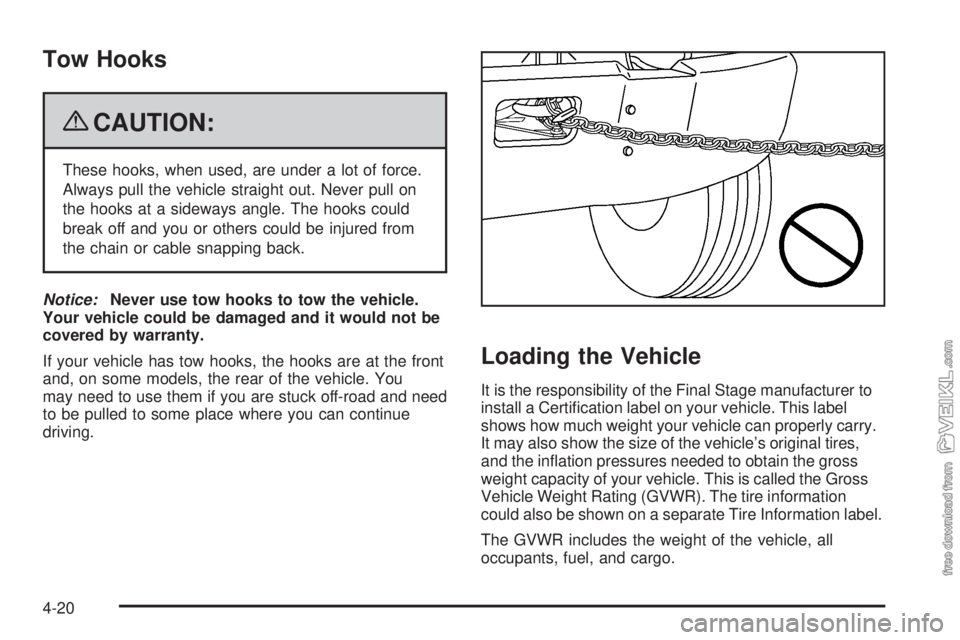
{CAUTION:
These hooks, when used, are under a lot of force.
Always pull the vehicle straight out. Never pull on
the hooks at a sideways angle. The hooks could
break off and you or others could be injured from
the chain or cable snapping back.
Notice:Never use tow hooks to tow the vehicle.
Your vehicle could be damaged and it would not be
covered by warranty.
If your vehicle has tow hooks, the hooks are at the front
and, on some models, the rear of the vehicle. You
may need to use them if you are stuck off-road and need
to be pulled to some place where you can continue
driving.
Loading the Vehicle
It is the responsibility of the Final Stage manufacturer to
install a Certification label on your vehicle. This label
shows how much weight your vehicle can properly carry.
It may also show the size of the vehicle’s original tires,
and the inflation pressures needed to obtain the gross
weight capacity of your vehicle. This is called the Gross
Vehicle Weight Rating (GVWR). The tire information
could also be shown on a separate Tire Information label.
The GVWR includes the weight of the vehicle, all
occupants, fuel, and cargo.
4-20
Page 210 of 376
Diesel Engine Fuel
For the Caterpillar®diesel, see the Caterpillar®
Operation & Maintenance Manual for information
concerning fuel usage.
Notice:Diesel fuel or fuel additives not
recommended in this manual could damage the fuel
system and engine. Your warranty would not
cover this damage. And:
•Diesel fuel that has been mixed with engine oil
or automatic transmission fluid could damage
the engine and emission controls.
•We do not test aftermarket diesel fuel additives.
Some additives, particularly those which
contain alcohol or water emulsifiers, could
damage the fuel system. If you believe that
unique circumstances call for a fuel additive to
be used, consult your dealer/retailer for
advice.
•If you ever run out of diesel fuel, it can be
difficult to restart the engine. To avoid this,
never let the tank get empty.
If gasoline is ever accidentally added to the fuel
tank, to avoid severe engine damage, do not run the
engine until the fuel tank can be drained.
If you run out of fuel,Running Out of Fuel on page 5-17
tells you how to restart the engine.
What Fuel to Use
Notice:Use of diesel fuel other than Ultra Low
Sulfur Diesel (15 ppm sulfur maximum) or engine oil
other than low ash CJ-4 oil will cause permanent
damage to the DPF and related components. This
damage would not be covered by your warranty.
The emission control system requires the use of diesel
fuel with ultra low-sulfur (0.0015% by weight, or 15 ppm,
maximum) content. Both Ultra Low Sulfur Diesel and Low
Sulfur Diesel fuels are available in the United States and
Ultra Low Sulfur Diesel fuel is available in Canada. In
Mexico, Ultra Low Sulfur Diesel fuel is not available in all
regions.
At a minimum, the diesel fuel you use should meet the
latest version of ASTM specification D 975 (Grades
No. 2-D or No. 1-D S15 commonly known as Ultra Low
Sulfur diesel) in the United States. In addition, the
Engine Manufacturers Association (EMA) has identified
properties of an improved diesel fuel for better engine
performance and durability. Diesel fuels corresponding to
the EMA Recommended Guideline on Premium Diesel
Fuel (FQP-1A) could provide better starting, less noise,
and better vehicle performance. If there are questions
about the fuel you are using, contact your fuel supplier.
5-8
Page 212 of 376
What Fuel to Use in Canada
Notice:Use of diesel fuel other than Ultra Low
Sulfur Diesel (15 ppm sulfur maximum) or engine oil
other than low ash CJ-4 oil will cause permanent
damage to the DPF and related components.
This damage would not be covered by your
warranty.
The emission control system requires the use of diesel
fuel with ultra low-sulfur (0.0015% by weight, or 15 ppm,
maximum) content. Both Ultra Low Sulfur Diesel and Low
Sulfur Diesel fuels are available in the United States and
Ultra Low Sulfur Diesel fuel is available in Canada. In
Mexico, Ultra Low Sulfur Diesel fuel is not available in all
regions.
At a minimum, the diesel fuel you use should meet the
latest version of specification CAN/CGSB-3.517 (ULS)
in Canada. In addition, the Engine Manufacturers
Association (EMA) has identified properties of an
improved diesel fuel for better engine performance and
durability (FQP-1A). Diesel fuels corresponding to the
EMA description could provide better starting, less noise,
and better vehicle performance. If there are questions
about the fuel you are using, contact your fuel supplier.Canadian fuels are blended for seasonal changes.
Diesel Type “A” fuel is blended for better cold weather
starting (below 0°F or−18°C); however, you might notice
some power and fuel economy loss. If Type “A” fuel is
used in warmer temperatures, stalling and hard
starting may occur. Diesel Type “B” fuel is blended for
temperatures above 0°F (−18°C).
It is acceptable to use diesel fuel containing up to
5% biodiesel (B5), but the final blended fuel must meet
the same specification, CAN/CGSB-3.517 (ULS) in
Canada, as other fuels used in your vehicle, and the
biodiesel used for making this fuel must meet the latest
version of ASTM specification D 6751. Biodiesel is
produced from vegetable oils or animal fat that have
been chemically modified to reduce the possibility
of damage to the fuel system and engine. Higher
concentration (i.e., greater than B5) biodiesel-containing
fuels or the use of unmodified bio-oils blended into
diesel fuel at any concentration is not recommended and
could damage the fuel system and engine. Such
damage would not be covered by your warranty. If there
are questions about the biodiesel-containing fuels you
are using, contact your fuel supplier.
5-10
Page 264 of 376
Jump Starting
If the vehicle’s battery (or batteries) has run down, you
may want to use another vehicle and some jumper
cables to start your vehicle. Be sure to use the following
steps to do it safely.
{CAUTION:
Batteries can hurt you. They can be dangerous
because:
•They contain acid that can burn you.
•They contain gas that can explode or ignite.
•They contain enough electricity to burn you.
If you do not follow these steps exactly, some or
all of these things can hurt you.Notice:Ignoring these steps could result in costly
damage to the vehicle that would not be covered
by the warranty.
Trying to start the vehicle by pushing or pulling it
will not work, and it could damage the vehicle.
1. Check the other vehicle. It must have a 12-volt
battery (or batteries) with a negative ground
system.
Notice:If the other vehicle’s system is not a 12-volt
system with a negative ground, both vehicles can
be damaged. Only use vehicles with 12-volt systems
with negative grounds to jump start your vehicle.
If you have a diesel engine vehicle with two batteries
(or more), you should know before you begin that,
especially in cold weather, you may not be able to get
enough power from a single battery in another
vehicle to start your diesel engine.
If your vehicle has more than one battery, use the
one closest to the starter — this will reduce electrical
resistance.
5-62
Page 287 of 376
Using wheels and tires with higher load-carrying limits
than the original wheels and tires does not change
the Gross Axle Weight Rating (GAWR) or the Gross
Vehicle Weight Rating (GVWR) of your vehicle.
SeeLoading the Vehicle on page 4-20for more
information.
Notice:The wrong wheel can cause trouble in
bearing life, brake cooling, speedometer/odometer
calibration, headlamp aim, bumper height, vehicle
ground clearance, stopping distance and tire
clearance to the body and chassis. You could also
have other problems like a tire air-out.
Used Replacement Wheels
{CAUTION:
Putting a used wheel on the vehicle is dangerous.
You cannot know how it has been used or how far
it has been driven. It could fail suddenly and
cause a crash. If you have to replace a wheel, use
a new GM original equipment wheel.
If a Tire Goes Flat
It is unusual for a tire to blowout while you are driving,
especially if you maintain your tires properly. If air
goes out of a tire, it is much more likely to leak out
slowly. But if you should ever have a blowout, here are
a few tips about what to expect and what to do:
If a front tire fails, the flat tire will create a drag that
pulls the vehicle toward that side. Take your foot off the
accelerator pedal and grip the steering wheel firmly.
Steer to maintain lane position, and then gently brake to
a stop well out of the traffic lane.
A rear blowout, particularly on a curve, acts much like a
skid and may require the same correction you would
use in a skid. In any rear blowout, remove your foot from
the accelerator pedal. Get the vehicle under control
by steering the way you want the vehicle to go. It may
be very bumpy and noisy, but you can still steer. Gently
brake to a stop –– well off the road if possible.
5-85
Page 342 of 376
Automatic Transmission Shift Indicator
Check
Check that the indicator points to the gear chosen.
Steering Check
Be alert for any changes in steering action, abnormal
front tire wear or steering wheel position. An inspection
or service is needed when the steering wheel is
harder to turn or has too much free play, or if there are
strange sounds when turning or parking.
Brake System Check
Be alert to the low air warning light or tone alarm, or
changes in braking action, such as repeated pulling to
one side, unusual sounds when braking or increased
brake pedal travel. Make sure air brake system reservoirs
are drained daily with full system air pressure, and check
system for leaks. Any of these conditions could indicate
the need for brake system inspection and/or service.
Engine Cooling System Service
Inspect the hoses and have them replaced if they are
cracked, swollen, or deteriorated. Inspect all pipes,
fittings, and clamps; replace as needed. Clean the
outside of the radiator and air conditioning condenser. To
help ensure proper operation, a pressure test of the
cooling system and pressure cap is recommended at
least once a year.
Exhaust System Inspection
Be alert for any changes in the sound of the exhaust
system or any smell of fumes. These are signs the
system may be leaking. Have it checked and/or repaired
at once. SeeEngine Exhaust on page 2-45and
Running the Vehicle While Parked on page 2-50.
Check to be sure that mud or dirt is not caked on the
exhaust system, especially in the area of the diesel
particulate filter and tailpipe. Clean the area as needed.
SeeDiesel Particulate Filter on page 2-46.
At high mileages, the DPF becomes loaded with ash.
This is normal. When the amount of ash loading is high,
see your dealer/retailer for DPF cleaning or replacement.
Windshield Wipers and Washers
Check
Check operation and condition of the wiper blades.
Check the flow of the washer spray.
Defroster Check
Move the control to the defrost symbol and the fan to HI
or the high symbol. Then check the airflow from the
ducts at the inside base of the windshield.
6-28
Page 352 of 376
Customer Assistance and
Information
Customer Satisfaction Procedure
Your satisfaction and goodwill are important to your
dealer and to Chevrolet. Normally, any concerns with the
sales transaction or the operation of the vehicle will be
resolved by the dealer’s sales or service departments.
Sometimes, however, despite the best intentions of all
concerned, misunderstandings can occur. If your concern
has not been resolved to your satisfaction, the following
steps should be taken:
STEP ONE:Discuss your concern with a member of
dealership management. Normally, concerns can be
quickly resolved at that level. If the matter has already
been reviewed with the sales, service or parts manager,
contact the owner of the dealership or the general
manager.STEP TWO:If after contacting a member of dealership
management, it appears your concern cannot be
resolved by the dealership without further help, call the
GM Medium Duty Truck Customer Assistance Center
at 1-800-862-4389. In Canada, call GM of Canada
Customer Communication Centre in Oshawa at
1-800-263-3777 (English), or 1-800-263-7854 (French).
We encourage you to call the toll-free number in
order to give your inquiry prompt attention. Have the
following information available to give the Customer
Assistance Representative:
•Vehicle Identification Number (VIN). This is
available from the vehicle registration or title, or the
plate at the top left of the instrument panel and
visible through the windshield.
•Dealership name and location.
•Vehicle delivery date and present mileage.
When contacting Chevrolet, remember that your
concern will likely be resolved at a dealer’s facility.
That is why we suggest following Step One first.
7-2