maintenance CHEVROLET KODIAK 2009 Owner's Manual
[x] Cancel search | Manufacturer: CHEVROLET, Model Year: 2009, Model line: KODIAK, Model: CHEVROLET KODIAK 2009Pages: 376, PDF Size: 5.39 MB
Page 210 of 376
Diesel Engine Fuel
For the Caterpillar®diesel, see the Caterpillar®
Operation & Maintenance Manual for information
concerning fuel usage.
Notice:Diesel fuel or fuel additives not
recommended in this manual could damage the fuel
system and engine. Your warranty would not
cover this damage. And:
•Diesel fuel that has been mixed with engine oil
or automatic transmission fluid could damage
the engine and emission controls.
•We do not test aftermarket diesel fuel additives.
Some additives, particularly those which
contain alcohol or water emulsifiers, could
damage the fuel system. If you believe that
unique circumstances call for a fuel additive to
be used, consult your dealer/retailer for
advice.
•If you ever run out of diesel fuel, it can be
difficult to restart the engine. To avoid this,
never let the tank get empty.
If gasoline is ever accidentally added to the fuel
tank, to avoid severe engine damage, do not run the
engine until the fuel tank can be drained.
If you run out of fuel,Running Out of Fuel on page 5-17
tells you how to restart the engine.
What Fuel to Use
Notice:Use of diesel fuel other than Ultra Low
Sulfur Diesel (15 ppm sulfur maximum) or engine oil
other than low ash CJ-4 oil will cause permanent
damage to the DPF and related components. This
damage would not be covered by your warranty.
The emission control system requires the use of diesel
fuel with ultra low-sulfur (0.0015% by weight, or 15 ppm,
maximum) content. Both Ultra Low Sulfur Diesel and Low
Sulfur Diesel fuels are available in the United States and
Ultra Low Sulfur Diesel fuel is available in Canada. In
Mexico, Ultra Low Sulfur Diesel fuel is not available in all
regions.
At a minimum, the diesel fuel you use should meet the
latest version of ASTM specification D 975 (Grades
No. 2-D or No. 1-D S15 commonly known as Ultra Low
Sulfur diesel) in the United States. In addition, the
Engine Manufacturers Association (EMA) has identified
properties of an improved diesel fuel for better engine
performance and durability. Diesel fuels corresponding to
the EMA Recommended Guideline on Premium Diesel
Fuel (FQP-1A) could provide better starting, less noise,
and better vehicle performance. If there are questions
about the fuel you are using, contact your fuel supplier.
5-8
Page 215 of 376
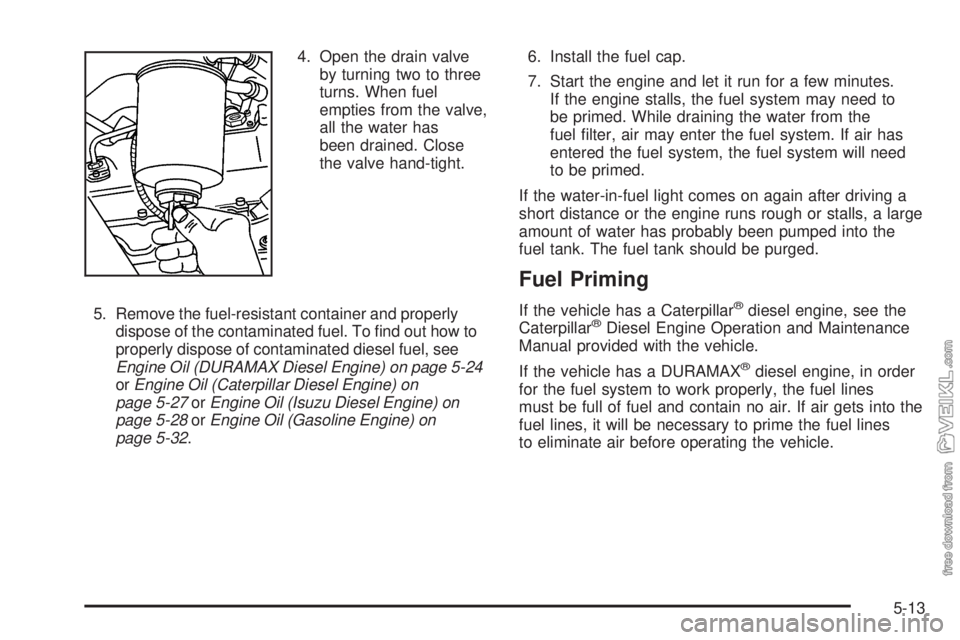
4. Open the drain valve
by turning two to three
turns. When fuel
empties from the valve,
all the water has
been drained. Close
the valve hand-tight.
5. Remove the fuel-resistant container and properly
dispose of the contaminated fuel. To find out how to
properly dispose of contaminated diesel fuel, see
Engine Oil (DURAMAX Diesel Engine) on page 5-24
orEngine Oil (Caterpillar Diesel Engine) on
page 5-27orEngine Oil (Isuzu Diesel Engine) on
page 5-28orEngine Oil (Gasoline Engine) on
page 5-32.6. Install the fuel cap.
7. Start the engine and let it run for a few minutes.
If the engine stalls, the fuel system may need to
be primed. While draining the water from the
fuel filter, air may enter the fuel system. If air has
entered the fuel system, the fuel system will need
to be primed.
If the water-in-fuel light comes on again after driving a
short distance or the engine runs rough or stalls, a large
amount of water has probably been pumped into the
fuel tank. The fuel tank should be purged.
Fuel Priming
If the vehicle has a Caterpillar®diesel engine, see the
Caterpillar®Diesel Engine Operation and Maintenance
Manual provided with the vehicle.
If the vehicle has a DURAMAX
®diesel engine, in order
for the fuel system to work properly, the fuel lines
must be full of fuel and contain no air. If air gets into the
fuel lines, it will be necessary to prime the fuel lines
to eliminate air before operating the vehicle.
5-13
Page 229 of 376
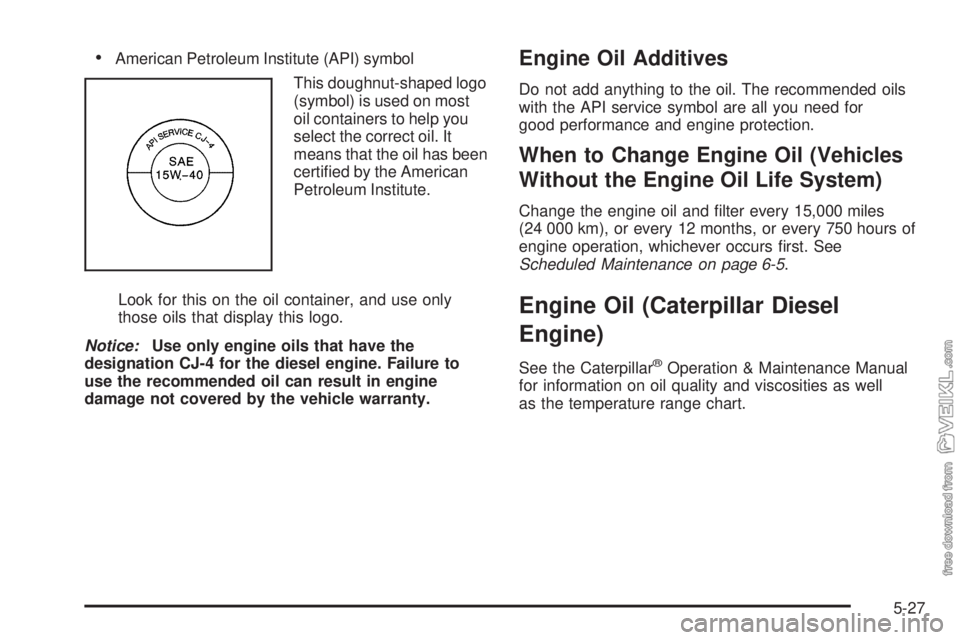
•American Petroleum Institute (API) symbol
This doughnut-shaped logo
(symbol) is used on most
oil containers to help you
select the correct oil. It
means that the oil has been
certified by the American
Petroleum Institute.
Look for this on the oil container, and use only
those oils that display this logo.
Notice:Use only engine oils that have the
designation CJ-4 for the diesel engine. Failure to
use the recommended oil can result in engine
damage not covered by the vehicle warranty.Engine Oil Additives
Do not add anything to the oil. The recommended oils
with the API service symbol are all you need for
good performance and engine protection.
When to Change Engine Oil (Vehicles
Without the Engine Oil Life System)
Change the engine oil and filter every 15,000 miles
(24 000 km), or every 12 months, or every 750 hours of
engine operation, whichever occurs first. See
Scheduled Maintenance on page 6-5.
Engine Oil (Caterpillar Diesel
Engine)
See the Caterpillar®Operation & Maintenance Manual
for information on oil quality and viscosities as well
as the temperature range chart.
5-27
Page 233 of 376
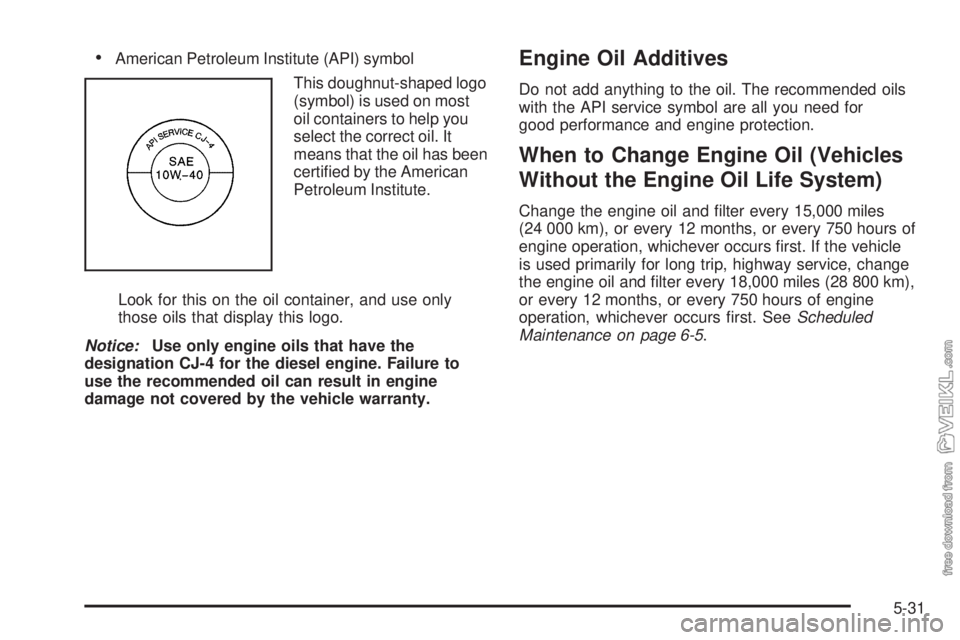
•American Petroleum Institute (API) symbol
This doughnut-shaped logo
(symbol) is used on most
oil containers to help you
select the correct oil. It
means that the oil has been
certified by the American
Petroleum Institute.
Look for this on the oil container, and use only
those oils that display this logo.
Notice:Use only engine oils that have the
designation CJ-4 for the diesel engine. Failure to
use the recommended oil can result in engine
damage not covered by the vehicle warranty.Engine Oil Additives
Do not add anything to the oil. The recommended oils
with the API service symbol are all you need for
good performance and engine protection.
When to Change Engine Oil (Vehicles
Without the Engine Oil Life System)
Change the engine oil and filter every 15,000 miles
(24 000 km), or every 12 months, or every 750 hours of
engine operation, whichever occurs first. If the vehicle
is used primarily for long trip, highway service, change
the engine oil and filter every 18,000 miles (28 800 km),
or every 12 months, or every 750 hours of engine
operation, whichever occurs first. SeeScheduled
Maintenance on page 6-5.
5-31
Page 244 of 376
Automatic Transmission Fluid
When to Check
A good time to check your automatic transmission fluid
level is when the engine oil is checked. See your
Allison Automatic Transmission Operator’s Manual to
find out when to change your transmission fluid
and filters.
How to Check and What to Use
The Allison Automatic Transmission Operator’s Manual
that came with the vehicle shows how to check the
automatic transmission fluid and what fluid to use.
Automatic Transmission External Filter
Your automatic transmission filter requires periodic
replacement.
Consult the Allison Automatic Transmission Operator’s
Manual that came with the vehicle for proper change
intervals.
Manual Transmission Fluid
When to Check
A good time to have it checked is when the engine oil is
checked. Refer to the Maintenance Schedule to find out
when to check and change your manual transmission
fluid. SeeScheduled Maintenance on page 6-5.
How to Check and What to Use
Check the fluid level only when your engine is off, the
vehicle is parked on a level place, and the transmission
is cool enough for you to rest your fingers on the
transmission case.
To check the transmission fluid level, do the following:
1. Remove the filler plug.
2. Check to be sure that the lubricant level is up
to the bottom of the fill opening. On heavy duty
transmissions, an inch of oil level equals about
one gallon of fluid.
3. If the fluid level is good, reinstall the plug and be
sure it is fully seated. If the fluid level is low, add
more fluid as described in the next steps. Refer to
the Maintenance Schedule to determine what
kind of fluid to use. SeePart C: Recommended
Fluids and Lubricants on page 6-31.
5-42
Page 245 of 376
How to Add Fluid
To add transmission fluid, do the following:
1. Remove the filler plug.
2. Add fluid at the filler plug hole. Add only enough
fluid to bring the fluid level up to the bottom of the
fill opening. Refer to the Maintenance Schedule
to determine the proper fluid to use. SeePart
C: Recommended Fluids and Lubricants on
page 6-31.
3. Reinstall the filler plug. Be sure the plug is fully
seated.
Cooling System
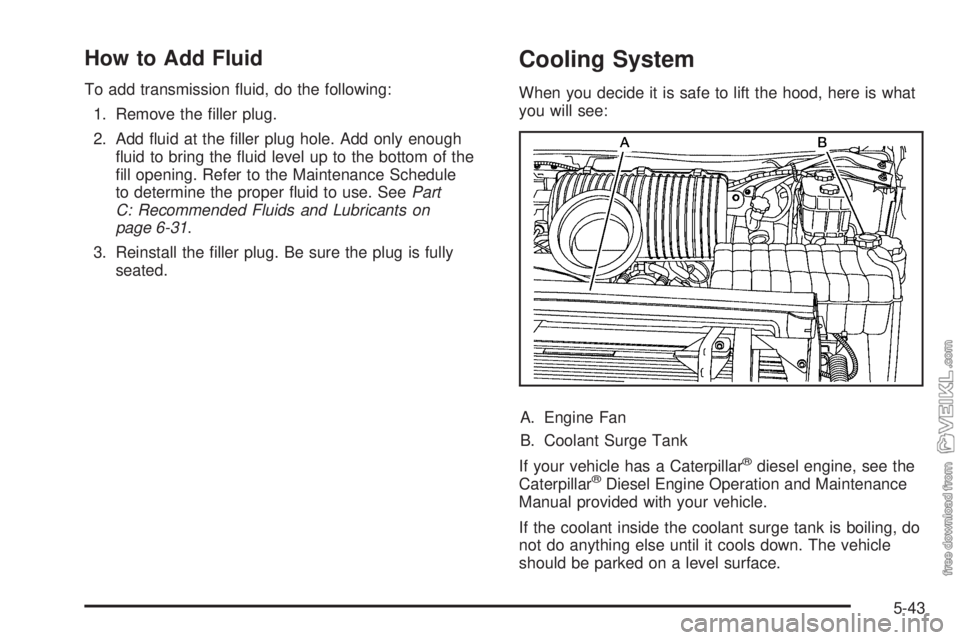
When you decide it is safe to lift the hood, here is what
you will see:
A. Engine Fan
B. Coolant Surge Tank
If your vehicle has a Caterpillar
®diesel engine, see the
Caterpillar®Diesel Engine Operation and Maintenance
Manual provided with your vehicle.
If the coolant inside the coolant surge tank is boiling, do
not do anything else until it cools down. The vehicle
should be parked on a level surface.
5-43
Page 249 of 376
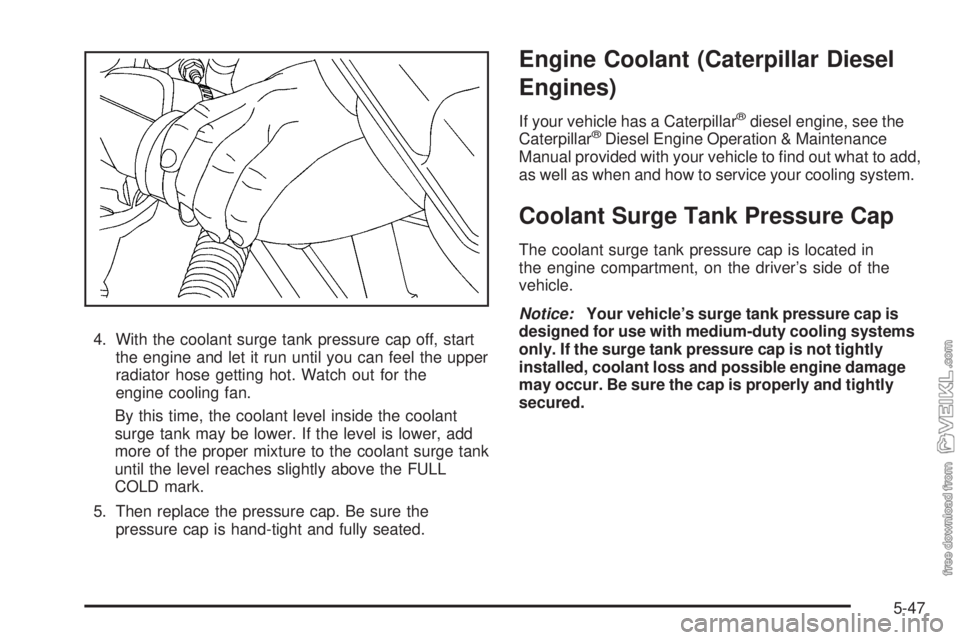
4. With the coolant surge tank pressure cap off, start
the engine and let it run until you can feel the upper
radiator hose getting hot. Watch out for the
engine cooling fan.
By this time, the coolant level inside the coolant
surge tank may be lower. If the level is lower, add
more of the proper mixture to the coolant surge tank
until the level reaches slightly above the FULL
COLD mark.
5. Then replace the pressure cap. Be sure the
pressure cap is hand-tight and fully seated.
Engine Coolant (Caterpillar Diesel
Engines)
If your vehicle has a Caterpillar®diesel engine, see the
Caterpillar®Diesel Engine Operation & Maintenance
Manual provided with your vehicle to find out what to add,
as well as when and how to service your cooling system.
Coolant Surge Tank Pressure Cap
The coolant surge tank pressure cap is located in
the engine compartment, on the driver’s side of the
vehicle.
Notice:Your vehicle’s surge tank pressure cap is
designed for use with medium-duty cooling systems
only. If the surge tank pressure cap is not tightly
installed, coolant loss and possible engine damage
may occur. Be sure the cap is properly and tightly
secured.
5-47
Page 251 of 376
If you get the overheat warning with no sign of steam,
try this for a minute or so:
1. In heavy traffic, let the engine idle in N (Neutral)
while stopped. If it is safe to do so, pull off the
road, shift to P (Park) or N (Neutral) and let
the engine idle.
2. Turn on your heater to full hot at the highest fan
speed and open the windows as necessary.
3. If climbing a hill, downshift to raise engine and fan
speeds.
If you no longer have the overheat warning, you can
drive. Just to be safe, drive slower for about 10 minutes.
If the warning does not come back on, you can drive
normally.
If the warning continues and you have not stopped, pull
over, stop, and park your vehicle right away.
If there is still no sign of steam, you can push down the
accelerator until the engine speed is about twice as
fast as normal idle speed for at least three minutes while
you are parked. If you still have the warning, turn off
the engine and get everyone out of the vehicle until it
cools down.
You may decide not to lift the hood but to get service
help right away.Engine Fan Noise
Your vehicle has a clutched engine cooling fan. When
the clutch is engaged, the fan spins faster to provide
more air to cool the engine. In most everyday driving
conditions, the clutch is not fully engaged. This improves
fuel economy and reduces fan noise. Under heavy
vehicle loading, trailer towing and/or high outside
temperatures, the fan speed increases when the clutch
engages. So you may hear an increase in fan noise.
This is normal and should not be mistaken as the
transmission slipping or making extra shifts. It is merely
the cooling system functioning properly. The fan will
slow down when additional cooling is not required and
the clutch disengages.
You may also hear this fan noise when you start the
engine. It will go away as the fan clutch disengages.
Power Steering Fluid
SeeScheduled Maintenance on page 6-5to determine
when to check your power steering fluid.
5-49
Page 254 of 376
Brakes
Brake Fluid
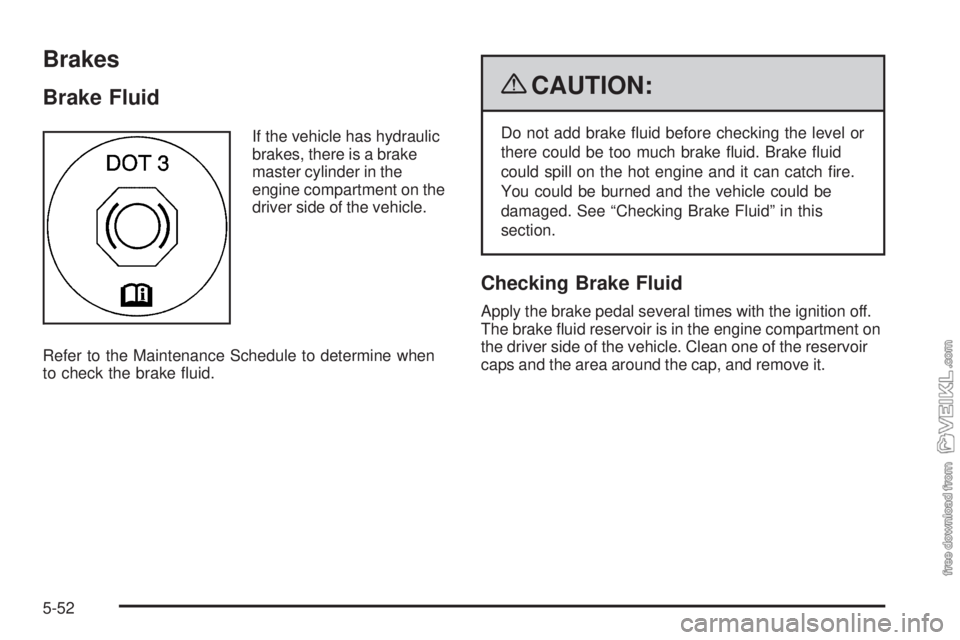
If the vehicle has hydraulic
brakes, there is a brake
master cylinder in the
engine compartment on the
driver side of the vehicle.
Refer to the Maintenance Schedule to determine when
to check the brake fluid.
{CAUTION:
Do not add brake fluid before checking the level or
there could be too much brake fluid. Brake fluid
could spill on the hot engine and it can catch fire.
You could be burned and the vehicle could be
damaged. See “Checking Brake Fluid” in this
section.
Checking Brake Fluid
Apply the brake pedal several times with the ignition off.
The brake fluid reservoir is in the engine compartment on
the driver side of the vehicle. Clean one of the reservoir
caps and the area around the cap, and remove it.
5-52
Page 255 of 376
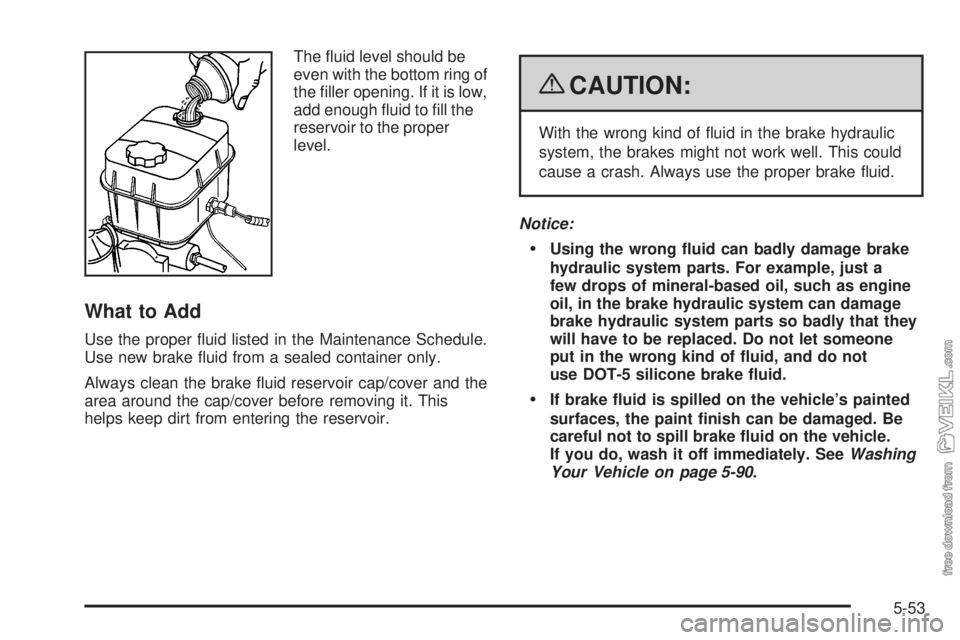
The fluid level should be
even with the bottom ring of
the filler opening. If it is low,
add enough fluid to fill the
reservoir to the proper
level.
What to Add
Use the proper fluid listed in the Maintenance Schedule.
Use new brake fluid from a sealed container only.
Always clean the brake fluid reservoir cap/cover and the
area around the cap/cover before removing it. This
helps keep dirt from entering the reservoir.
{CAUTION:
With the wrong kind of fluid in the brake hydraulic
system, the brakes might not work well. This could
cause a crash. Always use the proper brake fluid.
Notice:
•Using the wrong fluid can badly damage brake
hydraulic system parts. For example, just a
few drops of mineral-based oil, such as engine
oil, in the brake hydraulic system can damage
brake hydraulic system parts so badly that they
will have to be replaced. Do not let someone
put in the wrong kind of fluid, and do not
use DOT-5 silicone brake fluid.
•If brake fluid is spilled on the vehicle’s painted
surfaces, the paint finish can be damaged. Be
careful not to spill brake fluid on the vehicle.
If you do, wash it off immediately. SeeWashing
Your Vehicle on page 5-90.
5-53