maintenance CHEVROLET KODIAK 2009 Service Manual
[x] Cancel search | Manufacturer: CHEVROLET, Model Year: 2009, Model line: KODIAK, Model: CHEVROLET KODIAK 2009Pages: 376, PDF Size: 5.39 MB
Page 280 of 376
Wheel Loading
Wheels are stamped with a maximum load and cold
inflation rating. Be sure you do not exceed these limits.
Dual Tire Operation
When the vehicle is new, check the wheel nut tightness
on all wheels with a torque wrench after your first
100 miles (160 km) and then 1,000 miles (1 600 km) after
that. Whenever a wheel, wheel bolt or wheel nut is
removed or serviced, repeat the 100 miles (160 km), and
then 1,000 mile (1 600 km) wheel nut tightness check.
SeeTightening the Wheel Nuts on page 5-80for wheel
nut tightening information and proper torque values.
{CAUTION:
If you operate your vehicle with a tire that is badly
underinflated, the tire can overheat. An overheated
tire can lose air suddenly or catch fire. You or
others could be injured. Be sure all tires (including
the spare, if any) are properly inflated.
SeeTires on page 5-76andInflation - Tire Pressure on
page 5-77for more information on proper tire inflation.
When It Is Time for New Tires
Various factors, such as maintenance, temperatures,
driving speeds, vehicle loading, and road conditions,
influence when you need new tires.
Replace your tires when the tread depth is down to
1/8 of an inch (3.2 mm) for the front tires, or 1/16 of an
inch (1.6 mm) for a rear tire. Also, you need a new
tire if:
•You can see cord or fabric showing through the
tire’s rubber.
•The tread or sidewall is cracked, cut, or snagged
deep enough to show cord or fabric.
•The tire has a bump, bulge, or split.
•The tire has a puncture, cut, or other damage that
cannot be repaired well because of the size or
location of the damage.
The rubber in tires degrades over time, even if they are
not being used. This is also true for the spare tire, if your
vehicle has one. Multiple conditions affect how fast this
aging takes place, including temperatures, loading
conditions, and inflation pressure maintenance. With
proper care and maintenance tires will typically wear out
before they degrade due to age. If you are unsure about
the need to replace your tires as they get older, consult
the tire manufacturer for more information.
5-78
Page 285 of 376
{CAUTION:
If wheel studs are damaged, they can break. If all
the studs on a wheel broke, the wheel could come
off and cause a crash. If any stud is damaged
because of a loose-running wheel, it could be that
all of the studs are damaged. To be sure, replace
all studs on the wheel. If the stud holes in a wheel
have become larger, the wheel could collapse in
operation. Replace any wheel if its stud holes
have become larger or distorted in any way.
Inspect hubs and hub-piloted wheels for damage.
Because of loose running wheels, piloting pad
damage may occur and require replacement of the
entire hub, for proper centering of the wheels.
When replacing studs, hubs, wheel nuts or
wheels, be sure to use GM original equipment
parts.
{CAUTION:
Rust or dirt on a wheel, or on the parts to
which it is fastened, can make wheel nuts
become loose after a time. The wheel could
come off and cause a crash. When you
change a wheel, remove any rust or dirt from
places where the wheel attaches to the
vehicle. In an emergency, you can use a
cloth or a paper towel to do this; but be sure
to use a scraper or wire brush later, if you
need to, to get all the rust or dirt off.
How Often to Check
Wheel tightness is so important you should have a
technician check nut tightness on all wheels with
a torque wrench after your first 100 miles (160 km), and
then 1,000 miles (1 600 km) after that. Be sure to
repeat this service whenever you have a tire removed
or serviced. SeeScheduled Maintenance on page 6-5
for further information.
5-83
Page 295 of 376
Sheet Metal Damage
If the vehicle is damaged and requires sheet metal
repair or replacement, make sure the body repair shop
applies anti-corrosion material to parts repaired or
replaced to restore corrosion protection.
Original manufacturer replacement parts will provide the
corrosion protection while maintaining the vehicle
warranty.
Finish Damage
Any stone chips, fractures or deep scratches in the
finish should be repaired right away. Bare metal
will corrode quickly and may develop into major repair
expense.
Minor chips and scratches can be repaired with touch-up
materials available from your dealer/retailer. Larger
areas of finish damage can be corrected in your
dealer’s/retailer’s body and paint shop.
Underbody Maintenance
Chemicals used for ice and snow removal and dust
control can collect on the underbody. If these are not
removed, corrosion and rust can develop on the
underbody parts such as fuel lines, frame, floor pan,
and exhaust system even though they have corrosion
protection.
At least every spring, flush these materials from the
underbody with plain water. Clean any areas where mud
and debris can collect. Dirt packed in close areas of
the frame should be loosened before being flushed.
Your dealer/retailer or an underbody car washing system
can do this.
Chemical Paint Spotting
Some weather and atmospheric conditions can create a
chemical fallout. Airborne pollutants can fall upon and
attack painted surfaces on the vehicle. This damage can
take two forms: blotchy, ring-shaped discolorations, and
small, irregular dark spots etched into the paint surface.
Although no defect in the paint job causes this, we will
repair, at no charge to the owner, the surfaces of
new vehicles damaged by this fallout condition within
12 months or 12,000 miles (20 000 km) of purchase,
whichever occurs first.
5-93
Page 308 of 376
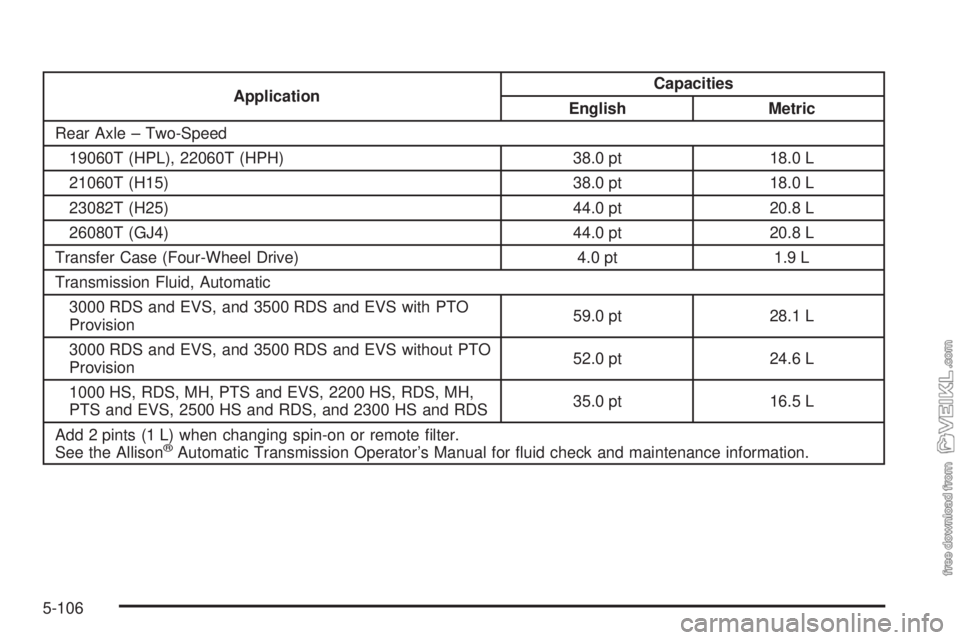
ApplicationCapacities
English Metric
Rear Axle – Two-Speed
19060T (HPL), 22060T (HPH) 38.0 pt 18.0 L
21060T (H15) 38.0 pt 18.0 L
23082T (H25) 44.0 pt 20.8 L
26080T (GJ4) 44.0 pt 20.8 L
Transfer Case (Four-Wheel Drive) 4.0 pt 1.9 L
Transmission Fluid, Automatic
3000 RDS and EVS, and 3500 RDS and EVS with PTO
Provision59.0 pt 28.1 L
3000 RDS and EVS, and 3500 RDS and EVS without PTO
Provision52.0 pt 24.6 L
1000 HS, RDS, MH, PTS and EVS, 2200 HS, RDS, MH,
PTS and EVS, 2500 HS and RDS, and 2300 HS and RDS35.0 pt 16.5 L
Add 2 pints (1 L) when changing spin-on or remote filter.
See the Allison
®Automatic Transmission Operator’s Manual for fluid check and maintenance information.
5-106
Page 310 of 376
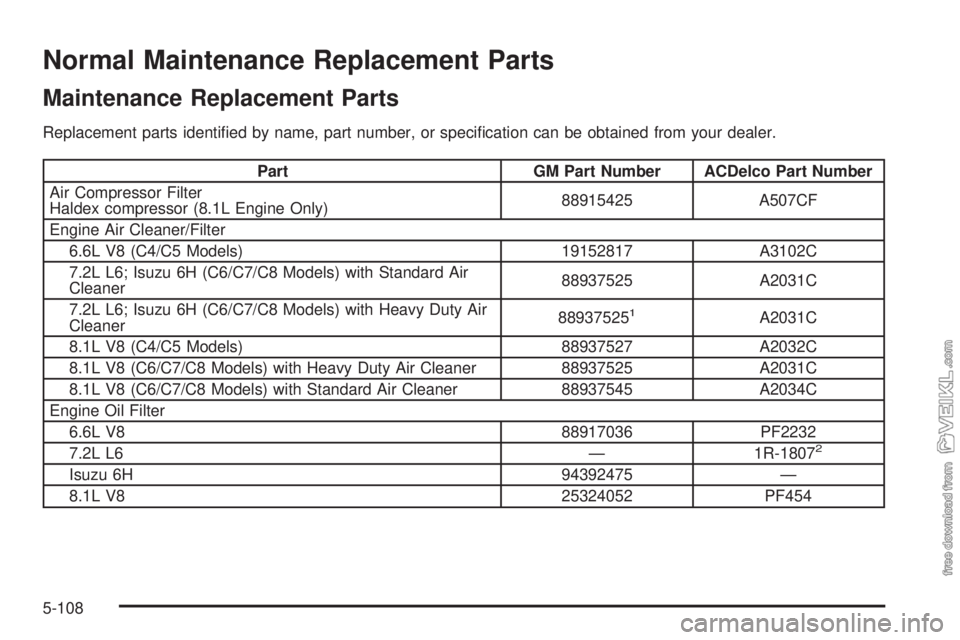
Normal Maintenance Replacement Parts
Maintenance Replacement Parts
Replacement parts identified by name, part number, or specification can be obtained from your dealer.
Part GM Part Number ACDelco Part Number
Air Compressor Filter
Haldex compressor (8.1L Engine Only)88915425 A507CF
Engine Air Cleaner/Filter
6.6L V8 (C4/C5 Models) 19152817 A3102C
7.2L L6; Isuzu 6H (C6/C7/C8 Models) with Standard Air
Cleaner88937525 A2031C
7.2L L6; Isuzu 6H (C6/C7/C8 Models) with Heavy Duty Air
Cleaner88937525
1A2031C
8.1L V8 (C4/C5 Models) 88937527 A2032C
8.1L V8 (C6/C7/C8 Models) with Heavy Duty Air Cleaner 88937525 A2031C
8.1L V8 (C6/C7/C8 Models) with Standard Air Cleaner 88937545 A2034C
Engine Oil Filter
6.6L V8 88917036 PF2232
7.2L L6 — 1R-1807
2
Isuzu 6H 94392475 —
8.1L V8 25324052 PF454
5-108
Page 315 of 376
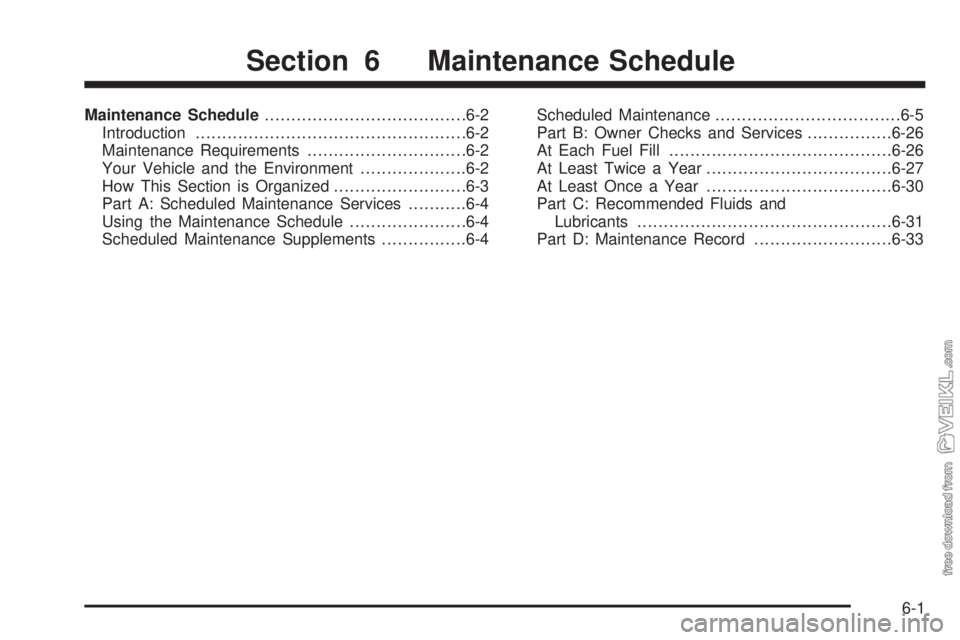
Maintenance Schedule......................................6-2
Introduction...................................................6-2
Maintenance Requirements..............................6-2
Your Vehicle and the Environment....................6-2
How This Section is Organized.........................6-3
Part A: Scheduled Maintenance Services...........6-4
Using the Maintenance Schedule......................6-4
Scheduled Maintenance Supplements................6-4Scheduled Maintenance...................................6-5
Part B: Owner Checks and Services................6-26
At Each Fuel Fill..........................................6-26
At Least Twice a Year...................................6-27
At Least Once a Year...................................6-30
Part C: Recommended Fluids and
Lubricants................................................6-31
Part D: Maintenance Record..........................6-33
Section 6 Maintenance Schedule
6-1
Page 316 of 376
Maintenance Schedule
Introduction
Important: Keep engine oil at the proper level and
change as recommended.
Have you purchased the GM Protection Plan? The Plan
supplements the vehicle warranties. See the Warranty
and Owner Assistance booklet or your dealer/retailer for
details.
Maintenance Requirements
Maintenance intervals, checks, inspections and
recommended fluids and lubricants as prescribed in this
manual are necessary to keep this vehicle in good
working condition. Any damage caused by failure to
follow scheduled maintenance may not be covered by
the vehicle warranty.
Your Vehicle and the Environment
Proper vehicle maintenance not only helps to keep
the vehicle in good working condition, but also helps the
environment. Improper vehicle maintenance can even
affect the quality of the air we breathe. Improper
fluid levels or the wrong tire inflation can increase the
level of emissions from the vehicle. To help protect
the environment, and to keep the vehicle in good
condition, be sure to maintain the vehicle properly.
6-2
Page 317 of 376
How This Section is Organized
This maintenance schedule is divided into four parts:
“Part A: Scheduled Maintenance Services”explains
what to have done and how often. Some of these
services can be complex, so unless you are technically
qualified and have the necessary equipment, let
your dealer/retailer do these jobs.
Your dealer/retailer has trained and supported service
people that will perform the work using genuine parts.
{CAUTION:
Performing maintenance work on a vehicle can be
dangerous. In trying to do some jobs, you can be
seriously injured. Do your own maintenance work
only if you have the required know-how and the
proper tools and equipment for the job. If you have
any doubt, have a qualified technician do the work.
SeeDoing Your Own Service Work on page 5-5.To purchase service information, seeService
Publications Ordering Information on page 7-10.
“Part B: Owner Checks and Services”tells what
should be checked and when. It also explains what can
easily be done to keep the vehicle in good condition.
“Part C: Recommended Fluids and Lubricants”lists
some recommended products necessary to help
keep the vehicle properly maintained. These products,
or their equivalents, should be used whether you do the
work yourself or have it done.
“Part D: Maintenance Record”is a place to record
and keep track of the maintenance performed on
the vehicle. Keep the maintenance receipts. They may
be needed to qualify the vehicle for warranty repairs.
6-3
Page 318 of 376
Part A: Scheduled Maintenance
Services
In this part are scheduled maintenance services which
are to be performed at the mileage intervals specified.
Using the Maintenance Schedule
We want to help keep this vehicle in good working
condition. But we do not know exactly how you will drive
it. You might drive very short distances only a few
times a week. Or you might drive long distances all the
time in very hot, dusty weather. You might use the
vehicle in making deliveries or in many other ways.
Because of all the different ways people use their
vehicles, maintenance needs vary. You might need
more frequent checks and replacements. So please read
the following and note how you drive. If you have any
questions on how to keep the vehicle in good condition,
see your dealer/retailer.
This part tells you the maintenance services that should
be done and when to schedule them.
When you go to your dealer/retailer for service, trained
and supported service people will perform the work
using genuine parts.The proper fluids and lubricants to use are listed in
Part C. Make sure whoever services the vehicle uses
these. All parts should be replaced and all necessary
repairs done before you or anyone else drives the
vehicle.
This schedule is for vehicles that:
•carry passengers and cargo within recommended
limits on the vehicle’s Certification or Tire
Information label. SeeLoading the Vehicle on
page 4-20.
•are driven on reasonable road surfaces within legal
driving limits.
•use the recommended fuel. SeeGasoline Octane
on page 5-6for gasoline engine vehicles orWhat
Fuel to Use on page 5-8for diesel engine vehicles.
Scheduled Maintenance
Supplements
If the vehicle has a Caterpillar®diesel engine, the owner
manual is supplemented by the Caterpillar®Diesel
Engine Operation & Maintenance Manual. If the vehicle
has an Allison Transmission
®, the owner manual is
supplemented by an Allison Transmission®Operator’s
Manual. Always refer to these manuals for related
maintenance services.
6-4
Page 319 of 376
Scheduled Maintenance
The services shown in this schedule up to 100,000 miles
(166 000 km) should be repeated after 100,000 miles
(166 000 km) at the same intervals for the life of
this vehicle. The services shown after 100,000 miles
(166 000 km) should be repeated at the same miles (km)
after those intervals for the life of this vehicle.
Gasoline engine vehicles and some DURAMAX
®diesel
and Isuzu diesel engine vehicles have a computer
that lets you know when to change the engine oil. This
is not based on mileage, but on engine operation
and engine temperature. When the computer has
calculated that the oil needs changing, the Engine Oil
Life System will indicate that a change is necessary. See
Engine Oil Life System (Gasoline Engine) on page 5-35
orEngine Oil Life System (DURAMAX/Isuzu Diesel
Engines) on page 5-36orEngine Oil Life System
(Caterpillar Diesel Engine) on page 5-38.
The “Footnotes” at the end of this Maintenance
Schedule further explain maintenance services.
SeeService Publications Ordering Information on
page 7-10.
100 Miles (160 km)
❑Wheel stud nut service.(36)
1,000 Miles (1 600 km)
❑Wheel stud nut service.(36)
❑Rear axle air shift motor service.(10)
7,500 Miles (12 000 km)
❑Gasoline Engine Only: Check engine oil life system.
If engine oil and filter are changed, reset system. See
“Engine Oil (Gasoline Engine)” in the Index.(2) (8)
❑Check fluid levels (or every 3 months, whichever
occurs first).(1) (5)
❑Chassis lubrication service (or every 6 months,
whichever occurs first).(11)
❑Spring-to-axle U-bolts and shackle bolts service.(15)
❑Wheels and tires service.(14)
❑Hydraulic brake service (or every 6 months, whichever
occurs first).(6) (36)
❑Parking brake service (or every 6 months, whichever
occurs first).(21)
❑Air brake service (or every 6 months, whichever
occurs first).(32)
❑Air brake automatic slack adjuster service (or every
500 hours, whichever occurs first).(33)
6-5