maintenance CHEVROLET KODIAK 2009 User Guide
[x] Cancel search | Manufacturer: CHEVROLET, Model Year: 2009, Model line: KODIAK, Model: CHEVROLET KODIAK 2009Pages: 376, PDF Size: 5.39 MB
Page 154 of 376
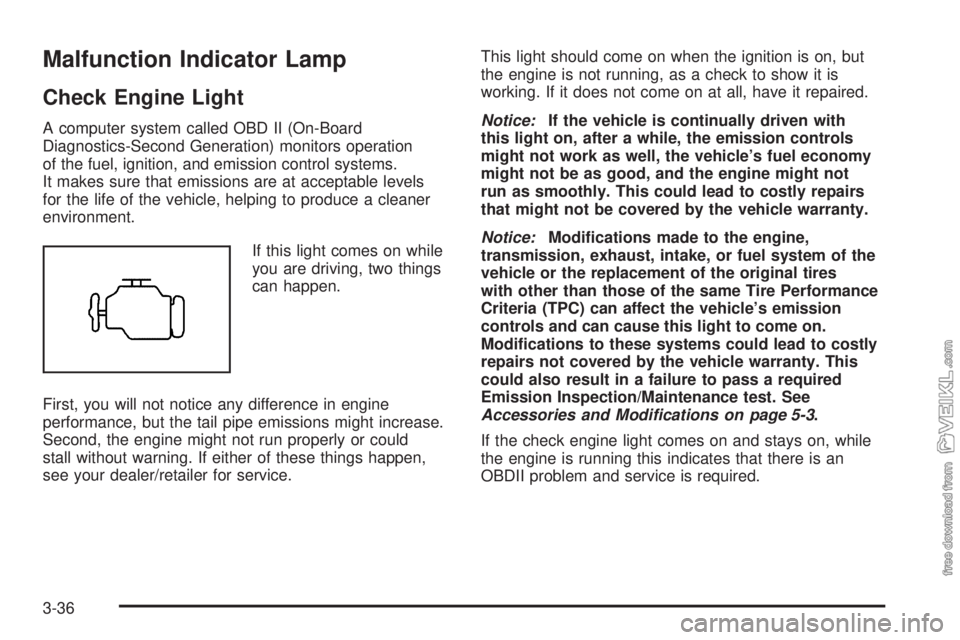
Malfunction Indicator Lamp
Check Engine Light
A computer system called OBD II (On-Board
Diagnostics-Second Generation) monitors operation
of the fuel, ignition, and emission control systems.
It makes sure that emissions are at acceptable levels
for the life of the vehicle, helping to produce a cleaner
environment.
If this light comes on while
you are driving, two things
can happen.
First, you will not notice any difference in engine
performance, but the tail pipe emissions might increase.
Second, the engine might not run properly or could
stall without warning. If either of these things happen,
see your dealer/retailer for service.This light should come on when the ignition is on, but
the engine is not running, as a check to show it is
working. If it does not come on at all, have it repaired.
Notice:If the vehicle is continually driven with
this light on, after a while, the emission controls
might not work as well, the vehicle’s fuel economy
might not be as good, and the engine might not
run as smoothly. This could lead to costly repairs
that might not be covered by the vehicle warranty.
Notice:Modifications made to the engine,
transmission, exhaust, intake, or fuel system of the
vehicle or the replacement of the original tires
with other than those of the same Tire Performance
Criteria (TPC) can affect the vehicle’s emission
controls and can cause this light to come on.
Modifications to these systems could lead to costly
repairs not covered by the vehicle warranty. This
could also result in a failure to pass a required
Emission Inspection/Maintenance test. See
Accessories and Modifications on page 5-3.
If the check engine light comes on and stays on, while
the engine is running this indicates that there is an
OBDII problem and service is required.
3-36
Page 155 of 376
An emission system malfunction might be corrected by
doing the following:
•If the vehicle has been driven through a deep
puddle of water, the vehicle’s electrical system
might be wet. The condition is usually corrected
when the electrical system dries out. A few driving
trips should turn the light off.
•Make sure to fuel the vehicle with quality fuel. Poor
fuel quality causes the engine not to run as efficiently
as designed and may cause: stalling after start-up,
stalling when the vehicle is changed into gear,
misfiring, hesitation on acceleration, or stumbling on
acceleration. These conditions might go away once
the engine is warmed up.
If one or more of these conditions occurs, change the
fuel brand used. It will require at least one full tank of
the proper fuel to turn the light off.
SeeDiesel Engine Fuel on page 5-8.
If none of the above have made the light turn off, your
dealer/retailer can check the vehicle. The dealer/retailer
has the proper test equipment and diagnostic tools to
fix any mechanical or electrical problems that might have
developed.
Emissions Inspection and Maintenance
Programs
Some state/provincial and local governments have or
might begin programs to inspect the emission control
equipment on the vehicle. Failure to pass this inspection
could prevent getting a vehicle registration.
Here are some things to know to help the vehicle pass
an inspection:
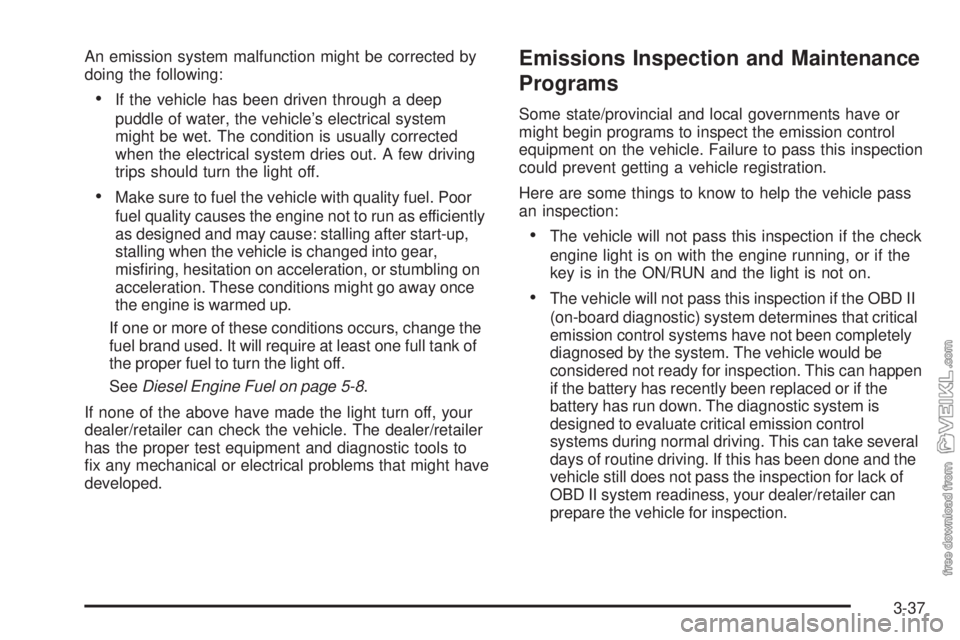
•The vehicle will not pass this inspection if the check
engine light is on with the engine running, or if the
key is in the ON/RUN and the light is not on.
•The vehicle will not pass this inspection if the OBD II
(on-board diagnostic) system determines that critical
emission control systems have not been completely
diagnosed by the system. The vehicle would be
considered not ready for inspection. This can happen
if the battery has recently been replaced or if the
battery has run down. The diagnostic system is
designed to evaluate critical emission control
systems during normal driving. This can take several
days of routine driving. If this has been done and the
vehicle still does not pass the inspection for lack of
OBD II system readiness, your dealer/retailer can
prepare the vehicle for inspection.
3-37
Page 156 of 376
Oil Pressure Gage
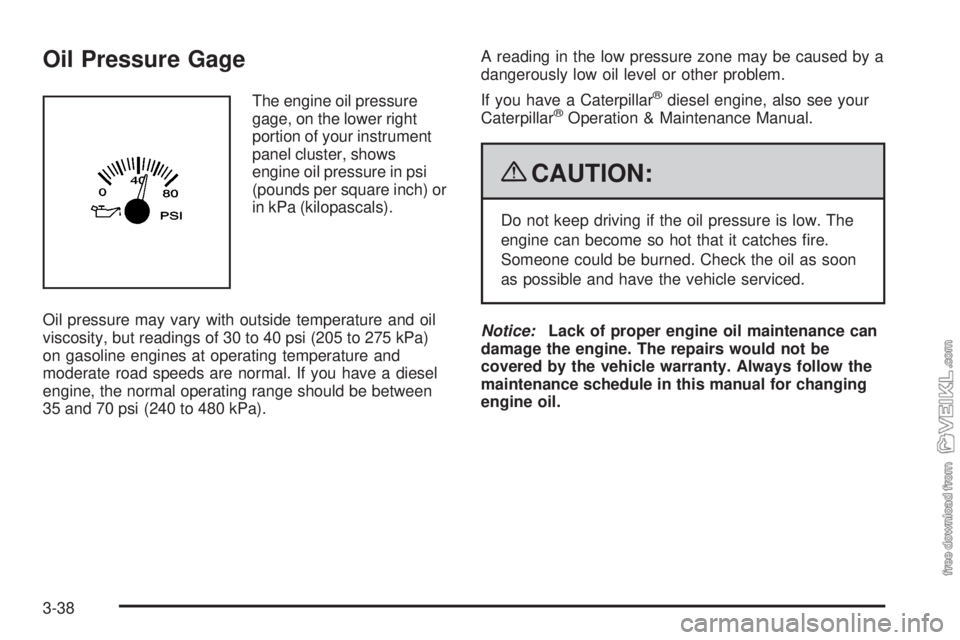
The engine oil pressure
gage, on the lower right
portion of your instrument
panel cluster, shows
engine oil pressure in psi
(pounds per square inch) or
in kPa (kilopascals).
Oil pressure may vary with outside temperature and oil
viscosity, but readings of 30 to 40 psi (205 to 275 kPa)
on gasoline engines at operating temperature and
moderate road speeds are normal. If you have a diesel
engine, the normal operating range should be between
35 and 70 psi (240 to 480 kPa).A reading in the low pressure zone may be caused by a
dangerously low oil level or other problem.
If you have a Caterpillar®diesel engine, also see your
Caterpillar®Operation & Maintenance Manual.
{CAUTION:
Do not keep driving if the oil pressure is low. The
engine can become so hot that it catches fire.
Someone could be burned. Check the oil as soon
as possible and have the vehicle serviced.
Notice:Lack of proper engine oil maintenance can
damage the engine. The repairs would not be
covered by the vehicle warranty. Always follow the
maintenance schedule in this manual for changing
engine oil.
3-38
Page 157 of 376
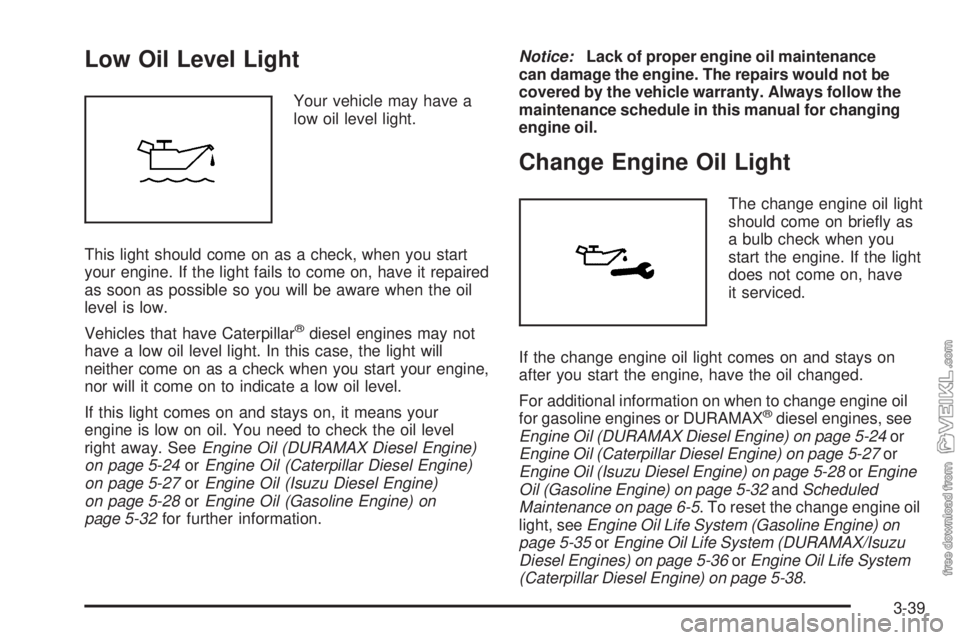
Low Oil Level Light
Your vehicle may have a
low oil level light.
This light should come on as a check, when you start
your engine. If the light fails to come on, have it repaired
as soon as possible so you will be aware when the oil
level is low.
Vehicles that have Caterpillar
®diesel engines may not
have a low oil level light. In this case, the light will
neither come on as a check when you start your engine,
nor will it come on to indicate a low oil level.
If this light comes on and stays on, it means your
engine is low on oil. You need to check the oil level
right away. SeeEngine Oil (DURAMAX Diesel Engine)
on page 5-24orEngine Oil (Caterpillar Diesel Engine)
on page 5-27orEngine Oil (Isuzu Diesel Engine)
on page 5-28orEngine Oil (Gasoline Engine) on
page 5-32for further information.Notice:Lack of proper engine oil maintenance
can damage the engine. The repairs would not be
covered by the vehicle warranty. Always follow the
maintenance schedule in this manual for changing
engine oil.
Change Engine Oil Light
The change engine oil light
should come on briefly as
a bulb check when you
start the engine. If the light
does not come on, have
it serviced.
If the change engine oil light comes on and stays on
after you start the engine, have the oil changed.
For additional information on when to change engine oil
for gasoline engines or DURAMAX
®diesel engines, see
Engine Oil (DURAMAX Diesel Engine) on page 5-24or
Engine Oil (Caterpillar Diesel Engine) on page 5-27or
Engine Oil (Isuzu Diesel Engine) on page 5-28orEngine
Oil (Gasoline Engine) on page 5-32andScheduled
Maintenance on page 6-5. To reset the change engine oil
light, seeEngine Oil Life System (Gasoline Engine) on
page 5-35orEngine Oil Life System (DURAMAX/Isuzu
Diesel Engines) on page 5-36orEngine Oil Life System
(Caterpillar Diesel Engine) on page 5-38.
3-39
Page 162 of 376
Fuel Gage
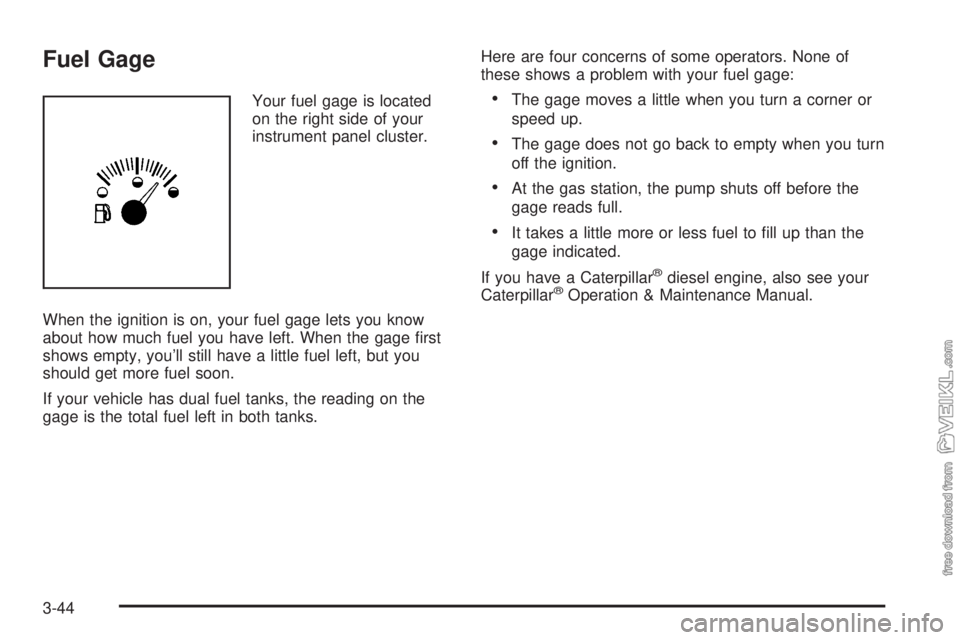
Your fuel gage is located
on the right side of your
instrument panel cluster.
When the ignition is on, your fuel gage lets you know
about how much fuel you have left. When the gage first
shows empty, you’ll still have a little fuel left, but you
should get more fuel soon.
If your vehicle has dual fuel tanks, the reading on the
gage is the total fuel left in both tanks.Here are four concerns of some operators. None of
these shows a problem with your fuel gage:•The gage moves a little when you turn a corner or
speed up.
•The gage does not go back to empty when you turn
off the ignition.
•At the gas station, the pump shuts off before the
gage reads full.
•It takes a little more or less fuel to fill up than the
gage indicated.
If you have a Caterpillar
®diesel engine, also see your
Caterpillar®Operation & Maintenance Manual.
3-44
Page 164 of 376
Diesel Particulate Filter Warning
Light
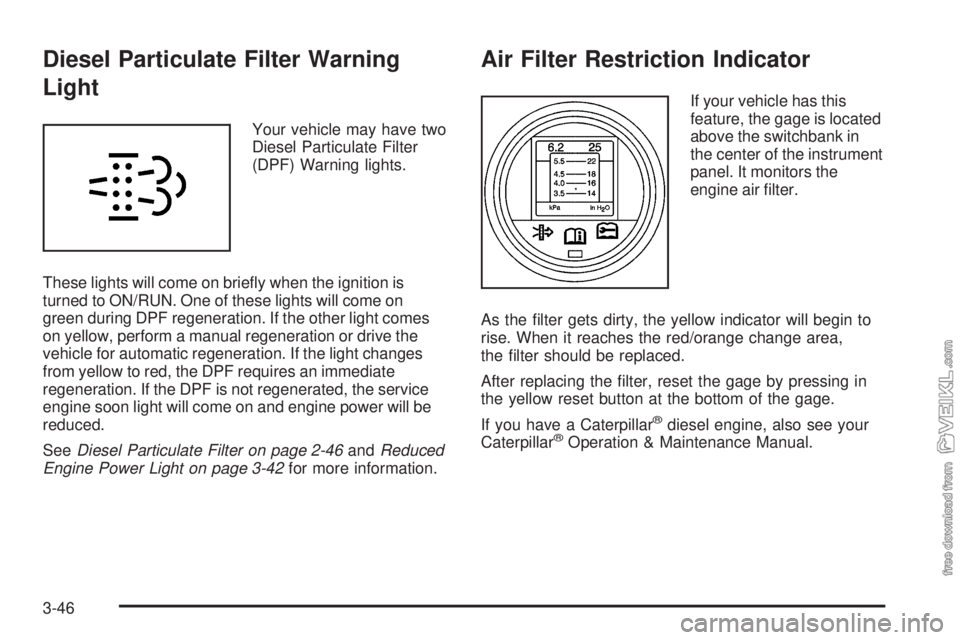
Your vehicle may have two
Diesel Particulate Filter
(DPF) Warning lights.
These lights will come on briefly when the ignition is
turned to ON/RUN. One of these lights will come on
green during DPF regeneration. If the other light comes
on yellow, perform a manual regeneration or drive the
vehicle for automatic regeneration. If the light changes
from yellow to red, the DPF requires an immediate
regeneration. If the DPF is not regenerated, the service
engine soon light will come on and engine power will be
reduced.
SeeDiesel Particulate Filter on page 2-46andReduced
Engine Power Light on page 3-42for more information.
Air Filter Restriction Indicator
If your vehicle has this
feature, the gage is located
above the switchbank in
the center of the instrument
panel. It monitors the
engine air filter.
As the filter gets dirty, the yellow indicator will begin to
rise. When it reaches the red/orange change area,
the filter should be replaced.
After replacing the filter, reset the gage by pressing in
the yellow reset button at the bottom of the gage.
If you have a Caterpillar
®diesel engine, also see your
Caterpillar®Operation & Maintenance Manual.
3-46
Page 178 of 376
Your Driving, the Road, and
the Vehicle
Driving for Better Fuel Economy
Driving habits can affect fuel mileage. Here are some
driving tips to get the best fuel economy possible.
•Avoid fast starts and accelerate smoothly.
•Brake gradually and avoid abrupt stops.
•Avoid idling the engine for long periods of time.
•When road and weather conditions are appropriate,
use cruise control, if equipped.
•Always follow posted speed limits or drive more
slowly when conditions require.
•Keep vehicle tires properly inflated.
•Combine several trips into a single trip.
•Replace the vehicle’s tires with the same TPC Spec
number molded into the tire’s sidewall near the size.
•Follow recommended scheduled maintenance.
Defensive Driving
Defensive driving means “always expect the
unexpected.” The first step in driving defensively is to
wear your safety belt — SeeSafety Belts: They Are for
Everyone on page 1-11.
{CAUTION:
Assume that other road users (pedestrians,
bicyclists, and other drivers) are going to be
careless and make mistakes. Anticipate what they
might do and be ready. In addition:
•Allow enough following distance between you
and the driver in front of you.
•Focus on the task of driving.
Driver distraction can cause collisions resulting in
injury or possible death. These simple defensive
driving techniques could save your life.
4-2
Page 204 of 376
Windshield Wiper Blade Replacement..............5-71
Other Service Items........................................5-72
Fuel Filter....................................................5-72
Primary Fuel Filter and Water Separator..........5-73
Secondary Fuel Filter and Water Separator/
Heater (Caterpillar Diesel)............................5-74
Front Wheel Bearings with
Oil-Filled Hubs..........................................5-75
Tires..............................................................5-76
Inflation - Tire Pressure.................................5-77
Wheel Loading.............................................5-78
Dual Tire Operation.......................................5-78
When It Is Time for New Tires.......................5-78
Buying New Tires.........................................5-79
Wheel Alignment and Tire Balance..................5-80
Tightening the Wheel Nuts.............................5-80
Wheel Replacement......................................5-84
If a Tire Goes Flat........................................5-85
Appearance Care............................................5-87
Interior Cleaning...........................................5-87
Fabric/Carpet...............................................5-88
Instrument Panel, Vinyl, and Other
Plastic Surfaces........................................5-89
Care of Safety Belts......................................5-89
Weatherstrips...............................................5-89
Washing Your Vehicle...................................5-90Cleaning Exterior Lamps/Lenses.....................5-90
Finish Care..................................................5-90
Windshield and Wiper Blades.........................5-91
Aluminum or Chrome-Plated Wheels
and Trim..................................................5-92
Tires...........................................................5-92
Sheet Metal Damage.....................................5-93
Finish Damage.............................................5-93
Underbody Maintenance................................5-93
Chemical Paint Spotting.................................5-93
Vehicle Identification
......................................5-94
Vehicle Identification Number (VIN).................5-94
Service Parts Identification Label.....................5-94
Electrical System............................................5-95
Add-On Electrical Equipment..........................5-95
Headlamp Wiring..........................................5-95
Windshield Wiper Fuses................................5-95
Fusible Links................................................5-95
Power Windows and Other Power Options..........5-96
Fuses and Circuit Breakers............................5-96
Instrument Panel Fuse Block..........................5-96
Underhood Fuse Block..................................5-99
Capacities and Specifications........................5-102
Normal Maintenance Replacement Parts.........5-108
Maintenance Replacement Parts...................5-108
Engine Drive Belt Routing............................5-110
Section 5 Service and Appearance Care
5-2
Page 207 of 376
Doing Your Own Service Work
{CAUTION:
You can be injured and the vehicle could be
damaged if you try to do service work on a vehicle
without knowing enough about it.
•Be sure you have sufficient knowledge,
experience, the proper replacement parts, and
tools before attempting any vehicle
maintenance task.
•Be sure to use the proper nuts, bolts, and
other fasteners. English and metric fasteners
can be easily confused. If the wrong fasteners
are used, parts can later break or fall off. You
could be hurt.If doing some of your own service work, use the proper
service manual. It tells you much more about how to
service the vehicle than this manual can. To order
the proper service manual, seeService Publications
Ordering Information on page 7-10.
This vehicle has an airbag system. Before attempting to
do your own service work, seeServicing Your
Airbag-Equipped Vehicle on page 1-58.
Keep a record with all parts receipts and list the mileage
and the date of any service work performed. SeePart
D: Maintenance Record on page 6-33.
5-5
Page 208 of 376
Engine Fan Breakage
{CAUTION:
Changing the Fan Drive Ratio or Engine Governed
Speed:
If you change the fan drive ratio or increase the
governed speed of the engine, you might increase
stress and the fan could eventually fail. If the fan
breaks apart while rotating, pieces can cause
severe injury to anyone — such as a service
technician — who is nearby. And, of course, the
pieces can severely damage the vehicle. Do not
change the fan drive ratio or increase the
governed speed of the vehicle without getting the
necessary information from your dealer/retailer.
Winter Fronts, Grille Covers, or Obstructions:
Winter Fronts, grille covers, or other add-on
equipment causing obstructions in front of or
behind the fan should not be used on this vehicle.
If this causes the fan to eventually break apart
while rotating, the pieces can cause severe injury
to anyone nearby, such as a service technician
working on the engine, and, of course, the pieces
can severely damage the vehicle.
Fuel
For diesel engine vehicles, seeDiesel Engine Fuel on
page 5-8.
For vehicles with gasoline engines, please read this.
Use of the recommended fuel is an important part of the
proper maintenance of this vehicle. To help keep the
engine clean and maintain optimum vehicle performance,
we recommend the use of gasoline advertised as TOP
TIER Detergent Gasoline.
Gasoline Octane
Use regular unleaded gasoline with a posted octane
rating of 87 or higher. If the octane rating is less than 87,
you might notice an audible knocking noise when you
drive, commonly referred to as spark knock. If this
occurs, use a gasoline rated at 87 octane or higher as
soon as possible. If you are using gasoline rated at
87 octane or higher and you hear heavy knocking, the
engine needs service.
5-6