parking brake CHEVROLET LOW CAB FORWARD 2017 User Guide
[x] Cancel search | Manufacturer: CHEVROLET, Model Year: 2017, Model line: LOW CAB FORWARD, Model: CHEVROLET LOW CAB FORWARD 2017Pages: 414, PDF Size: 7.97 MB
Page 104 of 414
Chevrolet Low Cab Forward Owner Manual (GMNA-Localizing-U.S.-
10716700) - 2017 - crc - 12/6/16
Lighting 103
Lighting
Exterior Lighting
Exterior Lamp Controls . . . . . . . 103
Headlamp High/Low-BeamChanger . . . . . . . . . . . . . . . . . . . . 104
Flash-to-Pass . . . . . . . . . . . . . . . . 104
Hazard Warning Flashers . . . . . 105
Turn and Lane-Change Signals . . . . . . . . . . . . . . . . . . . . . . 105
Cornering Lamps . . . . . . . . . . . . . 106
Interior Lighting
Instrument Panel Illumination Control . . . . . . . . . . . . . . . . . . . . . . 106
Cargo Lamp . . . . . . . . . . . . . . . . . . 107
Dome Lamps . . . . . . . . . . . . . . . . . 107
Exterior Lighting
Exterior Lamp Controls
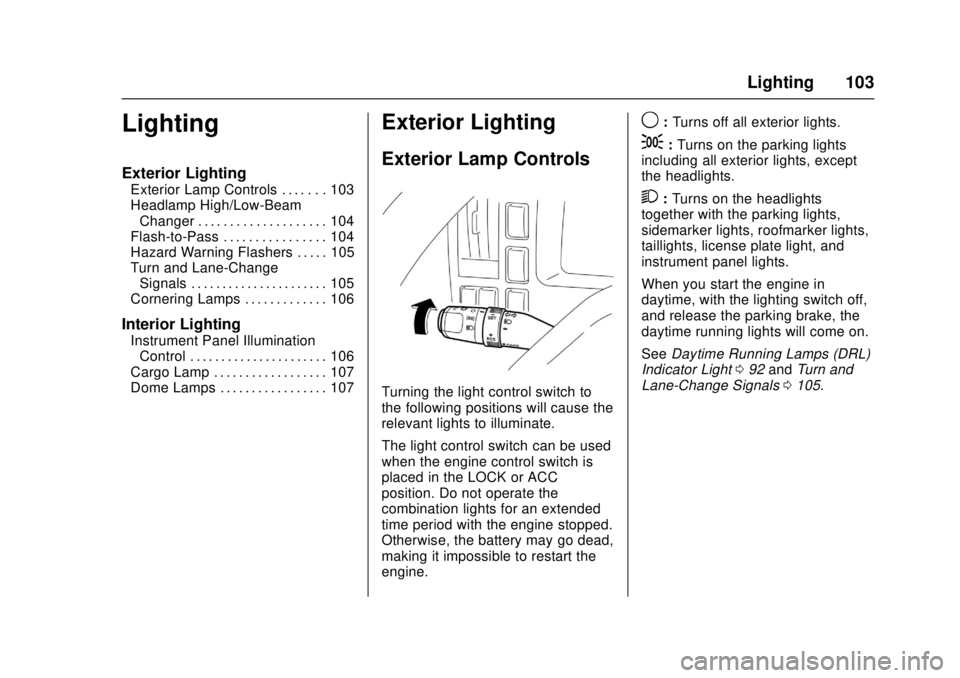
Turning the light control switch to
the following positions will cause the
relevant lights to illuminate.
The light control switch can be used
when the engine control switch is
placed in the LOCK or ACC
position. Do not operate the
combination lights for an extended
time period with the engine stopped.
Otherwise, the battery may go dead,
making it impossible to restart the
engine.
9: Turns off all exterior lights.
;:Turns on the parking lights
including all exterior lights, except
the headlights.
2: Turns on the headlights
together with the parking lights,
sidemarker lights, roofmarker lights,
taillights, license plate light, and
instrument panel lights.
When you start the engine in
daytime, with the lighting switch off,
and release the parking brake, the
daytime running lights will come on.
See Daytime Running Lamps (DRL)
Indicator Light 092 and Turn and
Lane-Change Signals 0105.
Page 133 of 414
Chevrolet Low Cab Forward Owner Manual (GMNA-Localizing-U.S.-
10716700) - 2017 - crc - 12/6/16
132 Driving and Operating
Driving and
Operating
Driving Information
Driver Behavior . . . . . . . . . . . . . . . 133
Distracted Driving . . . . . . . . . . . . 133
Control of a Vehicle . . . . . . . . . . . 133
Braking . . . . . . . . . . . . . . . . . . . . . . . 137
Steering . . . . . . . . . . . . . . . . . . . . . . 143
Driving on Wet Roads . . . . . . . . 143
Hill and Mountain Roads . . . . . 144
Winter Driving . . . . . . . . . . . . . . . . 145
If the Vehicle Is Stuck . . . . . . . . 148
Emergencies(Troubleshooting) . . . . . . . . . . . 148
Emergencies (Disabled Vehicle) . . . . . . . . . . . . . . . . . . . . . 161
Starting and Operating
New Vehicle Break-In . . . . . . . . . 162
Pedals . . . . . . . . . . . . . . . . . . . . . . . . 163
Ignition Positions . . . . . . . . . . . . . 163
Starting and Stopping theVehicle (Gasoline Only) . . . . . 165
Starting and Stopping the Vehicle (Diesel Only) . . . . . . . . 168
Operating Temperature . . . . . . . 172
Winter Cover . . . . . . . . . . . . . . . . . 172
Engine Heater . . . . . . . . . . . . . . . . 173 Engine Alarm and Automatic
Shutdown (Diesel Only) . . . . . 174
Idle Shutdown . . . . . . . . . . . . . . . . 174
High Idle System . . . . . . . . . . . . . 174
Engine Checks Before Operating . . . . . . . . . . . . . . . . . . . 175
Parking over Things That Burn . . . . . . . . . . . . . . . . . . . 176
Engine Exhaust
Engine Exhaust . . . . . . . . . . . . . . 178
Running the Vehicle WhileParked . . . . . . . . . . . . . . . . . . . . . . 179
Diesel Particulate Filter
Diesel Particulate Filter . . . . . . . 180
Diesel Exhaust Fluid
Diesel Exhaust Fluid . . . . . . . . . . 189
Automatic Transmission
Automatic Transmission . . . . . . 204
Selector Lever . . . . . . . . . . . . . . . . 214
Overdrive Off . . . . . . . . . . . . . . . . . 215
Brakes
Antilock BrakeSystem (ABS) . . . . . . . . . . . . . . . 217
Parking Brake . . . . . . . . . . . . . . . . 221
Exhaust Brake (Diesel Only) . . . . . . . . . . . . . . . . 222
Cruise Control
Cruise Control (Diesel) . . . . . . . 224
Cruise Control (Gas) . . . . . . . . . 227
Driver Assistance Systems
Speed Limiter (GasolineVehicle) . . . . . . . . . . . . . . . . . . . . . 231
Fuel
Fuel (Gasoline) . . . . . . . . . . . . . . . 231
Fuels in Foreign Countries . . . 232
Fuel for Diesel Engines . . . . . . . 232
Biodiesel . . . . . . . . . . . . . . . . . . . . . 233
Cold Weather Operation(Diesel) . . . . . . . . . . . . . . . . . . . . . 235
Water in Fuel (Diesel) . . . . . . . . 236
Running Out of Fuel (Diesel) . . . . . . . . . . . . . . . . . . . . . 238
Filling the Tank . . . . . . . . . . . . . . . 240
Conversions and Add-Ons
Add-On Electrical Equipment . . . . . . . . . . . . . . . . . . 241
Power Take-Off (PTO) . . . . . . . . 242
Page 135 of 414
Chevrolet Low Cab Forward Owner Manual (GMNA-Localizing-U.S.-
10716700) - 2017 - crc - 12/6/16
134 Driving and Operating
Warning (Continued)
If a warning light comes on or a
buzzer sounds while you are
driving, immediately stop the
vehicle in a safe place and
perform checks.
Slow down sufficiently when
approaching a curve. Applying the
brakes or sharply turning the
steering wheel while turning the
curve could cause the cargo to
shift, the tires to slip and the
vehicle to tip onto its side.
Avoid scraping the tire sidewalls
against curbstones or driving over
dips and protrusions in the road
surface. You could damage the
tires, resulting in a blowout or
flat tire.
You and others could be seriously
injured.
Pulling Away After Stopping
and Parking
Before pulling away, check that
there are no children or obstructions
around the vehicle and confirm that
it is safe to pull away.
If you cannot see the area behind
your vehicle well enough to confirm
it is safe to back up, get out of the
vehicle and check behind it.
Make it a habit to look around and
confirm that it is safe to pull away
after a temporary stop (at traffic
lights, for example).
If the Windshield Fogs Up
Use the heater to blow hot air on the
windshield or dehumidify the cabin
using the air conditioner and place
the outlet selector knob in the
5or
4position.
Place the air selector lever in the
outside air position.
Nighttime Visibility
If there is an old film on the
windshield, the lights of oncoming
traffic will be reflected in many directions, making it hard for you to
see ahead. Use glass cleaner to
clean the glass and the wiper
blades.
Worn wiper blades cannot wipe the
windshield clean and thus cannot
maintain visibility. When the wiper
blades become worn, replace them
with new ones.
Do Not Attach Accessories to
the Windshield or Windows
{Warning
Do not attach ornaments, films or
other accessories to the
windshield or windows. They
would impair visibility. Also, any
plastic suction cups used to
attach accessories could cause a
fire or other accident by acting as
lenses.
You and others could be seriously
injured.
Page 139 of 414

Chevrolet Low Cab Forward Owner Manual (GMNA-Localizing-U.S.-
10716700) - 2017 - crc - 12/6/16
138 Driving and Operating
Stopping Distance
The stopping distance of a vehicle
involves reaction time and braking
distance. Deciding to push the
brake pedal is reaction time.
Applying the brake pedal until the
vehicle comes to a complete stop is
braking distance. Average reaction
time is about three-fourths of a
second. But that is only an average.
It might be less with one driver and
as long as two or three seconds or
more with another. Age, physical
condition, alertness, coordination
and eyesight all play a part. Braking
distance will vary based reaction
time, the amount of force applied to
the brake pedal and the speed of
the vehicle.When driving, bear the stopping
distance in mind. Maintain a speed
and headway distance that allow
you to stop safely even if a hazard
occurs.
Overriding Accelerator with
Brakes (Gasoline Only)
In the unlikely event the accelerator
pedal becomes stuck, apply the
brakes firmly and steadily to reduce
engine power and bring your vehicle
to a safe stop. Turn the engine off,
move the selector lever to the
“P”
(Park) position, and apply the
parking brake. In a safe location,
inspect the accelerator pedal for any
interference and remove the item
causing the interference, if any is
found. If none is found and the
condition persists, have your vehicle
towed.
Braking Techniques
For the most effective braking and
for maximum life from brake system
components, follow these
suggestions when possible: .
Apply the brakes gradually as
road and load conditions permit.
Reduce pedal pressure as
speed drops so that a very light
pressure is used at the end of
the stop.
. Do not pump the brake pedal as
this will only deplete the vacuum
reserve or the hydraulic brake
booster (HBB) accumulator
reserve.
. To get maximum braking while
maintaining vehicle control, use
a "squeeze" braking technique.
Do this by pushing on the brake
pedal with steadily increasing
pressure. If possible, steer
around obstacles when there is
not enough room to stop.
Brake System Warning Light
Caution
If brake low vacuum warning light
(4500HD, 4500XD models), brake
booster warning light (5500HD,
5500XD models), or brake system (Continued)
Page 140 of 414
Chevrolet Low Cab Forward Owner Manual (GMNA-Localizing-U.S.-
10716700) - 2017 - crc - 12/6/16
Driving and Operating 139
Caution (Continued)
warning light comes on during
operation, have brake system
checked immediately.
Refer to Warning Lights, Gauges,
and Indicators 076.
When the Brakes Do Not Work
{Warning
It is very dangerous to suddenly
pull the parking brake lever all the
way while moving at high speed.
Reduce speed first by shifting
down and then gradually pull the
parking brake lever.
You and others could be seriously
injured.
(Diesel Only) The exhaust brake
should be turned on as soon as
service brake malfunction is
detected. This will slow the engine
speed. With the engine speed under
control and providing the grade conditions permit, the transmission
can be progressively downshifted
using the exhaust brake in each
gear. Eventually the exhaust brake
should slow the vehicle to a
controllable
“crawl.”Gradually pull
the parking brake lever while firmly
holding on to the steering wheel.
Stop the vehicle on the side of the
road. The vehicle should not be
driven further until corrective
measures are taken.
See Exhaust Brake (Diesel Only)
0 222 andParking Brake 0221.
(Gasoline Only) If the brakes do not
work in an unexpected situation,
promptly shift down from D6, D4,
2nd and then to 1st gear using the
selector lever to reduce the speed
and gradually pull the parking brake
lever to stop the vehicle on the side
of the road while firmly holding on to
the steering wheel.
See Parking Brake 0221. Riding the Brake
{Warning
"Riding the brake" by resting your
foot on the pedal, when you do
not intend to brake, can overheat
the brakes and wear out the
brake linings faster. This may also
damage the brakes and will waste
fuel. It can also result in reduced
braking performance.
You and others could be seriously
injured.
Applying the Parking Brake
Except in an emergency, do not
apply the parking brake until the
vehicle has come to a complete
stop. Applying the parking brake
before the vehicle has stopped can
cause a breakdown.
Refer to
Parking Brake 0221.
Parking Safely on a Slope
Avoid parking your vehicle on a
slope as much as possible and
choose a level and flat place. If you
Page 141 of 414

Chevrolet Low Cab Forward Owner Manual (GMNA-Localizing-U.S.-
10716700) - 2017 - crc - 12/6/16
140 Driving and Operating
must park your vehicle on a slope,
be sure to set the parking brake
fully. Make sure that the vehicle
does not move, and block the
wheels with chocks for added
safety. Also, leave the vehicle in
gear to further ensure that it will not
move. Leave the steering wheel
turned such that the vehicle will be
stopped by an obstruction (for
example, the curb) in the unlikely
event that it moves.
Stopping and Parking with the
Engine Running
{Warning
When parking with the engine
running, first come to a complete
stop, then firmly apply the parking
brake, then move the selector
lever to the "P" (Park) position.
Unless you take these steps, any
unintended pressure on the
accelerator pedal could cause an
accident.(Continued)
Warning (Continued)
To reduce the chance of personal
injury and/or vehicle damage due
to engine overheating, never
leave the engine idling without an
alert driver present. If the engine
should overheat, as indicated by
the engine coolant temperature
gauge, immediate action is
required to correct the condition.
Continued operation of the
engine, even for a short time, may
result in a fire. Do not engage the
exhaust brake while the engine is
idling as this may cause engine
overheating.
The diesel particulate filter (DPF)
may automatically start
regeneration when the vehicle is
stopped and parked with the
engine running. To prevent a fire,
make sure there is no flammable
material near the muffler, DPF,
and exhaust pipe. Be careful not
to get burned by hot exhaust
gases.(Continued)
Warning (Continued)
You and others could be seriously
injured.
Do Not Forget to Release the
Parking Brake
Pulling away with the parking brake
still applied can damage the brake
system.
Before pulling away, make sure the
parking brake is not set by checking
that the parking brake indicator light
is not on.
Be Sure to Have the Engine
Running When the Vehicle is
Moving
{Warning
When the engine is not running,
the power steering system does
not work so the steering wheel is
hard to turn. Also, the brake
booster does not work so there is
little braking ability. If you coast (Continued)
Page 142 of 414

Chevrolet Low Cab Forward Owner Manual (GMNA-Localizing-U.S.-
10716700) - 2017 - crc - 12/6/16
Driving and Operating 141
Warning (Continued)
down a slope without the engine
running, you would not be able to
properly control the vehicle and
could have an accident.
Parking, or Leaving
Driver’s Seat
{Danger
It can be dangerous to get out of
your vehicle if the selector lever is
not fully in "P" (Park) or the
parking brake is not applied all
the way. Your vehicle can roll or
move suddenly.
To be sure your vehicle will not
move, even when you are parking
on level ground, follow the steps
below. (If you have to park on a
hill, also turn your front wheels so
the vehicle will roll away from
traffic.)
You and others could be seriously
injured or killed. 1. Hold the regular brake pedal
down with your right foot and
apply the parking brake all the
way before shifting the
transmission. Follow the
Parking Brake instructions in
this manual for your vehicle.
2. To move the selector lever to "P" (Park), hold in the button
on the lever and push the lever
all the way toward the front of
your vehicle.
3. Turn the key to "LOCK".
4. Remove the key and take it with you.
5. Before you leave the driver's seat, be sure the vehicle is not
moving, or check that your
vehicle is in Park by trying to
pull the selector lever out of "P"
(Park) by pulling the selector
lever toward you without
pushing the button. If you can
do this, it means that the
selector lever was not fully
locked into "P" (Park). Do Not Touch the Selector Lever
While the Vehicle is Stationary
with the Engine Idling
(Gasoline Only)
(Diesel) Do not touch the selector
lever while the vehicle is stationary
with the engine idling. If you touch
the selector lever at this time, a gear
could be selected and the vehicle
could move even with the parking
brake applied. The risk of knocking
against the selector lever and
causing an accident is particularly
great when you move in or out of
your seat.
Driving Down a Long Slope
When driving down a long slope,
use the exhaust brake (diesel) or
engine brake (gasoline) together
with the foot brakes. Using the
exhaust brake (diesel) or engine
brake (gasoline) and low-gears
reduces the work load on the foot
brakes and yields greater braking
force. Even so, use the foot brakes
appropriately to prevent the engine
over-revving.
Page 144 of 414

Chevrolet Low Cab Forward Owner Manual (GMNA-Localizing-U.S.-
10716700) - 2017 - crc - 12/6/16
Driving and Operating 143
Warning (Continued)
personal injury. Before parking
the vehicle in winter, press the
brake pedal several times in the
same way to get rid of moisture in
the brakes. Otherwise, the
moisture in the brakes may freeze
and make the vehicle immovable.
You and others could be seriously
injured.
If the vehicle must be driven on a
flooded road or is parked in an area
that becomes flooded, promptly
perform a check for the following
points:
. Effectiveness of the brakes
. Water-ingress or damage to
drum brakes, disc brakes
. Engine damage due to
water-ingress
. Shorting of electrical
components .
Oil level and degradation
(cloudiness) of the engine,
transmission, differential
. Greasing of each components
(lubrication)
Steering
Do Not Leave the Steering
Wheel Fully Turned for a
Long Time
{Warning
If you leave the steering wheel
fully turned for a long time, the oil
in the power steering oil pump will
become extremely hot. This
would cause poor lubrication, oil
tank damage and seal
deterioration, leading to power
steering oil pump damage, power
steering unit damage and power
steering hose damage. As a
result the steering wheel could
become extremely hard to turn
and a fire or other accident could
occur.
(Continued)
Warning (Continued)
You and others could be seriously
injured.
Steering Wheel
If the steering parts have excess
play or looseness or if any abnormal
condition is noted, have the steering
system checked immediately.
Driving on Wet Roads
Driving on Slippery Surface or
Driving in Bad Weather (Rain,
Icy Roads, Snowy Roads, etc.)
In bad weather, visibility is reduced
and slippery road surfaces increase
stopping distances. Drive more
slowly than you would in good
weather. Also, avoid sharp turns of
the steering wheel and hard
braking. Use engine brakes together
with the foot brakes to decelerate.
For diesel vehicles, using the
exhaust brake on a slippery road
surface could cause the tires to slip.
Page 148 of 414

Chevrolet Low Cab Forward Owner Manual (GMNA-Localizing-U.S.-
10716700) - 2017 - crc - 12/6/16
Driving and Operating 147
For gasoline vehicles, use lower
gears to overcome the retardation
effect of the engine. Apply the foot
brakes lightly.
Pay Attention to the Way the
Steering Wheel Turns and Feels
On snowy roads, water and snow
splashed up by the tires can freeze
and accumulate inside the fenders,
making the steering wheel hard to
turn. From time to time, get out of
the vehicle and remove any
accumulated snow.
Check the Brakes from Time
to Time
When the vehicle is driven or
parked on a snowy surface, ice can
form on the brakes, decreasing their
effectiveness. From time to time
while you are driving, press the
brake pedal lightly and check the
effectiveness of the brakes. Pay
attention to vehicles both ahead of
and behind you when checking the
brakes in this way.
Also, check the effectiveness of the
brakes as soon as possible when
starting to drive the vehicle after ithas been parked. If the brakes do
not work well, drive slowly and
gently press the brake pedal several
times until the brakes dry out and
start working normally.
Parking in Cold Regions
When snow collects around the
wheels and the lights, try to remove
it before night falls.
Do not apply the parking brake in
extremely cold weather, such as in
temperatures or at below 0 °C (32 °
F). If you leave the parking brake
applied, the wires and brake shoes
could freeze up, making it
impossible for you to release the
parking brake. Be sure to park the
vehicle in gear.
Be sure to put chocks against the
tires.
Whenever possible, park in a
garage to help prevent parts from
freezing up and to help make the
engine easy to start.
{Warning
If you park in a place where there
is a lot of snowfall, snow
accumulating around the vehicle
could limit ventilation. Running
the engine with the vehicle in
these conditions could cause
exhaust gases to enter the cabin,
resulting in carbon monoxide
poisoning. Take preventive action
by, for example, clearing the snow
around the vehicle.
You and others could be seriously
injured.
Do not park under trees or under
the eaves of a building. Chunks of
ice could fall on the vehicle if you
park in such a place.
Cleaning the Vehicle after
Driving on Snowy Roads
. The vehicle speed sensors are
fitted on the wheels. When
removing snow, ice, and other
incrustation, take great care not
to damage the components.
Page 158 of 414
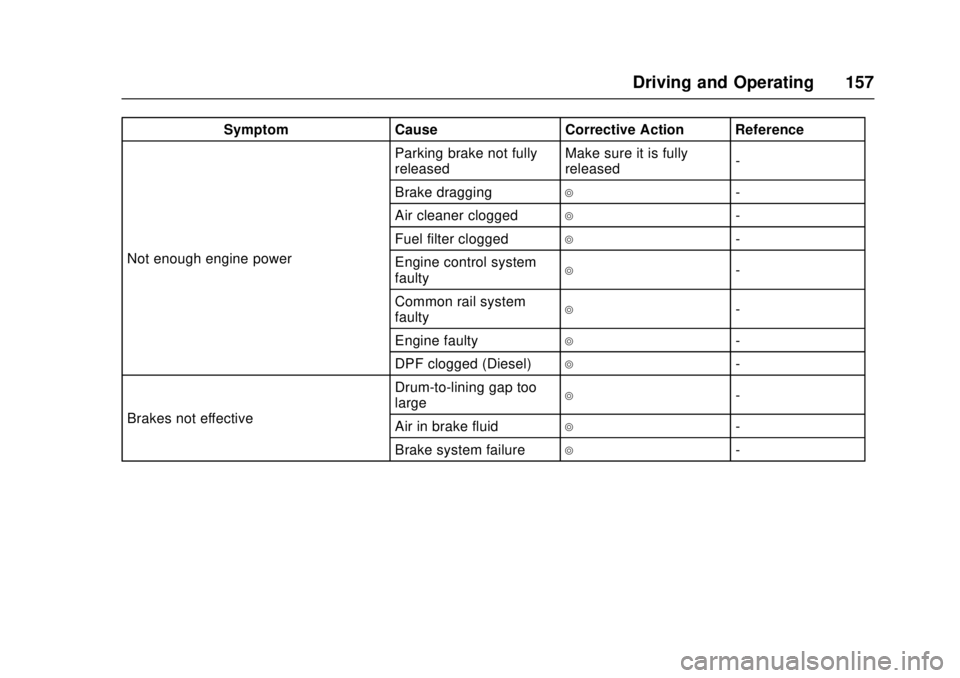
Chevrolet Low Cab Forward Owner Manual (GMNA-Localizing-U.S.-
10716700) - 2017 - crc - 12/6/16
Driving and Operating 157
SymptomCauseCorrective Action Reference
Not enough engine power Parking brake not fully
released
Make sure it is fully
released
-
Brake dragging
4-
Air cleaner clogged
4-
Fuel filter clogged
4-
Engine control system
faulty
4-
Common rail system
faulty
4-
Engine faulty
4-
DPF clogged (Diesel)
4-
Brakes not effective Drum-to-lining gap too
large
4-
Air in brake fluid
4-
Brake system failure
4-