brakes CHEVROLET LOW CAB FORWARD 2017 Owner's Guide
[x] Cancel search | Manufacturer: CHEVROLET, Model Year: 2017, Model line: LOW CAB FORWARD, Model: CHEVROLET LOW CAB FORWARD 2017Pages: 414, PDF Size: 7.97 MB
Page 163 of 414

Chevrolet Low Cab Forward Owner Manual (GMNA-Localizing-U.S.-
10716700) - 2017 - crc - 12/6/16
162 Driving and Operating
If There is a Fuel Leak
{Danger
Leaking fuel from the vehicle is
dangerous due to possible
combustion or explosion. Stop the
engine immediately.
You or others could be seriously
injured or killed.
Starting and
Operating
New Vehicle Break-In
Good vehicle care begins with
proper break-in. While every new
vehicle goes through rigid factory
and dealer inspection and tests
before delivery, the care you give
your vehicle during the initial
break-in period can pay off in longer
life, better performance and more
economical operation.
It is therefore always recommended
that during the initial 1 000 km
(600 mile) break-in period, the
following few simple precautions are
carefully observed.
Follow the recommendations listed
below for gasoline and diesel
engines:
.Warm up the engine by driving
easily for the first few minutes
before placing it under load. .
Do not drive for extended
periods at any one constant
speed, either fast or slow, during
the first 800 km (500 miles).
. Use the correct gear to maintain
the desired road speed without
lugging the engine.
. Avoid racing the engine,
full-throttle starts and aggressive
application of brakes when
stopping.
. Keep tires properly inflated for
the load carried.
. Check lubricant levels in the
engine and transmission weekly.
. For vehicles with gasoline
engines, keep speeds below
121 km/h (75 MPH) for the first
800 km (500 miles).
Follow the additional diesel only
recommendations listed below:
. Keep speeds below 80 km/h
(50 MPH) for the first 800 km
(500 miles).
Page 210 of 414

Chevrolet Low Cab Forward Owner Manual (GMNA-Localizing-U.S.-
10716700) - 2017 - crc - 12/6/16
Driving and Operating 209
Driving conditionsSelector lever position
Normal uphill road Diesel engine
–D (overdrive off
switch ON)
Gasoline engine –D4
Steep uphill, steep slope, mountain
road with many sharp curves 2 or 1
Long uphill road 2
Downhill driving:
Do not overuse the foot brake. This
will cause the brakes to overheat,
reducing their effectiveness. On
long downward slopes or sharp
downhill sections of road, use the
engine brake together with the foot
brakes to control the speed.
On vehicles with a diesel engine,
when the selector lever is in the D
position, you can drive with the
overdrive off switch ON to allow a
gentle engine brake to be applied.
On vehicles with a 3.0L diesel
engine, push the overdrive off
switch to the ON position at speeds below 135 km/h (84 MPH) to
increase engine braking action
when traveling downgrade.
On vehicles with a 5.2L diesel
engine, push the overdrive off
switch to the ON position at speeds
below 101 km/h (63 MPH) to
increase engine braking action
when traveling downgrade.
On vehicles with a gasoline engine,
with the selector lever in the D4
position at speeds below
121 km/h (75 MPH) to increase
engine braking action when
traveling downgrade.
You can increase engine braking by
driving with the selector lever in the
2 position.To apply a stronger engine brake on
sharp downhill sections, shift the
selector lever to the 1 position when
required.
See
Control of a Vehicle 0133.
Driving at Low Speeds for
Sustained Periods
On vehicles with a 3.0L diesel
engine, any low speed applications
such as sweeper, road marking
machinery, trash collectors, highway
striping or moving, etc. require the
following treatment to prevent the
automatic transmission fluid (ATF)
from overheating:
Select 1 position during low speed
operation under 28 km/h (17 MPH).
Select 2 position during low speed
operation under 53 km/h (33 MPH).
On vehicles with a 5.2L diesel
engine, any low speed applications
such as sweeper, road marking
machinery, trash collectors, highway
striping or moving, etc. require the
following treatment to prevent the
automatic transmission fluid (ATF)
from overheating:
Page 214 of 414

Chevrolet Low Cab Forward Owner Manual (GMNA-Localizing-U.S.-
10716700) - 2017 - crc - 12/6/16
Driving and Operating 213
Actions that Can Lead to a Breakdown with an Automatic Transmission
Actions that can lead to a breakdownBreakdown symptoms
Stopping the vehicle on an uphill road with the selector lever in a position
other than N or P, the accelerator pedal pressed, and the brakes not
applied. The transmission fluid overheats.
Pressing the accelerator pedal and brake pedal at the same time while the
vehicle is in a gear other than N or P.
Placing the selector lever into any gear with the accelerator pedal pressed
and the engine speed high. The transmission gears are
overloaded.
Placing the selector lever into P before the vehicle has completely stopped. The parking mechanism will be
damaged.
Turning off the engine control switch while driving. The transmission is not properly
lubricated.
Driving with the selector lever in the N position on a long downward slope
(this is dangerous due to the lack of engine brake).
Page 218 of 414

Chevrolet Low Cab Forward Owner Manual (GMNA-Localizing-U.S.-
10716700) - 2017 - crc - 12/6/16
Driving and Operating 217
Overdrive Off Indicator Light
Indicator lightFunction Usage conditions
Goes Off. 6-Speed (4-speed + overdrive) automatic
change (Overdrive ON). Use under normal driving conditions.
Comes On. 4-speed automatic change, but no change to
overdrive (overdrive OFF). Used when a light engine brake is required.
Doing so will reduce the number of gear
changes making the ride smoother on roads
that have many hills.
. During cold weather, the
transmission may not shift to the
5th or 6th gear (overdrive) until
the engine warms up.
. Even if the engine is stopped
with the overdrive OFF, the
overdrive will be ON the next
time the engine is started.
Brakes
Antilock Brake
System (ABS)
Wheels may be locked and slip
during sudden braking or braking on
a slippery road surface such as a
snowy road. ABS is a device to
prevent the wheels from locking by
detecting a slippery condition during
braking and securing the directional
stability and handling stability of the
vehicle. ABS only assists in limited
road conditions and will not prevent
an accident if you exceed safe
driving speeds for road conditions.
Always drive safely.
{Warning
The braking distance on slippery
road surfaces is longer than that
on a normal dry paved road even
with an ABS-equipped vehicle. In
addition the braking distance can
be slightly longer in deep snow
and on a gravel road when ABS
is activated. Therefore, always
keep in mind the road condition
and tire condition (type of tires
and worn condition), observe safe
driving habits and drive the
vehicle while keeping a proper
distance between vehicles.
(Continued)
Page 219 of 414

Chevrolet Low Cab Forward Owner Manual (GMNA-Localizing-U.S.-
10716700) - 2017 - crc - 12/6/16
218 Driving and Operating
Warning (Continued)
ABS does not prevent accidents if
you do not drive safely. Drive the
vehicle at a safe speed.
Install tires of the specified size,
same brand and same tread
design (including winter tires) on
all wheels. If different tires are
installed, the braking distance
becomes longer and directional
control stability of the vehicle
decreases. This is very
dangerous.
Steering during sudden braking
(when the ABS is working) will
feel slightly different than it does
when the brakes are not applied.
Operate the steering wheel
carefully keeping this in mind.
Driving in sand or on a muddy road
may adversely affect the brakes and
ABS sensors. Wash the vehicle to
remove sand and mud after
operating the vehicle in sandy or
muddy conditions. Before washing the vehicle, provide
necessary protection to prevent
water from being splashed on the
ABS components (sensors and
actuators). Especially when using
high-pressure washing, be careful
not to allow water to be directly
sprayed onto the ABS components
and their harness connectors.
These are not signs of ABS
malfunction:
.
Soon after you start the engine
and the vehicle starts moving,
the sound of motor or valve
working may be heard from the
rear of the vehicle or underside
of the cab. This sound is from a
self-check by the ABS system
and is normal. In addition, you
may also feel some vibration if
the brake pedal is pressed at
this time.
. When ABS is operating,
vibration is felt on the brake
pedal and steering wheel and
you may hear the system
operating. This is normal when
ABS is properly operating. .
On diesel vehicles, the exhaust
brake may release when ABS is
activated and the exhaust brake
is in operation.
. ABS is more likely to be
activated when the brake is
applied during cornering or
driving over a bump. This is
because inside wheels or
wheels that have gone over a
bump tend to lock.
. ABS is not activated immediately
after starting the vehicle. It is
activated only when the vehicle
speed reaches approx. 10 km/h
(6 MPH). ABS operation is
inactive when the vehicle speed
reduces to approx. 5 km/h
(3 MPH).
Page 220 of 414

Chevrolet Low Cab Forward Owner Manual (GMNA-Localizing-U.S.-
10716700) - 2017 - crc - 12/6/16
Driving and Operating 219
ABS Operation Indications and
Signs
ABS warning light
Operation Indications of ABS
When the engine control switch is
placed into the "ON" position, the
ABS warning light comes on and
then goes out in approx. 3 seconds.
The ABS is normal if the warning
light goes out.
Operation Signs of ABS
When ABS is activated, slight
vibration is generated on the brake
pedal (hydraulic brake model) and
steering wheel, and an operating
sound can be heard from the ABS
equipment.
If the ABS warning light does any of
the following, the ABS may be
faulty. Please contact the nearest
dealer. ‐
If the ABS warning light comes
on during driving
‐ The light does not come on when
the engine control switch is
placed into the "ON" position
See Antilock Brake System
(ABS) Warning Light 087.
Even if a problem has occurred with
the ABS, the regular brakes will still
work normally. However, ABS will
not operate.
Precautions for Driving an
ABS-Equipped Vehicle
ABS is not a device that enables
driving and stopping under
conditions exceeding safe driving
limits. Always drive safely.
{Warning
When braking suddenly, continue
pressing brake pedal hard so that
the ABS can take effect. (Continued)
Warning (Continued)
When braking suddenly, do not
pump the brakes (pushing and
releasing the brake pedal little by
little). Pumping brakes will
increase the braking distance.
The braking distance on slippery
road surfaces is longer than that
on a normal dry paved road even
with an ABS-equipped vehicle.
When ABS is activated in the
following road surface conditions,
the braking distance may be
slightly longer compared to that of
vehicles not equipped with an
ABS. Therefore, always be aware
of the road and tire condition (tire
type and wear condition), observe
safe driving habits and drive the
vehicle while keeping a safe
following distance.
‐ When driving on a gravel
road, or a road with a deep
snow covering.
‐ When tire chains are used.
(Continued)
Page 245 of 414
Chevrolet Low Cab Forward Owner Manual (GMNA-Localizing-U.S.-
10716700) - 2017 - crc - 12/6/16
244 Vehicle Care
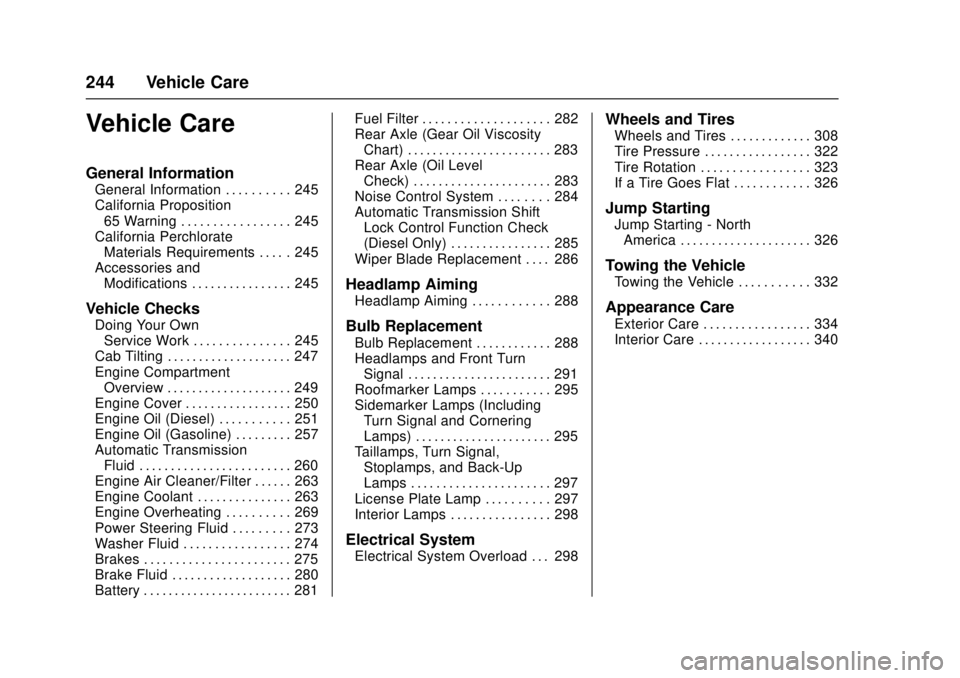
Vehicle Care
General Information
General Information . . . . . . . . . . 245
California Proposition65 Warning . . . . . . . . . . . . . . . . . 245
California Perchlorate Materials Requirements . . . . . 245
Accessories and Modifications . . . . . . . . . . . . . . . . 245
Vehicle Checks
Doing Your OwnService Work . . . . . . . . . . . . . . . 245
Cab Tilting . . . . . . . . . . . . . . . . . . . . 247
Engine Compartment Overview . . . . . . . . . . . . . . . . . . . . 249
Engine Cover . . . . . . . . . . . . . . . . . 250
Engine Oil (Diesel) . . . . . . . . . . . 251
Engine Oil (Gasoline) . . . . . . . . . 257
Automatic Transmission Fluid . . . . . . . . . . . . . . . . . . . . . . . . 260
Engine Air Cleaner/Filter . . . . . . 263
Engine Coolant . . . . . . . . . . . . . . . 263
Engine Overheating . . . . . . . . . . 269
Power Steering Fluid . . . . . . . . . 273
Washer Fluid . . . . . . . . . . . . . . . . . 274
Brakes . . . . . . . . . . . . . . . . . . . . . . . 275
Brake Fluid . . . . . . . . . . . . . . . . . . . 280
Battery . . . . . . . . . . . . . . . . . . . . . . . . 281 Fuel Filter . . . . . . . . . . . . . . . . . . . . 282
Rear Axle (Gear Oil Viscosity
Chart) . . . . . . . . . . . . . . . . . . . . . . . 283
Rear Axle (Oil Level Check) . . . . . . . . . . . . . . . . . . . . . . 283
Noise Control System . . . . . . . . 284
Automatic Transmission Shift Lock Control Function Check
(Diesel Only) . . . . . . . . . . . . . . . . 285
Wiper Blade Replacement . . . . 286
Headlamp Aiming
Headlamp Aiming . . . . . . . . . . . . 288
Bulb Replacement
Bulb Replacement . . . . . . . . . . . . 288
Headlamps and Front Turn Signal . . . . . . . . . . . . . . . . . . . . . . . 291
Roofmarker Lamps . . . . . . . . . . . 295
Sidemarker Lamps (Including Turn Signal and Cornering
Lamps) . . . . . . . . . . . . . . . . . . . . . . 295
Taillamps, Turn Signal, Stoplamps, and Back-Up
Lamps . . . . . . . . . . . . . . . . . . . . . . 297
License Plate Lamp . . . . . . . . . . 297
Interior Lamps . . . . . . . . . . . . . . . . 298
Electrical System
Electrical System Overload . . . 298
Wheels and Tires
Wheels and Tires . . . . . . . . . . . . . 308
Tire Pressure . . . . . . . . . . . . . . . . . 322
Tire Rotation . . . . . . . . . . . . . . . . . 323
If a Tire Goes Flat . . . . . . . . . . . . 326
Jump Starting
Jump Starting - North America . . . . . . . . . . . . . . . . . . . . . 326
Towing the Vehicle
Towing the Vehicle . . . . . . . . . . . 332
Appearance Care
Exterior Care . . . . . . . . . . . . . . . . . 334
Interior Care . . . . . . . . . . . . . . . . . . 340
Page 276 of 414

Chevrolet Low Cab Forward Owner Manual (GMNA-Localizing-U.S.-
10716700) - 2017 - crc - 12/6/16
Vehicle Care 275
Use a high quality premixed solvent
available at most dealers or service
stations.
Avoid hard water when mixing
windshield washer solvents. Hard
water contaminants may plug
orifices in the washer system and
reduce performance.
Do not use radiator antifreeze in the
windshield washer; it could cause
cab paint damage.
In cold weather, warm the
windshield with the defrosters
before using the washer, to help
prevent icing that may block the
driver's vision.Refilling Windshield Washer
Fluid
1. The windshield washer fluidtank (1) is located under the
instrument panel on the
passenger side.
2. Open the cap (2) and fill the tank with windshield washer
fluid.
Upon factory shipment, new
vehicles contain only tap water in
the washer fluid tank. Adjust the
concentration of the fluid to suit your
own usage. Follow the instructions provided with
the windshield washer fluid
regarding the ratio for mixing with
tap water.
Poor quality products, engine
coolant, and soapy water must not
be used. Failure to observe this
precaution can result in nozzle
blockage or damage to painted
surfaces.
The washer should never be used
while the tank is empty. Operating
the washer with the tank empty can
result in motor damage.Brakes
For the most effective braking and
for maximum life from brake system
components, follow these
suggestions:
.
Keep any obstructions from
interfering with brake pedal
travel.
. Keep tires properly inflated.
Improperly inflated tires can
reduce the efficiency of the
brakes.
Page 277 of 414

Chevrolet Low Cab Forward Owner Manual (GMNA-Localizing-U.S.-
10716700) - 2017 - crc - 12/6/16
276 Vehicle Care
Follow the recommendations for
brake checks in the Maintenance
Schedule.
GM replacement brake lining
material is recommended for this
vehicle to maintain the balance
between front and rear brake
performance. GM replacement
brake parts have been carefully
selected to provide the proper brake
balance for purposes of both
stopping distance and controllability
over the full range of operating
conditions. Installation of front or
rear brake lining material with
performance different from that of
the replacement parts
recommended for this vehicle can
change the intended brake balance
of this vehicle.
Checking the Brake Electric
Vacuum Pump (4500HD/
4500XD Series)
1. Turn the engine control switchto the "ON" position (do not
start the engine), and press the
brake pedal several times. 2. Check for the noisy sound of
the electric vacuum pump
inside the instrument panel at
the same time as vacuum
warning buzzer sound, and
check that the brake low
vacuum warning light
comes on.
3. Then, start the engine. The main vacuum pump driven by
the engine will start running.
If the electric vacuum pump
operation (noisy sound) and
the vacuum warning buzzer
stop, and the brake low
vacuum warning light goes off
thereafter, the operation is
normal.
4. If you cannot hear the noisy sound or the noisy sound stays
on all the time, have the
vehicle inspected by the
nearest dealer immediately.Hydraulic Brake Booster (HBB)
The 5500HD, 5500XD models are
equipped with a HBB system. HBB
is a brake booster device that utilizes hydraulic pressure from the
HBB pump integral with the power
steering pump.
If the brake booster warning light
comes on or a warning buzzer
continues to sound, there may be a
problem with the HBB.
If this warning light comes on while
driving, immediately stop your
vehicle at a safe place well clear of
traffic and promptly contact the
nearest dealer for inspection.
Hydraulic brake booster (HBB)
characteristics
In the 5500HD, 5500XD models, an
unusual sound from under the
instrument panel may be heard from
the hydraulic system while brakes
are used. It does not mean trouble.
It is not a sign of malfunction.
If you pump the brakes with the
engine off, a squeaking sound can
be heard. This comes from the
auxiliary accumulator. It is not a
malfunction. With the engine
running, a similar sound can be
heard during sudden braking.
Page 278 of 414

Chevrolet Low Cab Forward Owner Manual (GMNA-Localizing-U.S.-
10716700) - 2017 - crc - 12/6/16
Vehicle Care 277
Another characteristic of the HBB
system is that the brake pedal may
be depressed easily to the floor with
the vehicle at a stop. This is not a
sign of malfunction.
When the engine is running, the
system automatically charges the
accumulator whenever pressure has
been reduced after braking. Auto
charge may be activated without
braking, depending on temperature
changes in the accumulator. During
auto charge, a hissing and clicking
sound can be heard. This is not a
malfunction.
With the engine running, a booming
sound can be heard during hard
braking. This comes from the
brake-fluid pump. It is not a
malfunction.
Applying continuous hard braking
for a long time will lead to
considerable temperature rise in the
HBB pump. Such overworking of the
brakes is best avoided.Vacuum or hydraulic power
assisted brakes
If the engine stops, do not pump the
brakes. The system is designed to
stop the vehicle with reserve power
assist if the brake pedal is held
down. This reserve is greatly
reduced each time you apply and
release the brakes. If, when you
turn the steering wheel during
braking, the vehicle does not turn,
release some pressure from the
brake pedal.
In a Vehicle Equipped with a HBB,
Do Not Keep the Brake Pedal
Depressed for an Extended Period
Caution
Failure to follow the above
instruction will cause the oil inside
the HBB oil pump to get very hot.
This could damage the HBB tank
and deteriorate seals and also
could cause damage to the HBB
oil pump, HBB unit and/or HBB
hosing. Eventual leakage of HBB
(Continued)
Caution (Continued)
oil, sudden increase in brake
pedal resistance and fire could
unexpectedly result in an
accident.
Hydraulic Brake Booster (HBB)
Fluid (5500HD/5500XD Series)
The HBB system has been
designed to use ATF Dexron fluid is
used with this system, rubber
components may be damaged, oil
may leak and the system may
malfunction. It is important to
remember that the fluid used in the
hydro-booster is completely different
in characteristics from the brake
fluid used in the master and wheel
cylinders.
If hydro-booster fluid and brake fluid
from the master cylinder are
mistakenly mixed together and
used, rubber components will
deteriorate as a result of insufficient
lubrication. Any resultant oil leakage
or system malfunction can in turn
lead to dragging brakes or other