brakes CHEVROLET LOW CAB FORWARD 2017 Owner's Guide
[x] Cancel search | Manufacturer: CHEVROLET, Model Year: 2017, Model line: LOW CAB FORWARD, Model: CHEVROLET LOW CAB FORWARD 2017Pages: 414, PDF Size: 7.97 MB
Page 280 of 414

Chevrolet Low Cab Forward Owner Manual (GMNA-Localizing-U.S.-
10716700) - 2017 - crc - 12/6/16
Vehicle Care 279
5 - 10 mm (0.20 - 0.39 in)
(3500HD/4500HD/4500XD)
24 - 29 mm (0.95 - 1.14 in) (5500HD/5500XD)
1. Clearance from the floor.
2. Brake pedal bracket.
Next, start the engine, and wait at
least 1 minute. Then press the
brake pedal and measure the
clearance (1) of the pedal from the
floor (that is, the distance between
the brake pedal bracket (2) and the
brake pedal arm). Clearance between the brake
pedal and the brake pedal bracket with a pressure of 490 N (110 lbs)
applied to the brake pedal
35 mm (1.38 in) or more (3500HD/ 4500HD/4500XD)
45 mm (1.77 in) or more (3500/4500)
Clearance between the brake
pedal and the brake pedal bracket
with a pressure of 294 N (66 lbs) applied to the brake pedal
45 mm (1.77 in) or more (3500/4500)
35 mm (1.38 in) or more (3500HD/ 4500HD/4500XD/5500HD/ 5500XD)
If, after continued pressing of the
brake pedal, the clearance slowly
decreases or the pedal action feels
spongy, air may be trapped in the
brake hydraulic circuit. Have your
vehicle inspected at the nearest
dealer as soon as possible. If your vehicle's brakes squeak
during normal driving or braking, the
cause may be one of the following.
‐
Brake pad wear
Brake pads are about to wear
out. If this happens, have your
vehicle inspected at the nearest
dealer as soon as possible.
‐ Adherence of sand, grit or mud
If sand, grit or mud adheres to
the brakes, a screeching sound
may be emitted upon contact with
rotating components. If this
happens, wash the vehicle to
remove all such adhering matter.
If cleaning alone does not
eliminate the squeaking sound,
have your vehicle inspected at
the nearest dealer.Brake Hoses and Pipes
Inspection
With the steering wheel turned fully
to the left, check the left front brake
hose and pipe visually and by
touch, making sure that they are
free of scratches, cracks and
bulging. Also make sure that the
Page 281 of 414

Chevrolet Low Cab Forward Owner Manual (GMNA-Localizing-U.S.-
10716700) - 2017 - crc - 12/6/16
280 Vehicle Care
hose and pipe do not interfere with
any chassis part or wheel, and that
their joints are not leaking and are
free of any type of damage. Check
the right front brake hose and pipe
in the same way. The rear left and
right brake hoses and pipes should
also be checked in the same
manner.
Disc Brakes and Drum Brakes
If the brake pads and shoe linings
wear out beyond their usable limit,
not only will the brake performance
be impaired, but brake components
could also fail.
{Warning
Do not drive with brake pads and
shoe linings worn out beyond the
limit. Excessively worn brake
pads and shoe linings may cause
breakdown of brake components
and poor braking performance.
You and others could be seriously
injured.
Caution
The pad has an embedded wear
indicator. A squeaking noise from
the indicator means that the pad
is approaching the usable limit.
If the squeaking noise from the
indicator can be heard, contact
the nearest dealer for inspection
or replacement.
Brake Fluid
Checking the Brake Fluid
Level
Remove the inspection cover (1) on
the left- hand side of the instrument
panel by turning it with your fingers.
Check that the fluid level in the
reservoir is between the "MAX" and
"ADD" lines.
If the fluid surface cannot easily be
seen, rock the vehicle gently.
Adding Brake Fluid
If the level of brake fluid has
dropped below the "ADD" line,
remove the cap (2) and add fluid.
Take care to avoid filling beyond the
"MAX" line.
Tighten the cap securely after the
fluid has been added.
When adding brake fluid to the tank,
take care to prevent dirt and water
from entering it. Any dirt or water in
the system could cause the vehicle
to lose braking functions.
Inspect and change brake fluid
according to the Maintenance
Schedule.
Use the recommended brake fluid
when adding brake fluid.
Page 324 of 414
Chevrolet Low Cab Forward Owner Manual (GMNA-Localizing-U.S.-
10716700) - 2017 - crc - 12/6/16
Vehicle Care 323
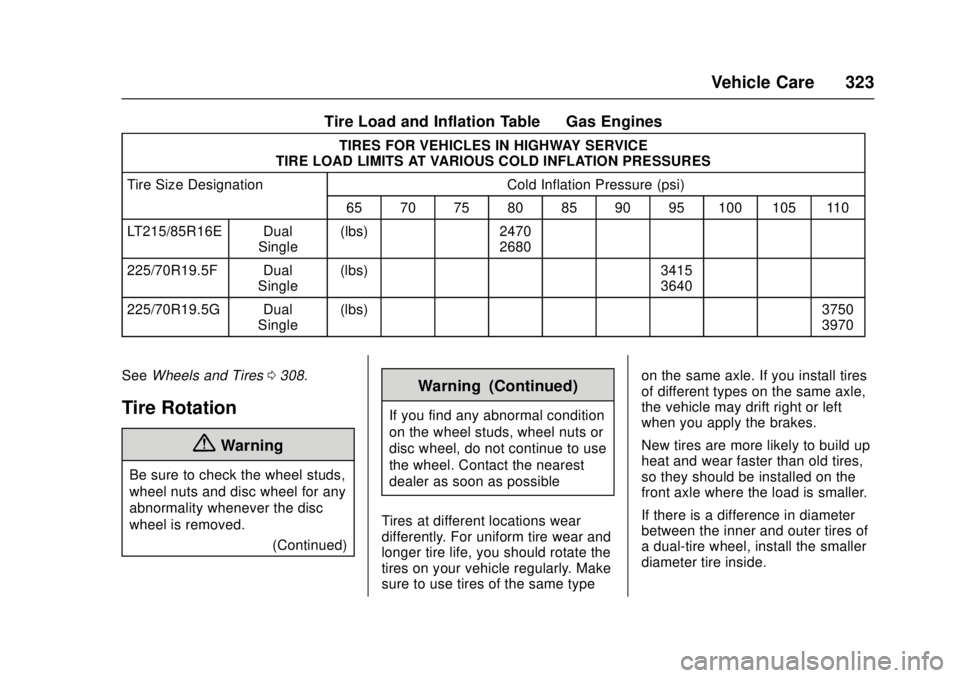
Tire Load and Inflation Table—Gas Engines
TIRES FOR VEHICLES IN HIGHWAY SERVICE
TIRE LOAD LIMITS AT VARIOUS COLD INFLATION PRESSURES
Tire Size Designation Cold Inflation Pressure (psi) 65 70 75 80 85 90 95 100 105 110
LT215/85R16E Dual Single(lbs) 2470
2680
225/70R19.5F Dual Single(lbs) 3415
3640
225/70R19.5G Dual Single(lbs)
3750
3970
See Wheels and Tires 0308.
Tire Rotation
{Warning
Be sure to check the wheel studs,
wheel nuts and disc wheel for any
abnormality whenever the disc
wheel is removed.
(Continued)
Warning (Continued)
If you find any abnormal condition
on the wheel studs, wheel nuts or
disc wheel, do not continue to use
the wheel. Contact the nearest
dealer as soon as possible
Tires at different locations wear
differently. For uniform tire wear and
longer tire life, you should rotate the
tires on your vehicle regularly. Make
sure to use tires of the same type on the same axle. If you install tires
of different types on the same axle,
the vehicle may drift right or left
when you apply the brakes.
New tires are more likely to build up
heat and wear faster than old tires,
so they should be installed on the
front axle where the load is smaller.
If there is a difference in diameter
between the inner and outer tires of
a dual-tire wheel, install the smaller
diameter tire inside.
Page 334 of 414

Chevrolet Low Cab Forward Owner Manual (GMNA-Localizing-U.S.-
10716700) - 2017 - crc - 12/6/16
Vehicle Care 333
After Towing
After towing the vehicle, block the
rear wheels and install axle shafts
or driveshaft.
Apply the parking brake before
disconnecting from the towing
vehicle.
Front End Towing (All Wheels On
the Ground)
Your vehicle may be towed on all
wheels provided the steering is
operable. Remember that power
steering and brakes will not have
power assist. There must be a tow
bar installed between the tow
vehicle and the disabled vehicle.
Towing with all wheels on theground
1. Bumper
2. Tow Hook
3. Front Axle
4. Towing Guide
5. Towing Chain
To prepare a disabled vehicle for
front end towing with all wheels on
the ground, the following steps are
necessary:
.Block the rear wheels of the
disabled vehicle.
. For gasoline vehicles, move the
selector lever into "N" position,
vehicles can be towed at speeds below 48 km/h (30 mph) and up
to distances less than
80 km (50 mi).
. Disconnect the driveshaft at the
rear axle. Secure the driveshaft
to the frame or crossmember.
When towing, disconnect the
driveshaft at the rear axle to ensure
the transmission is not damaged.
The rear end of the driveshaft must
be disconnected and safely secured
if the 80 km (50 mi) or 48 km/h
(30 mph) is exceeded.
Provide wood blocking to prevent
towing chains and bar from coming
into contact with the bumper.
If there is damage or suspected
damage to the rear axle, remove the
axle shafts.
Cover the hub openings to prevent
the loss of lubricant or entry of dirt
or foreign objects.
After Towing
After towing the vehicle, block the
rear wheels and install axle shafts
or driveshaft.
Page 353 of 414

Chevrolet Low Cab Forward Owner Manual (GMNA-Localizing-U.S.-
10716700) - 2017 - crc - 12/6/16
352 Service and Maintenance
7. SPARK PLUGS :Change every
160 000 km (100,000 miles).
8. SPARK PLUG WIRES : Clean
wires and inspect for burns, cracks
or other damage. Check the wire
boot fit at the coilpack and at the
spark plugs. And replace every
160 000 km (100,000 miles).
9. FUEL TANK, CAP AND LINES :
Inspect the fuel tank, cap and lines
for damage or leaks. Remove fuel
cap, inspect gasket for an even filler
neck imprint, and any damage.
Replace parts as needed.
10. ENGINE ACCESSORY DRIVE
BELT(S) : Inspect belts. Look for
cracks, fraying, wear, and proper
tension. Adjust or replace as
needed, and change every
160 000 km (100,000 miles).
11. EVAPORATIVE CONTROL
SYSTEM (ECS) : Visually check all
fuel and vapor lines and hoses for
proper hookup, routing, and
condition. Check that bowl vent and
purge valves work properly,
if equipped. Replace as needed. 12. SHIELDS AND UNDER HOOD
INSULATION :
Inspect shields and
under hood insulation for damage or
looseness. Adjust or replace as
required.
13. AIR INTAKE SYSTEM : Check
the air intake system installation to
see that gaskets are seated
properly and all hose connections,
fasteners, and other components
are tight. Also check to be sure that
the air cleaner housing is properly
seated, that the cover fits tightly,
and the wingnut(s) is/are tight.
Tighten connections and fasteners
or replace damaged parts as
required.
14. THERMOSTATICALLY
CONTROLLED ENGINE COOLING
FAN : With the engine off and below
normal operating temperature,
check to see that the fan can be
rotated by hand on fluid coupling or
viscous drives. Replace as
necessary. 15. AUTOMATIC TRANSMISSION
FLUID :
Check the automatic transmission
fluid level at each engine oil change
and replace fluid every 84 000 km
(52,500 miles). To check the fluid
level, first set the parking brake,
then start the engine in "P" position.
With the regular brakes applied,
move the selector lever through all
the gear positions, ending with "P".
You must check the fluid level with
the engine running at slow idle and
the truck must be on a level surface.
Page 354 of 414

Chevrolet Low Cab Forward Owner Manual (GMNA-Localizing-U.S.-
10716700) - 2017 - crc - 12/6/16
Service and Maintenance 353
If you have driven for a prolonged
period of time or in city traffic in hot
weather, wait until the fluid cools
down (Approx. 30 minutes) before
checking fluid level.
Single cab: Remove the dipstick
located at the rear right side of the
engine.
Crew cab: Remove the dipstick
located beneath the rear-of- engine
inspection panel. After unlatching
the A/T fluid inspection cover, the
dipstick will be visible.
Carefully touch the wet end of the
dipstick to find out if the fluid is cool,
warm or hot. Wipe it clean and push
it back in until the cap seats. Pull
out the dipstick and read the fluid
level.
If it felt cool, about room
temperature, the level should be in
the "C" range.
If it felt warm, about normal
operating temperature of 70 °C to
80 °C (158 °F to 176 °F), the level
should be in the "H" range.
16. ROTATE TIRES :To equalize
wear, rotate tires and adjust tire
pressures at every 12 000 km
(7,500 miles). See Tire Rotation
0 323.
17. BRAKE LINING AND PAD FOR
WEAR : Check drum brake linings
and disc brake pads for wear or
cracks at every 12 000 km
(7,500 miles). Check brakes
(including parking brake) more often
if conditions and habits result in
frequent braking.
Front disc brakes have built-in wear
indicators which are designed to
make a high pitched squeal or
cricket-like warning sound when the
brake pads are worn to the point
where new pads are needed. When the truck is in motion, the
sound may be constant or it may
come and go.
Pressing the brake pedal firmly may
cause the sound to stop.
Have the brake linings or the brake
pads replaced by your authorized
dealer as soon as possible after the
warning first becomes evident.
Failure to do so can result in
expensive damage to the brake
system or a serious accident.
18. BRAKE DRUM AND ROTOR
FOR WEAR AND DAMAGE :
Check brake drums (rear and
parking) and rotors for wear or
damage every 48 000 km
(30,000 miles) or 12 months
whichever occurs first.
19. BRAKE ELECTRIC VACUUM
PUMP (4500 Model) :
Inspect the
brake electric vacuum pump
operation every 12 000 km
(7,500 miles) or 12 months,
whichever occurs first.
Page 366 of 414

Chevrolet Low Cab Forward Owner Manual (GMNA-Localizing-U.S.-
10716700) - 2017 - crc - 12/6/16
Service and Maintenance 365
14. DPF (Clean Filter) :Clean the
filter every 160 000 km
(100,000 miles) or 3,000 hours
whichever occurs first.
15. DPF (Pressure Difference
Sensor 0 Point Adjustment) :
Adjust the sensor every 160 000 km
(100,000 miles) or 3,000 hours
whichever occurs first.
16. DPF (Pressure Difference
Sensor Hose) : Inspect the sensor
hose every 160 000 km
(100,000 miles) or 3,000 hours
whichever occurs first. Replace the
sensor hose every 400 000 km
(250,000 miles).
17. Fuel Line System : Inspect the
fuel tank, cap and lines for damage
which could cause leakage every
16 000 km (10,000 miles). Inspect
fuel cap for correct sealing ability
and indications of physical damage.
Replace any damaged or
malfunctioning parts.
18. Brake Lining and Pad for
Wear : Check drum brake lining and
disc brake pad for wear or cracks
every 16 000 km (10,000 miles).
Check brakes (including parking brake) more often if operating
conditions or driving habits result in
frequent braking.
Front disc brakes have built-in wear
noise indicators which are designed
to make a high pitched squeal or
cricket-like warning sound when the
brake pads are worn to the point
where new pads are needed.
When the truck is in motion, the
sound may be constant or it may
come and go. Pressing the brake
pedal firmly may cause the sound
to stop.
Have the brake linings or the brake
pads replaced by your authorized
dealer as soon as possible after the
warning first becomes evident.
Failure to do so can result in
expensive damage to the brake
system or a serious accident.
19. Brake Drum and Rotor for
Wear and Damage :
Check brake
drums (rear and parking) and rotors
(front) for wear or damage every
32 000 km (20,000 miles) or
12 months whichever occurs first. 20. Brake Electric Vacuum Pump
(4500HD, 4500XD models) :
Inspect the brake electric vacuum
pump operation every 16 000 km
(10,000 miles) or 12 months,
whichever occurs first.
21. Brake Fluid :
Check the fluid in
the brake fluid reservoir every
16 000 km (10,000 miles). Replace
the fluid every 48 000 km
(30,000 miles).
22. Hydraulic Brake Booster Fluid
(5500HD, 5500XD models) :
Replace ATF Dexron VI fluid every
24 months or 30,000 miles
(48,000 km), whichever occurs first.
23. Brake Line and Hoses : Check
lines and hoses for proper hook-up,
binding, leaks, cracks, chafing, etc.
every 32 000 km (20,000 miles).
Any questionable parts should be
replaced or repaired at once. When
rubbing or wear is noted on lines or
hoses, the cause must be corrected
at once.
24. Parking Brake Cable : Check
the parking brake cable every
16 000 km (10,000 miles) or
12 months whichever occurs first.
Page 376 of 414

Chevrolet Low Cab Forward Owner Manual (GMNA-Localizing-U.S.-
10716700) - 2017 - crc - 12/6/16
Service and Maintenance 375
Additional
Maintenance and Care
Owner Safety and Routine
Maintenance
Listed below are vehicle checks
which should be made periodically
by either the owner or a qualified
technician to ensure proper
performance and safety of your
vehicle. Take any problems promptly
to a technician for service advice.
For your safety and that of others,
any of the safety-related
components that may have been
damaged in an accident should be
checked and necessary repairs
performed before operating your
vehicle.
At the minimum, these routine
checks should be made every
6 months or 16,000 km
(10,000 miles) for diesel vehicles,
or every 9,600 km (6,000 miles) for
gasoline vehicles, whichever comes
first. Whenever repairs are
necessary, have them completed
before operating the vehicle.A: Parking Brake :
Park on a fairly
steep hill and hold the vehicle with
the parking brake only. This checks
holding ability.
Before checking item (B) below, be
sure to have enough room around
the vehicle. Then firmly apply both
the parking brake see Parking
Brake 0221 and the regular brakes.
Do not use the accelerator pedal.
If the engine starts, be ready to turn
off the engine control switch at
once. Take these precautions
because the vehicle could move
without warning and possibly cause
injury or property damage.
B: Starter Safety Switch : Check
by trying to start the engine in each
gear. The starter should crank only
at selector position "P" or "N".
C: Transmission Shift Indicator :
Check that the indicator points to
the gear chosen.
D: Steering : Be alert for any
changes in steering action. An
inspection or service is needed
when: the steering wheel is harder to turn or has too much free play,
or when there are strange sounds
when turning or parking.
E: Wheel Alignment, Balance, and
Tires :
Check tires for abnormal
wear or damage. Also, check for
damaged wheels. A pull right or left
on a straight and level road may
show the need for a wheel
alignment. A vibration of the
steering wheel or seat at normal
highway speeds may mean a wheel
balancing is needed. Check tire
pressure when the tires are "cold,"
at least monthly, and whenever the
vehicle is serviced.
Check the pressure more often if
daily checks show it's needed.
(Refer to "Recommended Daily
(Pre-operation) Inspections" under
Owner Checks and Services 0367).
Change tire pressure as needed
when changing loads.
F: Brakes : Be alert to illumination
of the brake system warning light or
brake low vacuum warning light
(4500HD, 4500XD models) or the
tone alarm, or changes in braking
action, such as repeated pulling to
Page 377 of 414

Chevrolet Low Cab Forward Owner Manual (GMNA-Localizing-U.S.-
10716700) - 2017 - crc - 12/6/16
376 Service and Maintenance
one side, unusual sounds when
braking, increased brake pedal
travel or harder pedal. The front and
rear brakes are attached to an auto
adjuster mechanism. If there are no
defects, as the pedal travel is
properly maintained, adjustments
are not necessary. Check regularly
that the brake fluid reservoir
(left-hand side of the instrument
panel) or HBB reservoir (5500HD,
5500XD models: left side behind the
cab) is properly filled and check for
fluid leaks. Any of these conditions
could indicate the need for brake
system inspection and/or service.
G: Exhaust System :Be alert for
any changes in the sound of the
exhaust system or any smell of
fumes. These are signs the system
may be leaking. Have it checked
and/or repaired at once. (Refer to
"Engine Exhaust Emissions Caution
(Carbon Monoxide)" under Engine
Exhaust 0178).
H: Windshield Wipers and
Washers : Check operation and
condition of the wiper blades. Check
the flow of the washer spray. I: Defroster :
Turn the outlet
selector knob to "Defroster" and the
fan speed control knob to the fully
clockwise position. Then check the
airflow from the ducts at the inside
base of the windshield.
J: Rearview Mirrors and Sun
Visors : Check that friction joints
hold mirrors and sun visors in place.
K: Horn : Sound the horn, now and
then, to be sure it works.
L: Lap-Shoulder Belts : Check the
seat belt system (including webbing,
buckles, latch plates and anchors)
for proper operation, and for
damage.
M: Seat Adjusters : When
adjusting the driver's manual seat,
be sure the seat adjusters latch by
pushing the seat forward and
backward. Do not attempt to adjust
the seat when the vehicle is in
motion.
N: Lamps : Check panel lighting,
warning lamps, indicator lamps and
interior lamps. On the outside,
check: license plate lamps, side
marker lamps, reflectors on outside mirrors, headlamps, parking lamps,
identification and clearance lamps,
taillights, brake lamps, turn signals,
cornering lamps, backup lamps and
hazard warning flashers. Have
headlamp aim checked immediately
if beams seem improperly aimed.
O: Glass, Mirrors, Lights and/or
Reflectors Condition :
Look for
broken, scratched, dirty or damaged
glass, mirrors, lamps or reflectors
that could reduce the view or
visibility, or cause injury. Replace,
clean or repair promptly.
P: Door Latches : Check that doors
close, latch and lock tightly. Check
for broken, damaged or missing
parts that might prevent tight
latching.
Q :Tilt Cab (Driving Position) : Be
sure the tilt lever is down and
locked.
R: Fluid Leaks : Check for fuel,
water, oil or other fluid leaks by
looking at the surface beneath the
vehicle after it has been parked for
a while. If you notice diesel fumes or
fluid at any time, have the cause
found and corrected at once.
Page 394 of 414

Chevrolet Low Cab Forward Owner Manual (GMNA-Localizing-U.S.-
10716700) - 2017 - crc - 12/6/16
Technical Data 393
Fuel
Fuel tank capacity
*6113 L (30.0 qt/24.9 gal) 113 L (30.0 qt/24.9 gal) 113 L (30.0 qt/24.9 gal)125 L (33.0 qt/27.5 gal)
Diesel Exhaust Fluid (DEF)
DEF tank capacity (Diesel Only) 16.0 L (4.23 gal)
Steering
Steering wheel free play 10 - 50 mm (0.39 - 1.97 in)
Power steering fluid capacity 1.5 L (1.6 qt)
Wheel
Wheel alignment Toe-in -2 to 2 mm (-0.08 to 0.08 in)
Camber 0°15’
Caster LH 2°50’, RH 3°40’
King pin 12°
Wheel hub bearing grease capacity 0.11 kg (0.24 lb)
Wheel stud nut torque : Front and rear 500 Y(50 kgf m/363 lb ft)
Disc Brakes
Model 3500/3500HD/4500HD 4500/4500XD/5500HD/5500XD
Brake size (Diameter x
Thickness) 293 x 40 mm (11.54 x 1.57 in) 363 x 42 mm (14.29 x 1.65 in)