oil CHEVROLET LOW CAB FORWARD 2017 Workshop Manual
[x] Cancel search | Manufacturer: CHEVROLET, Model Year: 2017, Model line: LOW CAB FORWARD, Model: CHEVROLET LOW CAB FORWARD 2017Pages: 414, PDF Size: 7.97 MB
Page 266 of 414

Chevrolet Low Cab Forward Owner Manual (GMNA-Localizing-U.S.-
10716700) - 2017 - crc - 12/6/16
Vehicle Care 265
Warning (Continued)
eyes are still irritated or otherwise
feel abnormal, seek immediate
medical attention.
If the engine coolant gets on your
skin, rinse it off using a soap with
a large amount of water. Also,
if abnormality is seen, seek
medical attention.
Engine coolant is flammable, and
therefore, it must be kept away
from flames and other heat
sources. Engine coolant also
could ignite if it comes in contact
with a hot surface, such as the
exhaust manifold. Exercise
caution to prevent this from
happening.
You and others could be seriously
injured.
Preparing Engine Coolant
To prevent engine damage due to
freezing of the engine coolant and
to protect the cooling system from
corrosion, use a mixture of the recommended type antifreeze and
water. If the engine of the vehicle is
at
−30 °C (−22 °F) or above, the
coolant concentration should be
50%. Direct use of “50/50
Pre-diluted” product which is already
diluted to 50% concentration is
recommended. If the outside
temperature engine or vehicle is
used at −30 °C (−22 °F) or below,
coolant concentration of 55% is
recommended.
It is the owner ’s responsibility to:
. Maintain the engine cooling
system freeze protection at or
above −30 °C (−22 °F) (at or
below −30 °C (−22 °F) in colder
climates to ensure protection
against corrosion and loss of
engine coolant from boiling.
A 50/50 (55/45 for colder
climates) mixture of the
recommended type antifreeze
and water will provide freeze
protection to at or above −30 °C
(−22 °F), (at or below −30 °C
(−22 °F) in colder climates) and
boil protection to 128 °C
(262 °F). Periodic replacement
of engine coolant is needed to replenish the anticorrosion
additives that wear out with use.
Engine coolant that has become
dark in color shows that it needs
to be changed.
. Use only the recommended
coolant. See Recommended
Fluids and Lubricants 0378.
. Do not use methanol-base
antifreeze, alcohol or plain water
alone in your vehicle at any time.
They will boil at a lower point
than that at which the engine
coolant temperature gauge will
warn of overheating, and they do
not provide proper protection
against corrosion.
Engine Coolant Quantity
For the quantity of engine coolant,
see Capacities and Specifications
0 389. After changing the engine
coolant, check that the engine
coolant is up to the specified level.
Page 271 of 414

Chevrolet Low Cab Forward Owner Manual (GMNA-Localizing-U.S.-
10716700) - 2017 - crc - 12/6/16
270 Vehicle Care
is overheating. The engine overheat
warning light will come on and on a
diesel vehicle, the warning buzzer
will sound. Either steam or boiling
engine coolant will squirt out of the
radiator. The diesel vehicle will also
have an“OVER HEAT” message
displayed. Take the following
corrective actions immediately.
{Warning
To help avoid being burned:
Do not tilt the cab or open the
engine access cover if you see or
hear steam or engine coolant
escaping from the engine
compartment. Wait until no steam
or engine coolant can be seen or
heard before tilting the cab or
opening the engine cover.
Do not remove the radiator cap or
engine coolant reserve tank cap if
the engine coolant in the tank is
boiling. Also do not remove the
radiator cap while the engine and
radiator are still hot. Scalding fluid
(Continued)
Warning (Continued)
and steam can be blown out
under pressure if either cap is
taken off too soon.
You and others could be seriously
injured.
If Steam is Coming from the
Engine Compartment
{Warning
If the engine coolant temperature
gauge shows an overheat
condition or you have other
reasons to suspect the engine
may be overheating, continued
operation of the engine (other
than as described here) even for
a short period of time may cause
a fire and the result in personal
injury and severe vehicle
damage. Take immediate action
as outlined.
You and others could be seriously
injured. If you see or hear escaping steam
or have any other reason to suspect
there is a serious overheat
condition, stop and park the vehicle
as soon as it is safe to do so, turn
on the hazard warning flasher and
then turn off the engine immediately
and safely exit the vehicle.
If Steam Is Not Coming from the
Engine Compartment
Page 273 of 414

Chevrolet Low Cab Forward Owner Manual (GMNA-Localizing-U.S.-
10716700) - 2017 - crc - 12/6/16
272 Vehicle Care
4. If no steam or engine coolantcan be seen or heard from the
engine compartment:
.Tilt the cab or open the
engine access cover.
‐If the engine coolant is
boiling, wait until it stops
before proceeding.
‐ Look at the see-through
reserve tank. The
engine coolant level
should be between the
"MAX" and "MIN" lines
on the reserve tank.
‐ If necessary, pour
engine coolant (See
Engine Coolant 0263
for the proper coolant
and water mixture) into
the reserve tank only,
not directly into the
radiator. Also, do not
check engine coolant
level at the radiator.
. Make sure the fan belts are
not broken, or off the
pulleys, and that the fan
turns when the engine is started. Make sure the fan
blade and pulleys are not
broken.
. Diesel engine only, check
the radiator hoses and
connections, heater hoses
and connections, radiator,
water pump, EGR cooler,
and SCR system and hoses
for leakage.
. Gasoline engine only, if the
engine coolant level in the
reserve tank is low, look for
leaks at the radiator hoses
and connections, heater
hoses and connections,
radiator, and water pump.
If the engine coolant level in
the reserve tank is at the
correct level but there is still
an indication on the
instrument panel of an
overheat condition:
You must let the engine
cool first. You may then add
engine coolant directly to
the radiator. See "Adding
Engine Coolant" under
Engine Coolant 0263. 5. Inspect to see if there is any
dirt, etc. attached to the front
surface of the radiator. Also,
inspect to see if there is
anything blocking the core.
If there is anything attached,
clean and remove it.
6. After the inspection, regardless of the vehicle condition, please
contact the nearest dealer.
Once the engine coolant
temperature gauge no longer
signals an overheat condition, you
can resume driving at a reduced
speed. Return to normal driving
after about 10 minutes if the gauge
pointer does not again show an
overheat condition.
When tap water only has been used
for engine coolant in an emergency,
change the engine coolant as soon
as possible.
Engine damage may be caused if
an overheating engine is suddenly
refilled with water. Instead, refill
slowly.
Page 274 of 414

Chevrolet Low Cab Forward Owner Manual (GMNA-Localizing-U.S.-
10716700) - 2017 - crc - 12/6/16
Vehicle Care 273
Power Steering Fluid
The power steering fluid level must
be checked and it must be changed
according to the Maintenance
Schedule. SeeMaintenance
Schedule 0345.
When replenishing power steering
fluid or flushing the power steering
system, always use ATF
(Dexron
®-VI). Failure to use the
proper fluid may damage the power
steering system seals and hoses,
leading to fluid leakage.
Checking the Power Steering
Fluid Level
For the 3.0L diesel vehicles, the
fluid level is correct if it is between
the “MAX” and“MIN” lines on the
reserve tank. If the level is lower
that the “MIN”line, add fluid up to
the “MAX” line.
For the 5.2L diesel vehicles, the
fluid level is correct if it is between
the“MAX” and“MIN” lines on the
reserve tank. If the level is lower
that the “MIN”line, add fluid up to
the “MAX” line.
The reserve tank is located at the
rear of the engine compartment on
the right. When you have finished
checking the fluid level, securely
install the cap and cover.
For single cab gasoline vehicles, the
fluid level is correct if it is between
the "MAX" and "MIN" lines on the oil
dipstick. If the level is lower than the
"MIN" line, add fluid up to the
"MAX" line.
The reserve tank is located at the
front left side of the engine.
Page 275 of 414
Chevrolet Low Cab Forward Owner Manual (GMNA-Localizing-U.S.-
10716700) - 2017 - crc - 12/6/16
274 Vehicle Care
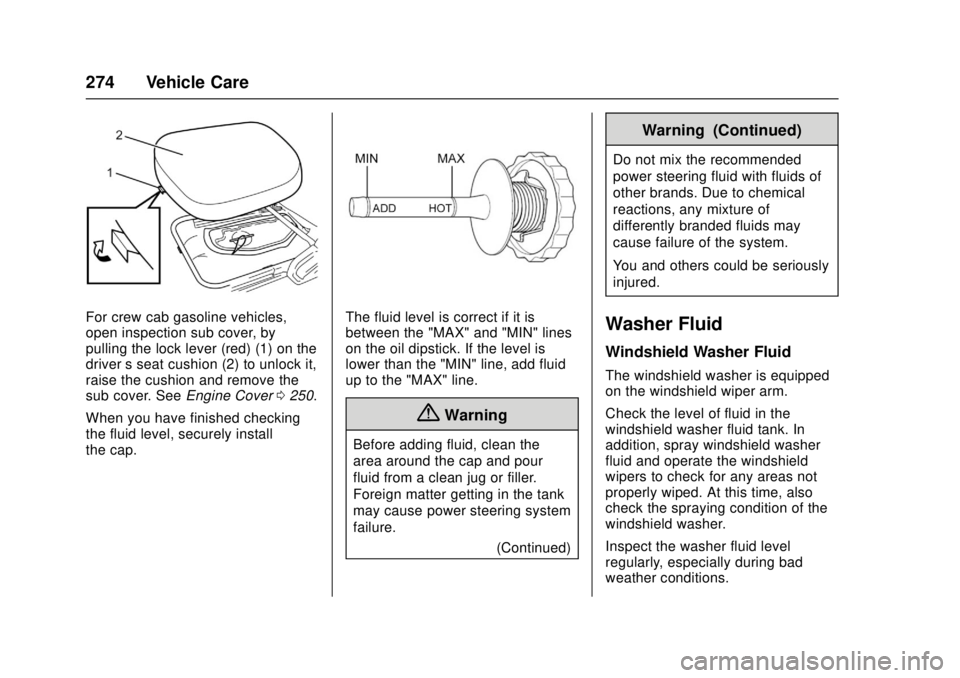
For crew cab gasoline vehicles,
open inspection sub cover, by
pulling the lock lever (red) (1) on the
driver’s seat cushion (2) to unlock it,
raise the cushion and remove the
sub cover. See Engine Cover0250.
When you have finished checking
the fluid level, securely install
the cap.The fluid level is correct if it is
between the "MAX" and "MIN" lines
on the oil dipstick. If the level is
lower than the "MIN" line, add fluid
up to the "MAX" line.
{Warning
Before adding fluid, clean the
area around the cap and pour
fluid from a clean jug or filler.
Foreign matter getting in the tank
may cause power steering system
failure. (Continued)
Warning (Continued)
Do not mix the recommended
power steering fluid with fluids of
other brands. Due to chemical
reactions, any mixture of
differently branded fluids may
cause failure of the system.
You and others could be seriously
injured.
Washer Fluid
Windshield Washer Fluid
The windshield washer is equipped
on the windshield wiper arm.
Check the level of fluid in the
windshield washer fluid tank. In
addition, spray windshield washer
fluid and operate the windshield
wipers to check for any areas not
properly wiped. At this time, also
check the spraying condition of the
windshield washer.
Inspect the washer fluid level
regularly, especially during bad
weather conditions.
Page 278 of 414

Chevrolet Low Cab Forward Owner Manual (GMNA-Localizing-U.S.-
10716700) - 2017 - crc - 12/6/16
Vehicle Care 277
Another characteristic of the HBB
system is that the brake pedal may
be depressed easily to the floor with
the vehicle at a stop. This is not a
sign of malfunction.
When the engine is running, the
system automatically charges the
accumulator whenever pressure has
been reduced after braking. Auto
charge may be activated without
braking, depending on temperature
changes in the accumulator. During
auto charge, a hissing and clicking
sound can be heard. This is not a
malfunction.
With the engine running, a booming
sound can be heard during hard
braking. This comes from the
brake-fluid pump. It is not a
malfunction.
Applying continuous hard braking
for a long time will lead to
considerable temperature rise in the
HBB pump. Such overworking of the
brakes is best avoided.Vacuum or hydraulic power
assisted brakes
If the engine stops, do not pump the
brakes. The system is designed to
stop the vehicle with reserve power
assist if the brake pedal is held
down. This reserve is greatly
reduced each time you apply and
release the brakes. If, when you
turn the steering wheel during
braking, the vehicle does not turn,
release some pressure from the
brake pedal.
In a Vehicle Equipped with a HBB,
Do Not Keep the Brake Pedal
Depressed for an Extended Period
Caution
Failure to follow the above
instruction will cause the oil inside
the HBB oil pump to get very hot.
This could damage the HBB tank
and deteriorate seals and also
could cause damage to the HBB
oil pump, HBB unit and/or HBB
hosing. Eventual leakage of HBB
(Continued)
Caution (Continued)
oil, sudden increase in brake
pedal resistance and fire could
unexpectedly result in an
accident.
Hydraulic Brake Booster (HBB)
Fluid (5500HD/5500XD Series)
The HBB system has been
designed to use ATF Dexron fluid is
used with this system, rubber
components may be damaged, oil
may leak and the system may
malfunction. It is important to
remember that the fluid used in the
hydro-booster is completely different
in characteristics from the brake
fluid used in the master and wheel
cylinders.
If hydro-booster fluid and brake fluid
from the master cylinder are
mistakenly mixed together and
used, rubber components will
deteriorate as a result of insufficient
lubrication. Any resultant oil leakage
or system malfunction can in turn
lead to dragging brakes or other
Page 284 of 414

Chevrolet Low Cab Forward Owner Manual (GMNA-Localizing-U.S.-
10716700) - 2017 - crc - 12/6/16
Vehicle Care 283
Rear Axle (Gear Oil Viscosity Chart)
Gear Oil Viscosity Chart
Select appropriate gear oil in accordance with the table below. It is important
to select the viscosity appropriate for the temperature at which your vehicle
operates. Use the following table for making correct selections.
Rear Axle (Oil Level
Check)
Rear Axle Differential Gear Oil
The rear axle differential gear oil
level must be checked for its level
and it must be changed according to
the Maintenance Schedule.
Use the oil quantities indicated later
in this section only as guidelines
when changing the rear axle
differential gear oil.
After changing the oil, ensure that it
is at the correct level.
Drained oil must be disposed of in a
method conforming to the regulatory
requirements in your state.
Page 285 of 414

Chevrolet Low Cab Forward Owner Manual (GMNA-Localizing-U.S.-
10716700) - 2017 - crc - 12/6/16
284 Vehicle Care
Checking the Oil Level
1. Remove the oil level plug.
2. Check that the oil level (1) isup to the lower edge of the oil
level plug hole (2). If the oil
level is tool low, add oil through
the oil level plug hole.
3. Fasten the oil level plug to the specified torque. Plug
tightening torque is 84 Nm
(8.6 kgFm/62 lb ft).
Any dirt on the plug should be
wiped off before installing it.
Noise Control System
The following information relates to
compliance with federal noise
emission standards for vehicles with
a Gross Vehicle Weight Rating
(GVWR) of more than 4 536 kg
(10,000 lb). The maintenance
schedule provides information on
maintaining the noise control system
to minimize degradation of the noise
emission control system during the
life of your vehicle. The noise
control system warranty is set forth
in your Warranty and Owner
Information book.
These standards apply only to
vehicles sold in the United States.
Tampering with Noise Control
System Prohibited
Federal law prohibits the following
acts or the causing thereof: 1. The removal or rendering inoperative by any person,
other than for purposes of
maintenance, repair or
replacement, of any device or
element of design incorporated
into any new vehicle for the
purpose of noise control, prior
to its sale or delivery to the
ultimate purchaser or while it is
in use; or
2. The use of the vehicle after such device or element of
design has been removed or
rendered inoperative by any
person.
Among those acts presumed to
constitute tampering are the acts
listed below.
Insulation:
Removal of the noise shields or any
undercab insulation.
Page 294 of 414
Chevrolet Low Cab Forward Owner Manual (GMNA-Localizing-U.S.-
10716700) - 2017 - crc - 12/6/16
Vehicle Care 293
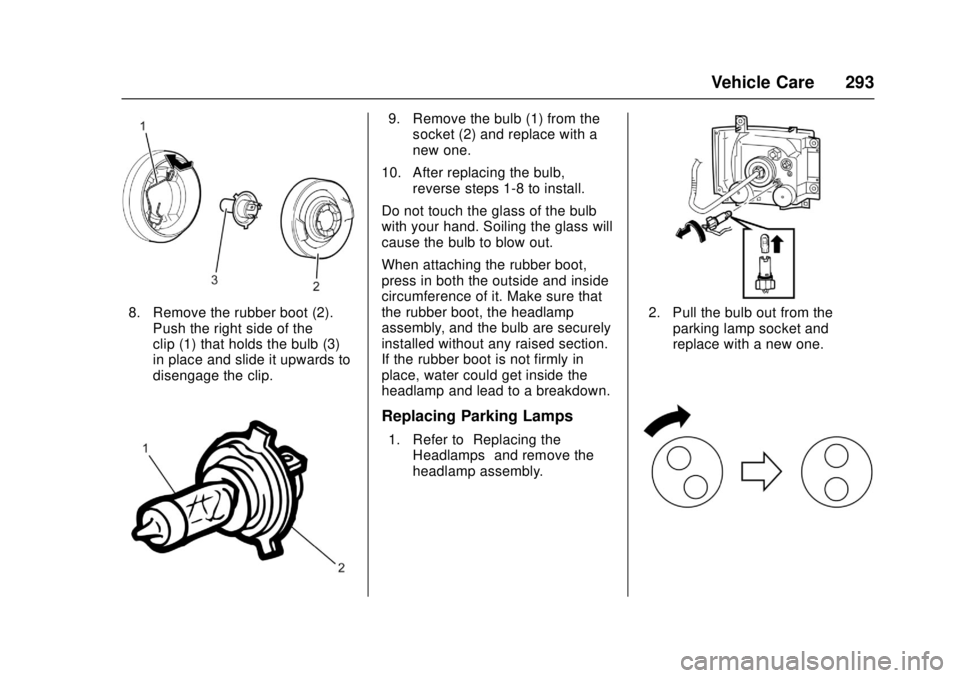
8. Remove the rubber boot (2).Push the right side of the
clip (1) that holds the bulb (3)
in place and slide it upwards to
disengage the clip.
9. Remove the bulb (1) from thesocket (2) and replace with a
new one.
10. After replacing the bulb, reverse steps 1-8 to install.
Do not touch the glass of the bulb
with your hand. Soiling the glass will
cause the bulb to blow out.
When attaching the rubber boot,
press in both the outside and inside
circumference of it. Make sure that
the rubber boot, the headlamp
assembly, and the bulb are securely
installed without any raised section.
If the rubber boot is not firmly in
place, water could get inside the
headlamp and lead to a breakdown.
Replacing Parking Lamps
1. Refer to “Replacing the
Headlamps” and remove the
headlamp assembly.
2. Pull the bulb out from the parking lamp socket and
replace with a new one.
Page 299 of 414

Chevrolet Low Cab Forward Owner Manual (GMNA-Localizing-U.S.-
10716700) - 2017 - crc - 12/6/16
298 Vehicle Care
Interior Lamps
1. Remove the lens and pull outthe bulb.
2. To install the lights, follow the removal procedure in reverse.
Electrical System
Electrical System
Overload
Electrical System
Following the after-delivery service,
it is the owner's responsibility to
check all wiring periodically for
cracked, chafed or oil-soaked
insulation and maintain it in a clean
and tight condition to ensure
satisfactory operation of the
electrical system.
Replacing the Fuses and Relays
Your vehicle is equipped with fuses
and fusible links to protect your
electrical wiring and equipment in
case of electrical overload.
When the lights do not come on or
flash, or the equipment in the
electrical system does not operate,
check to see if a fuse has blown.
Fuses : In case of an electrical
overload, the fuse will blow and stop
the flow of current in the circuit
before electrical components
become damaged. The cause of the circuit overload
must be identified and corrected
before the blown fuse is replaced,
or else the new fuse will also blow.
Since different circuits handle
different amounts of current, fuses
of various ampere ratings are used.
Be sure to replace a blown fuse with
a fuse of the correct rating.
To know if a fuse is blown or not,
remove the suspected fuse and look
at the wire for a break. If the wire is
broken, replace the fuse with one of
equal amperage rating.
The amperage rating of each fuse is
molded in its head.
Fuses are installed in the fuse
panel.