service CHEVROLET LOW CAB FORWARD 2018 Owner's Guide
[x] Cancel search | Manufacturer: CHEVROLET, Model Year: 2018, Model line: LOW CAB FORWARD, Model: CHEVROLET LOW CAB FORWARD 2018Pages: 358, PDF Size: 6.32 MB
Page 129 of 358

Chevrolet Low Cab Forward Owner Manual (GMNA-Localizing-U.S.-
11254764) - 2018 - crc - 12/5/16
128 Driving and Operating
Warning (Continued)
You and others could be seriously
injured.
The exhaust brake should be turned
on as soon as service brake
malfunction is detected. This will
slow the engine speed. With the
engine speed under control and
providing the grade conditions
permit, the transmission can be
progressively downshifted using the
exhaust brake in each gear.
Eventually the exhaust brake should
slow the vehicle to a controllable
“crawl.” Gradually pull the parking
brake lever while firmly holding on
to the steering wheel. Stop the
vehicle on the side of the road. The
vehicle should not be driven further
until corrective measures are taken.
See Exhaust Brake 0201 and
Parking Brake 0200. Riding the Brake{Warning
"Riding the brake" by resting your
foot on the pedal, when you do
not intend to brake, can overheat
the brakes and wear out the
brake linings faster. This may also
damage the brakes and will waste
fuel. It can also result in reduced
braking performance.
You and others could be seriously
injured.
Applying the Parking Brake
Except in an emergency, do not
apply the parking brake until the
vehicle has come to a complete
stop. Applying the parking brake
before the vehicle has stopped can
cause a breakdown.
Refer to
Parking Brake 0200.
Parking Safely on a Slope
Avoid parking your vehicle on a
slope as much as possible and
choose a level and flat place. If you must park your vehicle on a slope,
be sure to set the parking brake
fully. Make sure that the vehicle
does not move, and block the
wheels with chocks for added
safety. Also, leave the vehicle in
gear to further ensure that it will not
move. Leave the steering wheel
turned such that the vehicle will be
stopped by an obstruction (for
example, the curb) in the unlikely
event that it moves.
Stopping and Parking with the
Engine Running
{Warning
When parking with the engine
running, first come to a complete
stop, then firmly apply the parking
brake, then move the selector
lever to the "P" (Park) position.
Unless you take these steps, any
unintended pressure on the
accelerator pedal could cause an
accident.
(Continued)
Page 131 of 358

Chevrolet Low Cab Forward Owner Manual (GMNA-Localizing-U.S.-
11254764) - 2018 - crc - 12/5/16
130 Driving and Operating
1. Hold the regular brake pedaldown with your right foot and
apply the parking brake all the
way before shifting the
transmission. Follow the
Parking Brake instructions in
this manual for your vehicle.
2. To move the selector lever to "P" (Park), hold in the button
on the lever and push the lever
all the way toward the front of
your vehicle.
3. Turn the key to "LOCK".
4. Remove the key and take it with you.
5. Before you leave the driver's seat, be sure the vehicle is not
moving, or check that your
vehicle is in Park by trying to
pull the selector lever out of "P"
(Park) by pulling the selector
lever toward you without
pushing the button. If you can
do this, it means that the
selector lever was not fully
locked into "P" (Park).Driving Down a Long Slope
When driving down a long slope,
use the exhaust brake together with
the foot brakes. Using the exhaust
brake and low-gears reduces the
work load on the foot brakes and
yields greater braking force. Even
so, use the foot brakes
appropriately to prevent the engine
over-revving.
Frequent use of the foot brakes can
cause vapor lock and brake fade,
resulting in reduced brake
effectiveness.
Brake Fade : Frequent use of the
brakes can cause the brakes to
overheat so that the frictional force
of the brake linings decreases and
the brakes become less effective
than normal. This phenomenon is
called brake fade.
Vapor Lock : If the brakes overheat
due to frequent use, the heat can
cause the brake fluid to boil so that
air bubbles are created in the brake
fluid. Pressing the brake pedal
simply compresses the air bubbles;
pressure is not transmitted to the
wheel cylinders, so the brakes' effectiveness sharply deteriorates.
This phenomenon is called
vapor lock.
Even so, you should be very careful
when using engine braking in a low
gear because the engine is likely to
over-rev.
See
Exhaust Brake 0201 and
Selector Lever 0194.
Do not adjust the exhaust brake
valve.
The engine should never be allowed
to exceed the governed speed.
Supplement the exhaust brake with
vehicle service brakes intermittently
and/or shift to higher transmission
gear to prevent engine overspeed.
A rule of thumb for gear selection is
that the vehicle should be driven
down a grade in the same gear that
would be used to climb that grade.
{Warning
To reduce the risk of personal
injury, before going down a steep
or long grade, reduce speed, turn (Continued)
Page 146 of 358
Chevrolet Low Cab Forward Owner Manual (GMNA-Localizing-U.S.-
11254764) - 2018 - crc - 12/5/16
Driving and Operating 145
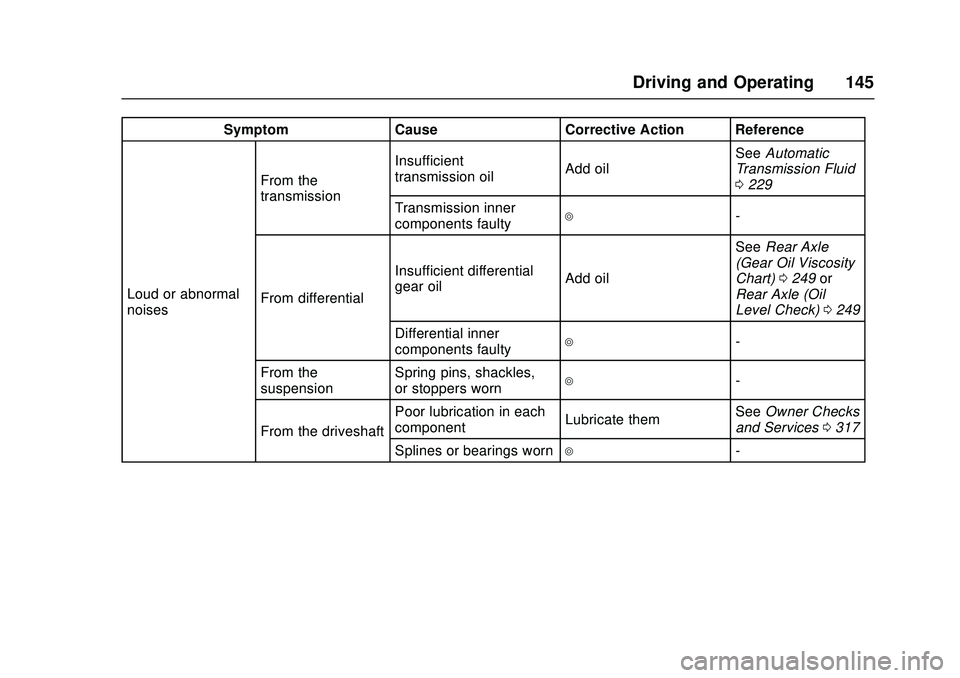
SymptomCauseCorrective Action Reference
Loud or abnormal
noises From the
transmission
Insufficient
transmission oil
Add oilSee
Automatic
Transmission Fluid
0 229
Transmission inner
components faulty
4-
From differential Insufficient differential
gear oil
Add oilSee
Rear Axle
(Gear Oil Viscosity
Chart) 0249 or
Rear Axle (Oil
Level Check) 0249
Differential inner
components faulty
4-
From the
suspension Spring pins, shackles,
or stoppers worn
4-
From the driveshaft Poor lubrication in each
component
Lubricate themSee
Owner Checks
and Services 0317
Splines or bearings worn
4-
Page 150 of 358

Chevrolet Low Cab Forward Owner Manual (GMNA-Localizing-U.S.-
11254764) - 2018 - crc - 12/5/16
Driving and Operating 149
The starting circuit, engine alarm
circuits and accessory circuits are
all controlled by the engine control
switch.1 LOCK :Lock is in the position
fully counterclockwise. In this
position, the key can be inserted or
removed. To place the engine
control switch in the LOCK position,
press and hold the key in the ACC
position and then turn it to the
LOCK position. If you will leave the
vehicle, remove the key and turn the
steering wheel until it locks. The
steering wheel will be locked to help
prevent theft.
2 ACC : Accessory is in the first
position clockwise. In this position,
the audio and other accessories can
be used with the engine stopped.
3 ON : This ON position is in the
second position clockwise. The key
stays in this position while the
engine is running. Engine control,
warning circuits, gauge circuits, and
accessory circuits are energized.
The engine cylinder heaters or glow
plugs are also turned on when the
switch is in the ON position. The
wait-to-start light will come on and
stay on until the glow plugs are heated enough. When this light
goes off, turn the switch to the
START position.
4 START :
On all engines, start is in
the position furthest clockwise. The
engine is started in this position.
Turn the key against spring
pressure to energize the starter.
When key is released, spring
pressure returns it to the ON
position. Release the key as soon
as the engine has started.
If the key cannot be turned from the
LOCK position to the ON position,
lightly move the steering wheel
clockwise and counterclockwise
while trying to turn the key.
Starting and Stopping the
Vehicle
Check around the Vehicle before
Starting the Engine
Proper care and operation will not
only extend the service life of your
vehicle but also improve fuel
economy.
Page 153 of 358
Chevrolet Low Cab Forward Owner Manual (GMNA-Localizing-U.S.-
11254764) - 2018 - crc - 12/5/16
152 Driving and Operating
Cold Weather Starting
If you plan ahead for cold weather,
starting and driving your vehicle
should be no problem. The following
tips will help ensure good starting in
cold weather.
Oil gets thicker as it gets colder,
which slows down the engine
cranking speed. The diesel engine
functions by the heat of
compression (and glow plugs when
cold), rather than through the use of
spark plugs as in a gasoline engine.
So, your engine must crank faster
than a gasoline engine before it will
start.
To be sure the engine can turn fast
enough to start, use SAE 10W-40
viscosity engine oil when prevailing
temperatures drop below 0 °C
(32 °F). See the oil quality and oil
viscosity recommendations. Using
the proper viscosity oil will make
starting easier down to -23 °C
(-10 °F). When prevailing
temperatures drop below -23 °C
(-10 °F), the engine block heater
may be needed for starting. See
Engine Heater0154. Maintenance Items to Aid Cold
Weather Starting
Since the basic principle of diesel
engine ignition is based on
compression, the diesel engine is
somewhat harder to start than a
gasoline engine when the
temperature is below freezing.
To help prevent hard starting
problems, special attention should
be given to following normal
maintenance items:
1. Neglecting to have the fuel filter and water separator
serviced can be one of the
major contributors to hard
starting. If water is permitted to
accumulate in the primary filter,
it will freeze and make starting
the engine impossible.
2. Make sure the fuel tank vent is open.
3. Always refuel at the end of a day's operation. Moisture will
condense in an empty tank;
therefore, the tank should be filled before leaving the vehicle
standing for an extended
period.
Do not use starting aids in the air
intake system. Such aids can cause
immediate engine damage. See
Fuel for Diesel Engines 0206.
Stopping the Engine
When stopping the engine, take the
following steps: 1. Bring the vehicle to a complete stop.
2. Firmly apply the parking brake.
3. Move the selector lever to the P position and make sure that
the shift indicator shows P.
4. Allow the engine to idle for approximately 3 minutes.
5. Turn the engine control switch to the ACC or LOCK position.
Do not shut down the engine
immediately after driving the vehicle.
Otherwise, a seizure or other
failures may result.
Page 156 of 358
Chevrolet Low Cab Forward Owner Manual (GMNA-Localizing-U.S.-
11254764) - 2018 - crc - 12/5/16
Driving and Operating 155
Engine Alarm and
Automatic Shutdown
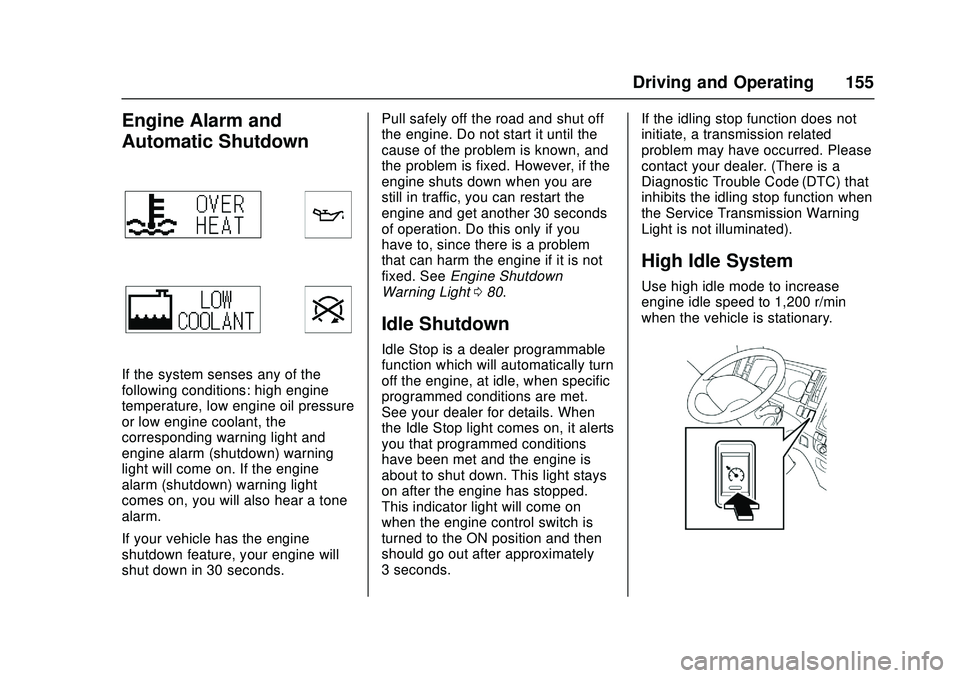
If the system senses any of the
following conditions: high engine
temperature, low engine oil pressure
or low engine coolant, the
corresponding warning light and
engine alarm (shutdown) warning
light will come on. If the engine
alarm (shutdown) warning light
comes on, you will also hear a tone
alarm.
If your vehicle has the engine
shutdown feature, your engine will
shut down in 30 seconds.Pull safely off the road and shut off
the engine. Do not start it until the
cause of the problem is known, and
the problem is fixed. However, if the
engine shuts down when you are
still in traffic, you can restart the
engine and get another 30 seconds
of operation. Do this only if you
have to, since there is a problem
that can harm the engine if it is not
fixed. See
Engine Shutdown
Warning Light 080.
Idle Shutdown
Idle Stop is a dealer programmable
function which will automatically turn
off the engine, at idle, when specific
programmed conditions are met.
See your dealer for details. When
the Idle Stop light comes on, it alerts
you that programmed conditions
have been met and the engine is
about to shut down. This light stays
on after the engine has stopped.
This indicator light will come on
when the engine control switch is
turned to the ON position and then
should go out after approximately
3 seconds. If the idling stop function does not
initiate, a transmission related
problem may have occurred. Please
contact your dealer. (There is a
Diagnostic Trouble Code (DTC) that
inhibits the idling stop function when
the Service Transmission Warning
Light is not illuminated).
High Idle System
Use high idle mode to increase
engine idle speed to 1,200 r/min
when the vehicle is stationary.
Page 173 of 358
Chevrolet Low Cab Forward Owner Manual (GMNA-Localizing-U.S.-
11254764) - 2018 - crc - 12/5/16
172 Driving and Operating
.Any substance other than the
DEF may cause a breakdown to
the SCR system.
. Use the DEF handling
equipment made of correct
materials (Polyethylene or
Stainless-steel).
. Avoid contamination from using
dirty funnel for filling.
. If a fluid other than the specified
DEF is mistakenly added,
incorrect fluid may cause a
failure. Have it inspected and
serviced at a dealer immediately.
. Ammonia odor may be
generated when the DEF is
exposed to high temperature.
. Do not add DEF above the F
position on the level gauge. DEF
may leak from the breather hose
while driving. Also, the sensor
may be broken when DEF
freezes.
. Do not put your feet on or stand
on the DEF tank. The tank, pipe
or sensors may be damaged. .
After stopping the engine, a flow
sound may be heard from the
DEF tank or DEF supply pump.
This sound occurs as the DEF in
the piping is returning to the
tank, and does not indicate an
abnormality.
See Winter Driving 0133.
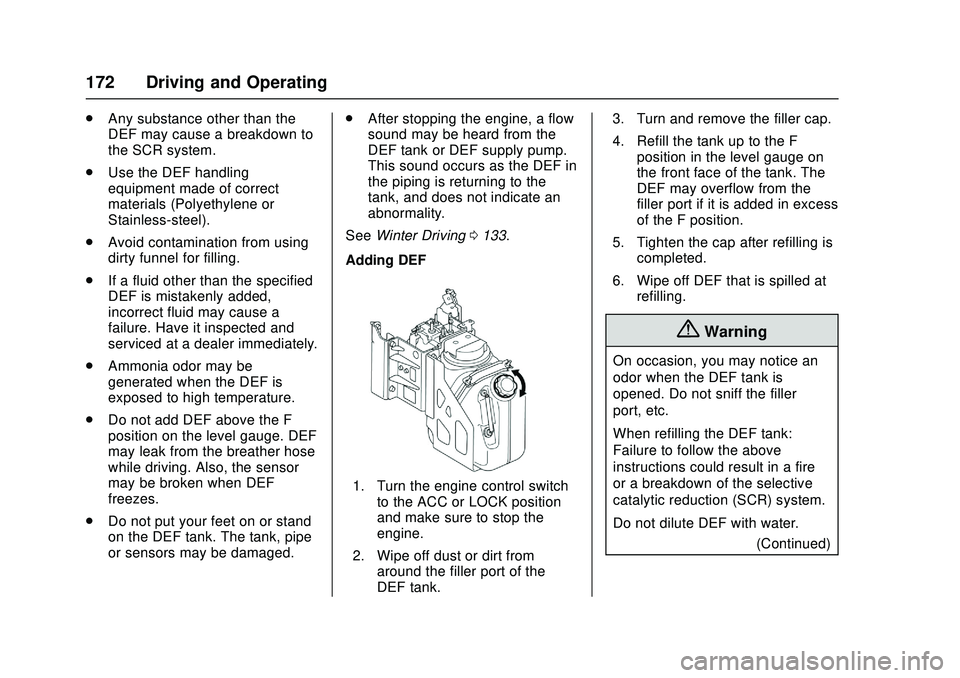
Adding DEF
1. Turn the engine control switch to the ACC or LOCK position
and make sure to stop the
engine.
2. Wipe off dust or dirt from around the filler port of the
DEF tank. 3. Turn and remove the filler cap.
4. Refill the tank up to the F
position in the level gauge on
the front face of the tank. The
DEF may overflow from the
filler port if it is added in excess
of the F position.
5. Tighten the cap after refilling is completed.
6. Wipe off DEF that is spilled at refilling.
{Warning
On occasion, you may notice an
odor when the DEF tank is
opened. Do not sniff the filler
port, etc.
When refilling the DEF tank:
Failure to follow the above
instructions could result in a fire
or a breakdown of the selective
catalytic reduction (SCR) system.
Do not dilute DEF with water.
(Continued)
Page 176 of 358

Chevrolet Low Cab Forward Owner Manual (GMNA-Localizing-U.S.-
11254764) - 2018 - crc - 12/5/16
Driving and Operating 175
If the DEF level becomes too low or
incorrect fluid is added to the DEF
tank, the warning buzzer will sound,
warning and indicator lights will
come on and engine power will be
reduced. If you see these warning
and indicator lights, add DEF as
soon as possible or have your
vehicle serviced as soon as
possible.
Continuing to drive for too long after
these lights come on will result in
additional warnings, more engine
power reduction and will eventually
result in a severe vehicle speed
limitation. See“Diesel Exhaust
Fluid (DEF) Low Level Warning” and
“Incorrect Diesel Exhaust Fluid
(DEF)/SCR System Malfunction
Warnings” later in this section.
{Warning
Do not touch the water that
comes out from the muffler. The
water is mildly acidified due to the
action of oxidation catalyst inside
the muffler. In the event that the
(Continued)
Warning (Continued)
fluid does come into contact with
your skin, completely wash it off
with water. You and others could
be seriously injured.
Do not relocate or modify the
exhaust pipe, muffler, DPF, SCR,
or DEF tank, which may affect the
exhaust gas cleaning performance.
If any relocation or modification is
necessary, consult your dealer.
The SCR system continues to
operate for approximately 3 minutes
after the engine control switch is
turned to the "LOCK" position. It is
normal to hear a buzzing type noise
from the DEF supply pump
(mounted on the left side frame rail
behind the cab) during the
shutdown process.
If it is necessary to disconnect the
batteries for any reason, be sure to
wait at least 3 minutes after turning
the engine control switch to the
"LOCK" position. This will allow the SCR system to properly complete
its shutdown processes. See
Winter
Driving 0133.
Diesel Exhaust Fluid (DEF) Low
Level Warning
Diesel Exhaust Fluid (DEF) is a
required fluid for the operation of
your diesel engine just as diesel fuel
is required. To avoid running out of
DEF your vehicle will turn on
warning and indicator lights and
reduce engine power in progressive
stages to encourage adding DEF.
The following is a summary of the
diesel exhaust fluid (DEF) low level
warning lights, indicator lights and
engine power reductions.
Continuing to drive for too long after
these lights come on will eventually
result in a severe vehicle speed
limitation.
These warning and indicator lights
will go out automatically and engine
power will be restored to normal
after the SCR system detects that
the DEF tank is refilled with DEF.
Page 179 of 358

Chevrolet Low Cab Forward Owner Manual (GMNA-Localizing-U.S.-
11254764) - 2018 - crc - 12/5/16
178 Driving and Operating
DEF Tank Level is Low/Empty (cont'd)
StageStage 1 Stage 2Stage 3Stage 4
CAUTION
This message indicates incorrect DEF or an SCR system malfunction. Immediately contact
your dealer to have your vehicle serviced *2
Remarks:
*1 –See Diesel Exhaust
Fluid (DEF).
*2 –See Incorrect Diesel Exhaust
Fluid (DEF) /SCR System
Malfunction Warnings.
*3 –The warning buzzer continues
to sound every 5 minutes.
*4 –The warning buzzer continues
to sound every 5 minutes and when
driving 8 km (5 miles) or more, the
buzzer changes its sound to
continuous beeping.
DEF tank low stages are as follows: Stage 1 :
When the remaining level
of DEF becomes excessively low
the DEF gauge will change color
from green to amber. In addition,
warning and indicator lights will
come on as shown in the table and
engine power will be reduced so the
vehicle speed will not exceed
89 km/h (55 MPH).
Stage 2 : If driving is continued
without adding DEF (approximately
320 km (200 miles)) the DEF gauge,
warning and indicator lights will
begin blinking. Again, engine power
will be reduced so the vehicle speed
will not exceed 56 km/h (35 MPH). Stage 3 :
If driving is continued until
the DEF tank is empty, the DEF
gauge will change color from amber
to red and the warning and indicator
lights will begin to blink faster.
Engine power will still be reduced so
the vehicle speed will not exceed
56 km/h (35 MPH). The vehicle
speed will be limited to
8 km/h (5 MPH) either when the
vehicle is stopped after driving
further on (approximately
8 km (5 miles)) or when the engine
is restarted.
Page 180 of 358

Chevrolet Low Cab Forward Owner Manual (GMNA-Localizing-U.S.-
11254764) - 2018 - crc - 12/5/16
Driving and Operating 179
Stage 4 :The DEF gauge is red,
the indicator light is blinking and the
buzzer is beeping continuously
indicates the vehicle speed is
limited to 8 km/h (5 MPH). See
Driver Information Center (DIC)
0 82.
Incorrect Diesel Exhaust Fluid
(DEF)/SCR System Malfunction
Warnings
The SCR system continuously
monitors emissions reduction
performance and SCR system
malfunction (Type A or Type B).
When a malfunction or incorrect
fluid (such as water or low
concentrated DEF, etc.) is detected,
the SCR system will turn on warning
and indicator lights to encourage
you to have the condition corrected.
In the case of incorrect fluid or if an
SCR system malfunction (Type A) is
detected, continuing to drive for too
long after these lights come on may
eventually result in a severe vehicle
speed limitation. The following is a summary of the
warning lights, indicator lights and
restrictions. When these warning
and indicator lights come on the
DIC, promptly have the vehicle
inspected and serviced at a dealer.
In the case of SCR system
malfunction (Type B), have the
vehicle inspected and serviced at a
dealer.