service CHEVROLET LOW CAB FORWARD 2018 Service Manual
[x] Cancel search | Manufacturer: CHEVROLET, Model Year: 2018, Model line: LOW CAB FORWARD, Model: CHEVROLET LOW CAB FORWARD 2018Pages: 358, PDF Size: 6.32 MB
Page 219 of 358

Chevrolet Low Cab Forward Owner Manual (GMNA-Localizing-U.S.-
11254764) - 2018 - crc - 12/5/16
218 Vehicle Care
General Information
Your authorized dealer has trained
technicians and genuine parts to
service your vehicle properly. For
expert advice and quality service,
see your authorized dealer.
California Proposition
65 Warning
Most motor vehicles, including this
one, as well as many of its service
parts and fluids, contain and/or emit
chemicals known to the State of
California to cause cancer and birth
defects or other reproductive harm.
Engine exhaust, many parts and
systems (including some inside the
vehicle), many fluids and some
component wear by-products
contain and/or emit these
chemicals.
California Perchlorate
Materials Requirements
Certain types of automotive
applications, such as airbag
initiators, seat belt pretensioners,
and lithium batteries contained inremote keyless transmitters, may
contain perchlorate materials.
Special handling may be necessary.
For additional information, see
www.dtsc.ca.gov/hazardouswaste/
perchlorate.
Accessories and
Modifications
Factory-Approved Accessories
Your dealer can furnish a wide
range of comfort, convenience, and
safety accessories, especially
designed for you and your new
truck. They can install all of the
safety accessories you will need to
comply with local, state and D.O.T.
regulations and advise you how to
comply with these regulations.
Be sure to ask your authorized
dealer about the accessories.
Vehicle Checks
Doing Your Own
Service Work
Precautions for Checking and
Adjustments
Your authorized dealer has trained
technicians and genuine parts to
service your vehicle properly. For
expert advice and quality service,
see your authorized dealer.
{Warning
To help avoid personal injury, take
care when doing any
maintenance or making any
check or repair. Follow
manufacturer's instructions for all
materials used during service and
maintenance of this vehicle.
If used or handled improperly,
they may be hazardous. Improper
or incomplete service can also
affect the vehicle and result in
personal injury, or damage to the
(Continued)
Page 220 of 358

Chevrolet Low Cab Forward Owner Manual (GMNA-Localizing-U.S.-
11254764) - 2018 - crc - 12/5/16
Vehicle Care 219
Warning (Continued)
vehicle or its equipment. If you
have any questions about
carrying out some service, have
the work done by a skilled
technician.
To prevent personal injury, keep
hands, tools and clothing clear of
the engine cooling fan when the
engine is running.
The engine, exhaust pipe and
radiator will be hot immediately
after the vehicle is driven. Be
careful around these parts to
prevent burns. Perform all checks
when the engine is cold.
Do not perform work near an
open flame or other heat sources.
Do not let the engine run in poorly
ventilated garages or sheds. This
could cause carbon monoxide
poisoning.(Continued)
Warning (Continued)
Performing maintenance work on
a truck or chassis can be
dangerous. In trying to do some
jobs, you can be seriously injured.
Do your own maintenance work
only if you have the required
know-how and the proper tools
and equipment for the job. If you
have any doubts, contact your
dealer.
You and others could be seriously
injured.
Pull firmly on the parking brake
lever and move the selector lever to
"P" and make sure the shift indicator
displays "P".
Make sure to turn off the engine and
remove the key from the engine
control switch before performing any
checks.
Select a place with a solid and level
surface to perform the checking and
maintenance work. Make sure to chock the wheels. It would be very
dangerous if the vehicle started
to move.
When performing work on the
electrical system, begin by turning
the engine control switch to the
"LOCK" position, wait at least
3 minutes, and then disconnect the
negative cable from the negative
terminal on battery. If the negative
cable is disconnected within
3 minutes, the engine control
module may malfunction.
When working on the fuel line or
fuel filter, remove the fuel tank filler
cap. The fuel system is under
pressure and the fuel will overspill
unless the pressure is relieved,
possibly leading to combustion or
a fire.
Do not make engine adjustments
yourself. Be sure to consult your
dealer.
Use only appropriate tools.
Oils, brake fluid and engine coolant
have lubrication, cooling and rust
prevention functions. If these liquids
deteriorate through loss or
Page 232 of 358

Chevrolet Low Cab Forward Owner Manual (GMNA-Localizing-U.S.-
11254764) - 2018 - crc - 12/5/16
Vehicle Care 231
.Dipstick H (HOT) —
Transmission fluid
temperature Approx.
70 - 80 °C (158 - 176 °F).
. The “C (COLD)” range on
the dipstick is a guide used
by your dealer for
specialized equipment used
to replace or service the
automatic transmission
fluid. When performing your
own inspections, always
use the “H (HOT)” range
after warming up the
vehicle.
The fluid must be hot to
ensure an accurate check.
The fluid level rises as
temperature increases.
6. If the fluid level is too low, add the specified fluid through the
dipstick guide tube. Also, check
whether there are no fluid
leaks.
7. Insert the dipstick securely into position.{Warning
Be extremely careful not to burn
yourself when checking the oil
level if the engine temperature is
high. Protect yourself with
gloves etc.
You and others could be seriously
injured.
Discarded parts, oil, grease and
fluids could have an adverse effect
on the environment. It is difficult to
dispose of these, so have your
dealer handle all checks and
replacements.
Engine Air Cleaner/Filter
Air Cleaner
Use of clogged air cleaner element
not only causes a deterioration in
the engine output but also increased
fuel consumption and dark exhaust
smoke. Be sure to use a genuine air cleaner
element. If other air cleaner element
is used, it may cause the sensor to
output a wrong signal.
See
Maintenance Schedule 0303.
Air Cleaner Indicator Light
When the air cleaner indicator light
comes on, check the air cleaner
element. If the air cleaner element is
clogged, replace the air cleaner
element.
See Vehicle Messages 086.
See Maintenance Schedule 0303.
Engine Coolant
Protection of Engine Against
Overcooling
Overcooling of the engine not only
accelerates wear of the vital engine
parts but also hurts fuel economy.
Engine Coolant in Cold
Weather
To prevent the engine damage due
to freezing of the engine coolant,
mix the coolant and water at the
ratio of 50/50.
Page 239 of 358

Chevrolet Low Cab Forward Owner Manual (GMNA-Localizing-U.S.-
11254764) - 2018 - crc - 12/5/16
238 Vehicle Care
If you see or hear escaping steam
or have any other reason to suspect
there is a serious overheat
condition, stop and park the vehicle
as soon as it is safe to do so, turn
on the hazard warning flasher and
then turn off the engine immediately
and safely exit the vehicle.
If Steam Is Not Coming from the
Engine Compartment
If the engine coolant temperature
gauge shows an overheat condition,
or you have reason to suspect the
engine may be overheating, take
the following steps:1. Operate the hazard warning flasher and pull the vehicle
immediately over to a safe
place that does not impede
traffic and park it.
2. Idle the engine and wait until the engine coolant temperature
drops to safety zone. If your air
conditioner (if equipped) is on,
turn it off. And turn on the
heater to help the engine
expel heat. 3. When the needle of the engine
coolant temperature gauge
returns to the middle of the
safety zone, stop the engine.
If the needle of engine coolant
temperature gauge does not
drop inside into the safety
zone, turn the engine off and
have your vehicle serviced at
the nearest dealer.
When the cooling fan for the
radiator is not turning, turn off
the engine immediately.
{Warning
Even when the engine has been
stopped, the engine coolant in the
radiator remains under pressure.
Immediately removing the radiator
cap could cause steam or hot
water to blow out, and you could
be scalded as a result. The
engine coolant in the reserve tank
may also be hot. Immediately
removing the cap could cause hot
water to blow out, and possibly
scald you. Perform inspection,
(Continued)
Page 242 of 358

Chevrolet Low Cab Forward Owner Manual (GMNA-Localizing-U.S.-
11254764) - 2018 - crc - 12/5/16
Vehicle Care 241
Warning (Continued)
Do not mix the recommended
power steering fluid with fluids of
other brands. Due to chemical
reactions, any mixture of
differently branded fluids may
cause failure of the system.
You and others could be seriously
injured.
Washer Fluid
Windshield Washer Fluid
The windshield washer is equipped
on the windshield wiper arm.
Check the level of fluid in the
windshield washer fluid tank. In
addition, spray windshield washer
fluid and operate the windshield
wipers to check for any areas not
properly wiped. At this time, also
check the spraying condition of the
windshield washer.Inspect the washer fluid level
regularly, especially during bad
weather conditions.
Use a high quality premixed solvent
available at most dealers or service
stations.
Avoid hard water when mixing
windshield washer solvents. Hard
water contaminants may plug
orifices in the washer system and
reduce performance.
Do not use radiator antifreeze in the
windshield washer; it could cause
cab paint damage.
In cold weather, warm the
windshield with the defrosters
before using the washer, to help
prevent icing that may block the
driver's vision.
Refilling Windshield Washer
Fluid
1. The windshield washer fluid
tank (1) is located under the
instrument panel on the
passenger side.
2. Open the cap (2) and fill the tank with windshield washer
fluid.
Upon factory shipment, new
vehicles contain only tap water in
the washer fluid tank. Adjust the
concentration of the fluid to suit your
own usage.
Page 265 of 358
Chevrolet Low Cab Forward Owner Manual (GMNA-Localizing-U.S.-
11254764) - 2018 - crc - 12/5/16
264 Vehicle Care
Interior Lamps
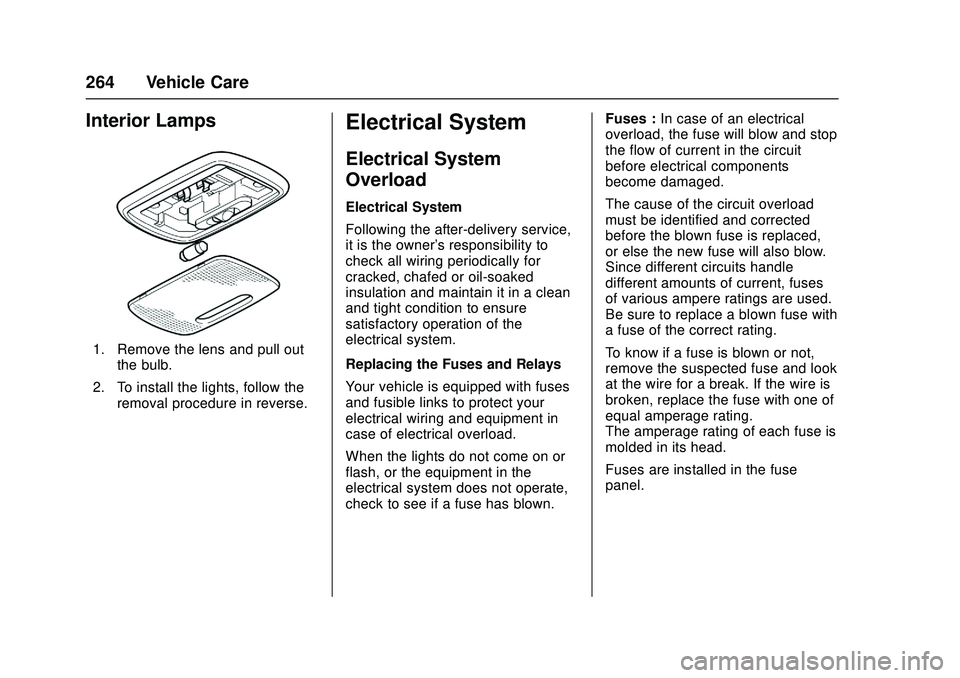
1. Remove the lens and pull outthe bulb.
2. To install the lights, follow the removal procedure in reverse.
Electrical System
Electrical System
Overload
Electrical System
Following the after-delivery service,
it is the owner's responsibility to
check all wiring periodically for
cracked, chafed or oil-soaked
insulation and maintain it in a clean
and tight condition to ensure
satisfactory operation of the
electrical system.
Replacing the Fuses and Relays
Your vehicle is equipped with fuses
and fusible links to protect your
electrical wiring and equipment in
case of electrical overload.
When the lights do not come on or
flash, or the equipment in the
electrical system does not operate,
check to see if a fuse has blown. Fuses :
In case of an electrical
overload, the fuse will blow and stop
the flow of current in the circuit
before electrical components
become damaged.
The cause of the circuit overload
must be identified and corrected
before the blown fuse is replaced,
or else the new fuse will also blow.
Since different circuits handle
different amounts of current, fuses
of various ampere ratings are used.
Be sure to replace a blown fuse with
a fuse of the correct rating.
To know if a fuse is blown or not,
remove the suspected fuse and look
at the wire for a break. If the wire is
broken, replace the fuse with one of
equal amperage rating.
The amperage rating of each fuse is
molded in its head.
Fuses are installed in the fuse
panel.
Page 273 of 358

Chevrolet Low Cab Forward Owner Manual (GMNA-Localizing-U.S.-
11254764) - 2018 - crc - 12/5/16
272 Vehicle Care
{Warning
Always use fuses specified by the
dealer when replacing the
slow-blow fuse. Using fuses with
a rating other than that specified,
or using wire or tin foil, etc., could
result in fire or damage.
If the new fuses blow right away
and the cause is unknown,
contact your dealer.
Do not inspect or replace fuses
when the starter switch is in the
ON position. Doing so may lead
to an accident.
When inspecting fuses, be sure to
park the vehicle on flat, level
ground and apply chocks to the
wheels.It is not necessary to open or close
the cover unless trouble is found.
The relay box structure makes it
difficult for water to enter. If you
should spill water or a beverage of
the cover, however, wipe it off
before opening the cover.
The area around the cover will get
warm when the vehicle is being
driven, but this is not abnormal.
Wheels and Tires
The operating load and cold inflation
pressure on the rim and wheel must
not exceed the rim and wheel
manufacturer's recommendations
even though the tire may be
approved for a higher load or
inflation. Rim and wheel may be
identified (stamped) with maximum
load and maximum cold inflation
rating. For rims and wheels not so
identified or for service conditions
exceeding the rate capacities,
consult the rim and wheel
manufacturer to determine rim and
wheel capacities for the intended
service. The factory-installed tires
on this vehicle were selected to
provide the best all-around tire
performance for normal operation.
When inflated, as shown on the
vehicle, they have the load carrying
capacity to operate satisfactorily at
all loads up to and including the full
rated load specified for the vehicle.
For more information concerning the
differences in capacities of tires and
rims, refer to the
“Tire and Rim
Association Inc. Yearbook,” or your
authorized dealer or tire dealer.
Page 282 of 358
Chevrolet Low Cab Forward Owner Manual (GMNA-Localizing-U.S.-
11254764) - 2018 - crc - 12/5/16
Vehicle Care 281
Damaged Tires
{Danger
It is dangerous to mount the
wrong size tire on a wheel. If you
do so, the tire/wheel can explode
as air is being added. This
explosion may result in severe
personal injury or death. To learn
which wheels and tires are
correct, look at the "VIN, Weight
Rating, and Greenhouse Gas
(GHG) Emissions Plate" on the
left side rear pillar panel below
the striker (single cab) or on the
left center pillar panel beside the
shoulder seat belt anchor (crew
cab). Wheel size is also stamped
on the side of each wheel.
To help avoid personal injury and
property damage if a wheel must
be changed, seek expert tire
services if you can. If you must
remove the wheel without any
such help, do the following:(Continued)
Danger (Continued)
.If the tire looks as if it may
be underinflated, stand to
the side and check whether
the wheel assembly
appears normal by
comparing it to another
wheel assembly on the
vehicle.
. Let the air out of the tire by
taking out the valve core.
If you have a way to put air
back in a tire, note that it is
good safety practice to let
the air out of both tires of a
dual assembly before taking
off the damaged tire and rim
assembly from the vehicle.
After letting out the air, take
off the tire and rim assembly
and install a spare tire and
rim assembly.
If your vehicle is equipped
with a differential lock
system or limited slip
differential (LSD), it might
(Continued)
Danger (Continued)
start moving when the
engine power is transmitted
to the rear axle even when
one of the wheels on the
axle is raised clear of the
ground. Do not start the
engine with any rear wheel
in contact with the ground.
If you are not fully
experienced on the
procedures to follow, and/or
are not equipped with the
proper tools and equipment,
again, do not attempt to
raise the vehicle, or remove
or install the tire and wheel
assembly—seek expert tire
services.
. Do not put air back in a tire
that has been run flat, or is
seriously low on air, without
first having the tire taken off
the wheel and the tire
checked for damage.
(Continued)
Page 283 of 358
Chevrolet Low Cab Forward Owner Manual (GMNA-Localizing-U.S.-
11254764) - 2018 - crc - 12/5/16
282 Vehicle Care
Danger (Continued)
.Note that taking off and
mounting tires on wheels
requires proper tools, safety
equipment and special
training. A person can be
severely injured or killed
and damage can result from
using the wrong service
methods. Truck tires and
wheels should be serviced
only by trained people using
the proper equipment.
. Never add air to your tires
unless an accurate pressure
gauge is also used. When
putting air in a tire on the
vehicle, stand to the side
and use a clip-on chuck and
hose extension. In choosing
the right tire pressure, be
careful not to exceed the
maximum pressure
capability shown on the tire;
see the tire pressure charts
in this manual.
(Continued)
Danger (Continued)
.Tire mounting or repair can
result in serious personal
injury or death, if not
performed correctly. This
section has detailed
instructions for proper wheel
and tire replacement, so be
sure to read and follow
them. Truck fleet owners
and operators: You can get
written instructions on truck
tire demounting, repair and
mounting from Rubber
Manufacturers Association
(RMA), 1400 K Street N.W.,
Washington, D.C. 20005,
and also from many tire
stores.
Wheel Nut Torque
{Warning
Never use oil or grease on studs
or nuts. Use the torque specified
for the type of wheels on the (Continued)
Warning (Continued)
vehicle. Snug all wheel nuts and
then tighten to the specified
torque in the numerical sequence
shown. Improperly tightened
wheel nuts could eventually allow
the wheel to come off while the
vehicle is moving, possibly
causing loss of control and
personal injury and property
damage.
When the vehicle, wheel or
fasteners are new, have a
technician tighten wheel stud nuts
and rim clamp nuts with a torque
wrench at 1 040 km (650 mi). This is
necessary because the clamping
system used on the wheels must
seat before the fastener will hold a
uniform clamp load and remain fully
tightened. Also have a technician
tighten wheel stud nuts and rim
clamp nuts with a torque wrench
after installing any wheel.
Page 285 of 358
Chevrolet Low Cab Forward Owner Manual (GMNA-Localizing-U.S.-
11254764) - 2018 - crc - 12/5/16
284 Vehicle Care
Tire Pressure
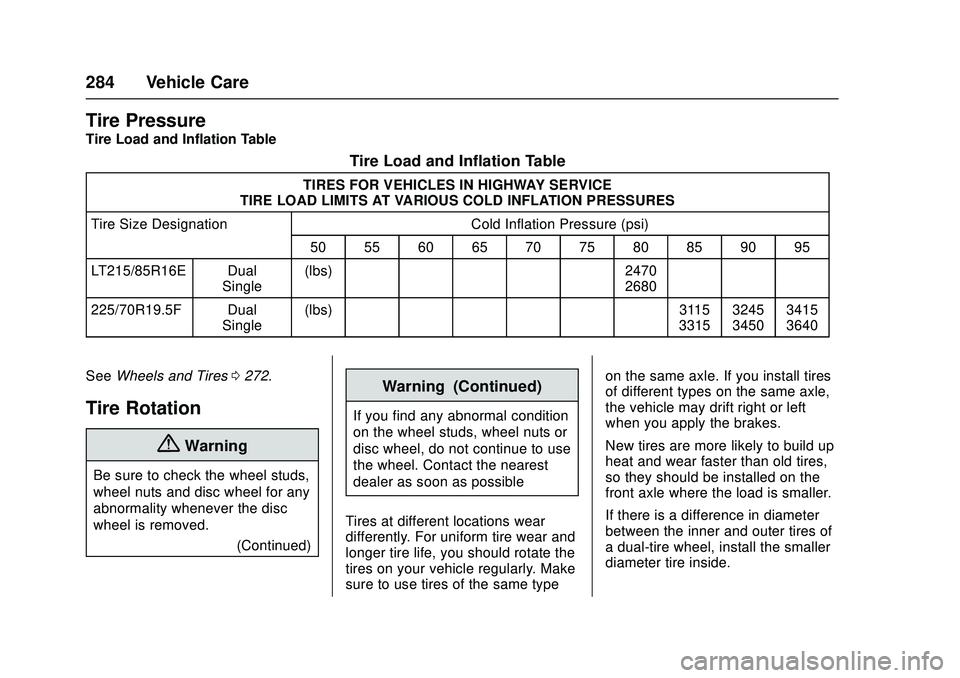
Tire Load and Inflation Table
Tire Load and Inflation Table
TIRES FOR VEHICLES IN HIGHWAY SERVICE
TIRE LOAD LIMITS AT VARIOUS COLD INFLATION PRESSURES
Tire Size Designation Cold Inflation Pressure (psi) 50 55 60 65 70 75 80 85 90 95
LT215/85R16E Dual Single(lbs) 2470
2680
225/70R19.5F Dual Single(lbs) 3115
33153245
34503415
3640
See Wheels and Tires 0272.
Tire Rotation
{Warning
Be sure to check the wheel studs,
wheel nuts and disc wheel for any
abnormality whenever the disc
wheel is removed.
(Continued)
Warning (Continued)
If you find any abnormal condition
on the wheel studs, wheel nuts or
disc wheel, do not continue to use
the wheel. Contact the nearest
dealer as soon as possible
Tires at different locations wear
differently. For uniform tire wear and
longer tire life, you should rotate the
tires on your vehicle regularly. Make
sure to use tires of the same type on the same axle. If you install tires
of different types on the same axle,
the vehicle may drift right or left
when you apply the brakes.
New tires are more likely to build up
heat and wear faster than old tires,
so they should be installed on the
front axle where the load is smaller.
If there is a difference in diameter
between the inner and outer tires of
a dual-tire wheel, install the smaller
diameter tire inside.