wheel CHEVROLET LOW CAB FORWARD 2018 Owner's Guide
[x] Cancel search | Manufacturer: CHEVROLET, Model Year: 2018, Model line: LOW CAB FORWARD, Model: CHEVROLET LOW CAB FORWARD 2018Pages: 358, PDF Size: 6.32 MB
Page 135 of 358
Chevrolet Low Cab Forward Owner Manual (GMNA-Localizing-U.S.-
11254764) - 2018 - crc - 12/5/16
134 Driving and Operating
SeeEngine Coolant 0231.
See Washer Fluid 0241.
See Battery 0247.
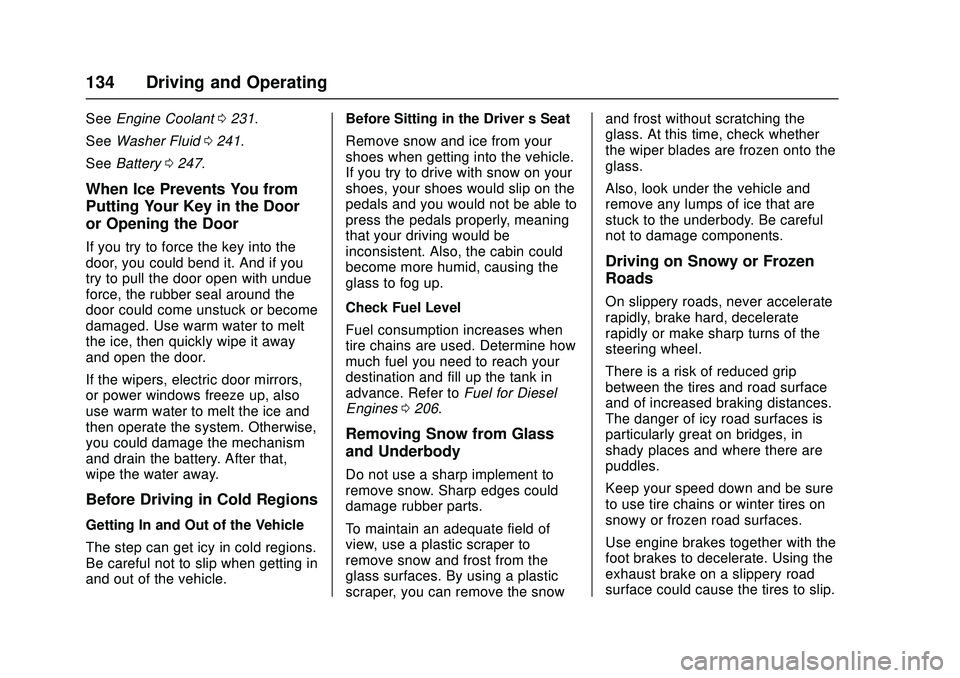
When Ice Prevents You from
Putting Your Key in the Door
or Opening the Door
If you try to force the key into the
door, you could bend it. And if you
try to pull the door open with undue
force, the rubber seal around the
door could come unstuck or become
damaged. Use warm water to melt
the ice, then quickly wipe it away
and open the door.
If the wipers, electric door mirrors,
or power windows freeze up, also
use warm water to melt the ice and
then operate the system. Otherwise,
you could damage the mechanism
and drain the battery. After that,
wipe the water away.
Before Driving in Cold Regions
Getting In and Out of the Vehicle
The step can get icy in cold regions.
Be careful not to slip when getting in
and out of the vehicle. Before Sitting in the Driver
’s Seat
Remove snow and ice from your
shoes when getting into the vehicle.
If you try to drive with snow on your
shoes, your shoes would slip on the
pedals and you would not be able to
press the pedals properly, meaning
that your driving would be
inconsistent. Also, the cabin could
become more humid, causing the
glass to fog up.
Check Fuel Level
Fuel consumption increases when
tire chains are used. Determine how
much fuel you need to reach your
destination and fill up the tank in
advance. Refer to Fuel for Diesel
Engines 0206.
Removing Snow from Glass
and Underbody
Do not use a sharp implement to
remove snow. Sharp edges could
damage rubber parts.
To maintain an adequate field of
view, use a plastic scraper to
remove snow and frost from the
glass surfaces. By using a plastic
scraper, you can remove the snow and frost without scratching the
glass. At this time, check whether
the wiper blades are frozen onto the
glass.
Also, look under the vehicle and
remove any lumps of ice that are
stuck to the underbody. Be careful
not to damage components.
Driving on Snowy or Frozen
Roads
On slippery roads, never accelerate
rapidly, brake hard, decelerate
rapidly or make sharp turns of the
steering wheel.
There is a risk of reduced grip
between the tires and road surface
and of increased braking distances.
The danger of icy road surfaces is
particularly great on bridges, in
shady places and where there are
puddles.
Keep your speed down and be sure
to use tire chains or winter tires on
snowy or frozen road surfaces.
Use engine brakes together with the
foot brakes to decelerate. Using the
exhaust brake on a slippery road
surface could cause the tires to slip.
Page 136 of 358
Chevrolet Low Cab Forward Owner Manual (GMNA-Localizing-U.S.-
11254764) - 2018 - crc - 12/5/16
Driving and Operating 135
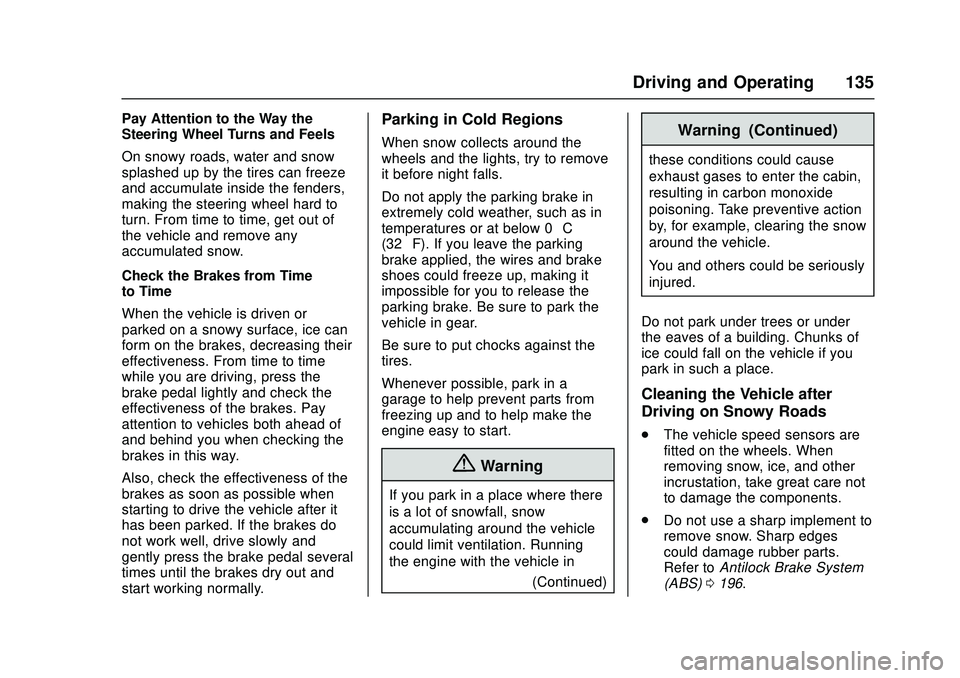
Pay Attention to the Way the
Steering Wheel Turns and Feels
On snowy roads, water and snow
splashed up by the tires can freeze
and accumulate inside the fenders,
making the steering wheel hard to
turn. From time to time, get out of
the vehicle and remove any
accumulated snow.
Check the Brakes from Time
to Time
When the vehicle is driven or
parked on a snowy surface, ice can
form on the brakes, decreasing their
effectiveness. From time to time
while you are driving, press the
brake pedal lightly and check the
effectiveness of the brakes. Pay
attention to vehicles both ahead of
and behind you when checking the
brakes in this way.
Also, check the effectiveness of the
brakes as soon as possible when
starting to drive the vehicle after it
has been parked. If the brakes do
not work well, drive slowly and
gently press the brake pedal several
times until the brakes dry out and
start working normally.Parking in Cold Regions
When snow collects around the
wheels and the lights, try to remove
it before night falls.
Do not apply the parking brake in
extremely cold weather, such as in
temperatures or at below 0 °C
(32 °F). If you leave the parking
brake applied, the wires and brake
shoes could freeze up, making it
impossible for you to release the
parking brake. Be sure to park the
vehicle in gear.
Be sure to put chocks against the
tires.
Whenever possible, park in a
garage to help prevent parts from
freezing up and to help make the
engine easy to start.
{Warning
If you park in a place where there
is a lot of snowfall, snow
accumulating around the vehicle
could limit ventilation. Running
the engine with the vehicle in(Continued)
Warning (Continued)
these conditions could cause
exhaust gases to enter the cabin,
resulting in carbon monoxide
poisoning. Take preventive action
by, for example, clearing the snow
around the vehicle.
You and others could be seriously
injured.
Do not park under trees or under
the eaves of a building. Chunks of
ice could fall on the vehicle if you
park in such a place.
Cleaning the Vehicle after
Driving on Snowy Roads
. The vehicle speed sensors are
fitted on the wheels. When
removing snow, ice, and other
incrustation, take great care not
to damage the components.
. Do not use a sharp implement to
remove snow. Sharp edges
could damage rubber parts.
Refer to Antilock Brake System
(ABS) 0196.
Page 137 of 358

Chevrolet Low Cab Forward Owner Manual (GMNA-Localizing-U.S.-
11254764) - 2018 - crc - 12/5/16
136 Driving and Operating
Remove snow that has stuck to the
inside of the fenders and to the
brake hoses. Otherwise, it may
damage components. After driving
on a salted road, wash the
underside of the vehicle as soon as
possible to prevent the salt from
causing rust. Spraying water under
high pressure is an effective way to
get the salt off.
After washing the vehicle, wipe the
door openings dry.
If the Vehicle Is Stuck
When Driving on Bad Roads
Freeing the Vehicle from Sand,
Mud, Snow, and Ice
If your vehicle gets stuck in sand,
mud, snow or ice, move the selector
lever from "Second" to "Reverse".
Apply a light pressure to the
accelerator pedal while the
transmission is in gear. Remove
your foot from the accelerator and
press the brake pedal while shifting.
Do not race the engine. For best
traction, avoid spinning the wheels.
When you cannot avoid drivingthrough deep mud, using tire chains
is an effective way to avoid getting
stuck.
Do not allow wheels to spin freely in
mud, sand, snow, ice or other poor
road conditions. This free spinning
will damage the rear axle. Even
vehicles equipped with LSD (Limited
Slip Differential) have traction
limitations. If your vehicle gets stuck
and it is difficult to extricate,
immediately stop driving and have
the vehicle towed. Spinning wheels
for an extended period of time may
cause abnormal noises or
malfunction to LSD.
Do not spin wheels faster than
32 km/h (20 MPH). Damage may
result from excessive wheel
spinning, including tire, transmission
and/or rear axle malfunction.
When driving in sand or mud, avoid
hard braking, sudden acceleration
and sharp turns of the steering
wheel. Such actions could get the
vehicle stuck and make it difficult to
extricate.
After driving through deep mud: any
mud stuck to the vehicle can harm
the steering, brakes and powertrain.
Wash the vehicle and remove all
mud and other incrustation.
The vehicle speed sensors are fitted
on the wheels. When removing mud
and other incrustation, take great
care not to damage the
components.
Do not use a sharp implement to
remove mud. Sharp edges could
damage rubber parts.
Refer to
Antilock Brake System
(ABS) 0196 andExterior Care
0 293.
Page 144 of 358
Chevrolet Low Cab Forward Owner Manual (GMNA-Localizing-U.S.-
11254764) - 2018 - crc - 12/5/16
Driving and Operating 143
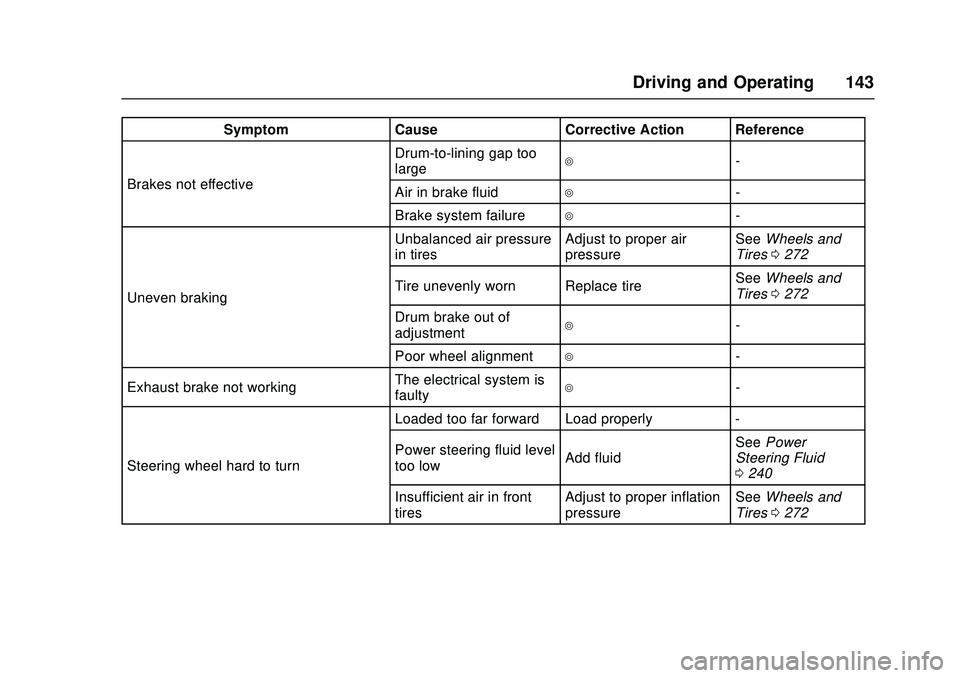
SymptomCauseCorrective Action Reference
Brakes not effective Drum-to-lining gap too
large
4-
Air in brake fluid
4-
Brake system failure
4-
Uneven braking Unbalanced air pressure
in tires
Adjust to proper air
pressureSee
Wheels and
Tires 0272
Tire unevenly worn Replace tire See
Wheels and
Tires 0272
Drum brake out of
adjustment
4-
Poor wheel alignment
4-
Exhaust brake not working The electrical system is
faulty
4-
Steering wheel hard to turn Loaded too far forward Load properly -
Power steering fluid level
too low
Add fluidSee
Power
Steering Fluid
0 240
Insufficient air in front
tires Adjust to proper inflation
pressureSee
Wheels and
Tires 0272
Page 145 of 358
Chevrolet Low Cab Forward Owner Manual (GMNA-Localizing-U.S.-
11254764) - 2018 - crc - 12/5/16
144 Driving and Operating
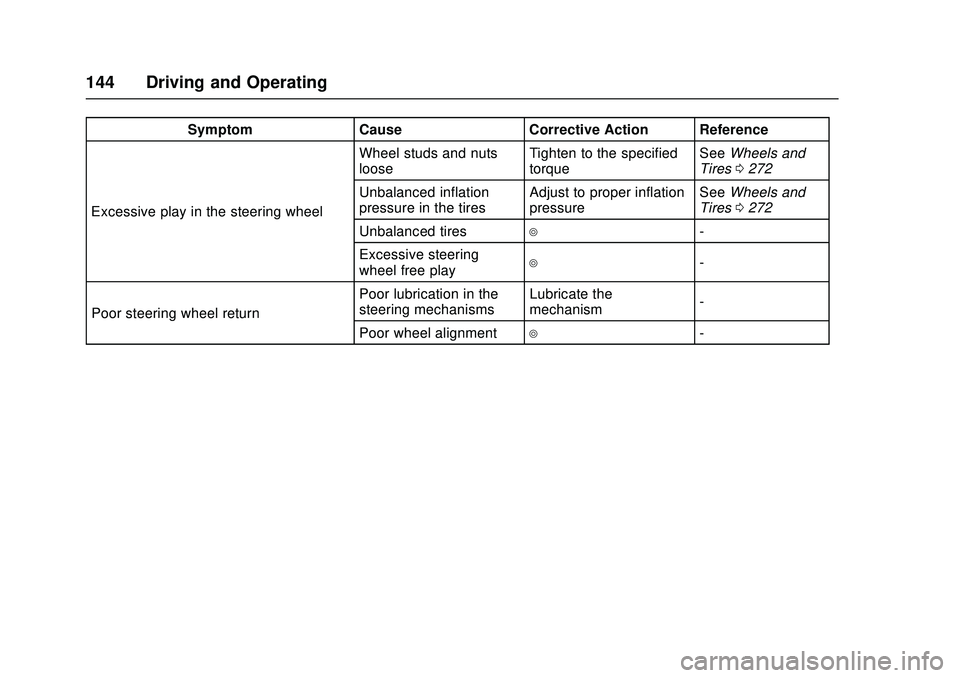
SymptomCauseCorrective Action Reference
Excessive play in the steering wheel Wheel studs and nuts
loose
Tighten to the specified
torqueSee
Wheels and
Tires 0272
Unbalanced inflation
pressure in the tires Adjust to proper inflation
pressureSee
Wheels and
Tires 0272
Unbalanced tires
4-
Excessive steering
wheel free play
4-
Poor steering wheel return Poor lubrication in the
steering mechanisms
Lubricate the
mechanism
-
Poor wheel alignment
4-
Page 147 of 358

Chevrolet Low Cab Forward Owner Manual (GMNA-Localizing-U.S.-
11254764) - 2018 - crc - 12/5/16
146 Driving and Operating
Emergencies (Disabled
Vehicle)
When the Vehicle
Breaks Down
When the Vehicle Stops While
Driving
The brake booster will no longer
operate and brake effectiveness will
be reduced. If the engine cannot be
started, promptly have the vehicle
inspected and repaired.
If the engine stopped because the
vehicle ran out of fuel while driving,
refueling alone will not be enough to
restart the engine. Bleed the fuel
system after refueling the vehicle.
When the Fuel Tank is Empty
SeeRunning Out of Fuel 0212.
When the Engine Stalls and
Cannot Be Restarted
Move the selector lever to the "N"
position and push the vehicle to a
safe place.
{Warning
Vehicle operations will change, so
stop the vehicle in a safe place
with the following in mind.
The power steering system will
not work so the steering wheel
will be hard to turn. It will require
more strength than during normal
operation.
As the brake booster will no
longer be functional, brake
effectiveness will be greatly
reduced. Be sure to apply more
pressure than usual to the brake
pedal.
If the power assist steering
system goes out because the
engine has stopped or the assist
system has malfunctioned, the
vehicle can still be steered.
However, much greater effort is
needed, especially in sharp turns
or at low speeds.
You and others could be seriously
injured. When the Vehicle Breaks Down
During Driving
1. Use the hazard warning flasher any time to warn other drivers,
day or night, and pull the
vehicle immediately over to a
safe place that does not
impede traffic (shoulder). Place
triangle reflectors to alert other
traffic to the presence of your
vehicle.
2. If the vehicle can be exited safely, have the other
passengers get out and wait in
a safe place.
3. If the vehicle can be exited safely, walk to a safe place and
take appropriate measures by
using the closest
telephone, etc.
See Hazard Warning Flashers 094.
Page 149 of 358

Chevrolet Low Cab Forward Owner Manual (GMNA-Localizing-U.S.-
11254764) - 2018 - crc - 12/5/16
148 Driving and Operating
vehicle break-in procedure.
Increased parking brake
performance will result when the
parking brake is burnished as
specified below:
.Make 10 moderate stops, using
the hand brake, from 16 km/h
(10 MPH) while spacing the
stops a minimum of 4 km
(2.5 miles) apart.
. Operate the vehicle at 32 km/h
(20 MPH) between stops.
Pedals
Sit in a correct driving position on
the seat and operate the brake
pedal (1) and accelerator pedal (2)
with your right foot. To avoid
accidentally pressing the wrong
pedal, check the pedal positions
and practice putting your foot on the
desired pedal.
{Warning
A can or bottle rolling on the floor
may prevent brake pedal
operation if it is caught under the
pedal. This is very dangerous.
A floor mat must be placed
correctly. An incorrectly installed
floor mat may hinder the free
movement of each pedal. You
and others could be seriously
injured.
Ignition Positions
Engine Control Switch
{Warning
While driving, never turn the
engine control switch to the
LOCK position. The key could be
removed from the switch, which
then locks the steering wheel.
This is extremely dangerous.
You and others could be seriously
injured.
Caution
After starting the engine, do not
turn the engine control switch to
the START position. Otherwise,
the starter motor may be
damaged.
Using electrical devices such as
the audio system for an extended
time period with the engine
stopped can completely discharge
the battery.
Page 150 of 358

Chevrolet Low Cab Forward Owner Manual (GMNA-Localizing-U.S.-
11254764) - 2018 - crc - 12/5/16
Driving and Operating 149
The starting circuit, engine alarm
circuits and accessory circuits are
all controlled by the engine control
switch.1 LOCK :Lock is in the position
fully counterclockwise. In this
position, the key can be inserted or
removed. To place the engine
control switch in the LOCK position,
press and hold the key in the ACC
position and then turn it to the
LOCK position. If you will leave the
vehicle, remove the key and turn the
steering wheel until it locks. The
steering wheel will be locked to help
prevent theft.
2 ACC : Accessory is in the first
position clockwise. In this position,
the audio and other accessories can
be used with the engine stopped.
3 ON : This ON position is in the
second position clockwise. The key
stays in this position while the
engine is running. Engine control,
warning circuits, gauge circuits, and
accessory circuits are energized.
The engine cylinder heaters or glow
plugs are also turned on when the
switch is in the ON position. The
wait-to-start light will come on and
stay on until the glow plugs are heated enough. When this light
goes off, turn the switch to the
START position.
4 START :
On all engines, start is in
the position furthest clockwise. The
engine is started in this position.
Turn the key against spring
pressure to energize the starter.
When key is released, spring
pressure returns it to the ON
position. Release the key as soon
as the engine has started.
If the key cannot be turned from the
LOCK position to the ON position,
lightly move the steering wheel
clockwise and counterclockwise
while trying to turn the key.
Starting and Stopping the
Vehicle
Check around the Vehicle before
Starting the Engine
Proper care and operation will not
only extend the service life of your
vehicle but also improve fuel
economy.
Page 151 of 358

Chevrolet Low Cab Forward Owner Manual (GMNA-Localizing-U.S.-
11254764) - 2018 - crc - 12/5/16
150 Driving and Operating
Before pulling away, perform a
thorough safety check, making sure
there are no children or obstructions
around the vehicle. Take off the
chocks after confirming that the
parking brake is securely applied.
Sit behind the wheel, adjust the seat
position, and buckle up the seat
belt. The passengers are also
required to buckle up the seat belts.
Adjust the positions of the steering
wheel and mirrors. Lock the doors.
Turn the power of the dome light or
accessories OFF before starting the
engine. SeeSeat Position 038,
Seat Belts 043, Steering Wheel
Adjustment 065, and Mirrors033.
Keep the Floor Around the
Driver's Seat Clean and Tidy
{Warning
It is extremely dangerous to have
empty cans, empty bottles or
other items rolling around on the
floor because they could get
trapped under the brake pedal (Continued)
Warning (Continued)
and prevent brake application.
For proper pedal operation, it is
also essential to lay floor mats
properly. Incorrectly installed floor
mats would hinder free movement
of the pedals.
Do not use the dashboard pocket
or the top of the dashboard as a
place to put items that could roll,
which could interfere with your
driving. You and others could be
seriously injured.
Choose Your Footwear Suitable
for Driving
{Warning
Choose footwear that ensures
proper operation of pedals when
driving the vehicle. Use of
footwear unsuitable for driving
may cause an accident. Starting the Engine
Do not keep the engine control
switch in the START position for
more than about 10 seconds.
Operating the starter for too long
might cause starter and battery
failure or may result in overheating.
When the engine does not start,
wait for 20 to 30 seconds and then
turn the engine control switch again.
Before starting the engine sit in the
driver seat, check that the parking
brake is firmly engaged, the selector
lever is in the P or N (P is preferred)
position and the shift indicator also
shows P or N, and firmly press the
brake pedal to start the engine.
When stopped on a slope, start the
engine with the selector lever in the
P position. See
Ignition Positions
0 148.
1. Make sure that the selector lever is in the P or N position
and firmly press the brake
pedal.
Page 186 of 358

Chevrolet Low Cab Forward Owner Manual (GMNA-Localizing-U.S.-
11254764) - 2018 - crc - 12/5/16
Driving and Operating 185
When the exhaust system warning
light comes on, promptly have the
vehicle inspected and serviced at a
dealer.
When a malfunction is detected in
the SCR system, the warning and
the indicator lights shown in the
table come on. SeeVehicle
Messages 086, Malfunction
Indicator Lamp (Check Engine
Light) 074, and Diesel Exhaust
Fluid (DEF) Warning Light 080.
When the Diesel Exhaust Fluid
(DEF) Tank is Empty
If the DEF tank is empty and
warning and indicator lights are on,
you must follow below procedure to
cancel the vehicle restriction: 1. Turn the engine control switch to the LOCK or ACC position,
and add DEF.
2. After adding DEF, turn the engine control switch to ON
position.
3. Wait until buzzer stops, warnings and indicators are
turned off. 4. If the buzzer does not stop,
return the engine control switch
back to the LOCK position and
add more DEF, and then start
over from step 2 above.
5. Restart the engine.
It may take a while until the warning
lights and indicators turn off and the
buzzer stops after turning the
engine control switch to the ON
position.
It is desirable to fill up the tank with
DEF to avoid DEF remaining level
warning indication from reappearing.
When the outside temperature is
low, refer to Adding DEF in Cold
Weather. See Driver Information
Center (DIC) 082, Brake System
Warning Light (Parking Brake Light)
0 75, Warning Buzzers 091, and
Winter Driving 0133.Automatic
Transmission
On an automatic transmission
vehicle, the driver does not use a
clutch pedal when pulling away,
changing gears, or stopping. Only
the selector lever, accelerator pedal,
and brake pedal are used.
Practice learning the characteristics
of the automatic transmission
vehicle and how to correctly operate
it. When the vehicle is stationary,
remember to keep the brake pedal
firmly pressed, and if necessary,
move the selector lever in the P or
N position and apply the parking
brake.
Creep : With the engine running
and a gear position other than P or
N selected with the selector lever,
power reaches the wheels even
when the accelerator pedal is not
pressed, causing the vehicle to tend
to move.
Furthermore, the higher the engine
speed, the stronger the creep and
the greater the vehicle's tendency
to move.