wheel CHEVROLET LOW CAB FORWARD 2018 Workshop Manual
[x] Cancel search | Manufacturer: CHEVROLET, Model Year: 2018, Model line: LOW CAB FORWARD, Model: CHEVROLET LOW CAB FORWARD 2018Pages: 358, PDF Size: 6.32 MB
Page 278 of 358
Chevrolet Low Cab Forward Owner Manual (GMNA-Localizing-U.S.-
11254764) - 2018 - crc - 12/5/16
Vehicle Care 277
{Warning
Consult your dealer before
replacing wheels. Never use
wheels that are not designed for
the vehicle. Doing so would
impede safe vehicle operation.
The use of wheels and/or tires with
higher load carrying limits than
originally equipped on your vehicle
does not in itself increase the
GAWR or the GVWR of the vehicle.
Replacement wheels can be
obtained from the authorized dealer
or tire dealer. Checking Tires
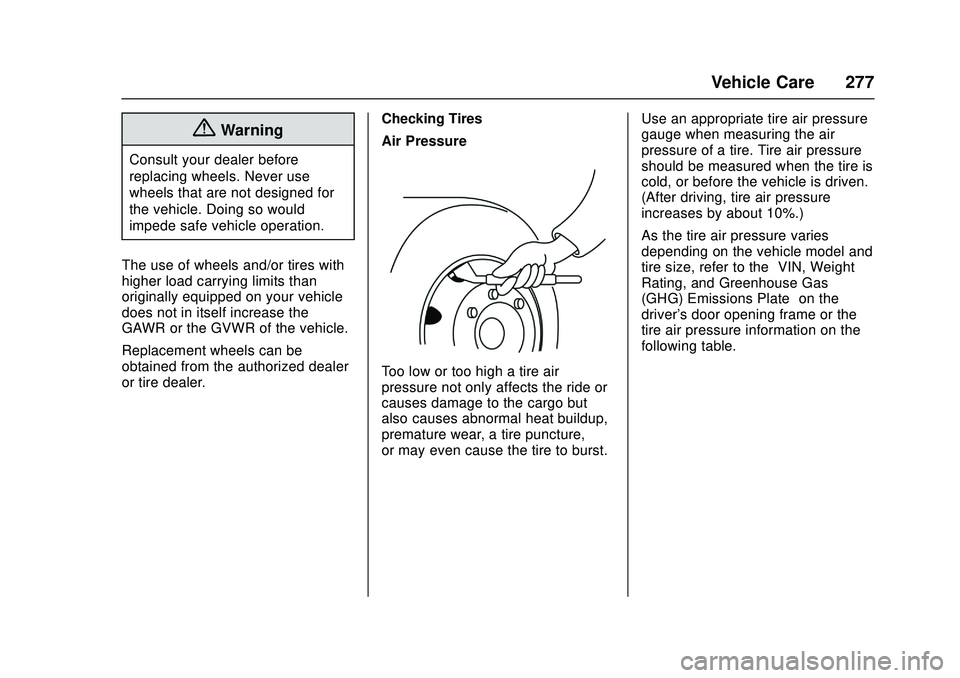
Air Pressure
Too low or too high a tire air
pressure not only affects the ride or
causes damage to the cargo but
also causes abnormal heat buildup,
premature wear, a tire puncture,
or may even cause the tire to burst.Use an appropriate tire air pressure
gauge when measuring the air
pressure of a tire. Tire air pressure
should be measured when the tire is
cold, or before the vehicle is driven.
(After driving, tire air pressure
increases by about 10%.)
As the tire air pressure varies
depending on the vehicle model and
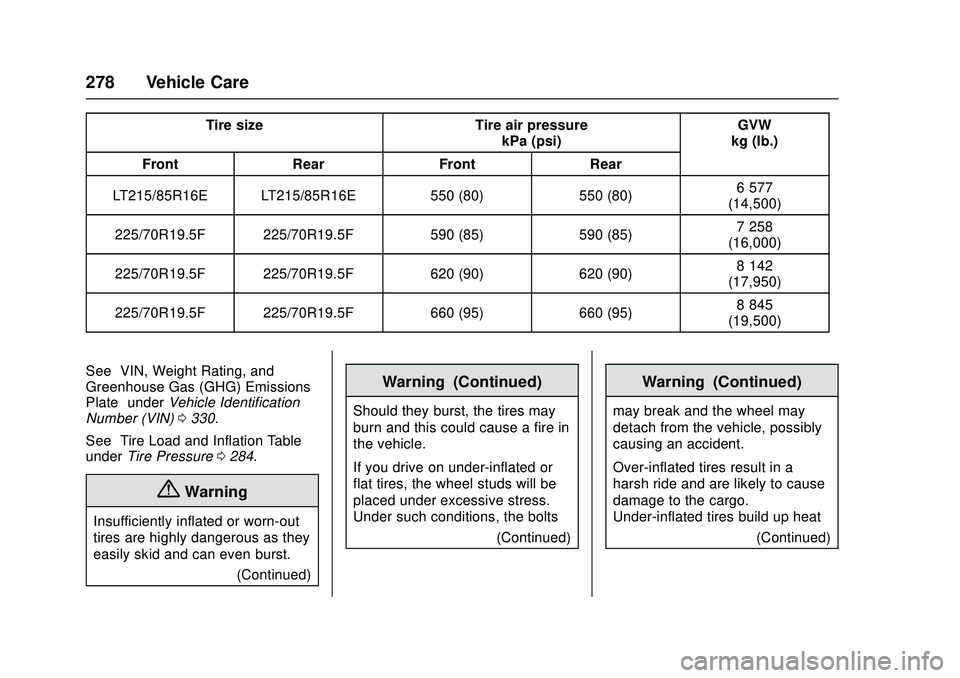
tire size, refer to the
“VIN, Weight
Rating, and Greenhouse Gas
(GHG) Emissions Plate” on the
driver's door opening frame or the
tire air pressure information on the
following table.
Page 279 of 358
Chevrolet Low Cab Forward Owner Manual (GMNA-Localizing-U.S.-
11254764) - 2018 - crc - 12/5/16
278 Vehicle Care
Tire sizeTire air pressure
kPa (psi) GVW
kg (lb.)
Front RearFront Rear
LT215/85R16E LT215/85R16E 550 (80)550 (80) 6 577
(14,500)
225/70R19.5F 225/70R19.5F 590 (85)590 (85) 7 258
(16,000)
225/70R19.5F 225/70R19.5F 620 (90)620 (90) 8 142
(17,950)
225/70R19.5F 225/70R19.5F 660 (95)660 (95) 8 845
(19,500)
See “VIN, Weight Rating, and
Greenhouse Gas (GHG) Emissions
Plate” underVehicle Identification
Number (VIN) 0330.
See “Tire Load and Inflation Table”
under Tire Pressure 0284.
{Warning
Insufficiently inflated or worn-out
tires are highly dangerous as they
easily skid and can even burst.
(Continued)
Warning (Continued)
Should they burst, the tires may
burn and this could cause a fire in
the vehicle.
If you drive on under-inflated or
flat tires, the wheel studs will be
placed under excessive stress.
Under such conditions, the bolts
(Continued)
Warning (Continued)
may break and the wheel may
detach from the vehicle, possibly
causing an accident.
Over-inflated tires result in a
harsh ride and are likely to cause
damage to the cargo.
Under-inflated tires build up heat(Continued)
Page 280 of 358
Chevrolet Low Cab Forward Owner Manual (GMNA-Localizing-U.S.-
11254764) - 2018 - crc - 12/5/16
Vehicle Care 279
Warning (Continued)
and could burst. Always keep the
tires of your vehicle adjusted at
the standard air pressures.
You and others could be seriously
injured.
There should not be a difference
tires on a dual-tire wheel.
It is not easy to visually identify an
under-inflated dual-wheel tire or low
aspect ratio tire (aspect ratio at
70%). Always use an appropriate
tire air pressure gauge to check the
air pressure of any tire.
If your vehicle is equipped with
aluminum wheels, use an extension
attached to the inner tire valve
together with a standard tire air
pressure gauge or use a special air
pressure gauge when checking the
air pressure of a dual-wheel's
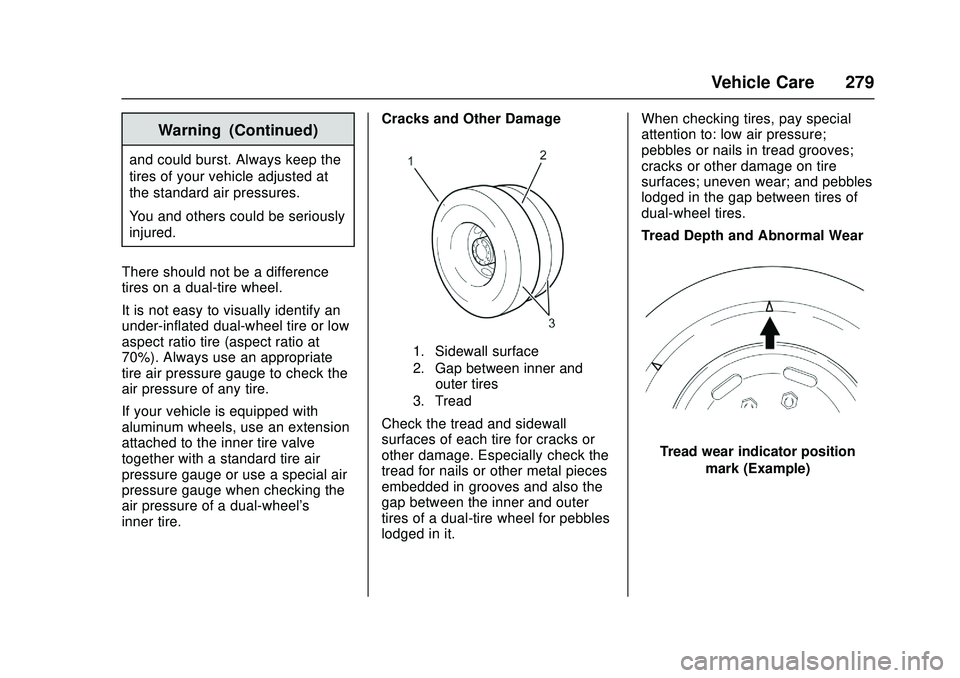
inner tire. Cracks and Other Damage
1. Sidewall surface
2. Gap between inner and
outer tires
3. Tread
Check the tread and sidewall
surfaces of each tire for cracks or
other damage. Especially check the
tread for nails or other metal pieces
embedded in grooves and also the
gap between the inner and outer
tires of a dual-tire wheel for pebbles
lodged in it. When checking tires, pay special
attention to: low air pressure;
pebbles or nails in tread grooves;
cracks or other damage on tire
surfaces; uneven wear; and pebbles
lodged in the gap between tires of
dual-wheel tires.
Tread Depth and Abnormal Wear
Tread wear indicator position
mark (Example)
Page 282 of 358
Chevrolet Low Cab Forward Owner Manual (GMNA-Localizing-U.S.-
11254764) - 2018 - crc - 12/5/16
Vehicle Care 281
Damaged Tires
{Danger
It is dangerous to mount the
wrong size tire on a wheel. If you
do so, the tire/wheel can explode
as air is being added. This
explosion may result in severe
personal injury or death. To learn
which wheels and tires are
correct, look at the "VIN, Weight
Rating, and Greenhouse Gas
(GHG) Emissions Plate" on the
left side rear pillar panel below
the striker (single cab) or on the
left center pillar panel beside the
shoulder seat belt anchor (crew
cab). Wheel size is also stamped
on the side of each wheel.
To help avoid personal injury and
property damage if a wheel must
be changed, seek expert tire
services if you can. If you must
remove the wheel without any
such help, do the following:(Continued)
Danger (Continued)
.If the tire looks as if it may
be underinflated, stand to
the side and check whether
the wheel assembly
appears normal by
comparing it to another
wheel assembly on the
vehicle.
. Let the air out of the tire by
taking out the valve core.
If you have a way to put air
back in a tire, note that it is
good safety practice to let
the air out of both tires of a
dual assembly before taking
off the damaged tire and rim
assembly from the vehicle.
After letting out the air, take
off the tire and rim assembly
and install a spare tire and
rim assembly.
If your vehicle is equipped
with a differential lock
system or limited slip
differential (LSD), it might
(Continued)
Danger (Continued)
start moving when the
engine power is transmitted
to the rear axle even when
one of the wheels on the
axle is raised clear of the
ground. Do not start the
engine with any rear wheel
in contact with the ground.
If you are not fully
experienced on the
procedures to follow, and/or
are not equipped with the
proper tools and equipment,
again, do not attempt to
raise the vehicle, or remove
or install the tire and wheel
assembly—seek expert tire
services.
. Do not put air back in a tire
that has been run flat, or is
seriously low on air, without
first having the tire taken off
the wheel and the tire
checked for damage.
(Continued)
Page 283 of 358
Chevrolet Low Cab Forward Owner Manual (GMNA-Localizing-U.S.-
11254764) - 2018 - crc - 12/5/16
282 Vehicle Care
Danger (Continued)
.Note that taking off and
mounting tires on wheels
requires proper tools, safety
equipment and special
training. A person can be
severely injured or killed
and damage can result from
using the wrong service
methods. Truck tires and
wheels should be serviced
only by trained people using
the proper equipment.
. Never add air to your tires
unless an accurate pressure
gauge is also used. When
putting air in a tire on the
vehicle, stand to the side
and use a clip-on chuck and
hose extension. In choosing
the right tire pressure, be
careful not to exceed the
maximum pressure
capability shown on the tire;
see the tire pressure charts
in this manual.
(Continued)
Danger (Continued)
.Tire mounting or repair can
result in serious personal
injury or death, if not
performed correctly. This
section has detailed
instructions for proper wheel
and tire replacement, so be
sure to read and follow
them. Truck fleet owners
and operators: You can get
written instructions on truck
tire demounting, repair and
mounting from Rubber
Manufacturers Association
(RMA), 1400 K Street N.W.,
Washington, D.C. 20005,
and also from many tire
stores.
Wheel Nut Torque
{Warning
Never use oil or grease on studs
or nuts. Use the torque specified
for the type of wheels on the (Continued)
Warning (Continued)
vehicle. Snug all wheel nuts and
then tighten to the specified
torque in the numerical sequence
shown. Improperly tightened
wheel nuts could eventually allow
the wheel to come off while the
vehicle is moving, possibly
causing loss of control and
personal injury and property
damage.
When the vehicle, wheel or
fasteners are new, have a
technician tighten wheel stud nuts
and rim clamp nuts with a torque
wrench at 1 040 km (650 mi). This is
necessary because the clamping
system used on the wheels must
seat before the fastener will hold a
uniform clamp load and remain fully
tightened. Also have a technician
tighten wheel stud nuts and rim
clamp nuts with a torque wrench
after installing any wheel.
Page 284 of 358
Chevrolet Low Cab Forward Owner Manual (GMNA-Localizing-U.S.-
11254764) - 2018 - crc - 12/5/16
Vehicle Care 283
In addition, nut tightness on all
wheels should be set with a torque
wrench every 10 400 km (6,500 mi).Tightening torque
500 N·m (362 lb·ft)
Wheel Tightening Sequence
Some studs and nuts have left-hand
threads. Those studs are marked on
their ends with the letter "L".
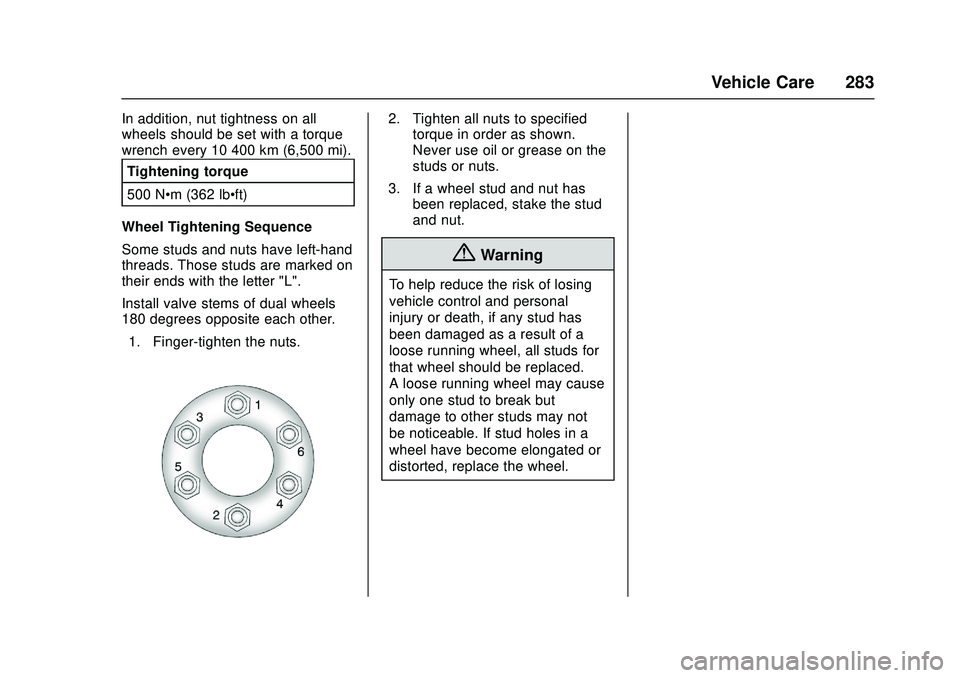
Install valve stems of dual wheels
180 degrees opposite each other. 1. Finger-tighten the nuts.2. Tighten all nuts to specified torque in order as shown.
Never use oil or grease on the
studs or nuts.
3. If a wheel stud and nut has been replaced, stake the stud
and nut.
{Warning
To help reduce the risk of losing
vehicle control and personal
injury or death, if any stud has
been damaged as a result of a
loose running wheel, all studs for
that wheel should be replaced.
A loose running wheel may cause
only one stud to break but
damage to other studs may not
be noticeable. If stud holes in a
wheel have become elongated or
distorted, replace the wheel.
Page 285 of 358
Chevrolet Low Cab Forward Owner Manual (GMNA-Localizing-U.S.-
11254764) - 2018 - crc - 12/5/16
284 Vehicle Care
Tire Pressure
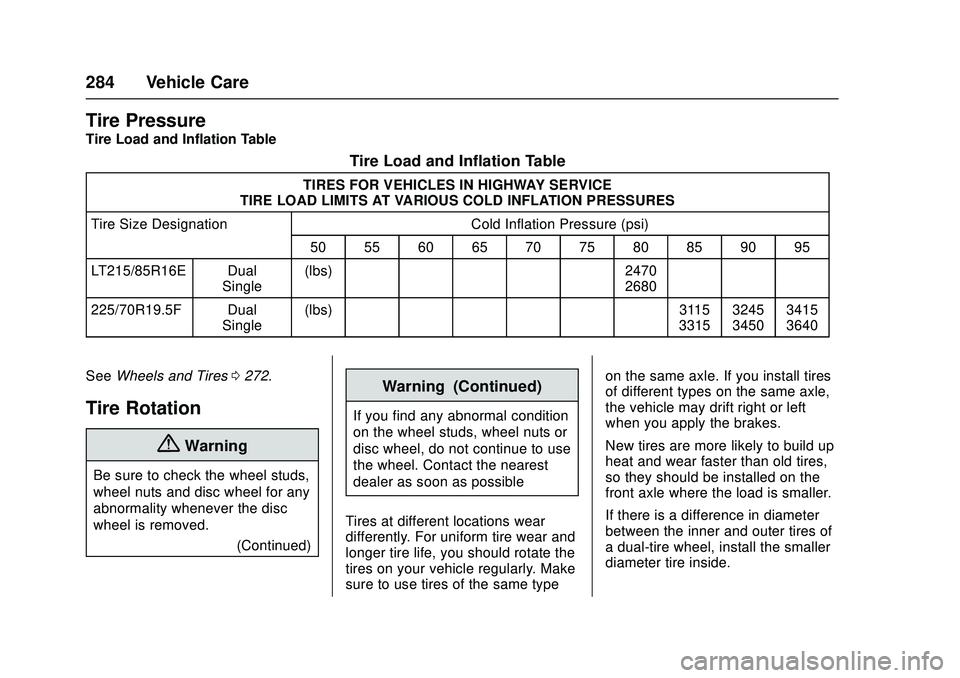
Tire Load and Inflation Table
Tire Load and Inflation Table
TIRES FOR VEHICLES IN HIGHWAY SERVICE
TIRE LOAD LIMITS AT VARIOUS COLD INFLATION PRESSURES
Tire Size Designation Cold Inflation Pressure (psi) 50 55 60 65 70 75 80 85 90 95
LT215/85R16E Dual Single(lbs) 2470
2680
225/70R19.5F Dual Single(lbs) 3115
33153245
34503415
3640
See Wheels and Tires 0272.
Tire Rotation
{Warning
Be sure to check the wheel studs,
wheel nuts and disc wheel for any
abnormality whenever the disc
wheel is removed.
(Continued)
Warning (Continued)
If you find any abnormal condition
on the wheel studs, wheel nuts or
disc wheel, do not continue to use
the wheel. Contact the nearest
dealer as soon as possible
Tires at different locations wear
differently. For uniform tire wear and
longer tire life, you should rotate the
tires on your vehicle regularly. Make
sure to use tires of the same type on the same axle. If you install tires
of different types on the same axle,
the vehicle may drift right or left
when you apply the brakes.
New tires are more likely to build up
heat and wear faster than old tires,
so they should be installed on the
front axle where the load is smaller.
If there is a difference in diameter
between the inner and outer tires of
a dual-tire wheel, install the smaller
diameter tire inside.
Page 286 of 358
Chevrolet Low Cab Forward Owner Manual (GMNA-Localizing-U.S.-
11254764) - 2018 - crc - 12/5/16
Vehicle Care 285
The difference in diameter of the
tires for a dual-tire wheel should be
within the limit specified in the table
below. If the limit is exceeded, the
tires wear more rapidly than they
should.
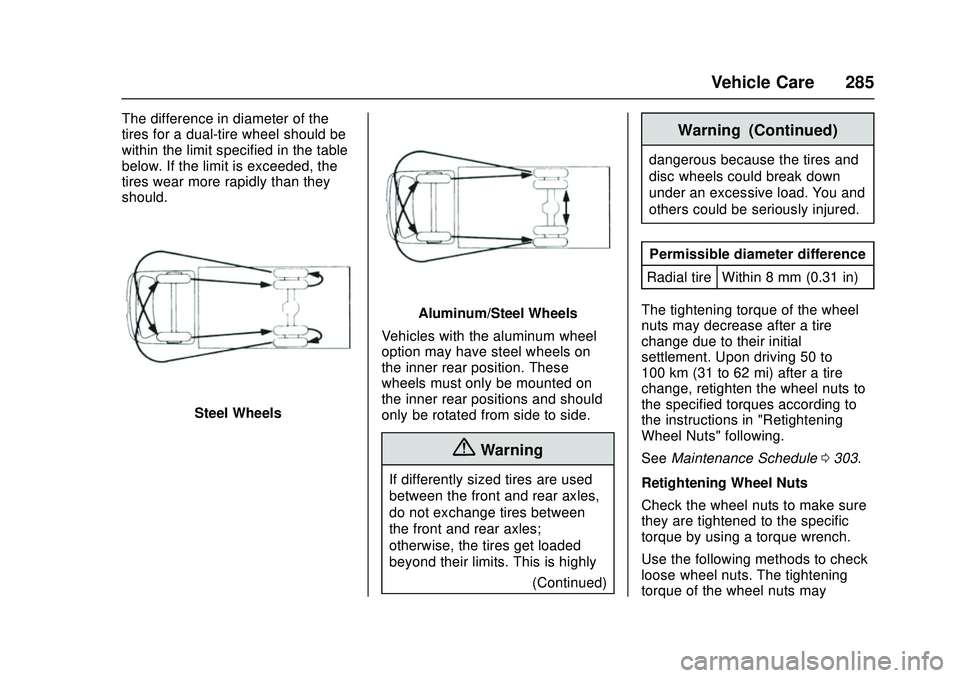
Steel Wheels
Aluminum/Steel Wheels
Vehicles with the aluminum wheel
option may have steel wheels on
the inner rear position. These
wheels must only be mounted on
the inner rear positions and should
only be rotated from side to side.
{Warning
If differently sized tires are used
between the front and rear axles,
do not exchange tires between
the front and rear axles;
otherwise, the tires get loaded
beyond their limits. This is highly (Continued)
Warning (Continued)
dangerous because the tires and
disc wheels could break down
under an excessive load. You and
others could be seriously injured.
Permissible diameter difference
Radial tire Within 8 mm (0.31 in)
The tightening torque of the wheel
nuts may decrease after a tire
change due to their initial
settlement. Upon driving 50 to
100 km (31 to 62 mi) after a tire
change, retighten the wheel nuts to
the specified torques according to
the instructions in "Retightening
Wheel Nuts" following.
See Maintenance Schedule 0303.
Retightening Wheel Nuts
Check the wheel nuts to make sure
they are tightened to the specific
torque by using a torque wrench.
Use the following methods to check
loose wheel nuts. The tightening
torque of the wheel nuts may
Page 287 of 358
Chevrolet Low Cab Forward Owner Manual (GMNA-Localizing-U.S.-
11254764) - 2018 - crc - 12/5/16
286 Vehicle Care
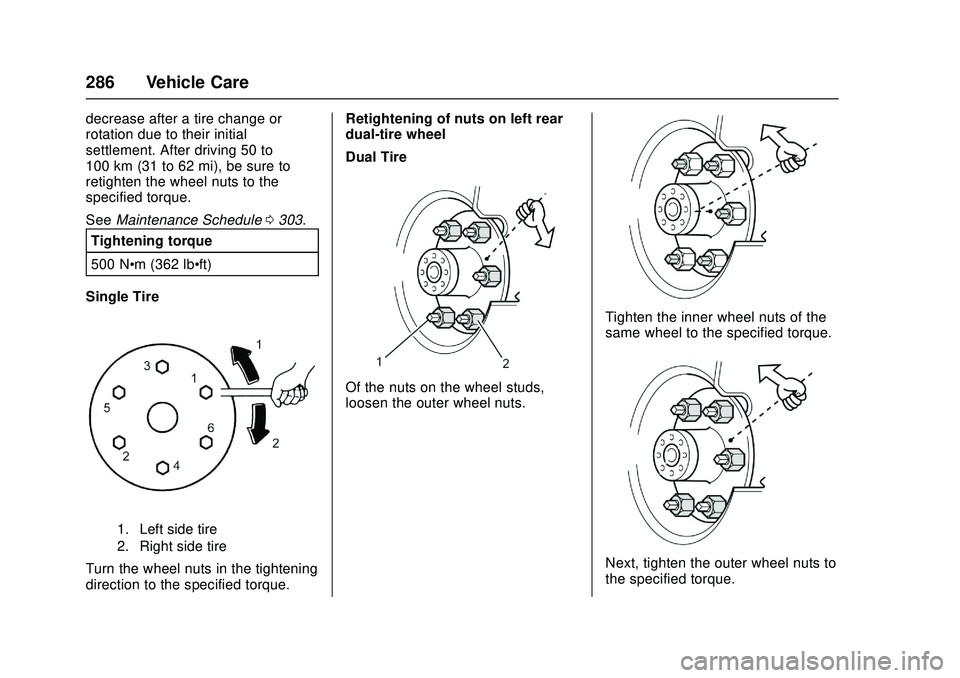
decrease after a tire change or
rotation due to their initial
settlement. After driving 50 to
100 km (31 to 62 mi), be sure to
retighten the wheel nuts to the
specified torque.
SeeMaintenance Schedule 0303.
Tightening torque
500 N·m (362 lb·ft)
Single Tire
1. Left side tire
2. Right side tire
Turn the wheel nuts in the tightening
direction to the specified torque. Retightening of nuts on left rear
dual-tire wheel
Dual Tire
Of the nuts on the wheel studs,
loosen the outer wheel nuts.
Tighten the inner wheel nuts of the
same wheel to the specified torque.
Next, tighten the outer wheel nuts to
the specified torque.
Page 288 of 358
Chevrolet Low Cab Forward Owner Manual (GMNA-Localizing-U.S.-
11254764) - 2018 - crc - 12/5/16
Vehicle Care 287
{Warning
If you find any abnormal
conditions with the wheel nuts
such as frequent loosening of
retightened nuts, have your
vehicle checked or serviced at the
nearest dealer as soon as
possible.
Fully engage the wheel wrench on a
wheel nut in order to tighten the nut
to the specified torque. However, do
not use a pipe as a handle
extension or your foot to apply force
on the wrench. This would tighten
the nut more than required and
might damage components.
Both under-tightening and
over-tightening of wheel nuts may
cause broken wheel studs or
cracked disc wheels and could lead
to wheel detachment. Adhere to the
specified tightening torques.
When replacing a tire with a new
one, use only a tire of the same
type and size as the replaced tire;
otherwise, driving safety could be affected. Avoid mixed use of
different types or different size tires
at all costs.
If a Tire Goes Flat
When the tire goes flat while driving,
ease off the accelerator pedal, avoid
hard braking, hold on to the steering
wheel firmly, and stop the vehicle.
The tire should be changed in a
safe, open location to prevent
obstructing other vehicles or
pedestrians.
{Warning
If you continue to drive on a flat
tire, undue force will be applied to
the wheel studs, possibly causing
the studs to break and the wheel
to come off. You and others could
be seriously injured.
See “Tire Replacement
Recommendations” underWheels
and Tires 0272.
Jump Starting
Jump Starting - North
America
When the Battery is
Discharged
Use a jumper cable (sold
separately) and the battery of
another vehicle to start the engine in
the following sequence.
{Danger
Follow the precautions listed in
the jump starting instructions
when working on or near the
battery. Personal injury
(particularly to eyes) or property
damage may result from battery
explosion, battery fluid or
electrical (short circuit) burns.
If battery fluid should come in
contact with an eye, immediately
wash away using a large amount
of water and continue washing for
(Continued)