wheel CHEVROLET LOW CAB FORWARD 2018 Repair Manual
[x] Cancel search | Manufacturer: CHEVROLET, Model Year: 2018, Model line: LOW CAB FORWARD, Model: CHEVROLET LOW CAB FORWARD 2018Pages: 358, PDF Size: 6.32 MB
Page 292 of 358
Chevrolet Low Cab Forward Owner Manual (GMNA-Localizing-U.S.-
11254764) - 2018 - crc - 12/5/16
Vehicle Care 291
7. If the engine in the disabledvehicle starts, remove the
jumper cables in the reverse
sequence as they were
connected.Towing the Vehicle
Consult your dealer or a
professional towing service if the
disabled vehicle must be towed.
Proper equipment must be used to
prevent damage to vehicles during
any towing. State and local laws
which apply to vehicles in tow must
be followed. Vehicles should not be
towed at speeds in excess of
88 km/h (55 mph).
Connect to the main structural parts
of the vehicle. Do not attach to
bumpers, tow hooks or brackets.
Use only equipment designed for
this purpose. Follow the instructions
of the wrecker manufacturer.
A safety chain system must
be used.
The procedures below must be
followed when towing to prevent
possible damage. Front End Towing (Front Wheels
Off Ground)
To prepare a disabled vehicle for
front end towing with front wheels
raised off the ground, the following
steps are necessary:
.
Block the rear wheels of the
disabled vehicle.
. Disconnect the driveshaft at the
rear axle. Secure the driveshaft
to the frame or crossmember.
When towing, disconnect the
driveshaft at the rear axle to ensure
the transmission is not damaged.
The rear end of the driveshaft must
be disconnected and safely secured
if the 80 km (50 mi) or 48 km/h
(30 mph) is exceeded.
If there is damage or suspected
damage to the rear axle, remove the
axle shafts. Cover the hub openings
to prevent the loss of lubricant or
entry of dirt or foreign objects.
Place a 10 cm (4 in) wood beam
against the towing guide behind the
bumper. (If no 10 cm (4 in) is
available, then remove the bumper.)
Ensure towing chains do not come
Page 293 of 358
Chevrolet Low Cab Forward Owner Manual (GMNA-Localizing-U.S.-
11254764) - 2018 - crc - 12/5/16
292 Vehicle Care
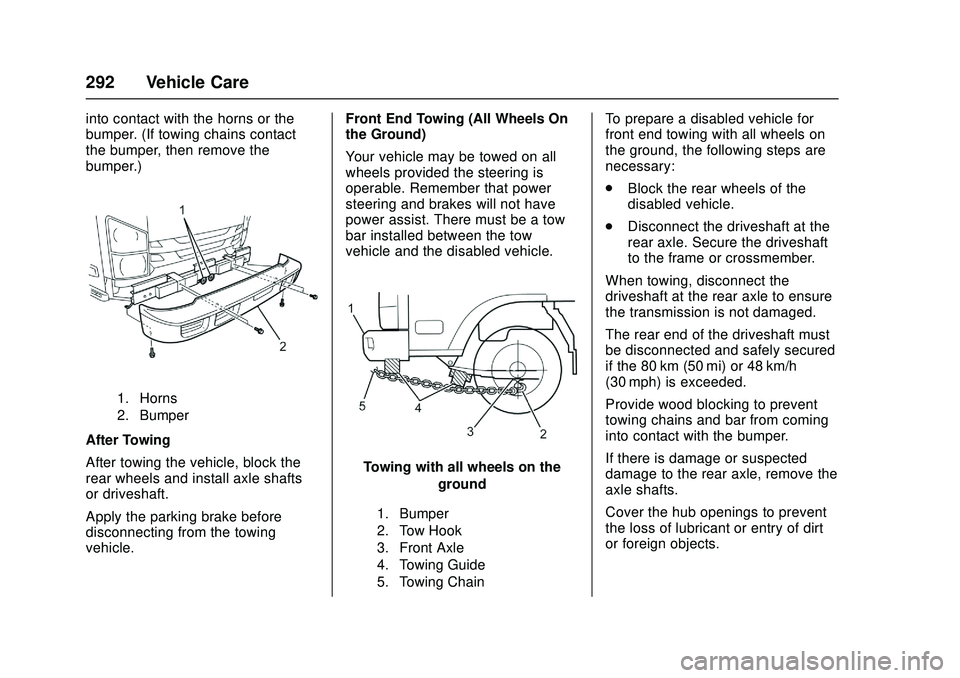
into contact with the horns or the
bumper. (If towing chains contact
the bumper, then remove the
bumper.)
1. Horns
2. Bumper
After Towing
After towing the vehicle, block the
rear wheels and install axle shafts
or driveshaft.
Apply the parking brake before
disconnecting from the towing
vehicle.Front End Towing (All Wheels On
the Ground)
Your vehicle may be towed on all
wheels provided the steering is
operable. Remember that power
steering and brakes will not have
power assist. There must be a tow
bar installed between the tow
vehicle and the disabled vehicle.
Towing with all wheels on the
ground
1. Bumper
2. Tow Hook
3. Front Axle
4. Towing Guide
5. Towing Chain
To prepare a disabled vehicle for
front end towing with all wheels on
the ground, the following steps are
necessary:
.Block the rear wheels of the
disabled vehicle.
. Disconnect the driveshaft at the
rear axle. Secure the driveshaft
to the frame or crossmember.
When towing, disconnect the
driveshaft at the rear axle to ensure
the transmission is not damaged.
The rear end of the driveshaft must
be disconnected and safely secured
if the 80 km (50 mi) or 48 km/h
(30 mph) is exceeded.
Provide wood blocking to prevent
towing chains and bar from coming
into contact with the bumper.
If there is damage or suspected
damage to the rear axle, remove the
axle shafts.
Cover the hub openings to prevent
the loss of lubricant or entry of dirt
or foreign objects.
Page 294 of 358
Chevrolet Low Cab Forward Owner Manual (GMNA-Localizing-U.S.-
11254764) - 2018 - crc - 12/5/16
Vehicle Care 293
After Towing
After towing the vehicle, block the
rear wheels and install axle shafts
or driveshaft.
Apply the parking brake before
disconnecting from the towing
vehicle. Check and fill rear axle with
oil, if required.
Rear End Towing
When towing a vehicle with rear
wheels raised, secure the steering
wheel to maintain straight-ahead
position. Make certain that the front
axle is not loaded beyond the front
axle gross axle weight rating
(GAWR) as indicated on the
vehicle's VIN and weight rating
plate.
Special Towing Instructions1. All state and local laws regarding such items as
warning signals, night
illumination, speed, etc., must
be followed. 2. Safety chains must be used.
3. No vehicle should ever be
towed over 88 km/h (55 mph).
4. Loose or protruding parts of damaged vehicles should be
secured prior to moving.
5. A safety chain system completely independent of the
primary lifting and towing
attachment must be used.
6. Operators should refrain from going under a vehicle which is
being lifted by the towing
equipment unless the vehicle is
adequately supported by safety
stands.
7. No towing operation which for any reason jeopardizes the
safety of the wrecker operator
or any bystanders or other
motorists should be attempted.Appearance Care
Exterior Care
Exterior Finish
The paint finish on your vehicle
provides beauty, depth of color,
gloss retention and durability.
While cleaning the vehicle, do not
grip the roofmarker lights to prevent
damage or water leakage.
Washing
The best way to preserve your
vehicle's finish is to keep it clean by
washing it often.
Wash the vehicle in lukewarm or
cold water. Do not use hot water or
wash your vehicle in the direct rays
of the sun. Do not use strong soap
or chemical detergents. All cleaning
agents should be flushed promptly
from the surface and not allowed to
dry on the finish.
These vehicles are designed to
operate under normal environmental
conditions to withstand natural
elements. However, unusual
Page 295 of 358
Chevrolet Low Cab Forward Owner Manual (GMNA-Localizing-U.S.-
11254764) - 2018 - crc - 12/5/16
294 Vehicle Care
conditions such as high-pressure
car washers may cause water to
enter inside the vehicle. If the
vehicle is operated with foreign
material adhering to the exterior,
this material may react chemically
with paint, resulting in staining,
discoloration, rusting or corrosion of
components. Also, the material may
become trapped within mechanical
components, adversely affecting
their functions or forming an
aerodynamic resistance. In the
following cases, therefore, the
vehicle must be washed and all
foreign matter removed.
.When soot, iron powder, dead
bugs, bird droppings, tree sap or
oily matter from coal tar and
smoke has adhered to painted
surfaces.
. When the vehicle has been
driven in coastal areas.
. When the vehicle has been
driven on roads where road
chemicals have been applied.
. When a large amount of mud or
dirt has adhered to the exterior. To wash the vehicle:
1. Fully turn on the tap, and wash out the undercarriage and
suspension.
2. Close all openings and wash the cab and cargo body panels
using a neutral detergent.
3. Clean wheels and tires using a brush and detergent.
4. After washing away all remaining detergent, use a
shammy or other clean cloth to
fully remove all moisture and
water droplets.
{Warning
Follow the manufacturer's advice
whenever cleaning agents or
other chemicals are used, inside
or outside the vehicle. Some
cleaners may be poisonous or
flammable, and improper use may
cause personal injury or damage.
When cleaning the inside or
outside of the vehicle, do not use
volatile cleaning solvents, such as
(Continued)
Warning (Continued)
acetone, lacquer thinners, enamel
reducers, nail polish removers; or
such cleaning materials as
laundry soaps, bleaches or
reducing agents, except as noted
in the following fabric cleaning
advice on stain removal.
Never use carbon tetrachloride,
gasoline, benzene or naphtha for
any cleaning purpose. Open all
vehicle doors for ventilation when
ANY cleaning agents or other
chemicals are used in the interior.
Overexposure to some vapors
may result in a health problem
that is more likely to occur in
small, unventilated spaces.
You and others could be seriously
injured.
Do not apply water directly in order
to clean the cab interior. Failure to
observe this precaution can result in
malfunction or breakdown of
electronic control units and electrical
components, or in rusting of the cab
Page 310 of 358
Chevrolet Low Cab Forward Owner Manual (GMNA-Localizing-U.S.-
11254764) - 2018 - crc - 12/5/16
Service and Maintenance 309
No. Service Interval16 000 km/10,000 mi
24 000 km/15,000 mi
32 000 km/20,000 mi
48 000 km/30,000 mi
64 000 km/40,000 mi
72 000 km/45,000 mi
80 000 km/50,000 mi
96 000 km/60,000 mi
112 000 km/70,000 mi
120 000 km/75,000 mi
128 000 km/80,000 mi
144 000 km/90,000 mi
160 000 km/100,000 mi
168 000 km/105,000 mi
176 000 km/110,000 mi
Service intervals
months or
kilometers
(miles)
whichever
occurs first (1)
22 Hydraulic brake booster
(HBB) fluid (5500HD
5500XD models) - - - R - - - R - - - R - - -
or every
24 months
23 Brake line and hoses - - I - I - - I - - I - I - I or every
12 months
24 Parking brake cable I - I I I - I I I - I I I - I or every
12 months
25 Automatic transmission
fluid
I - I R I - I R I - I R I - I or every
12 months
26 Differential gear oil I - I R I - I R I - I R I - I or every
24 months
27 Power steering fluid - - - R - - - R - - - R - - - or every
24 months
28 Power steering oil hoses - - - - - - R - - - - - R - - or every
24 months
29 Steering wheel free
play (4) Every 10 400 km (6,500 miles): I
Page 311 of 358
Chevrolet Low Cab Forward Owner Manual (GMNA-Localizing-U.S.-
11254764) - 2018 - crc - 12/5/16
310 Service and Maintenance
No. Service Interval16 000 km/10,000 mi
24 000 km/15,000 mi
32 000 km/20,000 mi
48 000 km/30,000 mi
64 000 km/40,000 mi
72 000 km/45,000 mi
80 000 km/50,000 mi
96 000 km/60,000 mi
112 000 km/70,000 mi
120 000 km/75,000 mi
128 000 km/80,000 mi
144 000 km/90,000 mi
160 000 km/100,000 mi
168 000 km/105,000 mi
176 000 km/110,000 mi
Service intervals
months or
kilometers
(miles)
whichever
occurs first (1)
30 Steering gear box torque - - T - T - - T - - T - T - - or every
12 months
31 Drive shaft flange torque T - T T T - T T T - T T T - T or every
12 months
32 Drive shaft lubrication L - L L L - L L L - L L L - L or every
12 months
33 Leaf spring U-bolt
torque (4) T - T T T - T T T - T T T - T
34 Wheel nut torque (4) Every 10 400 km (6,500 miles)
35 King pin L - L L L - L L L - L L L - L or every
12 months
36 Wheel hub bearing grease
- Front (5)
- - - R - - - R - - - R - - - or every
24 months
37 Air conditioner blower
filter Cleaned once a month
38 Exhaust injector Cleaned every 176,000 km (110,000 miles)
Page 316 of 358

Chevrolet Low Cab Forward Owner Manual (GMNA-Localizing-U.S.-
11254764) - 2018 - crc - 12/5/16
Service and Maintenance 315
20. Brake Electric Vacuum Pump
(4500HD, 4500XD models) :
Inspect the brake electric vacuum
pump operation every 16 000 km
(10,000 miles) or 12 months,
whichever occurs first.
21. Brake Fluid :Check the fluid in
the brake fluid reservoir every
16 000 km (10,000 miles). Replace
the fluid every 48 000 km
(30,000 miles).
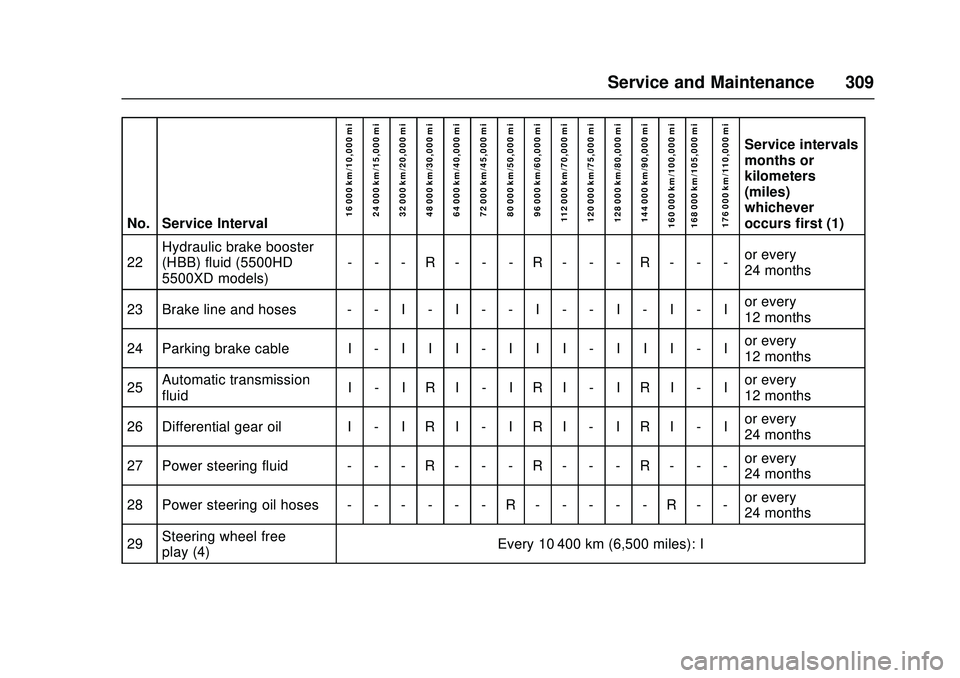
22. Hydraulic Brake Booster Fluid
(5500HD, 5500XD models) :
Replace Dexron VI ATF fluid every
24 months or 30,000 miles
(48,000 km), whichever occurs first.
23. Brake Line and Hoses : Check
lines and hoses for proper hook-up,
binding, leaks, cracks, chafing, etc.
every 32 000 km (20,000 miles).
Any questionable parts should be
replaced or repaired at once. When
rubbing or wear is noted on lines or
hoses, the cause must be corrected
at once.
24. Parking Brake Cable : Check
the parking brake cable every
16 000 km (10,000 miles) or
12 months whichever occurs first. 25. Automatic Transmission
Fluid :
Check the automatic
transmission fluid level at each
engine oil change and replace fluid
every 48 000 km (30,000 miles). Do
not overfill.
26. Differential Gear Oil : Replace
lubricant every 48 000 km
(30,000 miles). Check lubricant level
every 16,000 km (10,000 miles) or
every 12 months, and add lubricant
to within 0 to 10 mm (0 to 0.4 inch)
of the bottom edge of the filler hole
if necessary.
27. Power Steering Fluid :
Replace power steering fluid every
24 months or 48 000 km
(30,000 miles), whichever occurs
first.
28. Power Steering Oil Hoses :
Replace power steering oil hoses
every 24 months or 80 000 km
(50,000 miles), whichever occurs
first.
29. Steering Wheel Free Play :
Check steering wheel free play after
the first 1 040 km (650 miles) and
then every 10 400 km (6,500 miles). Steering wheel free play
10-50 mm (0.39-1.97 in)
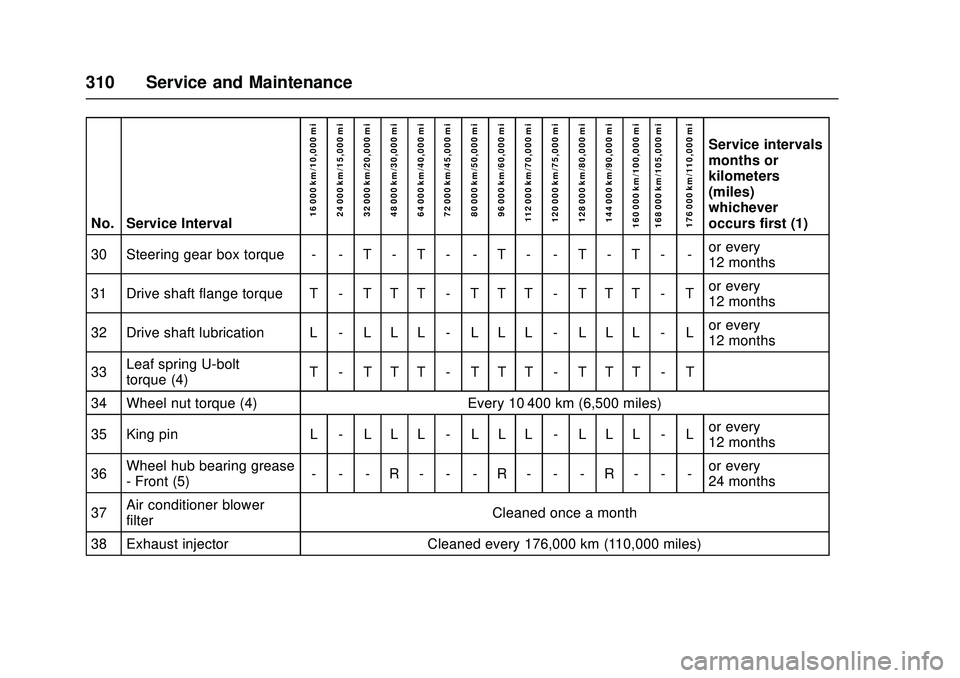
30. Steering Gear Box Torque :
Retighten the attaching bolts of the
steering gear box to the specified
torque every 12 months or every
32 000 km (20,000 miles) whichever
occurs first. Steering gear box tightening torque
103 Y(76 lb·ft)
31. Driveshaft Flange Torque :
Check the fixing bolts of driveshaft
flange for looseness or damage
after the first 16 000 km
(10,000 miles). Driveshaft flange tightening torque
103Y(76 lb·ft)
32. Driveshaft Lubrication :
Lubricate the grease fitting on the
center bearing, as well as each
universal joint and spline coupling
every 12 months or 16 000 km
(10,000 miles) whichever occurs
first.
Page 317 of 358

Chevrolet Low Cab Forward Owner Manual (GMNA-Localizing-U.S.-
11254764) - 2018 - crc - 12/5/16
316 Service and Maintenance
33. Leaf Spring U-bolt Torque :
Tighten the U-Bolt nuts to the
specified torque after the first
1 040 km (650 miles), thereafter
every 16 000 km (10,000 miles).Model Leaf spring U-bolt nut tightening torque
Front Rear
4500HD 127 Y
(94 lb·ft) 177
Y
(131 lb·ft)
4500XD 196 Y
(145lb·ft) 177
Y
(131 lb·ft)
5500HD, 5500XD 196
Y
(145lb·ft) 284
Y
(209 lb·ft)
34. Wheel Nut Torque : Check tires
for excessive or abnormal wear,
or damage. Also check tire inflation
pressures and adjust.
Be sure wheels are not bent or
cracked and that wheel nuts have
been tightened to the specified
torque after the first 1,040 km
(650 miles) and then every
10 400 km (6,500 miles). Note that
there are left and right hand
threads. Wheel nut tightening torque
500Y(362 lb·ft)
35. King Pin : Lubricate the grease
fitting on the king pins every
12 months or 16 000 km
(10,000 miles) whichever occurs
first.
36. Wheel Hub Bearing Grease :
Clean and repack front wheel
bearings every 24 months or
48 000 km (30,000 miles) whichever
occurs first.
37. Air Conditioner Blower
Filter : The air conditioner blower
filter should be removed and
cleaned once a month.
38. Exhaust Injector : Clean the
exhaust injector every 176,000 km
(110,000 miles).
39. DEF Supply Pump Filter
Element : Replace the DEF supply
pump filter element every
192 000 km (120,000 miles) or
24 months whichever occurs first. 40. Starter :
The color displayed by
the starter indicator light will change
from green to amber when the
number of times remaining is 0 or
below and the screen is selected.
When the indicator light (amber)
comes on, have the vehicle
inspected/serviced at the nearest
dealer.
Page 318 of 358

Chevrolet Low Cab Forward Owner Manual (GMNA-Localizing-U.S.-
11254764) - 2018 - crc - 12/5/16
Service and Maintenance 317
Owner Checks and
Services
Before Driving
Proper care and driving is important
not only for extended service life of
your vehicle, but also for improved
fuel and oil economy. Drive carefully
and defensively. Be sure you know
how to use your truck and its
equipment before operating it.
Starting and Operating
Proper care and operation will not
only extend the service life of your
vehicle but also improve fuel
economy.
Check Around the Vehicle Before
Starting the Engine
Before pulling away, perform a
thorough safety check, making sure
there are no children or obstructions
around the vehicle.
Take off the chocks after confirming
that the parking brake is securely
applied. Sit behind the wheel, adjust
the seat position, and buckle up the
seat belt. The passengers are alsorequired to buckle up the seat belts.
Adjust the positions of the steering
wheel and mirrors. Lock the doors.
Turn the power of the dome light or
accessories OFF before starting the
engine.
Engine Conditions
Checking the Engine for
Startability and Abnormal Noises
1. Make sure the parking brake is securely engaged. Step firmly
on the brake pedal.
2. Make sure the selector lever is in "P" or "N" position.
For safety, firmly press the
brake pedal before starting the
engine.
3. Turn the engine control switch to start the engine.
Check that the engine starts
quickly with no abnormal
noises. Checking Condition of the Engine
at Low Speeds and during
Acceleration
1. Make sure the transmission is in the "P" or "N" position and
the parking brake is securely
engaged.
2. Turn the engine control switch to start the engine, and run it to
warm up.
3. Check that the engine is running at a speed within the
standard idle speed range.
During regeneration of the
diesel particulate filter (DPF),
the engine idle speed may
increase.
4. Drive the vehicle, making sure the accelerator pedal does not
stick when gradually
accelerating, the engine speed
rises smoothly and it does not
knock.
Page 319 of 358

Chevrolet Low Cab Forward Owner Manual (GMNA-Localizing-U.S.-
11254764) - 2018 - crc - 12/5/16
318 Service and Maintenance
Recommended Daily
(Pre-operation) Inspections
These checks are in addition to, not
instead of, any legally required daily
inspections. See related topics
under "Maintenance Schedule",
especially if problems are found.
For safe and comfortable driving,
keep record of the distances driven
and the condition of the vehicle
during operation. Perform
inspections at appropriate intervals,
and perform maintenance in
accordance with the findings of the
inspections. If an inspection reveals
an abnormality or there was an
abnormality the previous time the
vehicle was driven, have the vehicle
repaired by the nearest dealer
before it is driven again.1. Components that showed abnormalities during the
previous operation
.Check components that
showed abnormalities
during the previous
operation 2. Checks performed at the
engine
.Fan belt looseness and
damage
. Engine oil level
. Engine coolant level
. Power steering fluid level
3. Checks performed from the driver's seat
.Brake fluid level
. Brake pedal free play
. Operation of meters,
gauges and warning/
indicator lights
. Engine startability,
abnormal noise and color of
exhaust gases
. Parking brake lever stroke
. Windshield washer fluid
spray condition and
windshield wiper
effectiveness
. Windshield washer fluid
level .
Steering wheel position and
free play
. Operation of horn and turn
signal lights
. Door lock operation
4. Checks performed during a walk around the vehicle
.Illumination, flashing,
contamination, damage and
obstruction of lights
. Contamination, damage ad
obstruction of windows,
mirrors and reflectors
. Leaf spring damage
. Oil, engine coolant, fuel,
brake fluid and power
steering fluid leaks
. Water separator
5. Checking wheels and tires .Air pressure
. Cracks and other damage
. Abnormal wear
. Tread depth
. Mounting condition of all
wheel nuts