engine oil CHEVROLET LOW CAB FORWARD 2019 User Guide
[x] Cancel search | Manufacturer: CHEVROLET, Model Year: 2019, Model line: LOW CAB FORWARD, Model: CHEVROLET LOW CAB FORWARD 2019Pages: 382, PDF Size: 5.95 MB
Page 152 of 382

Chevrolet Low Cab Forward 5.2L Diesel Engine 4500/5500 Series (GMNA-
Localizing-U.S.-12407814) - 2019 - crc - 12/13/17
Driving and Operating 151
.When going down on a steep
slope, avoid driving the vehicle
backward as much as possible.
Drive it forward slowly on the
down slope.
. Compared with forward
movement, the braking distance
of backward movement is longer,
and the steering response of
that is worse.
. If you must drive the vehicle
backward, drive it very carefully
and gradually by moving and
stopping repeatedly in order to
stop it any time.
Engine Brake : Engine brake is the
braking effect that occurs when you
release the accelerator pedal while
driving. The lower the gear, the
stronger the engine brake.
Exhaust Brake : The exhaust brake
is a system that closes the exhaust
pipe and uses the force of the
exhaust emissions to enhance the
effectiveness of engine brake. Overrunning :
An engine overrun is
an engine-speed increase that
causes the tachometer needle to
enter the red zone. It is dangerous
because it can cause engine failure.
Winter Driving
Recommendations for Driving
in Cold Regions
The following recommendations
apply to snowbound regions and to
mountainous regions, ski resorts
and other areas of extreme cold
and/or snowfall. Please follow them
also for reference in winter in other
regions.
For the sake of your vehicle, make
the winter preparations described in
the links below. Also have these
preparations made before driving to
a cold region.
See Engine Oil 0245.
See Engine Coolant 0253.
See Washer Fluid 0262.
See Battery - North America 0269.
When Ice Prevents You from
Putting Your Key in the Door
or Opening the Door
If you try to force the key into the
door, you could bend it. And if you
try to pull the door open with undue
force, the rubber seal around the
door could come unstuck or become
damaged. Use warm water to melt
the ice, then quickly wipe it away
and open the door.
If the wipers, electric door mirrors,
or power windows freeze up, also
use warm water to melt the ice and
then operate the system. Otherwise,
you could damage the mechanism
and drain the battery. After that,
wipe the water away.
Before Driving in Cold Regions
Getting In and Out of the Vehicle
The step can get icy in cold regions.
Be careful not to slip when getting in
and out of the vehicle.
Page 156 of 382
Chevrolet Low Cab Forward 5.2L Diesel Engine 4500/5500 Series (GMNA-
Localizing-U.S.-12407814) - 2019 - crc - 12/13/17
Driving and Operating 155
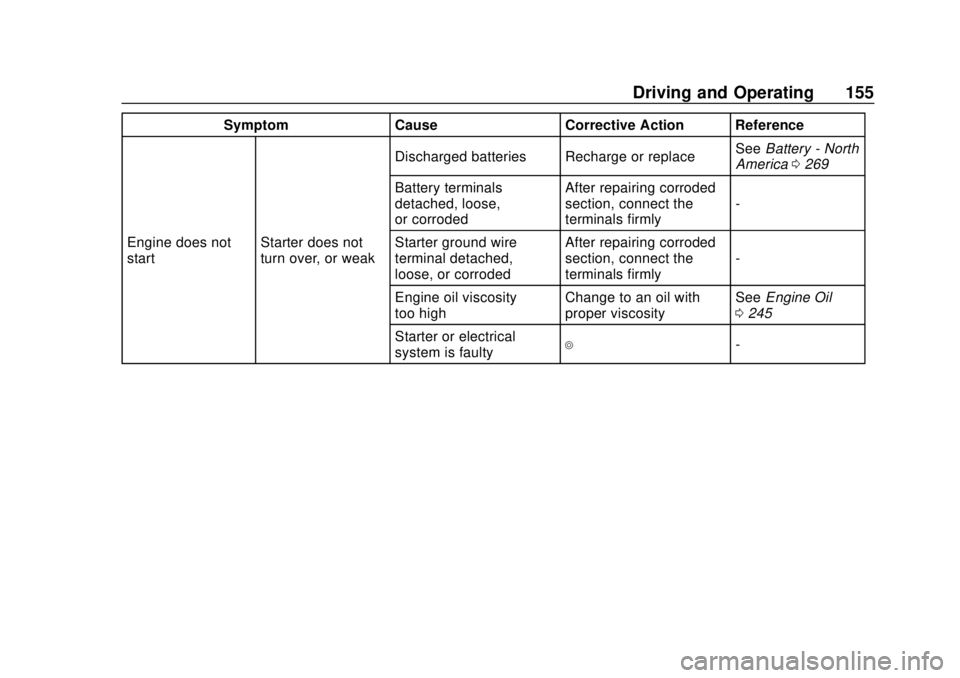
SymptomCauseCorrective Action Reference
Engine does not
start Starter does not
turn over, or weak Discharged batteries Recharge or replace
See
Battery - North
America 0269
Battery terminals
detached, loose,
or corroded After repairing corroded
section, connect the
terminals firmly
-
Starter ground wire
terminal detached,
loose, or corroded After repairing corroded
section, connect the
terminals firmly
-
Engine oil viscosity
too high Change to an oil with
proper viscositySee
Engine Oil
0 245
Starter or electrical
system is faulty
4-
Page 158 of 382
Chevrolet Low Cab Forward 5.2L Diesel Engine 4500/5500 Series (GMNA-
Localizing-U.S.-12407814) - 2019 - crc - 12/13/17
Driving and Operating 157
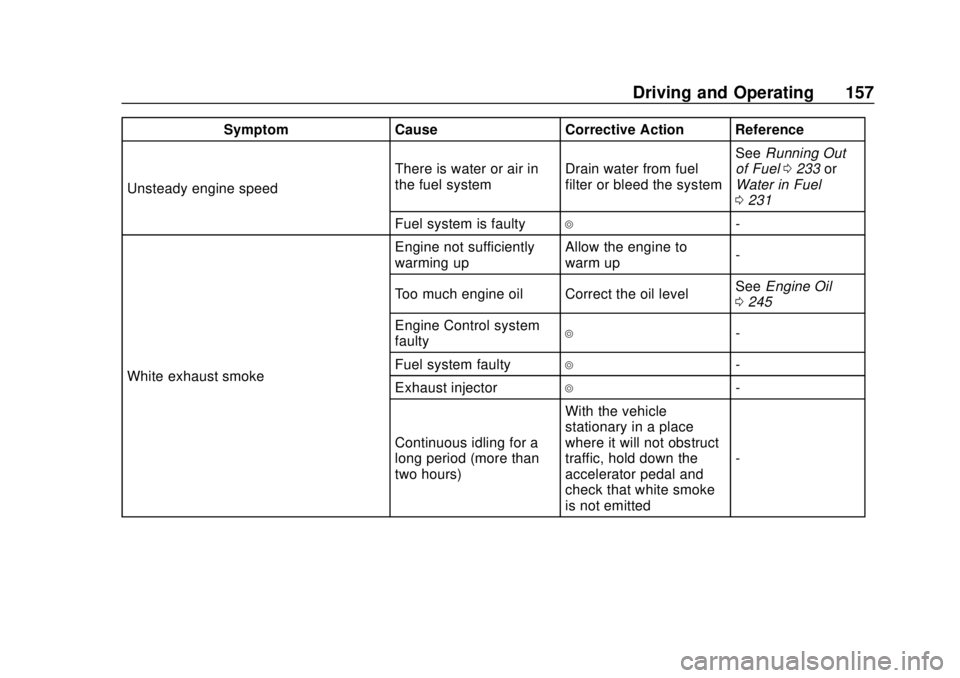
SymptomCauseCorrective Action Reference
Unsteady engine speed There is water or air in
the fuel system
Drain water from fuel
filter or bleed the systemSee
Running Out
of Fuel 0233 or
Water in Fuel
0 231
Fuel system is faulty
4-
White exhaust smoke Engine not sufficiently
warming up
Allow the engine to
warm up
-
Too much engine oil Correct the oil level See
Engine Oil
0 245
Engine Control system
faulty
4-
Fuel system faulty
4-
Exhaust injector
4-
Continuous idling for a
long period (more than
two hours) With the vehicle
stationary in a place
where it will not obstruct
traffic, hold down the
accelerator pedal and
check that white smoke
is not emitted
-
Page 160 of 382

Chevrolet Low Cab Forward 5.2L Diesel Engine 4500/5500 Series (GMNA-
Localizing-U.S.-12407814) - 2019 - crc - 12/13/17
Driving and Operating 159
SymptomCauseCorrective Action Reference
Engine is overheating No engine coolant Add engine coolant
See
Engine
Coolant 0253
Front of radiator is
clogged with dirt Wash clean with tap
waterSee
Exterior Care
0 317
Radiator cap not
sufficiently tightened Make sure it is firmly
tightened or replace the
radiator cap
-
Fan belt loose Adjust the tension or
replace the beltSee
Engine Drive
Belt Routing 0363
Engine coolant dirty
4-
Fan clutch is faulty
4-
Radiator cap dirty or
faulty Clean or replace -
Oil pressure is low Improper engine oil
viscosity
Change to an oil with
proper viscositySee
Engine Oil
0 245
Engine oil level too low Add engine oil See
Engine Oil
0 245
Engine inner
components are faulty
4-
Meter, indicator/warning
lights or switches faulty
4-
Page 164 of 382
Chevrolet Low Cab Forward 5.2L Diesel Engine 4500/5500 Series (GMNA-
Localizing-U.S.-12407814) - 2019 - crc - 12/13/17
Driving and Operating 163
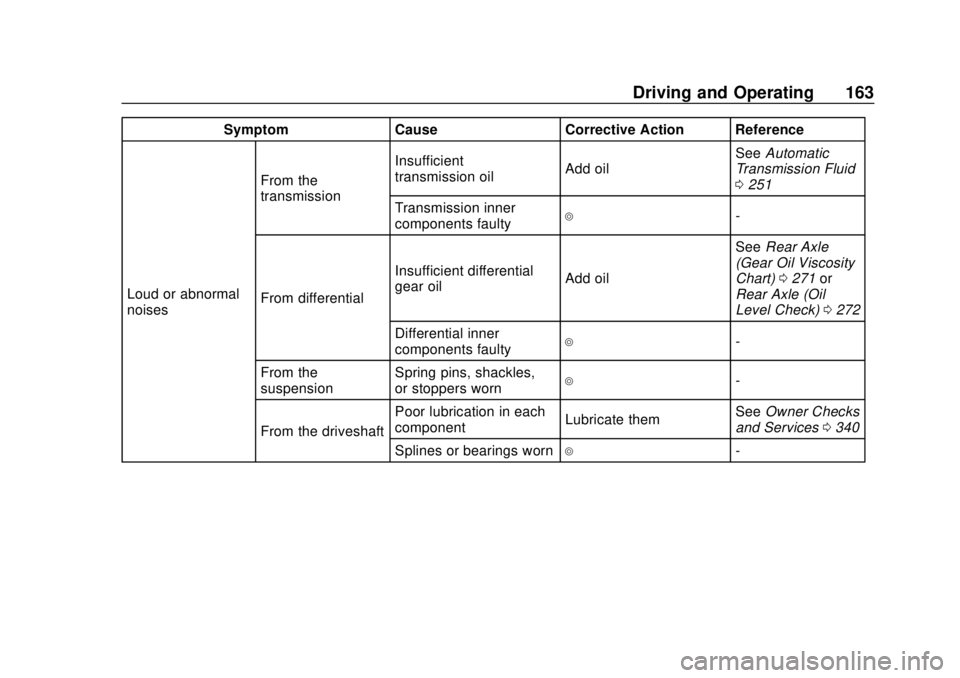
SymptomCauseCorrective Action Reference
Loud or abnormal
noises From the
transmission
Insufficient
transmission oil
Add oilSee
Automatic
Transmission Fluid
0 251
Transmission inner
components faulty
4-
From differential Insufficient differential
gear oil
Add oilSee
Rear Axle
(Gear Oil Viscosity
Chart) 0271 or
Rear Axle (Oil
Level Check) 0272
Differential inner
components faulty
4-
From the
suspension Spring pins, shackles,
or stoppers worn
4-
From the driveshaft Poor lubrication in each
component
Lubricate themSee
Owner Checks
and Services 0340
Splines or bearings worn
4-
Page 170 of 382
Chevrolet Low Cab Forward 5.2L Diesel Engine 4500/5500 Series (GMNA-
Localizing-U.S.-12407814) - 2019 - crc - 12/13/17
Driving and Operating 169
Starting the Engine
Do not keep the engine control
switch in the START position for
more than about 10 seconds.
Operating the starter for too long
might cause starter and battery
failure or may result in overheating.
When the engine does not start,
wait for 20 to 30 seconds and then
turn the engine control switch again.
Before starting the engine sit in the
driver seat, check that the parking
brake is firmly engaged, the selector
lever is in the P or N (P is preferred)
position and the shift indicator also
shows P or N, and firmly press the
brake pedal to start the engine.
When stopped on a slope, start the
engine with the selector lever in the
P position. SeeIgnition Positions
0 166.
1. Make sure that the selector lever is in the P or N position
and firmly press the brake
pedal.
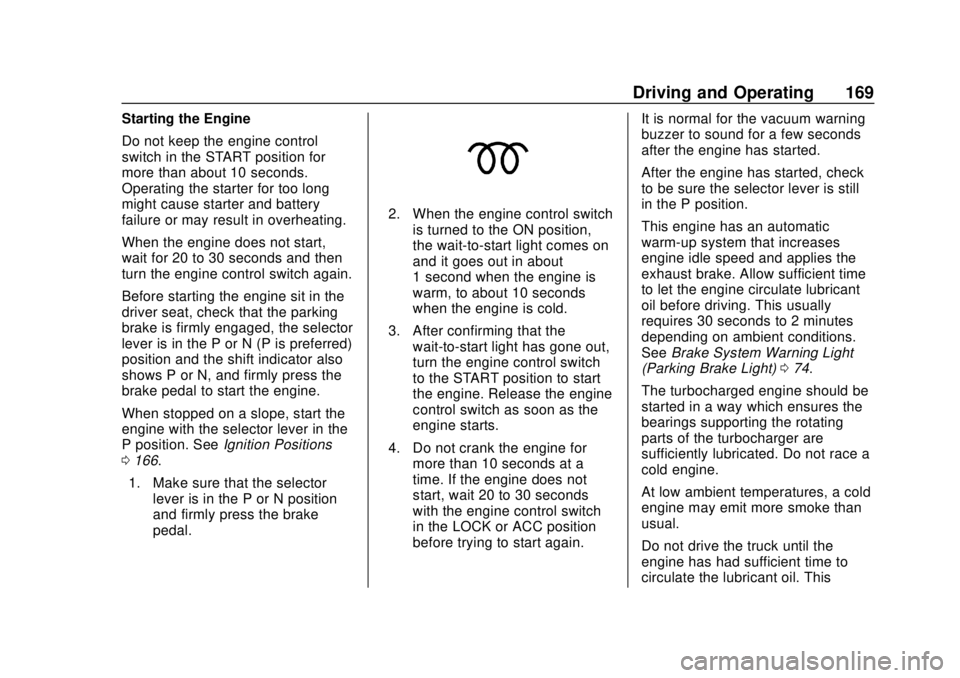
2. When the engine control switch
is turned to the ON position,
the wait-to-start light comes on
and it goes out in about
1 second when the engine is
warm, to about 10 seconds
when the engine is cold.
3. After confirming that the wait-to-start light has gone out,
turn the engine control switch
to the START position to start
the engine. Release the engine
control switch as soon as the
engine starts.
4. Do not crank the engine for more than 10 seconds at a
time. If the engine does not
start, wait 20 to 30 seconds
with the engine control switch
in the LOCK or ACC position
before trying to start again. It is normal for the vacuum warning
buzzer to sound for a few seconds
after the engine has started.
After the engine has started, check
to be sure the selector lever is still
in the P position.
This engine has an automatic
warm-up system that increases
engine idle speed and applies the
exhaust brake. Allow sufficient time
to let the engine circulate lubricant
oil before driving. This usually
requires 30 seconds to 2 minutes
depending on ambient conditions.
See
Brake System Warning Light
(Parking Brake Light) 074.
The turbocharged engine should be
started in a way which ensures the
bearings supporting the rotating
parts of the turbocharger are
sufficiently lubricated. Do not race a
cold engine.
At low ambient temperatures, a cold
engine may emit more smoke than
usual.
Do not drive the truck until the
engine has had sufficient time to
circulate the lubricant oil. This
Page 171 of 382

Chevrolet Low Cab Forward 5.2L Diesel Engine 4500/5500 Series (GMNA-
Localizing-U.S.-12407814) - 2019 - crc - 12/13/17
170 Driving and Operating
usually requires 30 seconds to
2 minutes depending on ambient
conditions. This will help reduce
white start-up smoke.
Preheating :Diesel engines are
compression ignited, which makes
them difficult to start when they are
cold because the compression
alone cannot create a temperature
high enough for fuel to ignite.
Preheating means warming the
compressed air inside the
combustion chambers to facilitate
engine starting. Be sure to start the
engine after the wait-to-start light
has gone out.
Start : Do not press the accelerator
pedal at the engine start. The
accelerator opening degree at the
engine start is electronically
controlled.
Warm-up : Do not race the engine
to speed warm-up. Cold Weather Starting
If you plan ahead for cold weather,
starting and driving your vehicle
should be no problem. The following
tips will help ensure good starting in
cold weather.
Oil gets thicker as it gets colder,
which slows down the engine
cranking speed. The diesel engine
functions by the heat of
compression (and glow plugs when
cold), rather than through the use of
spark plugs as in a gasoline engine.
So, your engine must crank faster
than a gasoline engine before it will
start.
To be sure the engine can turn fast
enough to start, use SAE 10W-40
viscosity engine oil when prevailing
temperatures drop below 0 °C
(32 °F). See the oil quality and oil
viscosity recommendations. Using
the proper viscosity oil will make
starting easier down to -23 °C
(-10 °F). When prevailing
temperatures drop below -23 °C
(-10 °F), the engine block heater
may be needed for starting. See
Engine Heater
0172. Maintenance Items to Aid Cold
Weather Starting
Since the basic principle of diesel
engine ignition is based on
compression, the diesel engine is
somewhat harder to start than a
gasoline engine when the
temperature is below freezing.
To help prevent hard starting
problems, special attention should
be given to following normal
maintenance items:
1. Neglecting to have the fuel filter and water separator
serviced can be one of the
major contributors to hard
starting. If water is permitted to
accumulate in the primary filter,
it will freeze and make starting
the engine impossible.
2. Make sure the fuel tank vent is open.
Page 172 of 382
Chevrolet Low Cab Forward 5.2L Diesel Engine 4500/5500 Series (GMNA-
Localizing-U.S.-12407814) - 2019 - crc - 12/13/17
Driving and Operating 171
3. Always refuel at the end of aday's operation. Moisture will
condense in an empty tank;
therefore, the tank should be
filled before leaving the vehicle
standing for an extended
period.
Do not use starting aids in the air
intake system. Such aids can cause
immediate engine damage. See
Fuel for Diesel Engines 0227.
Stopping the Engine
When stopping the engine, take the
following steps: 1. Bring the vehicle to a complete stop.
2. Firmly apply the parking brake.
3. Move the selector lever to the P position and make sure that
the shift indicator shows P.
4. Allow the engine to idle for approximately 3 minutes.
5. Turn the engine control switch to the ACC or LOCK position. Do not shut down the engine
immediately after driving the vehicle.
Otherwise, a seizure or other
failures may result.
To prevent the battery from going
dead, turn the engine control switch
to the ACC or LOCK position after
stopping the engine. If you leave the
vehicle for an extended period of
time, place the engine control switch
in the LOCK position.
Let the engine idle for 3 minutes
before shutting off the engine. This
allows the turbocharger to slow
down while keeping the bearings
lubricated.
If the Vehicle Has Not Been Used
for a Long Period
If a diesel vehicle has been
standing for an extended period of
time, the turbocharger bearings
should be pre-lubricated prior to
starting. See your authorized dealer
for more detailed information.
Before using a vehicle that has not
been driven for a long period, check
the engine and transmission for oil
leakage, and make sure the oil is at the required levels. If there is
insufficient oil, it will not adequately
reach and lubricate components,
and a breakdown will result.
Start the engine and allow it to idle
for at least five minutes. Check for
abnormal noises.
For instructions on warming up the
engine, refer to
“Starting the Engine”
previously in this section.
If one year has passed since the
diesel exhaust fluid (DEF) in the
DEF tank was added, the DEF in
the tank should be replaced. Be
careful not to inhale the ammonia
odor when replacing the DEF. Also,
please contact your nearest dealer
about the replacement work.
Operating Temperature
Recommendations for Warming
Up the Engine
The engine is sufficiently warmed
up when the needle of the engine
coolant temperature gauge starts
to move.
Page 173 of 382

Chevrolet Low Cab Forward 5.2L Diesel Engine 4500/5500 Series (GMNA-
Localizing-U.S.-12407814) - 2019 - crc - 12/13/17
172 Driving and Operating
Do not race the engine or quickly
accelerate before the engine has
sufficiently warmed up. Oil would
not have adequately reached and
lubricated components, and a
breakdown may result.
The exhaust pipe becomes
extremely hot while the engine is
idling. Before warming up the
engine, make sure there is no
flammable material, such as grass,
waste paper, oil, or old tires near the
exhaust pipe.
Engine Warm-up System
During cold ambient conditions, the
automatic engine warm-up system
operates to reduce engine warm-up
time during idling.
Automatic Engine Warm-up :
When the engine is idling with the
engine coolant temperature below
62 °C (144 °F), the engine warm-up
system automatically closes the
exhaust brake and increases engine
idle speed so that the engine is
warmed more quickly. Warm-up is
cancelled when the accelerator
pedal is pressed, and resumedwhen the pedal is released.
Warm-up is automatically cancelled
entirely after the engine coolant
temperature rises above 65 °C
(149 °F).
Winter Cover
.
Do not cover the front of the
radiator with newspapers,
cardboard or any other
flammable material to raise the
engine coolant temperature.
. If you allow the engine to warm
up but the engine coolant
temperature does not rise, have
the nearest dealer inspect the
thermostat.
Radiator Grille Covers
{Warning
Radiator shutters, winter fronts,
or grille covers are not to be used
and may cause the engine's
radiator cooling fan to fatigue
from the alternate unloading and (Continued)
Warning (Continued)
loading of the blades as they
pass by the masked area
followed by the unmasked area.
After the fan has been fatigued, it
may suddenly break apart while
rotating, possibly causing
personal injury to anyone
standing nearby, and equipment
damage. You and others could be
seriously injured.
Engine Heater
Engine Block and Oil Pan Heater
If the vehicle is parked in a garage,
the block and pan heaters should
not be needed until the garage
temperature drops below −23°C
(−10°F) regardless of outside
temperature.
Page 174 of 382

Chevrolet Low Cab Forward 5.2L Diesel Engine 4500/5500 Series (GMNA-
Localizing-U.S.-12407814) - 2019 - crc - 12/13/17
Driving and Operating 173
The engine block and oil pan
heaters are designed to warm the
block and oil pan areas that will let
the engine run faster. To use the
heaters:1. On single cab vehicles, tilt the cab.
2. Unwrap the electrical cord and remove the protective cap.
3. Plug the cord into any three-prong 110 volt outlet
(normal household current).
It may require several hours to
sufficiently heat the engine.
Outside temperature, oil
viscosity, etc., will affect how
long the block and oil pan
heater should remain plugged
in. Contact your dealer for the
conditions in your area.
4. After using the heater(s), be sure to restore the cord
properly, to help keep it away
from moving engine parts. If the cord is too short, use a heavy
duty, three-prong extension cord. Do
not use an extension cord such as
you would use for a lamp, because
the cord may overheat.
The engine should go through a
warm-up period to warm up the
engine oil before placing engine
under load. This will ensure proper
lubrication of the engine. See
Cab
Tilting 0243.
Engine Alarm and
Automatic Shutdown
If the system senses any of the
following conditions: high engine
temperature, low engine oil pressure
or low engine coolant, the
corresponding warning light and
engine alarm (shutdown) warning
light will come on. If the engine
alarm (shutdown) warning light
comes on, you will also hear a tone
alarm.
If your vehicle has the engine
shutdown feature, your engine will
shut down in 30 seconds.
Pull safely off the road and shut off
the engine. Do not start it until the
cause of the problem is known, and
the problem is fixed. However, if the
engine shuts down when you are
still in traffic, you can restart the
engine and get another 30 seconds
of operation. Do this only if you
have to, since there is a problem
that can harm the engine if it is not
fixed. See Engine Shutdown
Warning Light 080.