service CHEVROLET LOW CAB FORWARD 2019 Owner's Guide
[x] Cancel search | Manufacturer: CHEVROLET, Model Year: 2019, Model line: LOW CAB FORWARD, Model: CHEVROLET LOW CAB FORWARD 2019Pages: 382, PDF Size: 5.95 MB
Page 137 of 382
Chevrolet Low Cab Forward 5.2L Diesel Engine 4500/5500 Series (GMNA-
Localizing-U.S.-12407814) - 2019 - crc - 12/13/17
136 Climate Controls
Installing the Inside Air Filter
Install the filter in the reverse order
to removal.
Ensure that the filter is returned
securely to its original position.
Failure to observe this precaution
can lead to rattling during travel.
The vehicle must not be used with
the filter removed or incorrectly
installed. Failure to observe this
precaution can lead to air
conditioning system damage as a
result of dust, dirt and the like
entering the system.Removing the Outside Air Filter
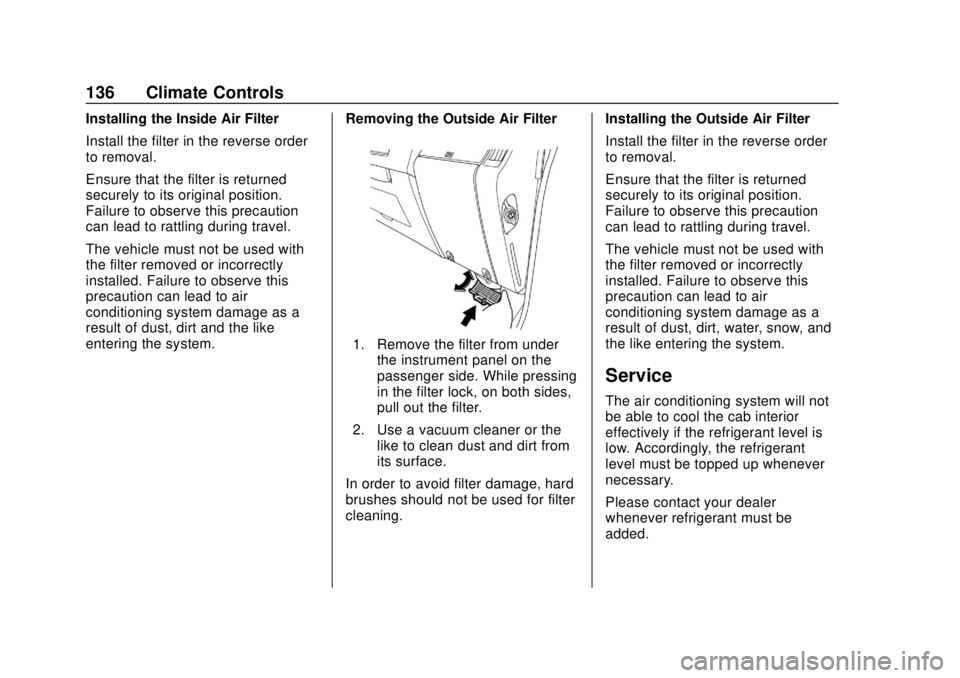
1. Remove the filter from under
the instrument panel on the
passenger side. While pressing
in the filter lock, on both sides,
pull out the filter.
2. Use a vacuum cleaner or the like to clean dust and dirt from
its surface.
In order to avoid filter damage, hard
brushes should not be used for filter
cleaning. Installing the Outside Air Filter
Install the filter in the reverse order
to removal.
Ensure that the filter is returned
securely to its original position.
Failure to observe this precaution
can lead to rattling during travel.
The vehicle must not be used with
the filter removed or incorrectly
installed. Failure to observe this
precaution can lead to air
conditioning system damage as a
result of dust, dirt, water, snow, and
the like entering the system.
Service
The air conditioning system will not
be able to cool the cab interior
effectively if the refrigerant level is
low. Accordingly, the refrigerant
level must be topped up whenever
necessary.
Please contact your dealer
whenever refrigerant must be
added.
Page 138 of 382
Chevrolet Low Cab Forward 5.2L Diesel Engine 4500/5500 Series (GMNA-
Localizing-U.S.-12407814) - 2019 - crc - 12/13/17
Climate Controls 137
Operation Tips
Operating the air conditioning while
the refrigerant level is too low leads
not only to poor cooling
performance but also to air
conditioning system damage.
This vehicle uses the new
refrigerant HFC134a (R134a) in the
air conditioning system. No other
type of refrigerant can be used. In
order to protect the environment,
care must be taken to ensure that
refrigerant gas is never released
into open air. When refrigerant must
be replaced, therefore, please
contact your dealer or other service
facility equipped with a gas recovery
installation system.
Page 144 of 382
Chevrolet Low Cab Forward 5.2L Diesel Engine 4500/5500 Series (GMNA-
Localizing-U.S.-12407814) - 2019 - crc - 12/13/17
Driving and Operating 143
fluid leakage, fuel leakage and
component damage. If any part of
the vehicle is damaged or broken,
promptly have the vehicle inspected
and repaired.
Highways
.Speeds on highways are higher
than those on regular roads, so
there is more danger. Also, a
breakdown on a highway
represents a hazard to other
vehicles and can cause a crash.
Concentrate on safe driving.
Remember to perform daily
pre-operation inspections and
use highway driving techniques.
When performing daily
pre-operation inspections,
perform the checks shown in the
table on the left with particularly
great care.
Refer to Owner Checks and
Services 0340.
. When merging with traffic on a
highway, use the turn signal
lights to indicate your intentions
ahead of time. Speed up
sufficiently when you are in the acceleration lane. Pay attention
to vehicles behind you and to
conditions in the lane you are
joining. Merge in such a way that
you do not obstruct vehicles in
the lane.
. Your sense of how fast you are
traveling becomes distorted on
long highway drives. Constantly
keep an eye on the
speedometer, and maintain a
suitable headway distance.
. During high-speed driving, even
a little turn of the steering wheel
causes a big movement of the
vehicle. Turn the steering wheel
slowly.
. Excessive use of the brake
pedal is extremely dangerous
because it rapidly wears the
brake linings and causes brake
fade. Make effective use of the
engine brake and the exhaust
brake when you want to
decelerate.
. When you want to turn off a
highway, use the turn signal
lights to indicate your intentions ahead of time. Paying attention
to vehicles behind you, turn off
the highway smoothly so as not
to obstruct other vehicles.
Brake Fade : Frequent use of the
brakes can cause the brakes to
overheat so that the frictional force
of the brake linings decreases and
the brakes become less effective
than normal. This phenomenon is
called brake fade.
Braking
Brake Operation
The brakes give strong braking
force with only light pressure on the
pedal. Do not press the brake pedal
hard except in the event of an
emergency.
Actual stopping distances vary
greatly. Your ability to stop safely
will be greatly affected by the
surface of the road, whether it is
pavement or gravel; the condition of
the road, whether it is wet, dry or
icy; tire tread; the condition of the
brakes; the weight of the vehicle;
the weight of the load; and the
Page 146 of 382

Chevrolet Low Cab Forward 5.2L Diesel Engine 4500/5500 Series (GMNA-
Localizing-U.S.-12407814) - 2019 - crc - 12/13/17
Driving and Operating 145
Brake System Warning Light
Caution
If brake low vacuum warning light
(4500HD, 4500XD models), brake
booster warning light (5500HD,
5500XD models), or brake system
warning light comes on during
operation, have brake system
checked immediately.
Refer to Warning Lights, Gauges,
and Indicators 068.
When the Brakes Do Not Work
{Warning
It is very dangerous to suddenly
pull the parking brake lever all the
way while moving at high speed.
Reduce speed first by shifting
down and then gradually pull the
parking brake lever.
You and others could be seriously
injured. The exhaust brake should be turned
on as soon as service brake
malfunction is detected. This will
slow the engine speed. With the
engine speed under control and
providing the grade conditions
permit, the transmission can be
progressively downshifted using the
exhaust brake in each gear.
Eventually the exhaust brake should
slow the vehicle to a controllable
“crawl.”
Gradually pull the parking
brake lever while firmly holding on
to the steering wheel. Stop the
vehicle on the side of the road. The
vehicle should not be driven further
until corrective measures are taken.
See Exhaust Brake 0222 and
Parking Brake 0220.
Riding the Brake
{Warning
"Riding the brake" by resting your
foot on the pedal, when you do
not intend to brake, can overheat
the brakes and wear out the (Continued)
Warning (Continued)
brake linings faster. This may also
damage the brakes and will waste
fuel. It can also result in reduced
braking performance.
You and others could be seriously
injured.
Applying the Parking Brake
Except in an emergency, do not
apply the parking brake until the
vehicle has come to a complete
stop. Applying the parking brake
before the vehicle has stopped can
cause a breakdown.
Refer toParking Brake 0220.
Parking Safely on a Slope
Avoid parking your vehicle on a
slope as much as possible and
choose a level and flat place. If you
must park your vehicle on a slope,
be sure to set the parking brake
fully. Make sure that the vehicle
does not move, and block the
wheels with chocks for added
Page 149 of 382
Chevrolet Low Cab Forward 5.2L Diesel Engine 4500/5500 Series (GMNA-
Localizing-U.S.-12407814) - 2019 - crc - 12/13/17
148 Driving and Operating
Vapor Lock :If the brakes overheat
due to frequent use, the heat can
cause the brake fluid to boil so that
air bubbles are created in the brake
fluid. Pressing the brake pedal
simply compresses the air bubbles;
pressure is not transmitted to the
wheel cylinders, so the brakes'
effectiveness sharply deteriorates.
This phenomenon is called
vapor lock.
Even so, you should be very careful
when using engine braking in a low
gear because the engine is likely to
over-rev.
See Exhaust Brake 0222 and
Selector Lever 0214.
Do not adjust the exhaust brake
valve.
The engine should never be allowed
to exceed the governed speed.
Supplement the exhaust brake with
vehicle service brakes intermittently
and/or shift to higher transmission
gear to prevent engine overspeed.
A rule of thumb for gear selection is
that the vehicle should be driven
down a grade in the same gear that
would be used to climb that grade.{Warning
To reduce the risk of personal
injury, before going down a steep
or long grade, reduce speed, turn
on the exhaust brake and shift the
transmission to the next lower
gear. This will help control your
speed. Do not hold the brake
pedal down too long or too often
while going down a steep or long
grade. This could cause the
brakes to get hot and not to work
as well. As a result, the truck will
not slow down at the usual rate.
Failure to take these steps could
result in loss of vehicle control.
You and others could be seriously
injured.
Brake Effectiveness When the
Vehicle Has Been Driven on a
Flooded Road or Washed
{Warning
When the vehicle is driven on a
flooded road, parked on a flooded
road or washed, water can get
into the brakes and reduce their
effectiveness. If the brakes do not
work well afterward, drive slowly
and gently press the brake pedal
several times until the brakes dry
out and start working normally.
Always do this after driving
through water or washing the
vehicle to help reduce the risk of
personal injury. Before parking
the vehicle in winter, press the
brake pedal several times in the
same way to get rid of moisture in
the brakes. Otherwise, the
moisture in the brakes may freeze
and make the vehicle immovable.
You and others could be seriously
injured.
Page 164 of 382
Chevrolet Low Cab Forward 5.2L Diesel Engine 4500/5500 Series (GMNA-
Localizing-U.S.-12407814) - 2019 - crc - 12/13/17
Driving and Operating 163
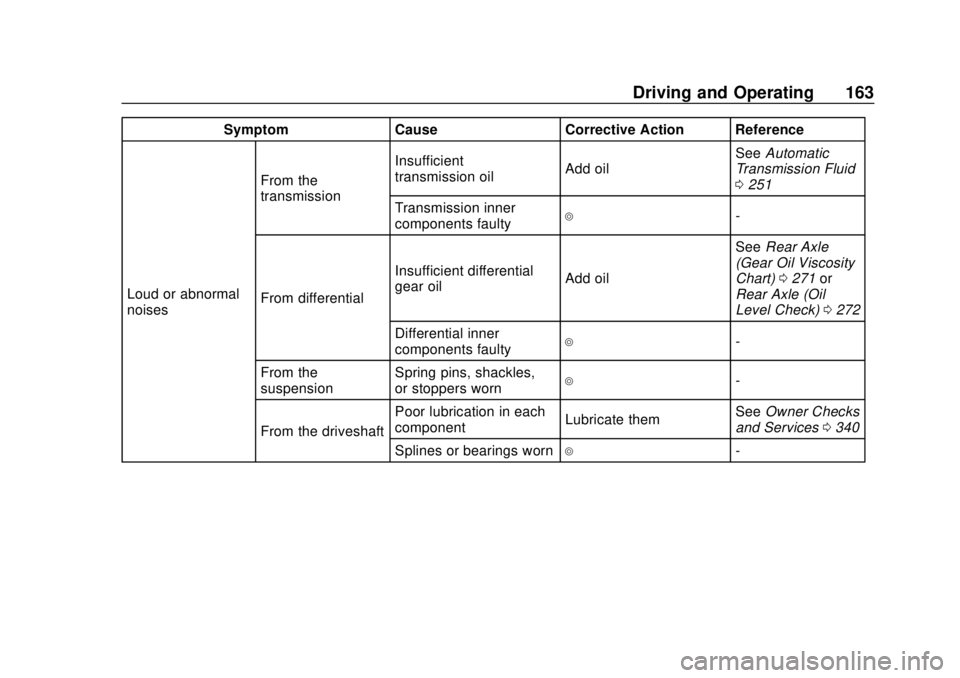
SymptomCauseCorrective Action Reference
Loud or abnormal
noises From the
transmission
Insufficient
transmission oil
Add oilSee
Automatic
Transmission Fluid
0 251
Transmission inner
components faulty
4-
From differential Insufficient differential
gear oil
Add oilSee
Rear Axle
(Gear Oil Viscosity
Chart) 0271 or
Rear Axle (Oil
Level Check) 0272
Differential inner
components faulty
4-
From the
suspension Spring pins, shackles,
or stoppers worn
4-
From the driveshaft Poor lubrication in each
component
Lubricate themSee
Owner Checks
and Services 0340
Splines or bearings worn
4-
Page 169 of 382

Chevrolet Low Cab Forward 5.2L Diesel Engine 4500/5500 Series (GMNA-
Localizing-U.S.-12407814) - 2019 - crc - 12/13/17
168 Driving and Operating
4 START :On all engines, start is in
the position furthest clockwise. The
engine is started in this position.
Turn the key against spring
pressure to energize the starter.
When key is released, spring
pressure returns it to the ON
position. Release the key as soon
as the engine has started.
If the key cannot be turned from the
LOCK position to the ON position,
lightly move the steering wheel
clockwise and counterclockwise
while trying to turn the key.
Starting and Stopping the
Vehicle
Check around the Vehicle before
Starting the Engine
Proper care and operation will not
only extend the service life of your
vehicle but also improve fuel
economy.
Before pulling away, perform a
thorough safety check, making sure
there are no children or obstructions around the vehicle. Take off the
chocks after confirming that the
parking brake is securely applied.
Sit behind the wheel, adjust the seat
position, and buckle up the seat
belt. The passengers are also
required to buckle up the seat belts.
Adjust the positions of the steering
wheel and mirrors. Lock the doors.
Turn the power of the dome light or
accessories OFF before starting the
engine. See
Seat Position 038,
Seat Belts 043, Steering Wheel
Adjustment 065, and Mirrors033.
Keep the Floor Around the
Driver's Seat Clean and Tidy{Warning
It is extremely dangerous to have
empty cans, empty bottles or
other items rolling around on the
floor because they could get
trapped under the brake pedal
and prevent brake application.
For proper pedal operation, it is (Continued)
Warning (Continued)
also essential to lay floor mats
properly. Incorrectly installed floor
mats would hinder free movement
of the pedals.
Do not use the dashboard pocket
or the top of the dashboard as a
place to put items that could roll,
which could interfere with your
driving. You and others could be
seriously injured.
Choose Your Footwear Suitable
for Driving
{Warning
Choose footwear that ensures
proper operation of pedals when
driving the vehicle. Use of
footwear unsuitable for driving
may cause an accident.
Page 171 of 382

Chevrolet Low Cab Forward 5.2L Diesel Engine 4500/5500 Series (GMNA-
Localizing-U.S.-12407814) - 2019 - crc - 12/13/17
170 Driving and Operating
usually requires 30 seconds to
2 minutes depending on ambient
conditions. This will help reduce
white start-up smoke.
Preheating :Diesel engines are
compression ignited, which makes
them difficult to start when they are
cold because the compression
alone cannot create a temperature
high enough for fuel to ignite.
Preheating means warming the
compressed air inside the
combustion chambers to facilitate
engine starting. Be sure to start the
engine after the wait-to-start light
has gone out.
Start : Do not press the accelerator
pedal at the engine start. The
accelerator opening degree at the
engine start is electronically
controlled.
Warm-up : Do not race the engine
to speed warm-up. Cold Weather Starting
If you plan ahead for cold weather,
starting and driving your vehicle
should be no problem. The following
tips will help ensure good starting in
cold weather.
Oil gets thicker as it gets colder,
which slows down the engine
cranking speed. The diesel engine
functions by the heat of
compression (and glow plugs when
cold), rather than through the use of
spark plugs as in a gasoline engine.
So, your engine must crank faster
than a gasoline engine before it will
start.
To be sure the engine can turn fast
enough to start, use SAE 10W-40
viscosity engine oil when prevailing
temperatures drop below 0 °C
(32 °F). See the oil quality and oil
viscosity recommendations. Using
the proper viscosity oil will make
starting easier down to -23 °C
(-10 °F). When prevailing
temperatures drop below -23 °C
(-10 °F), the engine block heater
may be needed for starting. See
Engine Heater
0172. Maintenance Items to Aid Cold
Weather Starting
Since the basic principle of diesel
engine ignition is based on
compression, the diesel engine is
somewhat harder to start than a
gasoline engine when the
temperature is below freezing.
To help prevent hard starting
problems, special attention should
be given to following normal
maintenance items:
1. Neglecting to have the fuel filter and water separator
serviced can be one of the
major contributors to hard
starting. If water is permitted to
accumulate in the primary filter,
it will freeze and make starting
the engine impossible.
2. Make sure the fuel tank vent is open.
Page 175 of 382
Chevrolet Low Cab Forward 5.2L Diesel Engine 4500/5500 Series (GMNA-
Localizing-U.S.-12407814) - 2019 - crc - 12/13/17
174 Driving and Operating
Idle Shutdown
Idle Stop is a dealer programmable
function which will automatically turn
off the engine, at idle, when specific
programmed conditions are met.
See your dealer for details. When
the Idle Stop light comes on, it alerts
you that programmed conditions
have been met and the engine is
about to shut down. This light stays
on after the engine has stopped.
This indicator light will come on
when the engine control switch is
turned to the ON position and then
should go out after approximately
3 seconds.
If the idling stop function does not
initiate, a transmission related
problem may have occurred. Please
contact your dealer. (There is a
Diagnostic Trouble Code (DTC) that
inhibits the idling stop function when
the Service Transmission Warning
Light is not illuminated).
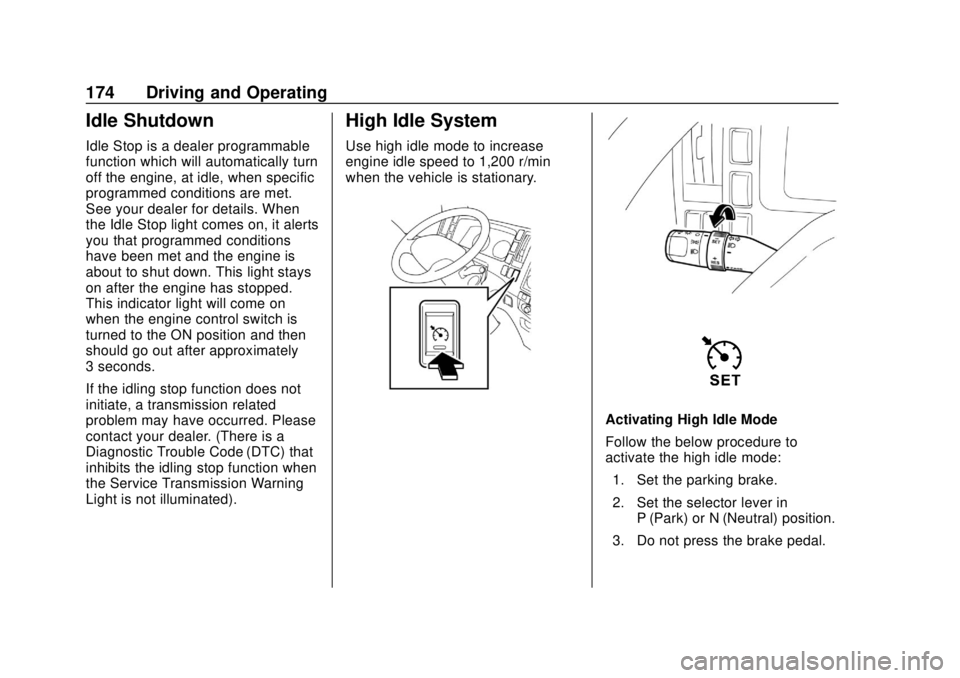
High Idle System
Use high idle mode to increase
engine idle speed to 1,200 r/min
when the vehicle is stationary.
Activating High Idle Mode
Follow the below procedure to
activate the high idle mode:1. Set the parking brake.
2. Set the selector lever in P (Park) or N (Neutral) position.
3. Do not press the brake pedal.
Page 192 of 382
Chevrolet Low Cab Forward 5.2L Diesel Engine 4500/5500 Series (GMNA-
Localizing-U.S.-12407814) - 2019 - crc - 12/13/17
Driving and Operating 191
.Any substance other than the
DEF may cause a breakdown to
the SCR system.
. Use the DEF handling
equipment made of correct
materials (Polyethylene or
Stainless-steel).
. Avoid contamination from using
dirty funnel for filling.
. If a fluid other than the specified
DEF is mistakenly added,
incorrect fluid may cause a
failure. Have it inspected and
serviced at a dealer immediately.
. Ammonia odor may be
generated when the DEF is
exposed to high temperature.
. Do not add DEF above the F
position on the level gauge. DEF
may leak from the breather hose
while driving. Also, the sensor
may be broken when DEF
freezes.
. Do not put your feet on or stand
on the DEF tank. The tank, pipe
or sensors may be damaged. .
After stopping the engine, a flow
sound may be heard from the
DEF tank or DEF supply pump.
This sound occurs as the DEF in
the piping is returning to the
tank, and does not indicate an
abnormality.
See Winter Driving 0151.
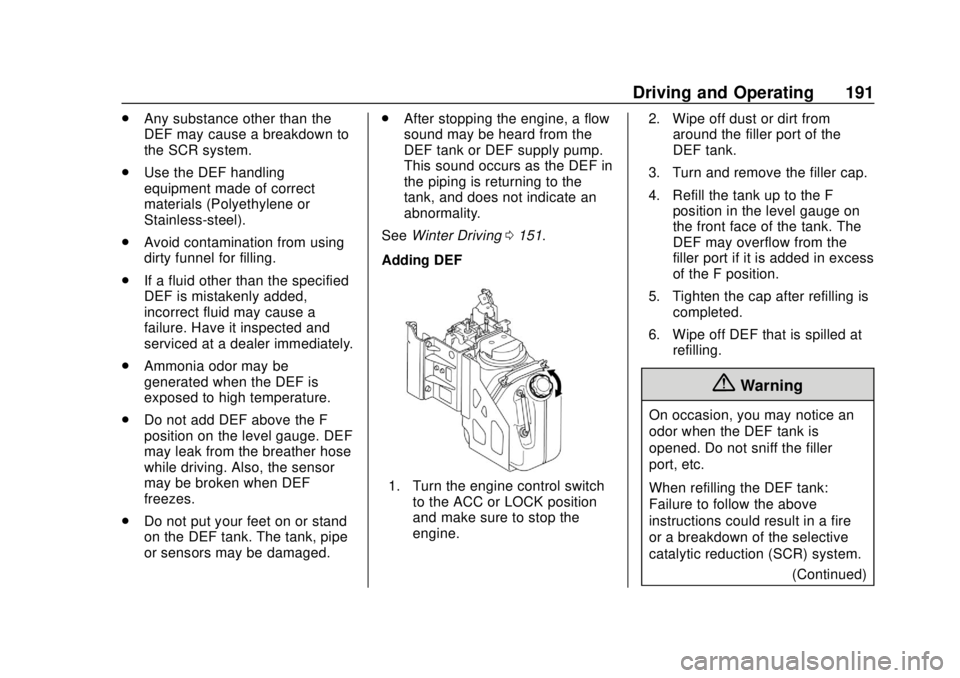
Adding DEF
1. Turn the engine control switch to the ACC or LOCK position
and make sure to stop the
engine. 2. Wipe off dust or dirt from
around the filler port of the
DEF tank.
3. Turn and remove the filler cap.
4. Refill the tank up to the F position in the level gauge on
the front face of the tank. The
DEF may overflow from the
filler port if it is added in excess
of the F position.
5. Tighten the cap after refilling is completed.
6. Wipe off DEF that is spilled at refilling.
{Warning
On occasion, you may notice an
odor when the DEF tank is
opened. Do not sniff the filler
port, etc.
When refilling the DEF tank:
Failure to follow the above
instructions could result in a fire
or a breakdown of the selective
catalytic reduction (SCR) system.
(Continued)