tow CHEVROLET MONTE CARLO 2004 Workshop Manual
[x] Cancel search | Manufacturer: CHEVROLET, Model Year: 2004, Model line: MONTE CARLO, Model: CHEVROLET MONTE CARLO 2004Pages: 416, PDF Size: 4.56 MB
Page 355 of 416
Cleaning Aluminum Wheels
Keep your wheels clean using a soft clean cloth with
mild soap and water. Rinse with clean water. After
rinsing thoroughly, dry with a soft clean towel. A wax
may then be applied.
The surface of these wheels is similar to the painted
surface of your vehicle. Do not use strong soaps,
chemicals, abrasive polishes, abrasive cleaners,
cleaners with acid, or abrasive cleaning brushes on
them because you could damage the surface.
Do not use chrome polish on aluminum wheels.
Do not take your vehicle through an automatic car
wash that has silicone carbide tire cleaning brushes.
These brushes can also damage the surface of
these wheels.
Cleaning Tires
To clean your tires, use a stiff brush with tire cleaner.
Notice:Using petroleum-based tire dressing
products on your vehicle may damage the paint
nish and/or tires. When applying a tire dressing,
always wipe off any overspray from all painted
surfaces on your vehicle.
Sheet Metal Damage
If your vehicle is damaged and requires sheet metal
repair or replacement, make sure the body repair shop
applies anti-corrosion material to parts repaired or
replaced to restore corrosion protection.
Original manufacturer replacement parts will provide the
corrosion protection while maintaining the warranty.
Finish Damage
Any stone chips, fractures or deep scratches in the
nish should be repaired right away. Bare metal
will corrode quickly and may develop into major repair
expense.
Minor chips and scratches can be repaired with touch-up
materials avaliable from your dealer. Larger areas of
nish damage can be corrected in your dealer’s
body and paint shop.
5-99
Page 376 of 416
(d)Visually inspect wiper blades for wear or cracking.
Replace blade inserts that appear worn or damaged
or that streak or miss areas of the windshield.
(e)Make sure the safety belt reminder light and all your
belts, buckles, latch plates, retractors and anchorages
are working properly. Look for any other loose or
damaged safety belt system parts. If you see anything
that might keep a safety belt system from doing its
job, have it repaired. Have any torn or frayed safety belts
replaced. Also look for any opened or broken air bag
coverings, and have them repaired or replaced. (The air
bag system does not need regular maintenance.)
(f)Lubricate all key lock cylinders. Lubricate all hinges
and latches, including those for the body doors,
hood, secondary latch, pivots, spring anchor, release
pawl, rear compartment, glove box door, console
door and any folding seat hardware. More frequent
lubrication may be required when exposed to a corrosive
environment. Applying silicone grease on weatherstrips
with a clean cloth will make them last longer, seal
better and not stick or squeak.
(g)If you drive regularly under dusty conditions, the
lter may require replacement more often.(h)Change automatic transaxle uid and lter if the
vehicle is mainly driven under one or more of these
conditions:
In heavy city traffic where the outside temperature
regularly reaches 90°F (32°C) or higher.
In hilly or mountainous terrain.
When doing frequent trailer towing.
Uses such as found in taxi, police or delivery
service.
(i)Drain, ush and rell cooling system. See Engine
Coolant on page 5-31for what to use. Inspect hoses.
Clean radiator, condenser, pressure cap and ller neck.
Pressure test the cooling system and pressure cap.
(j)Check throttle system for interference or binding and
for damaged or missing parts. Replace parts as
needed. Replace any components that have high effort
or excessive wear. Do not lubricate accelerator or
cruise control cables.
(k)A uid loss in any vehicle system could indicate a
problem. Have the system inspected and repaired
and the uid level checked. Add uid if needed.
(l)For supercharged engines onl: Check the
supercharger oil level and add the proper supercharger
oil as needed (or every 36 months, whichever occurs
rst). See Recommended Fluids and Lubricants on
page 6-12.
6-8
Page 392 of 416
GM Mobility Program for Persons
with Disabilities
This program, available to
qualied applicants, can
reimburse you up to $1,000
toward eligible aftermarket
driver or passenger
adaptive equipment you
may require for your vehicle
(hand controls, wheelchair/
scooter lifts, etc.).
This program can also provide you with free resource
information, such as area driver assessment centers and
mobility equipment installers. The offer is available for
a limited period of time from the date of vehicle
purchase/lease. For more details, or to determine your
vehicle’s eligibility, see your GM dealer or call the
GM Mobility Assistance Center at 1-800-323-9935. Text
telephone (TTY) users, call 1-800-833-9935.
GM of Canada also has a Mobility Program. Call
1-800-GM-DRIVE (463-7483) for details. All TTY
users call 1-800-263-3830.
Roadside Assistance Program
To enhance Chevrolet’s strong commitment to customer
satisfaction, Chevrolet is excited to announce the
establishment of the Chevrolet Roadside Assistance
Center. As the owner of a 2004 Chevrolet, membership
in Roadside Assistance is free.
Roadside Assistance is available 24 hours a day,
365 days a year, by calling 1-800-CHEV-USA
(243-8872). This toll-free number will provide you
over-the-phone roadside assistance with minor
mechanical problems. If your problem cannot be
resolved over the phone, our advisors have access to a
nationwide network of dealer recommended service
providers. Roadside membership is free; however some
services may incur costs.
Roadside offers two levels of service to the customer,
Basic CareandCourtesy Care:
RoadsideBasic Careprovides:
Toll-free number, 1-800-CHEV-USA (243-8872),
text telephone (TTY) users, call 1-888-889-2438
Free towing for warranty repairs
Basic over-the-phone technical advice
Available dealer services at reasonable costs
(i.e., wrecker services, locksmith/key service, glass
repair, etc.)
7-6
Page 393 of 416
RoadsideCourtesy Careprovides:
RoadsideBasic Careservices
(as outlined previously)
Plus:
FREE Non-Warranty Towing (to the closest dealer
from a legal roadway)
FREE Locksmith/Key Service (when keys are lost
on the road or locked inside)
FREE Flat Tire Service (spare installed on the road)
FREE Jump Start (at home or on the road)
FREE Fuel Delivery ($5 of fuel delivered on
the road)
Chevrolet offers Courtesy Transportation for customers
needing warranty service. Courtesy Transportation will be
offered in conjunction with the coverage provided by the
Bumper-to-Bumper New Vehicle Limited Warranty to
eligible purchasers of 2004 Chevrolet passenger cars
and light duty trucks. (See your selling dealer for details.)
Courtesy Careis available to retail and retail lease
customers operating 2004 and newer Chevrolet vehicles
for a period of 3 years/36,000 miles (60 000 km),
whichever occurs rst. AllCourtesy Careservices must
be pre-arranged by Chevrolet Roadside or dealer service
management.Basic CareandCourtesy Careare not part of or included
in the coverage provided by the New Vehicle Limited
Warranty. Chevrolet reserves the right to modify or
discontinueBasic CareandCourtesy Careat any time.
The Roadside Assistance Center uses companies that
will provide you with quality and priority service.
When roadside services are required, our advisors will
explain any payment obligations that may be incurred
for utilizing outside services.
For prompt assistance when calling, please have the
following available to give to the advisor;Vehicle Identication Number (VIN)
License plate number
Vehicle color
Vehicle location
Telephone number where you can be reached
Vehicle mileage
Description of problem
7-7
Page 398 of 416
Reporting Safety Defects
Reporting Safety Defects to the
United States Government
If you believe that your vehicle has a defect which could
cause a crash or could cause injury or death, you
should immediately inform the National Highway Traffic
Safety Administration (NHTSA), in addition to notifying
General Motors.
If NHTSA receives similar complaints, it may open an
investigation, and if it nds that a safety defect exists in
a group of vehicles, it may order a recall and remedy
campaign. However, NHTSA cannot become involved in
individual problems between you, your dealer or
General Motors.
To contact NHTSA, you may either call the Auto Safety
Hotline toll-free at 1-800-424-9393 (or 366-0123 in
the Washington, D.C. area) or write to:
NHTSA, U.S. Department of Transportation
Washington, D.C. 20590
You can also obtain other information about motor
vehicle safety from the hotline.
Reporting Safety Defects to the
Canadian Government
If you live in Canada, and you believe that your vehicle
has a safety defect, you should immediately notify
Transport Canada, in addition to notifying General
Motors of Canada Limited. You may write to:
Transport Canada
330 Sparks Street
Tower C
Ottawa, Ontario K1A 0N5
Reporting Safety Defects to General
Motors
In addition to notifying NHTSA (or Transport Canada) in
a situation like this, we certainly hope you’ll notify us.
Please call us at 1-800-222-1020, or write:
Chevrolet Motor Division
Chevrolet Customer Assistance Center
P.O. Box 33170
Detroit, MI 48232-5170
In Canada, please call us at 1-800-263-3777 (English)
or 1-800-263-7854 (French). Or, write:
General Motors of Canada Limited
Customer Communication Centre, 163-005
1908 Colonel Sam Drive
Oshawa, Ontario L1H 8P7
7-12
Page 404 of 416
Cooling System..............................................5-37
Courtesy Lamps.............................................3-16
Cruise Control................................................3-11
Cruise Control Light........................................3-42
Current and Past Model Order Forms................7-14
Customer Assistance Information
Courtesy Transportation.................................. 7-8
Customer Assistance for Text Telephone (TTY)
Users....................................................... 7-4
Customer Assistance Offices........................... 7-4
Customer Satisfaction Procedure..................... 7-2
GM Mobility Program for Persons with
Disabilities................................................ 7-6
Reporting Safety Defects to General Motors....7-12
Reporting Safety Defects to the Canadian
Government............................................7-12
Reporting Safety Defects to the United States
Government............................................7-12
Roadside Assistance Program......................... 7-6
Service Publications Ordering Information........7-13
D
Daytime Running Lamps / Automatic Headlamp
System......................................................3-15
Defensive Driving............................................. 4-2
Defogging and Defrosting.................................3-24
Delayed Entry Lighting.....................................3-17Delayed Exit Lighting.......................................3-18
Delayed Headlamps........................................3-15
Dinghy Towing................................................4-32
Disarming with the Remote Keyless Entry
Transmitter.................................................2-16
Disarming with Your Key..................................2-16
Doing Your Own Service Work........................... 5-3
Dolly Towing..................................................4-32
Dome Lamp...................................................3-18
Door
Ajar Warning Message.................................3-48
Locks.......................................................... 2-8
Power Door Locks......................................... 2-9
Programmable Automatic Door Locks............... 2-9
Driver
Position, Safety Belt.....................................1-16
Driver Information Center (DIC).........................3-52
Driving
At Night.....................................................4-17
City...........................................................4-21
Defensive..................................................... 4-2
Drunken....................................................... 4-2
Freeway.....................................................4-22
Hill and Mountain Roads..............................4-24
In Rain and on Wet Roads...........................4-18
Winter........................................................4-26
Driving On Grades..........................................4-43
Driving on Snow or Ice....................................4-27
4
Page 405 of 416
Driving Through Deep Standing Water...............4-20
Driving Through Flowing Water.........................4-20
Driving with a Trailer.......................................4-42
Dual Climate Control System............................3-21
E
Easy Entry Seat............................................... 1-7
Electrical System
Add-On Equipment.....................................5-103
Fuses and Circuit Breakers.........................5-104
Headlamp Wiring.......................................5-103
Power Windows and Other Power Options....5-103
Windshield Wiper Fuses.............................5-103
Emergency Trunk Release Handle.....................2-12
Emissions Inspection and
Maintenance Programs.................................3-41
Engine
Air Cleaner/Filter.........................................5-26
Battery.......................................................5-53
Change Oil Message...................................3-47
Check and Service Engine Soon Light............3-39
Coolant......................................................5-31
Coolant Heater............................................2-20
Coolant Temperature Gage...........................3-38
Drive Belt Routing.......................................6-14
Engine Compartment Overview......................5-12Engine (cont.)
Exhaust.....................................................2-29
Low Oil Level Message................................3-46
Oil .............................................................5-18
Overheating................................................5-34
Starting......................................................2-18
Supercharger Oil.........................................5-24
Engine Cooling When Trailer Towing..................4-45
Engine Oil Additives........................................5-22
Entry Lighting.................................................3-17
Erasing HomeLink
®Buttons..............................2-39
Event Data Records (EDR)..............................7-10
EXIT (Exit Feature
Customization Mode)....................................2-50
Express-Down Window....................................2-14
Extender, Safety Belt.......................................1-28
Exterior Lamps...............................................3-14
F
Filter
Engine Air Cleaner......................................5-26
Finding a Program Type (PTY)
Station (RDS and XM™)..............3-60, 3-71, 3-82
Finding a Station............................3-58, 3-69, 3-80
Finish Care....................................................5-98
Finish Damage...............................................5-99
5
Page 409 of 416
M
Maintenance Schedule
Additional Required Services........................... 6-6
At Each Fuel Fill........................................... 6-9
At Least Once a Month.................................. 6-9
At Least Once a Year..................................6-10
Introduction.................................................. 6-2
Maintenance Footnotes.................................. 6-7
Maintenance Record....................................6-15
Maintenance Requirements............................. 6-2
Normal Maintenance Replacement Parts.........6-13
Owner Checks and Services........................... 6-9
Recommended Fluids and Lubricants.............6-12
Scheduled Maintenance................................. 6-4
Using Your................................................... 6-2
Your Vehicle and the Environment................... 6-2
Maintenance When Trailer Towing.....................4-45
Making Turns.................................................4-43
Malfunction Indicator Light................................3-39
Manual Lumbar Controls.................................... 1-3
Manual Operation...........................................3-21
Manual Seats................................................... 1-2
Matching Transmitter(s) to Your Vehicle............... 2-6
Message
Battery Warning..........................................3-45
Center.......................................................3-44
Change Engine Oil......................................3-47Message (cont.)
Door Ajar Warning.......................................3-48
Highbeam Out Warning................................3-51
Hot Coolant Temperature Warning..................3-45
Low Brake Fluid Warning..............................3-50
Low Engine Oil Level...................................3-46
Low Fuel Warning.......................................3-50
Low Oil Pressure.........................................3-46
Low Tire .....................................................3-47
Low Washer Fluid Warning...........................3-49
Security.....................................................3-49
Service Traction System Warning...................3-44
Service Vehicle Soon...................................3-51
Traction Active............................................3-44
Trunk Ajar Warning......................................3-48
Mexico, Central America and Caribbean Islands/
Countries (Except Puerto Rico and U.S. Virgin
Islands) – Customer Assistance........................ 7-5
Mirrors
Automatic Dimming Rearview........................2-32
Automatic Dimming Rearview with OnStar
®.....2-32
Manual Rearview Mirror................................2-31
Manual Rearview Mirror with OnStar
®.............2-31
Outside Convex Mirror.................................2-34
Outside Heated Mirrors................................2-34
Outside Power Mirrors..................................2-33
MyGMLink.com................................................ 7-4
9
Page 411 of 416
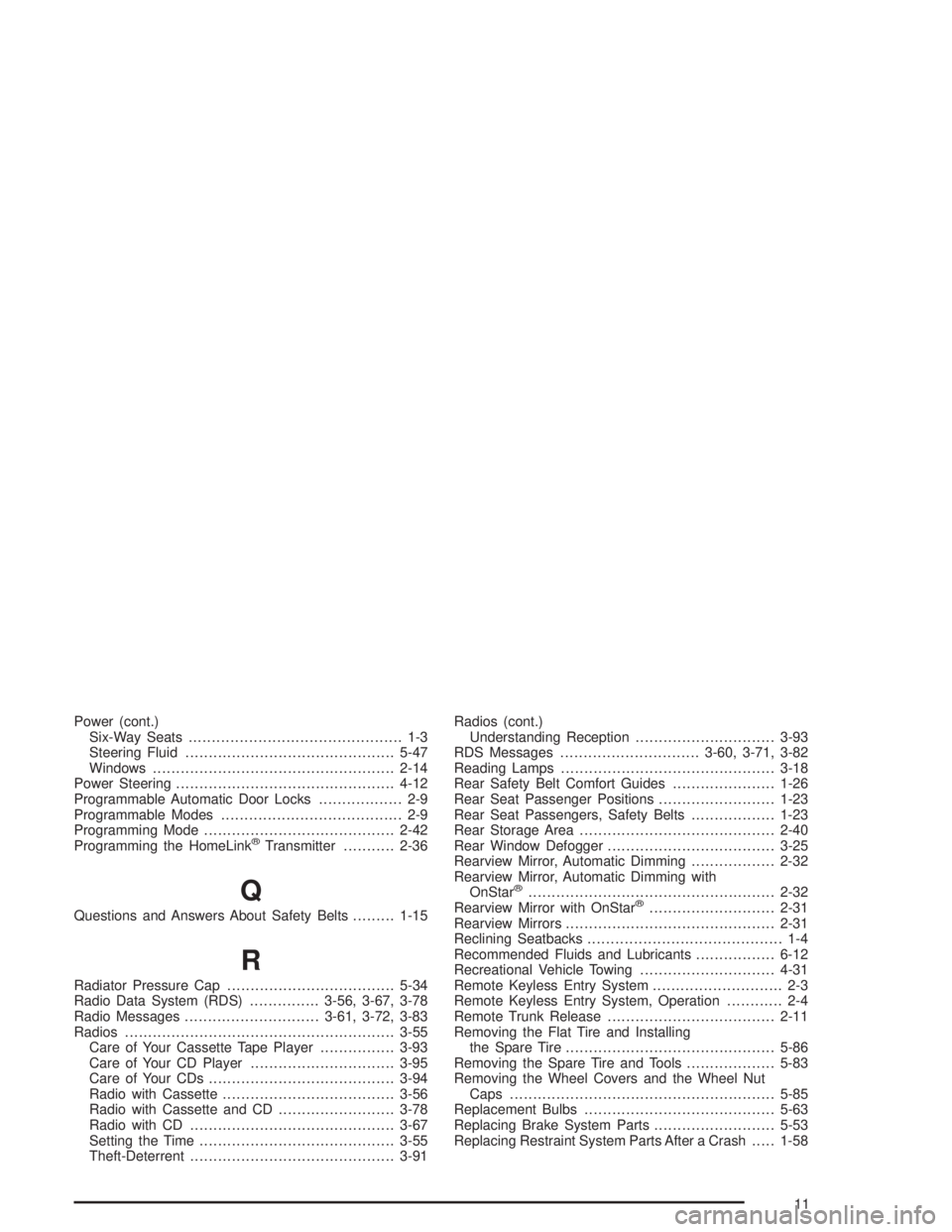
Power (cont.)
Six-Way Seats.............................................. 1-3
Steering Fluid.............................................5-47
Windows....................................................2-14
Power Steering...............................................4-12
Programmable Automatic Door Locks.................. 2-9
Programmable Modes....................................... 2-9
Programming Mode.........................................2-42
Programming the HomeLink
®Transmitter...........2-36
Q
Questions and Answers About Safety Belts.........1-15
R
Radiator Pressure Cap....................................5-34
Radio Data System (RDS)...............3-56, 3-67, 3-78
Radio Messages.............................3-61, 3-72, 3-83
Radios..........................................................3-55
Care of Your Cassette Tape Player................3-93
Care of Your CD Player...............................3-95
Care of Your CDs........................................3-94
Radio with Cassette.....................................3-56
Radio with Cassette and CD.........................3-78
Radio with CD............................................3-67
Setting the Time..........................................3-55
Theft-Deterrent............................................3-91Radios (cont.)
Understanding Reception..............................3-93
RDS Messages..............................3-60, 3-71, 3-82
Reading Lamps..............................................3-18
Rear Safety Belt Comfort Guides......................1-26
Rear Seat Passenger Positions.........................1-23
Rear Seat Passengers, Safety Belts..................1-23
Rear Storage Area..........................................2-40
Rear Window Defogger....................................3-25
Rearview Mirror, Automatic Dimming..................2-32
Rearview Mirror, Automatic Dimming with
OnStar
®.....................................................2-32
Rearview Mirror with OnStar®...........................2-31
Rearview Mirrors.............................................2-31
Reclining Seatbacks.......................................... 1-4
Recommended Fluids and Lubricants.................6-12
Recreational Vehicle Towing.............................4-31
Remote Keyless Entry System............................ 2-3
Remote Keyless Entry System, Operation............ 2-4
Remote Trunk Release....................................2-11
Removing the Flat Tire and Installing
the Spare Tire.............................................5-86
Removing the Spare Tire and Tools...................5-83
Removing the Wheel Covers and the Wheel Nut
Caps.........................................................5-85
Replacement Bulbs.........................................5-63
Replacing Brake System Parts..........................5-53
Replacing Restraint System Parts After a Crash.....1-58
11
Page 414 of 416
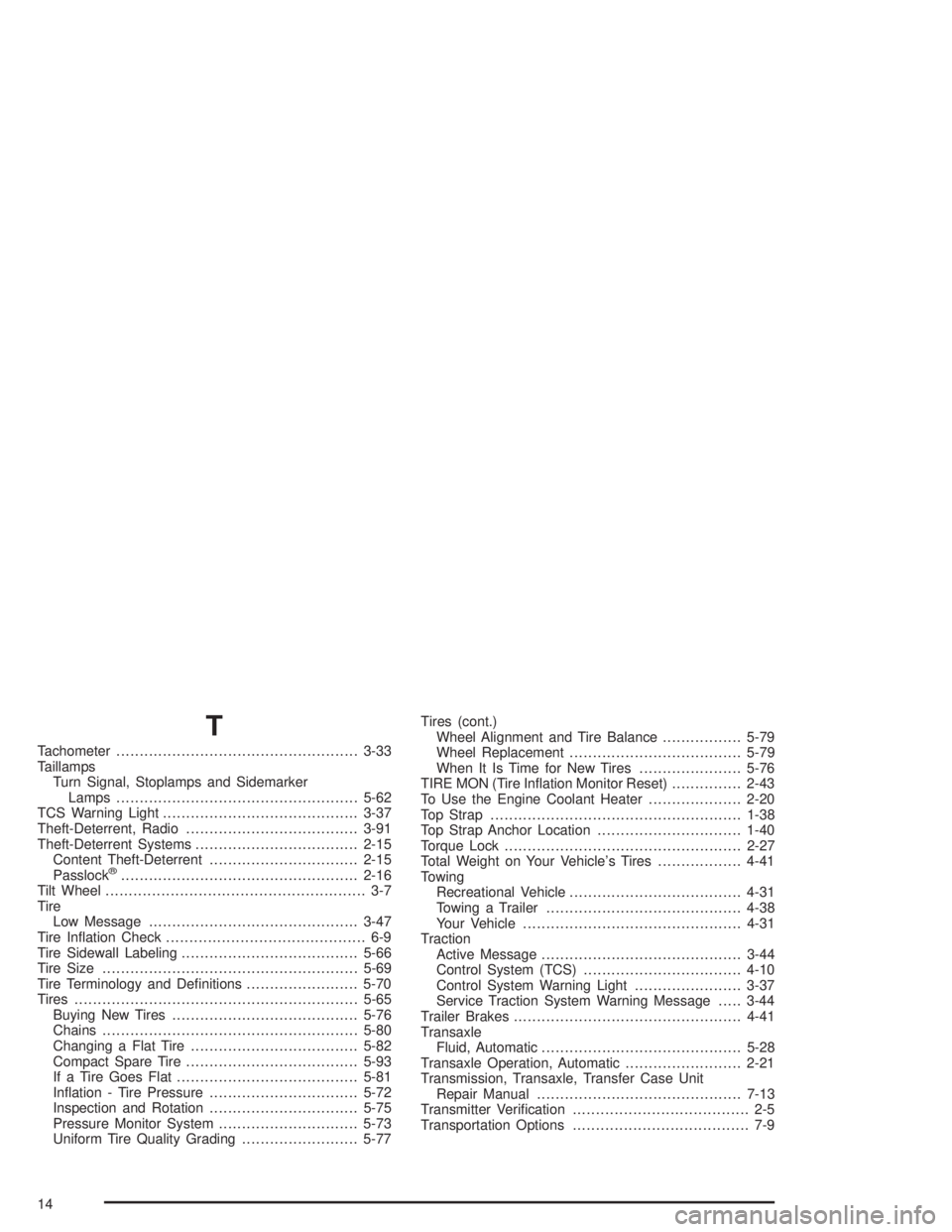
T
Tachometer....................................................3-33
Taillamps
Turn Signal, Stoplamps and Sidemarker
Lamps....................................................5-62
TCS Warning Light..........................................3-37
Theft-Deterrent, Radio.....................................3-91
Theft-Deterrent Systems...................................2-15
Content Theft-Deterrent................................2-15
Passlock
®...................................................2-16
Tilt Wheel........................................................ 3-7
Tire
Low Message.............................................3-47
Tire Ination Check........................................... 6-9
Tire Sidewall Labeling......................................5-66
Tire Size.......................................................5-69
Tire Terminology and Denitions........................5-70
Tires.............................................................5-65
Buying New Tires........................................5-76
Chains.......................................................5-80
Changing a Flat Tire....................................5-82
Compact Spare Tire.....................................5-93
If a Tire Goes Flat.......................................5-81
Ination - Tire Pressure................................5-72
Inspection and Rotation................................5-75
Pressure Monitor System..............................5-73
Uniform Tire Quality Grading.........................5-77Tires (cont.)
Wheel Alignment and Tire Balance.................5-79
Wheel Replacement.....................................5-79
When It Is Time for New Tires......................5-76
TIRE MON (Tire Ination Monitor Reset)...............2-43
To Use the Engine Coolant Heater....................2-20
Top Strap......................................................1-38
Top Strap Anchor Location...............................1-40
Torque Lock...................................................2-27
Total Weight on Your Vehicle’s Tires..................4-41
Towing
Recreational Vehicle.....................................4-31
Towing a Trailer..........................................4-38
Your Vehicle...............................................4-31
Traction
Active Message...........................................3-44
Control System (TCS)..................................4-10
Control System Warning Light.......................3-37
Service Traction System Warning Message.....3-44
Trailer Brakes.................................................4-41
Transaxle
Fluid, Automatic...........................................5-28
Transaxle Operation, Automatic.........................2-21
Transmission, Transaxle, Transfer Case Unit
Repair Manual............................................7-13
Transmitter Verication...................................... 2-5
Transportation Options...................................... 7-9
14