lock CHEVROLET OPTRA 5 2007 1.G Owners Manual
[x] Cancel search | Manufacturer: CHEVROLET, Model Year: 2007, Model line: OPTRA 5, Model: CHEVROLET OPTRA 5 2007 1.GPages: 422, PDF Size: 2.39 MB
Page 333 of 422
Storing a Flat or Spare Tire
and Tools
{CAUTION:
Storing a jack, a tire, or other equipment
in the passenger compartment of the
vehicle could cause injury. In a sudden
stop or collision, loose equipment could
strike someone. Store all these in the
proper place.To store a flat or spare tire, do the following:
1. Put the flat or spare tire in the compact spare
tire compartment, then secure the retainer.
2. Store the jack in its housing in the cargo area.
Secure the jack by turning the retainer
clockwise.
3. Store the tools securely in the foam tray and
place the tray on top of the tire.
4. Replace the trim cover.
The compact spare tire is for temporary use only.
Replace the compact spare tire with a full-size
tire as soon as you can. SeeCompact Spare Tire
on page 334.
333
Page 346 of 422
Headlamp Wiring
The headlamp wiring is protected by fuses in the
fuse block. An electrical overload will cause
the lamps to turn off. If this happens, have your
headlamp wiring checked right away.
Windshield Wiper Fuses
The windshield wiper motor is protected by an
internal circuit breaker and a fuse. If the motor
overheats due to heavy snow, etc., the wiper will
stop until the motor cools. If the overload is
caused by some electrical problem and not snow,
etc., be sure to get it fixed.
Power Windows and Other Power
Options
Circuit breakers in the fuse block protect the
power windows and other power accessories.
When the current load is too heavy, the circuit
breaker opens and closes, protecting the circuit
until the problem is fixed or goes away.
Fuses and Circuit Breakers
The wiring circuits in your vehicle are protected
from short circuits by a combination of fuses,
circuit breakers and fusible thermal links in
the wiring itself.
Look at the silver-colored band inside the fuse.
If the band is broken or melted, replace the fuse.
Be sure you replace a bad fuse with a new
one of the identical size and rating.
346
Page 347 of 422
There are spare fuses provided in the engine
compartment fuse block. If you ever have a problem
on the road and do not have a spare fuse, you can
borrow one that has the same amperage. Just pick
a feature of your vehicle that you can get along
without — like the radio or cigarette lighter — and
use its fuse, if it is the correct amperage. Replace it
as soon as you can.
There are two fuse blocks in your vehicle: the
instrument panel fuse block and the engine
compartment fuse block.
There is a fuse puller located on the engine
compartment fuse block. It can be used to easily
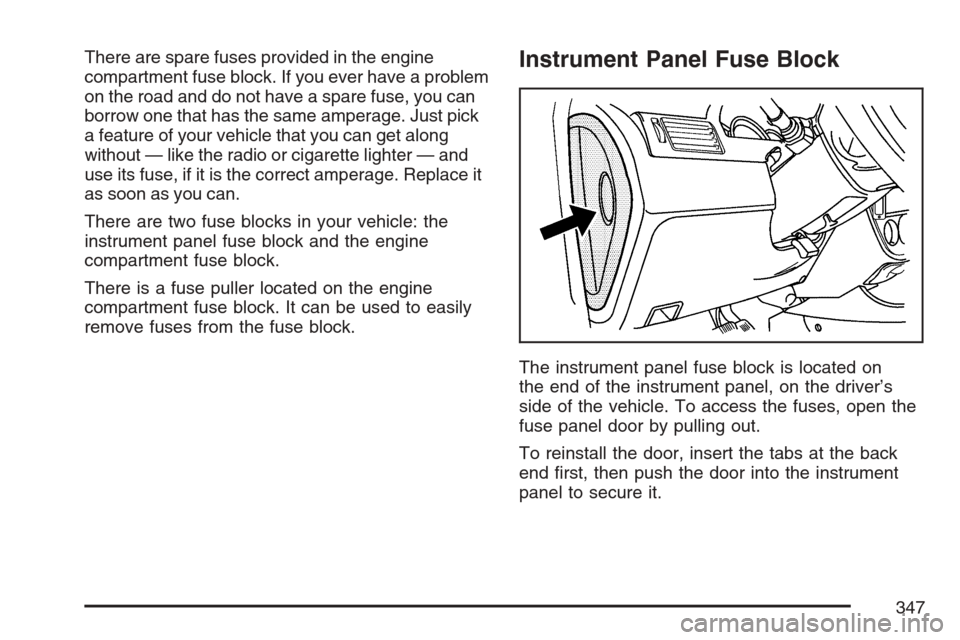
remove fuses from the fuse block.Instrument Panel Fuse Block
The instrument panel fuse block is located on
the end of the instrument panel, on the driver’s
side of the vehicle. To access the fuses, open the
fuse panel door by pulling out.
To reinstall the door, insert the tabs at the back
end first, then push the door into the instrument
panel to secure it.
347
Page 348 of 422
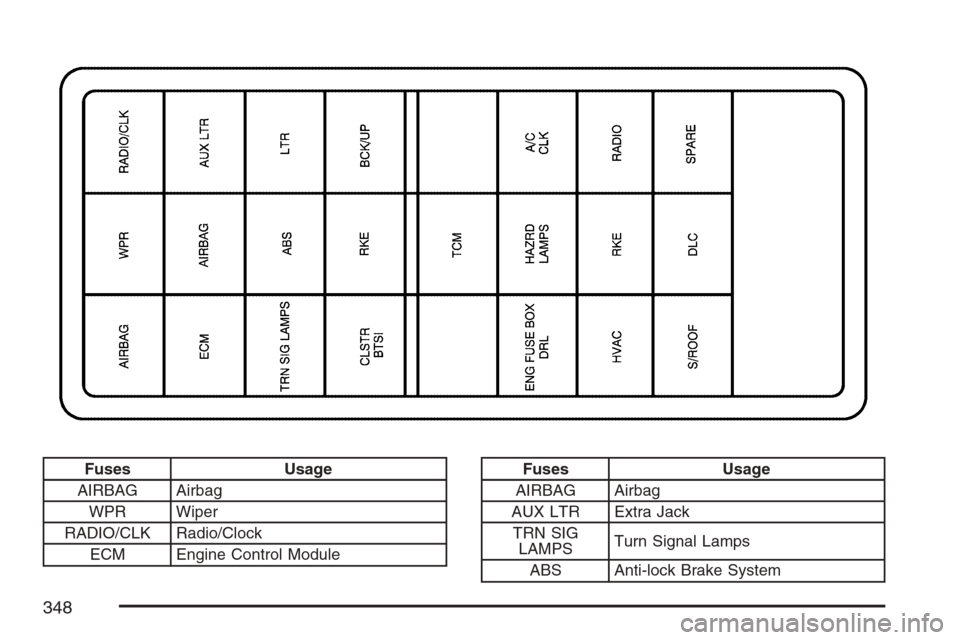
Fuses Usage
AIRBAG Airbag
WPR Wiper
RADIO/CLK Radio/Clock
ECM Engine Control ModuleFuses Usage
AIRBAG Airbag
AUX LTR Extra Jack
TRN SIG
LAMPSTurn Signal Lamps
ABS Anti-lock Brake System
348
Page 349 of 422
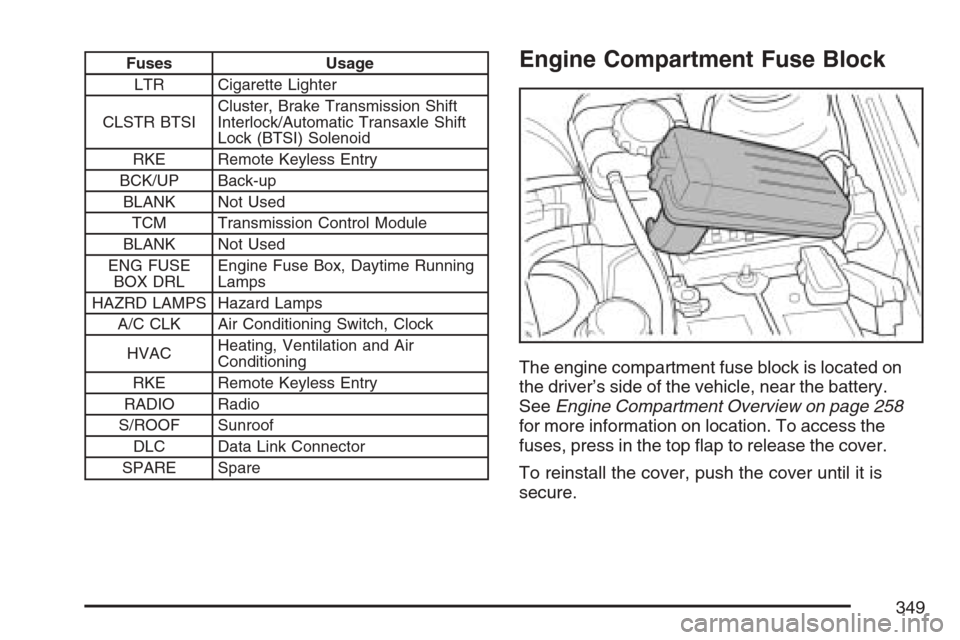
Fuses Usage
LTR Cigarette Lighter
CLSTR BTSICluster, Brake Transmission Shift
Interlock/Automatic Transaxle Shift
Lock (BTSI) Solenoid
RKE Remote Keyless Entry
BCK/UP Back-up
BLANK Not Used
TCM Transmission Control Module
BLANK Not Used
ENG FUSE
BOX DRLEngine Fuse Box, Daytime Running
Lamps
HAZRD LAMPS Hazard Lamps
A/C CLK Air Conditioning Switch, Clock
HVACHeating, Ventilation and Air
Conditioning
RKE Remote Keyless Entry
RADIO Radio
S/ROOF Sunroof
DLC Data Link Connector
SPARE SpareEngine Compartment Fuse Block
The engine compartment fuse block is located on
the driver’s side of the vehicle, near the battery.
SeeEngine Compartment Overview on page 258
for more information on location. To access the
fuses, press in the top flap to release the cover.
To reinstall the cover, push the cover until it is
secure.
349
Page 351 of 422
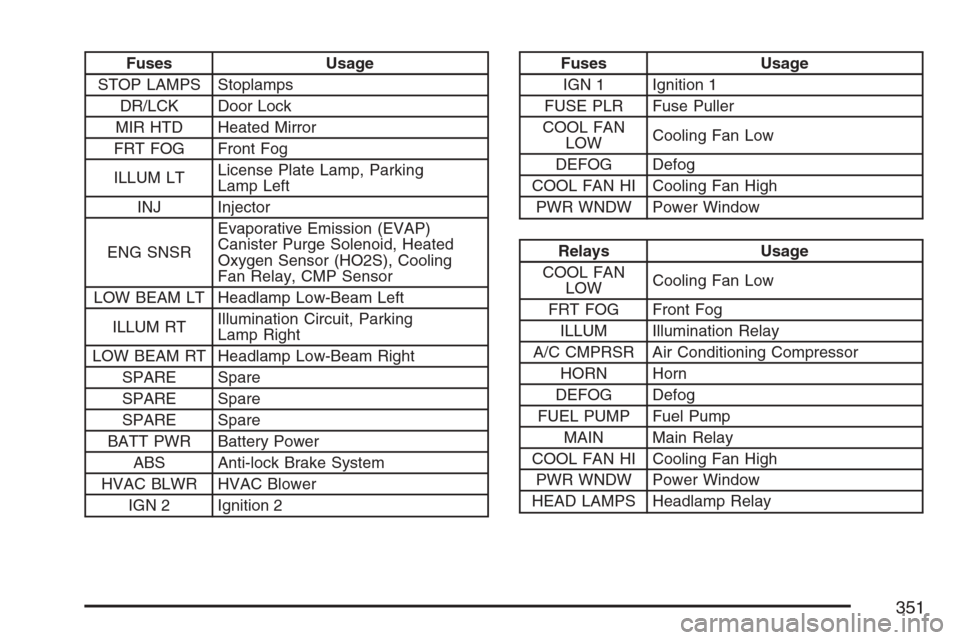
Fuses Usage
STOP LAMPS Stoplamps
DR/LCK Door Lock
MIR HTD Heated Mirror
FRT FOG Front Fog
ILLUM LTLicense Plate Lamp, Parking
Lamp Left
INJ Injector
ENG SNSREvaporative Emission (EVAP)
Canister Purge Solenoid, Heated
Oxygen Sensor (HO2S), Cooling
Fan Relay, CMP Sensor
LOW BEAM LT Headlamp Low-Beam Left
ILLUM RTIllumination Circuit, Parking
Lamp Right
LOW BEAM RT Headlamp Low-Beam Right
SPARE Spare
SPARE Spare
SPARE Spare
BATT PWR Battery Power
ABS Anti-lock Brake System
HVAC BLWR HVAC Blower
IGN 2 Ignition 2Fuses Usage
IGN 1 Ignition 1
FUSE PLR Fuse Puller
COOL FAN
LOWCooling Fan Low
DEFOG Defog
COOL FAN HI Cooling Fan High
PWR WNDW Power Window
Relays Usage
COOL FAN
LOWCooling Fan Low
FRT FOG Front Fog
ILLUM Illumination Relay
A/C CMPRSR Air Conditioning Compressor
HORN Horn
DEFOG Defog
FUEL PUMP Fuel Pump
MAIN Main Relay
COOL FAN HI Cooling Fan High
PWR WNDW Power Window
HEAD LAMPS Headlamp Relay
351
Page 376 of 422
Manual Transaxle Check
It is not necessary to check the transaxle fluid
level. Check for leaks. A fluid leak is the only
reason for fluid loss. Have the system inspected
and repaired if needed.
Clutch and Brake Pedal Free Play
Check
Check the clutch pedal and brake pedal for free
play and adjust as necessary.
At Least Once a Year
Key Lock Cylinders Service
Lubricate the key lock cylinders with the lubricant
specified in Part D.
Body Lubrication Service
Lubricate all hood latch assemblies, secondary
latch, pivots, spring anchor, release pawl,
hood and body door hinges, rear compartment,
and any folding seat hardware. Part D tells
you what to use. More frequent lubrication
may be required when exposed to a corrosive
environment.
376
Page 378 of 422
Automatic Transaxle Shift Lock Control
System Check
{CAUTION:
When you are doing this inspection, the
vehicle could move suddenly. If the vehicle
moves, you or others could be injured.
1. Before you start, be sure you have enough
room around the vehicle. It should be parked
on a level surface.
2. Firmly apply the parking brake. SeeParking
Brake on page 116if necessary.
Be ready to apply the regular brake
immediately if the vehicle begins to move.
3. With the engine off, turn the ignition to ON,
but do not start the engine. Without applying
the regular brake, try to move the shift
lever out of PARK (P) with normal effort. If the
shift lever moves out of PARK (P), your
vehicle needs service.
Ignition Transaxle Lock Check
While parked, and with the parking brake set, try
to turn the ignition to LOCK in each shift lever
position.
•With an automatic transaxle, the ignition
should turn to LOCK only when the shift lever
is in PARK (P).
•With a manual transaxle, the ignition should
turn to LOCK only when you press the key
release button.
On all vehicles, the ignition key should come out
only in LOCK.
Turn the steering wheel to the left and to the right.
It should only lock when turned to the right.
378
Page 382 of 422
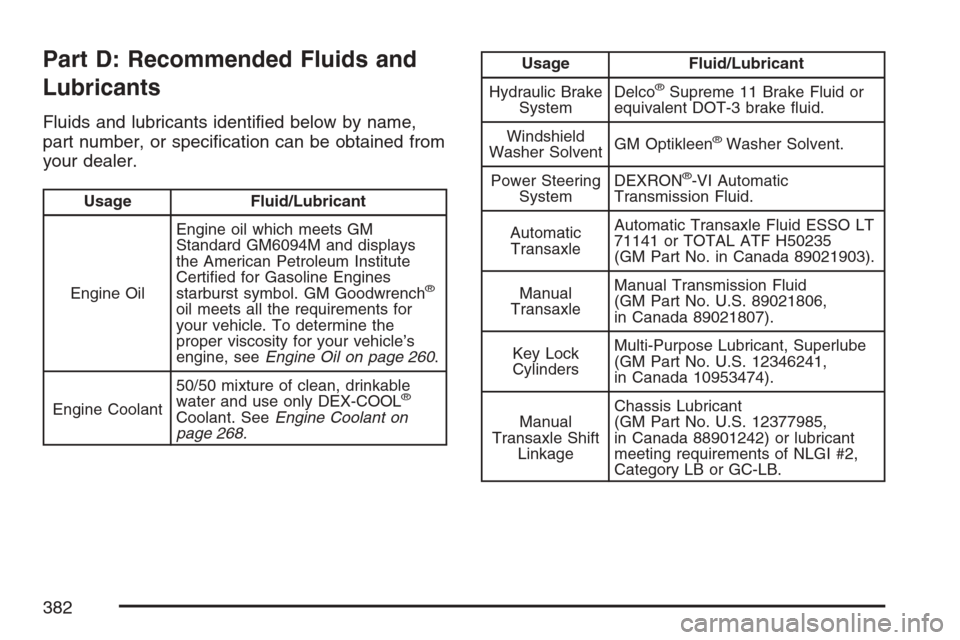
Part D: Recommended Fluids and
Lubricants
Fluids and lubricants identified below by name,
part number, or specification can be obtained from
your dealer.
Usage Fluid/Lubricant
Engine OilEngine oil which meets GM
Standard GM6094M and displays
the American Petroleum Institute
Certified for Gasoline Engines
starburst symbol. GM Goodwrench
®
oil meets all the requirements for
your vehicle. To determine the
proper viscosity for your vehicle’s
engine, seeEngine Oil on page 260.
Engine Coolant50/50 mixture of clean, drinkable
water and use only DEX-COOL
®
Coolant. SeeEngine Coolant on
page 268.
Usage Fluid/Lubricant
Hydraulic Brake
SystemDelco
®Supreme 11 Brake Fluid or
equivalent DOT-3 brake fluid.
Windshield
Washer SolventGM Optikleen
®Washer Solvent.
Power Steering
SystemDEXRON
®-VI Automatic
Transmission Fluid.
Automatic
TransaxleAutomatic Transaxle Fluid ESSO LT
71141 or TOTAL ATF H50235
(GM Part No. in Canada 89021903).
Manual
TransaxleManual Transmission Fluid
(GM Part No. U.S. 89021806,
in Canada 89021807).
Key Lock
CylindersMulti-Purpose Lubricant, Superlube
(GM Part No. U.S. 12346241,
in Canada 10953474).
Manual
Transaxle Shift
LinkageChassis Lubricant
(GM Part No. U.S. 12377985,
in Canada 88901242) or lubricant
meeting requirements of NLGI #2,
Category LB or GC-LB.
382
Page 395 of 422
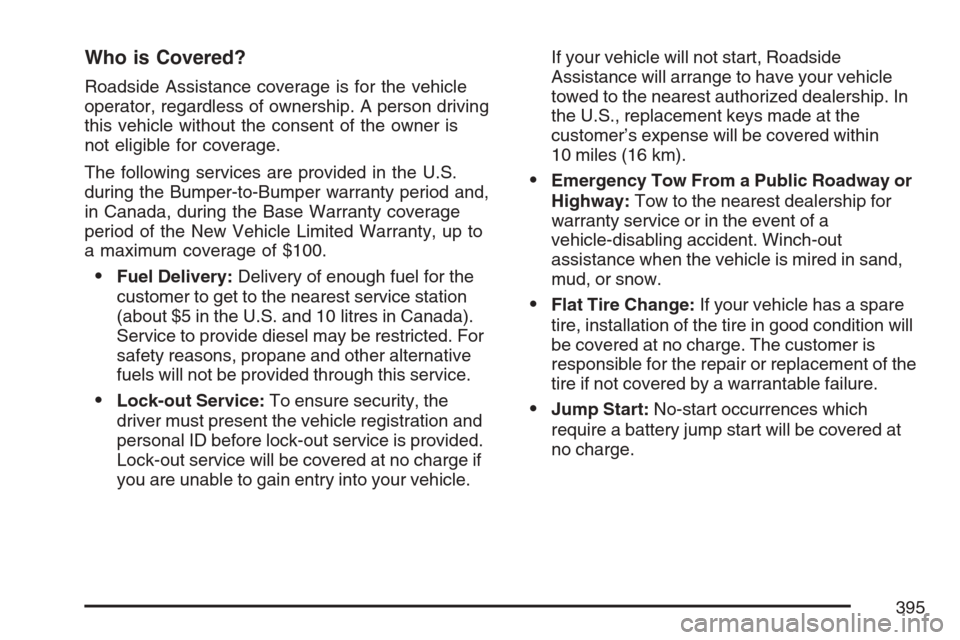
Who is Covered?
Roadside Assistance coverage is for the vehicle
operator, regardless of ownership. A person driving
this vehicle without the consent of the owner is
not eligible for coverage.
The following services are provided in the U.S.
during the Bumper-to-Bumper warranty period and,
in Canada, during the Base Warranty coverage
period of the New Vehicle Limited Warranty, up to
a maximum coverage of $100.
•Fuel Delivery:Delivery of enough fuel for the
customer to get to the nearest service station
(about $5 in the U.S. and 10 litres in Canada).
Service to provide diesel may be restricted. For
safety reasons, propane and other alternative
fuels will not be provided through this service.
•Lock-out Service:To ensure security, the
driver must present the vehicle registration and
personal ID before lock-out service is provided.
Lock-out service will be covered at no charge if
you are unable to gain entry into your vehicle.If your vehicle will not start, Roadside
Assistance will arrange to have your vehicle
towed to the nearest authorized dealership. In
the U.S., replacement keys made at the
customer’s expense will be covered within
10 miles (16 km).
•Emergency Tow From a Public Roadway or
Highway:Tow to the nearest dealership for
warranty service or in the event of a
vehicle-disabling accident. Winch-out
assistance when the vehicle is mired in sand,
mud, or snow.
•Flat Tire Change:If your vehicle has a spare
tire, installation of the tire in good condition will
be covered at no charge. The customer is
responsible for the repair or replacement of the
tire if not covered by a warrantable failure.
•Jump Start:No-start occurrences which
require a battery jump start will be covered at
no charge.
395