ignition CHEVROLET OPTRA 5 2007 1.G Workshop Manual
[x] Cancel search | Manufacturer: CHEVROLET, Model Year: 2007, Model line: OPTRA 5, Model: CHEVROLET OPTRA 5 2007 1.GPages: 422, PDF Size: 2.39 MB
Page 230 of 422
{CAUTION:
Coasting downhill in NEUTRAL (N) or with
the ignition off is dangerous. The brakes
will have to do all the work of slowing
down. They could get so hot that they
would not work well. You would then have
poor braking or even none going down a
hill. You could crash. Always have the
engine running and your vehicle in gear
when you go downhill.
•Know how to go down hills. The most important
thing to know is this: let your engine do some of
the slowing down. Shift to a lower gear when
you go down a steep or long hill.
•Know how to go uphill. Drive in the highest gear
possible.
•Stay in your own lane when driving on two-lane
roads in hills or mountains. Do not swing wide
or cut across the center of the road. Drive at
speeds that let you stay in your own lane.
•As you go over the top of a hill, be alert. There
could be something in your lane, like a stalled
car or an accident.
•You may see highway signs on mountains that
warn of special problems. Examples are long
grades, passing or no-passing zones, a falling
rocks area, or winding roads. Be alert to these
and take appropriate action.
230
Page 243 of 422
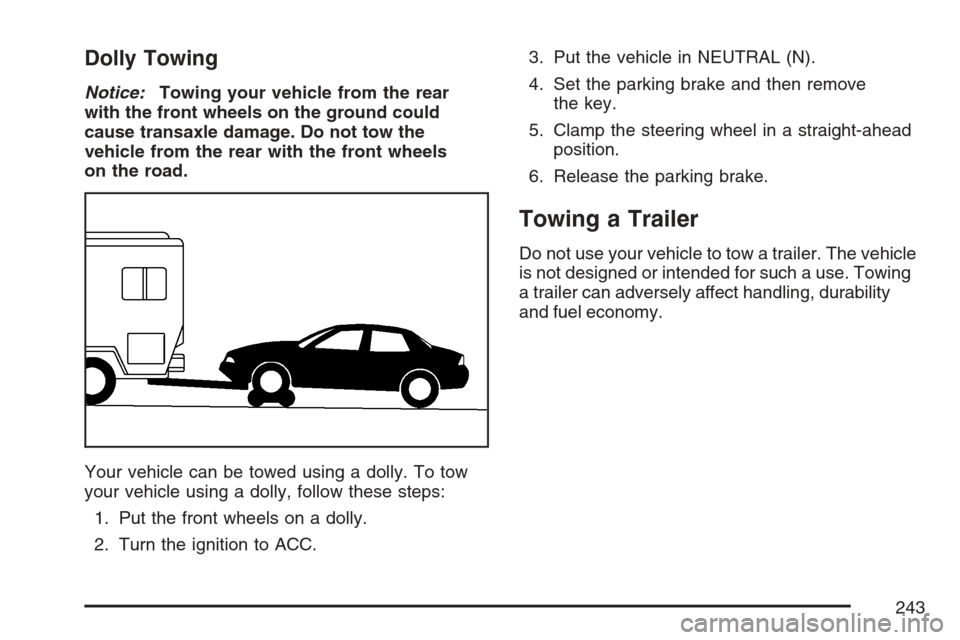
Dolly Towing
Notice:Towing your vehicle from the rear
with the front wheels on the ground could
cause transaxle damage. Do not tow the
vehicle from the rear with the front wheels
on the road.
Your vehicle can be towed using a dolly. To tow
your vehicle using a dolly, follow these steps:
1. Put the front wheels on a dolly.
2. Turn the ignition to ACC.3. Put the vehicle in NEUTRAL (N).
4. Set the parking brake and then remove
the key.
5. Clamp the steering wheel in a straight-ahead
position.
6. Release the parking brake.
Towing a Trailer
Do not use your vehicle to tow a trailer. The vehicle
is not designed or intended for such a use. Towing
a trailer can adversely affect handling, durability
and fuel economy.
243
Page 286 of 422
Notice:If you leave your radio or other
accessories on during the jump starting
procedure, they could be damaged. The repairs
would not be covered by your warranty.
Always turn off your radio and other
accessories when jump starting your vehicle.
3. Turn off the ignition on both vehicles.
Unplug unnecessary accessories plugged into
the cigarette lighter or the accessory power
outlet. Turn off the radio and all lamps that are
not needed. This will avoid sparks and help
save both batteries. And it could save
the radio!
4. Open the hoods and locate the batteries.
Find the positive (+) and negative (−)
terminal locations on each vehicle. Your
vehicle’s positive (+) terminal is located under
a red tethered cap on the battery. The
negative (–) terminal is located under a black
tethered cap on the battery. SeeEngine
Compartment Overview on page 258for more
information on location. Flip the caps up to
access the positive (+) and negative (–)
terminals.
{CAUTION:
An electric fan can start up even when the
engine is not running and can injure you.
Keep hands, clothing and tools away from
any underhood electric fan.
{CAUTION:
Using a match near a battery can cause
battery gas to explode. People have been
hurt doing this, and some have been
blinded. Use a ashlight if you need
more light.
Be sure the battery has enough water.
You do not need to add water to the
battery installed in your new vehicle.
CAUTION: (Continued)
286
Page 314 of 422
When a low tire pressure condition is detected,
the TPMS illuminates the low tire pressure warning
symbol on the instrument panel cluster.
The low tire pressure warning symbol comes on at
each ignition cycle until the tires are inflated to
the correct inflation pressure.
The tire pressure warning light may come on in
cool weather when the vehicle is first started, and
then turn off as you start to drive. This could
be an early indicator that the tire pressures are
getting low and need to be inflated to the
proper pressure.
A Tire and Loading Information label, attached to
your vehicle, shows the size of your vehicle’s
original equipment tires and the correct inflation
pressure for your vehicle’s tires when they
are cold. SeeLoading Your Vehicle on page 236,
for an example of the tire information label and
its location on your vehicle. Also seeInflation - Tire
Pressure on page 311.Your vehicle’s TPMS system can warn you about
a low tire pressure condition but it does not
replace normal tire maintenance. SeeTire
Inspection and Rotation on page 316andTires
on page 303.
Notice:Do not use a tire sealant if your
vehicle has Tire Pressure Monitors. The liquid
sealant can damage the tire pressure monitor
sensors.
The TPMS will not function properly if one or more
of the TPMS sensors are missing or inoperable.
See your dealer for service if all TPMS sensors are
installed and the low tire pressure warning light
comes on and stays on.
314
Page 351 of 422
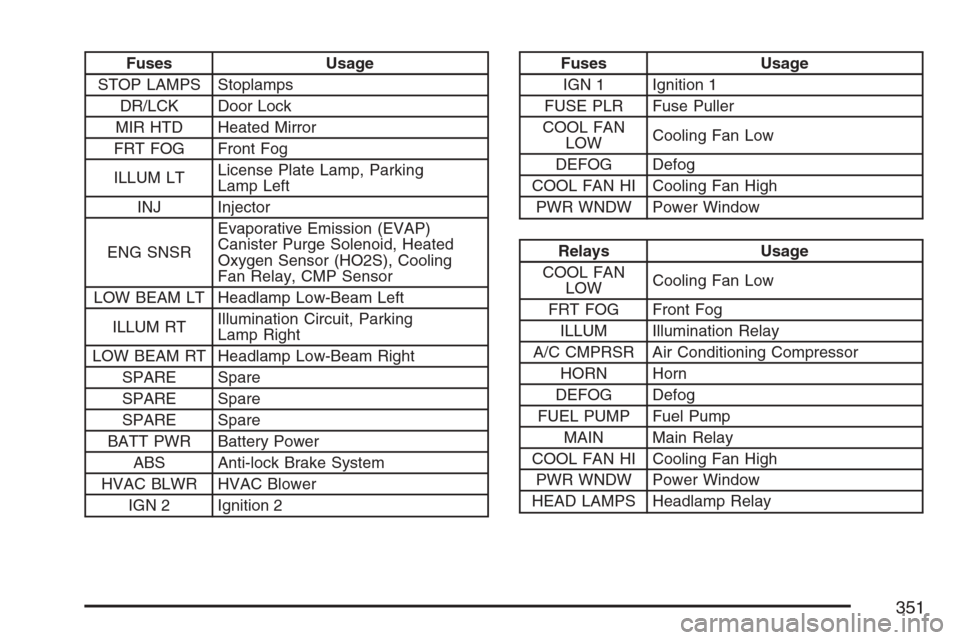
Fuses Usage
STOP LAMPS Stoplamps
DR/LCK Door Lock
MIR HTD Heated Mirror
FRT FOG Front Fog
ILLUM LTLicense Plate Lamp, Parking
Lamp Left
INJ Injector
ENG SNSREvaporative Emission (EVAP)
Canister Purge Solenoid, Heated
Oxygen Sensor (HO2S), Cooling
Fan Relay, CMP Sensor
LOW BEAM LT Headlamp Low-Beam Left
ILLUM RTIllumination Circuit, Parking
Lamp Right
LOW BEAM RT Headlamp Low-Beam Right
SPARE Spare
SPARE Spare
SPARE Spare
BATT PWR Battery Power
ABS Anti-lock Brake System
HVAC BLWR HVAC Blower
IGN 2 Ignition 2Fuses Usage
IGN 1 Ignition 1
FUSE PLR Fuse Puller
COOL FAN
LOWCooling Fan Low
DEFOG Defog
COOL FAN HI Cooling Fan High
PWR WNDW Power Window
Relays Usage
COOL FAN
LOWCooling Fan Low
FRT FOG Front Fog
ILLUM Illumination Relay
A/C CMPRSR Air Conditioning Compressor
HORN Horn
DEFOG Defog
FUEL PUMP Fuel Pump
MAIN Main Relay
COOL FAN HI Cooling Fan High
PWR WNDW Power Window
HEAD LAMPS Headlamp Relay
351
Page 378 of 422
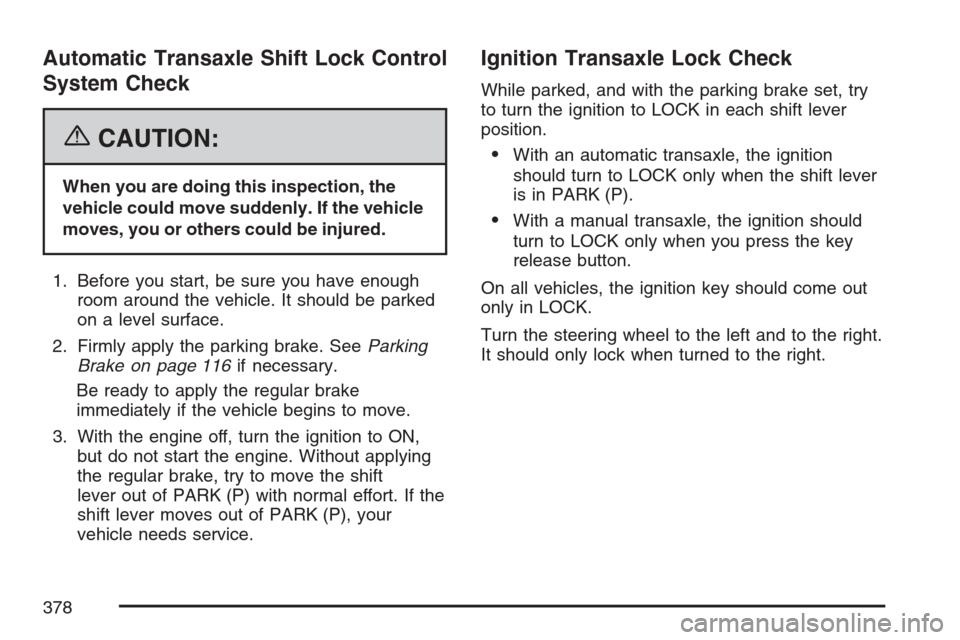
Automatic Transaxle Shift Lock Control
System Check
{CAUTION:
When you are doing this inspection, the
vehicle could move suddenly. If the vehicle
moves, you or others could be injured.
1. Before you start, be sure you have enough
room around the vehicle. It should be parked
on a level surface.
2. Firmly apply the parking brake. SeeParking
Brake on page 116if necessary.
Be ready to apply the regular brake
immediately if the vehicle begins to move.
3. With the engine off, turn the ignition to ON,
but do not start the engine. Without applying
the regular brake, try to move the shift
lever out of PARK (P) with normal effort. If the
shift lever moves out of PARK (P), your
vehicle needs service.
Ignition Transaxle Lock Check
While parked, and with the parking brake set, try
to turn the ignition to LOCK in each shift lever
position.
•With an automatic transaxle, the ignition
should turn to LOCK only when the shift lever
is in PARK (P).
•With a manual transaxle, the ignition should
turn to LOCK only when you press the key
release button.
On all vehicles, the ignition key should come out
only in LOCK.
Turn the steering wheel to the left and to the right.
It should only lock when turned to the right.
378
Page 415 of 422
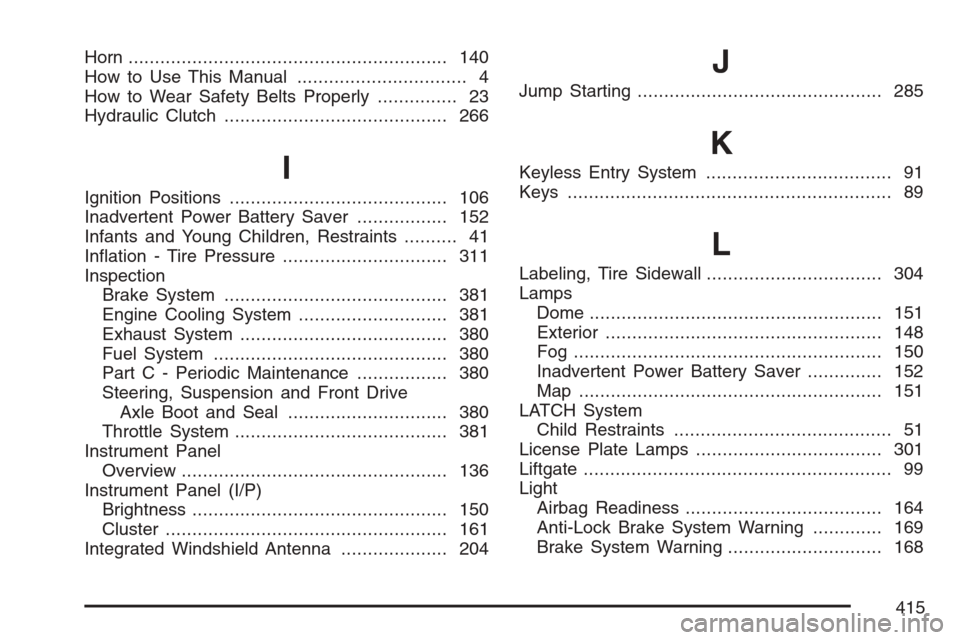
Horn............................................................ 140
How to Use This Manual................................ 4
How to Wear Safety Belts Properly............... 23
Hydraulic Clutch.......................................... 266
I
Ignition Positions......................................... 106
Inadvertent Power Battery Saver................. 152
Infants and Young Children, Restraints.......... 41
Inflation - Tire Pressure............................... 311
Inspection
Brake System.......................................... 381
Engine Cooling System............................ 381
Exhaust System....................................... 380
Fuel System............................................ 380
Part C - Periodic Maintenance................. 380
Steering, Suspension and Front Drive
Axle Boot and Seal.............................. 380
Throttle System........................................ 381
Instrument Panel
Overview.................................................. 136
Instrument Panel (I/P)
Brightness................................................ 150
Cluster..................................................... 161
Integrated Windshield Antenna.................... 204
J
Jump Starting.............................................. 285
K
Keyless Entry System................................... 91
Keys............................................................. 89
L
Labeling, Tire Sidewall................................. 304
Lamps
Dome....................................................... 151
Exterior.................................................... 148
Fog .......................................................... 150
Inadvertent Power Battery Saver.............. 152
Map ......................................................... 151
LATCH System
Child Restraints......................................... 51
License Plate Lamps................................... 301
Liftgate.......................................................... 99
Light
Airbag Readiness..................................... 164
Anti-Lock Brake System Warning............. 169
Brake System Warning............................. 168
415