time CHEVROLET OPTRA 5 2007 1.G Workshop Manual
[x] Cancel search | Manufacturer: CHEVROLET, Model Year: 2007, Model line: OPTRA 5, Model: CHEVROLET OPTRA 5 2007 1.GPages: 422, PDF Size: 2.39 MB
Page 233 of 422
Remember, unless you have ABS, if you brake so
hard that your wheels stop rolling, you will just
slide. Brake so your wheels always keep rolling
and you can still steer.
•Whatever your braking system, allow greater
following distance on any slippery road.
•Watch for slippery spots. The road might be
fine until you hit a spot that is covered with
ice. On an otherwise clear road, ice patches
may appear in shaded areas where the
sun cannot reach, such as around clumps of
trees, behind buildings, or under bridges.
Sometimes the surface of a curve or an
overpass may remain icy when the
surrounding roads are clear. If you see a
patch of ice ahead of you, brake before you
are on it. Try not to brake while you are
actually on the ice, and avoid sudden steering
maneuvers.
If You Are Caught in a Blizzard
If you are stopped by heavy snow, you could be in
a serious situation. You should probably stay
with your vehicle unless you know for sure that you
are near help and you can hike through the
snow. Here are some things to do to summon
help and keep yourself and your passengers safe:
•Turn on your hazard flashers.
•Tie a red cloth to your vehicle to alert police
that you have been stopped by the snow.
•Put on extra clothing or wrap a blanket around
you. If you do not have blankets or extra
clothing, make body insulators from
newspapers, burlap bags, rags, floor
mats — anything you can wrap around yourself
or tuck under your clothing to keep warm.
233
Page 234 of 422
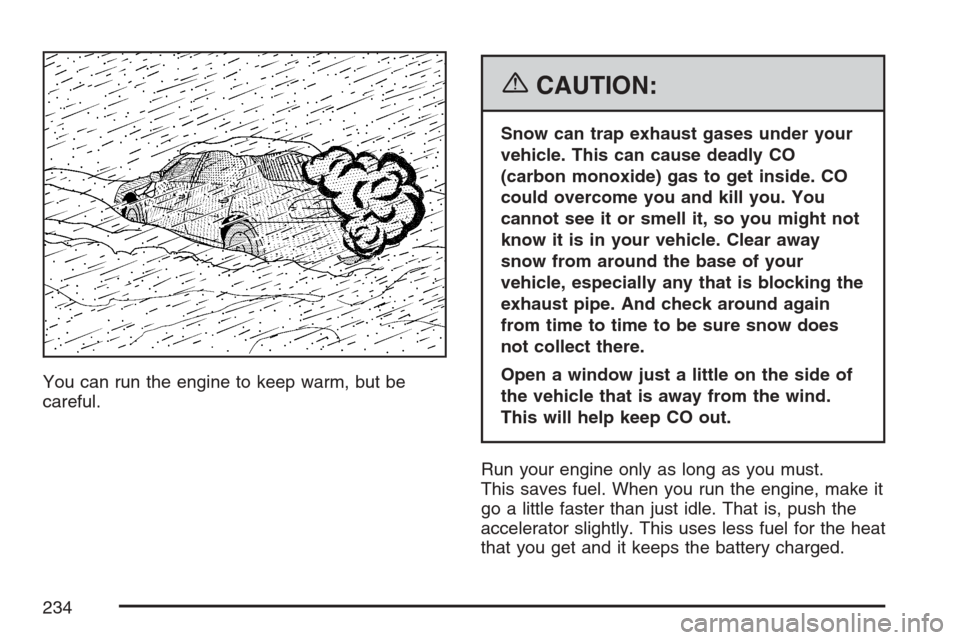
You can run the engine to keep warm, but be
careful.
{CAUTION:
Snow can trap exhaust gases under your
vehicle. This can cause deadly CO
(carbon monoxide) gas to get inside. CO
could overcome you and kill you. You
cannot see it or smell it, so you might not
know it is in your vehicle. Clear away
snow from around the base of your
vehicle, especially any that is blocking the
exhaust pipe. And check around again
from time to time to be sure snow does
not collect there.
Open a window just a little on the side of
the vehicle that is away from the wind.
This will help keep CO out.
Run your engine only as long as you must.
This saves fuel. When you run the engine, make it
go a little faster than just idle. That is, push the
accelerator slightly. This uses less fuel for the heat
that you get and it keeps the battery charged.
234
Page 246 of 422
Center High-Mounted Stoplamp (CHMSL)
(Hatchback)............................................ 296
Center High-Mounted Stoplamp (CHMSL)
(Wagon)................................................. 297
Taillamps, Turn Signal, and Stoplamps
(Hatchback)............................................ 298
Taillamps, Turn Signal, Stoplamps and
Back-up Lamps (Wagon)........................ 299
Taillamps, Stoplamps and Back-up Lamps
(Hatchback)............................................ 300
License Plate Lamp................................... 301
Replacement Bulbs................................... 301
Windshield Wiper Blade Replacement....... 302
Tires............................................................ 303
Tire Sidewall Labeling............................... 304
Tire Terminology and Definitions............... 307
Inflation - Tire Pressure............................. 311
Tire Pressure Monitor System................... 312
Tire Inspection and Rotation...................... 316
When It Is Time for New Tires.................. 317Buying New Tires...................................... 318
Different Size Tires and Wheels................ 319
Uniform Tire Quality Grading..................... 320
Wheel Alignment and Tire Balance............ 321
Wheel Replacement.................................. 322
Tire Chains............................................... 323
If a Tire Goes Flat.................................... 324
Changing a Flat Tire................................. 324
Removing the Spare Tire and Tools.......... 326
Removing the Flat Tire and Installing the
Spare Tire............................................. 329
Storing a Flat or Spare Tire and Tools...... 333
Compact Spare Tire.................................. 334
Appearance Care........................................ 335
Cleaning the Inside of Your Vehicle.......... 335
Fabric/Carpet............................................. 337
Leather...................................................... 338
Instrument Panel, Vinyl, and Other
Plastic Surfaces..................................... 338
Care of Safety Belts.................................. 339
Section 5 Service and Appearance Care
246
Page 260 of 422
Engine Oil
If the engine oil
pressure light appears
on the instrument
cluster, check the
engine oil level
right away.
For more information, seeOil Pressure Light on
page 175. You should check the engine oil
level regularly; this is an added reminder.
Checking Engine Oil
It is a good idea to check the engine oil every time
you get fuel. In order to get an accurate reading,
the oil must be warm and the vehicle must be
on level ground.
The engine oil dipstick handle is a yellow loop.
SeeEngine Compartment Overview on page 258
for the location of the engine oil dipstick.
1. Turn off the engine and give the oil several
minutes to drain back into the oil pan. If you
do not do this, the oil dipstick might not
show the actual level.
2. Pull the dipstick and clean it with a paper
towel or cloth, then push it back in all the
way. Remove it again, keeping the tip down
and check the level.
260
Page 269 of 422
{CAUTION:
Adding only plain water to your cooling
system can be dangerous. Plain water, or
some other liquid such as alcohol, can
boil before the proper coolant mixture will.
Your vehicle’s coolant warning system is
set for the proper coolant mixture. With
plain water or the wrong mixture, your
engine could get too hot but you would
not get the overheat warning. Your engine
could catch re and you or others could
be burned. Use a 50/50 mixture of clean,
drinkable water and DEX-COOL
®coolant.Notice:If you use an improper coolant
mixture, your engine could overheat and be
badly damaged. The repair cost would not be
covered by your warranty. Too much water
in the mixture can freeze and crack the engine,
radiator, heater core, and other parts.
If you have to add coolant more than four times a
year, have your dealer check your cooling system.
Notice:If you use extra inhibitors and/or
additives in your vehicle’s cooling system,
you could damage your vehicle. Use only the
proper mixture of the engine coolant listed
in this manual for the cooling system.
SeePart D: Recommended Fluids and
Lubricants on page 382for more information.
269
Page 272 of 422
If Steam Is Coming From Your Engine
{CAUTION:
Steam from an overheated engine can
burn you badly, even if you just open the
hood. Stay away from the engine if you
see or hear steam coming from it.
Just turn it off and get everyone away
from the vehicle until it cools down.
Wait until there is no sign of steam or
coolant before you open the hood.
If you keep driving when your engine is
overheated, the liquids in it can catch re.
You or others could be badly burned.
Stop your engine if it overheats, and get
out of the vehicle until the engine is cool.
Notice:If your engine catches re because
you keep driving with no coolant, your vehicle
can be badly damaged. The costly repairs
would not be covered by your warranty.
If No Steam Is Coming From
Your Engine
If you get an engine overheat warning, but see or
hear no steam, the problem may not be too
serious. Sometimes the engine can get a little
too hot when you:
•Climb a long hill on a hot day.
•Stop after high-speed driving.
•Idle for long periods in traffic.
If you get the overheat warning with no sign of
steam, try this for a minute or so:
1. In heavy traffic, let the engine idle in
NEUTRAL (N) while stopped. If it is safe to do
so, pull off the road, shift to PARK (P) or
NEUTRAL (N) and let the engine idle.
2. Turn on your heater to full hot at the highest
fan speed and open the windows as
necessary.
272
Page 278 of 422
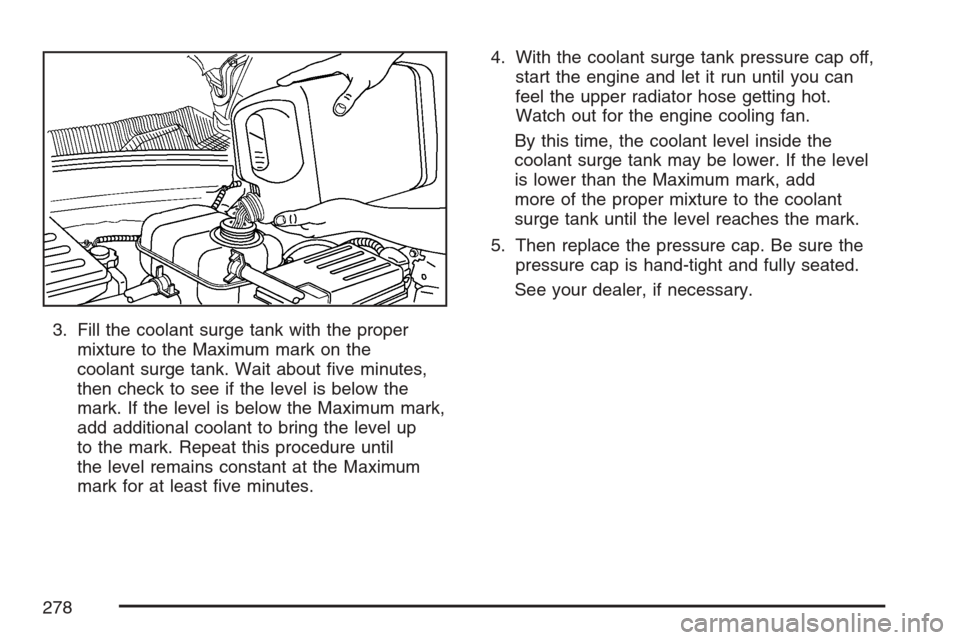
3. Fill the coolant surge tank with the proper
mixture to the Maximum mark on the
coolant surge tank. Wait about five minutes,
then check to see if the level is below the
mark. If the level is below the Maximum mark,
add additional coolant to bring the level up
to the mark. Repeat this procedure until
the level remains constant at the Maximum
mark for at least five minutes.4. With the coolant surge tank pressure cap off,
start the engine and let it run until you can
feel the upper radiator hose getting hot.
Watch out for the engine cooling fan.
By this time, the coolant level inside the
coolant surge tank may be lower. If the level
is lower than the Maximum mark, add
more of the proper mixture to the coolant
surge tank until the level reaches the mark.
5. Then replace the pressure cap. Be sure the
pressure cap is hand-tight and fully seated.
See your dealer, if necessary.
278
Page 283 of 422
Brake Wear
Your vehicle has four-wheel disc brakes.
Disc brake pads have built-in wear indicators that
make a high-pitched warning sound when the
brake pads are worn and new pads are needed.
The sound can come and go or be heard all
the time your vehicle is moving, except when you
are pushing on the brake pedal firmly.
{CAUTION:
The brake wear warning sound means that
soon the brakes will not work well. That
could lead to an accident. When you hear
the brake wear warning sound, have your
vehicle serviced.
Notice:Continuing to drive with worn-out
brake pads could result in costly brake repair.Some driving conditions or climates can cause a
brake squeal when the brakes are first applied
or lightly applied. This does not mean something
is wrong with the brakes.
Properly torqued wheel nuts are necessary to help
prevent brake pulsation. When tires are rotated,
inspect brake pads for wear and evenly tighten
wheel nuts in the proper sequence to GM torque
specifications.
Brake linings should always be replaced as
complete axle sets.
SeeBrake System Inspection on page 381.Brake Pedal Travel
See your dealer if the brake pedal does not return
to normal height, or if there is a rapid increase
in pedal travel. This could be a sign of brake
trouble.
Brake Adjustment
Every time you apply the brakes, with or without
the vehicle moving, the brakes adjust for wear.
283
Page 284 of 422
Replacing Brake System Parts
The braking system on a vehicle is complex.
Its many parts have to be of top quality and work
well together if the vehicle is to have really
good braking. Your vehicle was designed and
tested with top-quality GM brake parts. When you
replace parts of the braking system — for
example, when the brake linings wear down and
you need new ones put in — be sure you get new
approved GM replacement parts. If you do not,
the brakes might not work properly. For example,
if someone puts in brake linings that are wrong
for your vehicle, the balance between the front
and rear brakes can change — for the worse.
The braking performance you have come to expect
can change in many other ways if someone
puts in the wrong replacement brake parts.
Battery
Your vehicle has a maintenance free battery.
When it is time for a new battery, get one that has
the replacement number shown on the original
battery’s label. SeeEngine Compartment Overview
on page 258for battery location.Warning:Battery posts, terminals, and related
accessories contain lead and lead compounds,
chemicals known to the State of California
to cause cancer and reproductive harm.
Wash hands after handling.
Vehicle Storage
If you are not going to drive your vehicle for
25 days or more, remove the black, negative (−)
cable from the battery. This will help keep
your battery from running down.
{CAUTION:
Batteries have acid that can burn you and
gas that can explode. You can be badly
hurt if you are not careful. SeeJump
Starting on page 285for tips on working
around a battery without getting hurt.
284
Page 310 of 422
Traction:The friction between the tire and the
road surface. The amount of grip provided.
Tread:The portion of a tire that comes into
contact with the road.
Treadwear Indicators:Narrow bands, sometimes
called wear bars, that show across the tread of
a tire when only 1/16 inch (1.6 mm) of tread
remains. SeeWhen It Is Time for New Tires on
page 317.
UTQGS (Uniform Tire Quality Grading
Standards):A tire information system that
provides consumers with ratings for a tire’s
traction, temperature, and treadwear. Ratings are
determined by tire manufacturers using
government testing procedures. The ratings are
molded into the sidewall of the tire. SeeUniform
Tire Quality Grading on page 320.Vehicle Capacity Weight:The number of
designated seating positions multiplied by
150 lbs (68 kg) plus the rated cargo load.
SeeLoading Your Vehicle on page 236.
Vehicle Maximum Load on the Tire:Load on an
individual tire due to curb weight, accessory
weight, occupant weight, and cargo weight.
Vehicle Placard:A label permanently attached to
a vehicle showing the vehicle’s capacity weight
and the original equipment tire size and
recommended inflation pressure. See “Tire and
Loading Information Label” underLoading
Your Vehicle on page 236.
310