ECU CHEVROLET S10 1993 2.G User Guide
[x] Cancel search | Manufacturer: CHEVROLET, Model Year: 1993, Model line: S10, Model: CHEVROLET S10 1993 2.GPages: 356, PDF Size: 20.85 MB
Page 178 of 356
Downloaded from www.Manualslib.com manuals search engine Your Driving and the Road
J I I
A Cargo on the load floor piled higher than the seatbacks can be
b thrown forward during a sudden stop. You or your passengers
..* could be injured. Keep cargo below the top of the seatbacks.
E==: ---I: Unsecured cargo on the load floor can be tossed about when :&&
@;!%:y:L - _. driving over rough terrain. You or your passengers can be struck
igFFSi e%x ..5=$i:< by flying objects. Secure the cargo properly.
i:...~~ r* ..&-
- .-<--x :2* .,.% ! .- a%%> &--. .
L?- .&1. .. ~ c. = ~-
9-2; .-.$y<- -- Heavy loads on the roof raise the vehicle’s center of gravity,
making it more likely to roll over. You can be seriously or fatally
injured
if the vehicle rolls over. Put heavy loads inside the cargo
area, not on the roof. Keep cargo in the cargo area as far
forward and low as possible.
You’ll find other important information in this manual. See “Vehicle Loading”
and “Tires” in the Index.
Traveling to Remote Areas
It makes sense to plan your trip, especially when going to a remote area.
Know the terrain and plan your route. You are much less likely to get bad
surprises. Get accurate maps of trails and terrain. Try to learn of any blocked
or closed roads.
It’s also a good idea to travel with at least one other v\
ehicle. If something
happens to one of them, the other can help quickly.
Does your vehicle have a winch? If
so, be sure to read the winch
instructions. In a remote area, a winch can be handy
if you get stuck. But
you’ll want to know how to use
it properly.
Getting Familiar with Off-Road Driving
It’s a good idea to practice in an area that’s safe and close to home before
you go into the wilderness. Off-road driving does require some \
new and
different driving skills. Here’s what we mean.
Tune your senses to different kinds of signals. Your eyes, for example, need
to constantly sweep the terrain for unexpected obstacles. Your ears need to
listen for unusual tire or engine sounds. With your arms, hand\
s, feet, and
body you’ll need to respond
to vibrations and vehicle bounce.
4-24
Page 205 of 356
Downloaded from www.Manualslib.com manuals search engine Winter Driving
AN480001
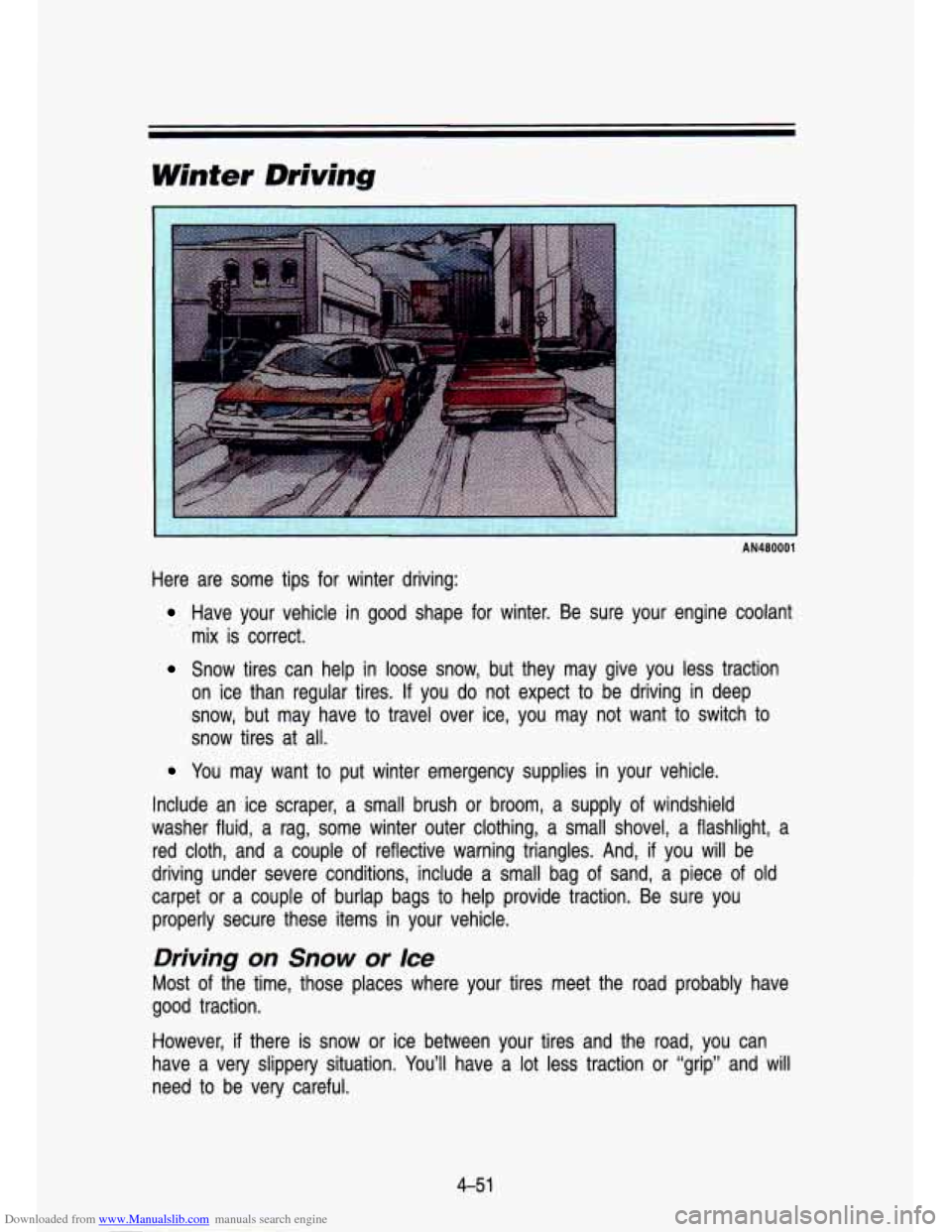
Here are some tips for winter driving:
Have your vehicle in good shape for winter. Be sure your engine coolant
mix is correct.
Snow tires can help in loose snow, but they may give you less traction
on ice than regular tires.
If you do not expect to be driving in deep
snow, but may have to travel over ice, you may not want to switch to
snow tires at all.
You may want to put winter emergency supplies in your vehicle.
Include an ice scraper, a small brush or broom, a supply of windshield
washer fluid, a rag, some winter outer clothing, a small shove\
l, a flashlight, a red cloth, and a couple of reflective warning triangles. And,
if you will be
driving under severe conditions, include a small bag of sand, a piece of old
carpet or a couple of burlap bags to help provide traction. Be sure you
properly secure these items in your vehicle.
Driving on Snow or Ice
Most of the time, those places where your tires meet the road probably\
have
good traction.
However,
if there is snow or ice between your tires and the road, you can
have a very slippery situation. You’ll have a lot less traction or “grip” and will
need to be very careful.
4-51
Page 213 of 356

Downloaded from www.Manualslib.com manuals search engine Safety Chains
You should always attach chains between your vehicle and your trail\
er. Cross
the safety chains under the tongue of the trailer
so that the tongue will not
drop to the road if
it becomes separated from the hitch. Instructions about
safety chains may be provided by the hitch manufacturer or by the trailer
manufacturer. Follow the manufacturer’s recommendation for atta\
ching safety
chains. Always leave just enough slack
so you can turn with your rig. And,
never allow safety chains to drag on the ground.
Trailer Brakes
If your trailer weighs more than 1,000 pounds (450 kg) loaded, then it needs
its own brakes-and they must be adequate. Be sure to read and follow the
instructions for the trailer brakes to install, adjust and maintain them properly.
And:
Don’t tap into your vehicle’s brake system if the trailer’s brake system
will use more than
0.02 cubic inch (0.3~~) of fluid from your vehicle’s
- master cylinder. If it does, both braking systems won’t work well. You
could even lose your brakes.
Will the trailer brake parts take 3,000 psi (20 650 kPa) of pressure? If
not, the trailer brake system must not be used with your vehi\
cle.
If everything checks out this far, then make the brake fluid tap \
at the
port on the master cylinder that sends fluid to the rear brak\
es. But don’t use copper tubing for this.
If you do, it will bend and finally break off.
Use steel brake tubing.
Driving with a Trailer
Towing a trailer requires a certain amount of experience. Before setti\
ng out
for the open road, you’ll want to get to know your rig. A\
cquaint yourself with
the feel of handling and braking with the added weight
of the trailer. And
always keep in mind that the vehicle you are driving is now a good deal
longer and not nearly
so responsive as your vehicle is by itself.
Before you start, check the trailer hitch and platform, safety \
chains, electrical
connector, lights, tires and mirror adjustment.
If the trailer has electric brakes,
start your vehicle and trailer moving and then apply the trail\
er brake controller
by hand to be sure the brakes are working. This lets you che\
ck your electrical
connection at the same time.
During your trip, check occasionally to be sure that the load \
is secure, and
that the lights and any trailer brakes are still working.
4-59
Page 223 of 356
Downloaded from www.Manualslib.com manuals search engine Towing Your Vehicle
Try to have a GM dealer or a professional towing service tow your vehicle.
They can provide the right equipment and know how to tow it without
damage.
If your vehicle has been changed since it was factory-new, by adding things
like fog lamps, aero skirting, or special tires and wheels, th\
ese things could
be damaged during towing.
Before you do anything, turn on the hazard warning flashers.
When you call, tell the towing service:
That your vehicle has rear-wheel drive, or that it has the fo\
ur-wheel drive
0 The make, model, and year of your vehicle.
Whether you can move the shift lever for the transmission and \
shift the
If there was an accident, what was damaged.
option.
transfer case,
if you have one.
I CAUTION
To help avoid injury to you or others:
A * Never let passengers ride ‘in a vehicle that is being towed.
Never tow faster than safe or posted speeds.
0 Never tow with damaged pads not fully secured.
Never get under your vehide after it has been lifted by the tow
. 0 Always use separate safety chains on each side when towing a
truck.
vehicle.
Never use “J” hooks. Use T-hooks instead.
5-7
Page 243 of 356
Downloaded from www.Manualslib.com manuals search engine 1
I
KO758
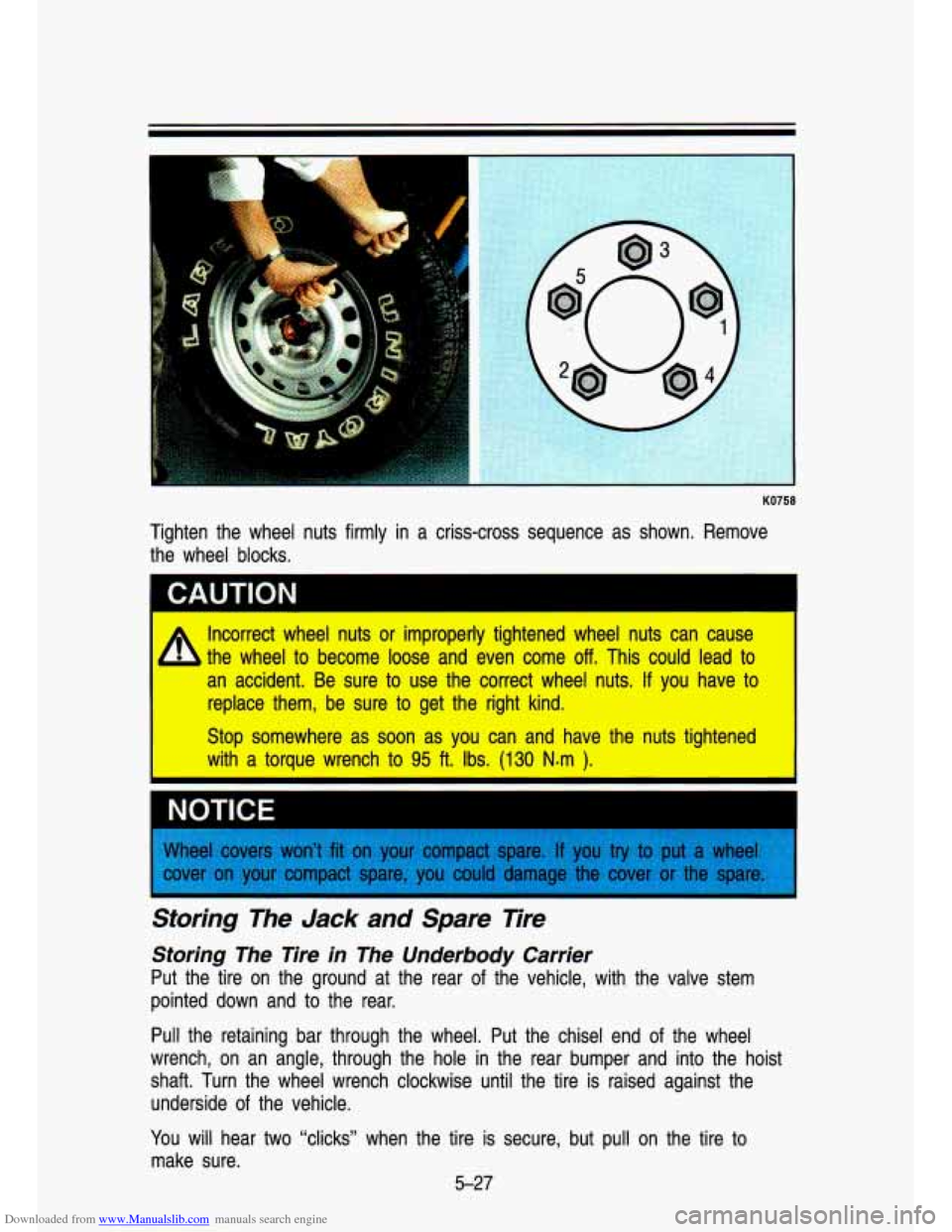
Tighten the wheel nuts firmly in a criss-cross sequence as shown. Remove
the wheel blocks.
A
Incorrect wheel nuts or improperly tightened wheel nuts can cause
the wheel to become loose and even come
off. This could lead to
an accident. Be sure to use the correct wheel nuts. If you have to
replace them, be sure
to get the right kind.
Stop somewhere as soon as you can and have the nuts tightened
with
a torque wrench to 95 ft. Ibs. (1 30 N.m ).
Storing The Tire in The Underbody Carrier
Put the tire on the ground at the rear of the vehicle, with the valve stem
pointed down and to the rear.
Pull the retaining bar through the wheel. Put the chisel end
of the wheel
wrench, on an angle, through the hole in the rear bumper and into the hoist
shaft. Turn the wheel wrench clockwise until the tire is raised against the
underside of the vehicle.
You will hear two “clicks” when the tire is secure,
but pull on the tire to
make sure.
5-27
Page 244 of 356

Downloaded from www.Manualslib.com manuals search engine Problenrs on the Road
KO546
Return the jack, wheel wrench and wheel blocks to the proper \
location behind
the seat. Secure the items and replace the jack cover.
Storing a jack, a tire, or other equipment in the passenger
compartment of the vehicle could cause injury. In a sudden stop or
collision, loose equipment could strike someone. Store all these\
in
I the proper place.
Compact Spare (If So Equipped)
Although your compact spare was fully inflated when the vehicle\
was new,
it can lose air over time. Check its inflation pressure regularly.\
It should be
60 psi (420 kPa). The compact spare is made to go up to 3,000 miles
(5000 km), so you can finish your trip and get a new tire where you want.
Of course, it's best to replace your spare with
a full-size tire as soon as you
can. Your spare will last longer and be in good shape in case you ever need
it again.
5-28
Page 263 of 356

Downloaded from www.Manualslib.com manuals search engine PO267
Lift the air cleaner assembly up from the vehicle. Open both \
clamps and lift
off cover to change the filter. While reassembling the air cleaner assembly, \
ensure that the air cleaner cover tabs are fully inserted into\
the slots in the
air cleaner housing, the two wingscrews are secure, and the
PCV air tube is
properly seated in the left hand valve cover.
Refer
to the Maintenance Schedule to determine when to replace the air
cleaner filter. See "Scheduled Maintenance Services'' in the Index.
I
I
I
4 Operating thie engine with the air cleaner off can cause you or others
i to be burned. The air deaner not only cleans the air, it stops filame
if the engine backfires. If it isn't there, and the englinle backfires, yolu
could be burned. Doin't drive with it dig and be careful wor'king oin
the enlgine with tihe air cleane:r off.
I YOTICE I
6-1 5
Page 286 of 356
Downloaded from www.Manualslib.com manuals search engine Service & Appearance Care
Loading Your Vehicle
K3651
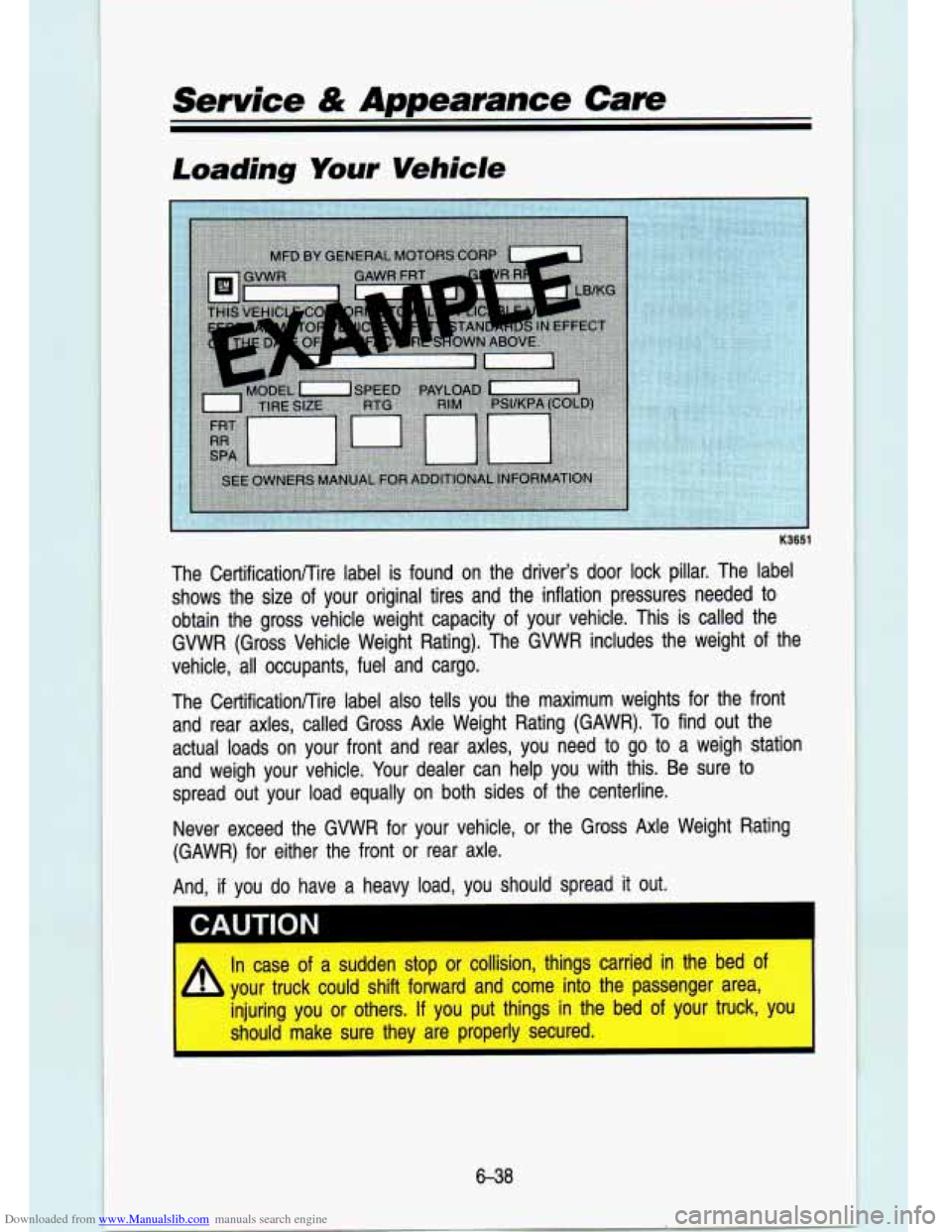
The CertificationRire label is found on the drive~r's door lock pillar. The label
shows t'he size of your original t'ires and the inflation pressu8res ne-eded to
obtain the gross vehicle weight capac-ity of your vehicle. This
is called the
GVWR (Gross Vehicle Weight Rating). The- GVWR includes the weight of the
vehlicle, all occupants, fuel and cargo.
The Certifi'cationKtre label also tells you the maximum weights for the front
and rear axles, called Gross
Axle Weight Rating (GAWR). To find out the
actual
loads on your front and rear axles, you need to go to a weigh station
and weigh your vehicle. Your dealer can help you with this. Be sure to
spread out your load equally
on both sides of the centerline.
Never exceed the GVWR for your vehicle, or the Gross Axle Wei\
ght Rating
(GAWR) for either the front or rear axle.
And,
if you do have a heavy load, you should spread it out.
I CAUTION
In case of a sudden stop or collision, things carried in the bed\
of
I [I! your truck could shift forward and come into the passenger are\
a
injuring you or others.
If you put things in the bed of your truck,
should make sure they are properly secured.
1
6-38
Page 287 of 356
Downloaded from www.Manualslib.com manuals search engine I I
CAUTION
Do not load your vehidle any heavier than tRle GVWR or tlhe
maximum
front and rear GAWRs. If you do, parts on your vehicle
can break, or it can change the way yolur vehicle hand;les. These
could cause
you to lose eonltrol. Also, overloading can shorten the
life
of your vehicle.
Using heavier suspension components
to get added durability might not
change your weight ratings. Ask your dealer
to help you load your vehicle the
right way.
I m
I NOriCE
-
II you put things inside your vehicle-like suitcases, tools, packages, or
anything else-they
will go as fast as the vehicle goes. If you have to stop
or turn quickly, or if there is a crash, they’ll keep going.
1 CAUTION
A Things you gut inside your vehicle can strike and injure peopl\
e in a
1 sudden stop or turn, or ita a ‘crash.
* Put things in the cargo area of your vehicle. Try to spread the
weight evenly.
Never stack heavier things, like suitcases, inside the vehicle so
that some of them are above the tops of the seats.
0 When you carry something inside the vehicle, secure it
whenever you can;
Don’t leave a seat folded down unless you need to.
Payload
The Payload Capacity is shown on the Certificationnire label. This is the
maximum load capacity that your vehicle can carry. Be sure to include the
weight of the people inside as part of your load.
If you added any
accessories or equipment after your vehicle
left the factory, remember to
subtract the weight of these things from the payload. Your dealer can help
you with this.
6-39