suspension CHEVROLET S10 1993 2.G Owners Manual
[x] Cancel search | Manufacturer: CHEVROLET, Model Year: 1993, Model line: S10, Model: CHEVROLET S10 1993 2.GPages: 356, PDF Size: 20.85 MB
Page 188 of 356

Downloaded from www.Manualslib.com manuals search engine Your Driving and the Road
After Off-Road Driving
Remove any brush or debris that has collected on the underbodv\
. chassis, or
under the hood. These accumulations can be a fire hazard.
After operation in mud or sand, have the brake linings cleaned\
and checked.
These substances can cause glazing and uneven braking. Check th\
e body
structure, steering, suspension, wheels, tires, and exhaust syste\
m for damage.
Also, check the fuel lines and cooling system for any leakage.\
Your vehicle will require more frequent service due to off-road use.\
Refer to
the Maintenance Schedule for additional information.
Driving at Night
AN450005
Night driving is more dangerous than day driving. One reason is that some
drivers are likely
to be impaired-by alcohol or drugs, with night vision
problems, or by fatigue.
Here are some tips on night driving.
Drive defensively. Remember, this is the most dangerous time.
Don’t drink and drive (See “Drunken Driving” in the Index for more on
this problem.)
Adjust your inside rearview mirror to reduce the glare from headlights
behind you.
4-34
Page 282 of 356
Downloaded from www.Manualslib.com manuals search engine Service & Appearance Care
Other Maintenance Items
Hydraulic Clutch Grease Fitting
If you have the 4.3L (VIN code Z) engine with a manual transmission, a
grease fitting is on the clutch housing for lubricating the cl\
utch fork ball stud.
Refer to the Maintenance Schedule for information on how to lu\
bricate the
clutch housing, and what type of lubricant to use. Be sure no\
t to over-fill
because you could
damage your clutch.
Front Suspension and Steering Linkage
Refer to the Maintenance Schedule to determine how often to lubricate the
fittings and what type of lubricant to use.
Front Wheel Bearings (Two-Wheel Drive)
If your vehicle is two-wheel drive, it has wheel bearings that mu\
st be cleaned
and repacked.
Refer
to the Maintenance Schedule to determine how often this must be
done.
Single Belt Accessory Drive
Your new vehicle uses a serpentine belt that is lighter, and more durable than
systems with several belts.
The belt runs over or around the pulleys
on the engine. A tensioner is used
to keep the belt tight at all times. The tensioner also makes replacing the
belt easier.
If you need to replace the belt, be sure to get the correct
replacement belt. Your dealership or parts supplier can help yo\
u with this.
The Accessory Drive Belt Routing label on your vehicle will sh\
ow you how to
route the belt your vehicle uses.
6-34
Page 287 of 356
Downloaded from www.Manualslib.com manuals search engine I I
CAUTION
Do not load your vehidle any heavier than tRle GVWR or tlhe
maximum
front and rear GAWRs. If you do, parts on your vehicle
can break, or it can change the way yolur vehicle hand;les. These
could cause
you to lose eonltrol. Also, overloading can shorten the
life
of your vehicle.
Using heavier suspension components
to get added durability might not
change your weight ratings. Ask your dealer
to help you load your vehicle the
right way.
I m
I NOriCE
-
II you put things inside your vehicle-like suitcases, tools, packages, or
anything else-they
will go as fast as the vehicle goes. If you have to stop
or turn quickly, or if there is a crash, they’ll keep going.
1 CAUTION
A Things you gut inside your vehicle can strike and injure peopl\
e in a
1 sudden stop or turn, or ita a ‘crash.
* Put things in the cargo area of your vehicle. Try to spread the
weight evenly.
Never stack heavier things, like suitcases, inside the vehicle so
that some of them are above the tops of the seats.
0 When you carry something inside the vehicle, secure it
whenever you can;
Don’t leave a seat folded down unless you need to.
Payload
The Payload Capacity is shown on the Certificationnire label. This is the
maximum load capacity that your vehicle can carry. Be sure to include the
weight of the people inside as part of your load.
If you added any
accessories or equipment after your vehicle
left the factory, remember to
subtract the weight of these things from the payload. Your dealer can help
you with this.
6-39
Page 324 of 356
Downloaded from www.Manualslib.com manuals search engine Scheduled Maintenance Services
Explanation Of Scheduled Maintenance Services
Below are explanations of the services listed in the maintenance charts.
The proper fluids and lubricants to use are listed in this se\
ction. Make sure whoever services your vehicle uses these. All parts should be \
replaced and all necessary repairs done before you or anyone else drives th\
e vehicle.
1. ENGINE OIL AND OIL FILTER CHANGE* -ALWAYS USE SG OR SG/CE QUALITY, ENERGY CONSERVING
II OILS OF THE PROPER
VISCOSITY. To determine the preferred viscosity oil for your vehicle’s
engine (e.g. SAE 5W-30). See “Engine Oil” in the Index.\
2. CHASSIS LUBRICATION -Lubricate the front suspension, ball joint,
steering linkage, clutch, and transfer case shift linkage, parki\
ng brake
cable guides, propshaft splines, universal joints, brake pedal s\
prings, and
clutch pedal springs at the intervals specified on the proper \
maintenance
schedule, or at every engine oil change, whichever comes first.\
On
vehicles without hydraulic clutches, lubricate the clutch cross \
shaft every
30,000 miles
(50 000 km).
Ball joints should not be lubricated unless their temperature i\
s 10°F
(-12°C) or higher. When the weather is cold, let them war\
m up before
lubricating them or they could be damaged.
Also, be sure to check all the vehicle fluid levels at this \
time.
3. CLUTCH FORK BALL STUD LUBRICATION (4.3L ENGINES ONLY)
-Lubricate the clutch fork ball stud through the fitting on th\
e clutch housing. Lubricant must be added “sparingly” to the fittin\
g, as only
.0066
Ib. (.003 kg) is required to lubricate the ball stud surface\
. Do not add
lubricant more often than the intervals recommended in the Main\
tenance
Schedules. Too much lubricant
will damage the clutch assembly.
4. COOLING SYSTEM SERVICE* -Drain, flush and refill the system wit\
h
new coolant. See “Engine Coolant’’ in the Index for th\
e proper coolant
and mixture to use in your vehicle.
Also inspect the hoses and replace them
if they are cracked, swollen, or
deteriorated. Tighten all hose clamps. Clean the outside of the radiator
and air conditioning condenser. Wash the radiator neck. To ensure proper
operation, pressure test the radiator and cap.
* An Emission Control Service
7-8
Page 329 of 356
Downloaded from www.Manualslib.com manuals search engine Periodic Maintenance Inspections
Listed below are inspections and services which should be performed at least
twice a year (for instance, each spring and fall). You should let your GM
dealer’s service department or other qualified service center
do these jobs.
Make sure any necessary repairs are completed at once.
Steering and Suspension lnspectiont -Inspect front and rear suspension
and steering system for damaged, loose or missing parts, signs \
of wear or
lack of lubrication. Inspect power steering lines and hoses for\
proper hook-up,
binding, leaks, cracks, chafing, etc. (On vehicles equipped with manual
steering gear, check for seal leakage.) Lubricate the steering linkage.
Accelerator Control System -Lubricate all pivot points with engine oil,
except the
TBI throttle shaft. Do not lubricate the cam pulley. Remove all
external deposits from pulley. Do not oil any accelerator or cruise control
cables. Replace any cables that have high effort or excessive wear.
Exhaust System Inspection -Inspect the complete system. Inspect the body
near the exhaust system. Look for broken, damaged, missing or
out-of-position parts, as well as open seams, holes, loose connections or
other conditions which could cause a heat buildup in the floor pan or could
let exhaust fumes seep into the passenger compartments. See “\
Engine Exhaust” in the Index..
Drive Axle Service -Check rear/front axle fluid level and add as needed.
Check constant velocity joints and axle seals for leaking.
Transfer Case (four-wheel drive) lnspectiont -Every
12 months or at oil
change intervals, check front axle and transfer case and add l\
ubricant when
necessary. Oil the control lever pivot point and all exposed control linkage. \
Check vent
hose at transfer case for kinks and proper installation. More
frequent lubrication may be required on off-road use.
tA fluid loss in these systems may indicate a problem. Have them inspected
and repaired at once.
7-1 3
Page 350 of 356
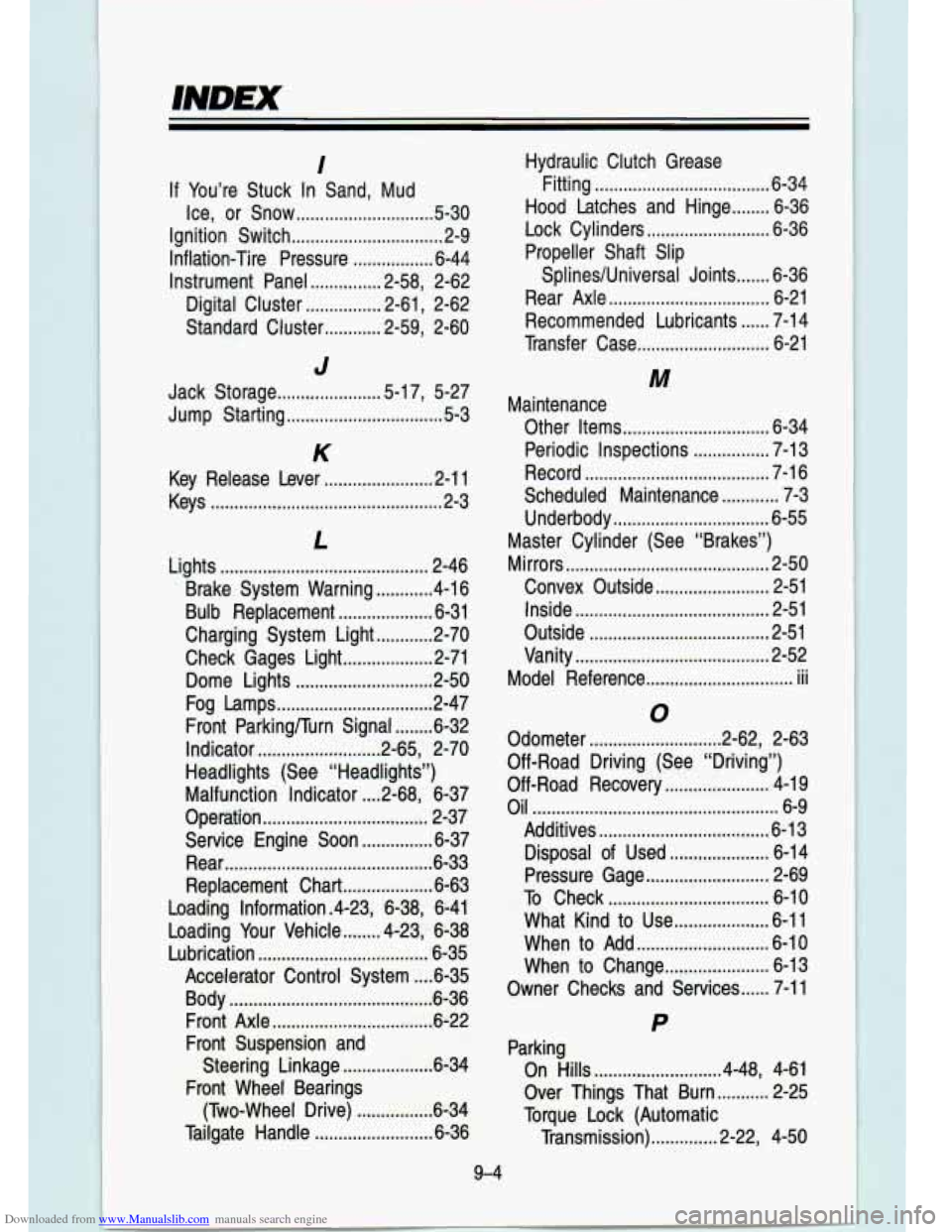
Downloaded from www.Manualslib.com manuals search engine I
If You’re Stuck In Sand. Mud
Ice. or Snow
............................. 5-30
Ignition Switch ................................ 2-9
Inflation-Tire Pressure ................. 6-44
Instrument Panel ............... 2-58, 2-62
Digital Cluster ................ 2-61, 2-62
Standard Cluster ............ 2-59, 2-60
J
Jack Storage ...................... 5-17, 5-27
Jump Starting ................................. 5-3
K
Key Release Lever ....................... 2-1 1
Keys ................................................. 2-3
L
Lights ........ ................................... 2-46
Brake System Warning ............ 4-1 6
Bulb Replacement .................... 6-31
Charging System Light ............ 2-70
Check Gages Light ................... 2-71
Dome Lights ............................. 2-50
Fog Lamps ................................. 2-47
Indicator ........................ ..2-65, 2-70
Headlights (See “Headlights”)
Malfunction Indicator
.... 2-68, 6-37
Operation ................................... 2-37
Service Engine Soon ............... 6-37
Rear ............................................ 6-33
Loading Information .4-23, 6-38, 6-41
Loading Your Vehicle ........ 4-23, 6-38
Lubrication .................................... 6-35
Front Parkingnurn Signal ........ 6-32
Replacement Chart ................... 6-63
Accelerator Control System .... 6-35
Body ........................................... .- 36
Front Axle ........................ ..... 6-22
Front Suspension and
Steering Linkage
................... 6-34
Front Wheel Bearings
(Two-Wheel Drive)
................ 6-34
Tailgate Handle ......................... 6-36
Hydraulic Clutch Grease
Fitting
..................................... 6-34
Hood Latches and Hinge ........ 6-36
Lock Cylinders .......................... 6-36
Propeller Shaft Slip
SplineslUniversal Joints
....... 6-36
Rear Axle .................................. 6-21
Recommended Lubricants ...... 7-14
Transfer Case ............................ 6-21
M
Other Items ............................... 6-34
Periodic Inspections ................ 7-13
Record ....................................... 7-16
Scheduled Maintenance ............ 7-3
Underbody ................................. 6-55
Master Cylinder (See “Brakes”)
Mirrors
........................................... 2-50
Convex Outside ........................ 2-51
inside ......................................... 2-51
Outside ...................................... 2-51
Vanity ......................................... 2-52
Model Reference ............................... iii
Maintenance
0
Odometer ............................ 2-62, 2-63
Off-Road Driving (See “Driving”)
Off-Road Recovery
...................... 4-1 9
Oil .................................................... 6-9
Additives .................................... 6-13
Disposal of Used ...................... 6-14
Pressure Gage .......................... 2-69
To Check .................................. 6-10
What Kind to Use .................... 6-11
When to Add ............................ 6-10
When to Change ...................... 6-13
Owner Checks and Services ...... 7-11
P
On Hills ........................... 4-48, 4-61
Torque Lock (Automatic
Parking
Over Things That Burn
........... 2-25
Transmission) .............. 2-22, 4-50