maintenance CHEVROLET S10 1993 2.G User Guide
[x] Cancel search | Manufacturer: CHEVROLET, Model Year: 1993, Model line: S10, Model: CHEVROLET S10 1993 2.GPages: 356, PDF Size: 20.85 MB
Page 264 of 356
Downloaded from www.Manualslib.com manuals search engine Service & Appearance Care
Automatic Transmission Fluid
When to Check and Change:
A good time to check your automatic transmission fluid level is when the
engine oil is changed. Refer to the Maintenance Schedule to de\
termine when
to change your fluid. See “Scheduled Maintenance Services” \
in the Index.
How to Check:
Because this operation can be a little difficult, you may choo\
se to have this
done at a dealership Service Department.
If you
do it yourself, be sure to follow all the instructions here, or \
you could
get a false reading on the dipstick.
I NOTICE
Wait at least 30 minutes before checking the transmission fluid level if you
have been driving:
When outside temperatures are above 90°F (32°C).
At high speed for quite a while.
In heavy traffic-especially in hot weather.
While pulling a trailer.
To get the right reading, the fluid must be at normal operating \
temperature,
which is 180°F to 200°F (82°C to 93°C).
To check transmission fluid hot: Get the vehicle warmed up by driving
about
15 miles (24 km) when outside temperatures are above 50°F (10°C). If
it’s colder then 50°F (IO’C), drive the vehicle in D (3rd gear) until the
temperature gage moves and then remains steady for ten minutes.\
Then
follow the hot check procedures.
To check transmission fluid cold: A cold check is made after the vehicle
has been sitting for eight hours or more with the engine off and is used
only
as a reference. Let the engine run at idle for five minutes if outside
temperatures are
50°F (10°C) or more. If it’s colder than 50°F (lO°C), you
may have to idle the engine longer. A hot check must follow when fluid is
added during a cold check.
6-1 6
I
Page 266 of 356

Downloaded from www.Manualslib.com manuals search engine Service & Appearance Care
If you have a 4.3L engine, you will have a flip-top handle. Flip\
the
handle up and then pull out the dipstick and wipe it clean with a rag or
paper towel.
2. Push it back in all the way, wait three seconds and then pull it back out
again. Flip top handle should remain in open position.
c
PO1 65
3. Check both sides of the dipstick, and read the lower level. The fluid
level must be in the COLD area for a cold check or in the HOT area or
cross-hatched area for a hot check.
4.
If the fluid. level is where it should be, push the dipstick bac\
k in all the
way.
If you have a flip-top handle, flip the handle down to lock it in place.
How To Add Fluid:
Refer to the Maintenance Schedule to determine what kind of transmission
fluid to use. See “Recommended Fluids and Lubricants” in \
the Index.
If the fluid level is low, add only enough of the proper fluid to bring the level
up to the COLD area for a cold check or the HOT area for a hot c\
heck. It
doesn’t take much fluid, generally less than a pint. Don’\
t overfill. We
recommend you use only fluid labeled DEXRON@lIE, because fluids \
with that
label are made especially for your automatic transmission. Damag\
e caused by
fluid other than DEXRON@IIE is not covered by your new vehicle\
warranty.
After adding fluid, recheck the fluid level as described under \
“How To
Check”.
When the correct fluid level is obtained, push the dipstick ba\
ck in all the
way. Flip the handle down
if you have a flip-top handle.
6-1 8
1
Page 268 of 356
Downloaded from www.Manualslib.com manuals search engine Service & Amearance Cam
How to Add Fluid:
Here’s how to add fluid. Refer to the Maintenance Schedule to determine
what kind of fluid to use. See “Recommended Fluids and Lubricants” in the
Index.
1. Remove the filler plug.
2. Add fluid at the filler plug hole. Add only enough fluid to bring the fluid
3. Install the plug. Be sure it is fully seated.
level up to the bottom
of the filler plug hole.
Hydraulic Clutch
The hydraulic clutch in your vehicle is self-adjusting. A slight amount of play
[1/4
(6 mm)-112 inch (13 mm)] in the pedal is normal.
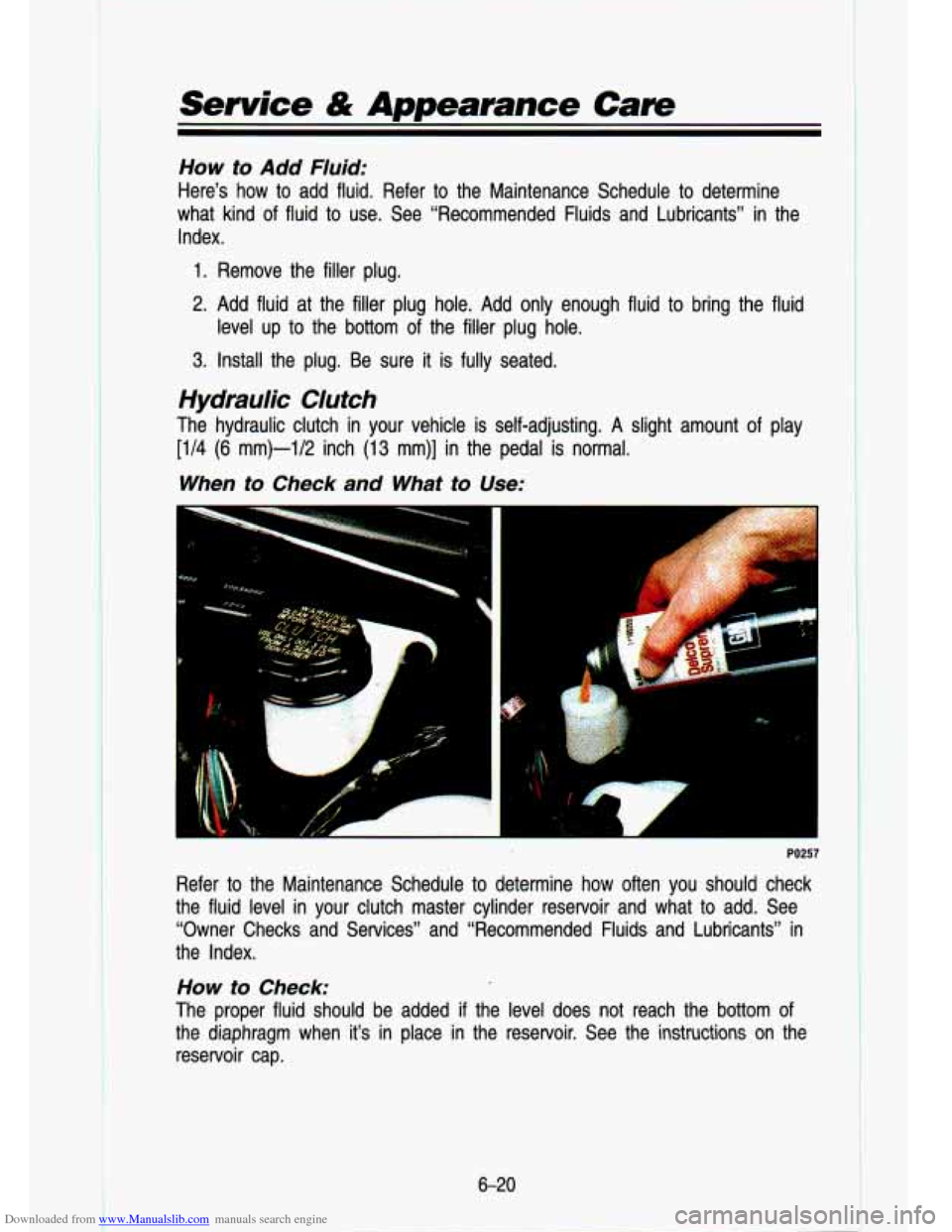
When to Check and What to Use:
i
c
PO257 I
Refer to the Maintenance Schedule to determine how often you s\
hould check
the fluid level in your clutch master cylinder reservoir and w\
hat to add. See
“Owner Checks and Services” and “Recommended Fluids and \
Lubricants” in
the Index.
How to Check:
The proper fluid should be added if the level does not reach the bottom of
the diaphragm when it’s in place in the reservoir. See the
instructions on the
reservoir cap.
6-20
Page 269 of 356
Downloaded from www.Manualslib.com manuals search engine Rear Axle
When to Check and Change Lubricant:
Refer to the Maintenance Schedule to determine how often to check the
lubricant and when to change it. See “Scheduled Maintenance Services” in
the Index.
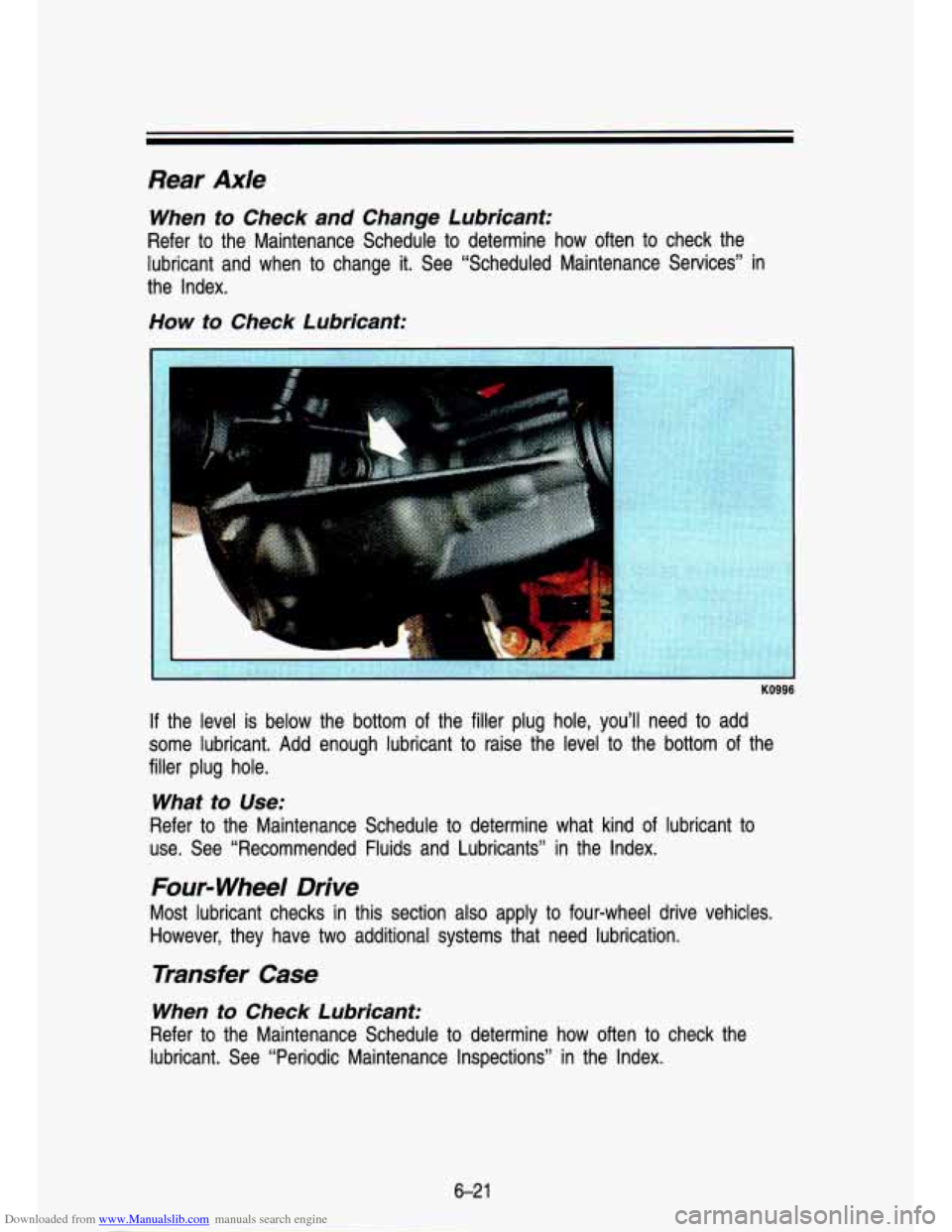
How to Check Lubricant:
KO996
If the level is below the bottom of the filler plug hole, you’ll need to add
some lubricant. Add enough lubricant to raise the level to the bottom
of the
filler plug hole.
What to Use:
Refer to the Maintenance Schedule to determine what kind of lubricant to
use. See “Recommended Fluids and Lubricants” in the Index.
Four- Wheel Drive
Most lubricant checks in this section also apply to four-wheel drive vehicles.
However, they have two additional systems that need lubrication.
Transfer Case
When to Check Lubricant:
Refer to the Maintenance Schedule to determine how often to check the
lubricant. See “Periodic Maintenance Inspections”
in the Index.
6-2 1
Page 270 of 356
Downloaded from www.Manualslib.com manuals search engine .. .
.- .. . ,-
_. .
Service & Appearance Care
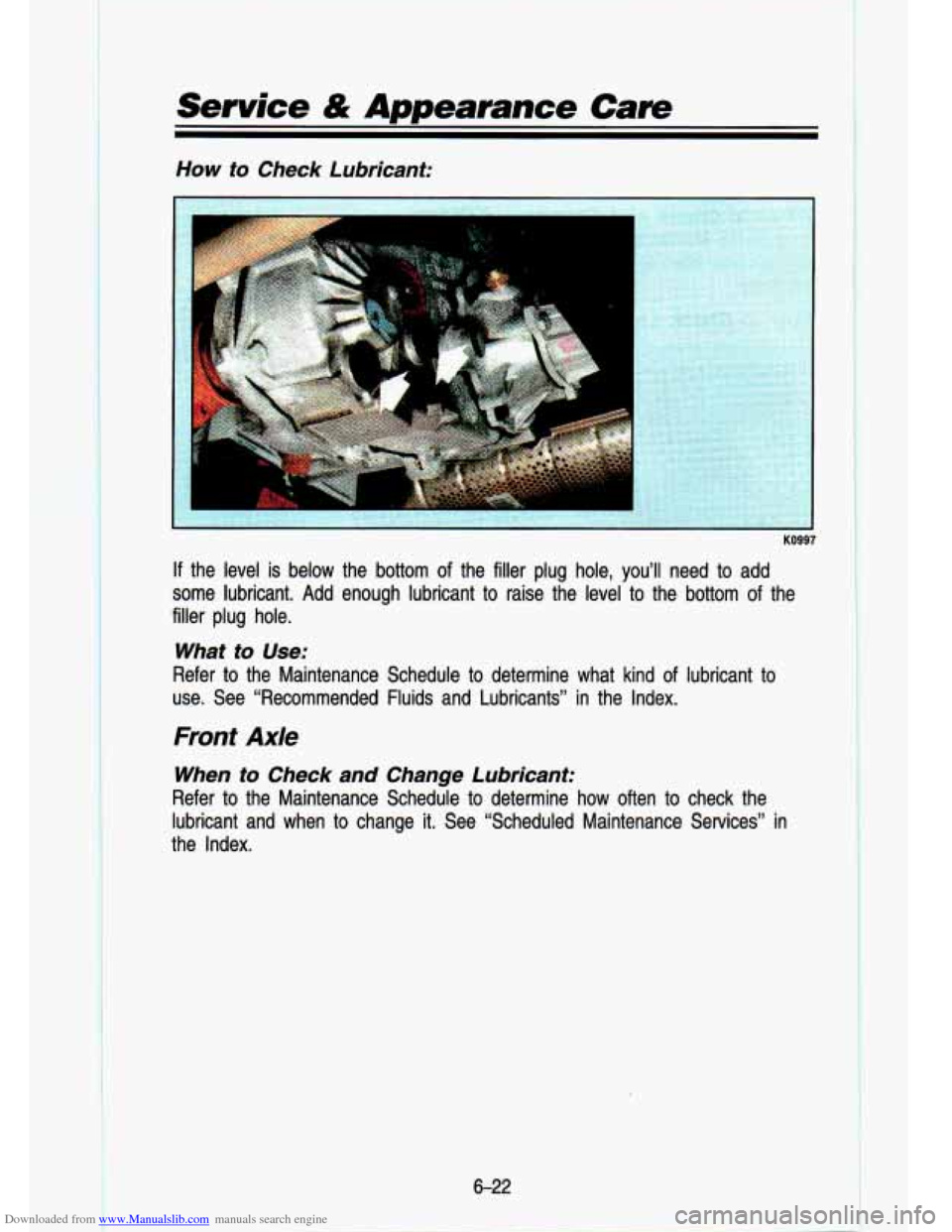
How to Check Lubricant:
I-
- KO997
If the level is below the bottom of the filler plug hole, you’ll need to a\
dd
some lubricant.
Add enough lubricant to raise the level to the bottom of the
filler plug hole.
What to Use:
Refer to the Maintenance Schedule to determine what kind of lubricant to
use. See “Recommended Fluids and Lubricants” in the Index.\
Front Axle
When to Check and Change Lubricant:
Refer to the Maintenance Schedule to determine how often to ch\
eck the
lubricant and when to change it. See “Scheduled Maintenance \
Services” in
the Index.
6-22
Page 271 of 356
Downloaded from www.Manualslib.com manuals search engine How to Check Lubricant:
i I
KO998
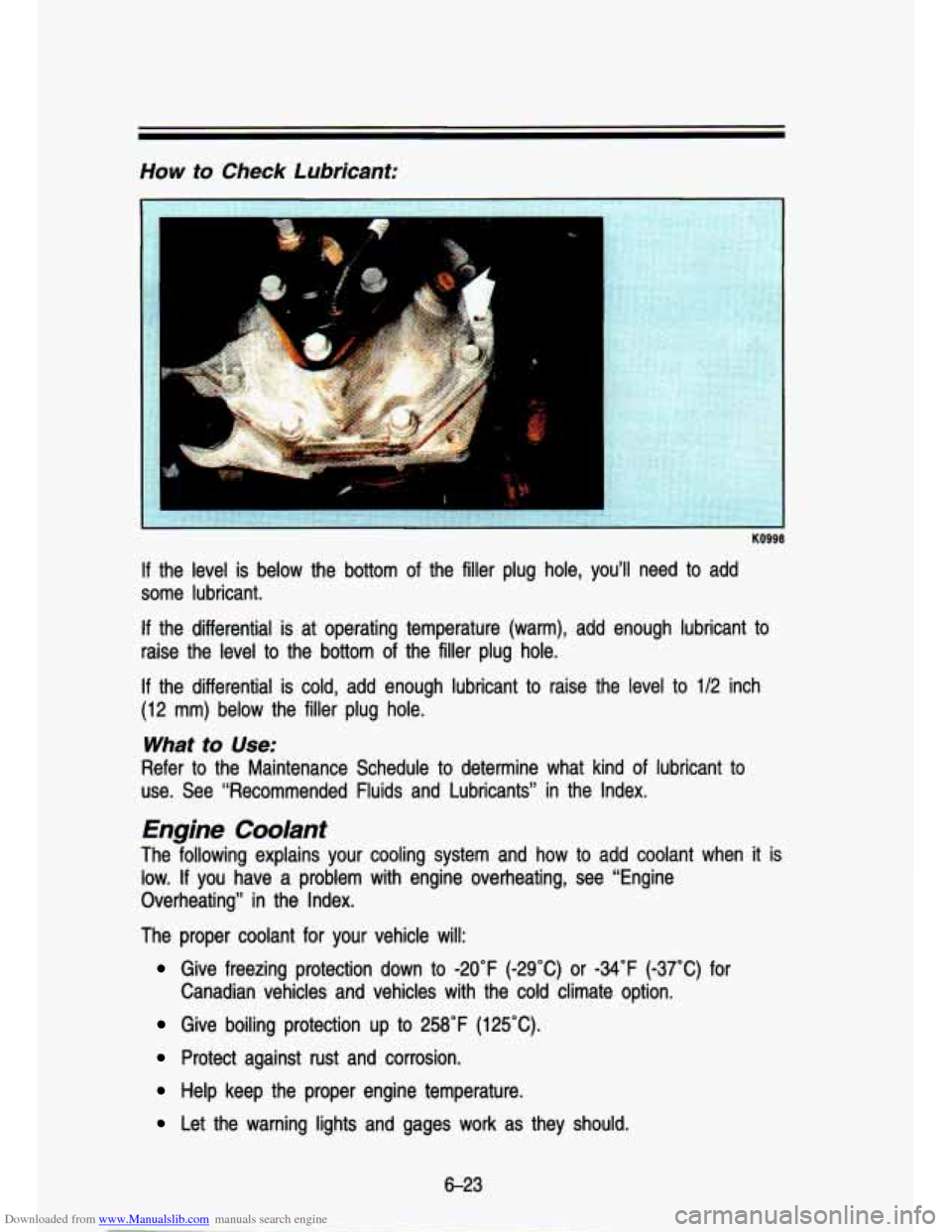
If the level is below the bottom of the filler plug hole, you’ll need to add
some lubricant.
If the differential is at operating temperature (warm), add enough lubricant to
raise the level
to the bottom of the filler plug hole.
If the differential is cold, add enough lubricant to raise the level to 1/2 inch
(12 mm) below the filler plug hole.
What to Use:
Refer to the Maintenance Schedule to determine what kind of lubricant to
use. See “Recommended Fluids and Lubricants” in the Index.\
Engine Coolant
The following explains your cooling system and how to add coolant when it is
low.
If you have a problem with engine overheating, see “Engine
Overheating’’ in the Index.
The proper coolant
for your vehicle will:
Give freezing protection down to -20°F (-29°C) or -34°F (-37°C) for
Give boiling protection up to 258°F (125°C).
Canadian vehicles and vehicles with the cold climate option.
Protect against rust and corrosion.
Help keep
the proper engine temperature.
Let the warning lights and gages work as they should.
6-23
Page 275 of 356

Downloaded from www.Manualslib.com manuals search engine Power Steering Fluid
How To Check Power Steering Fluid:
Unscrew the cap and wipe the dipstick with a clean rag. Repla\
ce the cap
and completely tighten
it. Then remove the cap again and look at the fluid
level on the dipstick.
When the engine compartment is hot, the level should be at the HOT
When the engine compartment is cool, the level should be at the FULL
mark.
COLD mark.
What to Add:
Refer to the Maintenance Schedule to determine what kind of fluid to use.
See “Recommended Fluids and Lubricants” in the Index.
NOTICE
6-27
Page 277 of 356
Downloaded from www.Manualslib.com manuals search engine Brake Master Cylinder
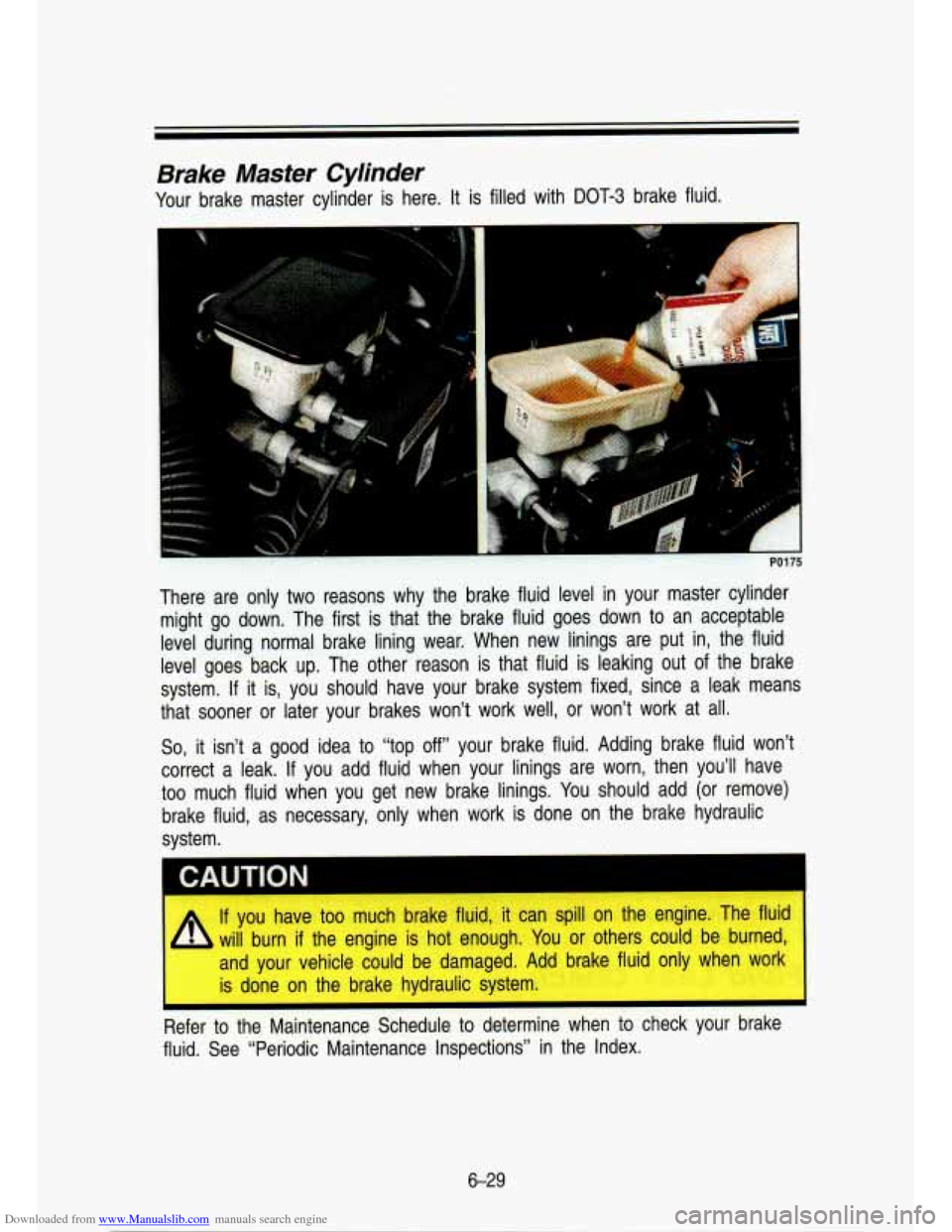
Your brake master cylinder is here. It is filled with DOT-3 brake fluid.
PO775
So, it isn’t a good idea to “top off” your brake fluid. Adding brake fluid won’t
correct a leak.
If you add fluid when your linings are worn, then you’ll have \
too much fluid when you get new brake linings. You should add (or remove)
brake fluid, as necessary, only when work is done on the brake hydraulic
system.
If you have too much brake fluid,
it can spill on the engine. The fluid
will burn if the engine is hot enough. You or others could be burned,
and your vehicle could be damaged. Add brake fluid only when work
is done on the brake hydraulic system. I
Refer to the Maintenance Schedule to determine when to check your brake
fluid. See “Periodic Maintenance Inspections” in the Index.
6-29
Page 282 of 356
Downloaded from www.Manualslib.com manuals search engine Service & Appearance Care
Other Maintenance Items
Hydraulic Clutch Grease Fitting
If you have the 4.3L (VIN code Z) engine with a manual transmission, a
grease fitting is on the clutch housing for lubricating the cl\
utch fork ball stud.
Refer to the Maintenance Schedule for information on how to lu\
bricate the
clutch housing, and what type of lubricant to use. Be sure no\
t to over-fill
because you could
damage your clutch.
Front Suspension and Steering Linkage
Refer to the Maintenance Schedule to determine how often to lubricate the
fittings and what type of lubricant to use.
Front Wheel Bearings (Two-Wheel Drive)
If your vehicle is two-wheel drive, it has wheel bearings that mu\
st be cleaned
and repacked.
Refer
to the Maintenance Schedule to determine how often this must be
done.
Single Belt Accessory Drive
Your new vehicle uses a serpentine belt that is lighter, and more durable than
systems with several belts.
The belt runs over or around the pulleys
on the engine. A tensioner is used
to keep the belt tight at all times. The tensioner also makes replacing the
belt easier.
If you need to replace the belt, be sure to get the correct
replacement belt. Your dealership or parts supplier can help yo\
u with this.
The Accessory Drive Belt Routing label on your vehicle will sh\
ow you how to
route the belt your vehicle uses.
6-34
Page 283 of 356
Downloaded from www.Manualslib.com manuals search engine Windshield Wiper Blade Inserts
i
.. i. KO637 .. .,' :-, ;iyy ?-is;+;.-, &!!f$i& . l'jf:. j<-:q;* j';gi3f47!:;I' b,(..;',$< t&..YT:i;; ;.l:z~ .''! ..' :.. y.?;i'!g.tyz , . ..
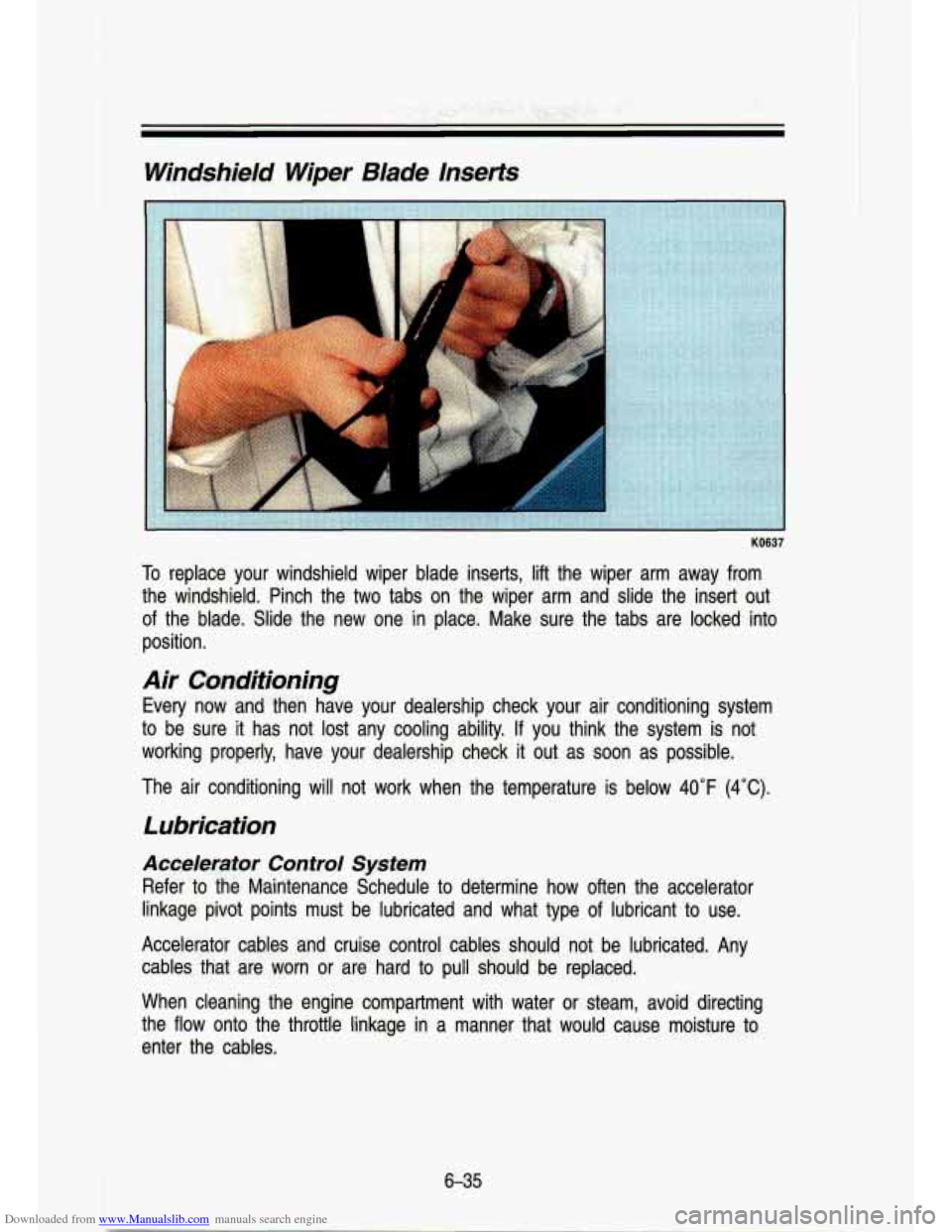
o rep ace your wlndshleld wiper blade inserts, lift the wiper ar\
m away from
the windshield. Pinch the
two tabs on the wiper arm and slide the insert out
of the bl'ade. Slide the new one in place. Make sure the tabs are locked into
position.
Air Conditioning
Every now and then have your dealership check your alr conditi\
oning system
to be sure it has not lost any cooling ability. If you think the system is not
working prope'rly, have your dealership check
it out as soon as possible.
The air conditioning will not work when the temperature is below
40°F (4°C).
Lubrication
Accelerator Control System
Refer to the Maintenance Schedule to determine how often the accelerator
linkage pivot points must be lubricated and what type
of lubricant to use.
Accelerator cables and cruise control cables should not be lubr\
icated. Any
cables that are worn or are hard
to pull should be replaced.
When cleaning the engine compartment with water or steam, avoid\
directing
the flow onto the throffle linkage in a manner that would cause moisture
to
enter the cables.