warning light CHEVROLET S10 1993 2.G User Guide
[x] Cancel search | Manufacturer: CHEVROLET, Model Year: 1993, Model line: S10, Model: CHEVROLET S10 1993 2.GPages: 356, PDF Size: 20.85 MB
Page 176 of 356

Downloaded from www.Manualslib.com manuals search engine Your Driving and the Road
Don’t overtake a slowly moving vehicle too rapidly. Even tho\
ugh the
brake lights are not flashing, it may be slowing down or starting to turn.
If you’re being passed, make it easy for the following driv\
er to get ahead
of you. Perhaps you can ease a little to the right.
Loss of Control
Let’s review what driving experts say about what happens whe\
n the three
control systems (brakes, steering and acceleration) don’t ha\
ve enough friction
where the tires meet the road to
do what the driver has asked.
In any emergency, don’t give up. Keep trying to steer, and constantly seek an
escape route or area of less danger.
Skidding
In a skid, a driver can lose control of the vehicle. Defensive drivers avoid
most skids by taking reasonable care suited to existing conditi\
ons, and by not
“overdriving” those conditions. But skids are always possib\
le.
The three types
of skids correspond to your vehicle’s three control systems.
In the braking skid, your wheels aren’t rolling. In the steering or cornering
skid, too much speed or steering in a curve causes tires to \
slip and lose
cornering force. And in the acceleration skid, too much throttle causes the
driving wheels to spin.
A cornering skid and an acceleration skid are best handled by easing your
foot off the accelerator pedal. If your vehicle starts to slide (as when you turn
a corner on a wet, snow- or ice-covered road), ease your foo\
t
off the
accelerator pedal as soon as you feel the tires start to slide. Quickly steer
the way you want the vehicle to go. If you start steering quickly enough, your
vehicle will straighten out.
As it does, straighten the front wheels.
Of course, traction is reduced when water, snow, ice, gravel, or other material
is on the road. For safety, you’ll want to slow down and adjust your driving to
these conditions.
It is important to slow down on slippery surfaces because
stopping distance will be longer and vehicle control more limit\
ed.
While driving on a surface with reduced traction, try your bes\
t to avoid
sudden steering, acceleration, or braking (including engine brak\
ing by shifting
to a lower gear). Any sudden move could cause the tires to slide. You may
not realize the surface is slippery until your vehicle is skidding. Learn to
recognize warning clues-such as enough water, ice or packed snow on the
road to make
a “mirrored surface”-and slow down when you have any
doubt.
4-22
Page 196 of 356
Downloaded from www.Manualslib.com manuals search engine I. - - .. .. Your Driving and the Road
Treat a green light as a warning signal. A traffic light is there because
the corner is busy enough
to need it. When a light turns green, and just
before you start
to move, check both ways for vehicles that have not
cleared the intersection or may be running the red light.
Obey all posted speed limits. But remember that they are for \
ideal road,
weather and visibility conditions. You may need
to drive below the
posted limit in bad weather or when visibility
is especially poor.
Pull to the right (with care) and stop clear of intersections when y\
ou see
or hear emergency vehicles.
Freeway Driving
..
. ~.
3. -. ..
.I
.1 , I- >. -
AN461 003
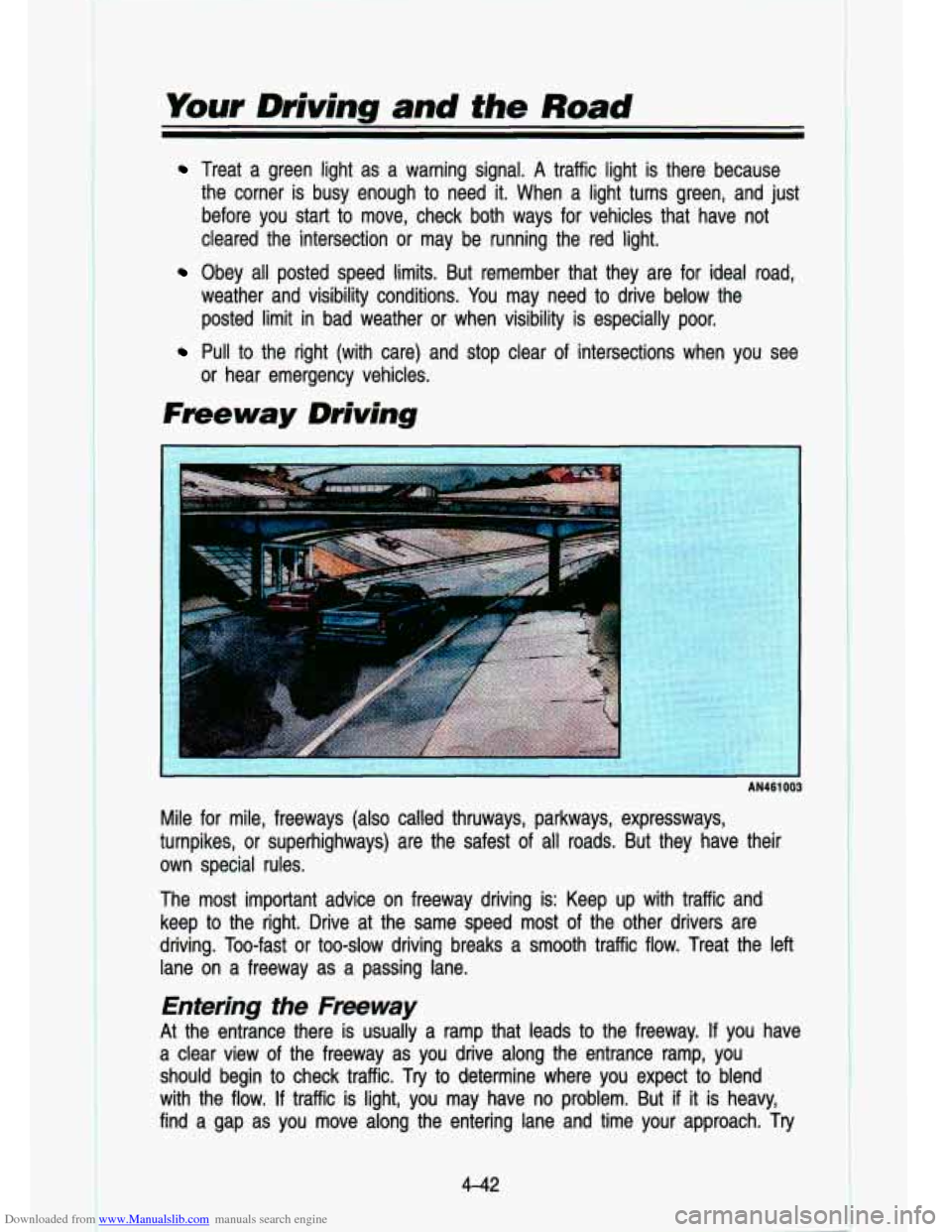
Mile for mile, freeways (also called thruways, parkways, expres\
sways,
turnpikes, or superhighways) are the safest of all roads. But they have \
their
own special rules.
The most important advice on freeway driving is: Keep up with \
traffic and keep
to the right. Drive at the same speed most of the other drivers are
driving. Too-fast or too-slow driving breaks a smooth traffic f\
low. Treat the left lane on a freeway as a passing lane.
Entering the Freeway
At the entrance there is usually a ramp that leads to the freeway. If you have
a clear view of the freeway as you drive along the entrance ramp, you
should begin
to check traffic. Try to determine where you expect to blend
with the flow.
If traffic is light, you may have no problem. But if it is heavy,
find a gap as you move along the entering lane and time your appr\
oach.
Try
4-42
Page 197 of 356
Downloaded from www.Manualslib.com manuals search engine to merge into the gap at close to the prevailing speed. Switch on your turn
signal, check your rearview mirrors as you move along, and glance over your
shoulder as often as necessary.
Try to blend smoothly with the traffic flow.
Driving on the Freeway
Once you are on the freeway, adjust your speed to the posted limit or to the
prevailing rate
if it’s slower. Stay in the right lane unless you want to pass. If
you are on a two-lane freeway, treat the right lane as the slow lane and the
left lane as the passing lane.
If you are on a three-lane freeway, treat the right lane as the slower-speed
through lane, the middle lane as the higher-speed through lane, and the left
lane as the passing lane.
Before changing lanes, check your rearview mirrors. Then use yo\
ur turn
signal. Just before you leave the lane, glance quickly over your shoulder
to
make sure there isn’t another vehicle in your “blind” spot.
If you are moving from an outside to a center lane on a freeway having
more than
two lanes, make sure another vehicle isn’t about to move into the
same spot. Look
at the vehicles two lanes over and watch for telltale signs:
turn signals flashing, an increase in speed, or moving toward the edge
of the
lane. Be prepared to delay your move.
Once you are moving on the freeway, make certain you allow a reasonable
following distance. Expect to move slightly slower at night.
Leaving the Freeway
When you want to leave the freeway, move to the proper lane well in
advance. Dashing across lanes at the last minute is dangerous. \
If you miss
your exit do not, under any circumstances, stop and back up. \
Drive on to the
next exit.
At each exit point is a deceleration lane. Ideally
it should be long enough for
you to enter
it at freeway speed (after signaling, of course) and then do your
braking before moving onto the exit ramp. Unfortunately, not all deceleration
lanes are long enough-some are too short for all the braking. Decide when
to start braking.
If you must brake on the through lane, and if there is traffic
close behind you, you can allow a little extra time and flash your brake lights
(in addition to your turn signal) as extra warning that you are about to slow
down and exit.
The exit ramp can be curved, sometimes quite sharply. The exit\
speed
is
usually posted. Reduce your speed according to your speedometer, not to
your sense of motion. After driving for any distance at higher\
speeds, you
4-43
Page 205 of 356
Downloaded from www.Manualslib.com manuals search engine Winter Driving
AN480001
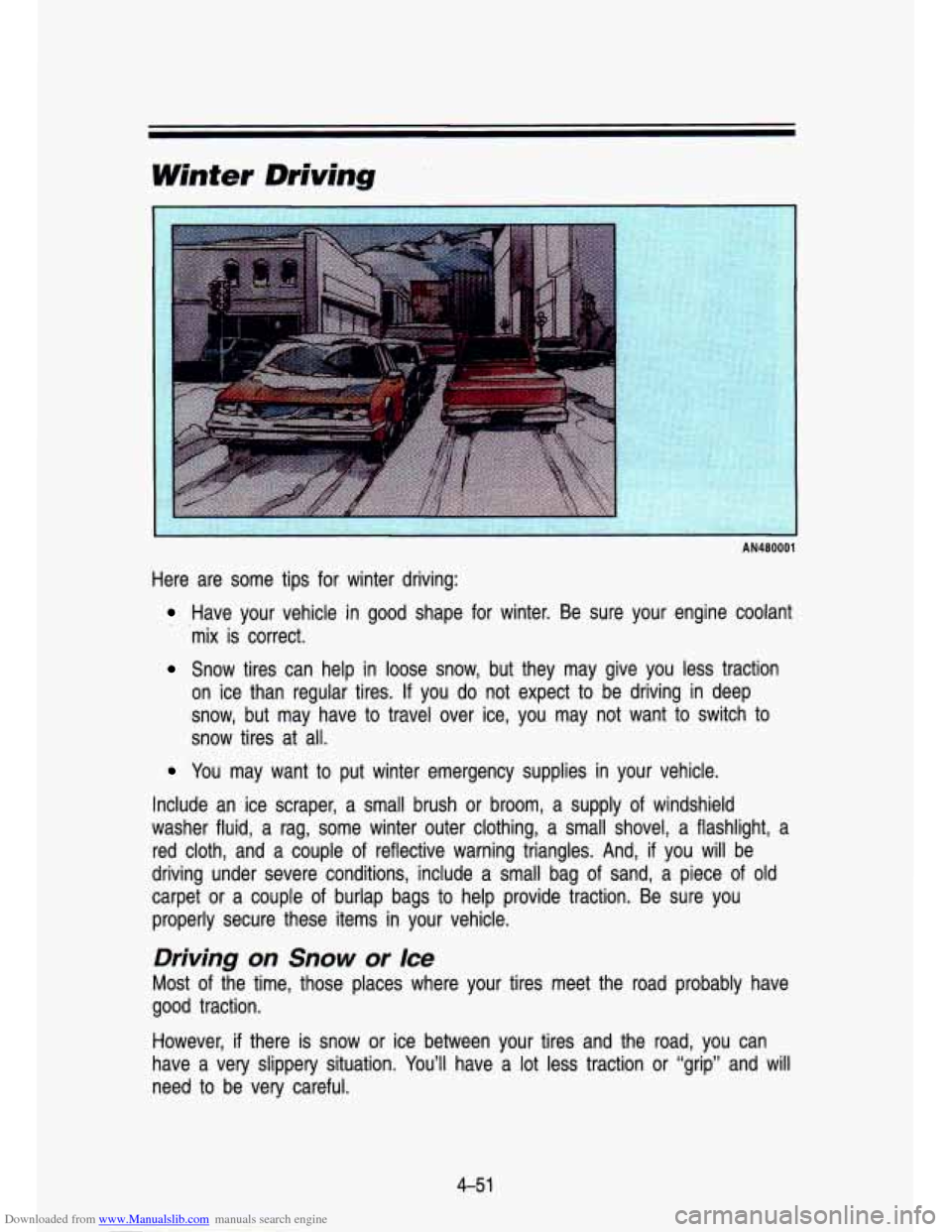
Here are some tips for winter driving:
Have your vehicle in good shape for winter. Be sure your engine coolant
mix is correct.
Snow tires can help in loose snow, but they may give you less traction
on ice than regular tires.
If you do not expect to be driving in deep
snow, but may have to travel over ice, you may not want to switch to
snow tires at all.
You may want to put winter emergency supplies in your vehicle.
Include an ice scraper, a small brush or broom, a supply of windshield
washer fluid, a rag, some winter outer clothing, a small shove\
l, a flashlight, a red cloth, and a couple of reflective warning triangles. And,
if you will be
driving under severe conditions, include a small bag of sand, a piece of old
carpet or a couple of burlap bags to help provide traction. Be sure you
properly secure these items in your vehicle.
Driving on Snow or Ice
Most of the time, those places where your tires meet the road probably\
have
good traction.
However,
if there is snow or ice between your tires and the road, you can
have a very slippery situation. You’ll have a lot less traction or “grip” and will
need to be very careful.
4-51
Page 218 of 356

Downloaded from www.Manualslib.com manuals search engine Problems on the Road
AM505003
Your hazard warning flashers let you warn others. They also let pol\
ice know
you have a problem. Your front and rear turn signal lights will flash on and
off. But they won’t flash if you’re braking.
i
Press the button in to make your front and rear turn signal lights flash on
and
off.
Your hazard warning flashers work no matter what position your key is in,
and even if the key isn’t in.
Page 271 of 356
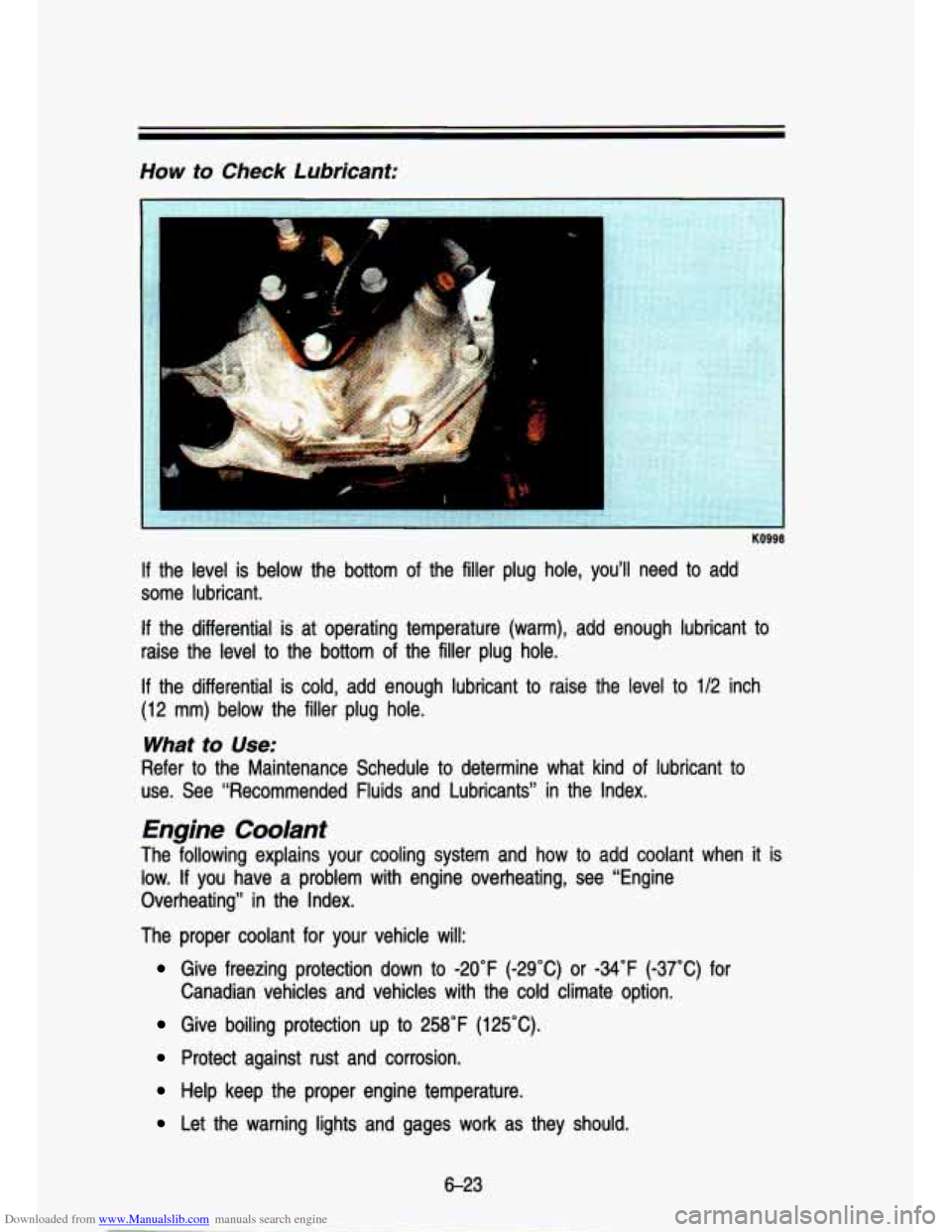
Downloaded from www.Manualslib.com manuals search engine How to Check Lubricant:
i I
KO998
If the level is below the bottom of the filler plug hole, you’ll need to add
some lubricant.
If the differential is at operating temperature (warm), add enough lubricant to
raise the level
to the bottom of the filler plug hole.
If the differential is cold, add enough lubricant to raise the level to 1/2 inch
(12 mm) below the filler plug hole.
What to Use:
Refer to the Maintenance Schedule to determine what kind of lubricant to
use. See “Recommended Fluids and Lubricants” in the Index.\
Engine Coolant
The following explains your cooling system and how to add coolant when it is
low.
If you have a problem with engine overheating, see “Engine
Overheating’’ in the Index.
The proper coolant
for your vehicle will:
Give freezing protection down to -20°F (-29°C) or -34°F (-37°C) for
Give boiling protection up to 258°F (125°C).
Canadian vehicles and vehicles with the cold climate option.
Protect against rust and corrosion.
Help keep
the proper engine temperature.
Let the warning lights and gages work as they should.
6-23
Page 312 of 356
Downloaded from www.Manualslib.com manuals search engine Service & Appearance Cam
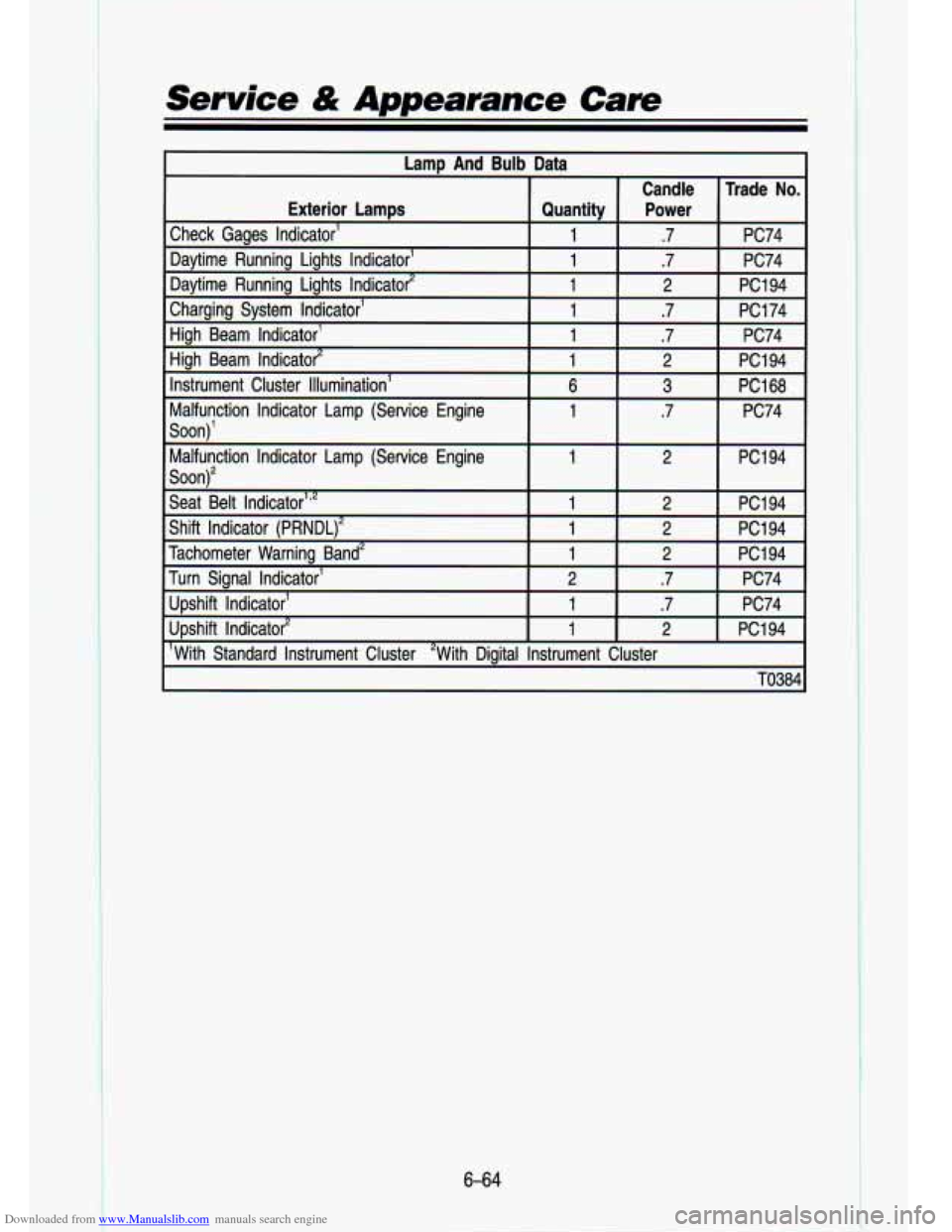
Lamp And Bulb Data
Exterior Lamps
Check Gages Indicator' Daytime Running Lights Indicator'
Daytime Running Lights Indicator2
..-
Charging System Indicator' High Beam Indicator'
High Beam lndicato?
I
Quantity 1 1
Trade No.
PC1 94
PC1 74
PC1 94
-
Instrument Cluster Illumination' 6 3 PC1 68
Malfunction Indicator Lamp (Service Engine 1 .7 PC74
Soon)'
Malfunction Indicator Lamp (Service Engine
Soon)'
I I pc194
Seat Belt Indicator'" 1 2 PC1 94
Shift Indicator (PRNDL)'
1 2 PC1 94
Tachometer Warning Band'
1 2 PC1 94
Turn Signal Indicator'
2 .7 PC74
Upshift Indicator' 1 .7 PC74
Upshift Indicator2 1
2 PC1 94
'With Standard Instrument Cluster 'With Digital Instrument Cluster
6-64
Page 315 of 356
Downloaded from www.Manualslib.com manuals search engine Fuses and Circuit Breakers
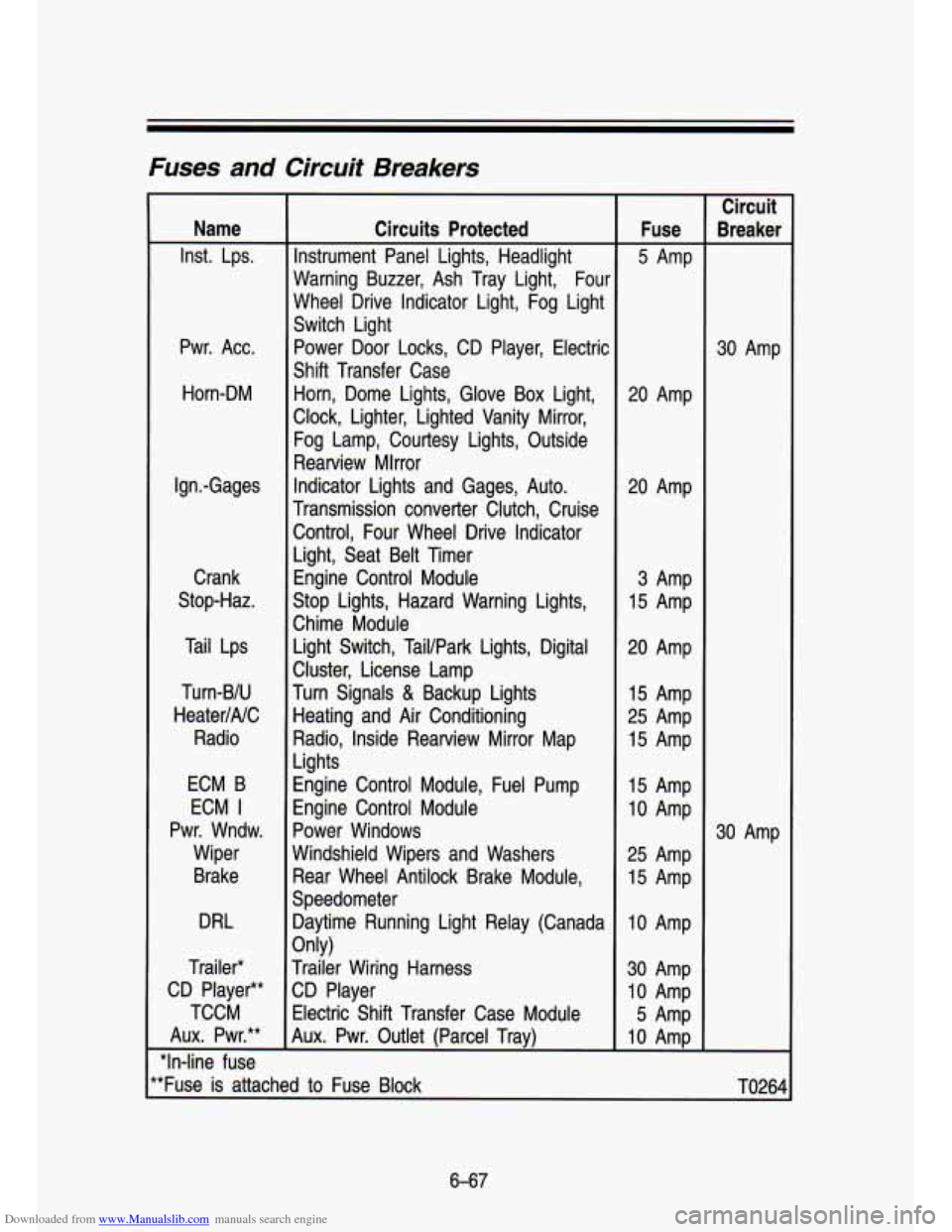
Name
Inst. Lps.
Pwr. Acc. Horn-DM
Ign.-Gages Crank
Stop-Haz.
Tail Lps
Turn-BIU
HeaterINC Radio
ECM B
ECM
I
Pwr. Wndw. Wiper
Brake
DRL
Trailer*
CD Player**
TCCM
Aux. Pwr.**
"In-line fuse Circuits Protected
Instrument Panel Lights, Headlight
Warning Buzzer, Ash Tray Light, Four
Wheel Drive Indicator Light, Fog Light
Switch Light Power Door Locks, CD Player, Electric
Shift Transfer Case Horn, Dome Lights, Glove Box Light,
Clock, Lighter, Lighted Vanity Mirror,
Fog Lamp, Courtesy Lights, Outside
Rearview Mlrror
Indicator Lights and Gages, Auto.
Transmission converter Clutch, Cruise Control, Four Wheel Drive Indicator
Light, Seat Belt Timer Engine Control Module
Stop Lights, Hazard Warning Lights,
Chime Module Light Switch, Tail/Park Lights, Digital
Cluster, License Lamp
Turn Signals
& Backup Lights
Heating and Air Conditioning
Radio, Inside Rearview Mirror Map
Lights
Engine Control Module, Fuel Pump
Engine Control Module
Power Windows
Windshield Wipers and Washers Rear Wheel Antilock Brake Module,
Speedometer Daytime Running Light Relay (Canada
Trailer Wiring Harness
CD Player
Electric Shift Transfer Case Module
Aux. Pwr. Outlet (Parcel Trav)
Only) Fuse
5 Amp
20 Amp
20 Amp
3 Amp
15 Amp
20 Amp 15 Amp
25 Amp
15 Amp
15 Amp
10 Amp
25 Amp
15 Amp
10 Amp
30 Amp
10 Amp
5 Amp
10 AmD Circuit
kea ker
30 Amp
30 Amp
'*Fuse is attached to Fuse Block
TO264
6-67
Page 347 of 356
Downloaded from www.Manualslib.com manuals search engine INDEX
Section
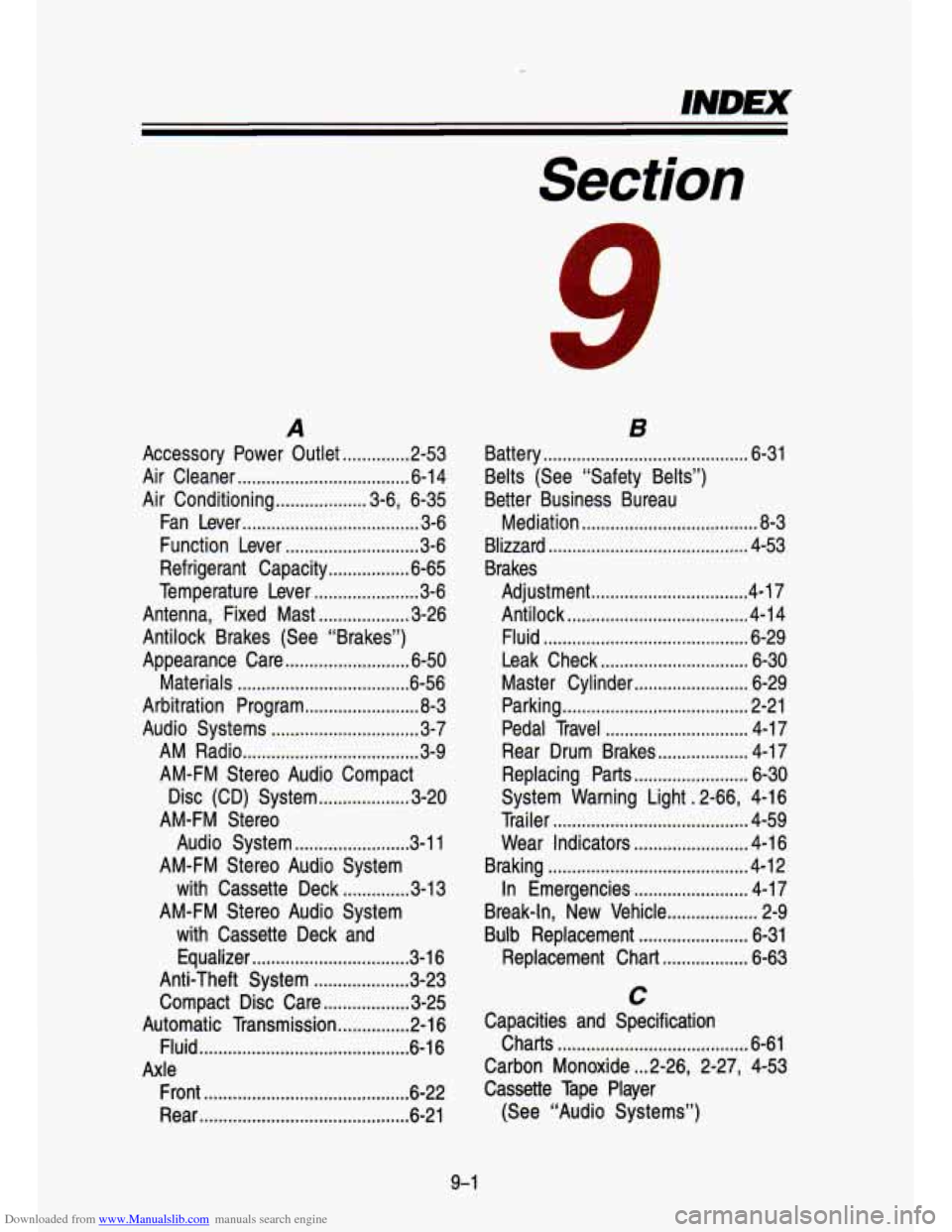
A
Accessory Power Outlet .............. 2-53
Air Cleaner
.................................... 6-14
Air Conditioning
................... 3-6, 6-35
Fan Lever
..................................... 3-6
Function Lever
............................ 3-6
Refrigerant Capacity
................. 6-65
Temperature Lever
...................... 3-6
Antenna, Fixed Mast
................... 3-26
Antilock Brakes (See “Brakes”)
Appearance Care
.......................... 6-50
Materials
.................................... 6-56
Arbitration Program
........................ 8-3
Audio Systems
............................... 3-7
AM Radio
..................................... 3-9
AM-FM Stereo Audio Compact
Disc (CD) System
................... 3-20
AM-FM Stereo Audio System
........................ 3-1 1
AM-FM Stereo Audio System with Cassette Deck
............ >.3-13
AM-FM Stereo Audio System
with Cassette Deck and Equalizer
................................. 3-1 6
Anti-Theft System
.................... 3-23
Compact Disc Care
.................. 3-25
Automatic Transmission
............... 2-1 6
Fluid
............................................ 6-1 6
Axle
Front
........................................... 6-22
Rear
............................................ 6-2 1
A
B
Battery ........................................... 6-31
Belts (See “Safety Belts”)
Better Business Bureau Mediation
.................................... -8-3
Blizzard
.......................................... 4.53
Brakes
Adjustment
................................. 4-17
Antilock
...................................... 4-14
Fluid
........................................... 6-29
Leak Check
............................... 6-30
Master Cylinder
........................ 6-29
Parking
....................................... 2-21
Pedal Travel
.............................. 4-17
Rear Drum Brakes
................... 4-17
Replacing Parts
........................ 6-30
System Warning Light .2-66, 4-16
Trailer
......................................... 4-59
Wear Indicators
........................ 4-16
Braking
.......................................... 4-12
In Emergencies
........................ 4-17
Break-In, New Vehicle
................... 2-9
Bulb Replacement
....................... 6-31
Replacement Chart
.................. 6-63
C
Capacities and Specification
Charts
........................................ 6-61
Carbon Monoxide
... 2.26. 2.27. 4-53
Cassette Tape Player
(See “Audio Systems”)
9-1
Page 350 of 356
Downloaded from www.Manualslib.com manuals search engine I
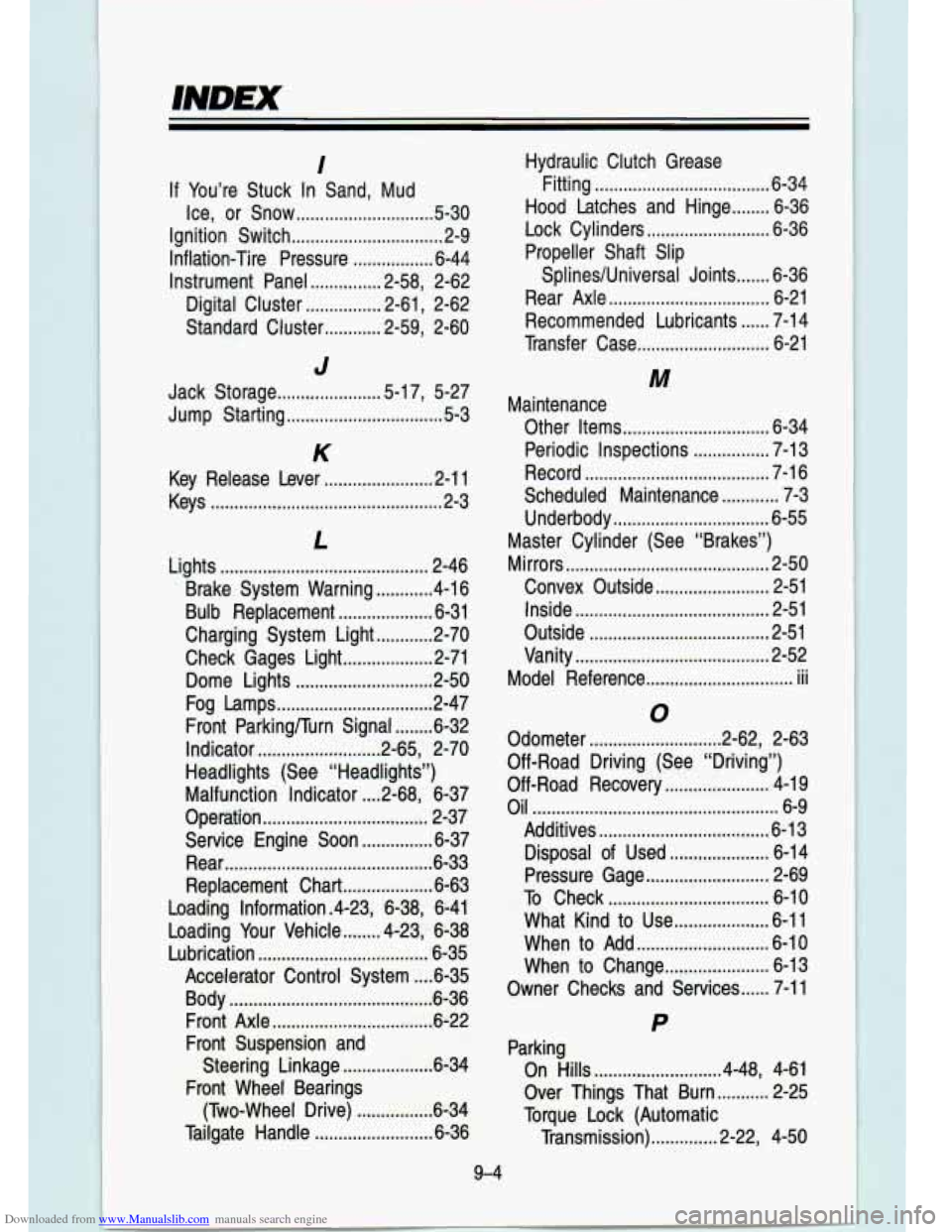
If You’re Stuck In Sand. Mud
Ice. or Snow
............................. 5-30
Ignition Switch ................................ 2-9
Inflation-Tire Pressure ................. 6-44
Instrument Panel ............... 2-58, 2-62
Digital Cluster ................ 2-61, 2-62
Standard Cluster ............ 2-59, 2-60
J
Jack Storage ...................... 5-17, 5-27
Jump Starting ................................. 5-3
K
Key Release Lever ....................... 2-1 1
Keys ................................................. 2-3
L
Lights ........ ................................... 2-46
Brake System Warning ............ 4-1 6
Bulb Replacement .................... 6-31
Charging System Light ............ 2-70
Check Gages Light ................... 2-71
Dome Lights ............................. 2-50
Fog Lamps ................................. 2-47
Indicator ........................ ..2-65, 2-70
Headlights (See “Headlights”)
Malfunction Indicator
.... 2-68, 6-37
Operation ................................... 2-37
Service Engine Soon ............... 6-37
Rear ............................................ 6-33
Loading Information .4-23, 6-38, 6-41
Loading Your Vehicle ........ 4-23, 6-38
Lubrication .................................... 6-35
Front Parkingnurn Signal ........ 6-32
Replacement Chart ................... 6-63
Accelerator Control System .... 6-35
Body ........................................... .- 36
Front Axle ........................ ..... 6-22
Front Suspension and
Steering Linkage
................... 6-34
Front Wheel Bearings
(Two-Wheel Drive)
................ 6-34
Tailgate Handle ......................... 6-36
Hydraulic Clutch Grease
Fitting
..................................... 6-34
Hood Latches and Hinge ........ 6-36
Lock Cylinders .......................... 6-36
Propeller Shaft Slip
SplineslUniversal Joints
....... 6-36
Rear Axle .................................. 6-21
Recommended Lubricants ...... 7-14
Transfer Case ............................ 6-21
M
Other Items ............................... 6-34
Periodic Inspections ................ 7-13
Record ....................................... 7-16
Scheduled Maintenance ............ 7-3
Underbody ................................. 6-55
Master Cylinder (See “Brakes”)
Mirrors
........................................... 2-50
Convex Outside ........................ 2-51
inside ......................................... 2-51
Outside ...................................... 2-51
Vanity ......................................... 2-52
Model Reference ............................... iii
Maintenance
0
Odometer ............................ 2-62, 2-63
Off-Road Driving (See “Driving”)
Off-Road Recovery
...................... 4-1 9
Oil .................................................... 6-9
Additives .................................... 6-13
Disposal of Used ...................... 6-14
Pressure Gage .......................... 2-69
To Check .................................. 6-10
What Kind to Use .................... 6-11
When to Add ............................ 6-10
When to Change ...................... 6-13
Owner Checks and Services ...... 7-11
P
On Hills ........................... 4-48, 4-61
Torque Lock (Automatic
Parking
Over Things That Burn
........... 2-25
Transmission) .............. 2-22, 4-50