warning CHEVROLET S10 1993 2.G Owner's Manual
[x] Cancel search | Manufacturer: CHEVROLET, Model Year: 1993, Model line: S10, Model: CHEVROLET S10 1993 2.GPages: 356, PDF Size: 20.85 MB
Page 205 of 356
Downloaded from www.Manualslib.com manuals search engine Winter Driving
AN480001
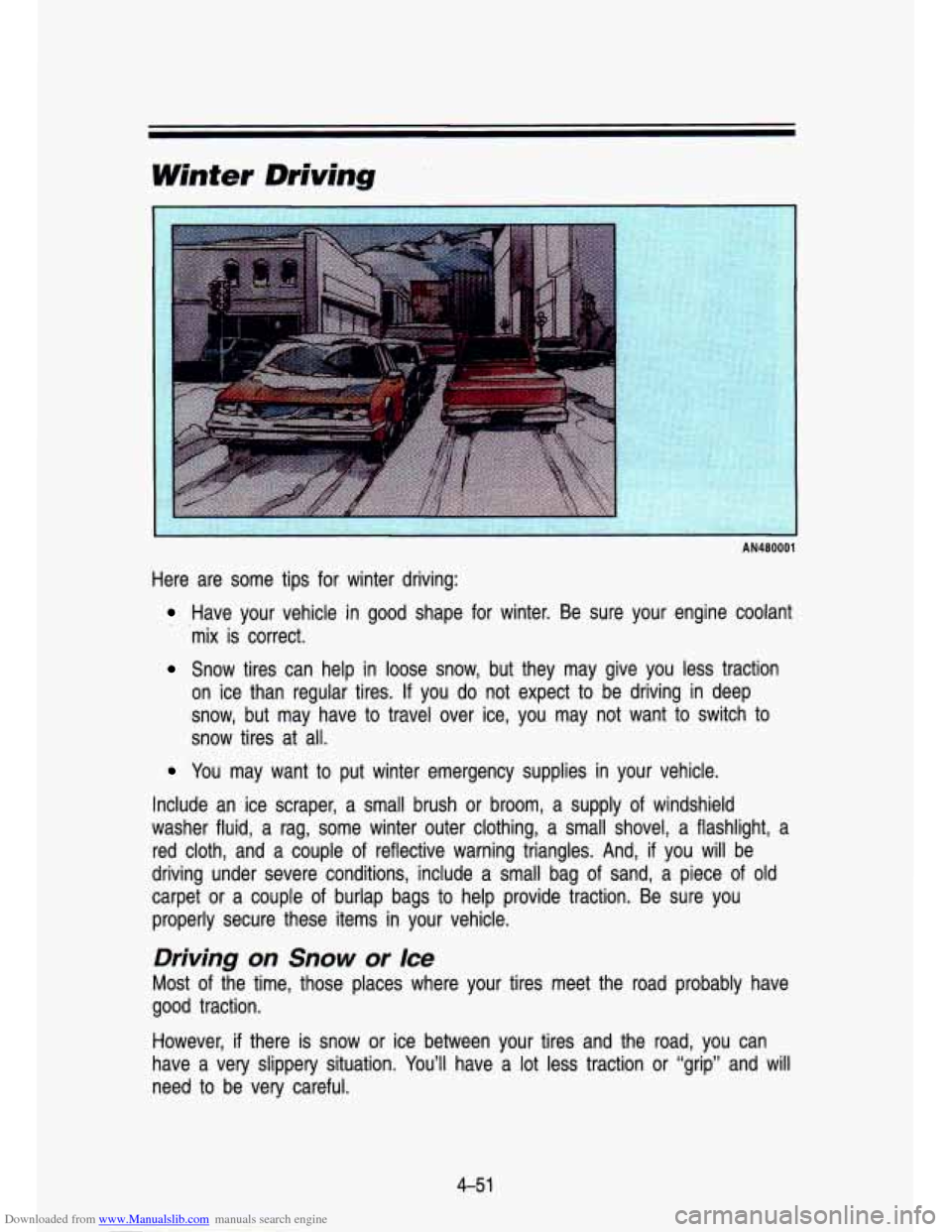
Here are some tips for winter driving:
Have your vehicle in good shape for winter. Be sure your engine coolant
mix is correct.
Snow tires can help in loose snow, but they may give you less traction
on ice than regular tires.
If you do not expect to be driving in deep
snow, but may have to travel over ice, you may not want to switch to
snow tires at all.
You may want to put winter emergency supplies in your vehicle.
Include an ice scraper, a small brush or broom, a supply of windshield
washer fluid, a rag, some winter outer clothing, a small shove\
l, a flashlight, a red cloth, and a couple of reflective warning triangles. And,
if you will be
driving under severe conditions, include a small bag of sand, a piece of old
carpet or a couple of burlap bags to help provide traction. Be sure you
properly secure these items in your vehicle.
Driving on Snow or Ice
Most of the time, those places where your tires meet the road probably\
have
good traction.
However,
if there is snow or ice between your tires and the road, you can
have a very slippery situation. You’ll have a lot less traction or “grip” and will
need to be very careful.
4-51
Page 217 of 356
Downloaded from www.Manualslib.com manuals search engine prOb/ems on the Road
. .-
r
7
Here you’ll find what to do about some problems that can occur on the road .
Hazard Warning Flashers ........................................................................\
............. 5-2
Other Warning Devices ........................................................................\
................. 5-3
Jump Starting ........................................................................\
................................ 5-3
Towing Your Vehicle ........................................................................\
...................... 5-7
Engine Overheating ........................................................................\
....................... 5-9
If a Tire Goes Flat ........................................................................\
...................... 5-15
Changing a Flat Tire ........................................................................\
................... 5-16
Compact Spare Tire ........................................................................\
.................... 5-28
If You’re Stuck: In Sand, Mud, Ice or Snow ................................................... 5-30
Page 218 of 356

Downloaded from www.Manualslib.com manuals search engine Problems on the Road
AM505003
Your hazard warning flashers let you warn others. They also let pol\
ice know
you have a problem. Your front and rear turn signal lights will flash on and
off. But they won’t flash if you’re braking.
i
Press the button in to make your front and rear turn signal lights flash on
and
off.
Your hazard warning flashers work no matter what position your key is in,
and even if the key isn’t in.
Page 219 of 356

Downloaded from www.Manualslib.com manuals search engine To turn off the flashers, pull out on the collar.
When the hazard warning flashers are on, your turn signals won\
’t work.
Other Warning Devices
If you carry reflective triangles, you can set one up at the sid\
e of the road
about
300 feet (100 m) behind your vehicle.
Jump Starting
If your battery has run down, you may want to use another vehicle and some
jumper cables to start your vehicle. But please follow the ste\
ps below to
do it
safely.
mwlmm A
A Batteries cart hurt you. They m be dangerous because:
* They contain acid that can burn you.
They contain gas that can explode or ignite.
* They contain enough electricity to burn you.
I
If you don’t follow these steps exactly, some 01: all .of thlese things
can hurt
yoW.
To Jump Start Your Vehicle
1. Check the other vehicle. It must have a 12-volt battery with ti negative
ground system.
IWU I IWL I
5-3
Page 223 of 356
Downloaded from www.Manualslib.com manuals search engine Towing Your Vehicle
Try to have a GM dealer or a professional towing service tow your vehicle.
They can provide the right equipment and know how to tow it without
damage.
If your vehicle has been changed since it was factory-new, by adding things
like fog lamps, aero skirting, or special tires and wheels, th\
ese things could
be damaged during towing.
Before you do anything, turn on the hazard warning flashers.
When you call, tell the towing service:
That your vehicle has rear-wheel drive, or that it has the fo\
ur-wheel drive
0 The make, model, and year of your vehicle.
Whether you can move the shift lever for the transmission and \
shift the
If there was an accident, what was damaged.
option.
transfer case,
if you have one.
I CAUTION
To help avoid injury to you or others:
A * Never let passengers ride ‘in a vehicle that is being towed.
Never tow faster than safe or posted speeds.
0 Never tow with damaged pads not fully secured.
Never get under your vehide after it has been lifted by the tow
. 0 Always use separate safety chains on each side when towing a
truck.
vehicle.
Never use “J” hooks. Use T-hooks instead.
5-7
Page 226 of 356
Downloaded from www.Manualslib.com manuals search engine Problems on the Road
If No Steam Is Coming From Your Engine:
If you get the overheat warning but see or hear no steam, the problem may
not be too serious. Sometimes the engine can get a little
too hot when you:
Climb a long hill on a hot day.
Stop after high speed driving.
Idle for long periods in traffic.
Tow a trailer.
If you get the overheat warning with no sign of steam, try this for a minute
or so:
1. If you have an air conditioner, turn it off.
2. Turn your heater to full hot at the highest fan speed and open the
3. If you're in a traffic jam, shift to N (Neutral).
window as necessary.
If you no longer have the overheat warning, you can drive. Just to
be safe,
drive slower for about ten minutes. If the warning doesn't com\
e back on, you
can drive normally.
If the warning continues, pull over, stop, and park your vehicle \
right away.
If there's still no sign of steam, push the accelerator until the engine speed is
about twice as fast as normal idle speed. Bring the engine sp\
eed back to
normal idle speed after
two or three minutes. Now see if the warning stops.
But then,
if you still have the warning, TURN OFF THE ENGINE AND GET
EVERYONE
OUT OF THE VEHICLE until it cools down.
You may decide
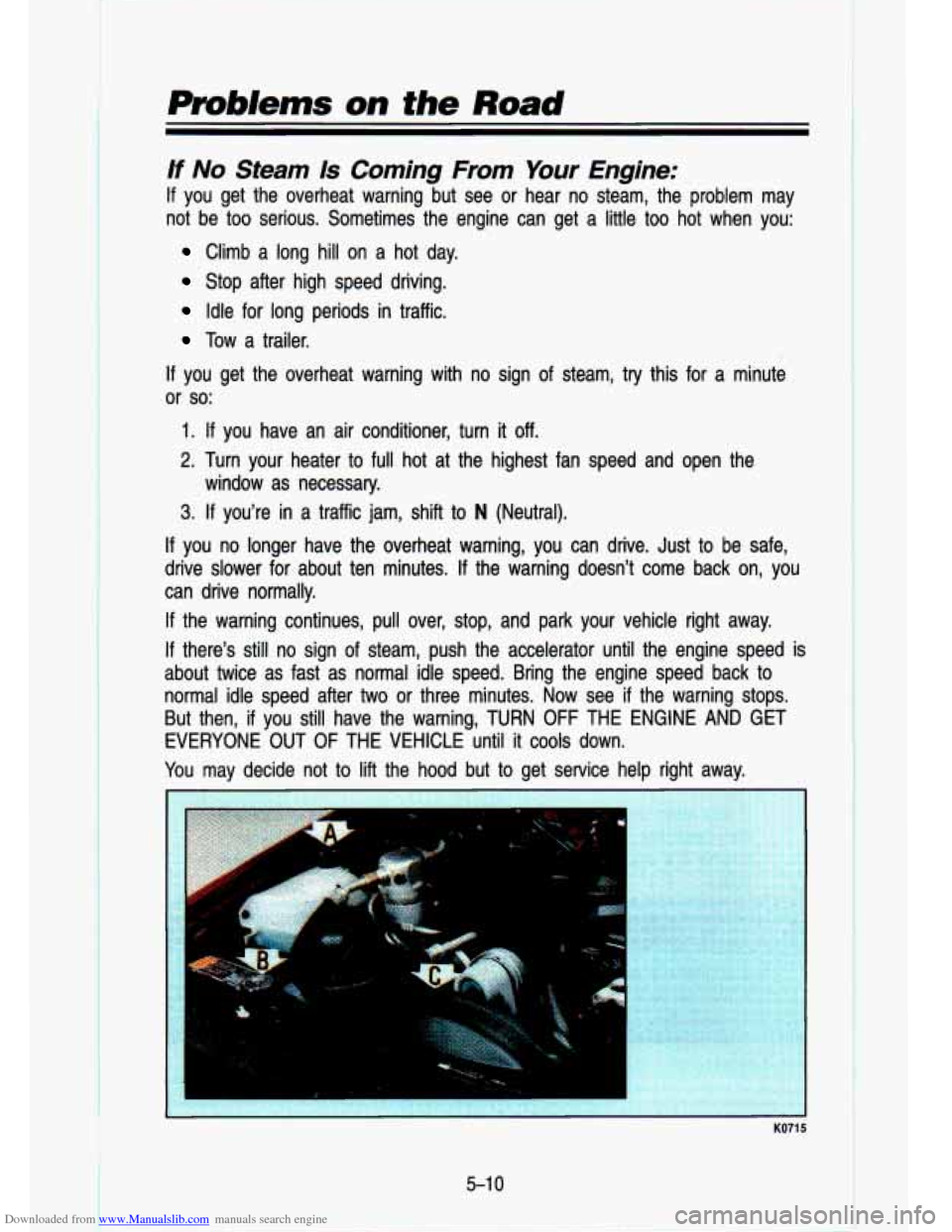
not to lift the hood but to get service help right away.
KO71 5
5-1 0
I
Page 228 of 356
Downloaded from www.Manualslib.com manuals search engine How to Add Coolant to the Coolant Recovery Tank
If you haven’t found a problem yet, but the coolant level isn’t at or above the
ADD mark, add a 50/50 mixture of clean water (preferably distilled) and the
proper antifreeze at the coolant recovery tank. (See “Engine\
Coolant” in the Index for more information about the proper coolant mix.)
I CAUTION
4
Adding only plain water to your cooling system can be dangerous.
Rain water,
or some other liquid, like alcohill, can boil before the
proper coolant mix
will. Your vehicle’s coolant warning system is set
for the proper coolant mix. With plain water, or the wrong mix, your
engine could get
too hot but you wouldn’t get the overheat warning.
Your engine could catch fire and you or others could be burned. Use
‘a 5Q/M mix of clean wafer and a proper antifreeze.
NOTICE
In cold weather, water can freeze and crack the en1
core and other
parts. Use the recommended coolan
*
I CAUTION
I I
You can be burned if you spill coolant on hot engine parts. Coolant
b contains ethylene glycol and it wil’l burn if the engine parts are hot
I’ enough. Don’t spill coolant on a hot engine.
When the coolant in the coolant recovery tank is at or above \
the
ADD mark,
start your vehicle.
If the overheat warning continues, there’s one more thing you c\
an try. You
can add the proper coolant mix directly to the radiator, but \
be sure the
cooling system
is cool before you do it.
A
Steam and scalding liquids from a hot cooling system can blow out
and burn you badly. They are under pressure, and if you turn the
radiator pressure cap-even a little-they can come out at high
speed. Never turn the pressure cap when the cooling system, including the radiator pressure cap, is hot. Wait for the cooling
system and radiator pressure cap
to cool if you ever have to turn
the pressure cap.
5-1 2
Page 232 of 356
Downloaded from www.Manualslib.com manuals search engine Problems on the Road
A rear blowout, particularly on a curve, acts much like a skid and may,
require the same correction you'd use in a skid. In any rear blowout, remove
your foot from the accelerator pedal. Get the vehicle under co\
ntrol by steering
the way you want the vehicle
to go. It may be very bumpy and noisy, but
you can still steer. Gently brake
to a stop, well off the road if possible.
If your tire goes flat, the next part shows how to use your jac\
king equipment
to change a flat tire safely.
Changing a Flat Tire
If a tire goes flat, avoid further tire and wheel damage by driving slowly to a
level place. Turn on your hazard warning flashers.
I CAUTION I
A Changing a tire can cause an injury. The vehicle can slip off the jack
A and roll over you or other people. You and they coulld be badly
injured. Fin'd a level place to change your tire. To help prevent the
vehicle from moving:
I. Set the parking brake firmly.
2. Put the shift lever in P (Park).
3. Shift a manual transmission to 1 (First) or R (Reverse).
4. If you have a four-wheel-drive vehicle with a manu'al transfer
case
shift lever, be sure the transfer case is in a drive
gear-not
in ' N (Neutral).
5- Turn off the engine.
To be even more certain the. vehick won't move, you can put blocks
at
the front and rear of the tire farthest away from the one being
changed. That would be the tire
on the other side of the vehicle, at
the opposite end.
5-1 6
Page 271 of 356
Downloaded from www.Manualslib.com manuals search engine How to Check Lubricant:
i I
KO998
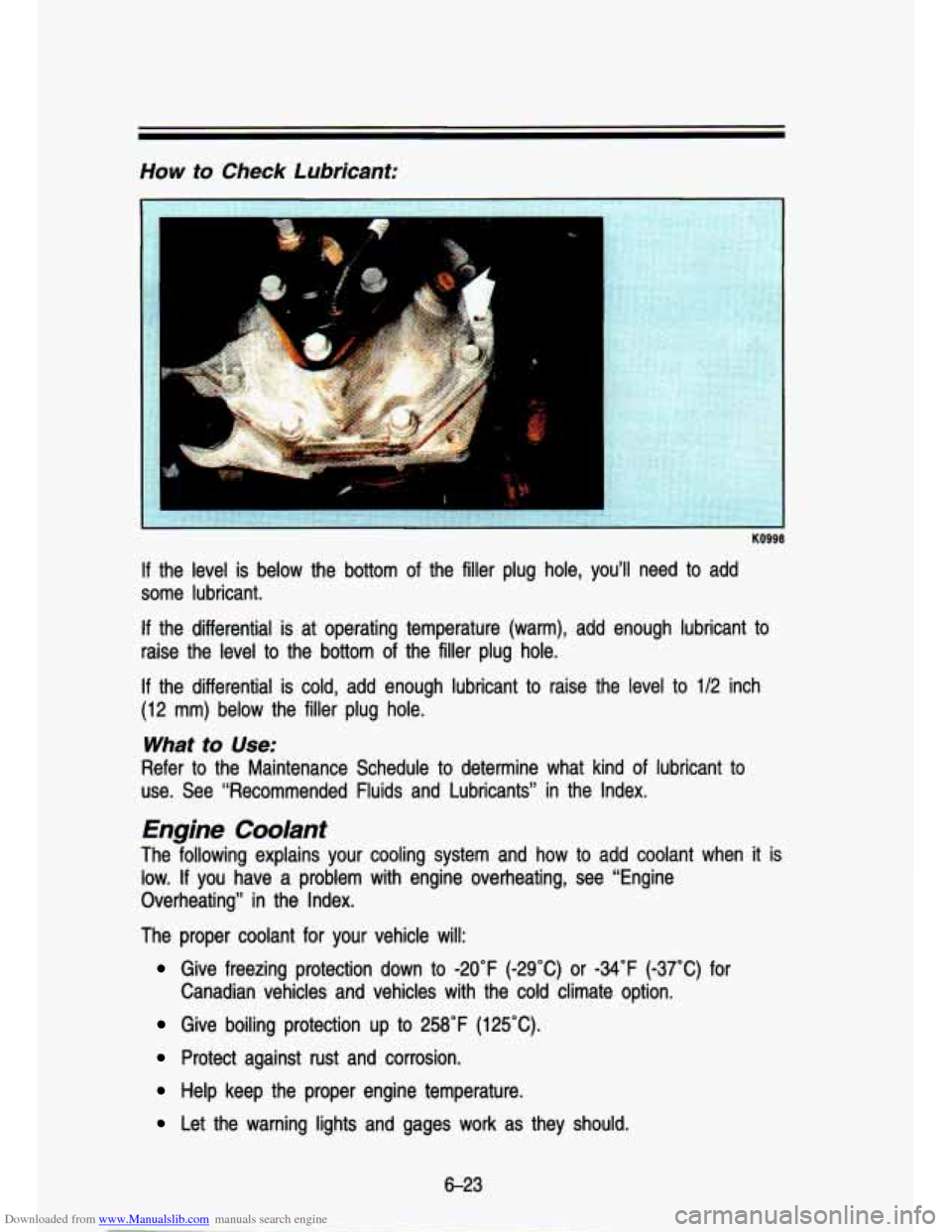
If the level is below the bottom of the filler plug hole, you’ll need to add
some lubricant.
If the differential is at operating temperature (warm), add enough lubricant to
raise the level
to the bottom of the filler plug hole.
If the differential is cold, add enough lubricant to raise the level to 1/2 inch
(12 mm) below the filler plug hole.
What to Use:
Refer to the Maintenance Schedule to determine what kind of lubricant to
use. See “Recommended Fluids and Lubricants” in the Index.\
Engine Coolant
The following explains your cooling system and how to add coolant when it is
low.
If you have a problem with engine overheating, see “Engine
Overheating’’ in the Index.
The proper coolant
for your vehicle will:
Give freezing protection down to -20°F (-29°C) or -34°F (-37°C) for
Give boiling protection up to 258°F (125°C).
Canadian vehicles and vehicles with the cold climate option.
Protect against rust and corrosion.
Help keep
the proper engine temperature.
Let the warning lights and gages work as they should.
6-23
Page 272 of 356
Downloaded from www.Manualslib.com manuals search engine t
..-
.I
Service & Appearance Care
What to Use:
Use a mixture of clean water (preferably distilled) and antifreeze that meets
“GM Specification 6038-M,” which won’t damage aluminum parts. Also use
GM Engine Coolant Supplement (sealer) with
a complete coolant change. If
you use these, you don’t need to add anything else.
I
Adding only plain water to your cooling system can be dangerous.
proper coolant mix will. Your vehicle’s coolant warning system is set
for the proper coolant mix. With plain water or the wrong mix, your
engine could get
too hot but you wouldn’t get the overheat warning.
Your engine could catch fire and you or others could be burned. Use
- Plain water, or some other liquid like alcohol, can boil before the
II a 50/50 mix of clean water and a proper antifreeze.
NOTICE
J use an improper coolant mix, your engine could overheat and be
badly damaged. The repair cost wouldn’t be covered by your warrant\
y
much water
in the mix can freeze and crack the engine, radiator, hea
core and other
part
Some conditions, such as air trapped in the cooling system, can affect the
coolant level in the radiator. Check the coolant level when th\
e engine is cold
and follow the steps under “Adding Coolant” for the prope\
r way to add
coolant.
If you have to add coolant more than four times a year, have your dealer
check your cooling system.
’‘ you use the proper coolant, you don’t have to add extra inhibitors c-
auditives which claim to improve the system. These can be harmful. ~ ~~~~~
6-24