warning CHEVROLET S10 1993 2.G User Guide
[x] Cancel search | Manufacturer: CHEVROLET, Model Year: 1993, Model line: S10, Model: CHEVROLET S10 1993 2.GPages: 356, PDF Size: 20.85 MB
Page 119 of 356
Downloaded from www.Manualslib.com manuals search engine I
1 CAUTION
1 A Your brake system may not be working properly if the brake warning
light is on. Driving with the brake warning light on can lead\
to an
accident.
If the light is still on after you’ve pulled off ? road and
stopped carefully, have the vehicle towed for servirn
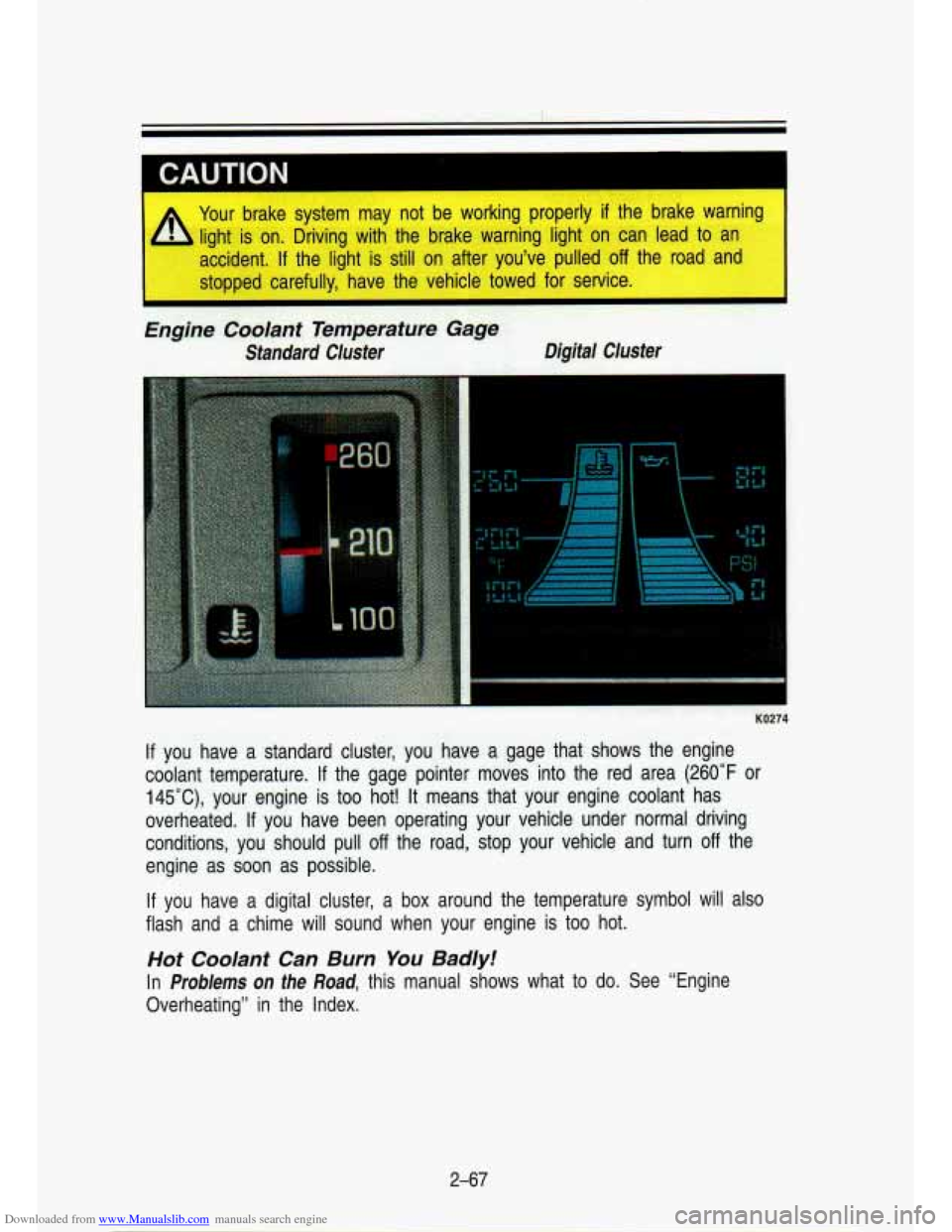
Engjne _Gaolant Temperature Gage
Standard Cluster Digital Cluster
KO274
2-67
Page 123 of 356

Downloaded from www.Manualslib.com manuals search engine CHECK GAGES Light
KO281
If you have the standard instrument cluster, this light will come \
on briefly
when you are starting the engine.
If the light comes on and stays on while
you are driving, check your various gages to see
if they are in the warning
zones.
Daytime Running Lights (DRL) Indicator Light (Canada Only)
KO242
This green light with the DRL symbol is on the lower left of the instrument
cluster. The DRL indicator is on whenever the ignition is on \
and the headlight
switch and parking brake are
off. For more details about DRL, see "Lights" in
this section.
2-71
Page 127 of 356
Downloaded from www.Manualslib.com manuals search engine Voltmeter
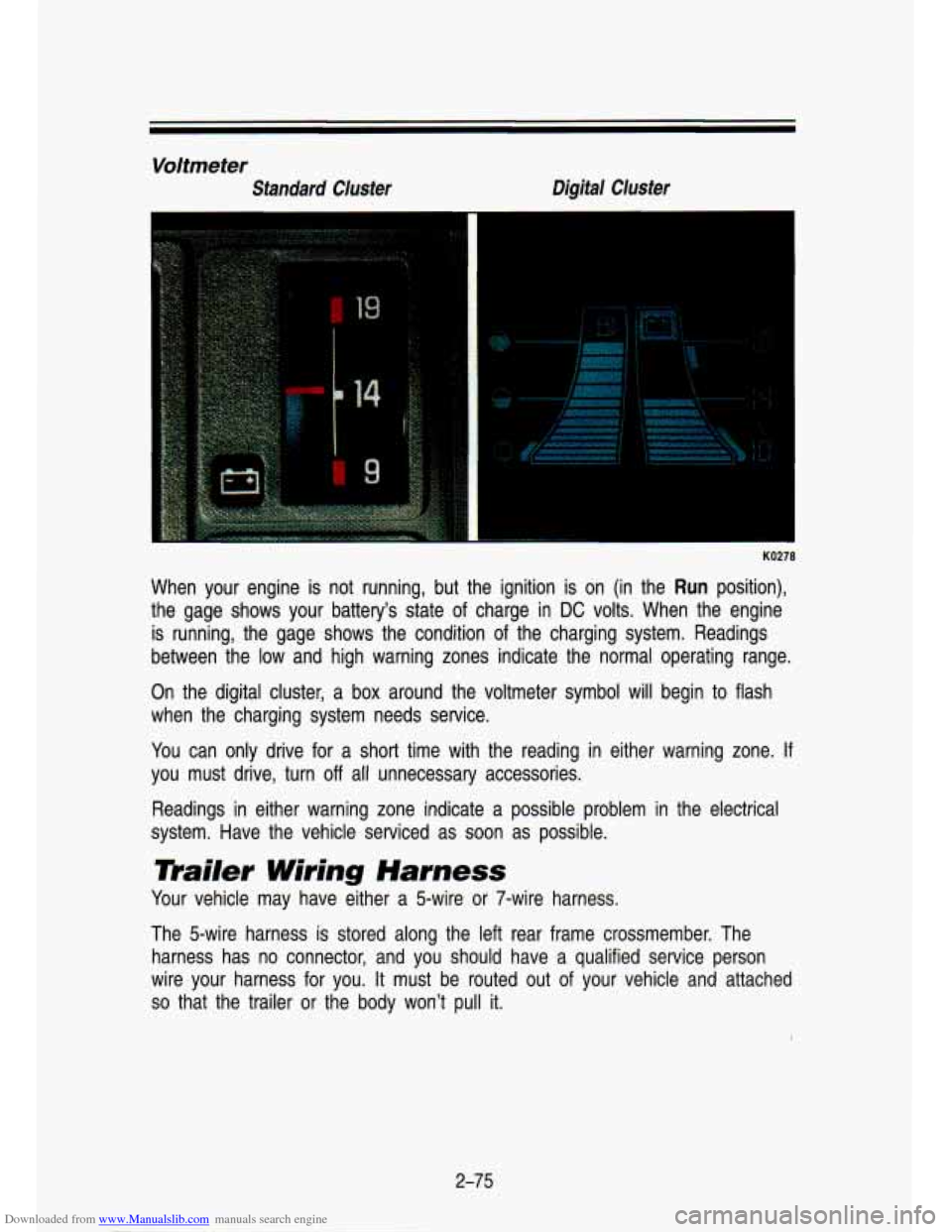
Standard Cluster Digital Cluster
I
KO278
When your engine
is not running, but the ignition is on (in the Run position),
the gage shows your battery's state of charge in
DC volts. When the engine
is running, the gage shows the condition of the charging system. Readings
between the low and high warning zones indicate the normal operating range.
On the digital cluster, a box around the voltmeter symbol will\
begin to flash
when the charging system needs service.
You can only drive for a short time with the reading in either warning zone. If
you must drive, turn
off all unnecessary accessories.
Readings in either warning zone indicate a possible problem in the electrical
system. Have the vehicle serviced as soon as possible.
mailer Wiring Harness
Your vehicle may have either a 5-wire or 7-wire harness.
The 5-wire harness is stored along the left rear frame crossme\
mber. The harness has no connector, and you should have a qualified serv\
ice person
wire your harness for you.
It must be routed out of your vehicle and attached
so that the trailer or the body won't pull it.
2-75
Page 156 of 356
Downloaded from www.Manualslib.com manuals search engine .. . .-
,- ..
,.
.. . .I
c- - r. i
Your Driving and the Road
Road Signs
The road signs you see everywhere are coded by color, shape a\
nd symbols. It's a good idea to know these codes
so that you can quickly grasp the basic
meaning or intent of the sign even before you have a chance to read
it.
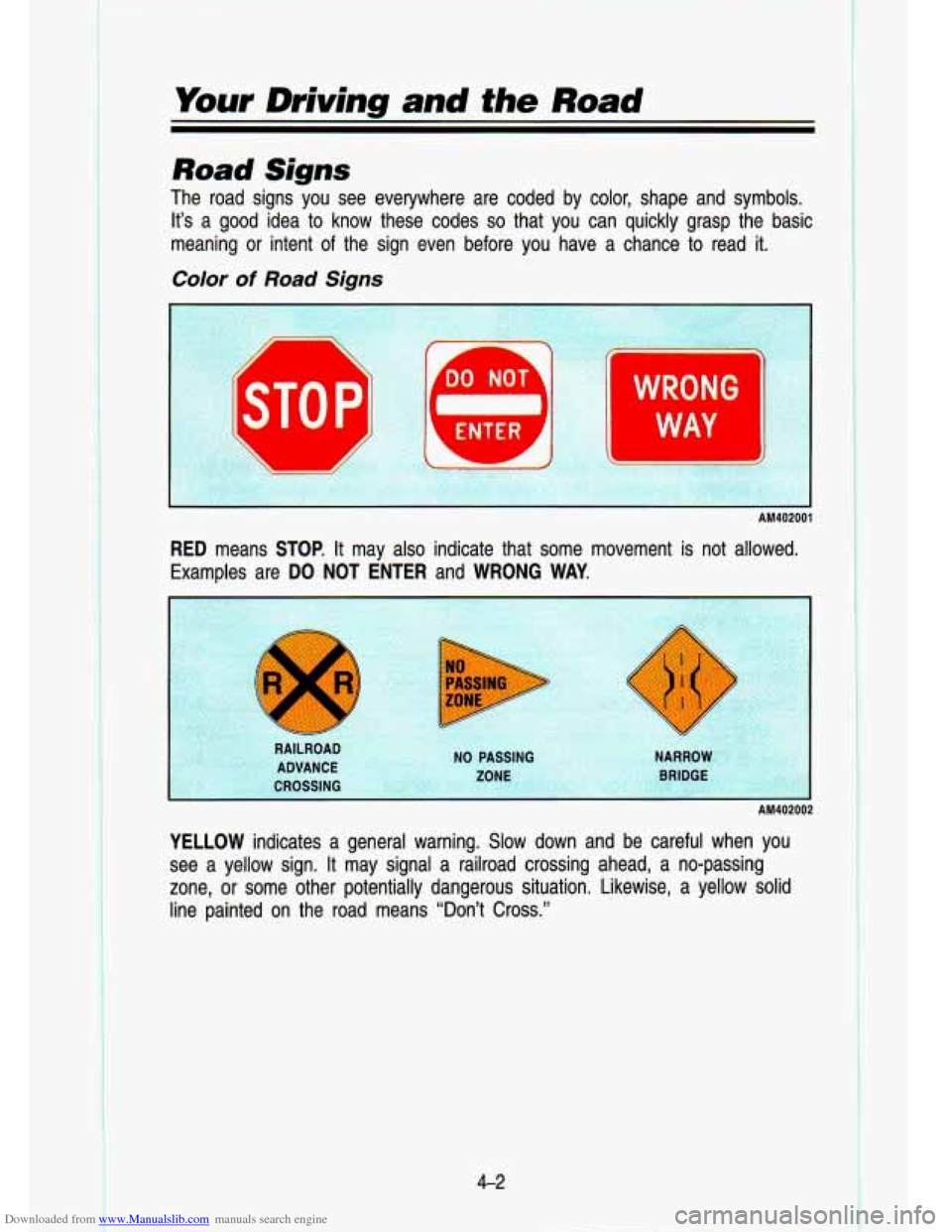
Color of Road Signs
mM402001
RED means S-IP. It may also indicate that some movement is not allowed.
Examples are
DO NOT ENTER and WRONG WAY.
YELLOW indicates a general warning. Slow down and be careful w\
hen you see a yellow sign. It may signal a railroad crossing ahead, a\
no-passing
zone,
or some other potentially dangerous situation. Likewise, a yellow s\
olid
line painted on the road means "Don't Cross."
4-2
Page 158 of 356
Downloaded from www.Manualslib.com manuals search engine - Your Driving and the Road
- - - - I
AM402006
BROWN signs point out recreation areas or points of historic or cultural
interest.
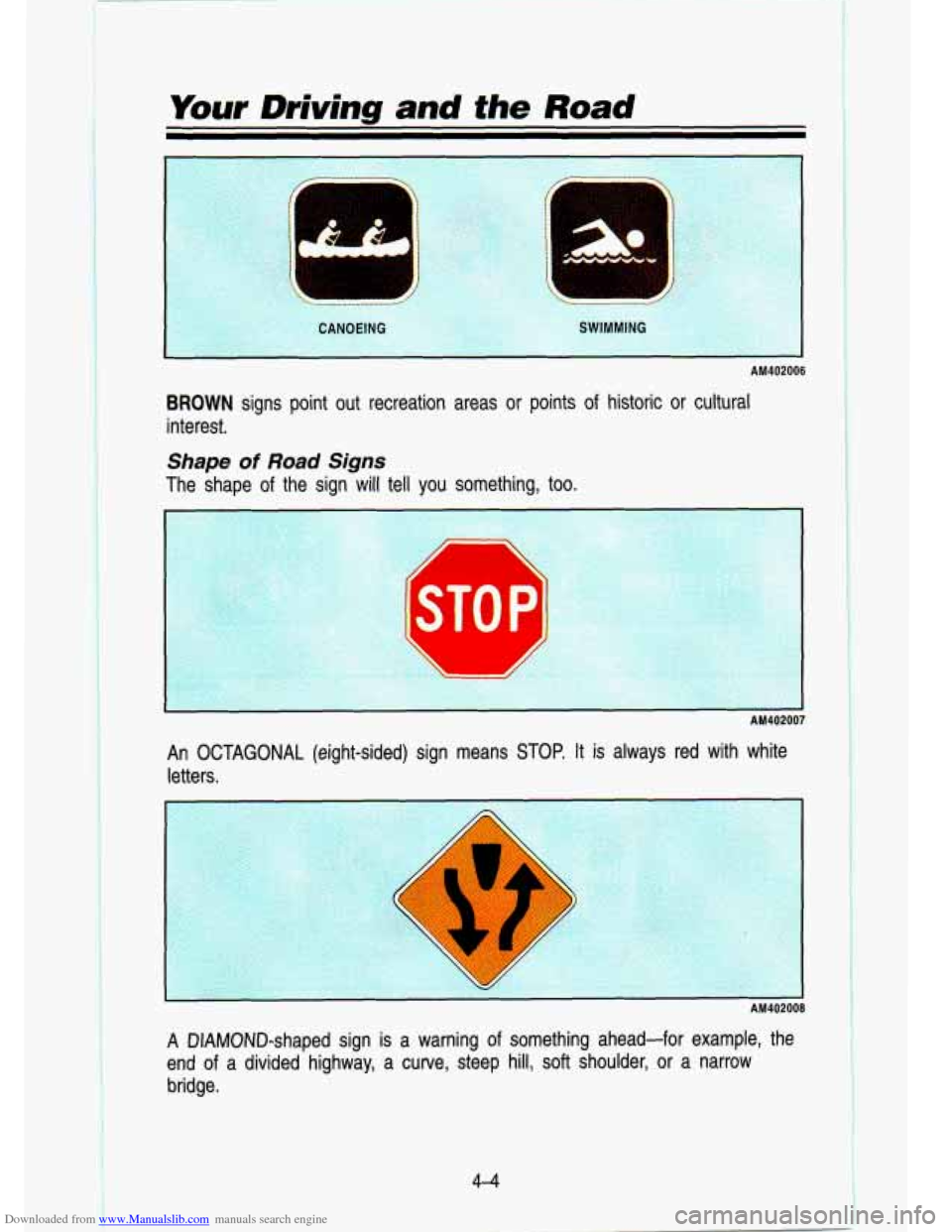
Shape of Road Signs
The shape of the sign will tell you something, too.
AM402007
An OCTAGONAL (eight-sided) sign means STOP. It is always red with white
letters.
A DIAMOND-shaped sign is a warning
of something ahead-for example, the
end
of a divided highway, a curve, steep hill, soft shoulder, or a narrow
bridge.
4-4
Page 162 of 356

Downloaded from www.Manualslib.com manuals search engine c. -. .. .
Your Driving and the Road
Turn and lane change signals: Always signal when you plan to \
turn or
change lanes.
If necessary, you can use hand signals out the window: Left arm \
straight out
for a left turn, down for slow or about-to-stop, and up for a right turn.
Slowing down:
If time allows, tap the brake pedal once or twice in advance
of slowing or stopping. This warns the driver behind you.
Disabled: Your four-way flashers signal that your vehicle is disabled or is a
hazard. See “Hazard Warning Flasher’’ in the Index.
Traffic Officer
The traffic police officer is also a source of important information. The officer’s
signals govern, no matter what the traffic lights or other sig\
ns say.
The next part discusses some of the road conditions you may encounter.
Defensive Driving
The best advice anyone can give about driving is: Drive defens\
ively.
Please
start with a very important safety device in your vehicle: Buckle up.
(See “Safety Belts” in the Index.)
Defensive driving really means “be ready for anything.” On\
city streets, rural
roads, or freeways, it means “always expect the unexpected.”
Assume that pedestrians or other drivers are going to be careless and make
mistakes. Anticipate what they might
do. Be ready for their mistakes.
Expect children to dash out from behind parked cars, often followed by other
children. Expect occupants in parked cars to open doors into traffic. Watch for
movement in parked cars-someone may be about to open a door.
Expect other drivers to run stop signs .when you are on a through street. Be
ready to brake
if necessary as you go through intersections. You may not
have to use the brake, but if you
do, you will be ready.
If you’re driving through a shopping center parking lot where there are
well-marked lanes, directional arrows, and designated parking are\
as, expect
some drivers to ignore all these markings and dash straight toward one part
of the lot.
Pedestrians can be careless. Watch for them. In general, you m\
ust give way
to pedestrians even
if you know you have the right of way.
Rear-end collisions are about the most preventable of accidents. Yet they are
common. Allow enough following distance. It’s the best defens\
ive driving
4-8
Page 170 of 356
Downloaded from www.Manualslib.com manuals search engine Your Driving and the Road
Brake System Warning Light
Standard Cluster
Digital Cluster
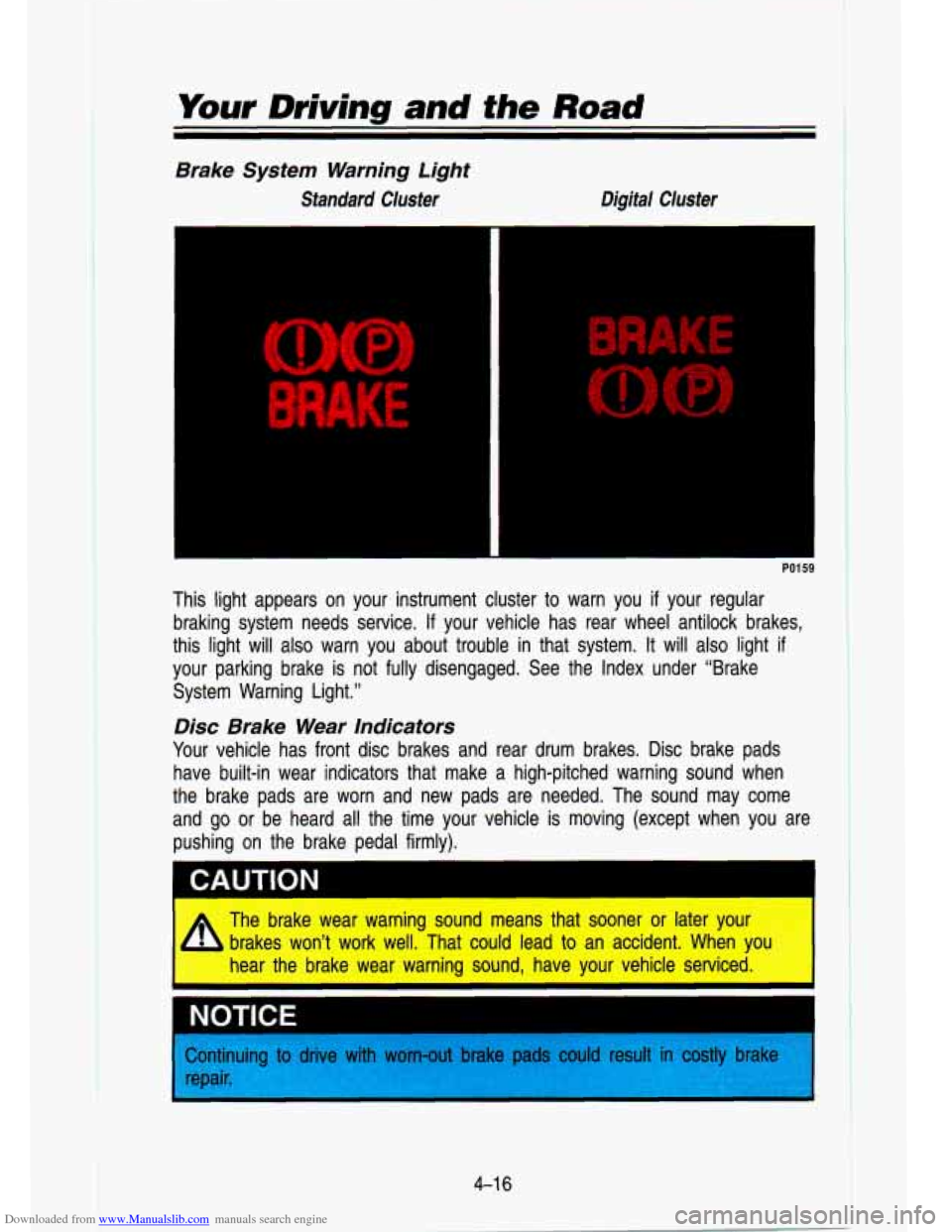
This light appears on your instrument cluster to warn you if your regular
braking system needs service.
If your vehicle has rear wheel antilock brakes,
this light will
also warn you about trouble in that system. It will also light if
your parking brake is not fully disengaged. See the Index unde\
r “Brake
System Warning Light.”
Disc Brake Wear Indicators
Your vehicle has front disc brakes and rear drum brakes. Disc brake pads
have built-in wear indicators that make a high-pitched warning \
sound when
the brake pads are worn and new pads are needed. The sound m\
ay come
and go or be heard all the time your vehicle is moving (except \
when you are
pushing on the brake pedal firmly).
The brake wear warning sound means that sooner or later your brakes won’t work well. That could lead to an accident. When yo
hear the brake wear warning sound, have your vehicle serviced. \
I NOTICE
>ontinuing ti
epair.
e with worn-out bra1 could sult in lstly brake
Page 176 of 356

Downloaded from www.Manualslib.com manuals search engine Your Driving and the Road
Don’t overtake a slowly moving vehicle too rapidly. Even tho\
ugh the
brake lights are not flashing, it may be slowing down or starting to turn.
If you’re being passed, make it easy for the following driv\
er to get ahead
of you. Perhaps you can ease a little to the right.
Loss of Control
Let’s review what driving experts say about what happens whe\
n the three
control systems (brakes, steering and acceleration) don’t ha\
ve enough friction
where the tires meet the road to
do what the driver has asked.
In any emergency, don’t give up. Keep trying to steer, and constantly seek an
escape route or area of less danger.
Skidding
In a skid, a driver can lose control of the vehicle. Defensive drivers avoid
most skids by taking reasonable care suited to existing conditi\
ons, and by not
“overdriving” those conditions. But skids are always possib\
le.
The three types
of skids correspond to your vehicle’s three control systems.
In the braking skid, your wheels aren’t rolling. In the steering or cornering
skid, too much speed or steering in a curve causes tires to \
slip and lose
cornering force. And in the acceleration skid, too much throttle causes the
driving wheels to spin.
A cornering skid and an acceleration skid are best handled by easing your
foot off the accelerator pedal. If your vehicle starts to slide (as when you turn
a corner on a wet, snow- or ice-covered road), ease your foo\
t
off the
accelerator pedal as soon as you feel the tires start to slide. Quickly steer
the way you want the vehicle to go. If you start steering quickly enough, your
vehicle will straighten out.
As it does, straighten the front wheels.
Of course, traction is reduced when water, snow, ice, gravel, or other material
is on the road. For safety, you’ll want to slow down and adjust your driving to
these conditions.
It is important to slow down on slippery surfaces because
stopping distance will be longer and vehicle control more limit\
ed.
While driving on a surface with reduced traction, try your bes\
t to avoid
sudden steering, acceleration, or braking (including engine brak\
ing by shifting
to a lower gear). Any sudden move could cause the tires to slide. You may
not realize the surface is slippery until your vehicle is skidding. Learn to
recognize warning clues-such as enough water, ice or packed snow on the
road to make
a “mirrored surface”-and slow down when you have any
doubt.
4-22
Page 196 of 356
Downloaded from www.Manualslib.com manuals search engine I. - - .. .. Your Driving and the Road
Treat a green light as a warning signal. A traffic light is there because
the corner is busy enough
to need it. When a light turns green, and just
before you start
to move, check both ways for vehicles that have not
cleared the intersection or may be running the red light.
Obey all posted speed limits. But remember that they are for \
ideal road,
weather and visibility conditions. You may need
to drive below the
posted limit in bad weather or when visibility
is especially poor.
Pull to the right (with care) and stop clear of intersections when y\
ou see
or hear emergency vehicles.
Freeway Driving
..
. ~.
3. -. ..
.I
.1 , I- >. -
AN461 003
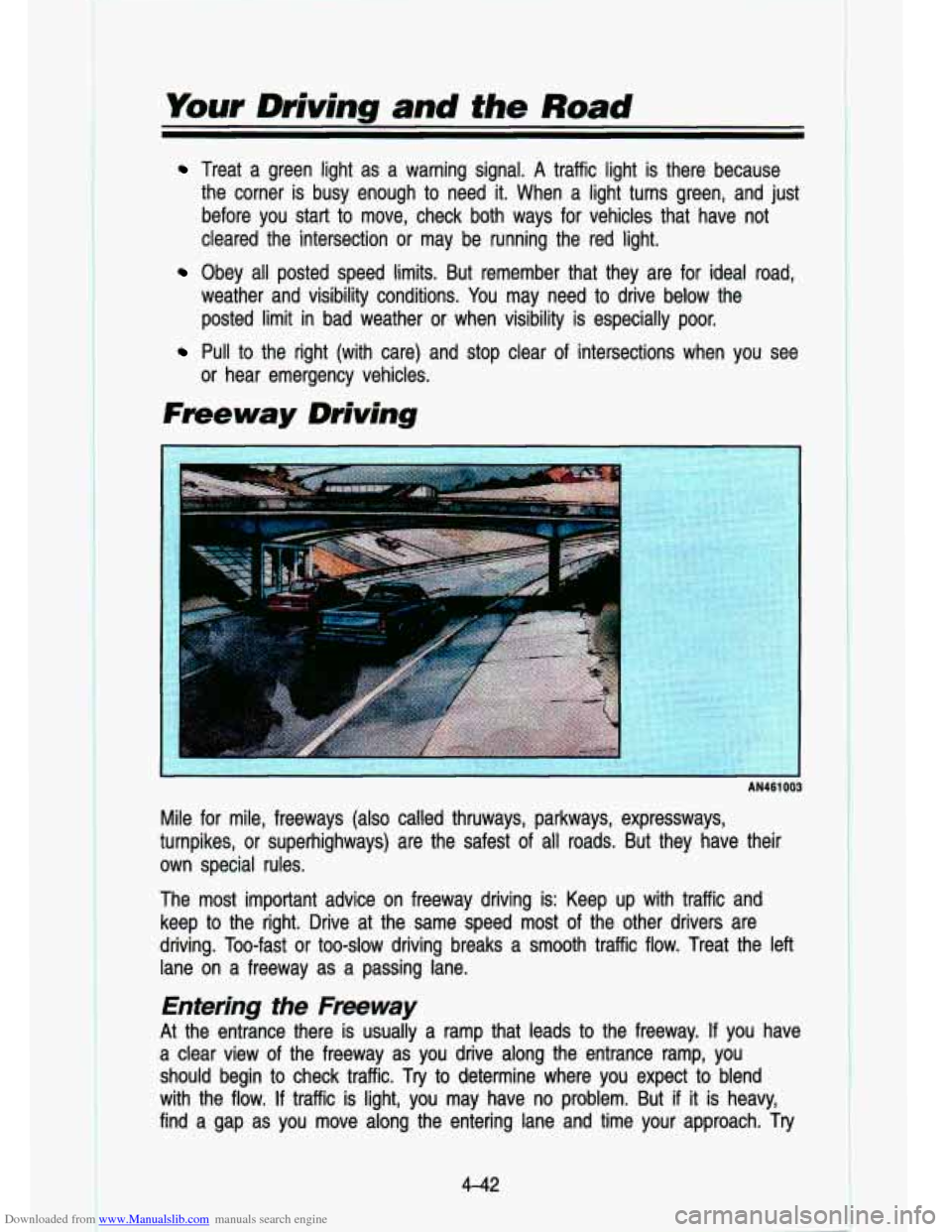
Mile for mile, freeways (also called thruways, parkways, expres\
sways,
turnpikes, or superhighways) are the safest of all roads. But they have \
their
own special rules.
The most important advice on freeway driving is: Keep up with \
traffic and keep
to the right. Drive at the same speed most of the other drivers are
driving. Too-fast or too-slow driving breaks a smooth traffic f\
low. Treat the left lane on a freeway as a passing lane.
Entering the Freeway
At the entrance there is usually a ramp that leads to the freeway. If you have
a clear view of the freeway as you drive along the entrance ramp, you
should begin
to check traffic. Try to determine where you expect to blend
with the flow.
If traffic is light, you may have no problem. But if it is heavy,
find a gap as you move along the entering lane and time your appr\
oach.
Try
4-42
Page 197 of 356
Downloaded from www.Manualslib.com manuals search engine to merge into the gap at close to the prevailing speed. Switch on your turn
signal, check your rearview mirrors as you move along, and glance over your
shoulder as often as necessary.
Try to blend smoothly with the traffic flow.
Driving on the Freeway
Once you are on the freeway, adjust your speed to the posted limit or to the
prevailing rate
if it’s slower. Stay in the right lane unless you want to pass. If
you are on a two-lane freeway, treat the right lane as the slow lane and the
left lane as the passing lane.
If you are on a three-lane freeway, treat the right lane as the slower-speed
through lane, the middle lane as the higher-speed through lane, and the left
lane as the passing lane.
Before changing lanes, check your rearview mirrors. Then use yo\
ur turn
signal. Just before you leave the lane, glance quickly over your shoulder
to
make sure there isn’t another vehicle in your “blind” spot.
If you are moving from an outside to a center lane on a freeway having
more than
two lanes, make sure another vehicle isn’t about to move into the
same spot. Look
at the vehicles two lanes over and watch for telltale signs:
turn signals flashing, an increase in speed, or moving toward the edge
of the
lane. Be prepared to delay your move.
Once you are moving on the freeway, make certain you allow a reasonable
following distance. Expect to move slightly slower at night.
Leaving the Freeway
When you want to leave the freeway, move to the proper lane well in
advance. Dashing across lanes at the last minute is dangerous. \
If you miss
your exit do not, under any circumstances, stop and back up. \
Drive on to the
next exit.
At each exit point is a deceleration lane. Ideally
it should be long enough for
you to enter
it at freeway speed (after signaling, of course) and then do your
braking before moving onto the exit ramp. Unfortunately, not all deceleration
lanes are long enough-some are too short for all the braking. Decide when
to start braking.
If you must brake on the through lane, and if there is traffic
close behind you, you can allow a little extra time and flash your brake lights
(in addition to your turn signal) as extra warning that you are about to slow
down and exit.
The exit ramp can be curved, sometimes quite sharply. The exit\
speed
is
usually posted. Reduce your speed according to your speedometer, not to
your sense of motion. After driving for any distance at higher\
speeds, you
4-43