light CHEVROLET S10 1994 2.G Owner's Manual
[x] Cancel search | Manufacturer: CHEVROLET, Model Year: 1994, Model line: S10, Model: CHEVROLET S10 1994 2.GPages: 340, PDF Size: 18.45 MB
Page 92 of 340
Downloaded from www.Manualslib.com manuals search engine A circuit breaker protects your headlights. If you have an electrical
overload, your headlights will flicker
on and off. Have your headlight
wiring checked right away if this happens.
Fog Lamps (Option)
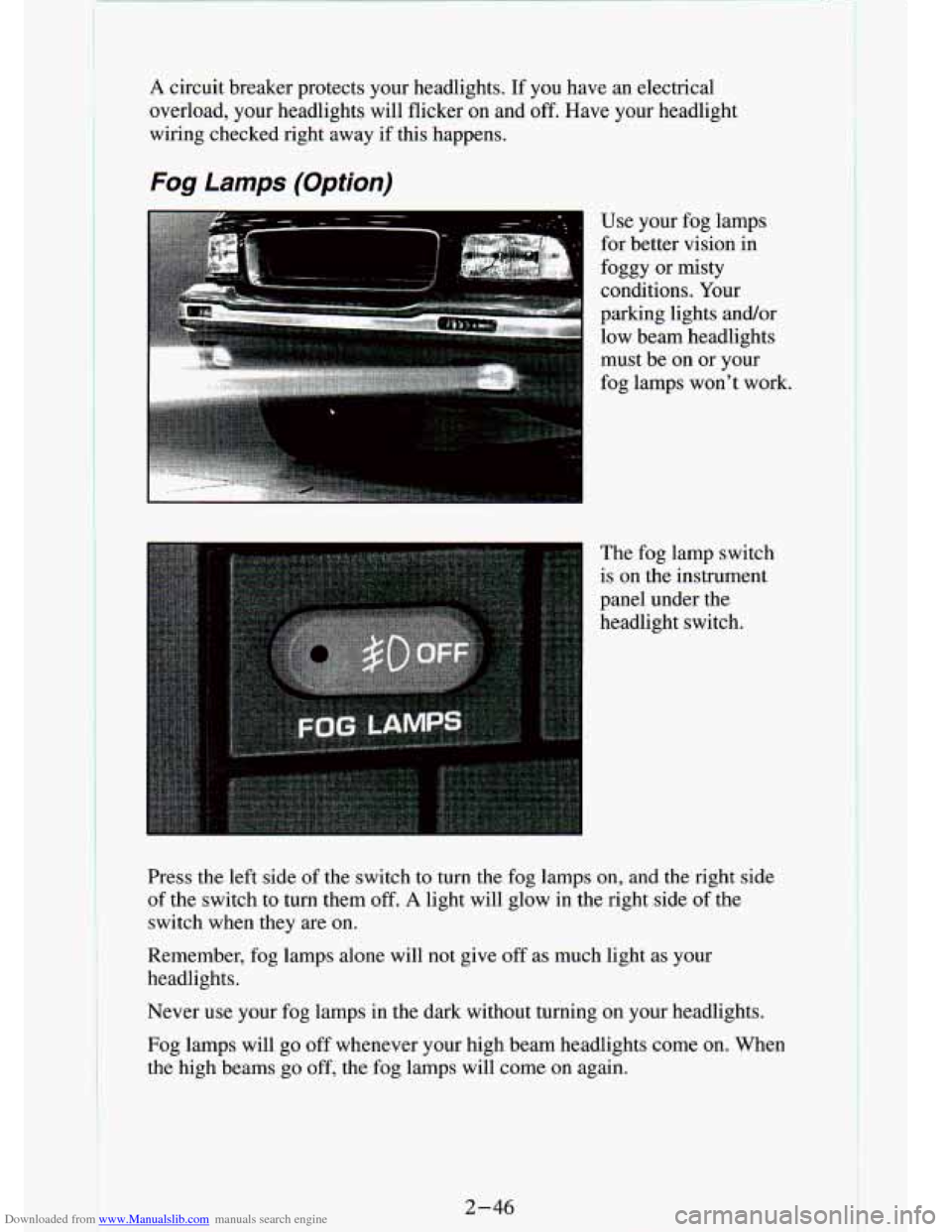
Use your fog lamps
for better vision in
foggy or misty
conditions. Your
parking lights and/or low beam headlights
must be
on or your
fog lamps won't work.
The fog lamp switch
is on the instrument
panel under the
headlight switch.
Press the left side of the switch to turn the fog lamps on, and the right side
of the switch
to turn them off. A light will glow in the right side of the
switch when they are on.
Remember, fog lamps alone will not give off as much light as your
headlights.
Never
use your fog lamps in the dark without turning on your headlights.
Fog lamps will go
off whenever your high beam headlights come on. When
the high beams go off, the fog lamps will come
on again.
2-46
I
Page 93 of 340
 Indicator Light
(Canada Only)
If your vehicle was first sold, when new, in Canada, you will\")
Downloaded from www.Manualslib.com manuals search engine Daytime Running Lights (DRL) Indicator Light
(Canada Only)
If your vehicle was first sold, when new, in Canada, you will\
have this light
on the instrument panel. It goes on whenever the Daytime Running Lights
are on, the ignition is on, the headlamp switch is
off, and the parking brake
is released.
Daytime Running Lights (Canada Only)
The Canadian Federal Government has decided that “Daytime Running \
Lights” (DRL) is a useful feature, in that
DRL can make your vehicle more
visible to pedestrians and other drivers during daylight hours. \
DRL is
required on new vehicles sold in Canada.
The high beam headlights will come
on at reduced brightness in daylight
when:
0 The ignition is on,
The headlight switch is off, and
The parking brake is released.
When you turn on your headlights, the DRL will switch off and the exterior
lights will come on. When you turn
off the headlights, the exterior lights
will go out and the high beams will change to the reduced brightness
of
DRL again.
The DRL indicator light on the instrument panel will go on whenever the
DRL is on. This light means that only the DRL is on. When you turn on
your exterior lights, this light will
20 out.
If the DRL indicator light is on at uawn or dusk, it is a reminder to turn on
your headlights.
2-47
Page 94 of 340
Downloaded from www.Manualslib.com manuals search engine Of course, you may still turn on the headlights any time you need to.
To idle your vehicle with the DRL off, set the parking brake. The DRL will
stay
off until you release the parking brake.
Headlights-On Reminder
A reminder tone will sound when your headlights or parking lights\
are
turned on and your ignition is in
OFF, LOCK or ACC. To turn the tone off,
turn the dimmer switch all the way down.
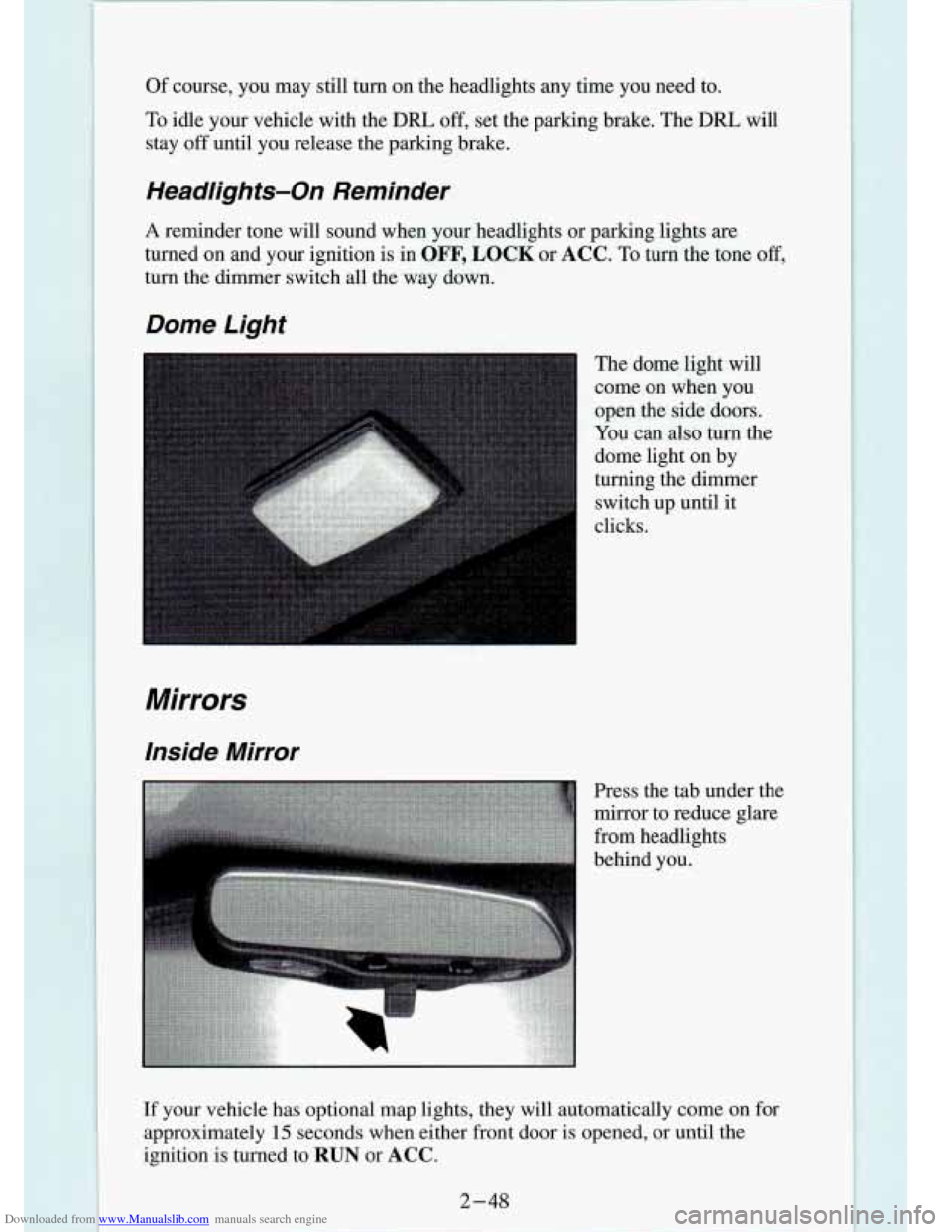
Dome Light
Mirrors
Inside Mirror
The dome light will
come
on when you
open the side
doors.
You can also turn the
dome light on by
turning the dimmer
switch up until it
clicks.
Press the tab under the
mirror to reduce glare
from headlights
behind you.
If your vehicle has optional map lights, they will automatically c\
ome on for
approximately
15 seconds when either front door is opened, or until the
ignition is turned to
RUN or ACC.
Page 95 of 340
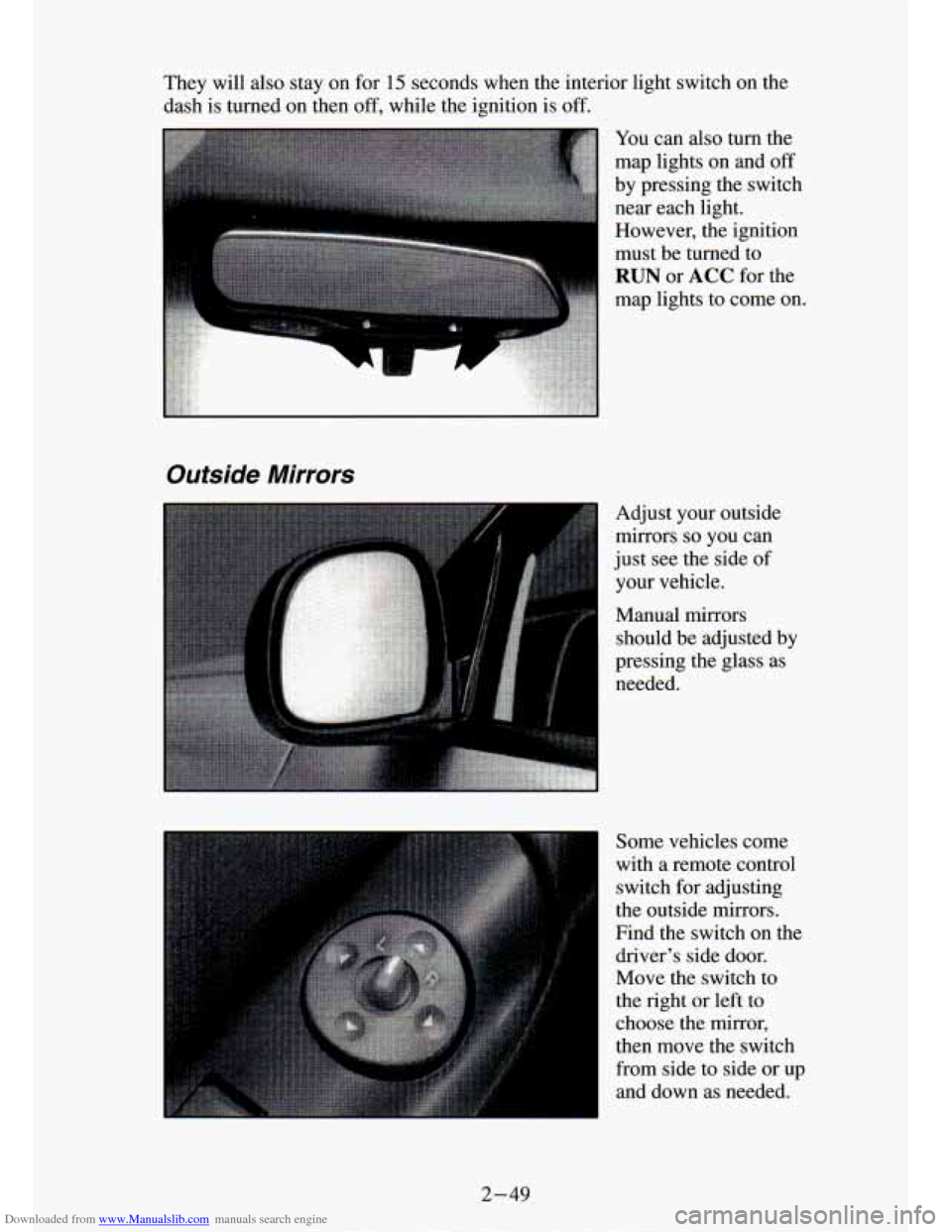
Downloaded from www.Manualslib.com manuals search engine They will also stay on for 15 seconds when the interior light switch on the
dash is turned on then
off, while the ignition is off.
Outside Mirrors
Adjust your outside
mirrors
so you can
just see the side of
your vehicle.
Manual
mirrors
should be adjusted by
pressing the glass as
needed.
Some vehicles come
with a remote control
switch for adjusting
the outside mirrors.
Find
the switch on the
driver's side door.
Move the switch to
the right
or left to
choose the mirror,
then move the switch
from side to side or up
and down as needed.
2-49
Page 97 of 340
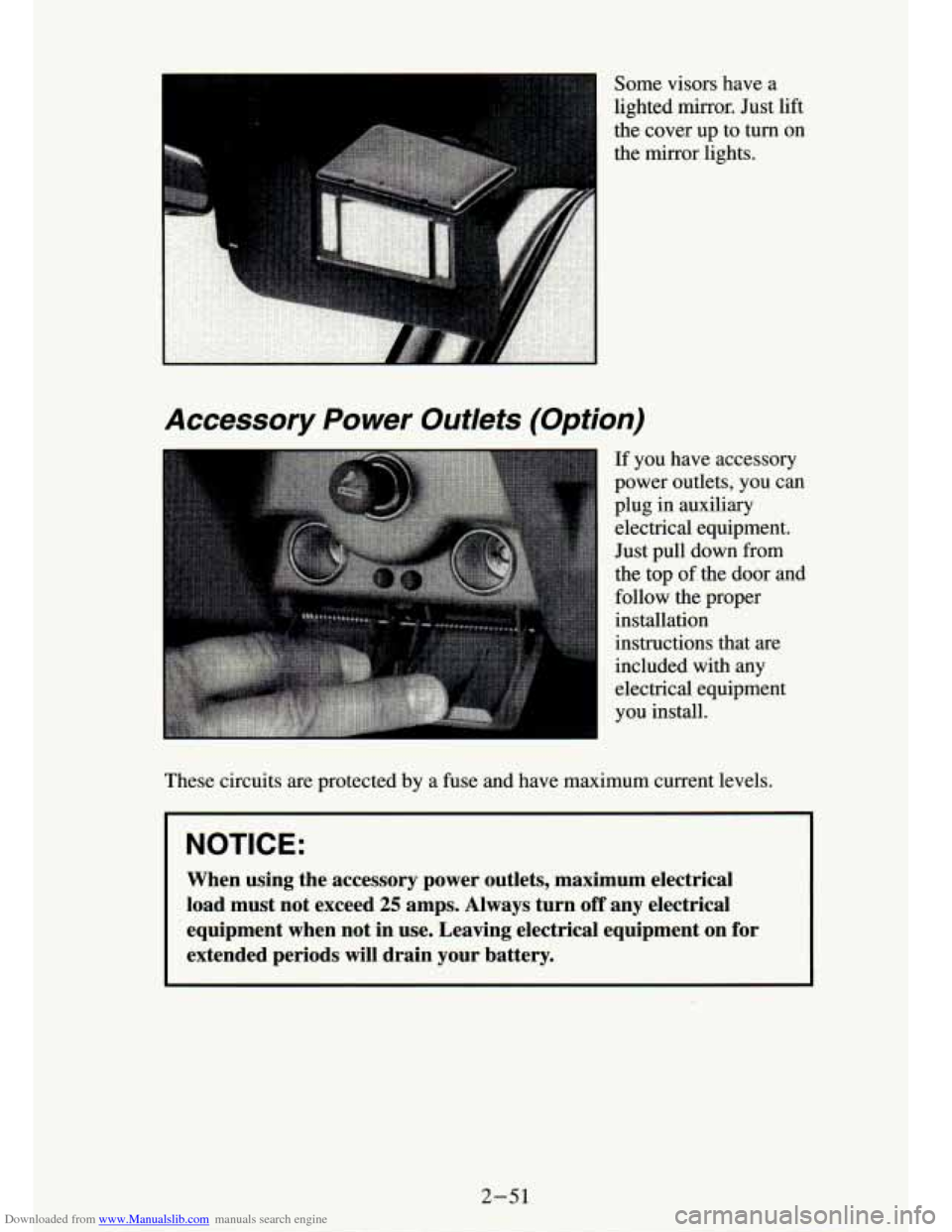
Downloaded from www.Manualslib.com manuals search engine Some visors have a
lighted mirror. Just lift
the cover up to turn on
the mirror lights.
Accessory Power Outlets (Option)
If you have accessory
power outlets, you can
plug
in auxiliary
electrical equipment.
Just pull down from
the top of the door and
follow the proper
installation
instructions that are
included with any
electrical equipment
you install.
These circuits
are protected by a fuse and have maximum current levels.
NOTICE:
When using the accessory power outlets, maximum electrical
load must not exceed
25 amps. Always turn off any electrical
equipment when not in use. Leaving electrical equipment
on for
extended periods will drain your battery.
2-51
Page 98 of 340
Downloaded from www.Manualslib.com manuals search engine Cigarette Lighter/Ashtray
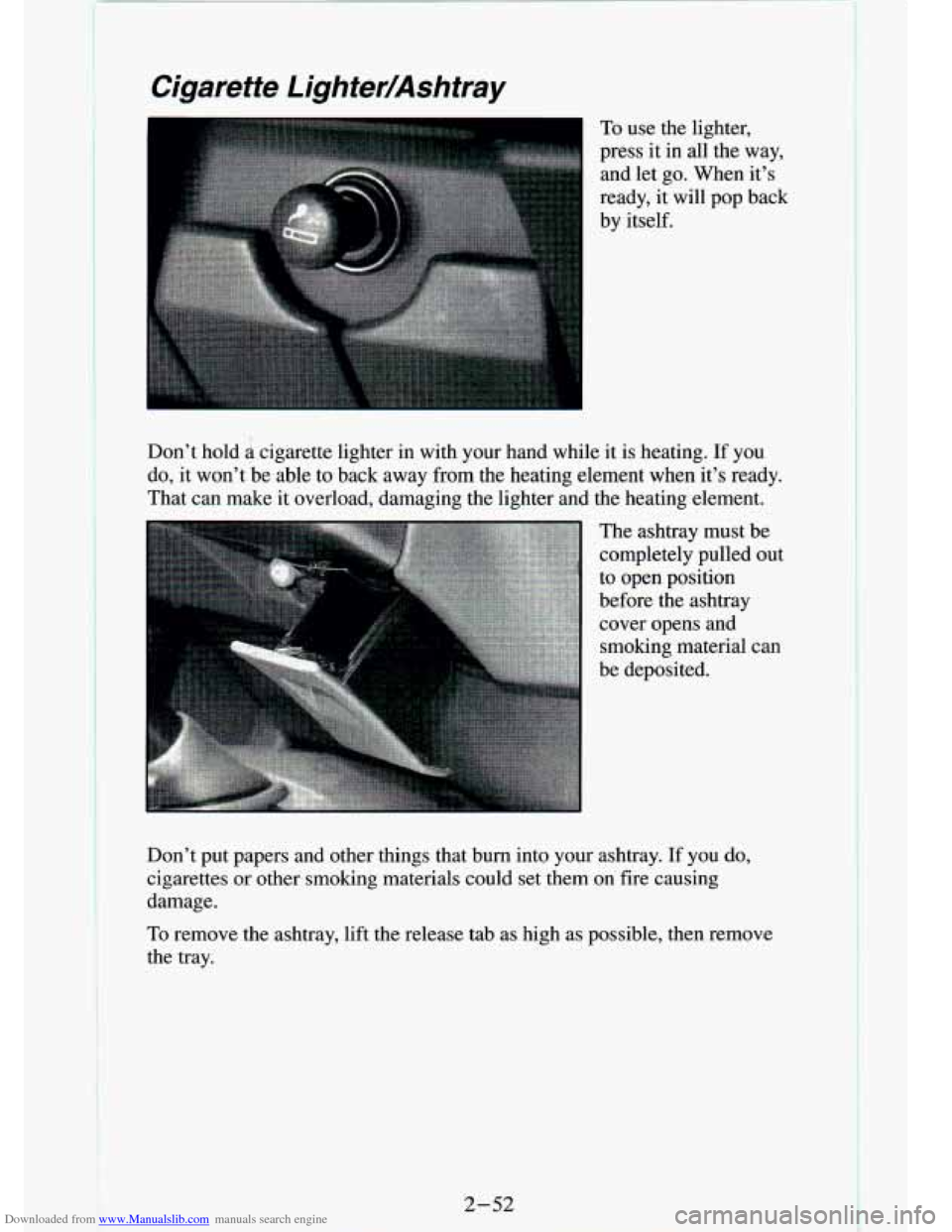
To use the lighter,
press it in all the way,
and let go. When it’s
ready, it will pop back
by itself.
Don’t hold
a cigarette lighter in with your hand while it is heating. If you
do, it won’t
‘be able to back away from the heating element when it’s ready.\
That can make it overload, damaging the lighter and the heating element.
The ashtray must be completely pulled out
to open position
before the ashtray
cover opens and
smoking material can
be deposited.
Don’t put papers and other things that bum into your ashtray.
If you do,
cigarettes or other smoking materials could set them on fire causing
damage.
To remove the ashtray, lift the release tab as high as possib\
le, then remove
the tray.
2-52
~
Page 101 of 340
Downloaded from www.Manualslib.com manuals search engine Instrument Panel ~ . -, .
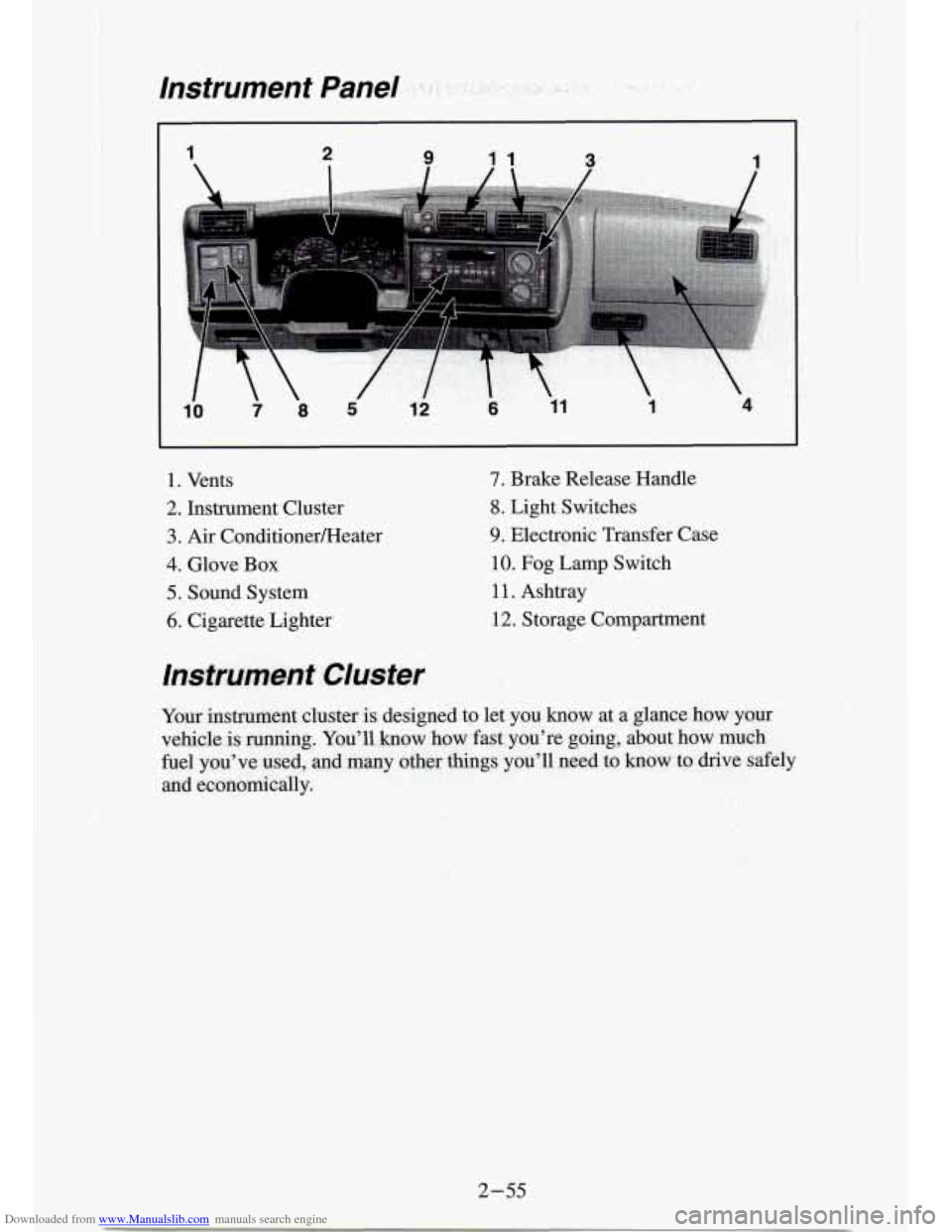
1. Vents
2. Instrument Cluster
3. Air ConditionerFteater
4. Glove Box
5. Sound System
6. Cigarette Lighter
7. Brake Release Handle
8. Light Switches
9. Electronic Transfer Case
10. Fog Lamp Switch
1 1. Ashtray
12. Storage Compartment
Instrument Cluster
Your instmmnt dustex is designed to let you know at a glance how yaur
vehicle is.
running. You’ll how bow fast^ you’re going, about how much
fuel you’ve
used, -and many other things you’ll need to know to drive safely
and economically.
2 - 5.5
Page 104 of 340
Downloaded from www.Manualslib.com manuals search engine running at 2,000 revolutions per minute (rpm). The tachometer needle will
vary all the time that the engine is running.
The yellow warning range tells you that your engine speed is reach\
ing its
upper limits. Don’t drive very long with the tachometer in the yellow range.
If you have a manual transmission, shift to a higher gear as soon as possible.
If you have an automatic transmission, lift your foot off
of the accelerator
pedal
so that the transmission can select a higher gear.
The Red danger range tells you that your engine speed is at its upper limits.
You should immediately shift to a higher gear, or lift your foot
off of the
accelerator pedal. If you drive for very long with the tachometer in the red
danger range, engine damage will result.
NOTICE:
Do not operate the engine with the tachometer in the red area,
or engine damage
will occur.
I
Warning Lightsy Gages and Indicators
This section describes the warning lights and gages that may be on your
vehicle. The pictures will help you locate them.
Warning lights and gages can signal that something is wrong be\
fore it
becomes serious enough to cause an expensive repair or replacem\
ent.
Paying attention to your warning lights and gages could also s\
ave you or
others from injury.
Warning lights
go on when there may be or is a problem with one of your
vehicle’s functions.
As you will see in the details on the next few pages,
some warning lights come on briefly when you turn the ignition\
key just to
let you know they’re working. If you are familiar with this sec\
tion, you
should not
be alarmed when this happens.
Gages can indicate when there may be or is a problem with one
of your
vehicle’s functions. Often gages and warning lights work toge\
ther to let you
know when there’s a problem with your vehicle.
When one of the warning lights comes on and stays on when you are
driving, or when one of the gages shows there may be a problem, check the
section that tells you what to
do about it. Please follow the manual’s advice.
Waiting to do repairs can be costly
- and even dangerous. So please get to
know your warning lights and gages. They’re a big help.
2-58
I
Page 105 of 340
Downloaded from www.Manualslib.com manuals search engine Brake System Warning Light
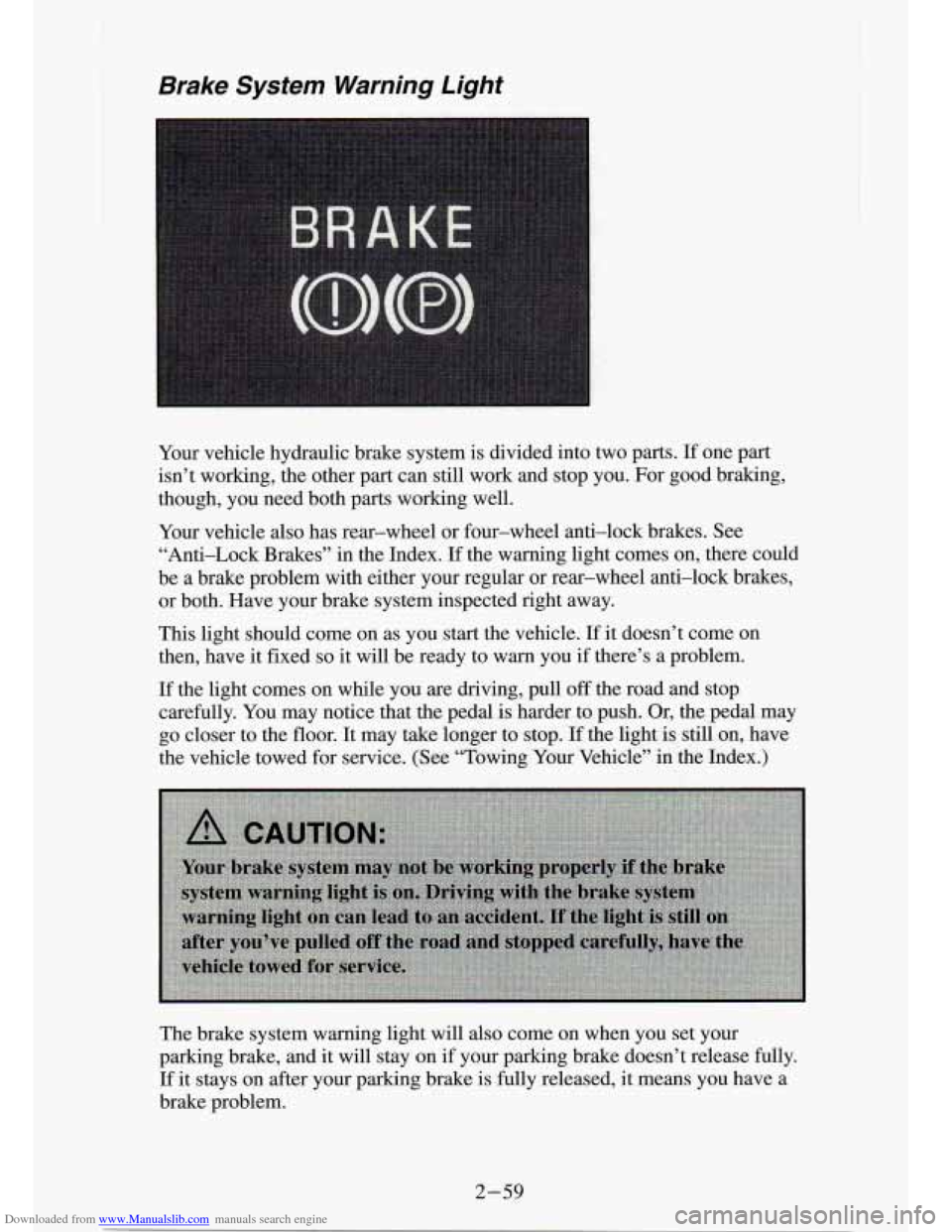
Your vehicle hydraulic brake system is divided into two parts. If one part
isn’t working, the other part can still work and stop you. For good braking,
though, you need both parts working well.
Your vehicle also has rear-wheel or four-wheel anti-lock brakes. See \
“Anti-Lock Brakes” in the Index.
If the warning light comes on, there could
be a brake problem with either your regular or rear-wheel anti\
-lock brakes, or both. Have your brake system inspected right away.
This light should come on as you start the vehicle.
If it doesn’t come on
then, have it fixed
so it will be ready to warn you if there’s a problem.
If the light comes on while you are driving, pull off the road and stop
carefully. You may notice that the pedal
is harder to push. Or, the pedal may
go closer to the floor. It may take longer to stop.
If the light is still on, have
the vehicle towed for service. (See “Towing Your Vehicle” in the Index.)
The brake system warning light
will also come on when you set your
parking brake, and it will stay on
if your parking brake doesn’t release fully.
If it stays on after your parking brake is fully released, it means you have a
brake problem.
2-59
Page 106 of 340
Downloaded from www.Manualslib.com manuals search engine Anti-Lock Brake System Warning Light (Option)
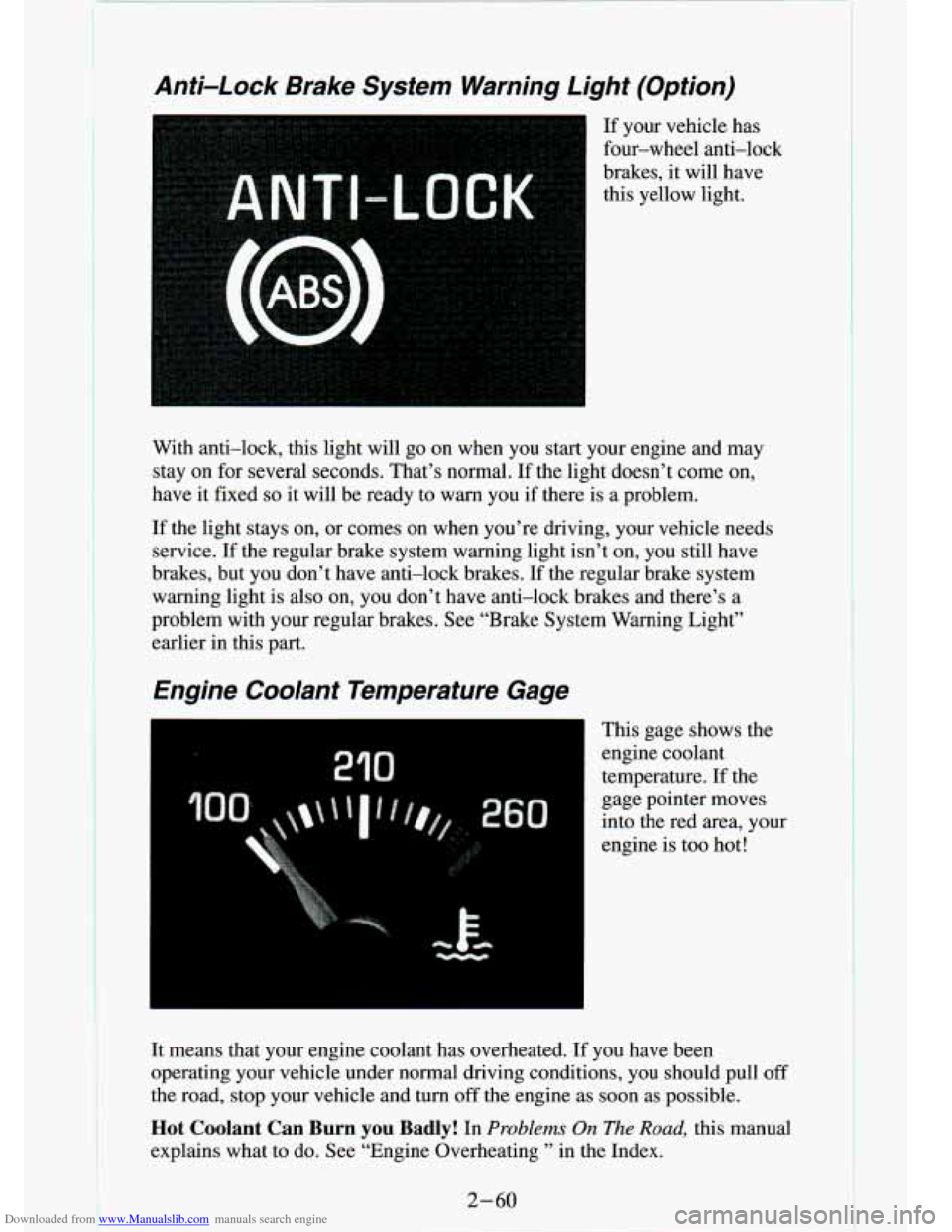
If your vehicle has
four-wheel anti-lock
brakes, it will have
this yellow light.
3
With anti-lock, this light will go on when you start your engine and may
stay on for several seconds. That’s normal. If the light doesn’t come \
on,
have it fixed
so it will be ready to warn you if there is a problem.
If the light stays on, or comes on when you’re driving, your vehic\
le needs
service.
If the regular brake system warning light isn’t on, you still \
have
brakes, but you don’t have anti-lock brakes.
If the regular brake system
warning light is also on, you don’t have anti-lock brakes and there’s a
problem with your regular brakes. See “Brake System Warning Light”
earlier in this part.
Engine Coolant Temperature Gage
I This gage shows the
engine coolant
temperature. If the
gage pointer moves
into the red area, your
engine is too hot!
It means that your engine coolant has overheated. If you have been
operating your vehicle under normal driving conditions, you shou\
ld pull
off
the road, stop your vehicle and turn off the engine as soon as possible.
Hot Coolant Can Burn you Badly! In Problems On The Road, this manual
explains what
to do. See “Engine Overheating ’’ in the Index.
2-60