cooling CHEVROLET S10 1994 2.G Owners Manual
[x] Cancel search | Manufacturer: CHEVROLET, Model Year: 1994, Model line: S10, Model: CHEVROLET S10 1994 2.GPages: 340, PDF Size: 18.45 MB
Page 118 of 340
Downloaded from www.Manualslib.com manuals search engine OFF: This setting turns off all heating functions. Some outside air will still
come out of the heater outlet whenever the vehicle is moving forward.
VENT Airflow is through the instrument panel vents. Set the upper knob to
the temperature desired. This setting is useful for mild outside temperatures,
when little heating
or cooling is desired.
BI-LEV: Outside air comes in through the heater floor vents and the
instrument panel vents. This setting is useful in cool weather \
with bright sunlight.
HEAT Heated air comes out through the heater floor vents and windsh\
ield
defroster vents. This setting is useful for cold weather.
BLEND: Airflow is divided equally between the heater floor vent and t\
he
windshield defroster vents. This setting is useful in cool weather when you
have fog or ice on the windshield or side windows.
DEF: This setting directs most air through the windshield defroster \
vents
and some through the heater vents. This setting is useful when\
you have fog
or ice on the windshield.
Heater/Air Conditioning Controls
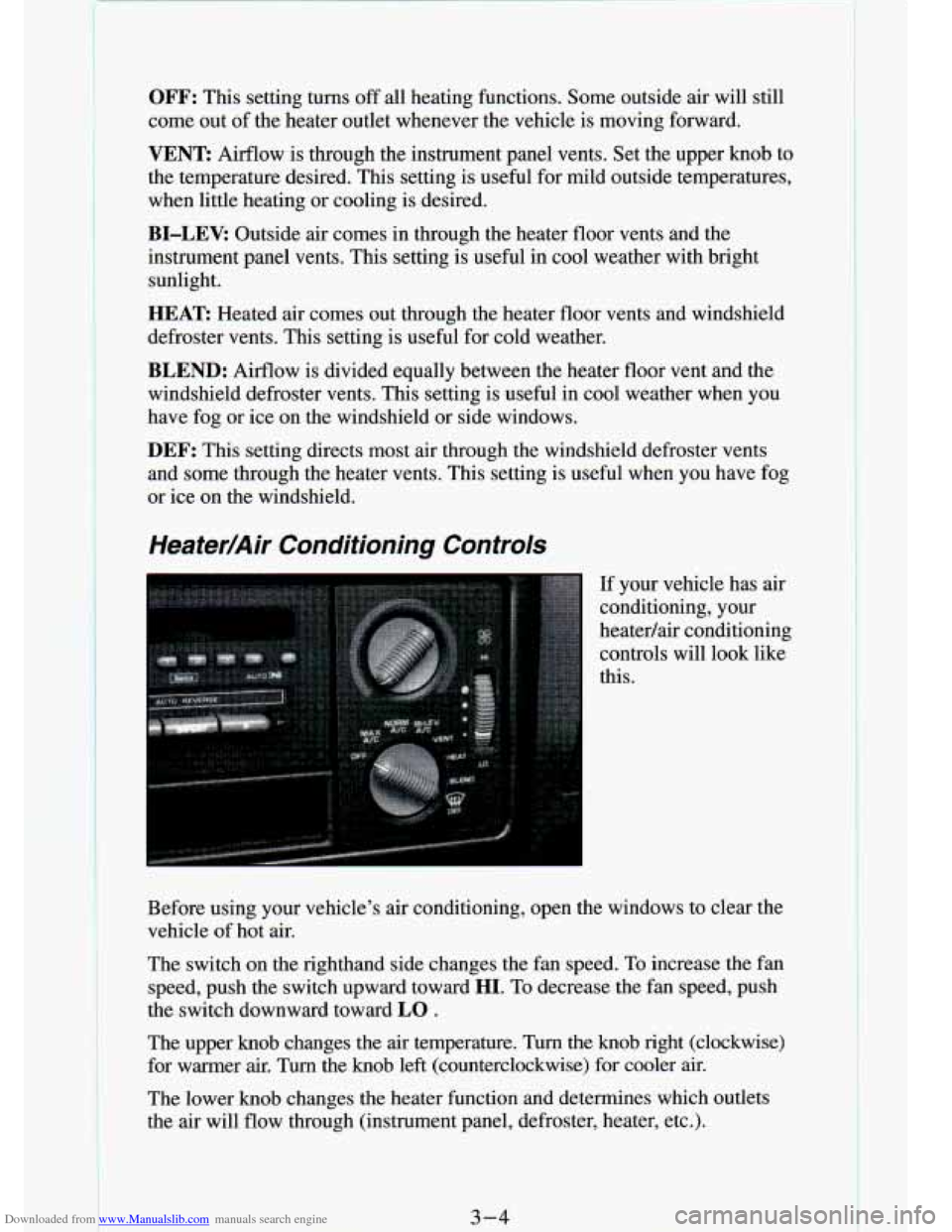
If your vehicle has air
conditioning, your
heatedair conditioning
controls will look like
this.
Before using your vehicle's air conditioning, open the windows \
to clear the vehicle
of hot air.
The switch on the righthand side changes the fan speed. To increase the fan
speed, push the switch upward toward
HI. To decrease the fan speed, push
the switch downward toward
LO .
The upper knob changes the air temperature. Turn the knob righ\
t (clockwise)
for warmer air. Turn the knob left (counterclockwise) for coo\
ler air.
The lower knob changes the heater function and determines which out\
lets
the air will flow through (instrument panel, defroster, heater, etc\
.).
3-4
Page 161 of 340
Downloaded from www.Manualslib.com manuals search engine After Off-Road Driving
Remove any brush or debris that has collected on the underbody, chassis or
under the hood. These accumulations can be a fire hazard.
After operation in mud or sand, have the brake linings cleaned and checked.
These substances can cause glazing and uneven braking. Check th\
e body structure, steering, suspension, wheels, tires, and exhaust syste\
m for
damage. Also, check the fuel lines and cooling system for any leakage.
Your vehicle will require more frequent service due to off-road use.\
Refer
to the Maintenance Schedule booklet for additional information.
Driving at Night
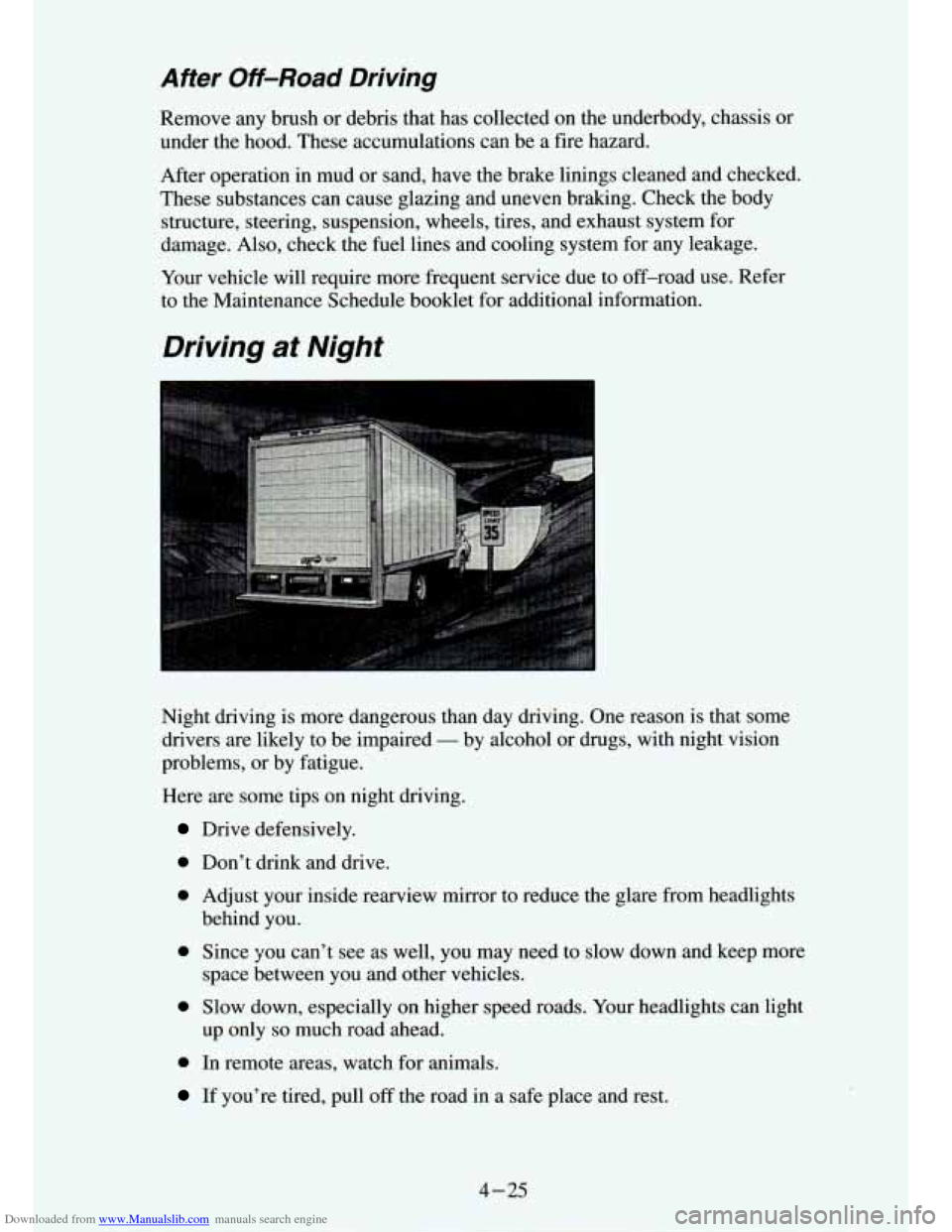
Night driving is more dangerous than day driving. 0 ne reason is that some
drivers are likely to be impaired
- by alcohol or drugs, with night vision
problems,
or by fatigue.
Here are some tips on night driving.
Drive defensively.
0 Don’t drink and drive.
0 Adjust your inside rearview mirror to reduce the glare from ndlights
behind you.
0 Since you can’t see as well, you may need to slow down and keep more
0 Slow down, especially on higher speed roads. Your headlights can light
space between you and other vehicles.
up only
so much road ahead.
0 In remote areas, watch for animals.
If you’re tired, pull off the road in a safe place and rest.
4-25
Page 168 of 340
Downloaded from www.Manualslib.com manuals search engine Keep your vehicle in good shape. Check all fluid levels and also the
brakes, tires, cooling system and transmission. These parts can \
work
hard on mountain roads.
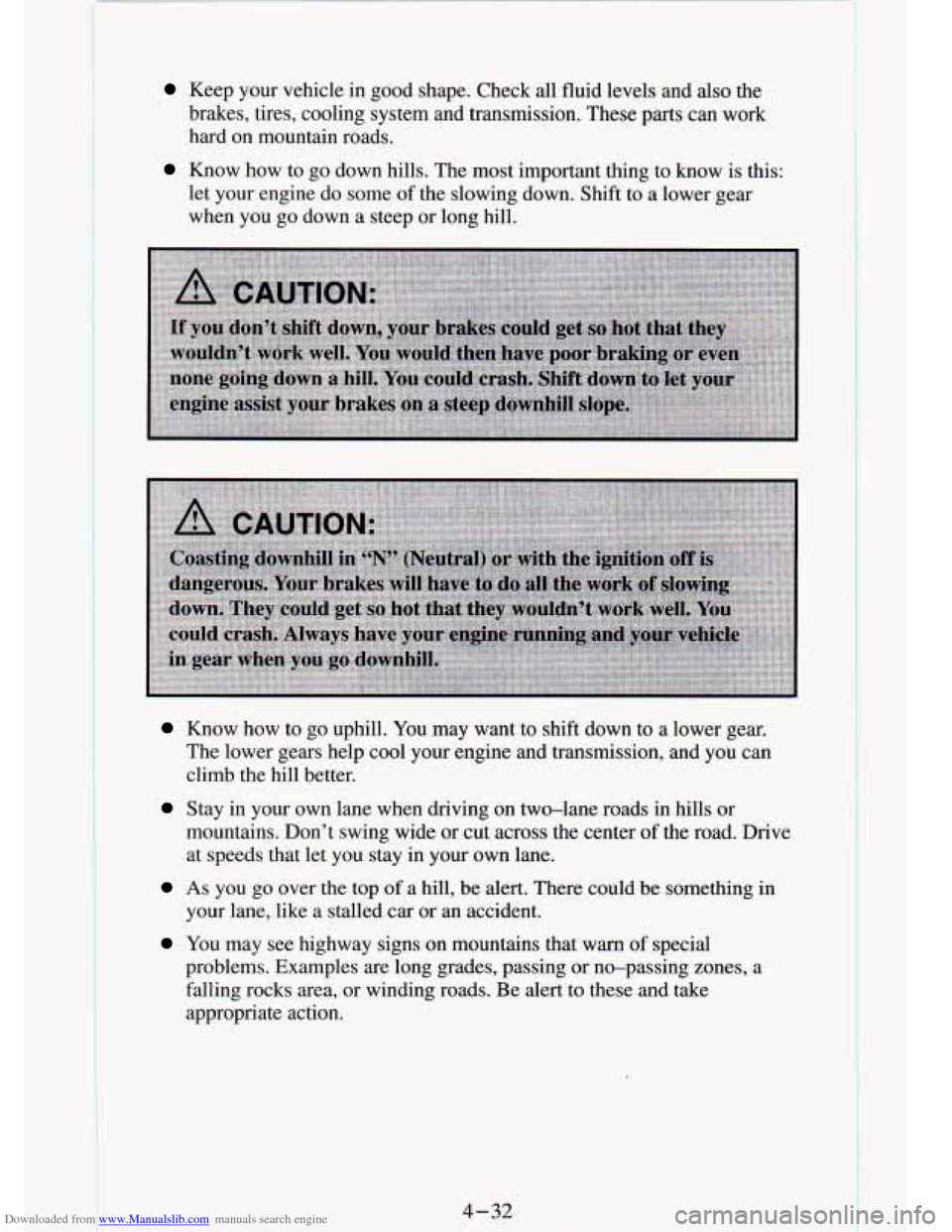
Know how to go down hills. The most important thing to know is this:
let your engine do some of the slowing down. Shift to a lower gear
when you go down a steep or long hill.
Know how to go uphill. You may want to shift down to a lower gear.
The lower gears help cool your engine and transmission, and you ca\
n
climb the hill better.
Stay in your own lane when driving on two-lane roads in hills or
mountains. Don’t swing wide
or cut across the center of the road. Drive
at speeds that
let you stay in your own lane.
As you .go over the top of a hill, be alert. There could be something in
your lane, like a stalled
car or an accident.
You may see highway signs on mountains that warn of special
problems. Examples are long grades, passing or no-passing zones, a
falling- rocks area, or winding roads. Be alert to these and \
take
appropriate action.
4 - 3.2
1 t
Page 180 of 340
Downloaded from www.Manualslib.com manuals search engine - . ?
-. “C ^.
When You Are Ready to Leave After Parking on a Hill
1. Apply your regular brakes and hold the pedal down while you:
Start your engine;
Shift into a gear; and
Release the parking brake.
2. Let up on the brake pedal.
3. Drive slowly until the trailer is clear of the chocks.
4. Stop and have someone pick up and store the chocks.
Maintenance When Trailer Towing
Your vehicle will need service more often when you’re pulling a trailer. See
the Maintenance Schedule for more on this. Things that are especially
important in trailer operation are automatic transmission fluid (don’t
overfill), engine oil, axle lubricant, belt, cooling system, an\
d brake
adjustment. Each
of these is covered in this manual, and the Index will help
you find them quickly.
If you’re trailering, it’s a good idea to review these
sections before you
start your trip.
Check periodically to see that all hitch nuts and bolts are tight.
Trailer Light Wiring
See “Trailer Wiring Harness” in the Index.
4-44
I b
Page 196 of 340
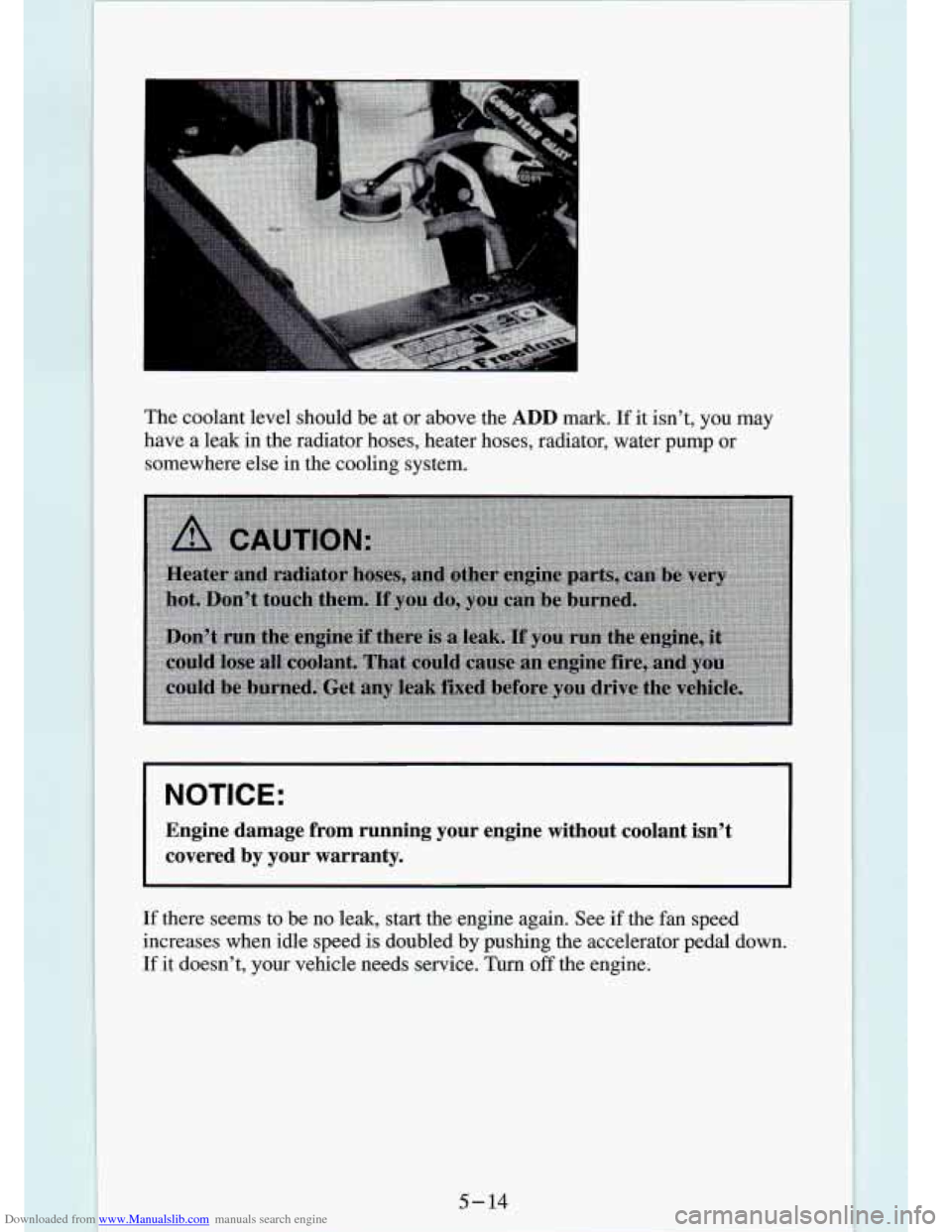
Downloaded from www.Manualslib.com manuals search engine The coolant level should be at or above the ADD mark. If it isn’t, you may
have a leak in the radiator hoses, heater hoses, radiator, wat\
er pump or
somewhere else in the cooling system.
I NOTICE:
Engine damage from running your engine without coolant isn’t \
covered
by your warranty.
If there seems to be no leak, start the engine again. See if the fan speed
increases when idle speed is doubled by pushing the accelerator\
pedal down.
If it doesn’t, your vehicle needs service. Turn off the engine.
Page 197 of 340
Downloaded from www.Manualslib.com manuals search engine How to Add Coolant to the Coolant Recovery Tank
If you haven’t found a problem yet, but the coolant level isn’t at or above
the
ADD mark, add a 50/50 mixture of clean water (preferably distilled) and
a proper antifreeze at the coolant recovery tank. (See “Engine Coolant” in
the Index for more information about the proper coolant mix.)
I NOTICE:
In cold weather, water can freeqe and crack the engine, radiator, \
heater core and other parts. Use the recommended coolant.
When the coolant in the coolant recovery tank is at or above the ADD mark,
start your vehicle.
If the overheat warning continues, there’s one more thing you can t\
ry. You
can add the proper coolant mix directly
to the radiator, but be sure the
cooling system is cool before you do it.
5-15
Page 199 of 340
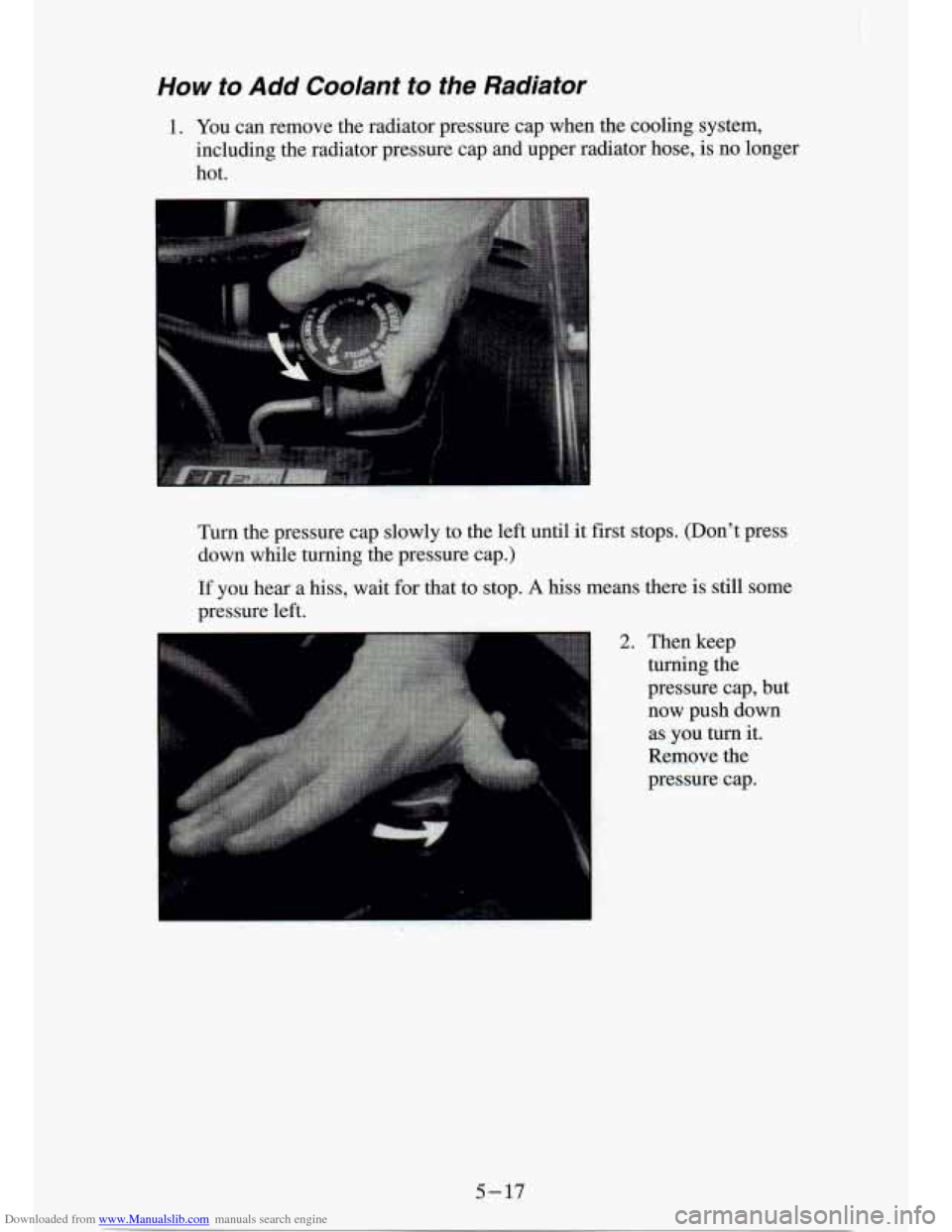
Downloaded from www.Manualslib.com manuals search engine How to Add Coolant to the Radiator
1. You can remove the radiator pressure cap when the cooling system,
including the radiator pressure cap and upper radiator hose, is no longer
hot.
Turn the pressure cap slowly to the left until it first stops. (Don’t press
down while turning the pressure cap.)
If you hear a hiss, wait for that to stop. A hiss means there is still some
pressure left.
2. Then keep
turning the
pressure cap, but now push down
as you turn it.
Remove the pressure cap.
Page 201 of 340
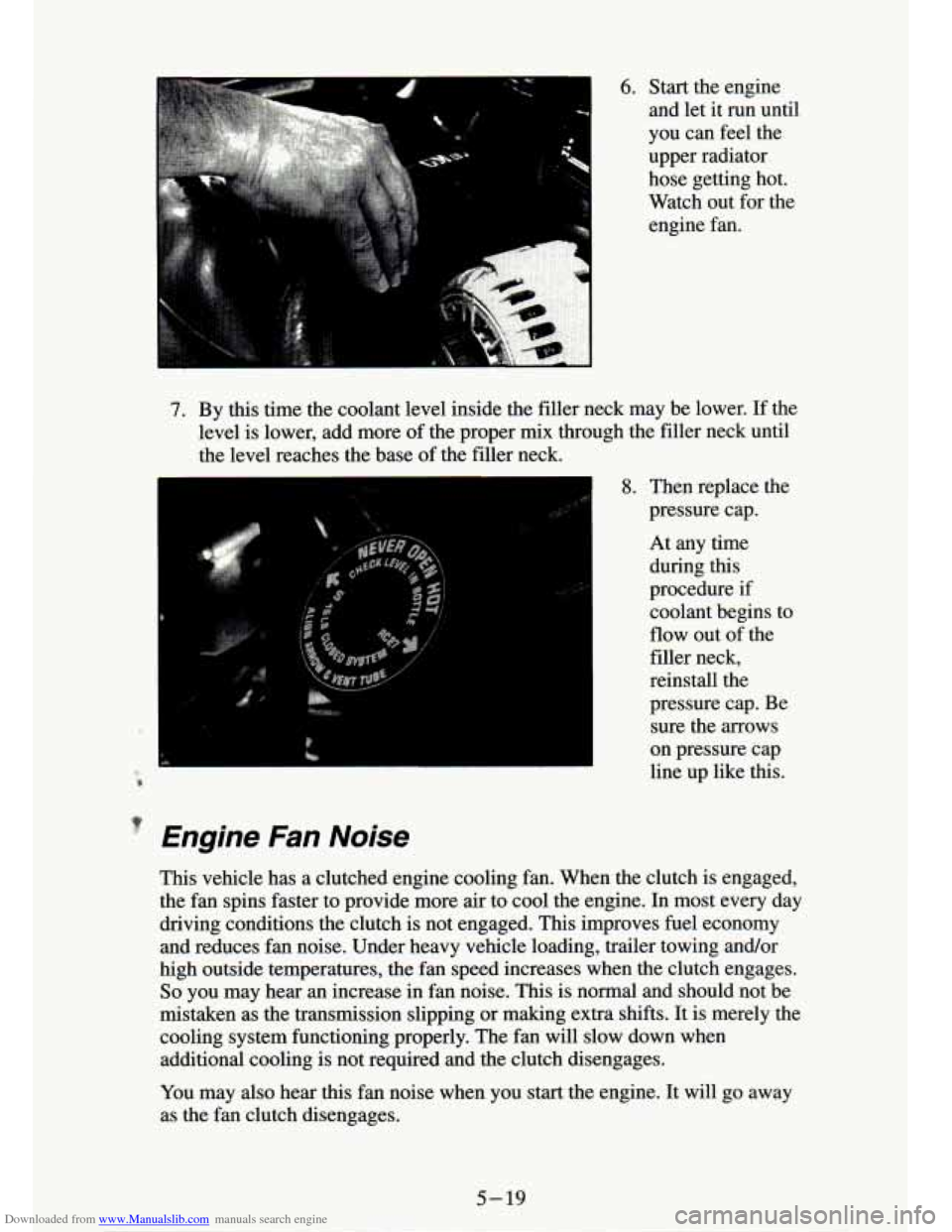
Downloaded from www.Manualslib.com manuals search engine 7. By this time the coolant level inside the filler neck may be lower. If the
level is lower, add more of the proper
mix through the filler neck until
the level reaches the base of the filler neck.
8. Then replace the
pressure cap.
At any time during
this
procedure if coolant begins to
flow out of the
filler neck,
reinstall the
pressure cap. Be sure the arrows
on pressure cap
line up like this.
P
' Engine Fan Noise
This vehicle has a clutched engine cooling fan. When the clutch is engaged,
the fan spins faster to provide more air
to cool the engine. In most every day
driving conditions the clutch is not engaged. This improves fuel economy
and reduces fan noise. Under heavy vehicle loading, trailer towing and/or
high outside temperatures, the fan speed increases when the clutch engages.
So you may hear an increase in fan noise. This is normal and should not be
mistaken as the transmission slipping or making extra shifts. It is merely the
cooling system functioning properly. The fan will slow down when
additional cooling is not required and the clutch disengages.
You may also hear this fan noise when you
start the engine. It will go away
as the
fan clutch disengages.
5-19
Page 241 of 340
, add enou\
gh lubricant
to raise the level to the bottom of the filler")
Downloaded from www.Manualslib.com manuals search engine If the differential is at operating temperature (w,arm), add enou\
gh lubricant
to raise the level to the bottom of the filler plug hole.
If the differential is cold, add enough lubricant to raise the level to 1/2 inch
(12
mm) below the filler plug hole.
What to use
Refer to the Maintenance Schedule to determine what kind of lubricant to
use. See “Recommended Fluids and Lubricants” in the Index.
Engine Coolant
The following explains your cooling system and how to add coolant \
when it
is low.
If you have a problem with engine overheating, see “Engine
Overheating” in the Index.
The proper coolant for your vehicle will:
Give freezing protection down to -20 “F (-29” C), or -34°F (-37 “C) in
Canada and for vehicles with the cold climate option.
e Give boiling protection up to 258°F (125°C).
Protect against rust and corrosion.
Help keep the proper engine temperature.
Let the warning lights and gages work as they should.
What to Use
Use a mi,xture of one-half clean water (preferably distilled) and one-half
antifreeze that meets “GM Specification 603%” or “GM Specification
6043-M ”for the 2.2L (LN2) Code 4 engine, which won’t damage
aluminum parts. You can also use
a recycled coolant conforming to “GM
Specification 603%” or “GM Specification 6043-M ”for the 2.2L (LN2)
Code 4 engine with a complete coolant flush and refill.
If you use this
mixture, you don’t need to add anything else.
6-23
Page 242 of 340
Downloaded from www.Manualslib.com manuals search engine I NOTICE:
If you use an improper coolant mix, your engine could overheat
and be badly damaged. The repair cost wouldn’t be covered by
your warranty. Too much water in the
mix can freeze and crack
the engine, radiator, heater core and other parts.
Some conditions, such as air trapped in the cooling system, ca\
n affect the
coolant level in the radiator. Check the coolant level when th\
e engine
is cold
and foilow the steps under “Adding Coolant” for the proper way to add
coolant.
If you have to add coolant more than four times a year, have your dealer
check your cooling system.
I NOTICE:
If you use the proper coolant, you don’t have to add extra
inhibitors or additives which claim to improve the system. These
can be harmful.
Adding Coolant
To Check Coolant
When your engine is cold, the coolant level should be at “ADD,” or a little
higher. When your engine is warm, the level should be up to
“FULL HOT,”
or a little higher.
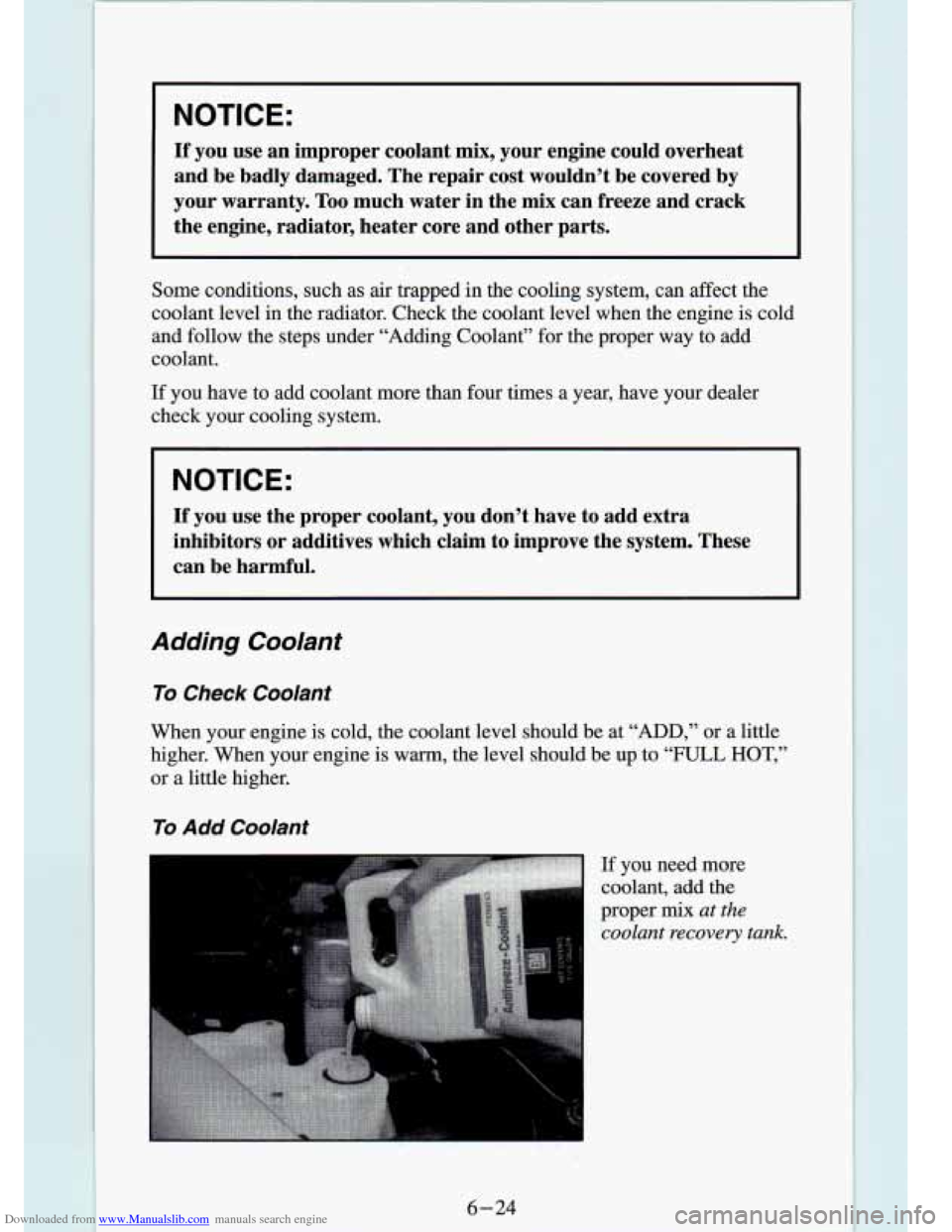
To Add Coolant
I
If you need more
coolant, add the
proper
mix at the
coolant recovery tank.
6-24