change wheel CHEVROLET S10 1995 2.G User Guide
[x] Cancel search | Manufacturer: CHEVROLET, Model Year: 1995, Model line: S10, Model: CHEVROLET S10 1995 2.GPages: 354, PDF Size: 18.92 MB
Page 201 of 354
Downloaded from www.Manualslib.com manuals search engine Engine Fan Noise
This vehicle has a clutched engine cooling fan. When the clutch is engaged,
the fan spins faster to provide more air to cool the engine. In most every day
driving conditions the clutch is not engaged. This improves fuel economy
and reduces fan noise. Under heavy vehicle loading, trailer towing and/or
high outside temperatures, the fan speed increases when
the clutch engages.
So you may hear an increase in fan noise. This is normal and should not be
mistaken as the transmission slipping or making extra shifts. It is merely the
cooling system functioning properly. The fan will slow down when
additional cooling is not required and the clutch disengages.
You may also hear this fan noise when you start the engine. It will go away
as the fan clutch disengages.
if a Tire Goes Flat
It’s unusual for a tire to “blow out” while you’re driving, especially if you
maintain your tires properly. If air goes out of
a tire, it’s much more likely to
leak out slowly. But if you should ever have a “blowout,” here are a few tips
about what to expect and
what to do:
If a front tire fails, the flat tire
will create a drag that pulls the vehicle
toward that side. Take your foot off the accelerator pedal and grip the
steering wheel firmly. Steer to maintain lane position, then gently brake to a
stop well out of the traffic lane.
A rear blowout, particularly on a curve, acts much like a skid and may
require the same correction you’d use in a skid. In any rear blowout, remove
your foot from
the accelerator pedal. Get the vehicle under control by
steering the way you want the vehicle to go. It may be very bumpy and
noisy, but you can still steer. Gently brake to a stop, well off the road if
possible.
If a tire goes flat, the next part shows how to use your jacking equipment to
change a flat tire safely.
5-18
Page 203 of 354
Downloaded from www.Manualslib.com manuals search engine The following steps will tell you how to use the jack and change a tire.
Jacking Equipment Storage
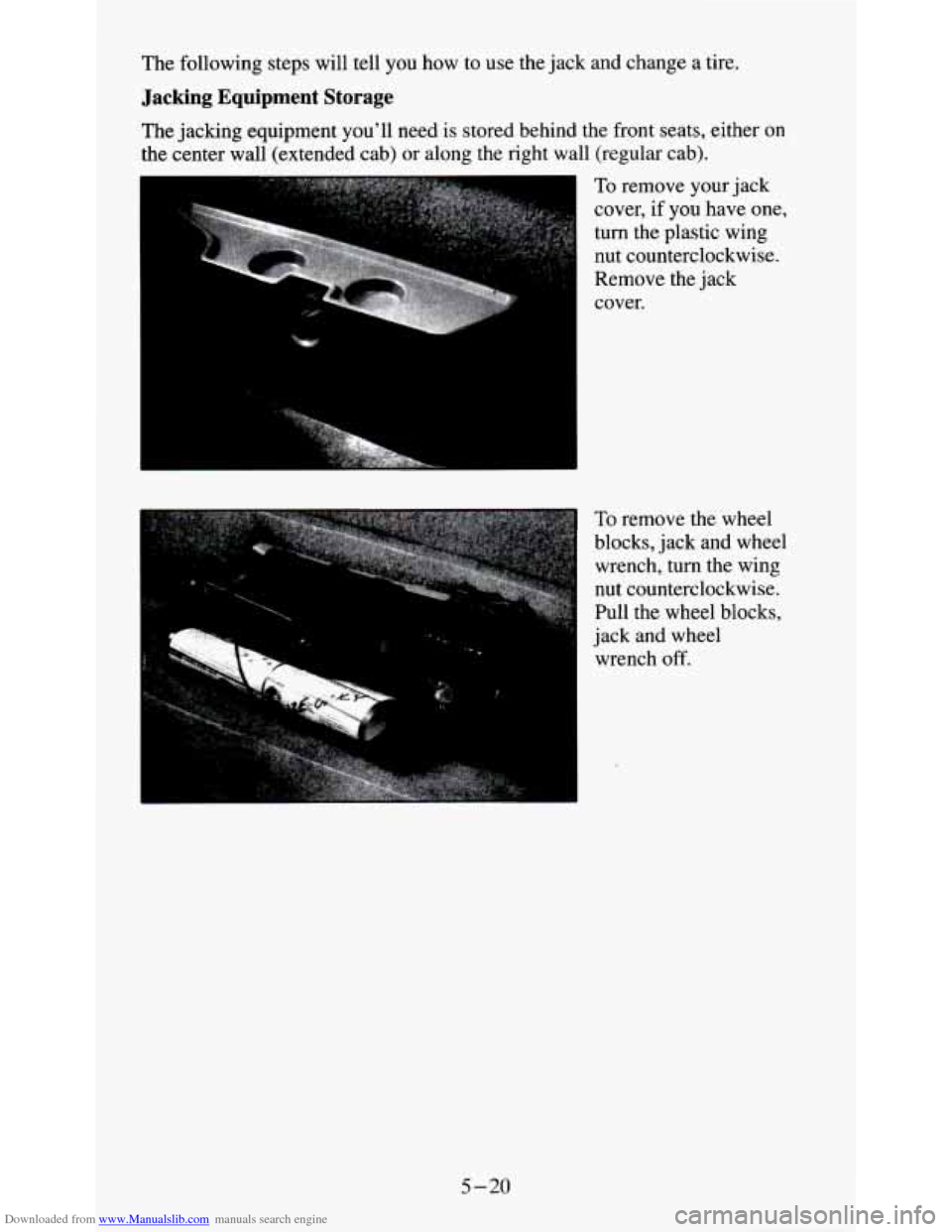
The jacking equipment you’ll need is stored behind the front seats, either on
the center wall (extended cab) or along the right wall (regular cab).
To remove your jack
cover, if you have one,
turn the plastic wing
nut counterclockwise.
Remove the jack
cover.
To remove the wheel
blocks, jack and wheel
wrench, turn the wing
nut counterclockwise.
Pull the wheel blocks,
jack and wheel
wrench
off.
5-20
Page 208 of 354
Downloaded from www.Manualslib.com manuals search engine Changing the Tire
Start with the jacking equipment. See “Jacking Equipment Storage” earlier
in this section.
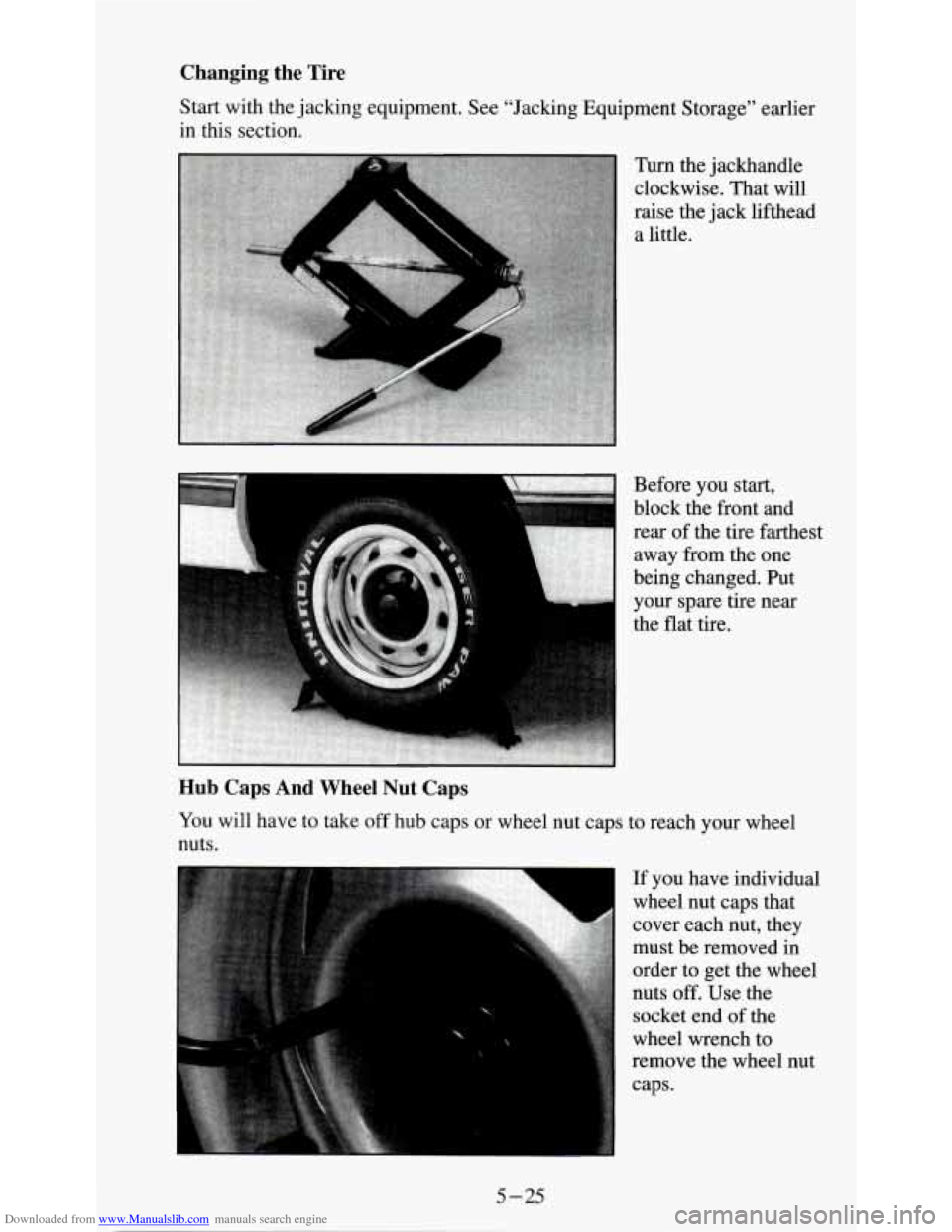
Turn the jackhandle
clockwise. That will
raise the jack lifthead
a little.
Before you start,
block the front and
rear of the tire farthest
away from the one
being changed. Put
your spare tire near
the flat tire.
Hub Caps And Wheel Nut Caps
You will have to take off hub caps or wheel nut caps to reach your wheel
nuts.
If you have individual
wheel nut caps that
cover each nut, they
must be removed in
order
to get the wheel
nuts
off. Use the
socket end of the
wheel wrench to
remove the wheel nut
caps.
5-25
Page 229 of 354
Downloaded from www.Manualslib.com manuals search engine Four-wheel Drive Remote Oil Filter
If your vehicle has four-wheel drive, you will have a remote oil filter. There
is a special access door in the steering linkage shield assembly located under
the radiator support. Twist the screw to lock or unlock the door.
Engine Coolant Heater
An engine coolant heater can be a big help if you have to park outside in
very cold weather,
0°F (-1 8 O C) or colder. If your vehicle has this option,
see “Engine Coolant Heater” in the Index.
What to Do with Used Oil
Did you know that used engine oil contains certain elements that may be
unhealthy for your skin and could
even cause cancer? Don’t let used oil stay
on your skin for very long. Clean your skin and nails with soap and water,
or a good hand cleaner. Wash or properly throw away clothing or rags
containing used engine oil. (See the manufacturer’s warnings about the use
and disposal of oil products.)
Used oil can be a real threat to the environment. If you change your own oil,
be sure to drain all free-flowing oil from the filter before disposal. Don’t
ever dispose of oil by putting
it in the trash, pouring it on the ground, into
sewers, or into streams or bodies of water. Instead, recycle it by taking it
to
a place that collects used oil. If you have a problem properly disposing of
your used oil, ask your dealer, a service station or a local recycling center
for help.
Air Cleaner
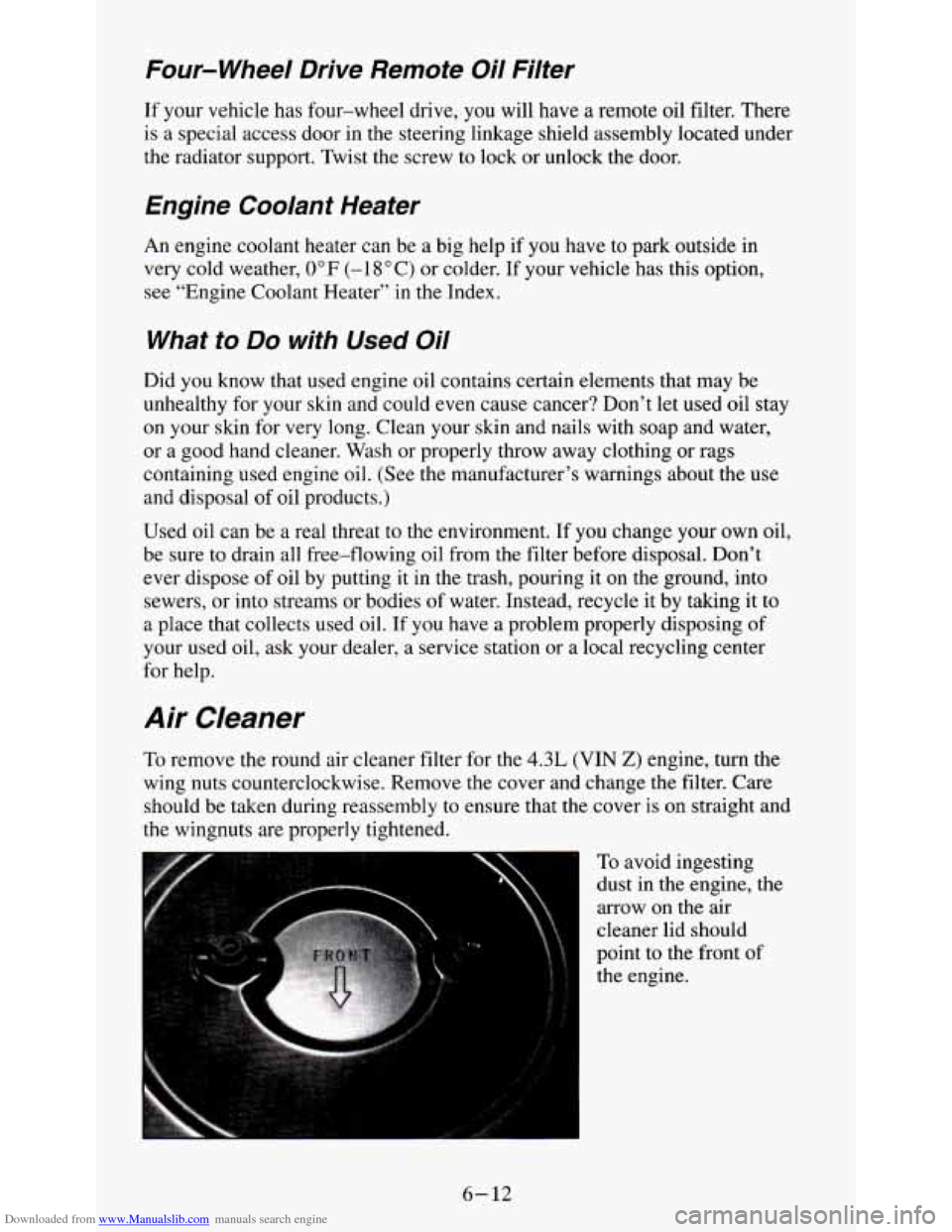
To remove the round air cleaner filter for the 4.3L (VIN 2) engine, turn the
wing nuts counterclockwise. Remove the cover and change the filter. Care
should be taken during reassembly to ensure that the cover is on straight and
the wingnuts
are properly tightened.
= To avoid ingesting
dust in the engine, the
arrow on the air
cleaner lid should
point
to the front of
the engine.
6- 12
Page 236 of 354
Downloaded from www.Manualslib.com manuals search engine Rear Axle
When to Check and Change Lubricant
Refer to the Maintenance Schedule to determine how often to check the
lubricant and when to change it. See “Scheduled Maintenance Services” in
the Index.
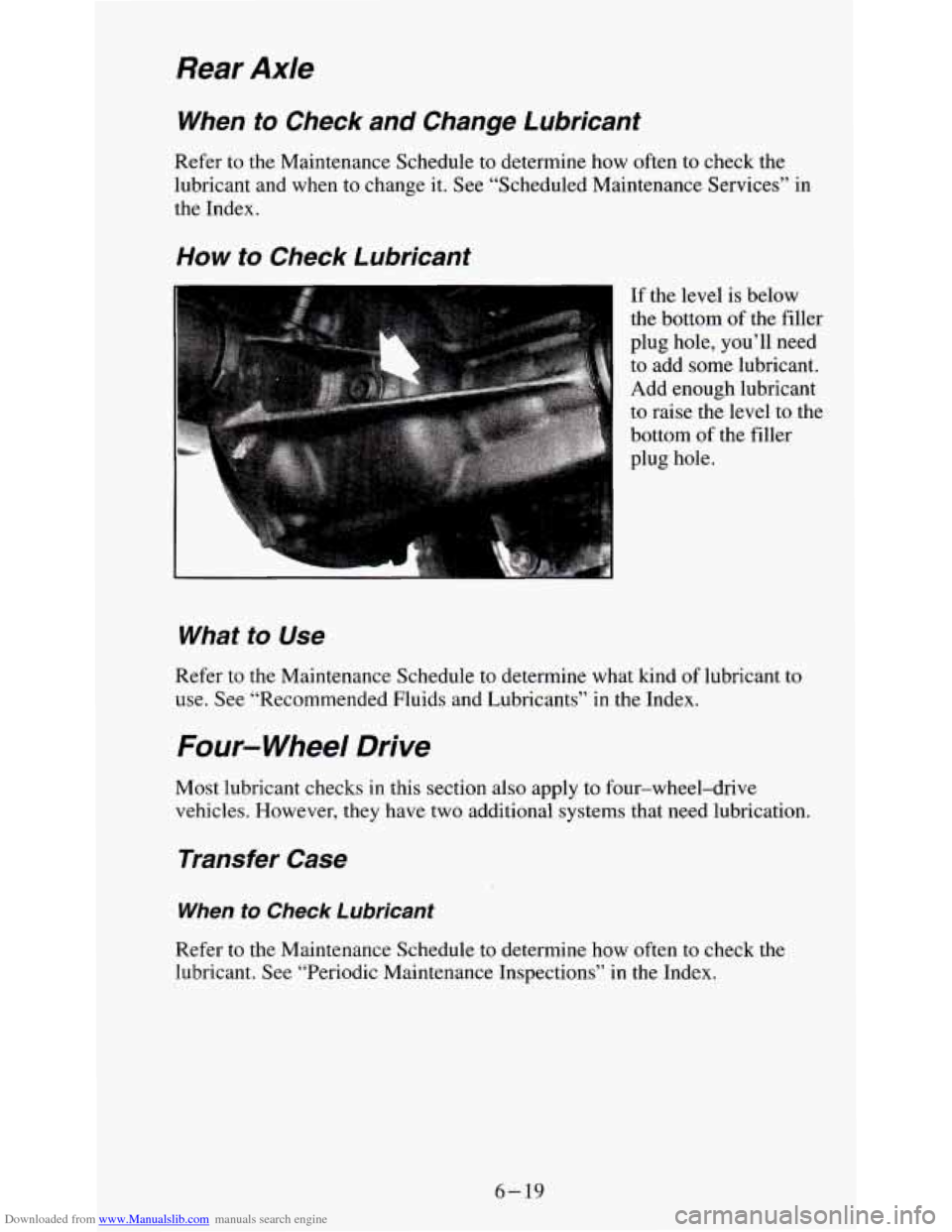
How to Check Lubricant
I 1
If the level is below
the bottom
of the filler
plug hole, you’ll need
to add some lubricant.
Add enough lubricant
to raise the level to the
bottom
of the filler
plug hole.
What to Use
Refer to the Maintenance Schedule to determine what kind of lubricant to
use. See “Recommended Fluids and Lubricants” in the Index.
Four- Wheel Drive
Most lubricant checks in this section also apply to four-wheel-drive
vehicles. However, they have two additional systems that need lubrication.
Transfer Case
When to Check Lubricant
Refer to the Maintenance Schedule to determine how often to check the
lubricant. See “Periodic Maintenance Inspections”
in the Index.
6-19
Page 291 of 354
Downloaded from www.Manualslib.com manuals search engine Selecting the Right Schedule
First you’ll need to decide which of the two schedules is right for your
vehicle. Here’s how to decide which schedule to follow:
I Schedule I Definition I
Follow Maintenance Schedule I if any one of these is true for your vehicle:
0 Most trips are less than 5 to 10 miles (8 to 16 km). This is particularly
0 Most trips include extensive idling (such as frequent driving in
0 You operate your vehicle in dusty areas or off-road frequently.
0 You frequently tow a trailer.
important
when outside temperatures are below freezing.
stop-and-go traffic).
Schedule
I should also be followed if the vehicle is used for delivery
service, police, taxi, or other commercial application.
I Schedule I Intervals I
Every 3,000 Miles (5 000 km) or 3 Months
Engine Oil and Filter Change
Chassis Lubrication
Drive Axle Service
At 6,000 Miles (10 OOO km) - Then Every 12,000 Miles (25 OOO km)
Tire Rotation
Every 15,000 Miles (25 000 km)
Air Cleaner Filter Inspection, if driving in dusty conditions
Front Wheel Bearing Repack (or at each brake relining) (2WD Only)
Every 30,000 Miles (50 000 km)
Air Cleaner Filter Replacement
Spark Plug Replacement (Except
2.2L Code 4 engine)
Fuel Filter Replacement
Cooling System Service (or every 24 months)
7-4
Page 292 of 354
Downloaded from www.Manualslib.com manuals search engine Every 50,000 Miles (83 000 km)
Automatic Transmission Service (severe conditions)
Every 60,000 Miles (100 000 km)
Engine Accessory Drive Belt Inspection
Spark Plug Wire Inspection
Engine Timing Check
Fuel Tank, Cap and Lines Inspection
Every 100,000 Miles (166 000 km)
Spark Plug Replacement (2.2L Code 4 engine Only)
-
Schedule /I Definition
Follow Schedule I1 only if none of the conditions from Schedule I is true.
Schedule I1 Intervals I
Every 7,500 Miles (12 500 km)
Engine Oil and Filter Change (or every 12 months)
Chassis Lubrication (or every 12 months)
Drive Axle Service
At 7,500 Miles (12 500 km) - Then Every 15,000 Miles (25 000 km)
Tire Rotation
Every 30,000 Miles (50 000 km)
Cooling System Service (or every 24 months)
Spark Plug Replacement (Except 2.2L Code
4 engine)
Fuel Filter Replacement
Air Cleaner Filter Replacement
Front Wheel Bearing Repack (2-Wheel Drive
Only)
Every 50,000 Miles (83 000 km)
Automatic Transmission Service (severe conditions)
7-5
Page 296 of 354
Downloaded from www.Manualslib.com manuals search engine I Maintenance Schedule I
15,000 Miles (25 000 km)
0
0
Change engine oil and filter (or every 3 months, whichever occurs
first).
An Emission Control Service.
Lubricate the front suspension, ball joints, steering linkage and transfer
case shift linkage, parking brake cable guides, propshaft splines,
universal joints, brake pedal springs, and clutch pedal springs (or every
6 months, whichever occurs first).
Inspect air cleaner filter
if you are driving in dusty conditions. Replace
filter
if necessary. An Emission Control Service.
Check readfront axle fluid level and add fluid as needed. Check
constant velocity joints and axle seals for leaking.
**
For 2-Wheel Drive vehicles only: Clean and repack the front wheel
bearings (or at each brake relining, whichever occurs first).
DATE
SERVICED BY ACTUAL MILEAGE
18,000 Miles (30 000 km)
Change engine oil and filter (or every 3 months, whichever occurs
0 Lubricate the front suspension, ball joints, steering linkage and transfer
case shift linkage, parking brake cable guides, propshaft splines,
universal joints, brake pedal springs, and clutch pedal springs (or every
6 months, whichever occurs first).
first).
An Emission Control Service.
0 Check
readfront axle fluid level and add fluid as needed. Check
constant velocity joints and axle seals for leaking.
**
rotation pattern and additional information.
0 Rotate tires. See “Tire Inspection and Rotation” in the Index for proper
DATE
SERVICED BY ACTUAL MILEAGE
7-9
Page 298 of 354
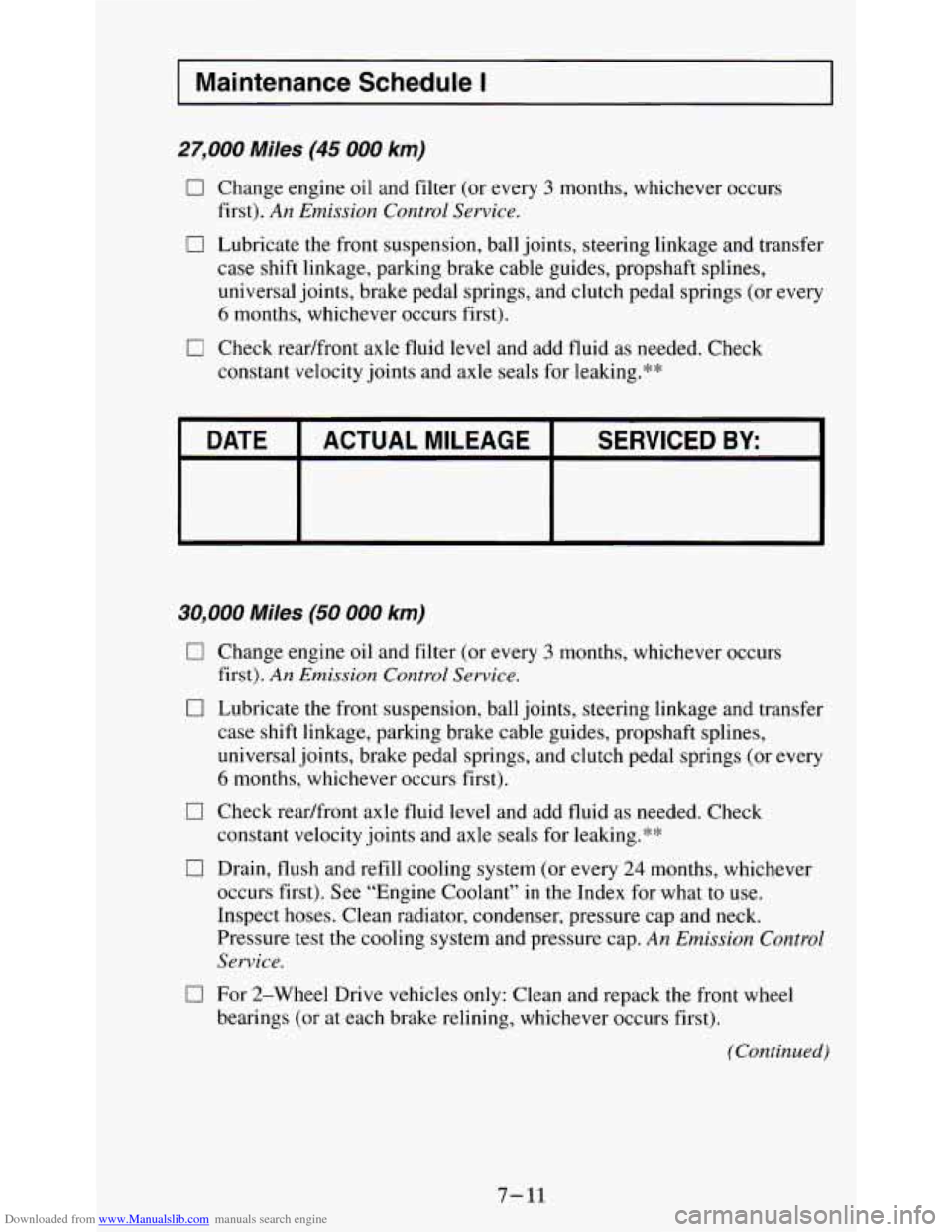
Downloaded from www.Manualslib.com manuals search engine I Maintenance Schedule I
27,000 Miles (45 000 km)
0 Change engine oil and filter (or every 3 months, whichever occurs
0 Lubricate the front suspension, ball joints, steering linkage and transfer
case shift linkage, parking brake cable guides, propshaft splines,
universal joints, brake pedal springs, and clutch pedal springs (or every
6 months, whichever occurs first).
first).
An Emission Control Service.
0 Check
readfront axle fluid level and add fluid as needed. Check
constant velocity joints and axle seals for leaking.**
c
DATE SERVICED BY: ACTUAL MILEAGE
30,000 Miles (50 000 km)
0
0
0
0
0
Change engine oil and filter (or every 3 months, whichever OCCuri
first).
An Emission Control Service.
Lubricate the front suspension, ball joints, steering linkage and transfer
case shift linkage, parking brake cable guides, propshaft splines,
universal joints, brake pedal springs, and clutch pedal springs (or every
6 months, whichever occurs first).
Check readfront axle fluid level and add fluid as needed. Check
constant velocity joints and axle seals for leaking.**
Drain,
flush and refill cooling system (or every 24 months, whichever
occurs first). See “Engine Coolant” in the Index for what to use.
Inspect hoses. Clean radiator, condenser, pressure cap and neck.
Pressure test the cooling system and pressure cap.
An Emission Control
Sewice.
For 2-Wheel Drive vehicles only: Clean and repack the front wheel
bearings (or at each brake relining, whichever occurs first).
(Continued)
7-11
Page 301 of 354
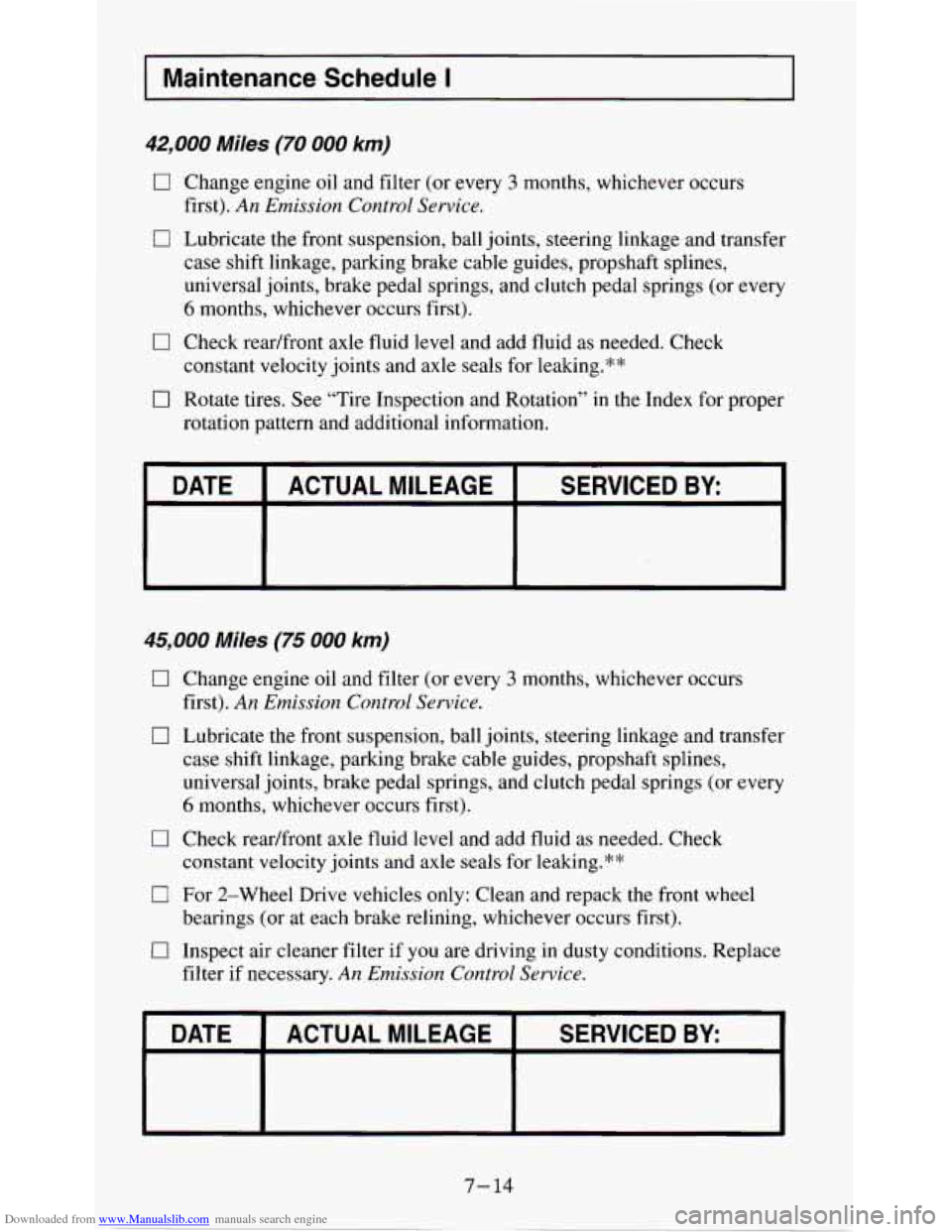
Downloaded from www.Manualslib.com manuals search engine Maintenance Schedule I
42,000 Miles (70 000 km)
0 Change engine oil and filter (or every 3 months, whichever occurs
0 Lubricate the front suspension, ball joints, steering linkage and transfer
case shift linkage, parking brake cable guides, propshaft splines,
universal joints, brake pedal springs, and clutch pedal springs (or every
6 months, whichever occurs first).
first).
An
Emission Control Service.
0 Check readfront axle fluid level and add fluid as needed. Check
constant velocity joints and axle seals for leaking.**
rotation pattern and additional information.
0 Rotate tires. See “Tire Inspection and Rotation” in the Index for proper
DATE ACTUAL MILEAGE SERVICED BY:
45,000 Miles (75 000 km)
0 Change engine oil and filter (or every 3 months, whichever occurs
first).
An Emission Control Service.
0 Lubricate the front suspension, ball joints, steering linkage and transfer
case shift linkage, parking brake cable guides, propshaft splines,
universal joints, brake pedal springs, and clutch pedal springs (or every
6 months, whichever occurs first).
0 Check readfront axle fluid level and add fluid as needed. Check
constant velocity
joints and axle seals for leaking.**
0 For 2-Wheel Drive vehicles only: Clean and repack the front wheel
0 Inspect air cleaner filter if you are driving in dusty conditions. Replace
bearings (or
at each brake relining, whichever occurs first).
filter if necessary.
An Emission Control Service.
DATE SERVICED BY ACTUAL MILEAGE
7-14