child lock CHEVROLET S10 1995 2.G Owners Manual
[x] Cancel search | Manufacturer: CHEVROLET, Model Year: 1995, Model line: S10, Model: CHEVROLET S10 1995 2.GPages: 354, PDF Size: 18.92 MB
Page 19 of 354
Downloaded from www.Manualslib.com manuals search engine 0: Why don’t they just put in air bags so people won ’t have to wear
safety belts?
A: Air bags are in many vehicles today and will be in more of them in the
future. But they are supplemental systems only;
so they work with
safety belts - not instead of them. Every air bag system ever offered
for sale has required the
use of safety belts. Even if you’re in a vehicle
that has air bags,
you still have to buckle up to get the most protection.
That’s true
not only in frontal collisions, but especially in side and
other collisions.
Q: If I’m a good driver, and I never drive far from home, why should I
A: You may be an excellent driver, but if you’re in an accident - even
wear safety belts?
one that isn’t your fault - you and your passengers can be hurt. Being
a good driver doesn’t protect you from things beyond your control,
such as bad drivers.
Most accidents occur within
25 miles (40 km) of home. And the
greatest number of serious injuries and deaths occur at speeds of less
than
40 mph (65 km/h).
Safety belts are for everyone.
How to Wear Safety Belts Properly
Adults
This part is only for people of adult size.
Be aware that there are special things to know about safety belts and
children. And there are different rules for smaller children and babies. If a
child will be riding in your vehicle, see the part
of this manual called
“Children.” Follow those rules for everyone’s protection.
First, you’ll want
to know which restraint systems your vehicle has.
We’ll start with the driver Position.
Driver Position
This part describes the driver’s restraint system.
Lap-Shoulder Belt
The driver has a lap-shoulder belt. Here’s how to wear it properly.
1. Close and lock the door.
1-10
Page 40 of 354
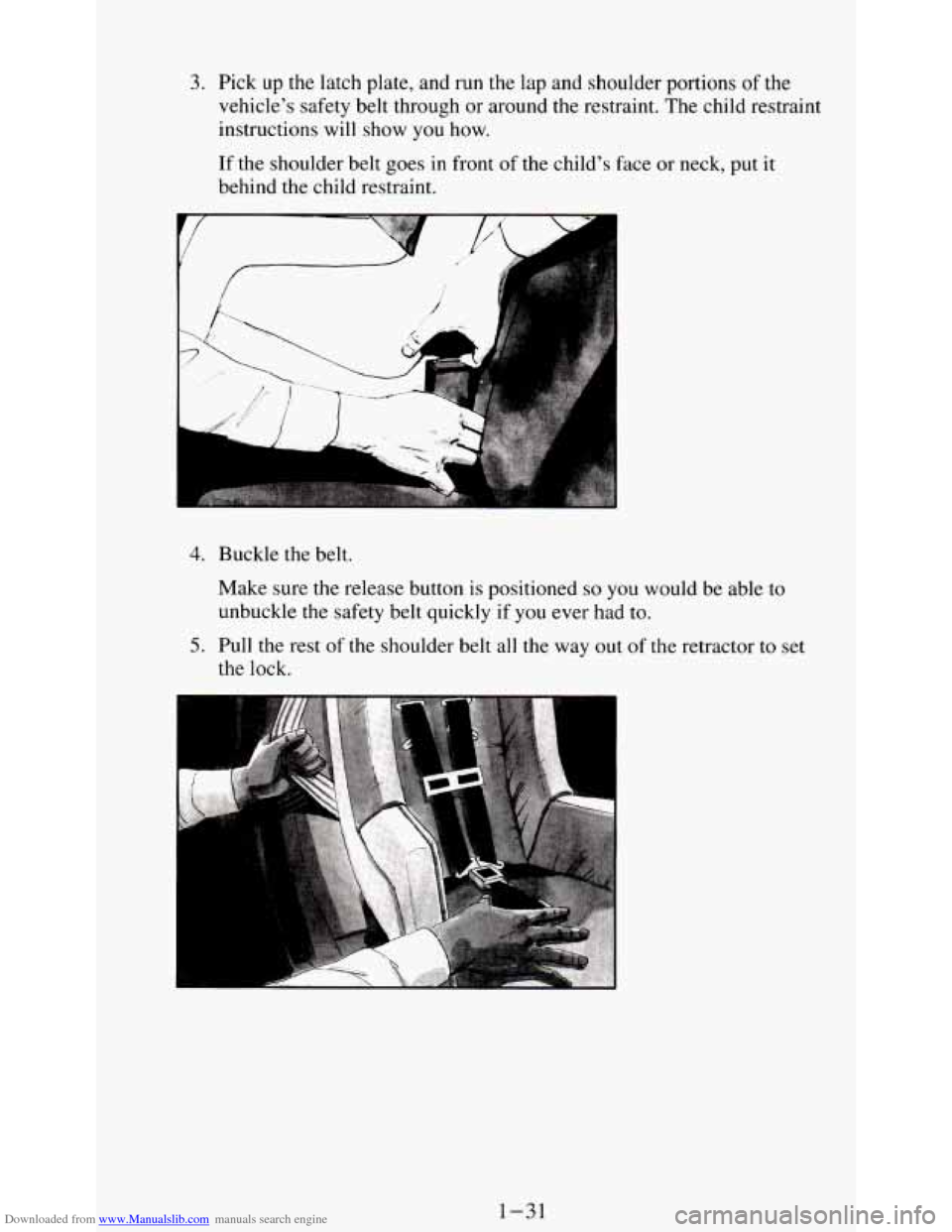
Downloaded from www.Manualslib.com manuals search engine 3. Pick up the latch plate, and run the lap and shoulder portions of the
vehicle’s safety belt through or around the restraint. The child restraint
instructions will show
you how.
If the shoulder belt goes in front of the child’s face or neck, put it
behind the child restraint.
4. Buckle the belt.
Make sure the release button is positioned
so you would be able to
unbuckle the safety belt quickly if
you ever had to.
5. Pull the rest of the shoulder belt all the way out of the retractor to set
the lock.
1-31
Page 47 of 354
Downloaded from www.Manualslib.com manuals search engine A CAUTION:
Leaving young children in a vehicle with the ignition key is
dangerous for many reasons.
A child or others could be badly
injured
or even killed.
They could operate power windows or other controls or even
make the vehicle move. Don’t leave the keys in a vehicle w\
ith
young children.
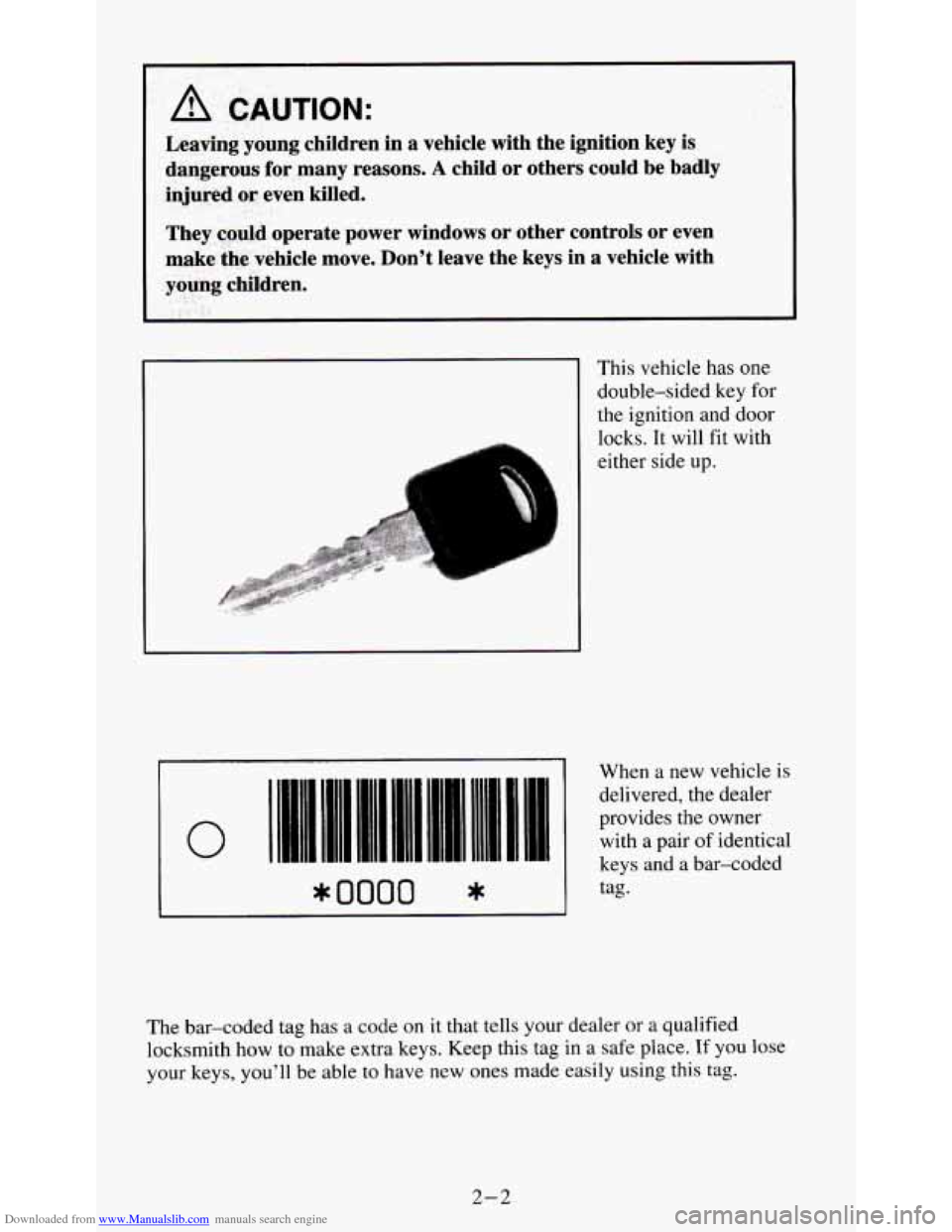
This vehicle has one
double-sided key for
the ignition and door
locks. It will fit with
either side up.
iIIII Ill1
FMllM 11111 1111I 11111 IllUl 111111 II I1
I
When a new vehicle is
delivered, the dealer
provides the owner
with a pair of identical
keys and a bar-coded
0 11111 11111 11.11 .1..1 ,1111. .... I. I. .-
* 0000 *
The bar-coded tag has a code on it that tells your dealer or a qualified
locksmith how to make extra keys. Keep this tag
in a safe place. If you lose
your keys,
you’ll be able to have new ones made easily using this tag.
2-2
Page 141 of 354
Downloaded from www.Manualslib.com manuals search engine surface makes it possible for the vehicle to change its path when you ,turn
the front wheels. If there’s no traction, inertia will keep the vehicle going in
the same direction. If you’ve ever tried to steer a vehicle
on wet ice, you’ll
understand this.
The traction you can get in a curve depends
on the condition of your tires
and the road surface, the angle at which the curve is banked, and your
speed. While you’re in a curve, speed is the one factor you can control.
Suppose you’re steering through
a sharp curve. Then you suddenly apply
the brakes. Both control systems
- steering and braking - have to do their
work where the tires meet the road. Unless
you have four-wheel anti-lock
brakes, adding the hard braking can demand
too much of those places. You
can lose control.
The same thing
can happen if you’re steering through a sharp curve and you
suddenly accelerate. Those two control systems - steering and acceleration
- can overwhelm those places where the tires meet the road and make you
lose control.
What should you do if this ever happens? Ease up on the brake or
accelerator pedal, steer the vehicle the way you want it to go, and slow
down.
Speed limit signs near curves warn that you should adjust your speed. Of
course, the posted speeds are based
on good weather and road conditions.
Under less favorable conditions you’ll want to go slower.
If
you need to reduce your speed as you approach a curve, do it before you
enter the curve, while your front wheels are straight ahead.
Try to adjust your speed so you can “drive” through the curve. Maintain a
reasonable, steady speed. Wait to accelerate until
you are out of the curve,
and then accelerate gently into the straightaway.
Steering in Emergencies
There are times when steering can be more effective than braking. For
example, you come over a hill and find a truck stopped in your lane, or a car
suddenly pulls out from nowhere, or a child darts
out from between parked
cars and stops right in front of
you. You can avoid these problems by
braking
- if you can stop in time. But sometimes you can’t; there isn’t
room. That’s the time for evasive action
- steering around the problem.
Your vehicle can perform very well in emergencies like these. First apply
your brakes
- but, unless you have four-wheel anti-lock, not enough to
lock your front wheels.
It is better to remove as much speed as you can from
a possible collision. Then steer around the problem,
to the left or right
depending on the space available.
4-8
Page 345 of 354
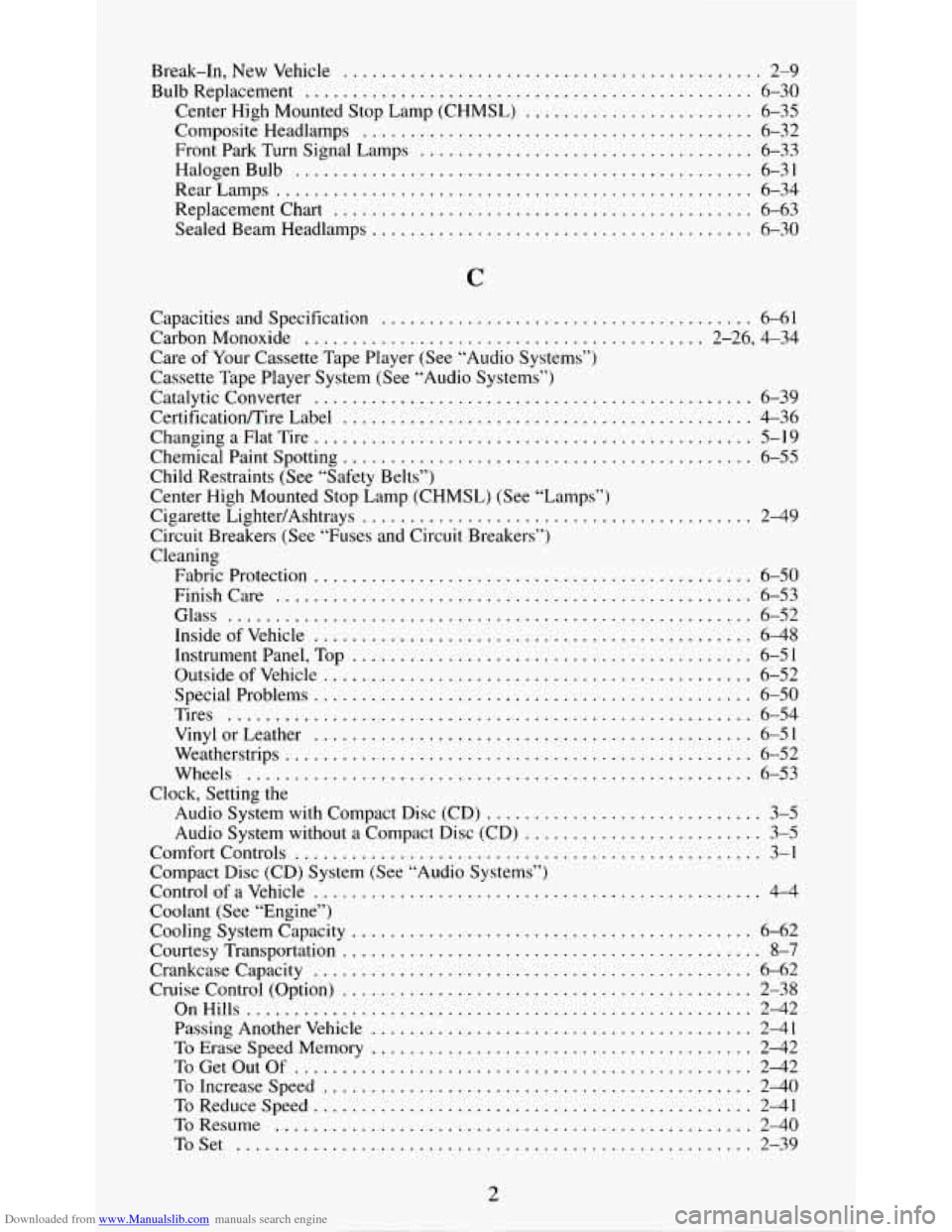
Downloaded from www.Manualslib.com manuals search engine Break.1n. New Vehicle ............................................ 2-9
Bulb Replacement
............................................... 6-30
Composite Headlamps
......................................... 6-32
Halogen Bulb
................................................ 6-31
Replacement Chart ............................................ 6-63
Sealed Beam Headlamps
........................................ 6-30
Center
High Mounted Stop Lamp (CHMSL)
........................ 6-35
Front Park Turn Signal Lamps
................................... 6-33
RearLamps .................................................. 6-34
Capacities and Specification
............ ....................... 6-61
CarbonMonoxide
.......................................... 2-26, 4-34
Care of Your Cassette Tape Player (See “Audio Systems”)
Cassette Tape Player System (See “Audio Systems”)
Catalytic Converter
.............................................. 6-39
CertificatiodTire Label
........................................... 4-36
Changing
a Flat Tire .............................................. 5-19
Chemical Paint Spotting
........................................... 6-55
Cigarette LightedAshtrays
......................................... 2-49
Child
Restraints (See “Safety Belts”)
Center High Mounted Stop Lamp (CHMSL) (See “Lamps“)
Circuit Breakers (See “Fuses and Circuit Breakers”)
Cleaning Fabric Protection
.............................................. 6-50
Finishcare
.................................................. 6-53
Glass ....................................................... 6-52
InsideofVehicle
.............................................. 6-48
Instrumentpanel, Top .......................................... 6-51
Outsideofvehicle
............................................. 6-52
Tires
....................................................... 6-54
VinylorLeather
.............................................. 6-51
Wheels
........................................ ........ 6-53
Special
Problems
.............................................. 6-50
Weatherstrips ................................................. 6-52
Audio System with Compact Disc (CD)
............................. 3-5
Clock, Setting
the
Audio System without
a Compact Disc (CD) ......................... 3-5
Comfort Controls
................................................. 3-1
Compact Disc (CD) System (See “Audio Systems”)
Control
of a Vehicle ........................................... 4-4
Coolant (See “Engine”)
Cooling System Capacity
.......................................... 6-62
Courtesy Transportation
............................................ 8-7
Crankcase Capacity .............................................. 6-62
Cruise Control (Option)
........................................... 2-38
Passing Another Vehicle
........................................ 2-41
To Erase Speed Memory
........................................ 2-42
To Increase Speed
............................................. 2-40
OnHills
..................................................... 2-42
ToGetOutOf
................................................ 2-42
ToReduceSpeed
.............................................. 2-41
ToResume .................................................. 2-40
ToSet ...................................................... 2-39
2
Page 351 of 354
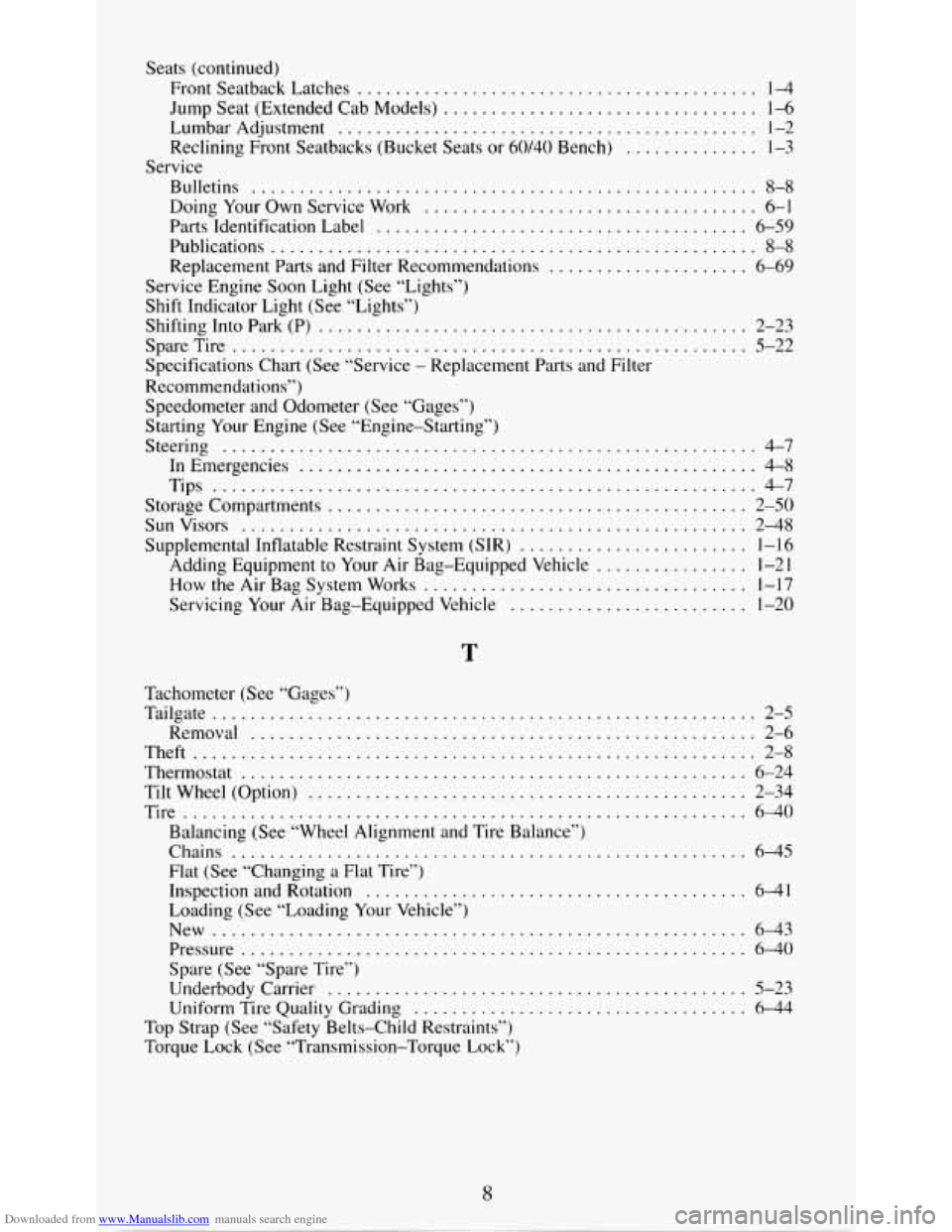
Downloaded from www.Manualslib.com manuals search engine Seats (continued) Front Seatback Latches
.......................................... 1-4
Jump Seat (Extended Cab Models) ................................. 1-6
Lumbar Adjustment ............................................ 1-2
Reclining Front Seatbacks (Bucket Seats or
60/40 Bench) .............. 1-3
Bulletins ..................................................... 8-8
Doing Your Own Service Work ................................... 6-1
Parts Identification Label ....................................... 6-59
Publications ................................................... 8-8
Replacement Parts and Filter Recommendations .... .......... 6-69
Service
Service Engine Soon Light (See “Lights”)
Shift Indicator Light (See “Lights”)
Shifting Into Park
(P) ............................................. 2-23
SpareTire ...................................................... 5-22
Specifications Chart (See “Service - Replacement Parts and Filter
Recommendations”)
Speedometer and Odometer (See “Gages”)
Starting Your Engine (See “Engine-Starting”)
Steering
........................................................ 4-7
InEmergencies ................................................ 4-8
Tips ......................................................... 4-7
Storage Compartments ............................................ 2-50
SunVisors ..................................................... 2-48
Supplemental Inflatable Restraint System (SIR) ........................ 1-16
Adding Equipment to Your Air Bag-Equipped Vehicle ................ 1-21
How the Air Bag System Works .................................. 1-17
Servicing Your Air Bag-Equipped Vehicle ......................... 1-20
T
Tachometer (See “Gages”)
Tailgate
................. ... ............. 2-5
Removal ................................................. 2-6
Theft
........................................................... 2-8
Thermostat ..................................................... 6-24
Tilt Wheel (Option) .............................................. 2-34
Tire ........................................................... 640
Balancing (See “Wheel Alignment and Tire Balance”)
Chains
...................................................... 6-45
Flat (See “Changing a Flat Tire”)
Inspection and Rotation
...................................... 6-41
Loading (See “Loading Your Vehicle”)
New
........................................................ 6-43
Pressure ..................................................... 6-40
Spare (See “Spare Tire”)
Underbody Carrier
............................................ 5-23
Uniform Tire Quality Grading ................................... 6-44
Top Strap (See “Safety Belts-Child Restraints”)
Torque Lock (See “Transmission-Torque Lock”)