ignition CHEVROLET S10 1995 2.G User Guide
[x] Cancel search | Manufacturer: CHEVROLET, Model Year: 1995, Model line: S10, Model: CHEVROLET S10 1995 2.GPages: 354, PDF Size: 18.92 MB
Page 67 of 354
Downloaded from www.Manualslib.com manuals search engine While you accelerate, it is normal for the light to go on and off if you
quickly change the position of the accelerator. Ignore the SHIFT light when
you downshift.
Four- Wheel Drive Vehicles Only:
If your vehicle has four-wheel drive and is equipped with a manual
transmission, disregard the shift light when the transfer case is in
4LO.
Locking Rear Axle
If you have this feature, your rear axle can give you additional traction on
snow, mud, ice, sand or gravel. It
works like a standard axle most of the
time, but when one
of the rear wheels has no traction and the other does, the
locking feature will allow the wheel with traction
to move the vehicle.
Parking Brake
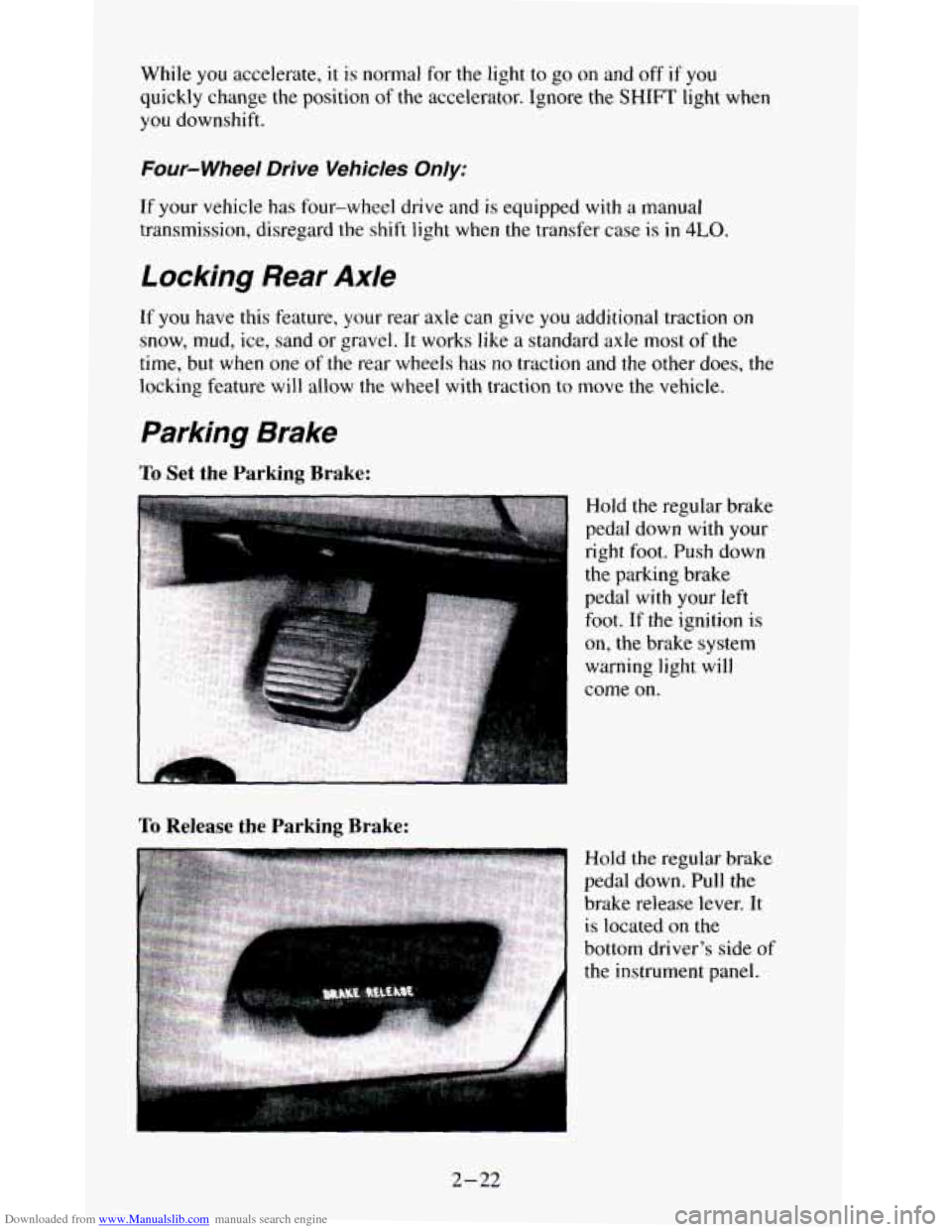
To Set the Parking Brake:
To Release the Parking Brake:
Hold the regular brake
pedal down with your
right
foot. Push down
the parking brake
pedal
with your left
foot. If the ignition is
on, the brake system
warning light will
come on.
Hold the regular brake
pedal down. Pull the
brake release lever.
It
is located on the
bottom driver's side
of
the instrument panel.
2-22
Page 75 of 354
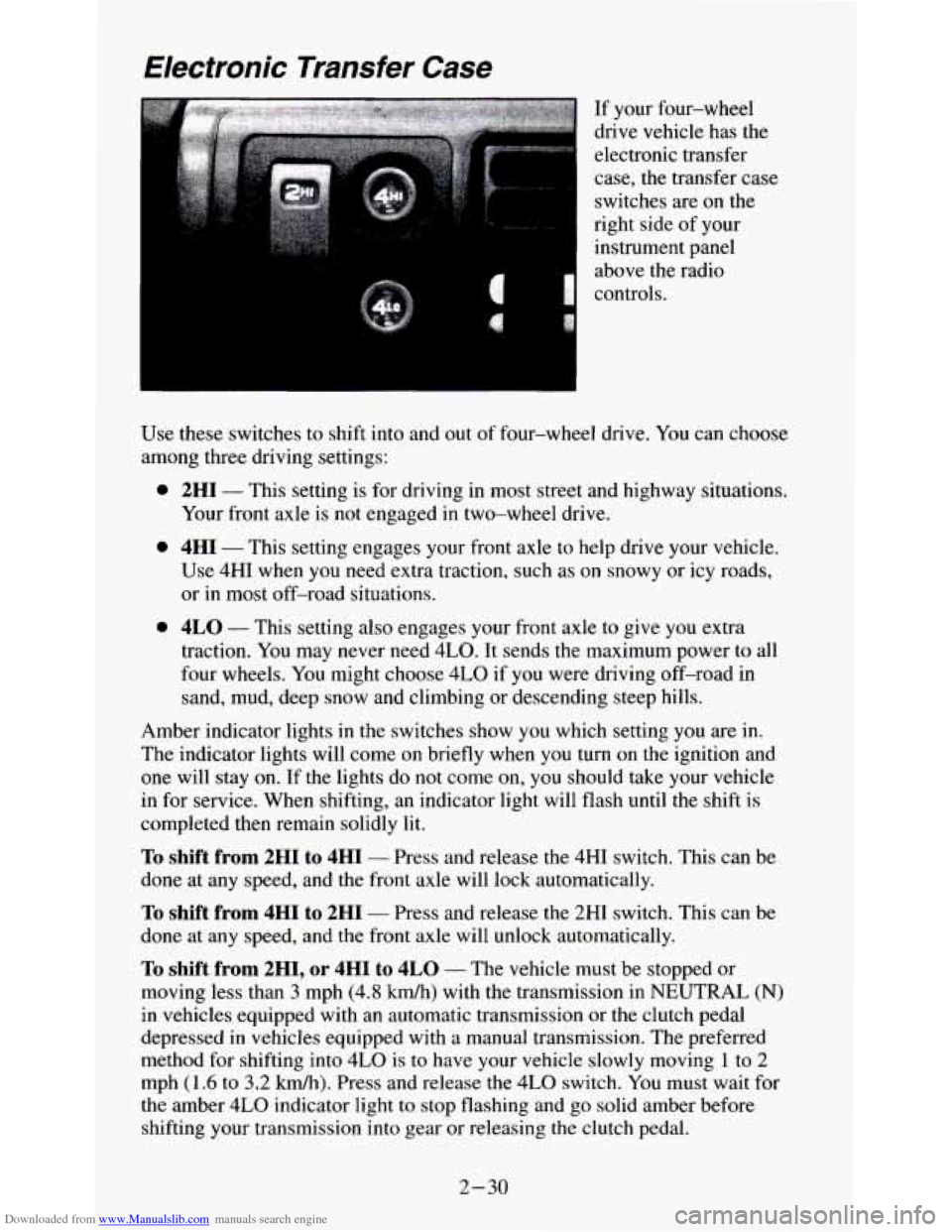
Downloaded from www.Manualslib.com manuals search engine Use these switches to shift into and out of four-wheel drive. You can choose
among three driving settings:
0
0
0
2HI - This setting is for driving in most street and highway situations.
Your front axle
is not engaged in two-wheel drive.
4HI - This setting engages your front axle to help drive your vehicle.
Use 4HI when you need extra traction, such as
on snowy or icy roads,
or
in most off-road situations.
4LO - This setting also engages your front axle to give you extra
traction. You may never need
4LO. It sends the maximum power to all
four wheels. You might choose
4LO if you were driving off-road in
sand, mud, deep snow and climbing or descending steep hills.
Amber indicator lights
in the switches show you which setting you are in.
The indicator lights will come on briefly when you turn on the ignition and
one will stay
on. If the lights do not come on, you should take your vehicle
in for service. When shifting, an indicator light will flash until the shift is
completed then remain solidly lit.
To shift from 2HI to 4HI - Press and release the 4HI switch. This can be
done at any speed, and the front axle will lock automatically.
To shift from 4HI to 2HI - Press and release the 2HI switch. This can be
done at any speed, and the front axle will unlock automatically.
To shift from 2H1, or 4HI to 4LO - The vehicle must be stopped or
moving less than
3 mph (4.8 km/h) with the transmission in NEUTRAL (N)
in vehicles equipped with an automatic transmission or the clutch pedal
depressed
in vehicles equipped with a manual transmission. The preferred
method for shifting into
4LO is to have your vehicle slowly moving 1 to 2
mph (1.6 to 3.2 kdh). Press and release the 4LO switch. You must wait for
the amber
4LO indicator light to stop flashing and go solid amber before
shifting your transmission into gear or releasing
the clutch pedal.
2-30
Page 87 of 354
Downloaded from www.Manualslib.com manuals search engine Using Cruise Control on Hills
How well your Cruise Control will work on hills depends upon your speed,
load, and the steepness of the hills. When going up steep hills, you may
want to step on the accelerator pedal to maintain your speed. When going
downhill, you may have to brake
or shift to a lower gear to keep your speed
down. Of course, applying the brake takes you
out of Cruise Control. Many
drivers find this to be too much trouble and don’t
use Cruise Control on
steep hills.
To Get Out of Cruise Control
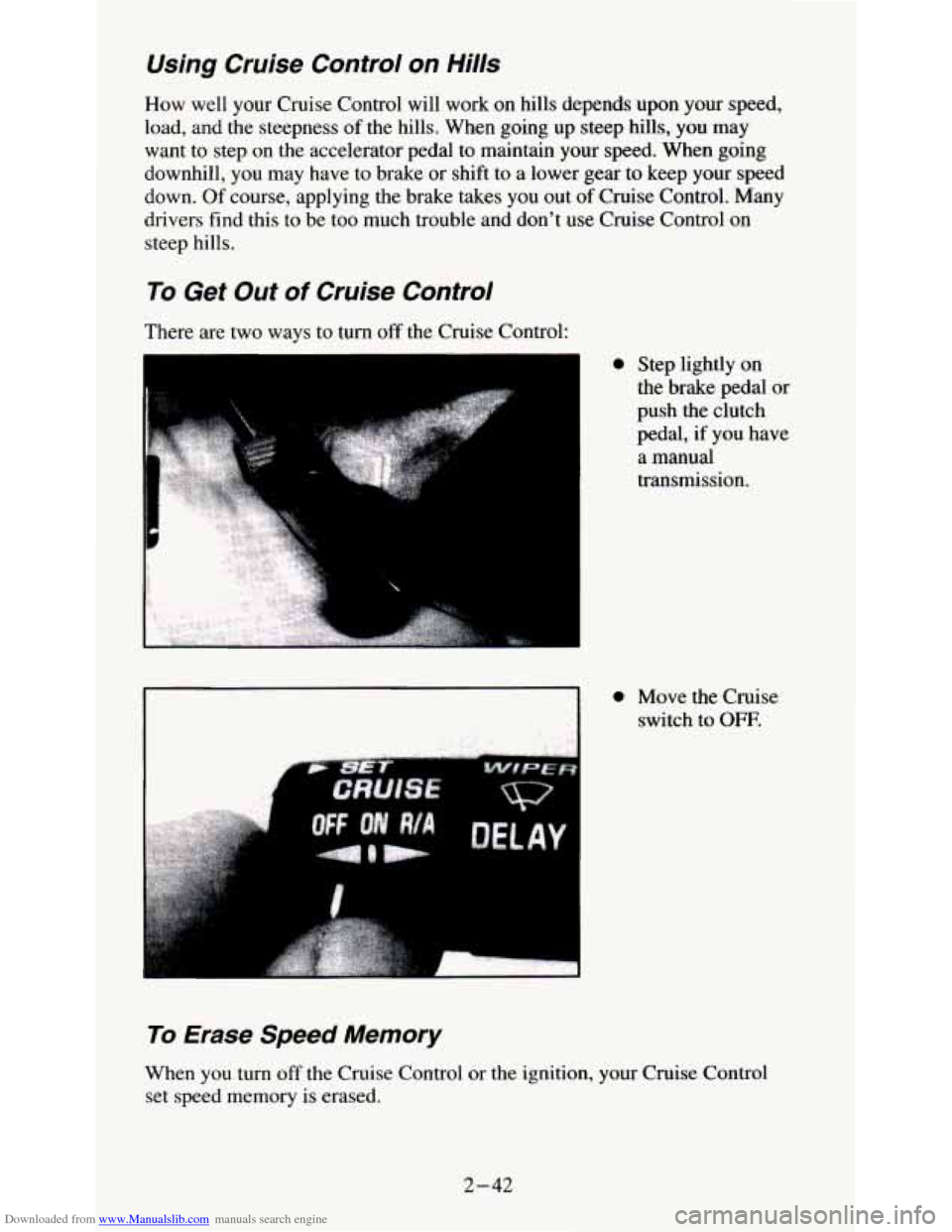
There are two ways to turn off the Cruise Control:
To Erase Speed Memory
0 Step lightly on
the brake pedal or
push the clutch
pedal,
if you have
a manual
transmission.
0 Move the Cruise
switch to
OFF.
When you turn off the Cruise Control or the ignition, your Cruise Control
set speed memory is erased.
2-42
Page 90 of 354
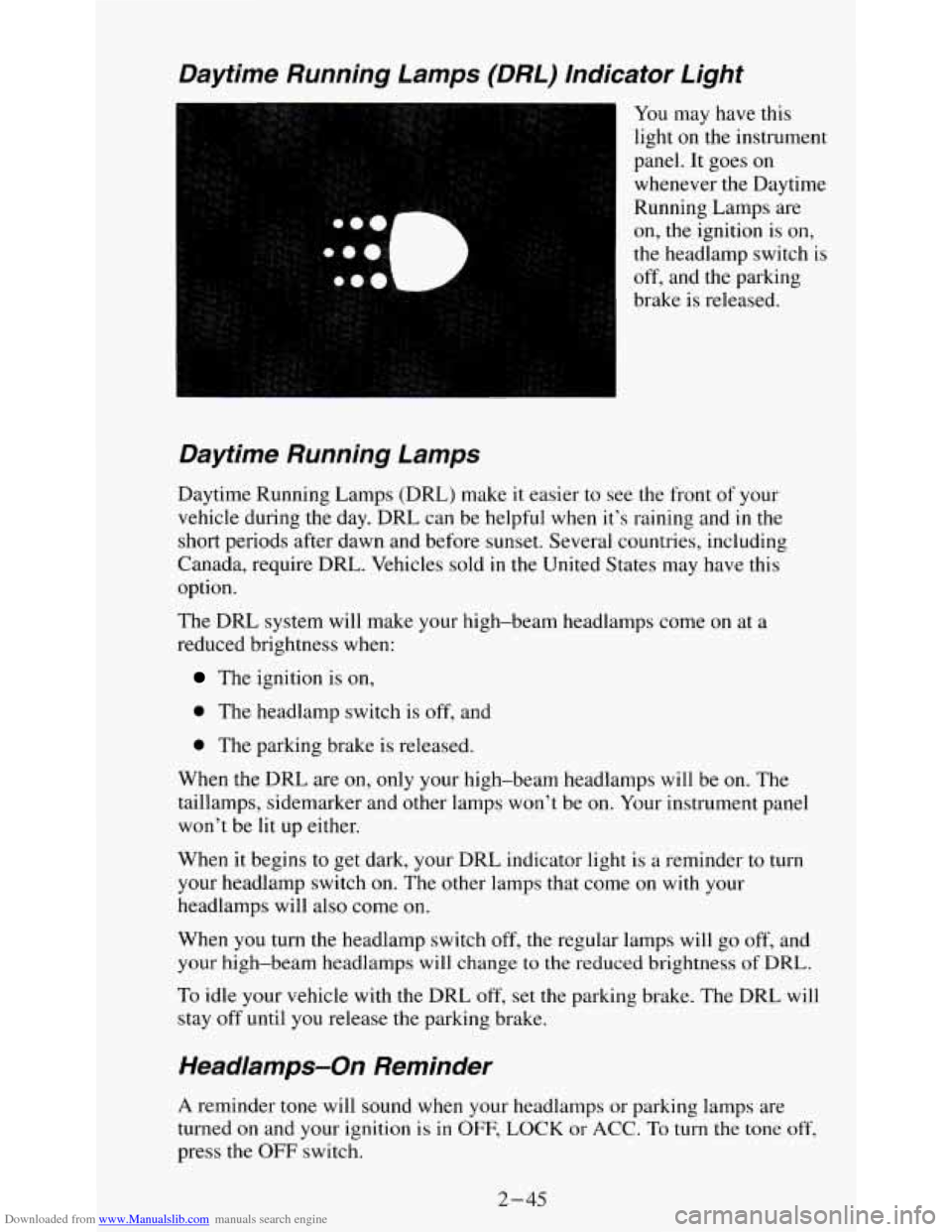
Downloaded from www.Manualslib.com manuals search engine Daytime Running Lamps (DRL) lndicator Light
I You may have this
light
on the instrument
panel.
It goes on
whenever the Daytime
Running Lamps
are
on, the ignition is on,
the headlamp switch is
off, and the parking
brake is released.
Daytime Running Lamps
Daytime Running Lamps (DRL) make it easier to see the front of your
vehicle during the day. DRL can be helpful when it’s raining and
in the
short periods after dawn and before sunset. Several countries, including
Canada, require DRL. Vehicles sold
in the United States may have this
option.
The DRL system will make your high-beam headlamps come
on at a
reduced brightness when:
The ignition is on,
0 The headlamp switch is off, and
0 The parking brake is released.
When the DRL are on, only your high-beam headlamps will be on. The
taillamps, sidemarker and other lamps won’t be
on. Your instrument panel
won’t be lit up either.
When it begins
to get dark, your DRL indicator light is a reminder to turn
your headlamp switch on. The other lamps that come
on with your
headlamps will also come on.
When you turn the headlamp switch off, the regular lamps
will go off, and
your high-beam headlamps will change to the reduced brightness of DRL.
To idle your vehicle with the DRL off, set the parking brake. The DRL will
stay
off until you release the parking brake.
Headamps-On Reminder
A reminder tone will sound when your headlamps or parking lamps are
turned
on and your ignition is in OFF, LOCK or ACC. To turn the tone off,
press the OFF switch.
2-45
Page 91 of 354
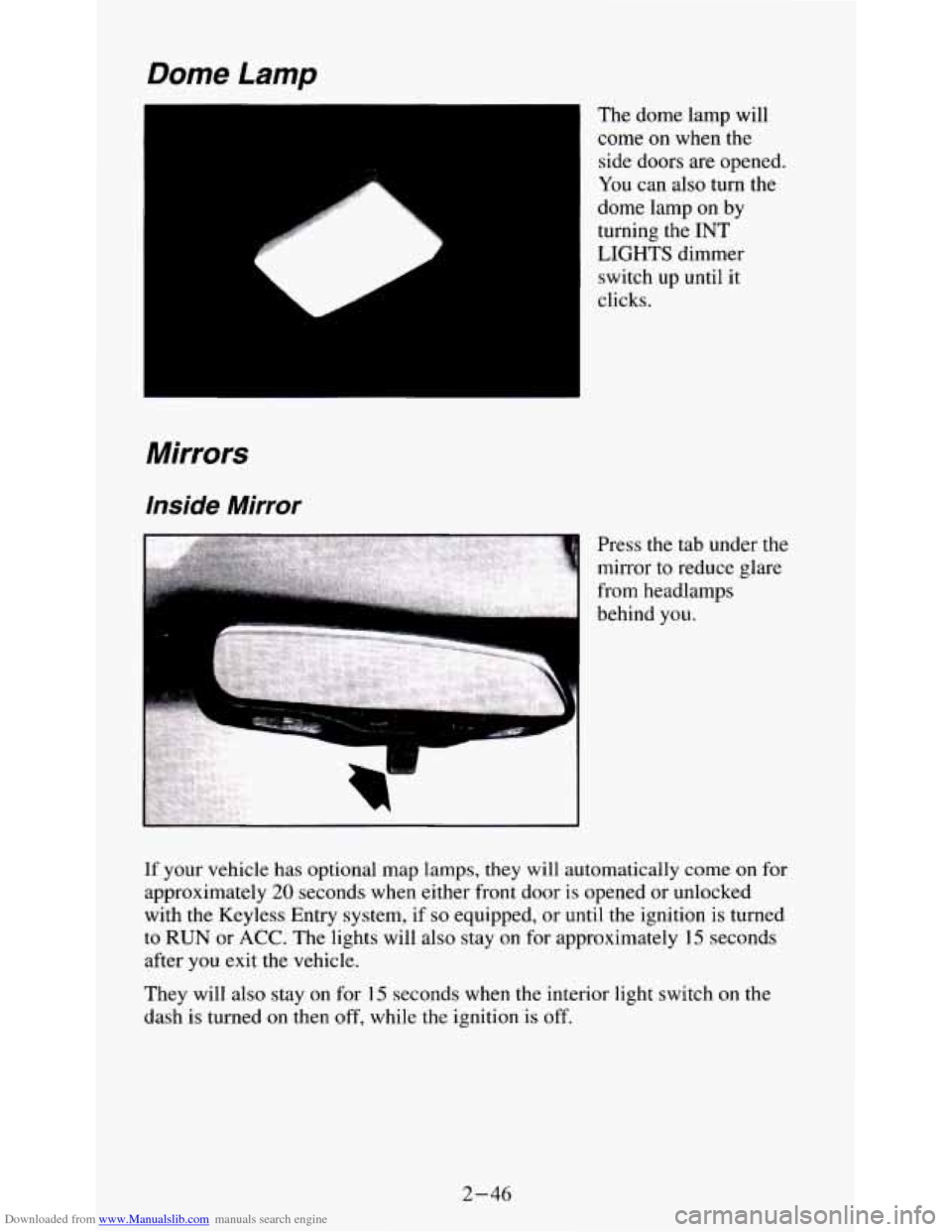
Downloaded from www.Manualslib.com manuals search engine Dome Lamp
L A
The dome lamp will
come
on when the
side doors are opened
You can also turn the
dome lamp on by
turning the INT
LIGHTS dimmer
switch up until it
clicks.
Mirrors
Inside Mirror
If your vehicle has optional map lamps, they will automatically come on for
approximately
20 seconds when either front door is opened or unlocked
with
the Keyless Entry system, if so equipped, or until the ignition is turned
to RUN or ACC. The lights will also stay on for approximately 15 seconds
after you exit the vehicle.
They will also stay on for 15 seconds when the interior light switch on the
dash is turned
on then off, while the ignition is off.
2-46
Page 103 of 354
Downloaded from www.Manualslib.com manuals search engine You will see this light flash for a few seconds when you turn your ignition
to RUN or START. Then the light should go out. This means the system is
ready.
If the air bag readiness light doesn’t come
on when you start your vehicle,
or stays on, or comes
on when you are driving, your air bag system may not
work properly. Have your vehicle serviced right away.
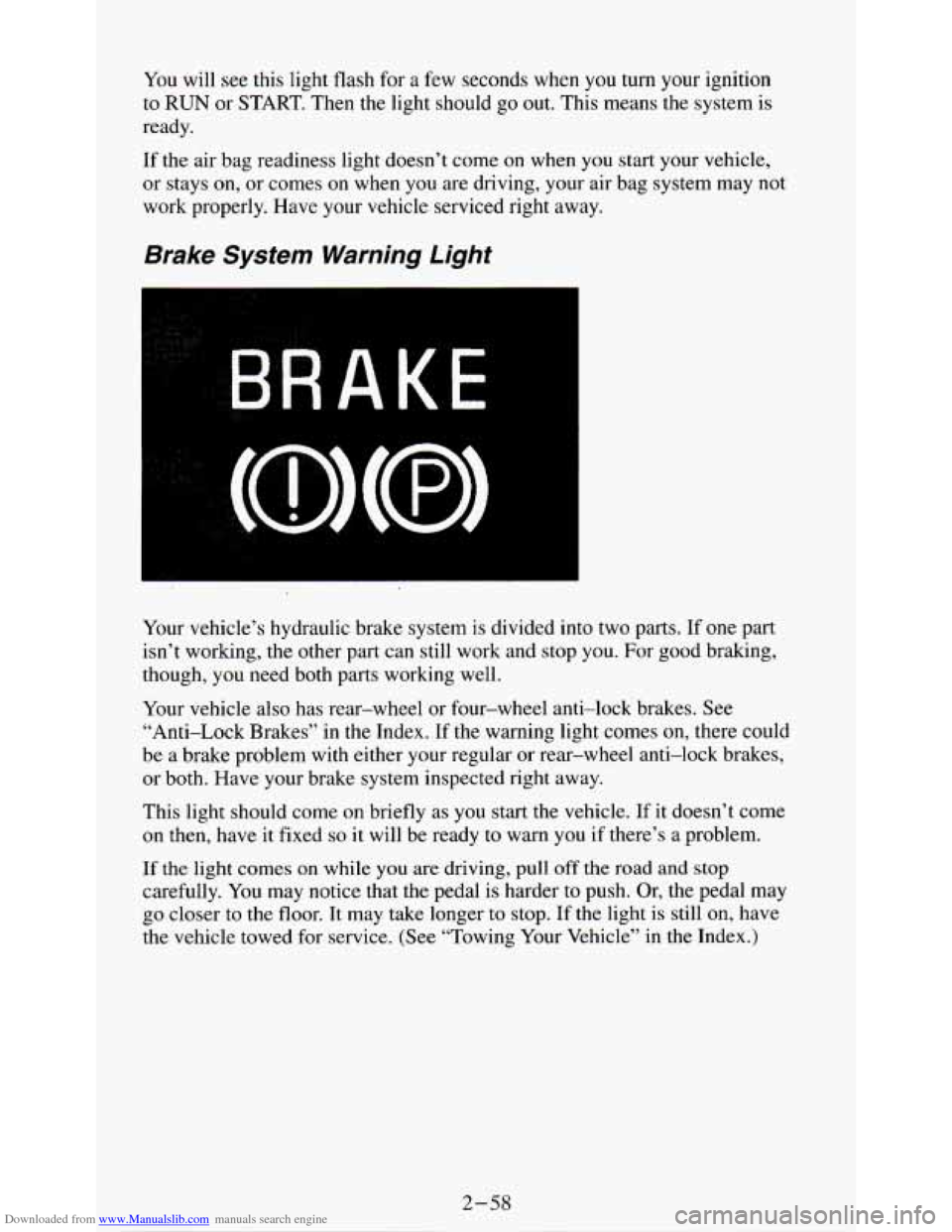
Brake System Warning Light
-1
BRAKE
Your vehicle’s hydraulic brake system is divided into two parts. If one part
isn’t working, the other part can still work and stop you. For good braking,
though, you need both parts working well.
Your vehicle also has rear-wheel or four-wheel anti-lock brakes. See
“Anti-Lock Brakes” in the Index. If the warning light comes on, there could
be a brake problem with either your regular or rear-wheel anti-lock brakes,
or both. Have your brake system inspected right away.
This light should come
on briefly as you start the vehicle. If it doesn’t come
on then, have it fixed
so it will be ready to warn you if there’s a problem.
If the light comes on while you are driving, pull off the road and stop
carefully. You may notice that the pedal is harder
to push. Or, the pedal may
go closer to the floor. It may take longer to stop. If the light
is still on, have
the vehicle towed for service. (See “Towing Your Vehicle” in the Index.)
2-58
Page 105 of 354
Downloaded from www.Manualslib.com manuals search engine Indicator Lights
Indicator lights go on when you use your turn signals, change from low
beam headlights
to high beams, or when you use your hazard flashers. The
next few pages will also tell you about the indicator lights on your vehicle
and help
you locate them.
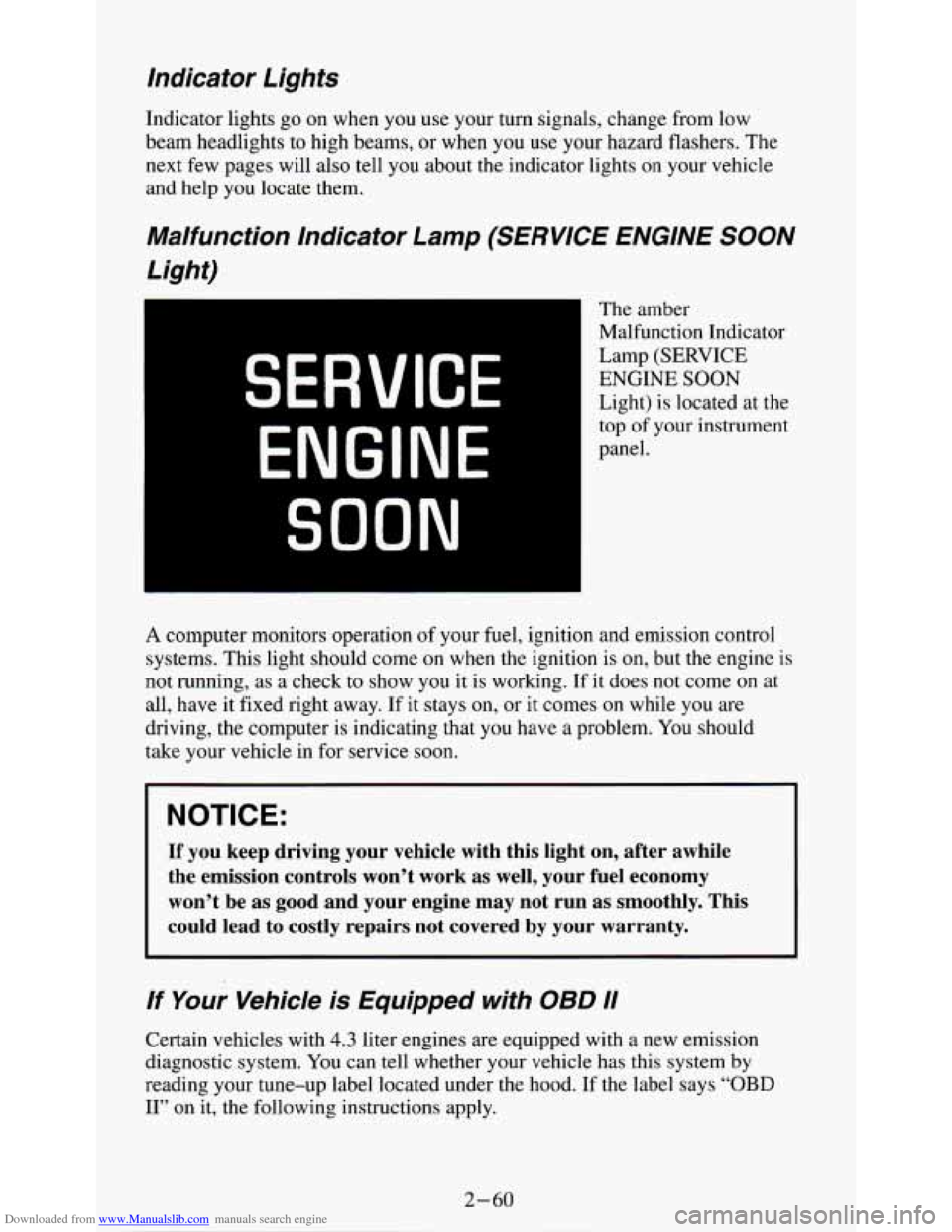
Malfunction Indicator Lamp (SERVICE ENGINE SOON
Light)
The amber
Malfunction Indicator
Lamp (SERVICE
ENGINE SOON
Light) is located at the
top of your instrument
panel.
SERVICE
ENGINE
SOON
A computer monitors operation of your fuel, ignition and emission control
systems. This light should come
on when the ignition is on, but the engine is
not running, as a check to show you it is working. If it does not come
on at
all, have it fixed right away.
If it stays on, or it comes on while you are
driving, the computer is indicating that
you have a problem. You should
take your vehicle in for service
soon.
NOTICE:
If you keep driving your vehicle with this light on, after awhile
the emission controls won’t work as well, your fuel economy
won’t be as good and your engine may not run as smoothly. This
could lead
to costly repairs not covered by your warranty.
If Your Vehicle is Equipped with OBD I1
Certain vehicles with 4.3 liter engines are equipped with a new emission
diagnostic system. You can tell whether your vehicle has this system
by
reading your tune-up label located under the hood. If the label says “OBD
11” on it, the following instructions apply.
Page 106 of 354
Downloaded from www.Manualslib.com manuals search engine Malfunction Indicator Lamp (SERVICE ENGINE SOON Light)
Your vehicle is equipped with an onboard computer which monitors
operation of the emission control system. This system is called OBD I1
(On-Board Diagnostics-Second Generation) and is intended to assure that
emissions are at acceptable levels for the life of the vehicle, helping to
produce a cleaner environment. The “SERVICE ENGINE
SOON’ light
comes on to indicate when service is required. Malfunctions often will be
indicated by
the system before any problem is apparent, which may prevent
more serious damage to your vehicle. This system is also designed to assist
your service technician in correctly diagnosing any malfunction.
The “SERVICE ENGINE
SOON, light should come on, as a check to show
you it is working, when the ignition is on and the engine is not running. This
light will also come during a malfunction in one
of two ways:
0
0
Light on steady - indicates a system malfunction has been detected.
Drive the vehicle to the dealer for service at your first opportunity.
Light flashing
- indicates a misfire has been detected which may
damage the emission control system. The damage may be reduced by
lowering the vehicle speed, reducing the amount of cargo being hauled
or trailered, avoiding hard acceleration, or by avoiding steep uphill
grades.
If these actions are effective, the light will stop flashing and
remain on steady. Drive the vehicle to a dealer for service. If the light
continues to flash, stop the vehicle. Wait for a steady light to come on,
then drive the vehicle to a dealer for service.
These following conditions also may cause the “SERVICE ENGINE
SOON” light to come on:
Low FueVOut of Fuel
- As the vehicle starts to run out of fuel the
“SERVICE ENGINE
SOON” light may come on as a result of an engine
misfire. Filling your gasoline tank should correct this condition. Make sure
to install the gas cap fully. It will require a few driving trips to turn the light
off.
Poor Quality Fuel
- Be sure to fuel your vehicle with quality fuel. Your
engine may not run efficiently on poor fuel. Poor fuel may cause stalling,
hesitation or misfire. These conditions may go away when the engine is
warned-up. However, poor quality fuel may cause the “SERVICE ENGINE
SOON, light to come on.
Have a dealer check the vehicle. If no problems are found, you may want to
change to another brand
of fuel.
Driving Through Standing Water
- Driving your vehicle through puddles
of deep standing water may result in a temporary misfire condition. This
condition will usually correct itself shortly after the electrical system dries
out. It will require a few driving trips to turn the light off.
2-61
Page 107 of 354
Downloaded from www.Manualslib.com manuals search engine Charging System lndicator Light
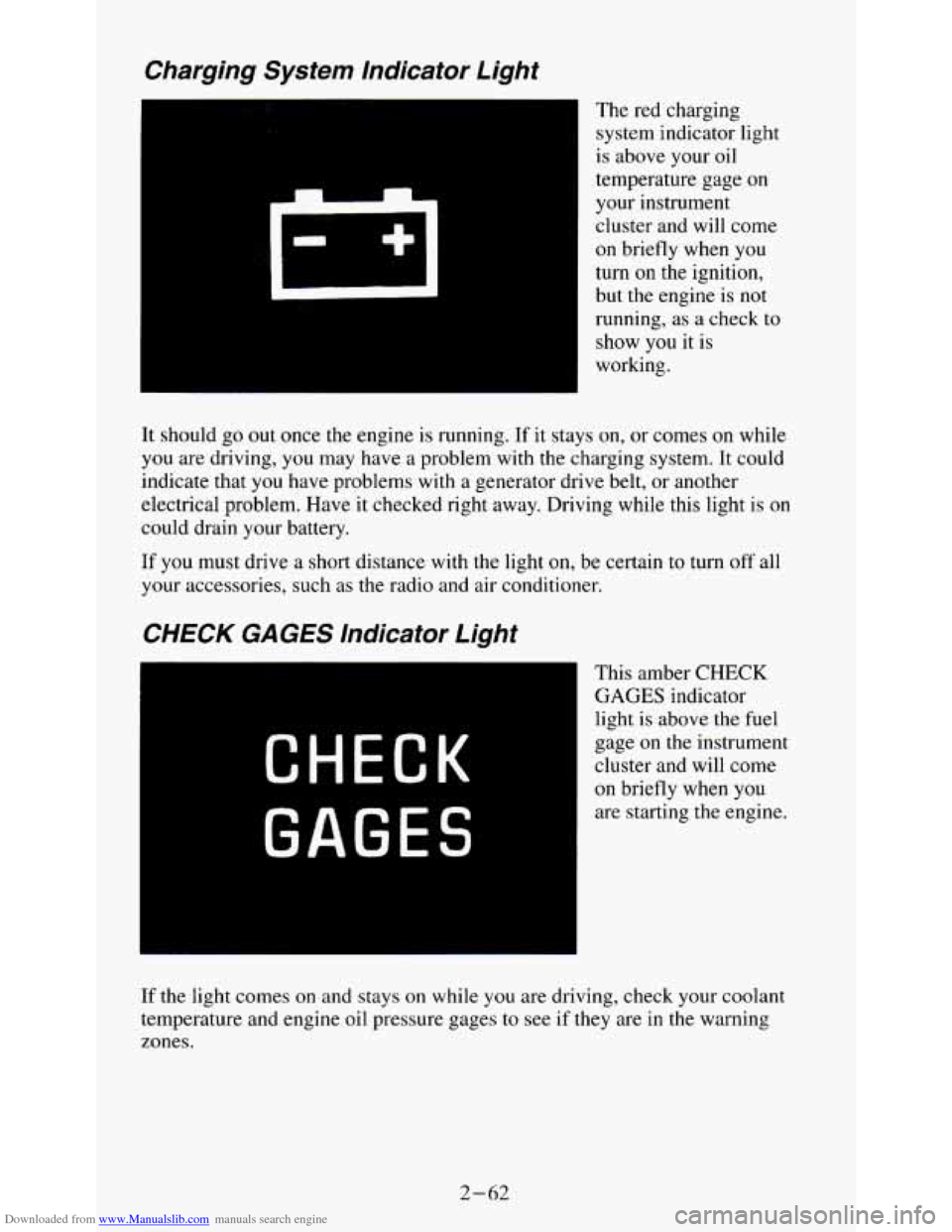
The red charging
system indicator light
is above your oil
temperature gage on
your instrument
cluster and will come
on briefly when you
turn
on the ignition,
but the engine is
not
running, as a check to
show you it is
working.
It should go
out once the engine is running. If it stays on, or comes on while
you are driving, you may have a problem with the charging system. It could
indicate that
you have problems with a generator drive belt, or another
electrical problem. Have it checked right away. Driving while this light is
on
could drain your battery.
If you must drive a short distance with the light on, be certain to turn off all
your accessories, such as the radio and air conditioner.
CHECK GAGES lndicator Light
CHECK
GAGES
This amber CHECK
GAGES indicator
light
is above the fuel
gage
on the instrument
cluster and will come
on briefly when you
are starting the engine.
If the light comes on and stays on while you are driving, check your coolant
temperature and engine oil pressure gages
to see if they are in the warning
zones.
2-62
Page 108 of 354
Downloaded from www.Manualslib.com manuals search engine Daytime Running Lamps (DRL) Indicator Light
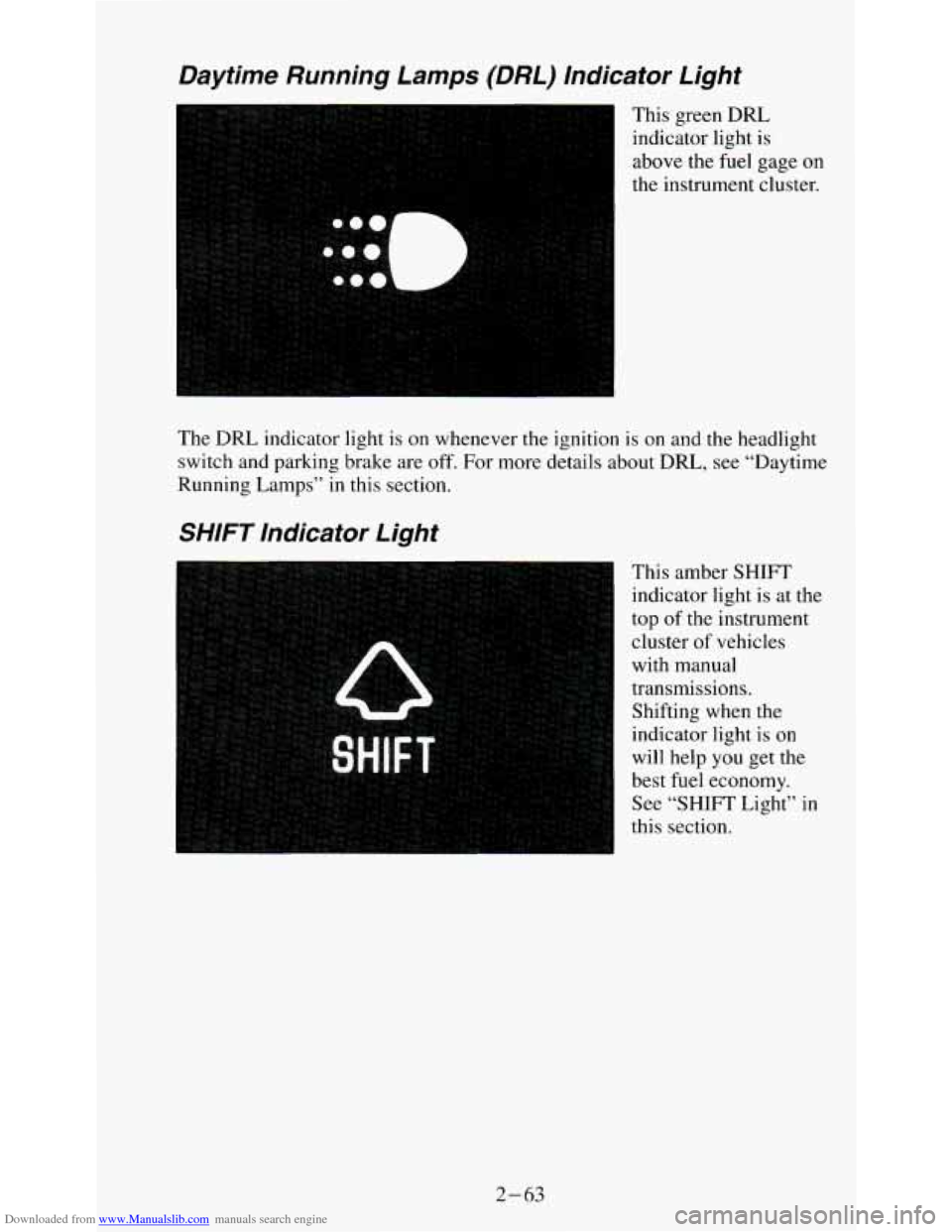
This green DRL
indicator light is
above the fuel gage on
the instrument cluster.
The
DRL indicator light is on whenever the ignition is on and the headlight
switch and parking brake are off. For more details about
DRL, see “Daytime
Running
Lamps” in this section.
SHIFT Indicator Light
This amber SHIFT
indicator light is at the
top of the instrument
cluster of vehicles
with manual
transmissions.
Shifting when the
indicator light
is on
will help
you get the
best fuel economy.
See “SHIFT Light”
in
this section.
2- 63