tow CHEVROLET S10 1995 2.G Service Manual
[x] Cancel search | Manufacturer: CHEVROLET, Model Year: 1995, Model line: S10, Model: CHEVROLET S10 1995 2.GPages: 354, PDF Size: 18.92 MB
Page 201 of 354
Downloaded from www.Manualslib.com manuals search engine Engine Fan Noise
This vehicle has a clutched engine cooling fan. When the clutch is engaged,
the fan spins faster to provide more air to cool the engine. In most every day
driving conditions the clutch is not engaged. This improves fuel economy
and reduces fan noise. Under heavy vehicle loading, trailer towing and/or
high outside temperatures, the fan speed increases when
the clutch engages.
So you may hear an increase in fan noise. This is normal and should not be
mistaken as the transmission slipping or making extra shifts. It is merely the
cooling system functioning properly. The fan will slow down when
additional cooling is not required and the clutch disengages.
You may also hear this fan noise when you start the engine. It will go away
as the fan clutch disengages.
if a Tire Goes Flat
It’s unusual for a tire to “blow out” while you’re driving, especially if you
maintain your tires properly. If air goes out of
a tire, it’s much more likely to
leak out slowly. But if you should ever have a “blowout,” here are a few tips
about what to expect and
what to do:
If a front tire fails, the flat tire
will create a drag that pulls the vehicle
toward that side. Take your foot off the accelerator pedal and grip the
steering wheel firmly. Steer to maintain lane position, then gently brake to a
stop well out of the traffic lane.
A rear blowout, particularly on a curve, acts much like a skid and may
require the same correction you’d use in a skid. In any rear blowout, remove
your foot from
the accelerator pedal. Get the vehicle under control by
steering the way you want the vehicle to go. It may be very bumpy and
noisy, but you can still steer. Gently brake to a stop, well off the road if
possible.
If a tire goes flat, the next part shows how to use your jacking equipment to
change a flat tire safely.
5-18
Page 206 of 354
Downloaded from www.Manualslib.com manuals search engine To Remove the Underbody-Mounted Spare Tire
I NOTICE:
Never remove or restow a tire frodto a stowage position under
the vehicle while the vehicle is supported by a jack. Always
tighten the tire fully against the underside of the vehicle wh\
en restowing.
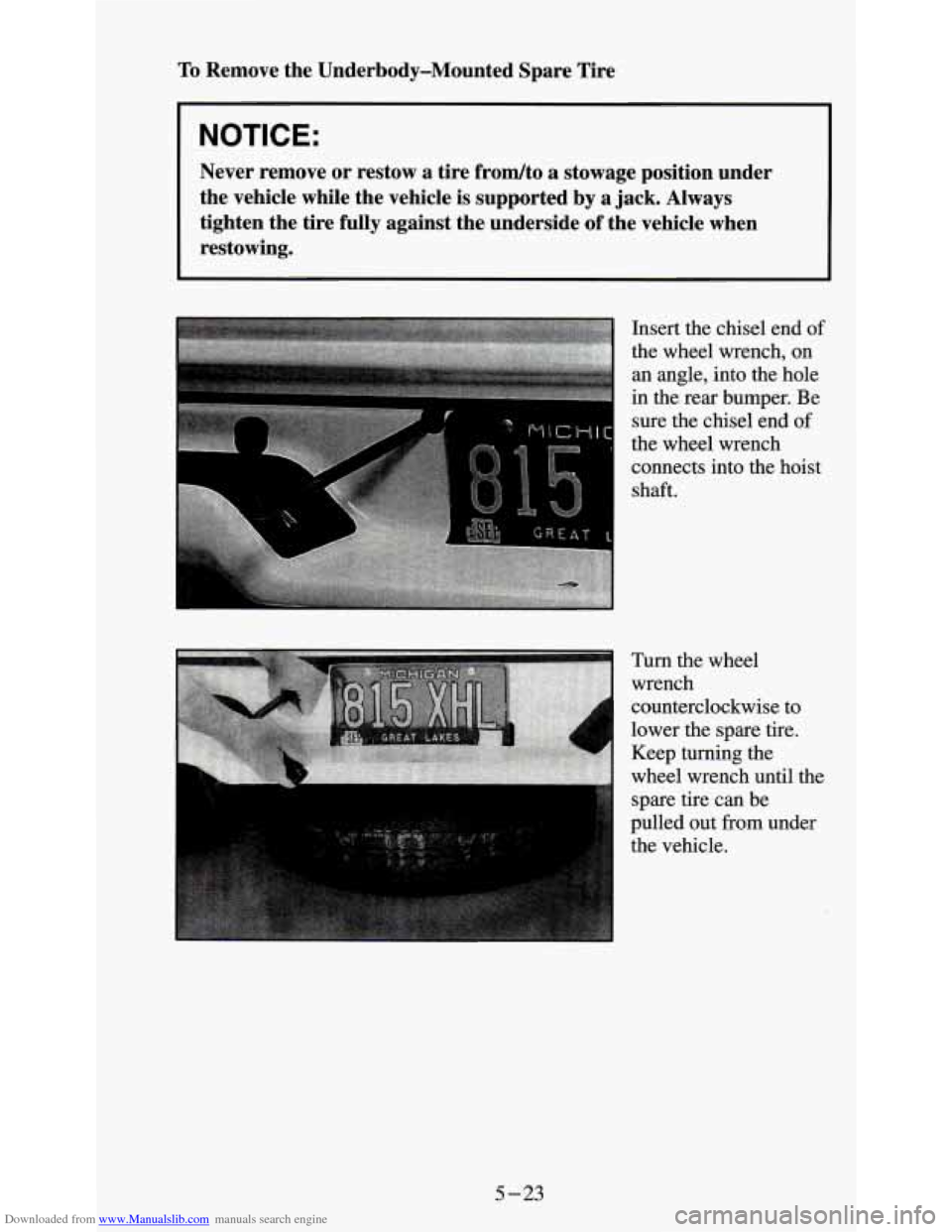
Insert the chisel end of
the wheel wrench, on
an angle, into the hole
in the rear bumper. Be
sure the chisel end
of
the wheel wrench
connects into the hoist
shaft.
... spare tire can be
pulled out from under
the vehicle.
5-23
Page 213 of 354
Downloaded from www.Manualslib.com manuals search engine Put on the spare tire.
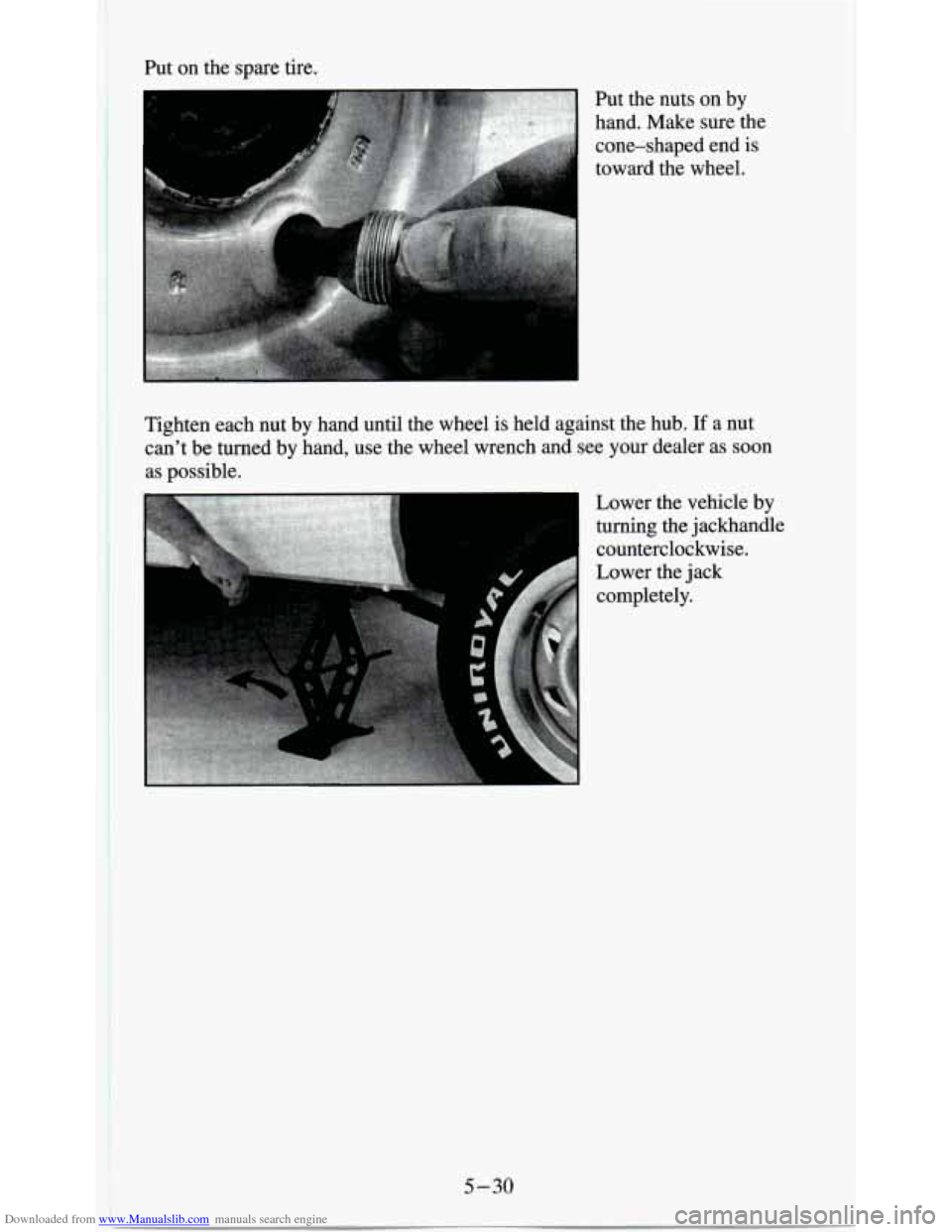
Put the nuts on by
hand.
Make sure the
cone-shaped end is
toward the wheel.
I ~~~~,,~.;"~,'~~~~~~.~~~ . ;,~,$ + ii ,,
Tighten each nut by hand until the wheel is held against the hub. If a nut
can't be turned by hand, use the wheel wrench and see your dealer as soon
as possible.
Lower the vehicle by
turning the jackhandle
counterclockwise.
Lower the jack
completely.
I 5-30 ~
i
Page 216 of 354

Downloaded from www.Manualslib.com manuals search engine NOTICE:
Spinning your wheels can destroy parts of your vehicle as well\
as
the tires. If you spin the wheels too fast while shifting you\
r
transmission back and forth, you can destroy your transmission. \
For information about using tire chains on your vehicle, see “Tire Chains”
in the Index.
Rocking your vehicle to get it out:
First, turn your steering wheel left and right. That will clear the area around
your front wheels. Then shift back and forth between REVERSE (R) and a
forward gear (or with a manual transmission, between FIRST
(1) or
SECOND
(2) gear and REVERSE), spinning the wheels as little as possible.
Release the accelerator pedal while you shift, and press lightly
on the
accelerator pedal when the transmission
is in gear. If that doesn’t get you
out after a few tries, you may need to be towed out. Or, you can use your
recovery hooks, if your vehicle has them.
If you do need to be towed out,
see “Towing Your Vehicle” in the Index.
Using the Recovery Hooks
Your vehicle may be equipped with recovery hooks. The recovery hooks are
provided at the front of your vehicle. You may need to use them
if you’re
stuck off-road and need to be pulled to some place where you can continue
driving.
5-33
Page 217 of 354
Downloaded from www.Manualslib.com manuals search engine NOTICE:
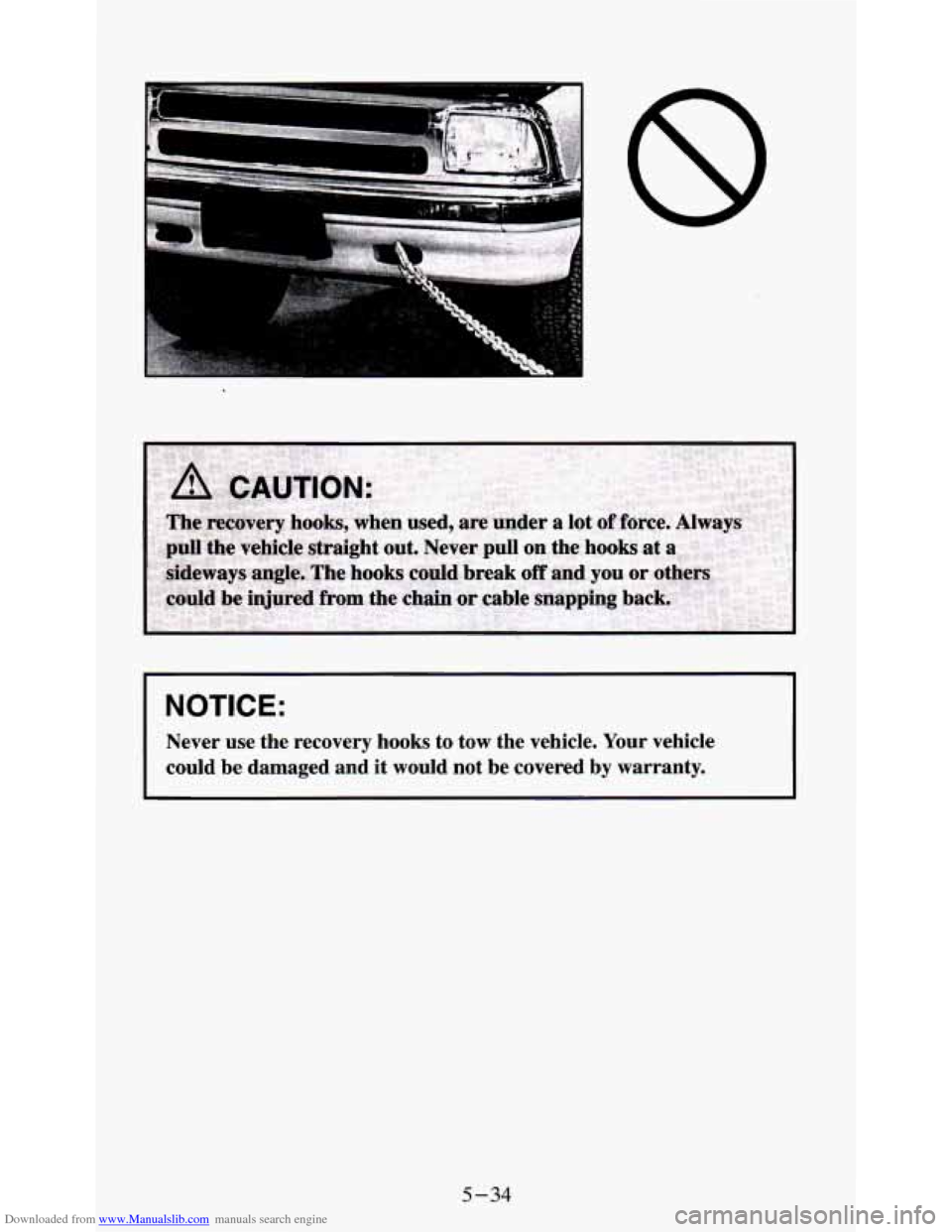
Never use the recovery hooks to tow the vehicle. Your vehicle
could be damaged and it would not be covered by warranty.
5-34
Page 219 of 354
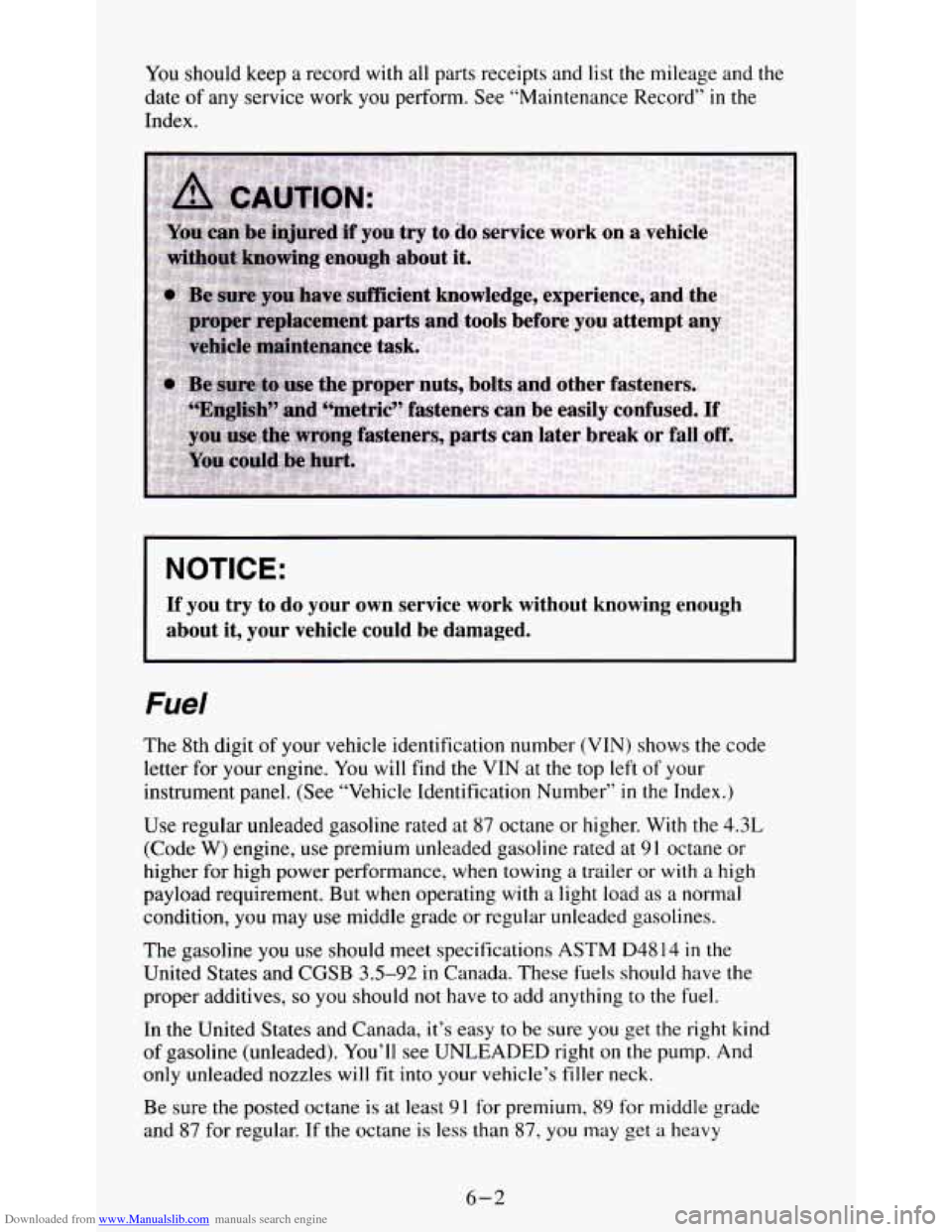
Downloaded from www.Manualslib.com manuals search engine You should keep a record with all parts receipts and list the mileage and the
date
of any service work you perform. See “Maintenance Record” in the
Index.
NOTICE:
If you try to do your own service work without knowing enough
about it, your vehicle could be damaged.
Fuel
The 8th digit of your vehicle identification number (VIN) shows the code
letter for your engine. You will find the VIN at the top left
of your
instrument panel. (See “Vehicle Identification Number”
in the Index.)
Use regular unleaded gasoline rated at 87 octane or higher. With the
4.3L
(Code W) engine, use premium unleaded gasoline rated at 9 1 octane or
higher for high power performance, when towing
a trailer or with a high
payload requirement. But when operating with a light load
as a normal
condition, you may use middle grade or regular unleaded gasolines.
The gasoline you use should meet specifications
ASTM D48 14 in the
United States and CGSB
3.5-92 in Canada. These fuels should have the
proper additives,
so you should not have to add anything to the fuel.
In the United States and Canada, it’s easy to be sure you get the right kind
of gasoline (unleaded). You’ll see UNLEADED right on the pump. And
only unleaded nozzles will fit into your vehicle’s filler neck.
Be sure the posted octane
is at least 91 for premium, 89 for middle grade
and 87 for regular. If the octane
is less than 87, you may get a heavy
6-2
Page 225 of 354
Downloaded from www.Manualslib.com manuals search engine Engine Oil
It’s a good idea to check your engine oil every time you get fuel. In order to
get an accurate reading, the oil must be warm and the vehicle must be on
level ground.
Turn off the engine
and give the
oil a few
minutes to drain back
into the oil pan.
If you
don’t, the oil dipstick
might not show the
actual level.
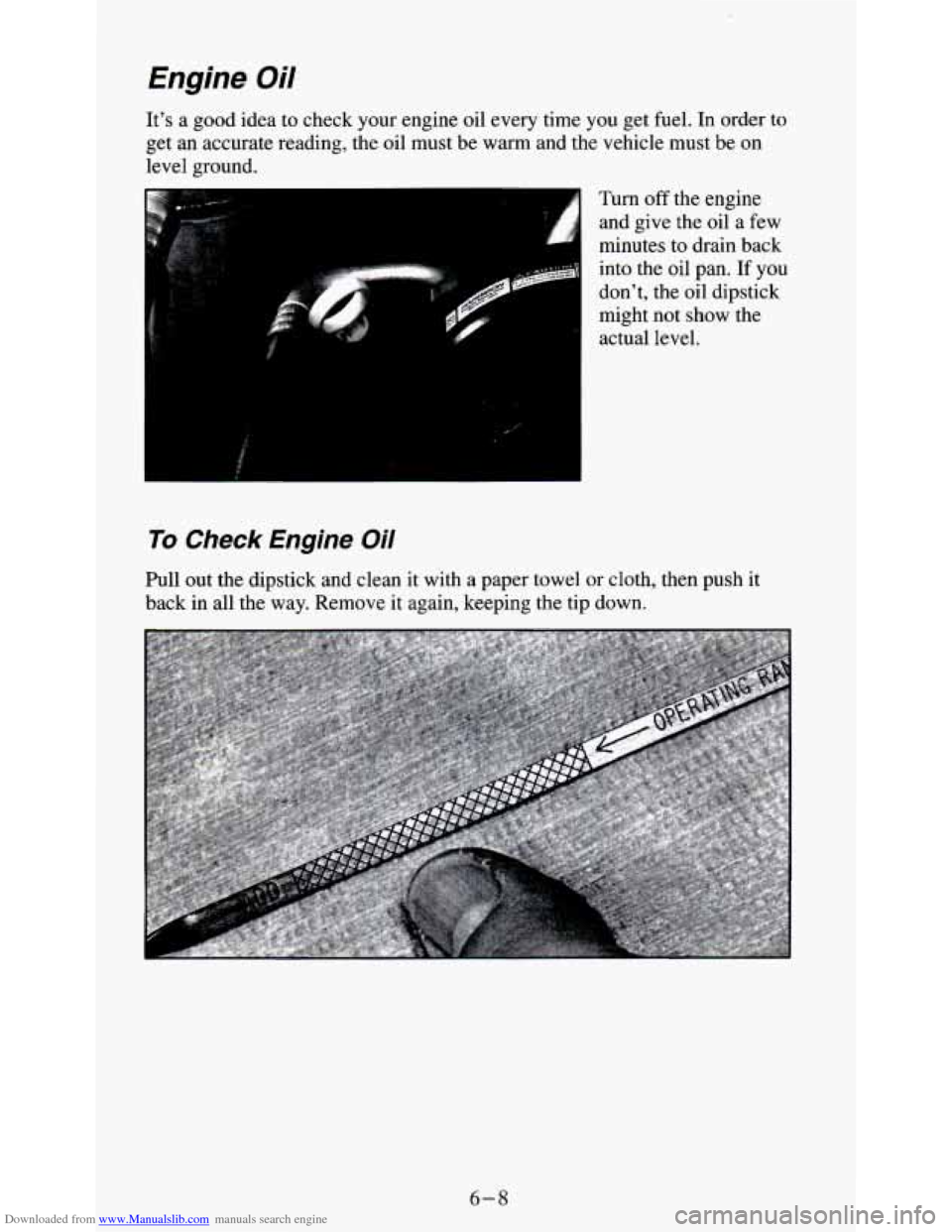
To Check Engine Oil
Pull out the dipstick and clean it with a paper towel or cloth, then push it
back in all the way. Remove it again, keeping the tip down.
6-8
Page 228 of 354
Downloaded from www.Manualslib.com manuals search engine I NOTICE:
Use only engine oil with the American Petroleum Institute Certified For Gasoline Engines “Starburst” symbol. Failure \
to
use the proper oil can result in engine damage not covered by
your warranty.
GM Goodwrench@ oil (in Canada, GM Engine Oil) meets all the
requirements for your vehicle.
Engine Oil Additives
Don’t add anything to your oil. Your GM dealer is ready to advise if you
think something should be added.
When to Change Engine Oil
See if any one of these is true for you:
Most trips are less than 5 to 10 miles (8 to 16 km). This is particularly
important when outside temperatures are below freezing.
Most trips include extensive idling (such as frequent driving in stop and
go traffic).
You operate your vehicle in dusty areas or off-road frequently.
0 You frequently tow a trailer.
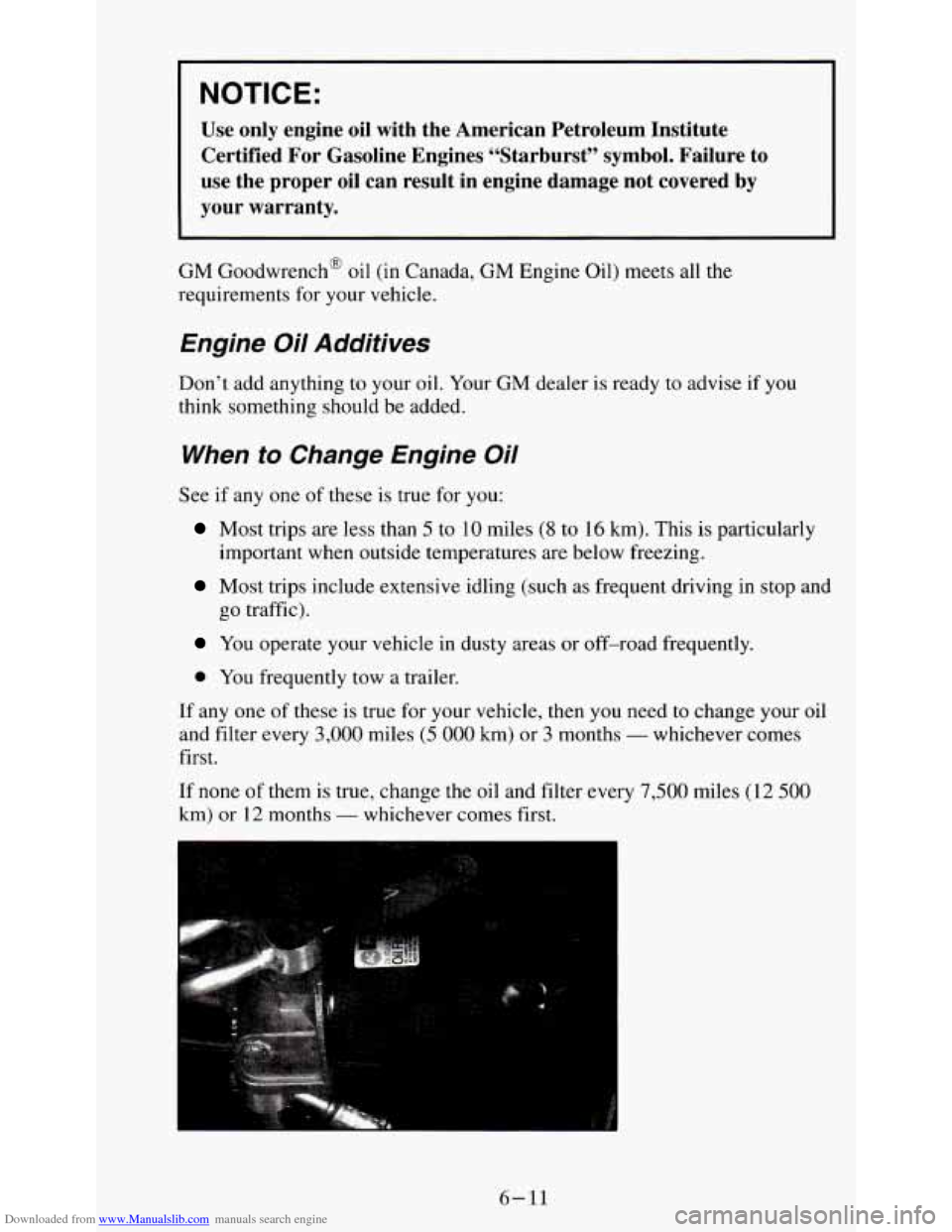
If any one of these is true for your vehicle, then
you need to change your oil
and filter every
3,000 miles (5 000 km) or 3 months - whichever comes
first.
If none of them is true, change the
oil and filter every 7,500 miles (12 500
km) or 12 months - whichever comes first.
6- 11
Page 230 of 354
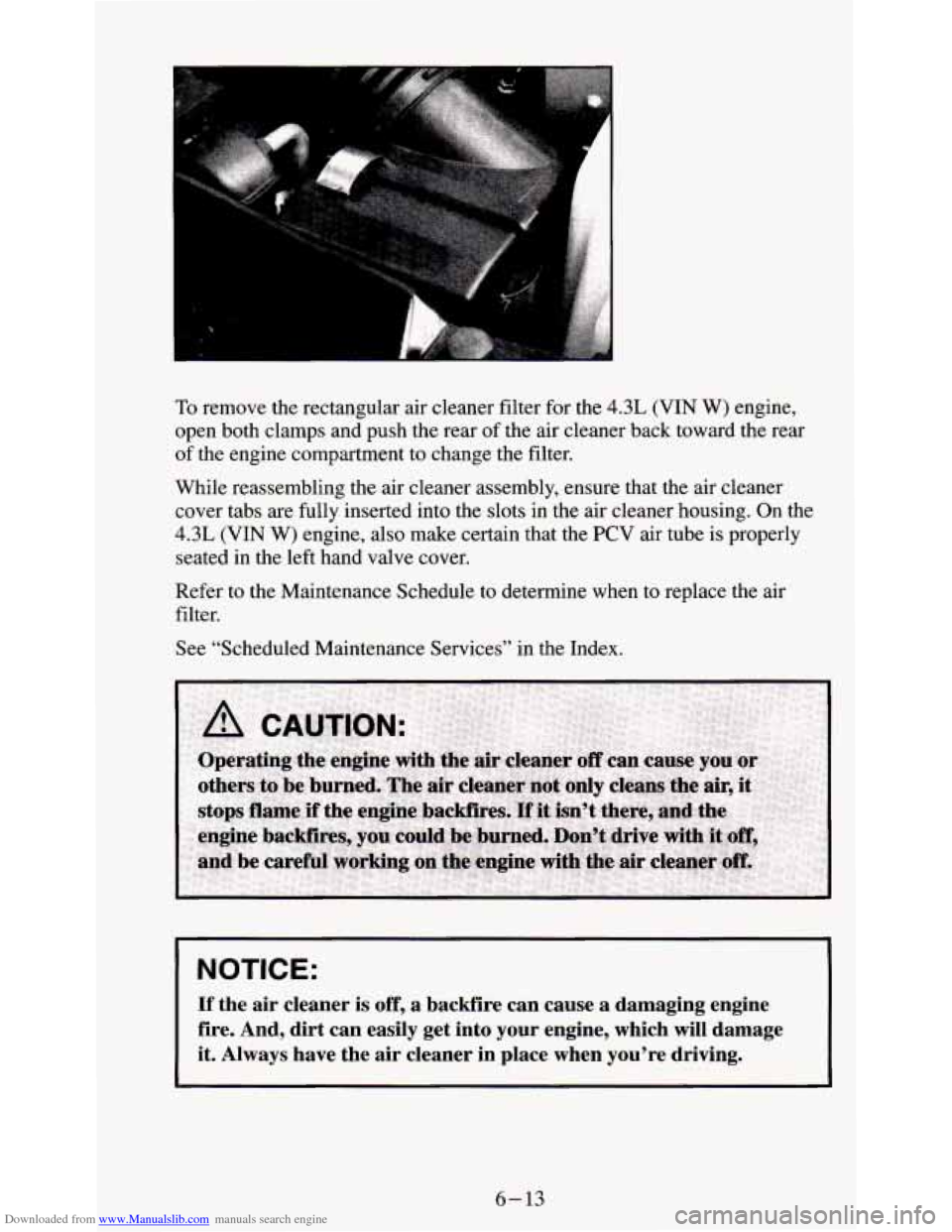
Downloaded from www.Manualslib.com manuals search engine To remove the rectangular air cleaner filter for the 4.3L (VIN W) engine,
open both clamps and push the rear of the air cleaner back toward the rear
of the engine compartment to change the filter.
While reassembling the air cleaner assembly, ensure that the air cleaner
cover tabs are fully inserted into the slots in the air cleaner housing. On the
4.3L (VIN W) engine, also make certain that the PCV air tube is properly
seated in the left hand valve cover.
Refer to the Maintenance Schedule to determine when to replace the air
filter.
See “Scheduled Maintenance Services’’ in the Index.
I NOTICE:
If the air cleaner is off, a backfire can cause a damaging engine
fire. And, dirt can easily get into your engine, which
will damage
it. Always have the air cleaner in place when you’re drivin\
g.
6- 13
Page 232 of 354
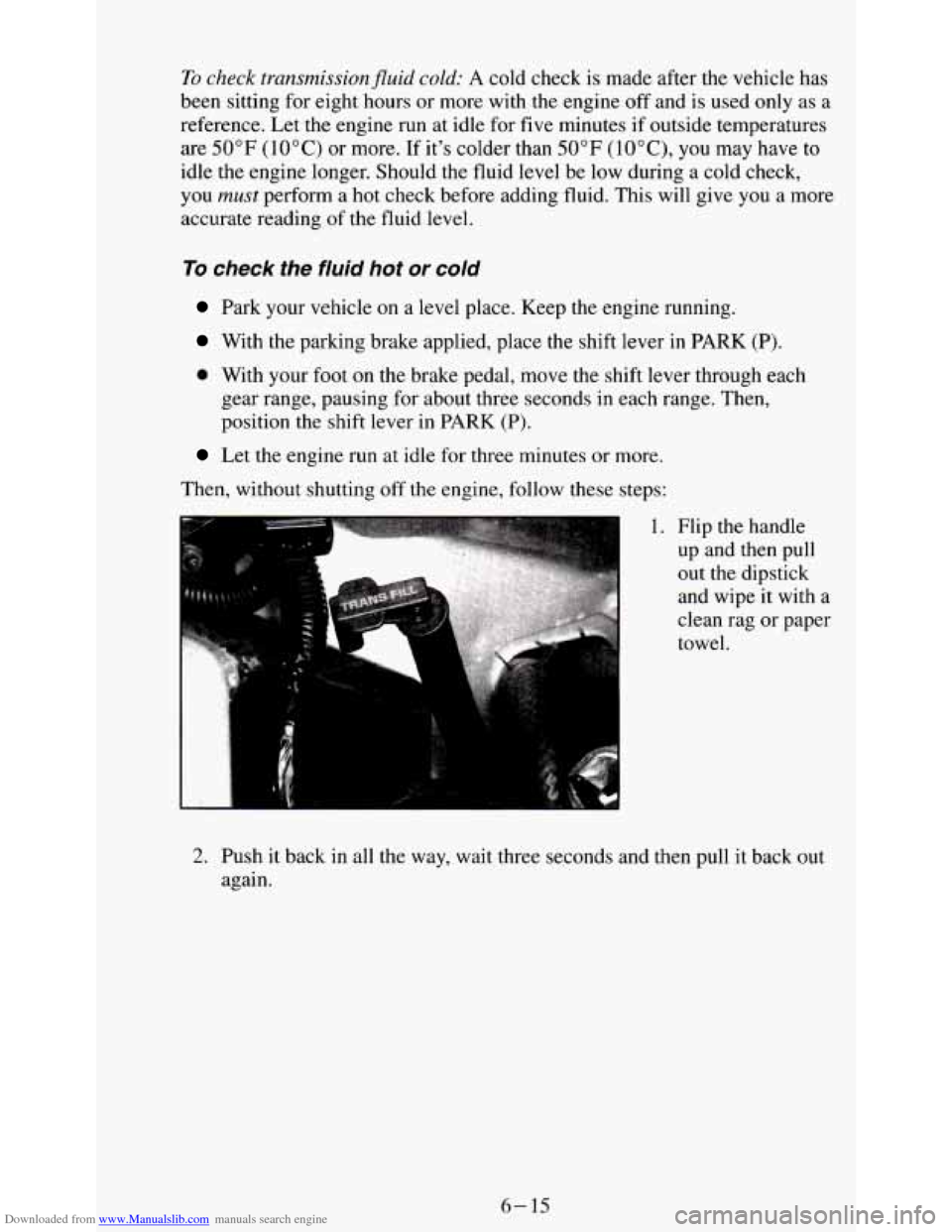
Downloaded from www.Manualslib.com manuals search engine To check transmissionfluid cold: A cold check is made after the vehicle has
been sitting for eight hours or more with the engine off and is used only as a
reference. Let the engine run at idle
for five minutes if outside temperatures
are
50°F ( 10°C) or more. If it's colder than 50°F ( lO"C), you may have to
idle the engine longer. Should the fluid level be low during a cold check,
you must perform a hot check before adding fluid. This will give you a more
accurate reading of the fluid level.
To check the fluid hot or cold
Park your vehicle on a level place. Keep the engine running.
With the parking brake applied, place the shift lever in PARK (P).
0 With your foot on the brake pedal, move the shift lever through each
gear range, pausing for about three seconds in each range.
Then,
position the shift lever in PARK (P).
Let the engine run at idle for three minutes or more.
Then, without shutting
off the engine, follow these steps:
1. Flip the handle up and then pull
out the dipstick
and wipe it with a
clean rag or paper
towel.
2. Push it back in all the way, wait three seconds and then pull it back out
again.
6- 15