Power CHEVROLET S10 1996 2.G Owner's Manual
[x] Cancel search | Manufacturer: CHEVROLET, Model Year: 1996, Model line: S10, Model: CHEVROLET S10 1996 2.GPages: 375, PDF Size: 20.73 MB
Page 137 of 375
Downloaded from www.Manualslib.com manuals search engine Avoid needless heavy braking. Some people drive in
spurts -- heavy acceleration followed by heavy
braking
-- rather than keeping pace with traffic. This
is a mistake. Your brakes may not have time to cool
between hard stops. Your brakes will wear out much
faster if you
do a lot of heavy braking. If you keep pace
with the traffic and allow realistic following distances,
you will eliminate a lot
of unnecessary braking. That
means better braking and longer brake life.
If your engine ever stops while you’re driving, brake
normally but don’t pump your brakes. If you do,
the
pedal may get harder to push down. If your engine
stops,
you will still have some power brake assist. But
you will use it when you brake. Once the power assist is
used up,
it may take longer to stop and the brake pedal
will be harder to push.
Anti-Lock Brakes
Your vehicle has anti-lock brakes (ABS). ABS is an
advanced electronic braking system that will help
prevent
a braking skid.
When you start your engine and begin to drive away,
your anti-lock brake system will check itself.
You may
hear a momentary motor or clicking noise while this test
is going on. This is normal.
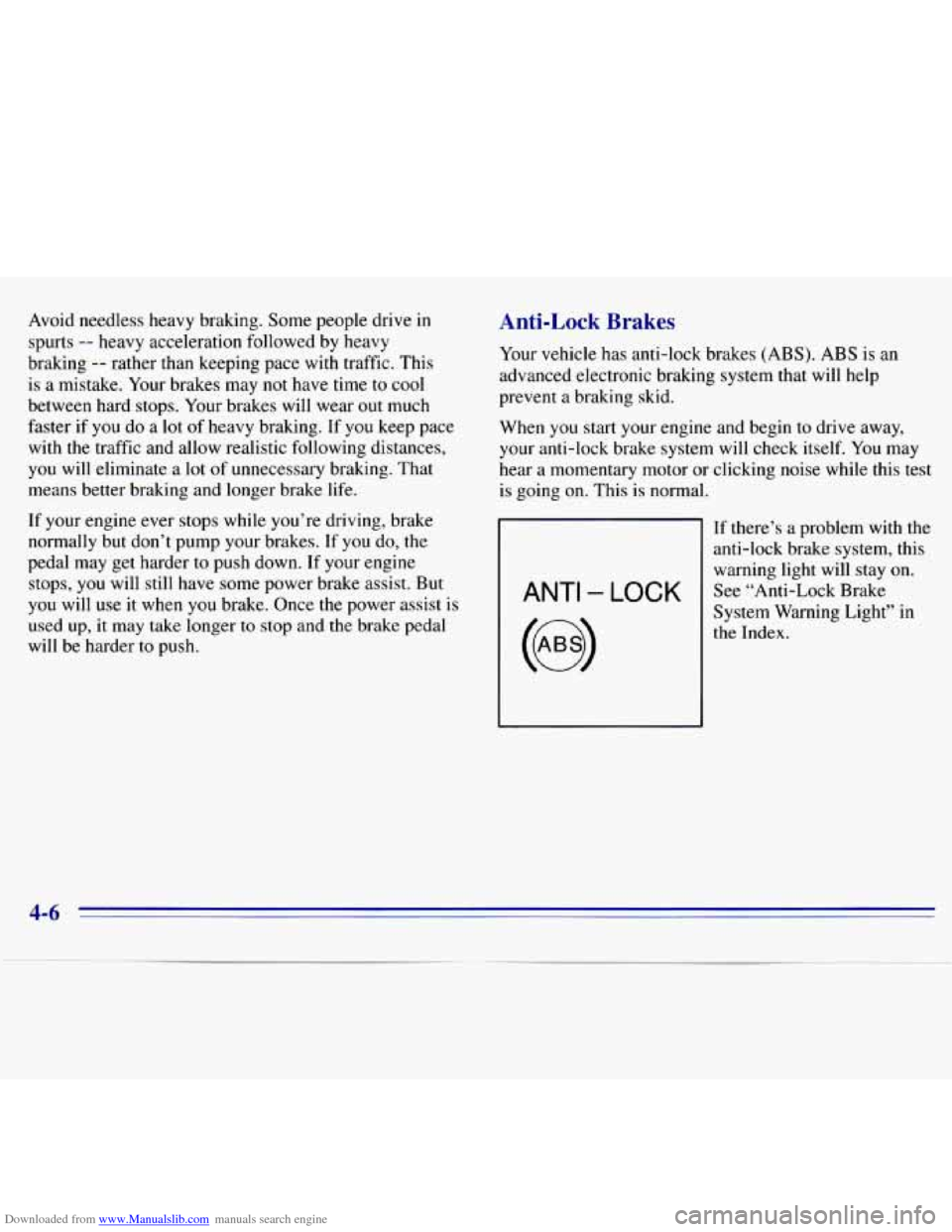
If there’s a problem with the
anti-lock brake system, this
warning light will stay
on.
See “Anti-Lock Brake
System Warning Light” in
the Index.
4-6
Page 139 of 375
Downloaded from www.Manualslib.com manuals search engine As you brake, your computer keeps receiving updates on
wheel speed and controls braking pressure accordingly.
Remember: Anti-lock doesn’t change the time you need
to get your foot up to the brake pedal or always decrease
stopping distance. If
you get too close to the vehicle in
front of
you, you won’t have time to apply your brakes
if that vehicle suddenly
slows or stops. Always leave
enough room up ahead
to stop, even though you have
anti-lock brakes.
Using Anti-Lock
Don’t pump the brakes. Just hold the brake pedal
down and let anti-lock work for
you. You may feel
the brakes vibrate, or
you may notice some noise, but
this is normal. On vehicles with four-wheel drive, your
anti-lock brakes work at all times
-- whether you are
in two-wheel drive or four-wheel drive.
Braking in Emergencies
Use your anti-lock braking system when you need to.
With anti-lock, you can steer and brake
at the same
time. In many emergencies, steering can help you more
than even the very best braking.
Steering
Power Steering
If you lose power steering assist because the engine
stops or the system is not functioning,
you can steer but
it will take much more effort.
Steering Tips
Driving on Curves
It’s important to take curves at a reasonable speed.
A lot of the “driver lost control” accidents mentioned on
the news happen
on curves. Here’s why:
Experienced driver or beginner, each
of us is subject to
the same laws
of physics when driving on curves. The
traction
of the tires against the road surface makes it
possible for the vehicle to change its path when you turn
the front wheels. If there’s no traction, inertia will keep
the vehicle going
in the same direction. If you’ve ever
tried
to steer a vehicle on wet ice, you’ll understand this.
The traction you can get in a curve depends
on the
condition of your tires and the road surface, the angle at which
the curve is banked, and your speed. While you’re
in a curve, speed is the one factor you can control.
4-8
Page 149 of 375
Downloaded from www.Manualslib.com manuals search engine Approaching a Hill
When you approach a hill, you need to decide if it’s one
of those hills that’s just too steep to climb, descend or
cross. Steepness can be hard
to judge. On a very small
hill,
for example, there may be a smooth, constant
incline with
only a small change in elevation where you
can easily see all the way to the top. On a large hill, the
incline may get steeper as
you near the top, but you may
not see this because the crest
of the hill is hidden by
bushes, grass or shrubs.
Here
are some other things to consider as you
approach a hill.
0
0
0
0
Is there a constant incline, or does the hill get sharply
steeper in places?
Is there good traction on the hillside, or will the
surface cause tire slipping?
Is there a straight path up or down the hill so you
won’t have to make turning maneuvers?
Are there obstructions on the hill that can block your
path (boulders, trees, logs or ruts)?
0 What’s beyond the hill? Is there a cliff, an
embankment, a drop-off, a fence? Get out and walk the
hill if
you don’t know. It’s the smart way to find out.
0 Is the hill simply too rough? Steep hills often have
ruts, gullies, troughs and exposed rocks because they
are more susceptible to the effects
of erosion.
Driving Uphill
Once you decide you can safely drive up the hill, you
need
to take some special steps.
0
0
0
Use a low gear and get a firm grip on the
steering wheel.
Get a smooth start up the hill and try to maintain
your speed. Don’t use more power than
you need,
because you don’t want your wheels to start spinning
or sliding.
Try
to drive straight up the hill if at all possible.
If the path twists and turns, you might want to find
another route.
4-18
Page 192 of 375
Downloaded from www.Manualslib.com manuals search engine 2. Get the vehicles close enough so the jumper cables
can reach, but be sure the vehicles aren’t touching
each other.
If they are, it could cause a ground
connection you don’t want. You wouldn’t be able
to
start your vehicle, and the bad grounding could
damage the electrical systems.
You could be injured
if the vehicles roll. Set the
parking brake firmly on each vehicle. Put an
automatic transmission
in PARK (P) or a manual
transmission in NEUTRAL
(N). If you have a
four-wheel-drive vehicle with a manual transfer case
shift lever, be sure the transfer case is not
in
NEUTRAL (N).
3. Turn off the ignition on both vehicles. Unplug
unnecessary accessories plugged into the cigarette
lighter, or accessory power outlets,
if you have this
option. Turn off all lamps that aren’t needed as well
as radios. This will avoid sparks and help save both
batteries.
In addition, it could save your radio!
NOTICE:
If you leave your radio on, it could be badly
damaged. The repair wouldn’t be covered by
your warranty.
If your vehicle has air conditioning, the auxiliary
electric fan under the hood can start up even
when the engine is not running and can injure
you. Keep hands, clothing and tools away from
-7 any underhood electric fan.
5-3
Page 234 of 375
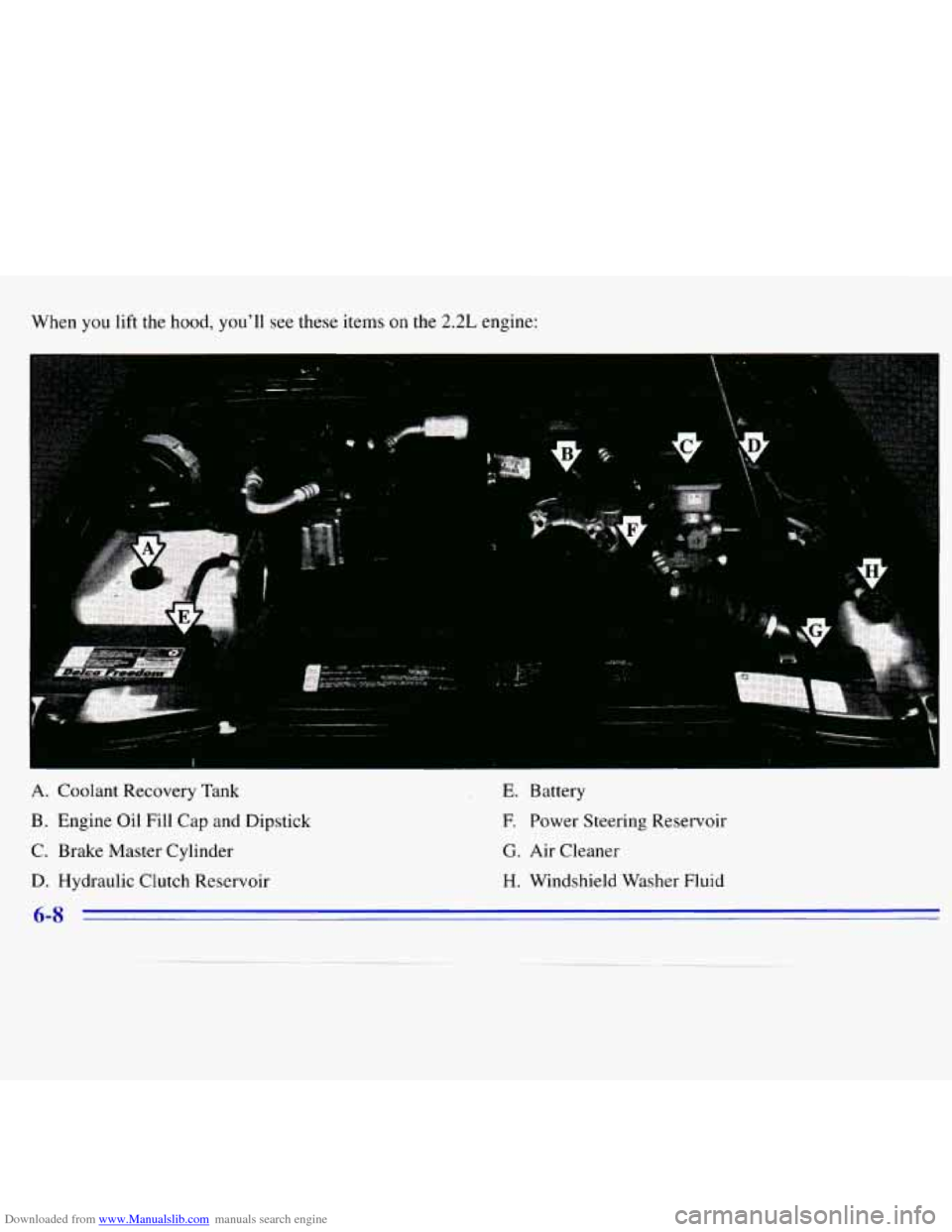
Downloaded from www.Manualslib.com manuals search engine When you lift the hood, you'll see these items on the 2.2L engine:
A. Coolant Recovery Tank
E. Battery
B. Engine Oil Fill Cap and Dipstick E Power Steering Reservoir
C. Brake Master Cylinder G. Air Cleaner
D. Hydraulic Clutch Reservoir H. Windshield Washer Fluid
6-8
Page 235 of 375
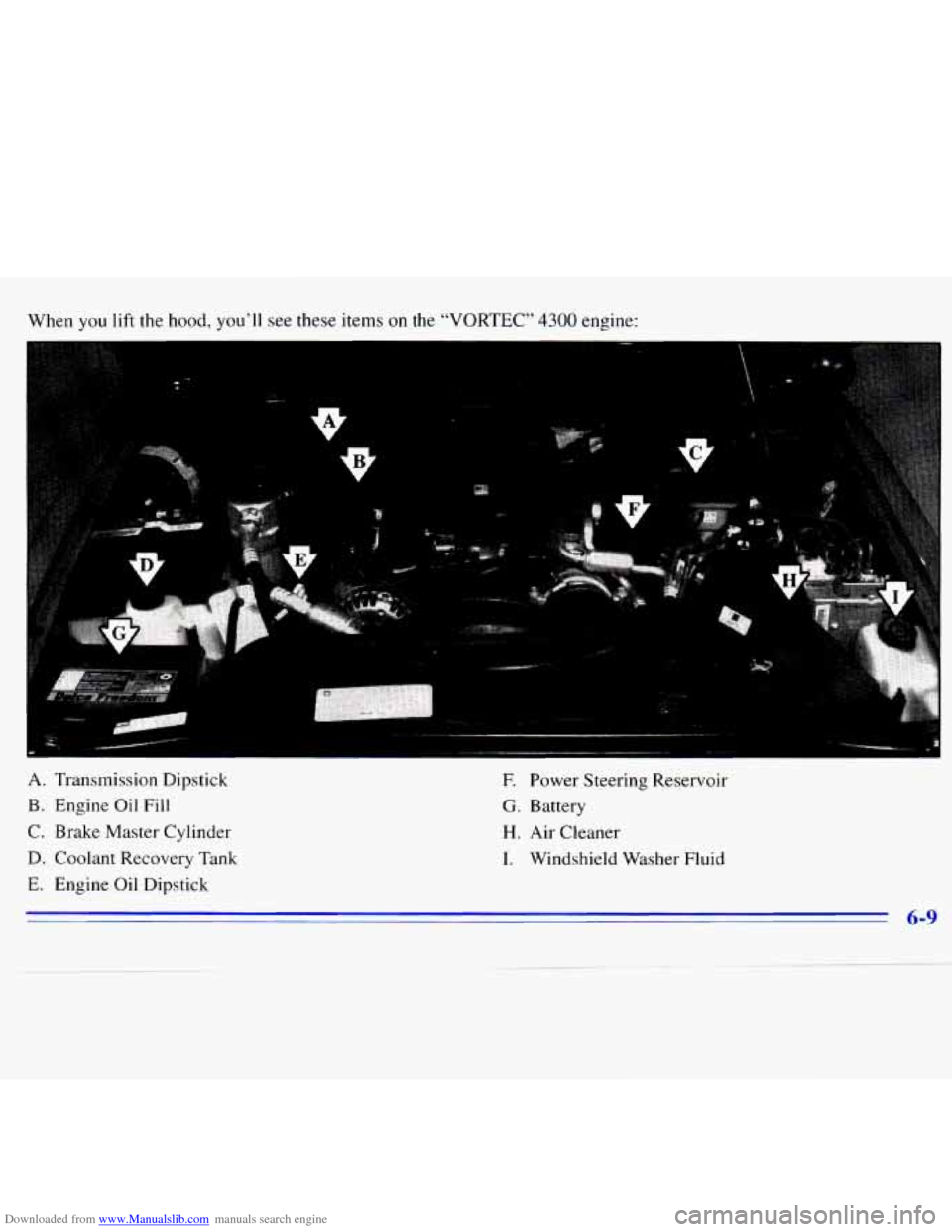
Downloaded from www.Manualslib.com manuals search engine When you lift the hood, you’ll see these items on the “VORTEC” 4300 engine:
V
I. Transmission Dipstick
3. Engine Oil Fill
2. Brake Master Cylinder
1. Coolant Recovery Tank
:. Engine Oil Dipstick
6-9
E Power Steering Reservoir
G. Battery
H. Air Cleaner
I. Windshield Washer Fluid
Page 255 of 375
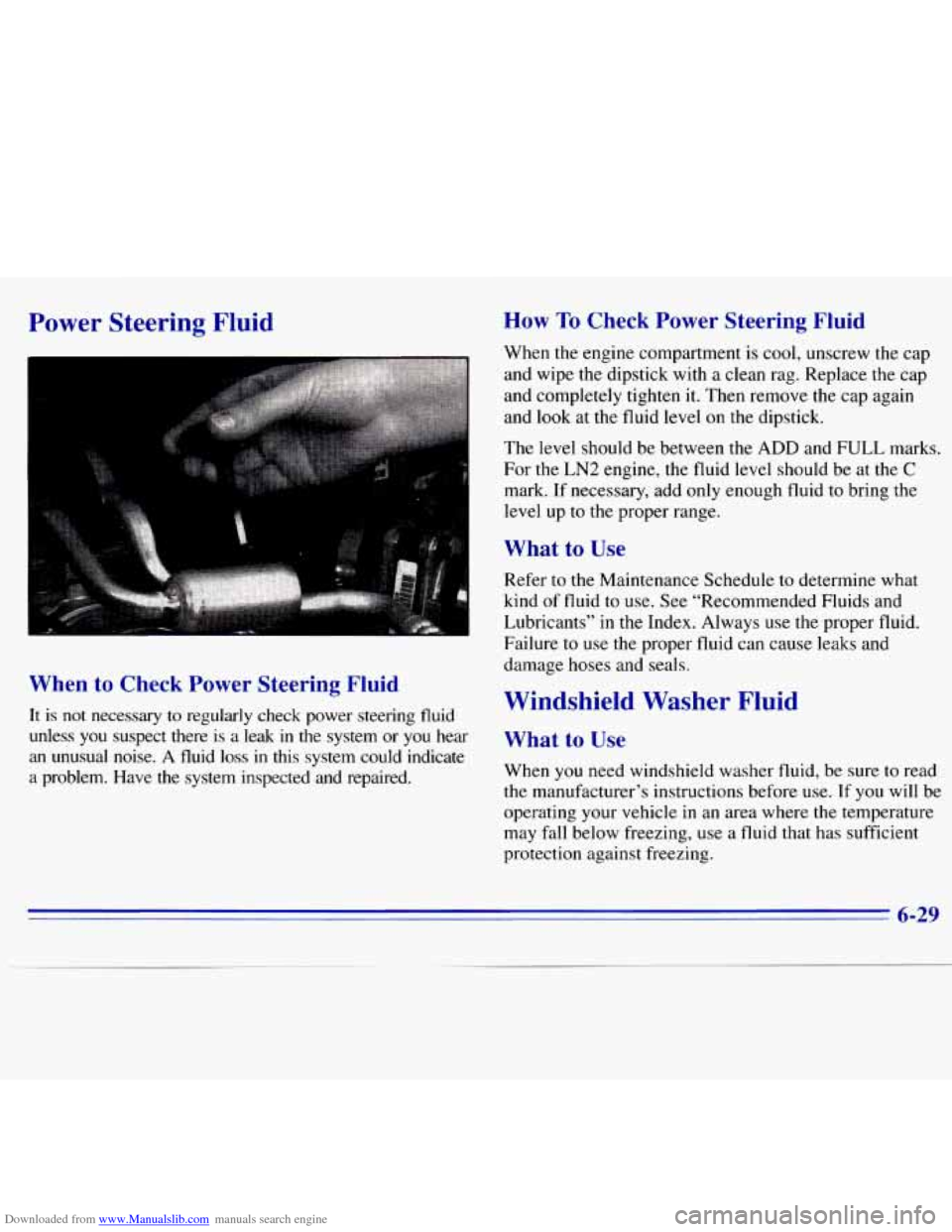
Downloaded from www.Manualslib.com manuals search engine Power Steering Fluid How To Check Power Steering Fluid
When the engine compartment is cool, unscrew the cap
and wipe the dipstick with a clean rag. Replace the cap
and completely tighten it. Then remove the cap again
and
look at the fluid level on the dipstick.
The level should be between the
ADD and FULL marks.
For the
LN2 engine, the fluid level should be at the C
mark. If necessary, add only enough fluid to bring the
level up
to the proper range.
What to Use
Refer to the Maintenance Schedule to determine what
kind of fluid
to use. See “Recommended Fluids and
Lubricants” in the Index. Always use the proper fluid.
Failure to
use the proper fluid can cause leaks and
damage hoses and seals.
Windshield Washer Fluid
What to Use
When you need windshield washer fluid, be sure to read
the manufacturer’s instructions before use. If you will be
operating your vehicle
in an area where the temperature
may fall below freezing, use a fluid that has sufficient
protection against freezing.
When to Check Power Steering Fluid
It is not necessary to regularly check power steering fluid
unless you suspect there is a leak
in the system or you hear
an unusual noise.
A fluid loss in this system could indicate
a problem. Have
the system inspected and repaired.
6-29
Page 288 of 375
Downloaded from www.Manualslib.com manuals search engine Electrical System
Add-on Electrical Equipment
NOTICE:
Don’t add anything electrical to your vehicle
unless you check with your dealer first. Some
electrical equipment can damage your vehicle
and the damage wouldn’t be covered by your
warranty. Some add-on electrical equipment can
keep other components from working as they
should.
Your vehicle has an air bag system. Before attempting to
add anything electrical
to your vehicle, see “Servicing
Your Air Bag-Equipped Vehicle” in the Index.
Headlamps
The headlamp wiring is protected by an internal circuit
breaker. An electrical overload will cause the lamps to
go on and
off, or in some cases to remain off. If this
happens, have your headlamp wiring checked right away.
Windshield Wipers
The windshield wiper motor is protected by a circuit
breaker and a fuse. If the motor overheats due
to heavy
snow, etc., the wiper will stop until the motor cools. If
the overload is caused by some electrical problem, be
sure to get it fixed.
Power Windows and Other Power Options
Circuit breakers protect the power windows and other
power accessories. When the current load is too heavy,
the circuit breaker opens and closes, protecting the
circuit until the problem is fixed
or goes away.
6-62
Page 290 of 375
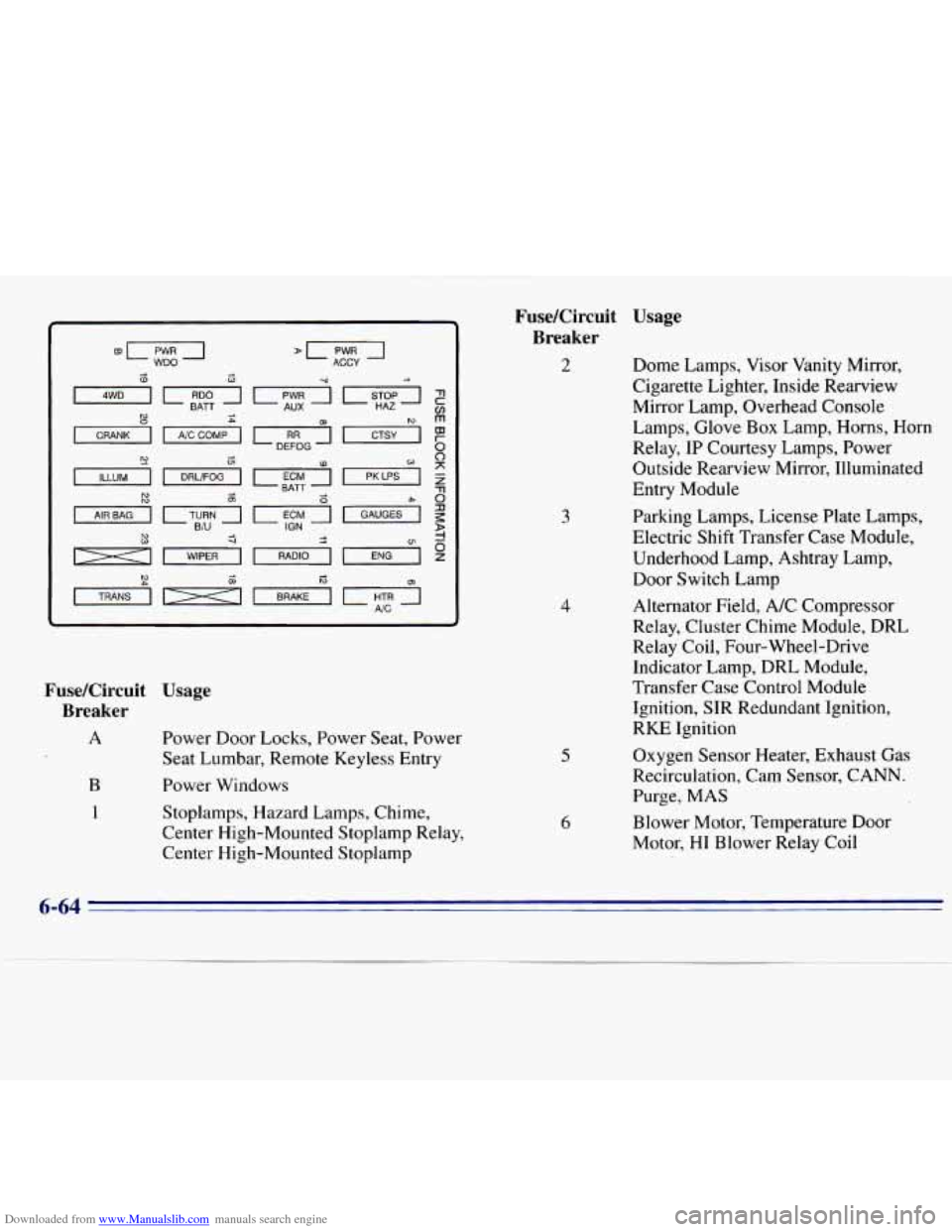
Downloaded from www.Manualslib.com manuals search engine FuseKircuit Usage Breaker
A
B
1
Power Door Locks, Power Seat, Power
Seat Lumbar, Remote Keyless Entry
Power Windows
Stoplamps, Hazard Lamps, Chime,
Center High-Mounted Stoplamp Relay,
Center High-Mounted Stoplamp
3
4
5
6
FuseKircuit Usage
Breaker
2 Dome Lamps, Visor Vanity Mirror,
Cigarette Lighter, Inside Rearview
Mirror Lamp, Overhead Console
Lamps, Glove
Box Lamp, Horns, Horn
Relay, IP Courtesy Lamps, Power
Outside Rearview Mirror, Illuminated
Entry Module
Parking Lamps, License Plate Lamps,
Electric Shift Transfer Case Module,
Underhood Lamp, Ashtray Lamp,
Door Switch Lamp
Alternator Field, A/C Compressor
Relay, Cluster Chime Module, DRL
Relay Coil, Four-Wheel-Drive
Indicator Lamp, DRL Module,
Transfer Case Control Module Ignition, SIR Redundant Ignition,
RKE Ignition
Oxygen Sensor Heater, Exhaust Gas
Recirculation, Cam Sensor, CANN.
Purge, MAS
Blower Motor, Temperature Door
Motor,
HI Blower Relay Coil
6-64
Page 291 of 375
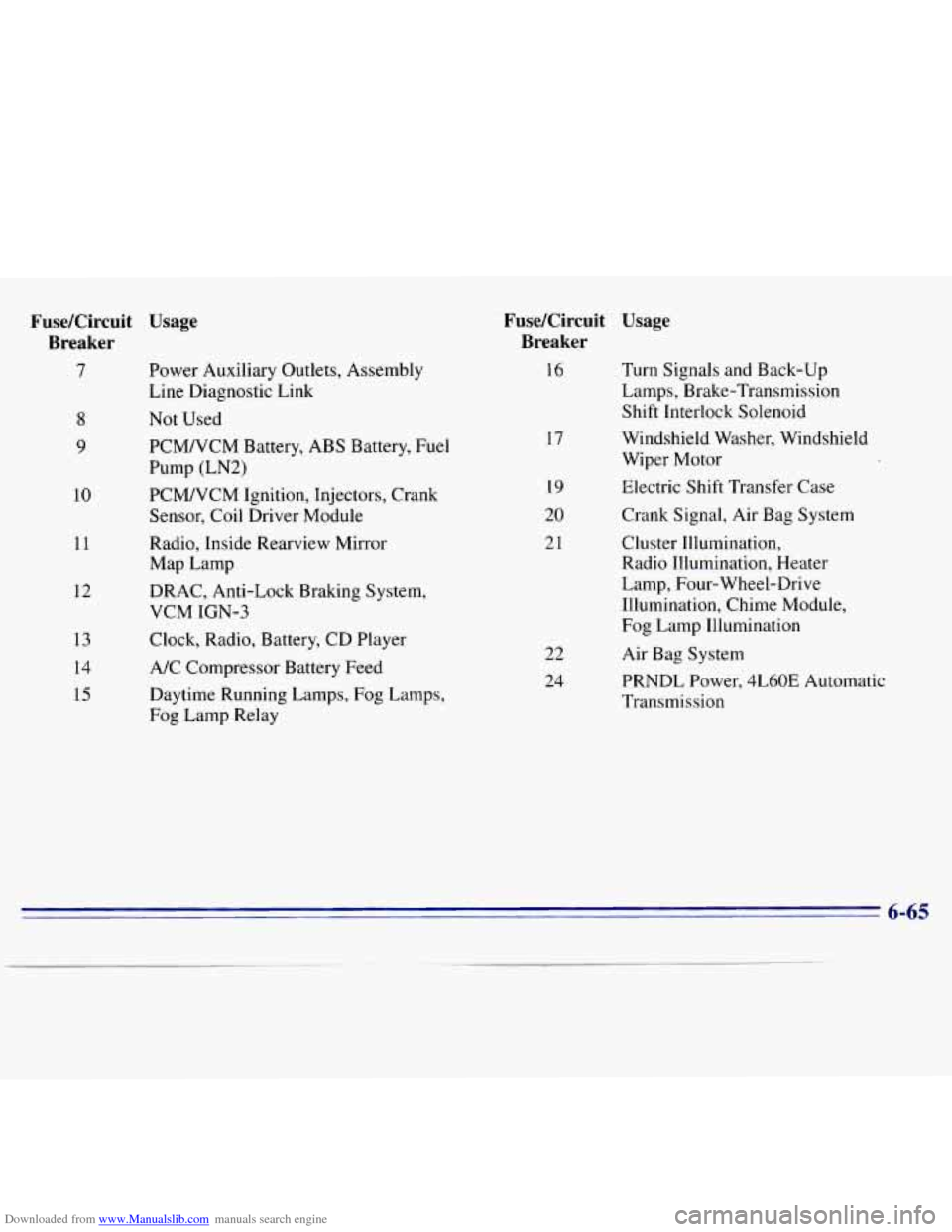
Downloaded from www.Manualslib.com manuals search engine Fuse/Circuit Usage Breaker
7 Power Auxiliary Outlets, Assembly
Line Diagnostic Link
8
9
10
11
12
13
14
15
Not Used
PCMNCM Battery,
ABS Battery, Fuel
Pump (LN2)
PCM/VCM Ignition, Injectors, Crank
Sensor, Coil Driver Module
Radio, Inside Rearview Mirror
Map Lamp
DRAC, Anti-Lock Braking System,
Clock, Radio, Battery,
CD Player
VCM
IGN-3
A/C Compressor Battery Feed
Daytime Running Lamps,
Fog Lamps,
Fog Lamp Relay
Fuse/Circuit Usage Breaker
16
17
19
20 21
22
24 Turn
Signals and Back-up
Lamps, Brake-Transmission
Shift Interlock Solenoid
Windshield Washer, Windshield Wiper Motor
Electric Shift Transfer Case
Crank Signal, Air Bag System
Cluster Illumination,
Radio Illumination, Heater
Lamp, Four- Wheel-Drive
Illumination, Chime Module,
Fog Lamp Illumination
Air Bag System
PRNDL Power, 4L60E Automatic
Transmission
6-65