light CHEVROLET S10 1996 2.G Owner's Guide
[x] Cancel search | Manufacturer: CHEVROLET, Model Year: 1996, Model line: S10, Model: CHEVROLET S10 1996 2.GPages: 375, PDF Size: 20.73 MB
Page 122 of 375
Downloaded from www.Manualslib.com manuals search engine Playing a Cassette Tape
Your tape player is built to work best with tapes that are
30 to 45 minutes long on each side. Tapes longer than
that
are so thin they may not work well in this player.
Once the tape is playing, use the PWR-VOL-PROG-RCL
knob, just as you do for radio. A lighted arrow will be
displayed
to show tape play direction.
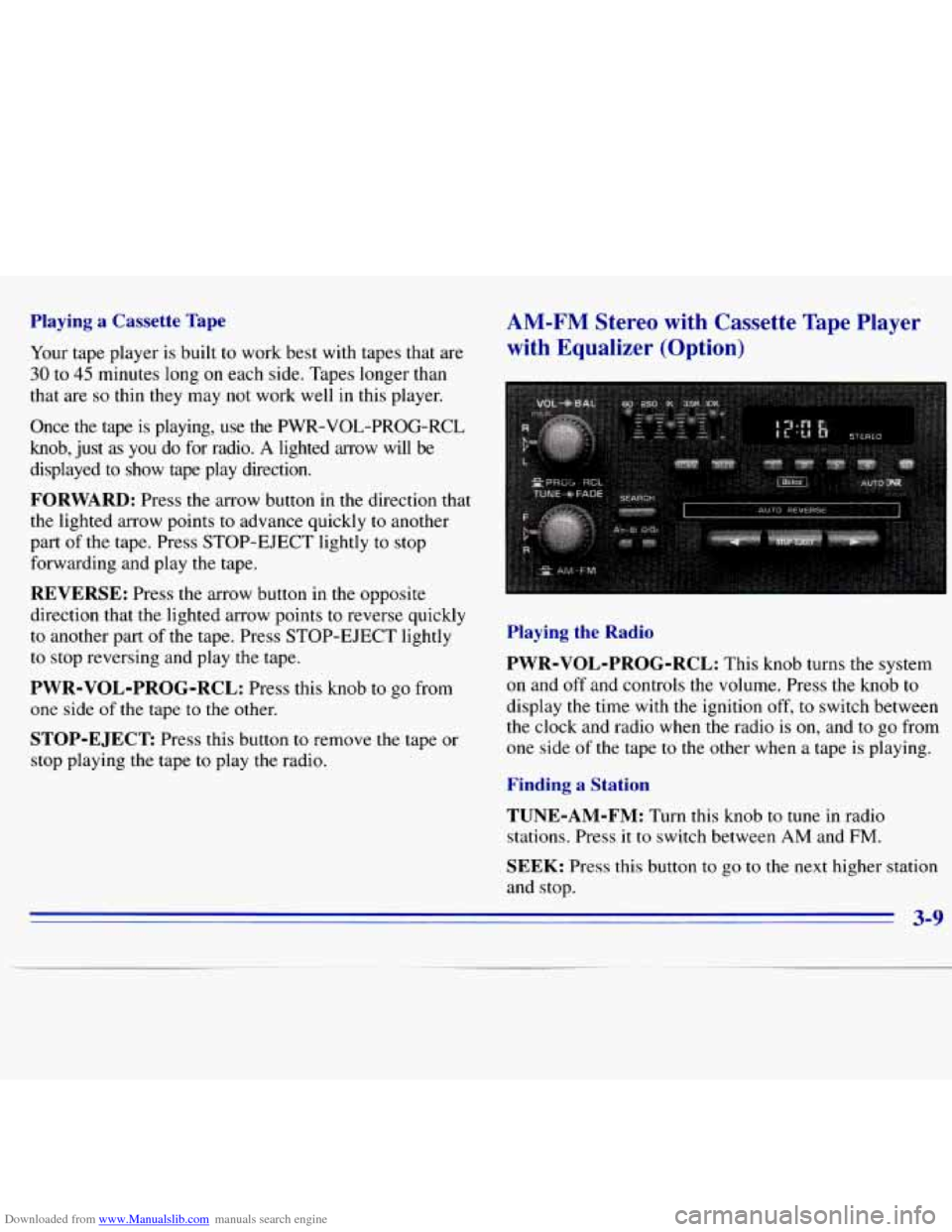
FORWARD: Press the arrow button in the direction that
the lighted
arrow points to advance quickly to another
part
of the tape. Press STOP-EJECT lightly to stop
forwarding and play the tape.
REVERSE: Press the arrow button in the opposite
direction that the lighted arrow points
to reverse quickly
to another part of the tape. Press STOP-EJECT lightly
to stop reversing and play the tape.
PWR-VOL-PROG-RCL: Press this knob to go from
one side
of the tape to the other.
STOP-EJECT: Press this button to remove the tape or
stop playing the tape to play the radio.
AM-FM Stereo with Cassette Tape Player
with Equalizer (Option)
Playing the Radio
PWR-VOL-PROG-RCL:
This knob turns the system
on and off and controls the volume. Press the knob to
display
the time with the ignition off, to switch between
the clock and radio when the radio is
on, and to go from
one side
of the tape to the other when a tape is playing.
Finding a Station
TUNE-AM-FM:
Turn this knob to tune in radio
stations. Press
it to switch between AM and FM.
SEEK: Press this button to go to the next higher station
and stop.
3-9
Page 123 of 375
Downloaded from www.Manualslib.com manuals search engine SCAN: Press this button to listen to each station for a
few seconds. The radio will go to the next station, stop
for
a few seconds, then go to the next station. SCAN will
appear
on the display. Press SCAN again to stop scanning.
PUSHBUTTONS: The four numbered pushbuttons let
you return to your favorite stations. You can set up to
14 stations (seven AM and seven FM).
1. Tune in the desired station.
2. Press SET.
3. Press one of the four pushbuttons, within five seconds,
to store the station. Whenever you press that numbered
button,
the station you set will return.
4. Repeat the steps for each pushbutton.
In addition to the four stations set as above, up to
three additional stations may be preset on each band by
pressing two adjoining buttons at the same time. Just:
1. Tune in the desired station.
2. Press SET. (SET will appear on the display.)
3. Press two adjoining pushbuttons at the same time,
within five seconds. Whenever you press the same
two buttons, the station you set will return.
4. Repeat these steps for each pair of buttons.
AM-ST Press this button to tune an AM station that
broadcasts in stereo. Your STEREO light will come on
when you’re receiving
AM stereo. If you press AM-ST
and there is no more noise, it means the station is weak.
You’ll hear the station better if you do not use
AM-ST.
Press the button again to delete stereo.
Setting the Tone
TONE ADJUSTMENT
Set the bass, midrange and
treble
by using the levers in the upper middle left corner to
get the sound you
want. The 60 and 250 levers adjust the
bass,
1K is midrange, and 3.5K and 10K control the treble.
We suggest you start with
1K in the midpoint position.
Then move
the other levers up until you get the amount
of bass and treble you like.
Adjusting the Speakers
BAL:
This control ring behind the PWR-VOL-PROG-RCL
knob adjusts the balance between the left and right speakers.
FADE: This control ring behind the TUNE-AM-FM knob
adjusts the balance between the front
and rear speakers.
3-10
Page 124 of 375
Downloaded from www.Manualslib.com manuals search engine Playing a Cassette Tape
Your tape player is built to work best with tapes that are
30 to 45 minutes long on each side. Tapes longer than
that are
so thin they may not work well in this player.
Once the
tape is playing, use the PWR-VOL-PROG-RCL
knob, just
as you do for radio. A lighted arrow will be
displayed to
show tape play direction.
Cr02: This button lets you set the system for the type of
cassette being used. If you are using chrome or metal
tapes, press the button in.
FORWARD: Press the arrow button in the direction that
the lighted arrow points to advance quickly to another
part of the tape. Press STOP-EJECT lightly to stop
forwarding and play the tape.
SEARCH: Press this button to the recessed position.
Press the lighted
arrow to skip to the next selection. Press
the opposite direction arrow that is not lighted to replay the current selection or skip to the previous selection.
PWR-VOL-PROG-RCL: Press this knob to go from
one side
of the tape to the other.
STOP-EJECT: Press this button to remove the tape or
stop playing the tape to play the radio.
Your Delco system may be able to receive C-QUAM@
stereo broadcasts. Many AM stations around the country
use C-QUAM to produce stereo, though some do not.
C-QUAM is a registered trademark of Motorola, Inc.
If your Delco system can get C-QUAM signals,
your STEREO light
will come on when you are
receiving stereo.
REVERSE: Press the arrow button in the opposite
direction that the lighted arrow points to reverse quickly
to another part of the tape. Press STOP-EJECT lightly
to stop reversing and play the tape.
3-11
Page 131 of 375
Downloaded from www.Manualslib.com manuals search engine Care of Your Cassette Tape Player
A tape player that is not cleaned regularly can cause
reduced sound quality, ruined cassettes or a damaged
mechanism. Cassette tapes should be stored
in their
cases away from contaminants, direct sunlight and
extreme heat. If they aren’t, they may not operate
properly or may cause failure of the tape player.
Your tape player should be cleaned regularly after every
50 hours of use. If you notice a reduction in sound
quality, try
a known good cassette to see if the tape or
the tape player is at fault. If this other cassette has no
improvement in sound quality, clean the tape player.
Cleaning may be done with a scrubbing action,
non-abrasive cleaning cassette with pads which scrub
the tape head as the hubs of
the cleaner cassette turn. It
is normal for the cassette
to eject while cleaning. Insert
the cassette at least three times
to ensure thorough
cleaning.
A scrubbing action cleaning cassette is
available through your
GM dealer.
You may also choose a non-scrubbing action, wet-type
cleaner which uses a cassette with a fabric belt to clean
the tape head. This type of cleaning cassette will not
eject. It may not clean as thoroughly as
the scrubbing
type cleaner. Cassettes are
subject to wear and the sound quality may
degrade over time. Always make sure that the cassette
tape is in good condition before you have your tape
player serviced.
Care of Your Compact Discs
Handle discs carefully. Store them in their original cases
or other protective cases and away from direct sunlight
and dust. If
the surface of a disc is soiled, dampen a
clean, soft cloth
in a mild, neutral detergent solution and
clean it, wiping from the center to the edge.
Be sure never to touch the signal surface when handling
discs. Pick up discs by grasping the outer edges or the
edge of the hole and the outer edge.
Fixed Mast Antenna
The fixed mast antenna can withstand most car washes
without being damaged. If the mast should ever become
slightly bent,
you can straighten it out by hand. If the
mast is badly bent, as
it might be by vandals, you should
replace
it.
Check every once in a while to be sure the mast is still
tightened to
the fender.
3-18
Page 137 of 375
Downloaded from www.Manualslib.com manuals search engine Avoid needless heavy braking. Some people drive in
spurts -- heavy acceleration followed by heavy
braking
-- rather than keeping pace with traffic. This
is a mistake. Your brakes may not have time to cool
between hard stops. Your brakes will wear out much
faster if you
do a lot of heavy braking. If you keep pace
with the traffic and allow realistic following distances,
you will eliminate a lot
of unnecessary braking. That
means better braking and longer brake life.
If your engine ever stops while you’re driving, brake
normally but don’t pump your brakes. If you do,
the
pedal may get harder to push down. If your engine
stops,
you will still have some power brake assist. But
you will use it when you brake. Once the power assist is
used up,
it may take longer to stop and the brake pedal
will be harder to push.
Anti-Lock Brakes
Your vehicle has anti-lock brakes (ABS). ABS is an
advanced electronic braking system that will help
prevent
a braking skid.
When you start your engine and begin to drive away,
your anti-lock brake system will check itself.
You may
hear a momentary motor or clicking noise while this test
is going on. This is normal.
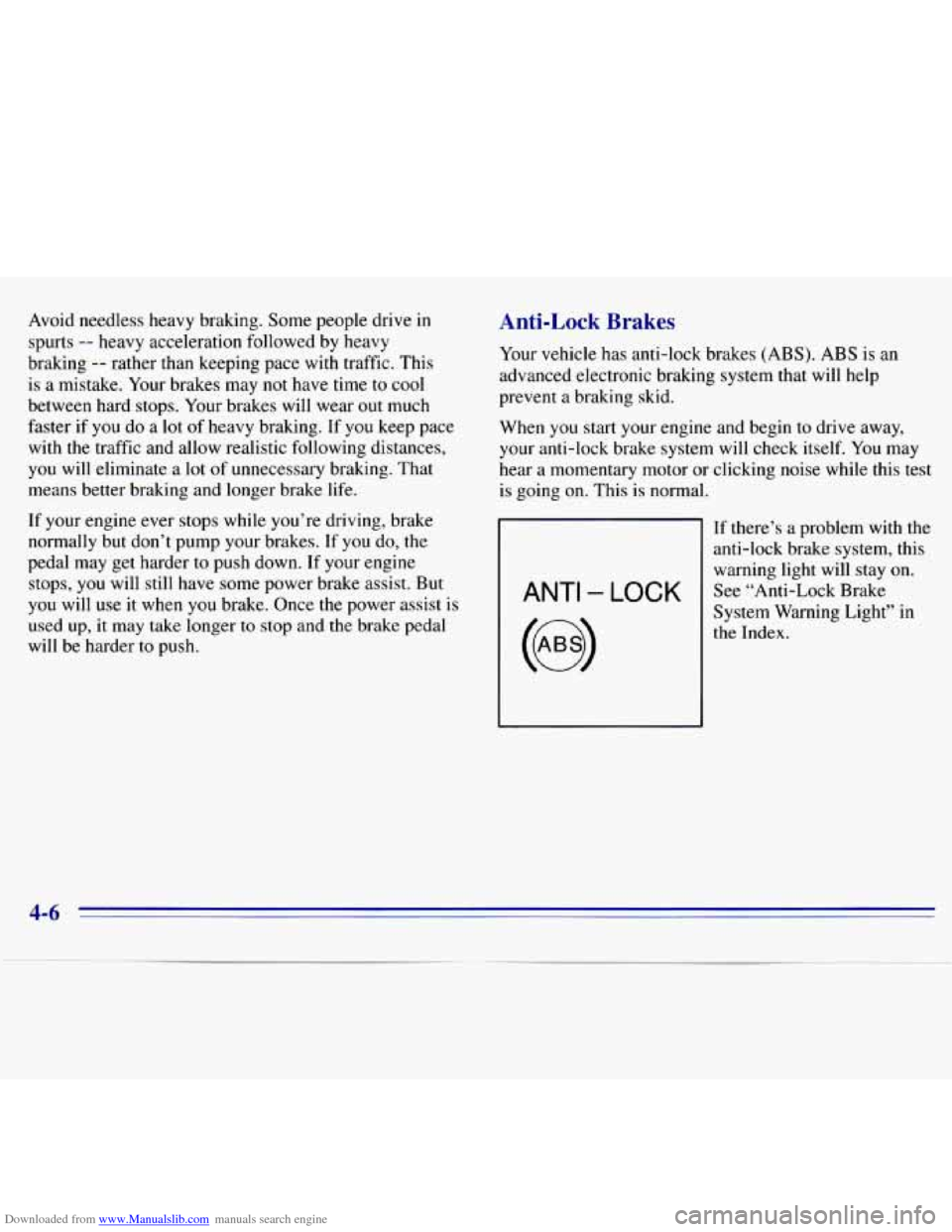
If there’s a problem with the
anti-lock brake system, this
warning light will stay
on.
See “Anti-Lock Brake
System Warning Light” in
the Index.
4-6
Page 141 of 375
Downloaded from www.Manualslib.com manuals search engine Off-Road Recovery
An emergency like this requires close attention and a
quick decision. If you are holding
the steering wheel at
the recommended
9 and 3 o’clock positions, you can
turn it a full
180 degrees very quickly without removing
either hand. But you have
to act fast, steer quickly, and
just as quickly straighten the wheel once you have
avoided the object.
The fact that such emergency situations are always
possible is a good reason
to practice defensive driving at
all times and wear safety belts properly. You may
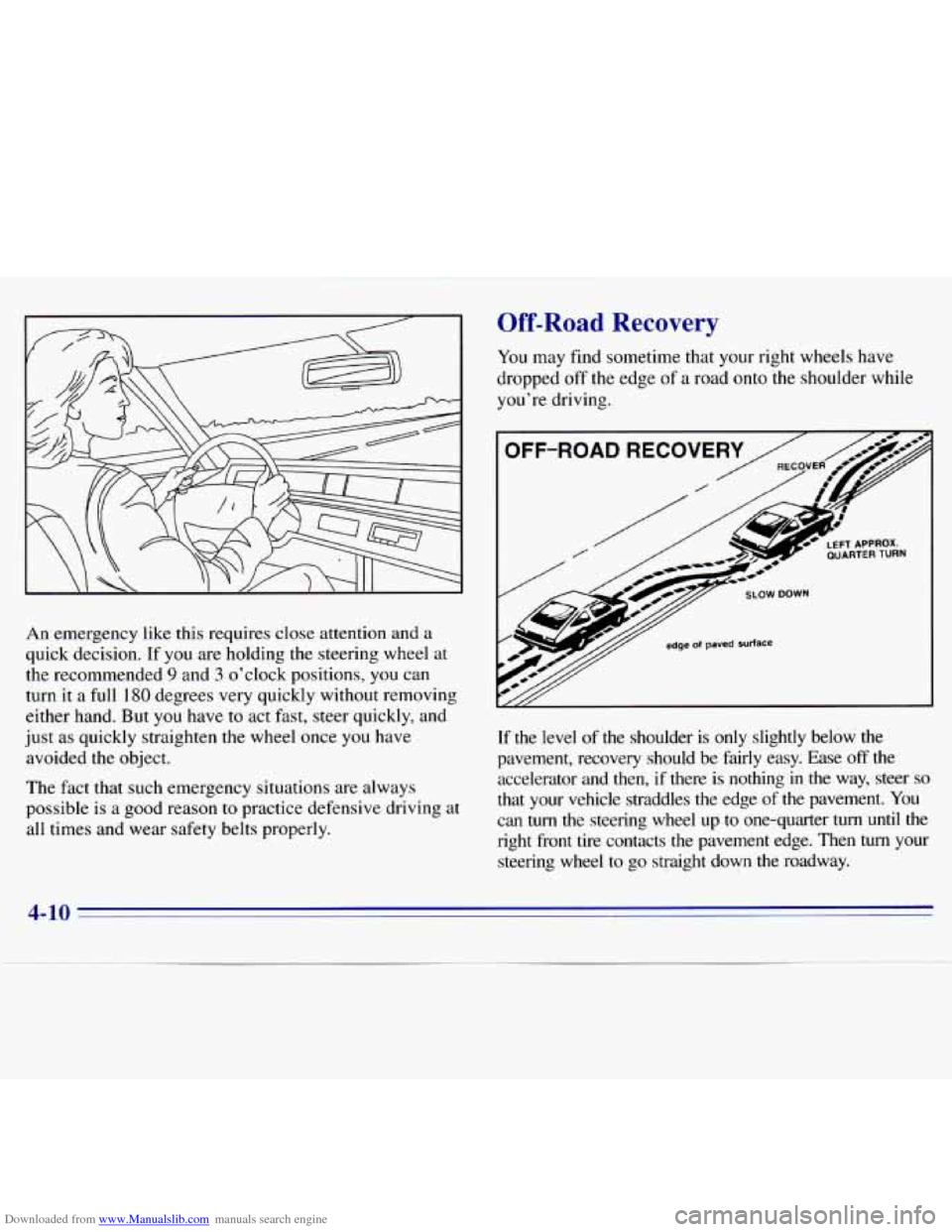
find sometime that your right wheels have
dropped
off the edge of a road onto the shoulder while
you’re driving.
If the level of the shoulder is only slightly below the
pavement, recovery should be fairly easy. Ease
off the
accelerator and
then, if there is nothing in the way, steer so
that your vehicle straddles the edge
of the pavement. You
can
turn the steering wheel up to one-quarter turn until the
right front tire contacts the pavement edge.
Then turn your
steering wheel
to go straight down the roadway.
4-10
Page 148 of 375
Downloaded from www.Manualslib.com manuals search engine When you drive over obstacles or rough terrain, keep a
firm grip
on the steering wheel. Ruts, troughs or other
surface features can jerk
the wheel out of your hands if
you’re not prepared.
When
you drive over bumps, rocks, or other obstacles,
your wheels can leave the ground. If this happens, even
with
one or two wheels, you can’t control the vehicle as
well or at all.
Because
you will be on an unpaved surface, it’s
especially important to avoid sudden acceleration,
sudden turns or sudden braking.
In a way, off-road driving requires a different kind
of
alertness from driving on paved roads and highways.
There are
no road signs, posted speed limits or signal
lights. You have to use your own good judgment about
what is safe and what isn’t.
Drinking and driving
can be very dangerous on any
road. And this is certainly true for off-road driving.
At the very time you need special alertness and driving
skills, your reflexes, perceptions and judgment can be
affected by even a small amount of alcohol. You could
have a serious
-- or even fatal -- accident if you drink
and drive or ride with a driver
who has been drinking.
See “Drunken Driving” in
the Index.
Driving on Off-Road Hills
Off-road driving often takes you up, down or across a
hill. Driving safely on hills requires good judgment and
an understanding of what your vehicle can and can’t do.
There are
some hills that simply can’t be driven, no
matter how well built the vehicle.
A CAUTION:
0
Many hills are simply too steep for any vehicle,
If you drive up them, you will stall. If you drive
down them, you can’t control your speed.
If you
drive across them, you will roll over.
You could be
seriously injured or killed.
If you have any doubt
about the steepness, don’t drive the hill.
4-17
Page 153 of 375
Downloaded from www.Manualslib.com manuals search engine Driving Downhill
When off-roading takes you downhill, you’ll want to
consider a number
of things:
How steep is the downhill? Will I be able to maintain
vehicle control?
0 What’s the surface like? Smooth? Rough? Slippery?
0 Are there hidden surface obstacles? Ruts? Logs?
Hard-packed dirt? Gravel?
Boulders?
0 What’s at the bottom of the hill? Is there a hidden
creek bank
or even a river bottom with large rocks?
If you decide you can go down a hill safely, then try to
keep your vehicle headed straight down, and use a low
gear. This way, engine drag can help your brakes and
they won’t have to do all the work. Descend slowly,
keeping your vehicle under control at all times.
I
’ CAUF3N:
Heavy braking when going down a hill can cause
your brakes to overheat and fade. This could
cause loss of control and a serious accident.
Apply the brakes lightly when descending a
hill and use a low gear to keep vehicle speed
under control.
1
4-22
Page 157 of 375
Downloaded from www.Manualslib.com manuals search engine Driving in Mud, Sand, Snow or Ice
When you drive in mud, snow or sand, your wheels
won’t get good traction.
You can’t accelerate as quickly,
turning is more difficult. and you’ll need longer
braking distances.
It’s best
to use a low gear when you’re in mud -- the
deeper the mud, the lower the gear. In really deep mud,
the idea is to keep your vehicle moving
so you don’t
get stuck.
When you drive on
sand, you’ll sense a change in wheel
traction. But it will depend upon how loosely packed the
sand is. On loosely packed sand (as
on beaches or sand
dunes) your tires will tend to sink into the sand. This has
an effect on steering, accelerating and braking. You may
want to reduce the air pressure in your tires slightly
when driving on sand. This will improve traction.
Hard packed snow and ice offer the worst tire traction.
On these surfaces, it’s
very easy to lose control. On wet
ice, for example, the traction is
so poor that you will
have difficulty accelerating. And if you do get moving,
poor steering and difficult braking can cause you to slide
out of control.
I A C. UTIC-T:
I
Driving on frozen lakes, ponds or rivers can be
dangerous. Underwater springs, currents under
the ice, or sudden thaws can weaken the ice. Your
vehicle could fall through the ice and you and
your passengers could drown. Drive your vehicle
on safe surfaces only.
Driving in Water
Light rain causes no special off-road driving problems.
But heavy rain can mean flash flooding, and
flood
waters demand extreme caution.
Find out how deep the water
is before you drive through
it. If it’s deep enough to cover your wheel hubs, axles or
exhaust pipe, don’t try it
-- you probably won’t get
through. Also, water that,deep can damage your axle
and other vehicle parts.
4-26
Page 159 of 375
Downloaded from www.Manualslib.com manuals search engine Here are some tips on night driving. Driving at Night
Night driving is more dangerous than day driving. One
reason is that some drivers are likely
to be impaired -- by
alcohol or drugs, with night vision problems, or by fatigue.
0
0
0
0
0
0 0
Drive defensively.
Don’t drink and drive.
Adjust your inside rearview mirror to reduce the
glare from headlamps behind
you.
Since you can’t see as well, you may need to
slow down and keep more space between
you and
other vehicles.
Slow down, especially on higher speed roads. Your
headlamps can light up only
so much road ahead.
In remote areas, watch for animals.
If you’re tired, pull
off the road in a safe place
and rest.
Night Vision
No one can see as well at night as in the daytime. But as
we get older these differences increase. A 50-year-old
driver may require at least twice as much light to see the
same thing at night as a 20-year-old.
What you do
in the daytime can also affect your night
vision. For example, if
you spend the day in bright
sunshine you are wise to wear sunglasses. Your eyes will
have less trouble adjusting to night. But if you’re
4-28