brake CHEVROLET S10 1997 2.G Owners Manual
[x] Cancel search | Manufacturer: CHEVROLET, Model Year: 1997, Model line: S10, Model: CHEVROLET S10 1997 2.GPages: 402, PDF Size: 21.04 MB
Page 6 of 402
Downloaded from www.Manualslib.com manuals search engine L
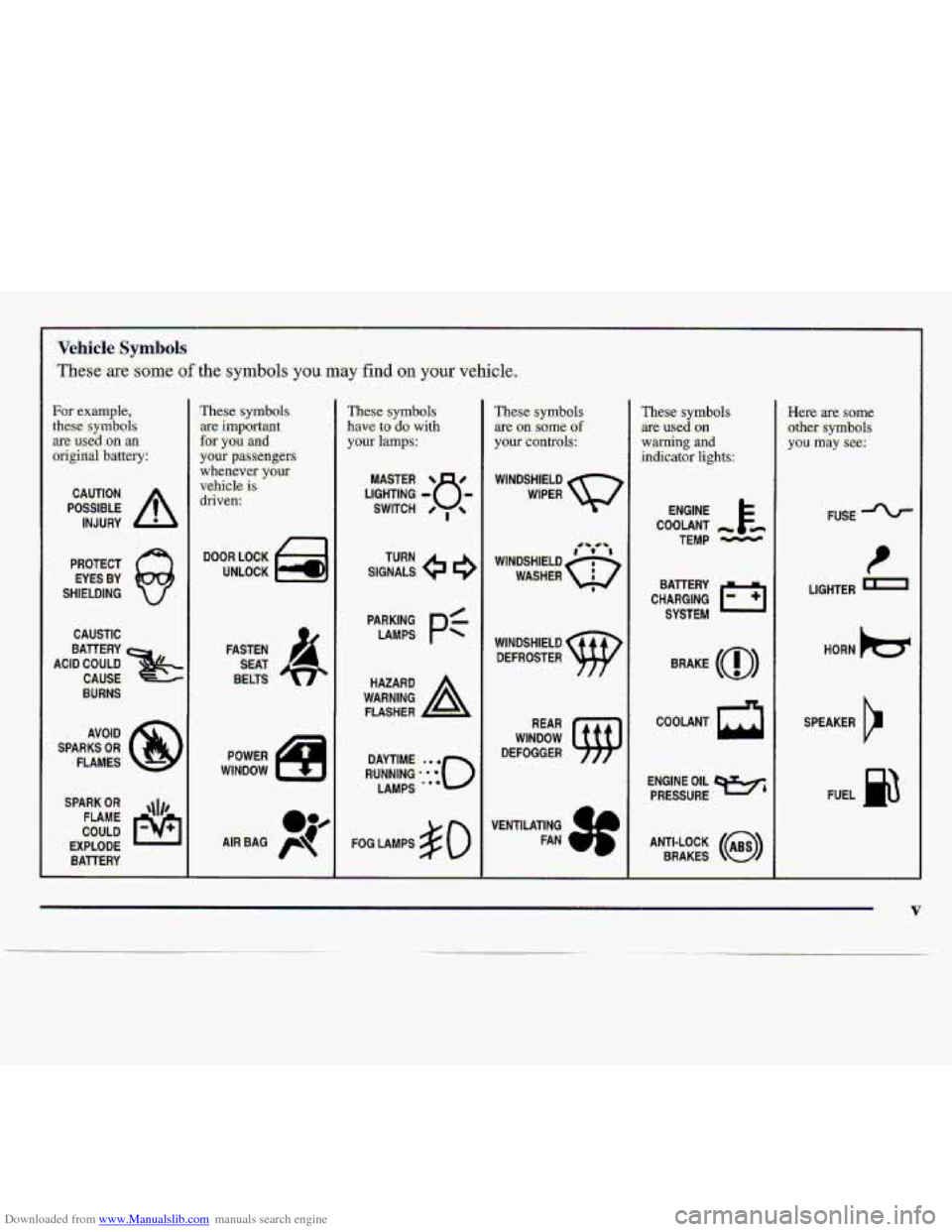
Vehkle .Symbols.
These are sa-me of the s,ymbols you may find on your vehicle.
For-example,
these symbols
are used :on an
original battery:
PROTECT EYES
BY
SHIELDING
CAUSTIC
BURNS
SPARK OR ,111,
COULD FLAME
EXPLODE
BATTERY
These- symbols
:are important
for you and
yo,ur passengers
whenever your
vehicle is
driven:
DOOR LOCK
UNLOCK
FASTEN
SEAT
'BELTS
POWER
WINDOW
These symbols
have to do. with
your iamps.:
LlGmmI ING
.SIGNALS.
6 e3
TURN
WARNING A
HAZARD
FLASHER
FOG LAMPS
$0
These symbols
are on some Qf
your daritroh:
WINDSHIELD WIPER
WINDSHIELD
WINDSHIELD 'DEFROSTER
WiNDOW
DEFOGGER
These symbols
are used oil
warning and
indicator lights:
-BATTERY
CHARGING
SYSTEM
BRAKE (@)
ENGINE OIL w,
PRESSURE
Here are so.me
dther symbols
you may see:
FUSE -%F
I
LIGHTER
HORN
ttT
,SPEAKER
b
FUEL. p3
ANTI-LOCK (@)
BRAKES
V
.."
Page 48 of 402
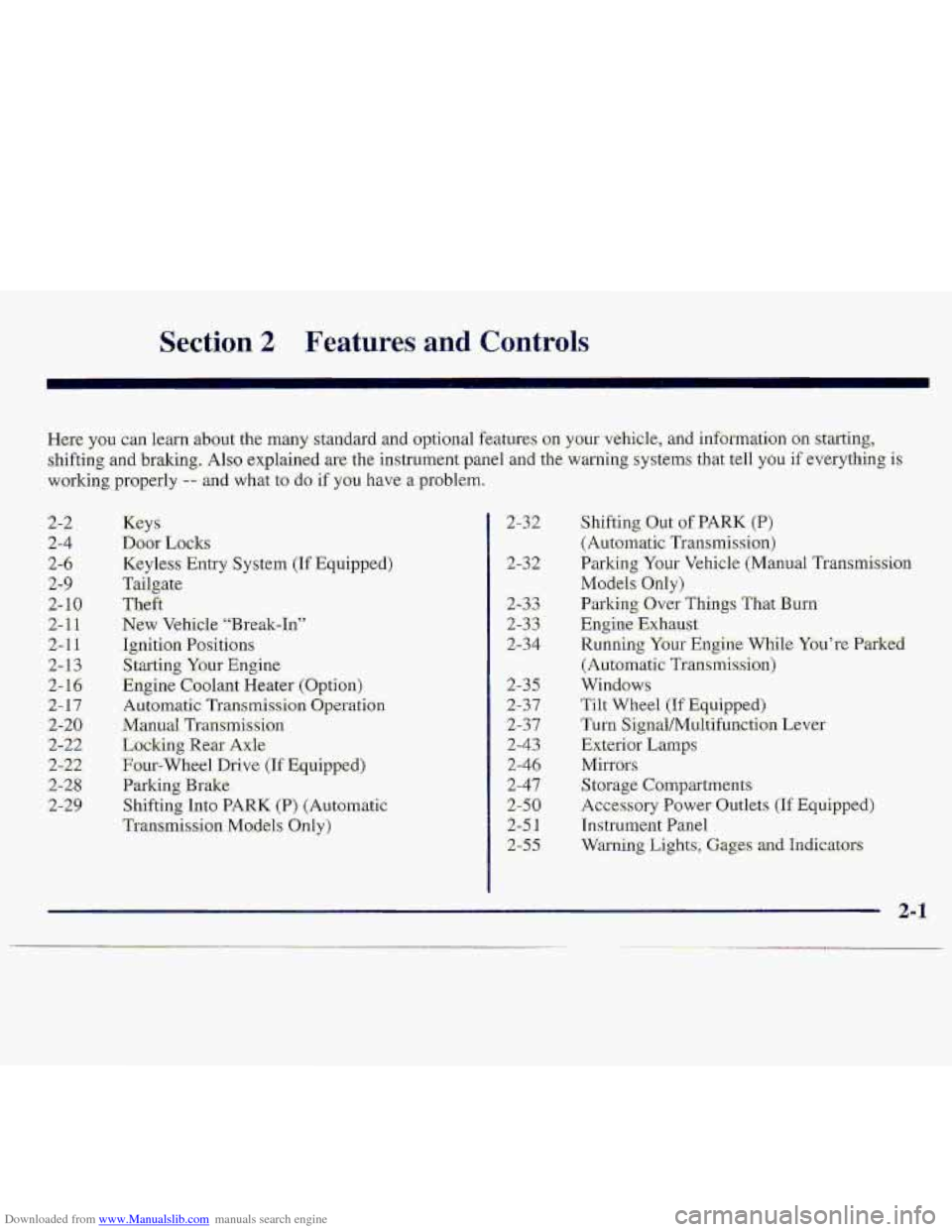
Downloaded from www.Manualslib.com manuals search engine Section 2 Features and Controls
Here y~u can learn about the many standard and opti-onal features o.n your-vehide, and irkofmation on starting,,
shifting
and braking. Also explained are the instrument panel and, the warning systems that teil you if everything is
working properly -- and what to do if you have a problem.
Keys
Door L.ocks
Key1e.s~ Entry 'System- (If Equipped)
Tailgate
Theft
Ne.w Vihicle "Break-In"
Ignition Positions
S.tarting
You Engine
Engine Coolant Heater (Option)
htqmatic. Tr.ansmission Operation
Manual Trmsrnissio,n
Locking Rear Axle:
Four-wheel Drive (If Equipped)
Parking Brake.
Shi€ting
Into PARK (P) (Automatic
Transmission
Ma.dels Only)
2-32
2-52
2-33
2-3 3
2-34
2-35
2-3 7
2-37
2-43
2,-47
2-50
2-5 1
2-55
2-4-6;
Shifting Out of PARK (P)
(Auto'mmtic Transmission)
Parking
Your Vehicle (Manual Transmission
Models Only)
Parlung Qve.1- Things That Burn
.Engine
Exhaust
Running Your EQg-ine While YGu're Parked
(Automatic Transmission)
Windows
Ti it Wheel (If Equipped)
Turn Signal/Multi~~ncti-on- Lever
Exterior Lamps
'3 t-orage Compartments
Accessory
Power Outlets (If Equipped)
Tnstrument Panel
Warning
Lights; Gap .and Tndicatms
2-1
Page 58 of 402
Downloaded from www.Manualslib.com manuals search engine New Vehkk “Bre-ak-In”
NOTICE:
Your modern vehicle d.oesn’t need an elaborate
“break-in.”
But it will perform better in the long
run if you follow these guidelines:
0 Keep your speed at 55 mph (88 km/h) or
less far the first 500 miles (805 km).
Don’t drive at any one speed -- fast or
slow
-- for the first-500 miles (805 km).
Don’t make full-thro.ttle starts.
200 miles. (322 km) or so. During this time
your
new brake linings aren’t yetbro-ken
in. Hard stops with new linings cmmean
premature wear and earlier replacement.
Follow this breaking-in guideline every
time you
get new brake linings.
See “Tbwing a Trailer” in the Index for
more information..
Avoid makiilg hard stops for the first
Don’ttow a trailer during break-in.
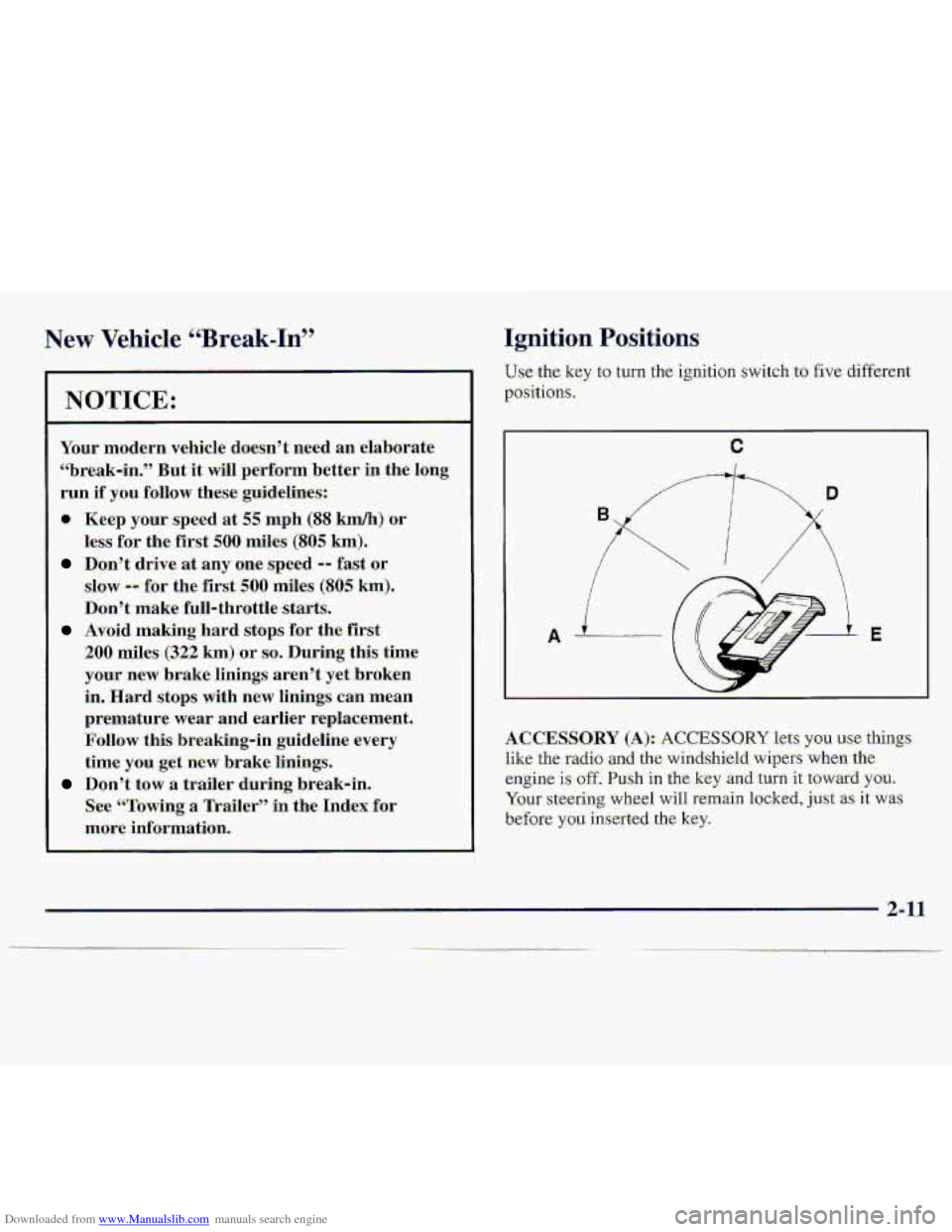
Ignition Positions
Use.the key to-turn the ignition switch to €ive different
positions,
A 3.
ACCESSORY (A):. ACCESSO-RY lets ysu .use‘-thi-ngs
like the radio ad the.winds,hield wipe-rs when the
engine is off. Push i.n the key -and turn it toward. YOU.
Your steering wheel will remain locked, just. as it was
before
you inserted the. key.
2-11
Page 64 of 402
Downloaded from www.Manualslib.com manuals search engine Automatic Transmission Operation
Your automatic transmission may have a shift lever
located
on the console between the seats or on the
steering column.
There are several different positions for your shift lever.
If your vehicle is equipped with a column shift lever,
it
features an electronic shift position indicator within the
instrument cluster. This display must be powered
anytime the shift lever is capable of being moved out
of
the PARK (P) position. This means that if your key is in
the
OFF position, but not locked, there will be a small
current drain
on your battery which could discharge
your battery over a period of time.
If you need to leave
your key in the ignition
in the OFF position for an
extended period, it is recommended that you disconnect
the battery cable from the battery
to prevent discharging
your battery.
PARK (P): This locks your rear wheels. It’s the best
position to use when you start your engine because your
vehicle can’t move easily.
Lf! C A TION:
It is dangerous to get out of your vehicle if the
shift lever is not fully in
PARK (P) with the
parking brake
firmly set. Your vehicle can roll.
Don’t leave your vehicle when the engine is
running unless you have to.
If you have left the
engine running, the vehicle can move suddenly.
You or others could be injured.
To be sure your
vehicle won’t move, even when you’re on fairly
level ground, always set your parking brake and
move the shift lever to
PARK (P).
If you have four-wheel drive, your vehicle
will be free to roll
-- even if your shift lever
is in
PARK (P) -- if your transfer case is in
NEUTRAL (N). So, be sure the transfer case is in
a drive gear, two-wheel high (2HI) or four-wheel
high (4HI) or four-wheel low (4LO)
-- not in
NEUTRAL (N). See “Shifting Into PARK (P)” in
the Index.
If you’re pulling a trailer, see “Towing
a Trailer’’ in the Index.
2-17
Page 65 of 402
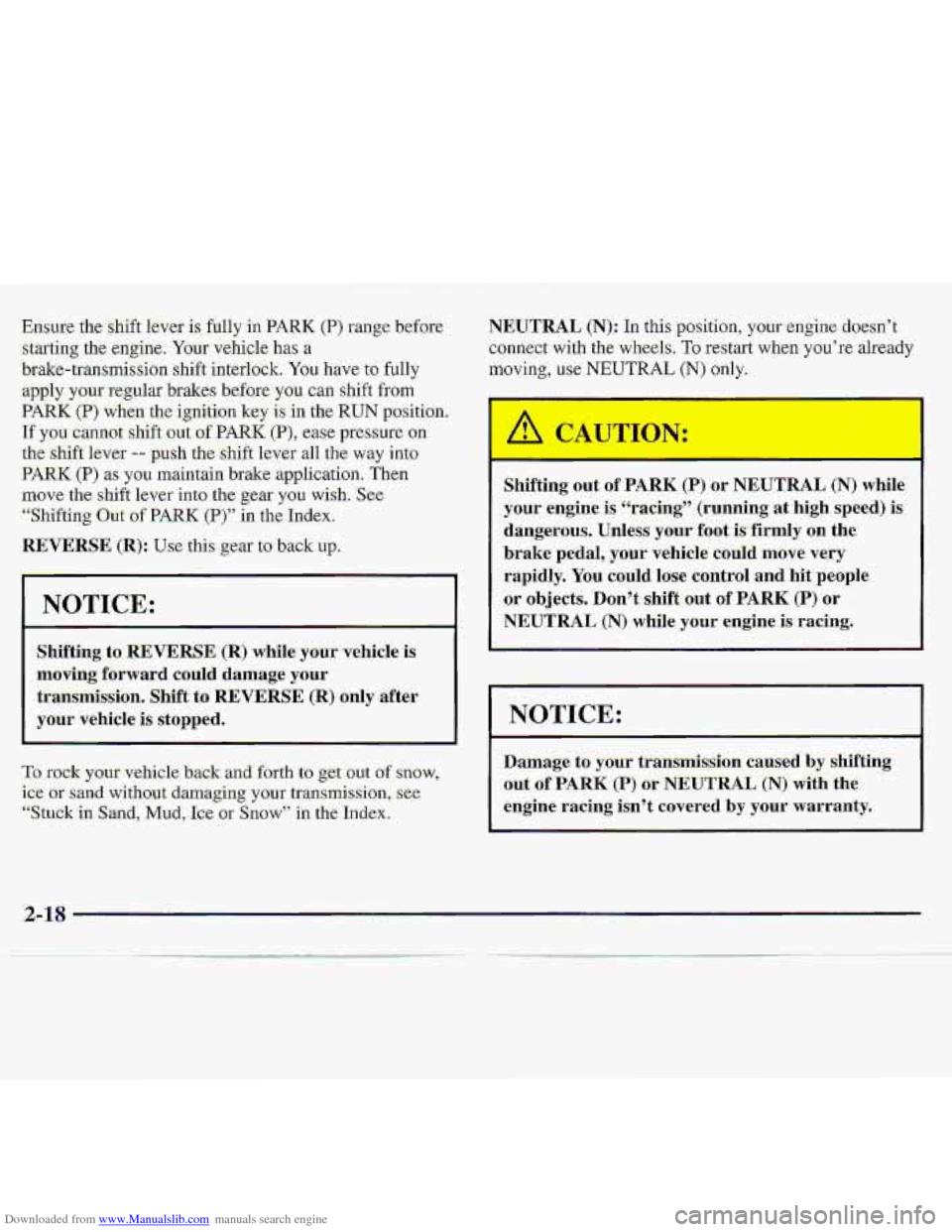
Downloaded from www.Manualslib.com manuals search engine NOTICE:
-Shifting tu REVERSE (R) wh’ilcrymr whide is
moving
forward codd damage your
tran&issio.n. Shift to REVERa (,R) only -after
your vehicle is stopped.
NEUTRAL (N): In this position, your-engme doesn’t.
connect- with the wheels. To restart when you’rcyalready
moving, use NE.UTRAL CN) only.
I
Shifting out of PARK (I?) or NEUTRAL (N) while.
your engine is “racing” (running at high speed) is
dangerous, Unless your foot is’firrmly on the
brake pedal, your vehicle. ,could move. very
rapidly. You could luse control and- hit people
or objects. Don’t shift out of PARK (P) or
NEUTRAL (N) while you-r- errgin& rac-hg.
NOTICE:
2-18
Page 66 of 402
Downloaded from www.Manualslib.com manuals search engine AUT-OMATIC OVERDRIVE (@): This yosition is for
normal driving. If y.ou need more :power for passing, and
yodre:
(r, GQing less than about 35 mpli (56: krnlh), push your
axelerator p:edal about halfway down.
Going< about 35 inph (56 knci/h> or more, push the
accelerator all the way down.
You'-ll shift down to the next gedr and have more power.
AUTOMATIC OVERDRIVE (0) should not b.e used
when towing
a trailer, carrying a heavy load, driving on
steep.
hills, 6r for off-road-driving.. Selecr DRIVE (D)
when operating the vehicle under any of these
conditions.
DRIVE @): This position is also use.d for normal
driving,'however it offers more power -and lower fuel
economy than AUTQMATIC -aVERDRIVE (a). You
should use DRIVE (D) when rowing a trailer; carrying a
heavy load, driving. on steep hills or winding roads or
for .off-road driving.
SEC-OND (2): This position gives. you more power but.
lower fuel economy.' You can use SECOND (2) aji hills.
It can help control your speed as-you go .down steep
mountain
roads., but then you would..also want to use
your brakes off-and on. YOU can ds~ use SECOND (2)
2-19
Page 70 of 402
Downloaded from www.Manualslib.com manuals search engine Manual Transfer Case
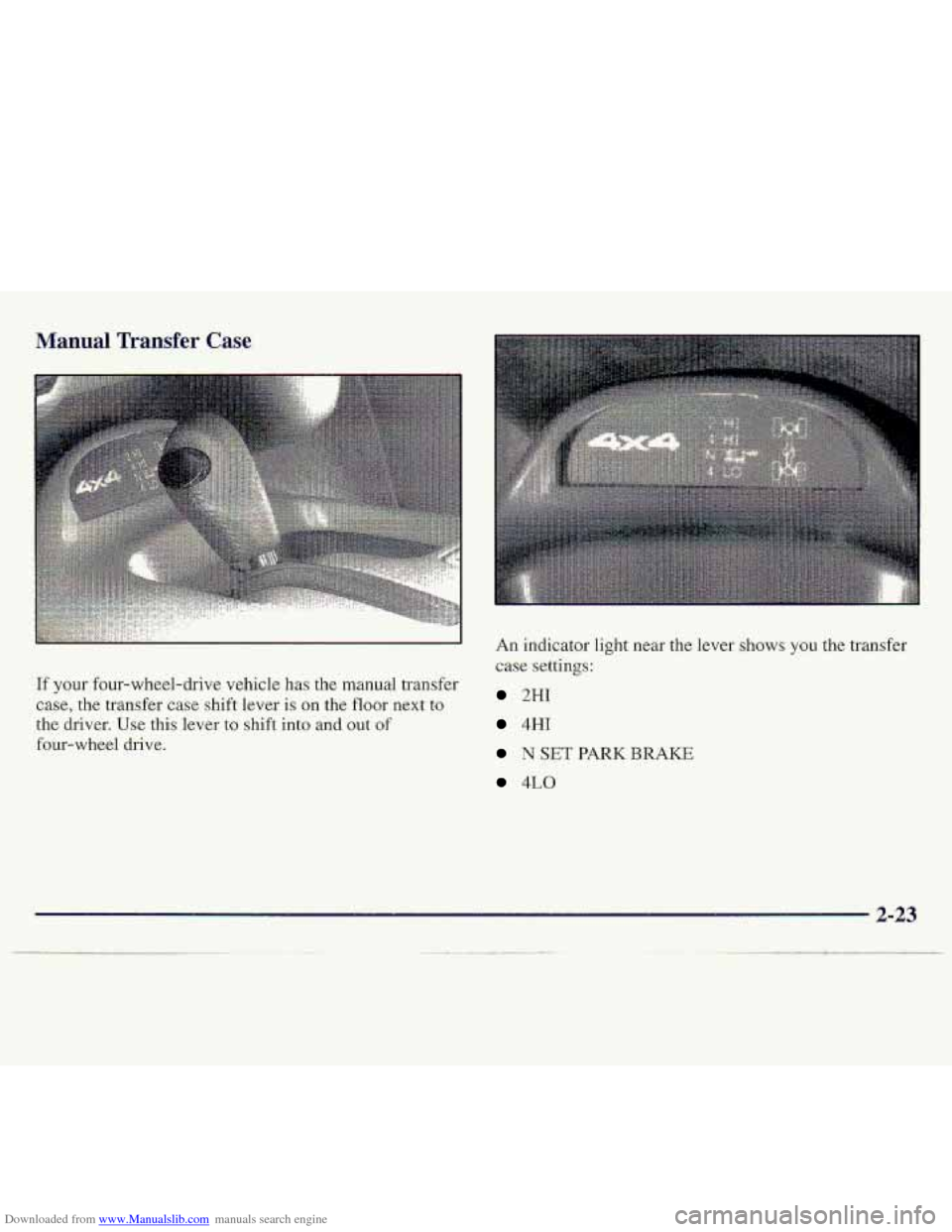
If your four-whd-.drive vehicle has the manual transfer
case, the transfer case
sh.ift lever is on the floor next to
the driver. Use this lever to shift into and out -of
four-wheel drive. An
indicator
light near the
,settings:
2HI
4HI
N SET PARK BRAKE
4LO
2-23
Page 71 of 402
Downloaded from www.Manualslib.com manuals search engine 2HI: This Setting. is for, driving in most street and
highvay- sitwatiaizs. Your front ;axle is not engaged in
tW.D-wbee1 dkive..
4Hl: This getting. &fijjag& y8Ui front axle to. help
drive your vehicle. Use 4HI when you neesl extra
traction, s.uch as on snowy or icy roads, or in most
off-mad .situxti.o.ns.
N SET PARK BRAKE: Shift to this neutral setting
only when
your vehicle needs to be towed.
3. Pull the .trans€er case shift lever into N SET
PARK BRAKE.
2-24
Page 72 of 402
Downloaded from www.Manualslib.com manuals search engine TO shift into or mt. of 4LQ:
1. The-vehicle myst be movingless than 3 mph
(4.8 h) with the tfansrnissi-on in NEUTRAL (N)
fa an automatic transmisSion. Fm a n~anual.
transmission, the clutch pedal must
.be engaged. The
p-referred method for shi€tin.g into 4LO is to have
your vehicle moving
1 to 2 mph (1.5 to 3.2 Wh).
2. Press the trans€er case s:hi€t buttan .and shift in one
continuous motion.
Don't pausejn
N SET PARIK;BRAKE as y-ou shift into
or out of 4L0, or your gears could clash.
Remember that driving in 4HI ur 4LO may reduce fuel
ec-onomy.
Also, driving in fo.ur-whee1 drive:on dry
pavement could cause your tires to wear faster and
make your transfer case harder to shift and-reduce
powertrain longevity.
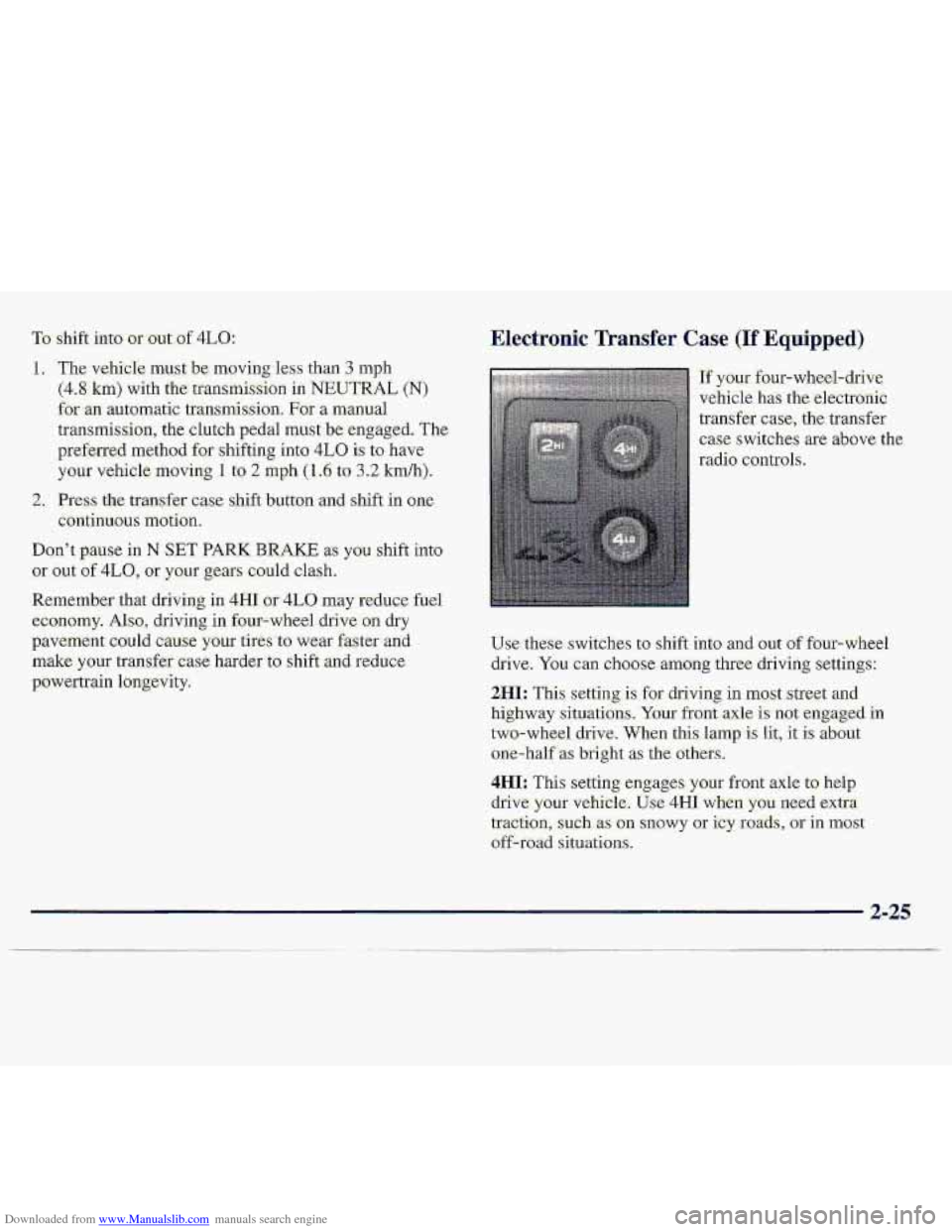
Electronic Transfer. Case (KEquipped)
I~y~~~-four-wheel-drive
vehicle
has the electrofiic
transfer
case, the transfer
case switches are above the,
radio controls.
Use these switches to shift into and out of four-wheel
drive.
You can choosea-rmng three driving settings:
2M[: This setting- is for driving in most .street and
highway situatibns ... Your front axle is not engaged in
two-wheel drive. When this. lamp is lit, it is about
orre-half as bright as the Others.
4HI: This setting engages your front axle ta- help
drive,
your vehitk. Use 4Hi when YOU. need extra
traction, such as
on snowy or icy rcmds, or in mast
off-road situations-.
Page 75 of 402
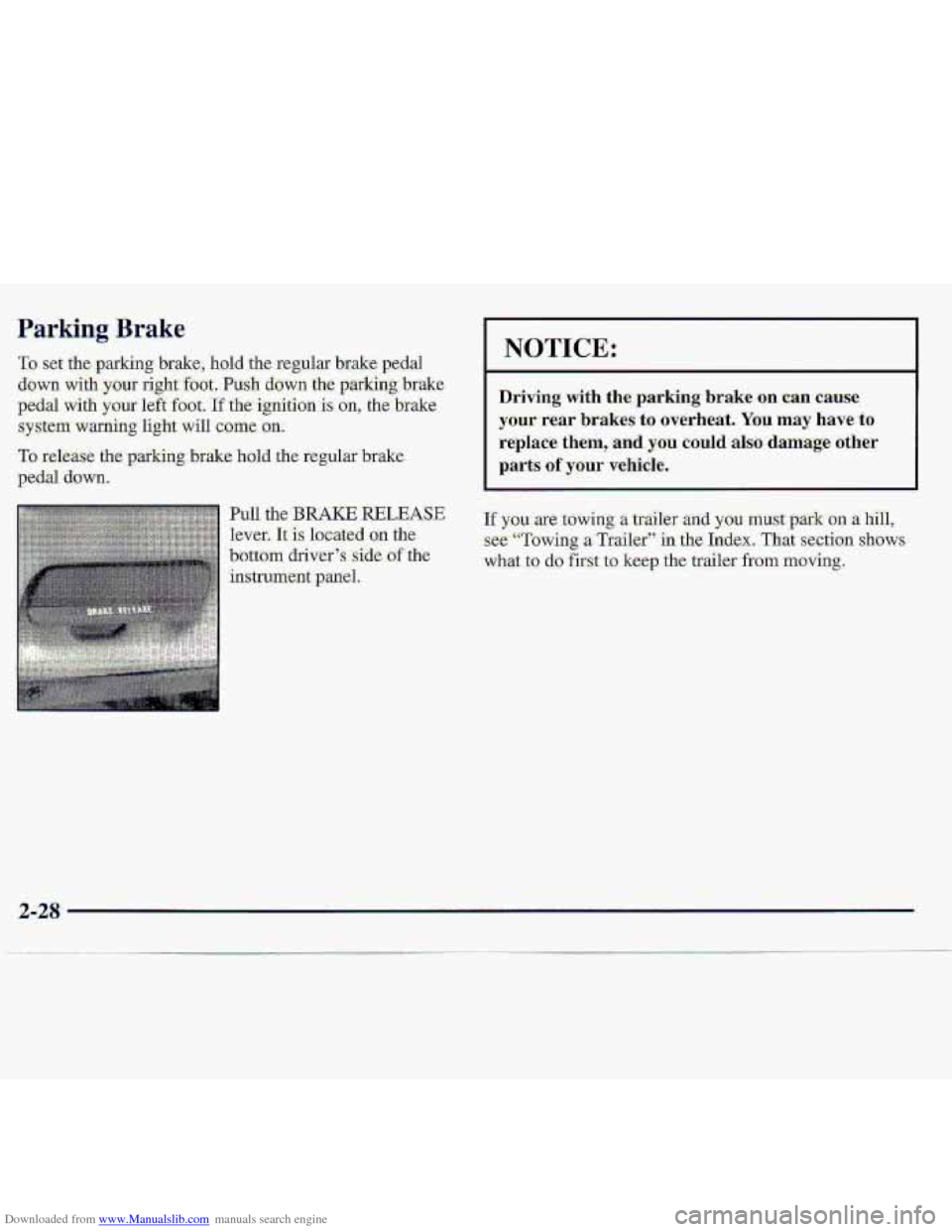
Downloaded from www.Manualslib.com manuals search engine Parking Brake
I NOTICE: I
Driving with .the:p.arking brake on c=an.cause
your- rear brakes to overheat. Y0.u may have to
replace them, and you. could .also-damage other
parts of your vehicle.
If you. are towing a trailer and.you must. park on a hill,
see--"Towing a Trailer" in. the Iadex. That section shows
what to
do first- to. ke.ep the trailer from moving.