body mount CHEVROLET S10 2004 Owners Manual
[x] Cancel search | Manufacturer: CHEVROLET, Model Year: 2004, Model line: S10, Model: CHEVROLET S10 2004Pages: 422, PDF Size: 4.16 MB
Page 187 of 422
Many adults — by some estimates, nearly half the adult
population — choose never to drink alcohol, so they
never drive after drinking. For persons under 21,
it is against the law in every U.S. state to drink alcohol.
There are good medical, psychological and
developmental reasons for these laws.
The obvious way to eliminate the leading highway safety
problem is for people never to drink alcohol and then
drive. But what if people do? How much is “too much” if
someone plans to drive? It is a lot less than many might
think. Although it depends on each person and situation,
here is some general information on the problem.
The Blood Alcohol Concentration (BAC) of someone
who is drinking depends upon four things:
•The amount of alcohol consumed
•The drinker’s body weight
•The amount of food that is consumed before and
during drinking
•The length of time it has taken the drinker to
consume the alcohol.
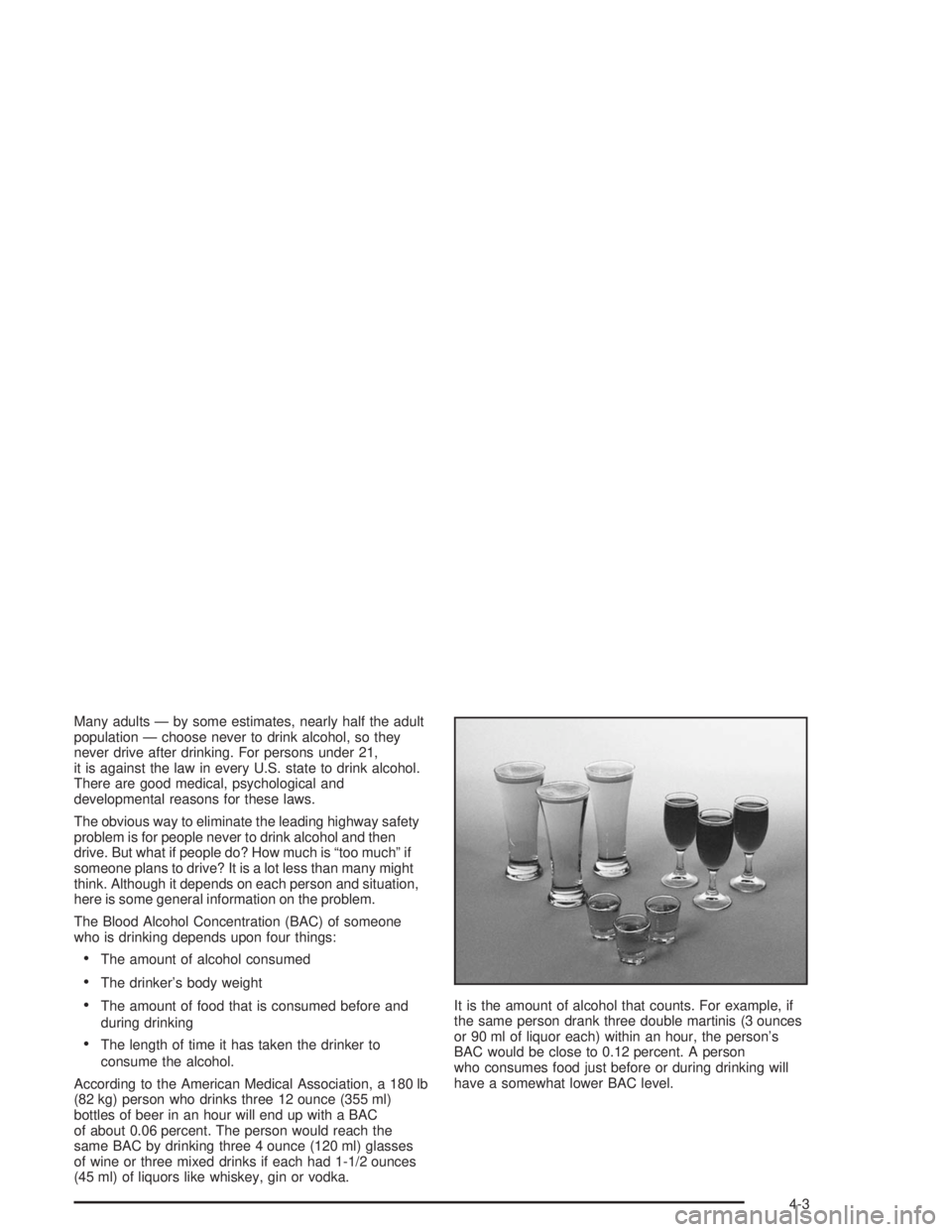
According to the American Medical Association, a 180 lb
(82 kg) person who drinks three 12 ounce (355 ml)
bottles of beer in an hour will end up with a BAC
of about 0.06 percent. The person would reach the
same BAC by drinking three 4 ounce (120 ml) glasses
of wine or three mixed drinks if each had 1-1/2 ounces
(45 ml) of liquors like whiskey, gin or vodka.It is the amount of alcohol that counts. For example, if
the same person drank three double martinis (3 ounces
or 90 ml of liquor each) within an hour, the person’s
BAC would be close to 0.12 percent. A person
who consumes food just before or during drinking will
have a somewhat lower BAC level.
4-3
Page 188 of 422
There is a gender difference, too. Women generally
have a lower relative percentage of body water
than men. Since alcohol is carried in body water, this
means that a woman generally will reach a higher BAC
level than a man of her same body weight will when
each has the same number of drinks.
The law in an increasing number of U.S. states, and
throughout Canada, sets the legal limit at 0.08 percent.
In some other countries, the limit is even lower. For
example, it is 0.05 percent in both France and Germany.
The BAC limit for all commercial drivers in the United
States is 0.04 percent.
The BAC will be over 0.10 percent after three to six
drinks (in one hour). Of course, as we have seen,
it depends on how much alcohol is in the drinks, and
how quickly the person drinks them.
But the ability to drive is affected well below a BAC of
0.10 percent. Research shows that the driving skills
of many people are impaired at a BAC approaching
0.05 percent, and that the effects are worse at night. All
drivers are impaired at BAC levels above 0.05 percent.Statistics show that the chance of being in a collision
increases sharply for drivers who have a BAC of
0.05 percent or above. A driver with a BAC level of
0.06 percent has doubled his or her chance of having a
collision. At a BAC level of 0.10 percent, the chance
of this driver having a collision is 12 times greater; at a
level of 0.15 percent, the chance is 25 times greater!
The body takes about an hour to rid itself of the alcohol
in one drink. No amount of coffee or number of cold
showers will speed that up. “I will be careful” is not the
right answer. What if there is an emergency, a need
to take sudden action, as when a child darts into
the street? A person with even a moderate BAC might
not be able to react quickly enough to avoid the
collision.
There is something else about drinking and driving that
many people do not know. Medical research shows that
alcohol in a person’s system can make crash injuries
worse, especially injuries to the brain, spinal cord or
heart. This means that when anyone who has been
drinking — driver or passenger — is in a crash, that
person’s chance of being killed or permanently disabled
is higher than if the person had not been drinking.
4-4
Page 323 of 422
Each new wheel should have the same load-carrying
capacity, diameter, width, offset and be mounted
the same way as the one it replaces.
If you need to replace any of your wheels, wheel bolts
or wheel nuts, replace them only with new GM
original equipment parts. This way, you will be sure to
have the right wheel, wheel bolts and wheel nuts
for your vehicle.
{CAUTION:
Using the wrong replacement wheels, wheel
bolts or wheel nuts on your vehicle can be
dangerous. It could affect the braking and
handling of your vehicle, make your tires lose
air and make you lose control. You could have
a collision in which you or others could be
injured. Always use the correct wheel, wheel
bolts and wheel nuts for replacement.Notice:The wrong wheel can also cause problems
with bearing life, brake cooling, speedometer or
odometer calibration, headlamp aim, bumper height,
vehicle ground clearance and tire or tire chain
clearance to the body and chassis.
SeeChanging a Flat Tire on page 5-82for more
information.
Used Replacement Wheels
{CAUTION:
Putting a used wheel on your vehicle is
dangerous. You can’t know how it’s been used
or how far it’s been driven. It could fail
suddenly and cause a crash. If you have to
replace a wheel, use a new GM original
equipment wheel.
5-79
Page 335 of 422
Storing a Flat or Spare Tire and Tools
{CAUTION:
Storing a jack, a tire, or other equipment in the
passenger compartment of the vehicle could
cause injury. In a sudden stop or collision,
loose equipment could strike someone. Store
all these in the proper place.
Notice:An aluminum wheel with a at tire should
always be stored under the vehicle with the
hoist. However, storing it that way for an extended
period could damage the wheel. To avoid this,
have the wheel repaired as soon as possible.
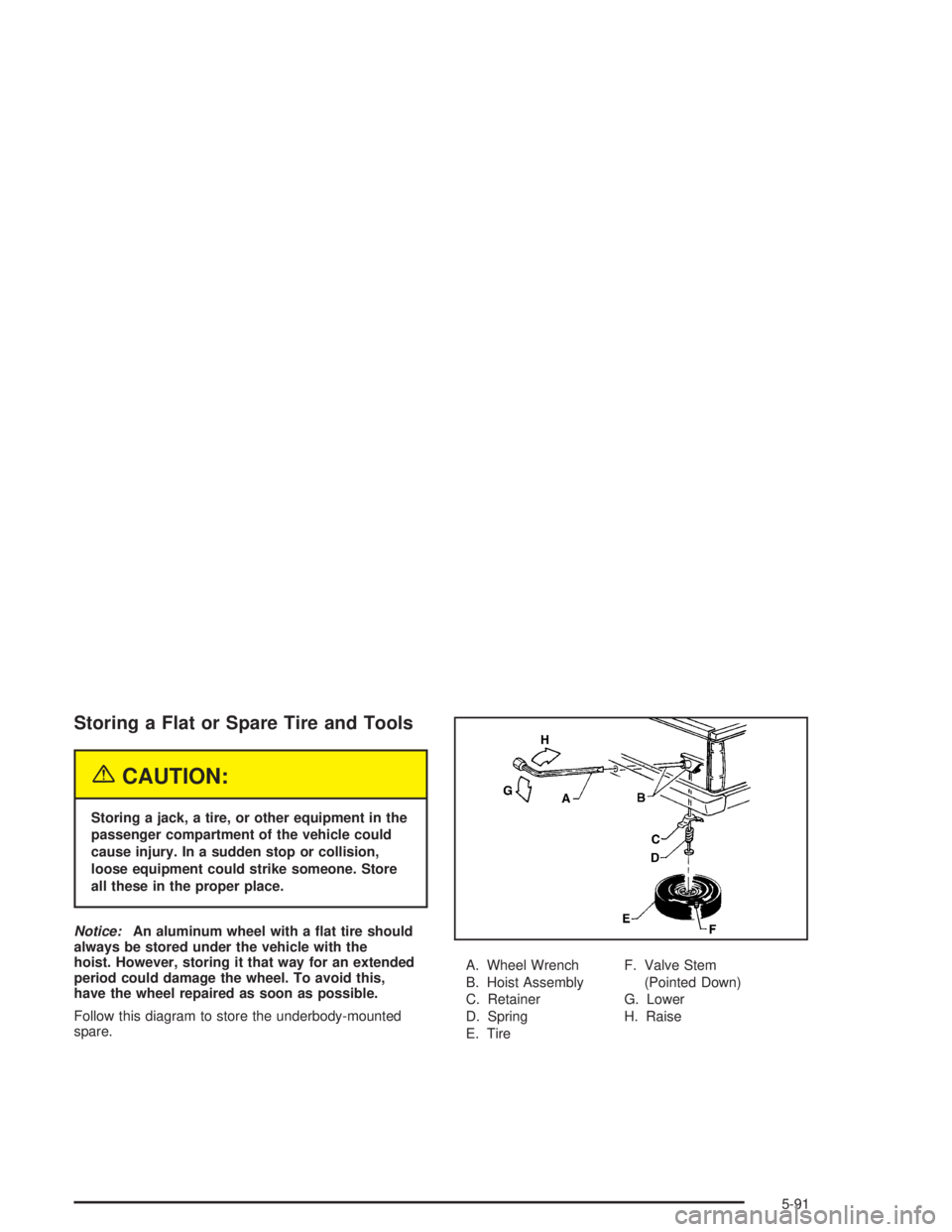
Follow this diagram to store the underbody-mounted
spare.A. Wheel Wrench
B. Hoist Assembly
C. Retainer
D. Spring
E. TireF. Valve Stem
(Pointed Down)
G. Lower
H. Raise
5-91
Page 354 of 422
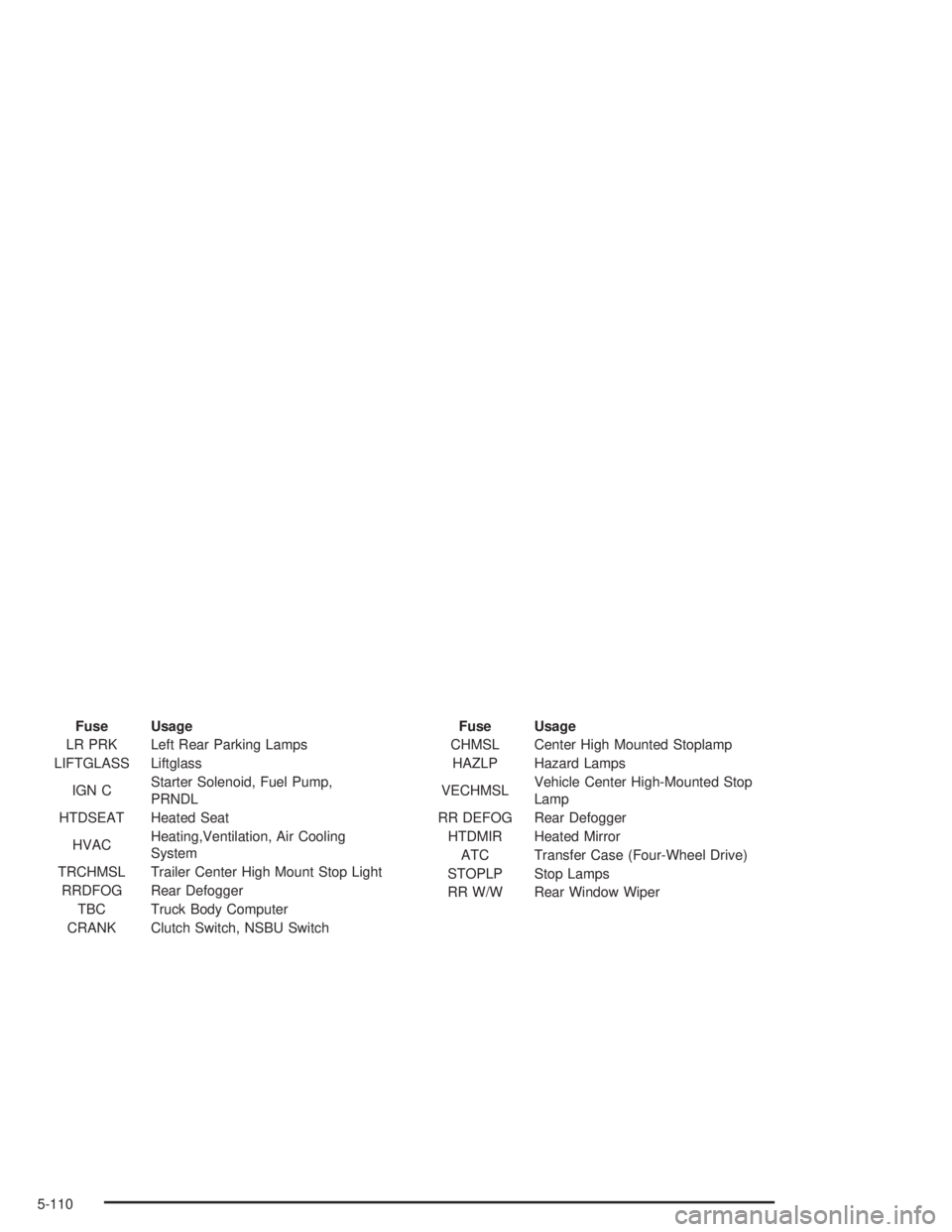
Fuse Usage
LR PRK Left Rear Parking Lamps
LIFTGLASS Liftglass
IGN CStarter Solenoid, Fuel Pump,
PRNDL
HTDSEAT Heated Seat
HVACHeating,Ventilation, Air Cooling
System
TRCHMSL Trailer Center High Mount Stop Light
RRDFOG Rear Defogger
TBC Truck Body Computer
CRANK Clutch Switch, NSBU SwitchFuse Usage
CHMSL Center High Mounted Stoplamp
HAZLP Hazard Lamps
VECHMSLVehicle Center High-Mounted Stop
Lamp
RR DEFOG Rear Defogger
HTDMIR Heated Mirror
ATC Transfer Case (Four-Wheel Drive)
STOPLP Stop Lamps
RR W/W Rear Window Wiper
5-110
Page 408 of 422
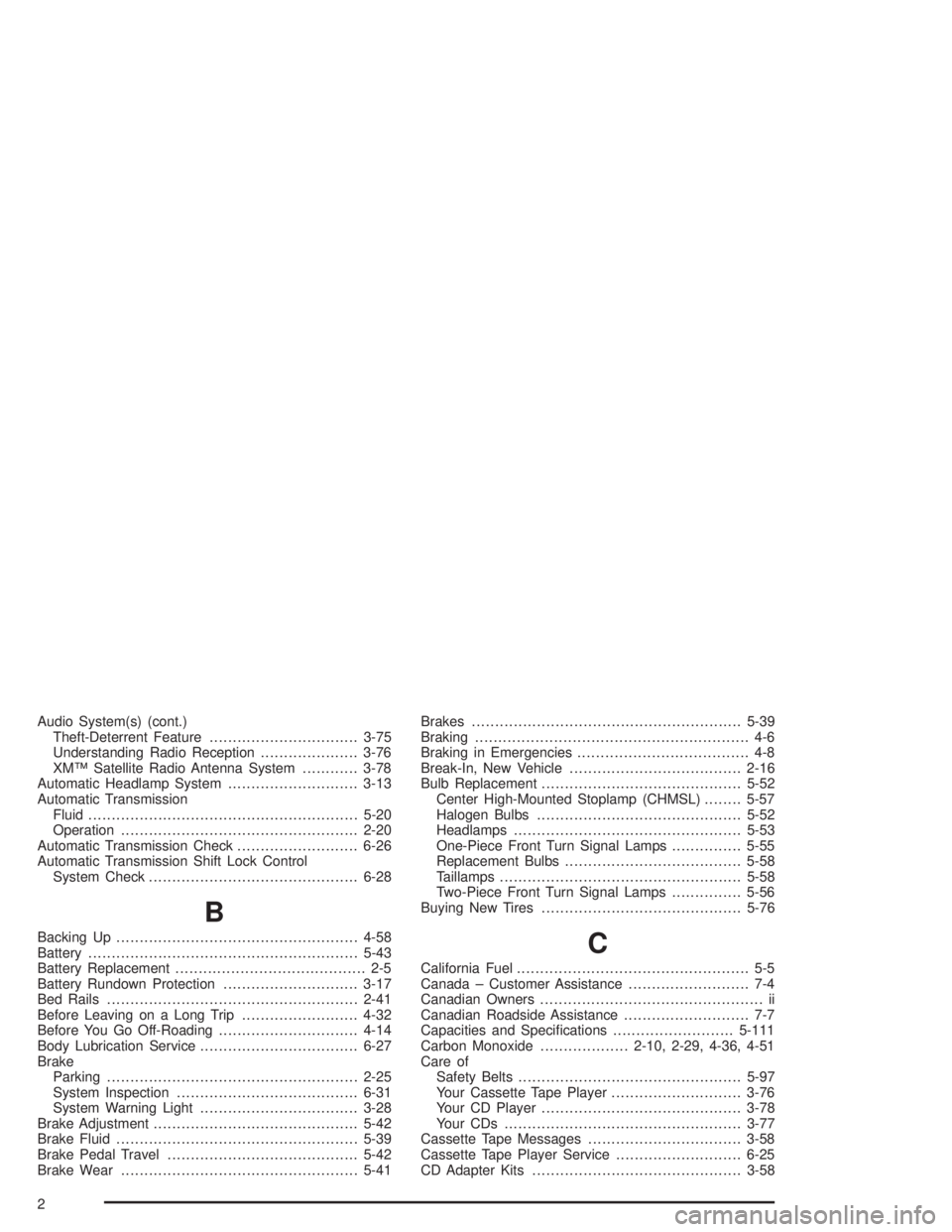
Audio System(s) (cont.)
Theft-Deterrent Feature................................3-75
Understanding Radio Reception.....................3-76
XM™ Satellite Radio Antenna System............3-78
Automatic Headlamp System............................3-13
Automatic Transmission
Fluid..........................................................5-20
Operation...................................................2-20
Automatic Transmission Check..........................6-26
Automatic Transmission Shift Lock Control
System Check.............................................6-28
B
Backing Up....................................................4-58
Battery..........................................................5-43
Battery Replacement......................................... 2-5
Battery Rundown Protection.............................3-17
Bed Rails......................................................2-41
Before Leaving on a Long Trip.........................4-32
Before You Go Off-Roading..............................4-14
Body Lubrication Service..................................6-27
Brake
Parking......................................................2-25
System Inspection.......................................6-31
System Warning Light..................................3-28
Brake Adjustment............................................5-42
Brake Fluid....................................................5-39
Brake Pedal Travel.........................................5-42
Brake Wear...................................................5-41Brakes..........................................................5-39
Braking........................................................... 4-6
Braking in Emergencies..................................... 4-8
Break-In, New Vehicle.....................................2-16
Bulb Replacement...........................................5-52
Center High-Mounted Stoplamp (CHMSL)........5-57
Halogen Bulbs............................................5-52
Headlamps.................................................5-53
One-Piece Front Turn Signal Lamps...............5-55
Replacement Bulbs......................................5-58
Taillamps....................................................5-58
Two-Piece Front Turn Signal Lamps...............5-56
Buying New Tires...........................................5-76C
California Fuel.................................................. 5-5
Canada – Customer Assistance.......................... 7-4
Canadian Owners................................................ ii
Canadian Roadside Assistance........................... 7-7
Capacities and Specifications..........................5-111
Carbon Monoxide...................2-10, 2-29, 4-36, 4-51
Care of
Safety Belts................................................5-97
Your Cassette Tape Player............................3-76
Your CD Player...........................................3-78
Your CDs ...................................................3-77
Cassette Tape Messages.................................3-58
Cassette Tape Player Service...........................6-25
CD Adapter Kits.............................................3-58
2
Page 409 of 422
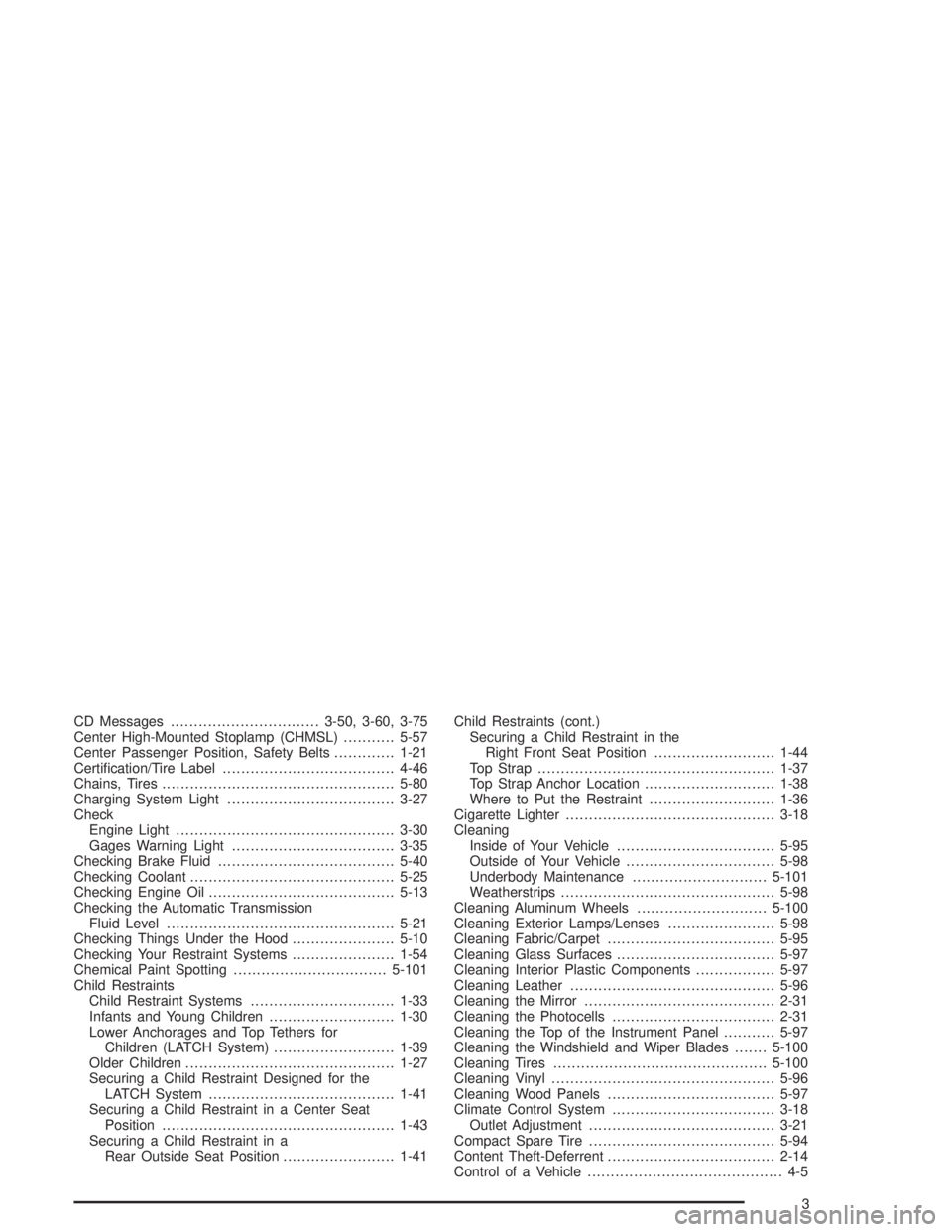
CD Messages................................3-50, 3-60, 3-75
Center High-Mounted Stoplamp (CHMSL)...........5-57
Center Passenger Position, Safety Belts.............1-21
Certification/Tire Label.....................................4-46
Chains, Tires..................................................5-80
Charging System Light....................................3-27
Check
Engine Light...............................................3-30
Gages Warning Light...................................3-35
Checking Brake Fluid......................................5-40
Checking Coolant............................................5-25
Checking Engine Oil........................................5-13
Checking the Automatic Transmission
Fluid Level.................................................5-21
Checking Things Under the Hood......................5-10
Checking Your Restraint Systems......................1-54
Chemical Paint Spotting.................................5-101
Child Restraints
Child Restraint Systems...............................1-33
Infants and Young Children...........................1-30
Lower Anchorages and Top Tethers for
Children (LATCH System)..........................1-39
Older Children.............................................1-27
Securing a Child Restraint Designed for the
LATCH System........................................1-41
Securing a Child Restraint in a Center Seat
Position..................................................1-43
Securing a Child Restraint in a
Rear Outside Seat Position........................1-41Child Restraints (cont.)
Securing a Child Restraint in the
Right Front Seat Position..........................1-44
Top Strap...................................................1-37
Top Strap Anchor Location............................1-38
Where to Put the Restraint...........................1-36
Cigarette Lighter.............................................3-18
Cleaning
Inside of Your Vehicle..................................5-95
Outside of Your Vehicle................................5-98
Underbody Maintenance.............................5-101
Weatherstrips..............................................5-98
Cleaning Aluminum Wheels............................5-100
Cleaning Exterior Lamps/Lenses.......................5-98
Cleaning Fabric/Carpet....................................5-95
Cleaning Glass Surfaces..................................5-97
Cleaning Interior Plastic Components.................5-97
Cleaning Leather............................................5-96
Cleaning the Mirror.........................................2-31
Cleaning the Photocells...................................2-31
Cleaning the Top of the Instrument Panel...........5-97
Cleaning the Windshield and Wiper Blades.......5-100
Cleaning Tires..............................................5-100
Cleaning Vinyl................................................5-96
Cleaning Wood Panels....................................5-97
Climate Control System...................................3-18
Outlet Adjustment........................................3-21
Compact Spare Tire........................................5-94
Content Theft-Deferrent....................................2-14
Control of a Vehicle.......................................... 4-5
3