ignition CHEVROLET SILVERADO 2006 1.G Owners Manual
[x] Cancel search | Manufacturer: CHEVROLET, Model Year: 2006, Model line: SILVERADO, Model: CHEVROLET SILVERADO 2006 1.GPages: 594, PDF Size: 3.41 MB
Page 11 of 594
Heated Seats
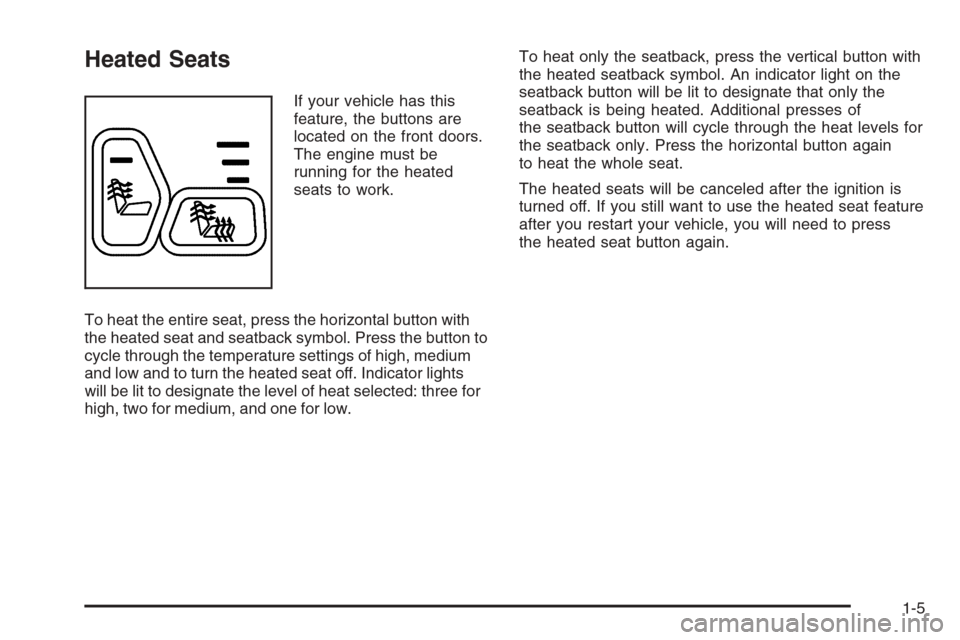
If your vehicle has this
feature, the buttons are
located on the front doors.
The engine must be
running for the heated
seats to work.
To heat the entire seat, press the horizontal button with
the heated seat and seatback symbol. Press the button to
cycle through the temperature settings of high, medium
and low and to turn the heated seat off. Indicator lights
will be lit to designate the level of heat selected: three for
high, two for medium, and one for low.To heat only the seatback, press the vertical button with
the heated seatback symbol. An indicator light on the
seatback button will be lit to designate that only the
seatback is being heated. Additional presses of
the seatback button will cycle through the heat levels for
the seatback only. Press the horizontal button again
to heat the whole seat.
The heated seats will be canceled after the ignition is
turned off. If you still want to use the heated seat feature
after you restart your vehicle, you will need to press
the heated seat button again.
1-5
Page 69 of 594
If your vehicle has a rear seat, there is no top tether
anchor at the right front seating position. Do not secure
a child seat in this position if a national or local law
requires that the top tether be anchored or if the
instructions that come with the child restraint say that
the top tether must be anchored. SeeLower Anchors
and Tethers for Children (LATCH) on page 1-44if
the child restraint has a top tether.
You will be using the lap-shoulder belt to secure the
child restraint in this position. Be sure to follow the
instructions that came with the child restraint. Secure
the child in the child restraint when and as the
instructions say.
1. Your vehicle has a right front passenger’s frontal
airbag. SeeAirbag Off Switch on page 1-78.If
your child restraint is forward-facing, move the seat
as far back as it will go before securing the
restraint in this seat. SeeManual Seats on page 1-3
orPower Seats on page 1-4. If you need to use a
rear-facing child restraint in this seat, make sure the
airbag is off once the child restraint has been
installed.
When the airbag off switch has turned off the right
front passenger’s frontal airbag, the off indicator
in the airbag off light should light and stay lit when
you turn the ignition to RUN or START. See
Airbag Off Light on page 3-34.2. Put the child restraint on the seat.
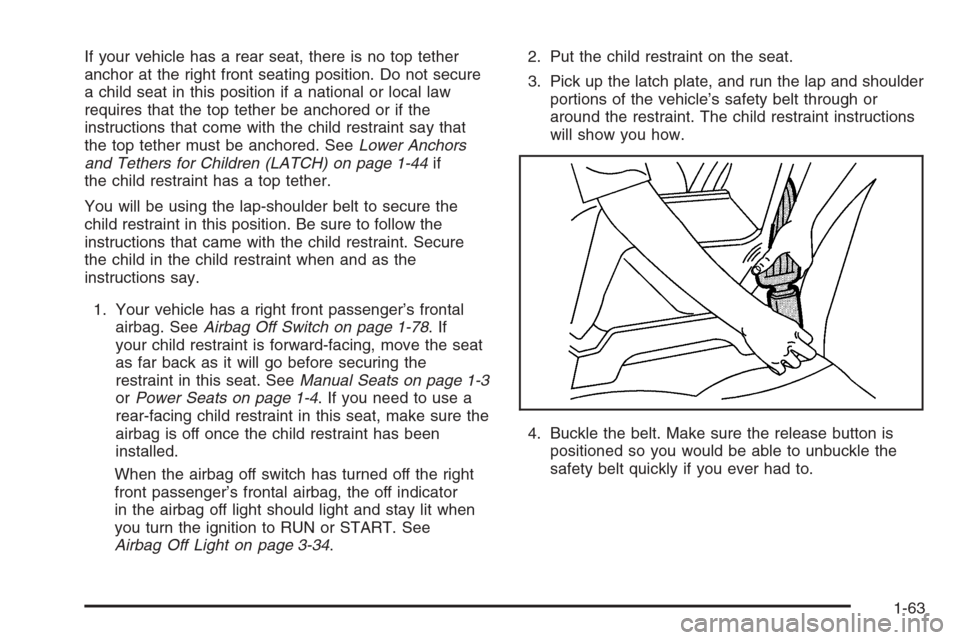
3. Pick up the latch plate, and run the lap and shoulder
portions of the vehicle’s safety belt through or
around the restraint. The child restraint instructions
will show you how.
4. Buckle the belt. Make sure the release button is
positioned so you would be able to unbuckle the
safety belt quickly if you ever had to.
1-63
Page 74 of 594
If you need to secure a forward-facing child restraint in
the right front seat position, move the seat as far
back as it will go before securing the forward-facing
child restraint. SeePower Seats on page 1-4orManual
Seats on page 1-3.
If your child restraint is equipped with the LATCH
system, seeLower Anchors and Tethers for Children
(LATCH) on page 1-44.
If your vehicle has a rear seat, there is no top tether
anchor at the right front seating position. Do not secure
a child seat in this position if a national or local law
requires that the top tether be anchored or if the
instructions that come with the child restraint say that
the top tether must be anchored. SeeLower Anchors
and Tethers for Children (LATCH) on page 1-44if
the child restraint has a top tether.You will be using the lap-shoulder belt to secure the
child restraint in this position. Be sure to follow the
instructions that came with the child restraint. Secure
the child in the child restraint when and as the
instructions say.
1. Your vehicle has a right front passenger’s frontal
airbag. SeePassenger Sensing System on
page 1-80. General Motors recommends that
rear-facing child restraints be secured in a rear seat,
even if the airbag is off. If your child restraint is
forward-facing, move the seat as far back as it will
go before securing the child restraint in this
seat. SeePower Seats on page 1-4orManual
Seats on page 1-3.
When the passenger sensing system has turned off
the right front passenger’s frontal airbag, the off
indicator in the passenger airbag status indicator
should light and stay lit when you turn the ignition to
RUN or START. SeePassenger Airbag Status
Indicator on page 3-36.
2. Put the child restraint on the seat.
3. Pick up the latch plate, and run the lap and shoulder
portions of the vehicle’s safety belt through or
around the restraint. The child restraint instructions
will show you how.
1-68
Page 85 of 594
Medical Condition.A passenger has a
medical condition which, according to his or
her physician:
causes the passenger airbag to pose a special risk
for the passenger; and
makes the potential harm from the passenger
airbag in a crash greater than the potential
harm from turning off the airbag and allowing the
passenger, even if belted, to hit the dashboard
or windshield in a crash.
{CAUTION:
If the right front passenger’s airbag is turned off
for a person who is not in a risk group identied
by the national government, that person will
not have the extra protection of an airbag. In a
crash, the airbag will not be able to inate and
help protect the person sitting there. Do not turn
off the passenger’s airbag unless the person
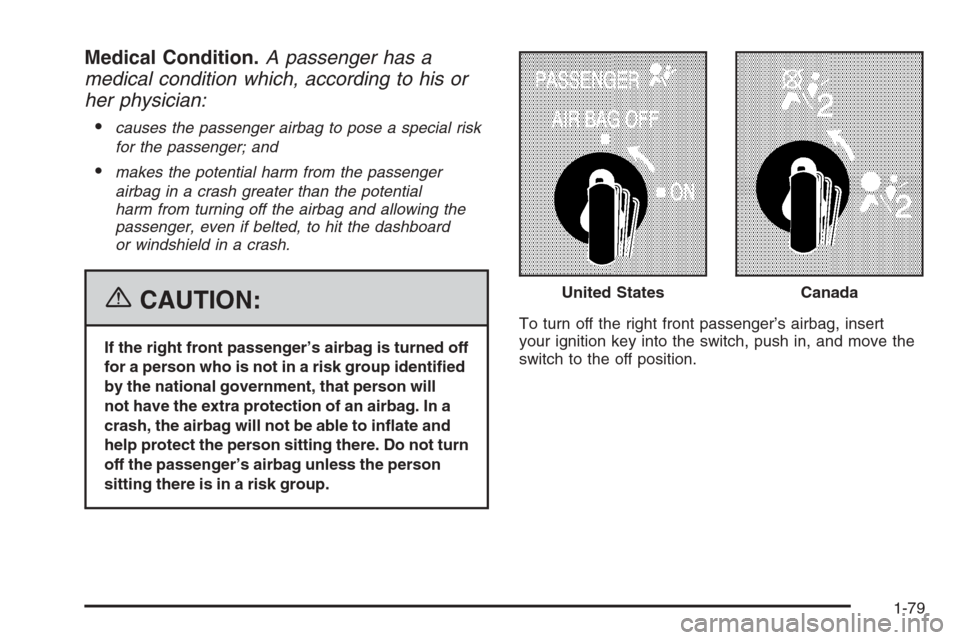
sitting there is in a risk group.To turn off the right front passenger’s airbag, insert
your ignition key into the switch, push in, and move the
switch to the off position.United States
Canada
1-79
Page 86 of 594
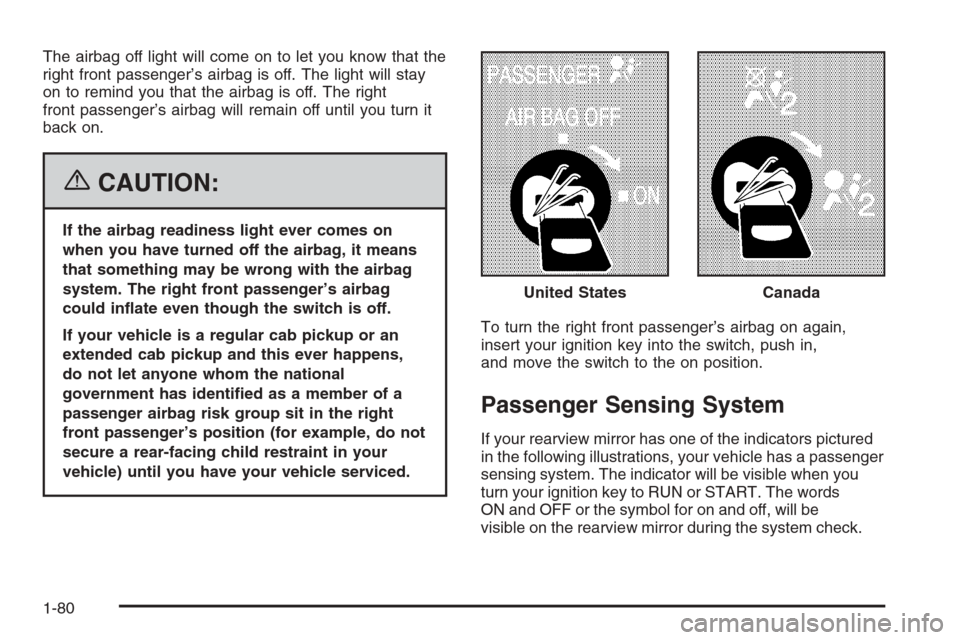
The airbag off light will come on to let you know that the
right front passenger’s airbag is off. The light will stay
on to remind you that the airbag is off. The right
front passenger’s airbag will remain off until you turn it
back on.
{CAUTION:
If the airbag readiness light ever comes on
when you have turned off the airbag, it means
that something may be wrong with the airbag
system. The right front passenger’s airbag
could inate even though the switch is off.
If your vehicle is a regular cab pickup or an
extended cab pickup and this ever happens,
do not let anyone whom the national
government has identied as a member of a
passenger airbag risk group sit in the right
front passenger’s position (for example, do not
secure a rear-facing child restraint in your
vehicle) until you have your vehicle serviced.To turn the right front passenger’s airbag on again,
insert your ignition key into the switch, push in,
and move the switch to the on position.
Passenger Sensing System
If your rearview mirror has one of the indicators pictured
in the following illustrations, your vehicle has a passenger
sensing system. The indicator will be visible when you
turn your ignition key to RUN or START. The words
ON and OFF or the symbol for on and off, will be
visible on the rearview mirror during the system check.United States
Canada
1-80
Page 92 of 594
Aftermarket equipment, such as seat covers, can affect
how well the passenger sensing system operates.
You may want to consider not using seat covers or other
aftermarket equipment if your vehicle has the passenger
sensing system. SeeAdding Equipment to Your
Airbag-Equipped Vehicle on page 1-87for more
information about modications that can affect how the
system operates.
{CAUTION:
Stowing of articles under the passenger’s seat
or between the passenger’s seat cushion and
seatback may interfere with the proper
operation of the passenger sensing system.
Servicing Your Airbag-Equipped
Vehicle
Airbags affect how your vehicle should be serviced.
There are parts of the airbag system in several places
around your vehicle. You do not want the system to
inate while someone is working on your vehicle. Your
dealer and the service manual have information
about servicing your vehicle and the airbag system. To
purchase a service manual, seeService Publications
Ordering Information on page 7-14.
{CAUTION:
For up to 10 seconds after the ignition key is
turned off and the battery is disconnected, an
airbag can still inate during improper service.
You can be injured if you are close to an
airbag when it inates. Avoid yellow
connectors. They are probably part of the
airbag system. Be sure to follow proper
service procedures, and make sure the person
performing work for you is qualied to do so.
The airbag system does not need regular maintenance.
1-86
Page 97 of 594
Keys...............................................................2-3
Remote Keyless Entry System.........................2-4
Remote Keyless Entry System Operation...........2-5
Doors and Locks.............................................2-8
Door Locks....................................................2-8
Power Door Locks..........................................2-8
Delayed Locking.............................................2-9
Programmable Automatic Door Locks..............2-10
Rear Door Security Locks (Crew Cab).............2-12
Lockout Protection........................................2-12
Rear Doors..................................................2-13
Tailgate.......................................................2-14
Windows........................................................2-15
Manual Windows..........................................2-15
Power Windows............................................2-16
Swing-Out Windows......................................2-17
Sliding Rear Window.....................................2-17
Sun Visors...................................................2-17
Theft-Deterrent Systems..................................2-18
Content Theft-Deterrent.................................2-18
Passlock
®....................................................2-19Starting and Operating Your Vehicle................2-20
New Vehicle Break-In....................................2-20
Ignition Positions..........................................2-20
Retained Accessory Power (RAP)...................2-22
Starting the Engine.......................................2-22
Engine Coolant Heater..................................2-23
Automatic Transmission Operation...................2-24
Tow/Haul Mode............................................2-30
Manual Transmission Operation......................2-32
Four-Wheel Drive..........................................2-36
Parking Brake..............................................2-49
Shifting Into Park (P)
(Automatic Transmission)............................2-50
Shifting Out of Park (P)
(Automatic Transmission)............................2-52
Parking Your Vehicle
(Manual Transmission)...............................2-53
Parking Over Things That Burn.......................2-53
Engine Exhaust............................................2-54
Running the Engine While Parked...................2-54
Section 2 Features and Controls
2-1
Page 99 of 594
Keys
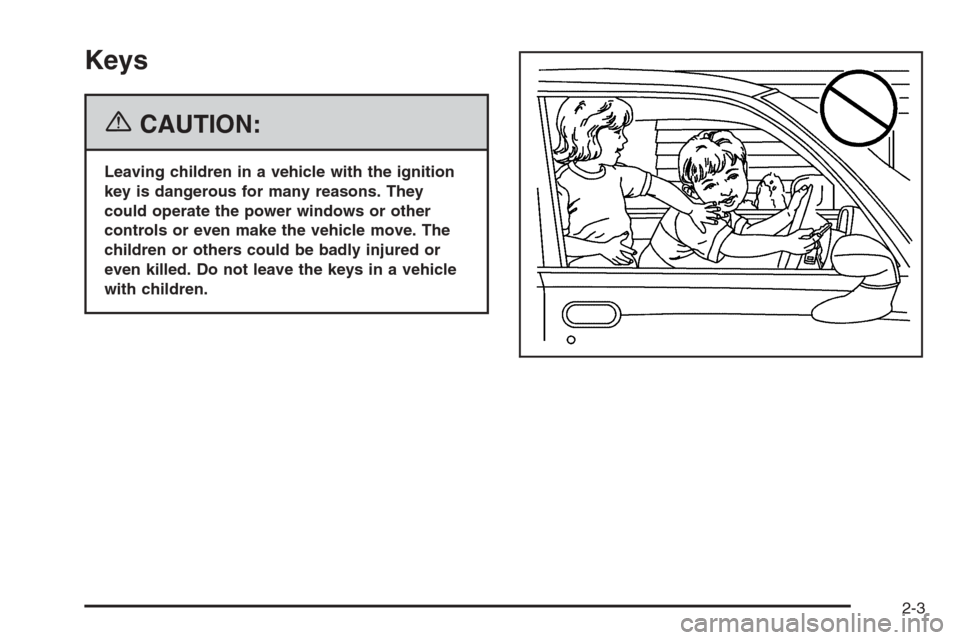
{CAUTION:
Leaving children in a vehicle with the ignition
key is dangerous for many reasons. They
could operate the power windows or other
controls or even make the vehicle move. The
children or others could be badly injured or
even killed. Do not leave the keys in a vehicle
with children.
2-3
Page 100 of 594
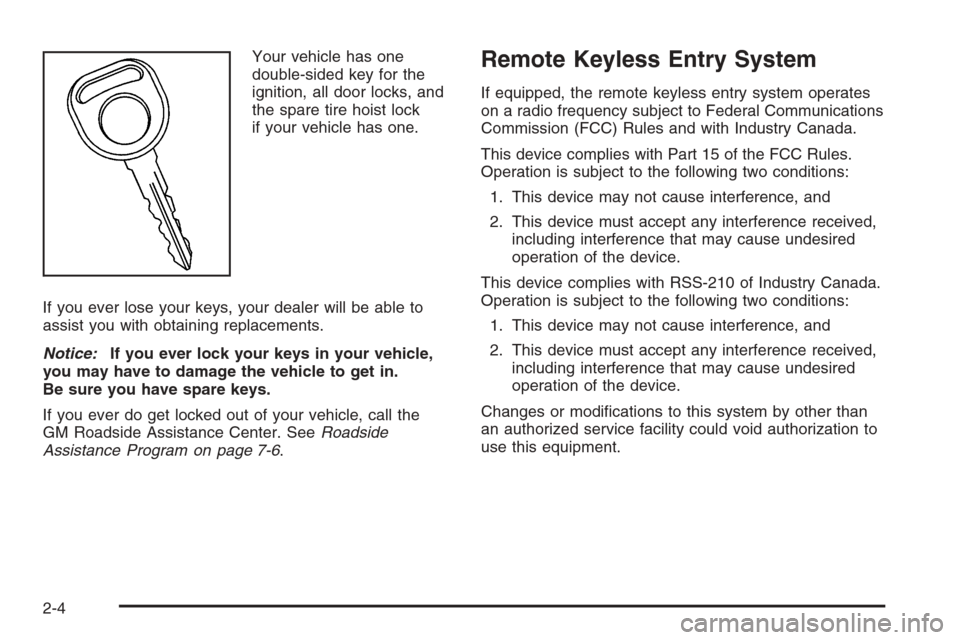
Your vehicle has one
double-sided key for the
ignition, all door locks, and
the spare tire hoist lock
if your vehicle has one.
If you ever lose your keys, your dealer will be able to
assist you with obtaining replacements.
Notice:If you ever lock your keys in your vehicle,
you may have to damage the vehicle to get in.
Be sure you have spare keys.
If you ever do get locked out of your vehicle, call the
GM Roadside Assistance Center. SeeRoadside
Assistance Program on page 7-6.Remote Keyless Entry System
If equipped, the remote keyless entry system operates
on a radio frequency subject to Federal Communications
Commission (FCC) Rules and with Industry Canada.
This device complies with Part 15 of the FCC Rules.
Operation is subject to the following two conditions:
1. This device may not cause interference, and
2. This device must accept any interference received,
including interference that may cause undesired
operation of the device.
This device complies with RSS-210 of Industry Canada.
Operation is subject to the following two conditions:
1. This device may not cause interference, and
2. This device must accept any interference received,
including interference that may cause undesired
operation of the device.
Changes or modications to this system by other than
an authorized service facility could void authorization to
use this equipment.
2-4
Page 105 of 594
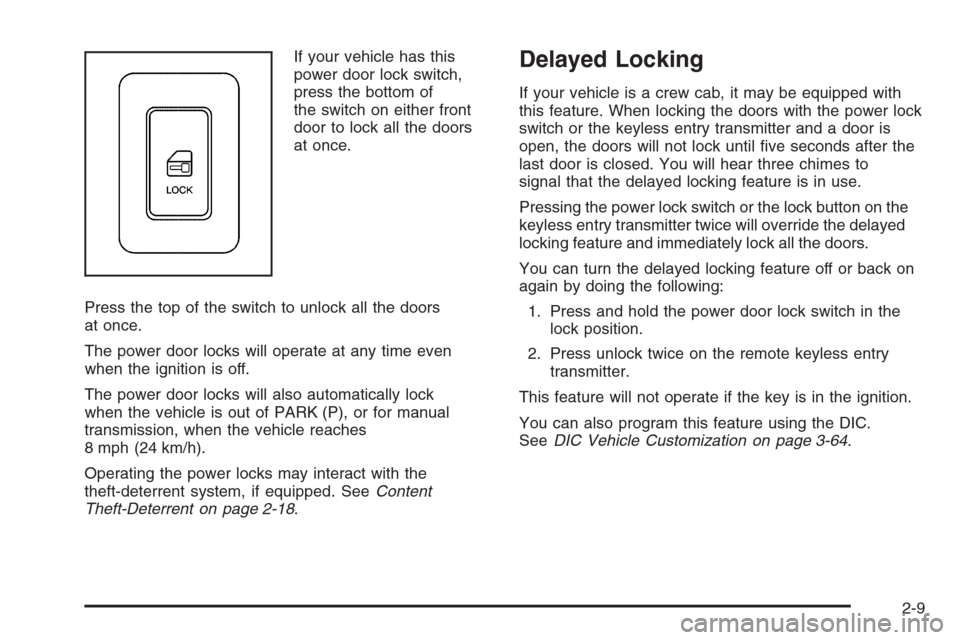
If your vehicle has this
power door lock switch,
press the bottom of
the switch on either front
door to lock all the doors
at once.
Press the top of the switch to unlock all the doors
at once.
The power door locks will operate at any time even
when the ignition is off.
The power door locks will also automatically lock
when the vehicle is out of PARK (P), or for manual
transmission, when the vehicle reaches
8 mph (24 km/h).
Operating the power locks may interact with the
theft-deterrent system, if equipped. SeeContent
Theft-Deterrent on page 2-18.Delayed Locking
If your vehicle is a crew cab, it may be equipped with
this feature. When locking the doors with the power lock
switch or the keyless entry transmitter and a door is
open, the doors will not lock until ve seconds after the
last door is closed. You will hear three chimes to
signal that the delayed locking feature is in use.
Pressing the power lock switch or the lock button on the
keyless entry transmitter twice will override the delayed
locking feature and immediately lock all the doors.
You can turn the delayed locking feature off or back on
again by doing the following:
1. Press and hold the power door lock switch in the
lock position.
2. Press unlock twice on the remote keyless entry
transmitter.
This feature will not operate if the key is in the ignition.
You can also program this feature using the DIC.
SeeDIC Vehicle Customization on page 3-64.
2-9