tow CHEVROLET SILVERADO 2017 3.G Owners Manual
[x] Cancel search | Manufacturer: CHEVROLET, Model Year: 2017, Model line: SILVERADO, Model: CHEVROLET SILVERADO 2017 3.GPages: 509, PDF Size: 8.87 MB
Page 375 of 509
Chevrolet Silverado Owner Manual (GMNA-Localizing-U.S./Canada/Mexico-9956065) - 2017 - CRC - 4/29/16
374 Vehicle Care
Overheated Engine
Protection
Operating Mode
If an overheated engine conditionexists and the ENGINE POWER ISREDUCED message displays, anoverheat protection mode whichalternates firing groups of cylindershelps to prevent engine damage. Inthis mode, a loss in power andengine performance will be noticed.This operating mode allows thevehicle to be driven to a safe placein an emergency. Driving extendeddistances and/or towing a trailer inthe overheat protection modeshould be avoided.
Caution
After driving in the overheated
engine protection operating
mode, the engine oil will be
severely degraded. Any repairs
performed before the engine is
cool may cause engine damage.
Allow the engine to cool before
(Continued)
Caution (Continued)
attempting any repair. Repair the
cause of coolant loss, change the
oil, and reset the oil life system.
SeeEngine Oil0359.
Engine Fan
If the vehicle has a clutched enginecooling fan, when the clutch isengaged, the fan spins faster toprovide more air to cool the engine.In most everyday driving conditions,the fan is spinning slower and theclutch is not fully engaged. Thisimproves fuel economy and reducesfan noise. Under heavy vehicleloading, trailer towing, and/or highoutside temperatures, the fan speedincreases as the clutch more fullyengages, so an increase in fannoise may be heard. This is normaland should not be mistaken as thetransmission slipping or makingextra shifts. It is merely the coolingsystem functioning properly. The fanwill slow down when additionalcooling is not required and theclutch disengages.
This fan noise may also be heardwhen starting the engine. It will goaway as the fan clutch partiallydisengages.
If the vehicle has electric coolingfan(s), the fans may be heardspinning at low speed during mosteveryday driving. The fans may turnoff if no cooling is required. Underheavy vehicle loading, trailer towing,high outside temperatures,or operation of the air conditioningsystem, the fans may change tohigh speed and an increase in fannoise may be heard. This is normaland indicates that the coolingsystem is functioning properly. Thefans will change to low speed whenadditional cooling is no longerrequired.
The electric engine cooling fansmay run after the engine has beenturned. off. This is normal and noservice is required.
Page 415 of 509
Chevrolet Silverado Owner Manual (GMNA-Localizing-U.S./Canada/Mexico-9956065) - 2017 - CRC - 4/29/16
414 Vehicle Care
{Warning
Rust or dirt on a wheel, or on the
parts to which it is fastened, can
make wheel nuts become loose
after time. The wheel could come
off and cause an accident. When
changing a wheel, remove any
rust or dirt from places where the
wheel attaches to the vehicle. In
an emergency, a cloth or a paper
towel can be used; however, use
ascraperorwirebrushlaterto
remove all rust or dirt.
Lightly coat the inner diameter of
the wheel hub opening with
wheel bearing grease after a
wheel change or tire rotation to
prevent corrosion or rust
build-up. Do not get grease on
the flat wheel mounting surface
or on the wheel nuts or bolts.
Reset the Tire Pressure Monitor
System (TPMS), if the vehicle
has one. SeeTire Pressure
Monitor Operation0408.
Check that the spare tire, if the
vehicle has one, is stored
properly. Push, pull, and then try
to rotate or turn the tire. If it
moves, tighten the cable. See
“Storing a Flat or Spare Tire and
To o l s”underTire
Changing0422.
When It Is Time for New
Tires
Factors, such as maintenance,temperatures, driving speeds,vehicle loading, and road conditionsaffect the wear rate of the tires.
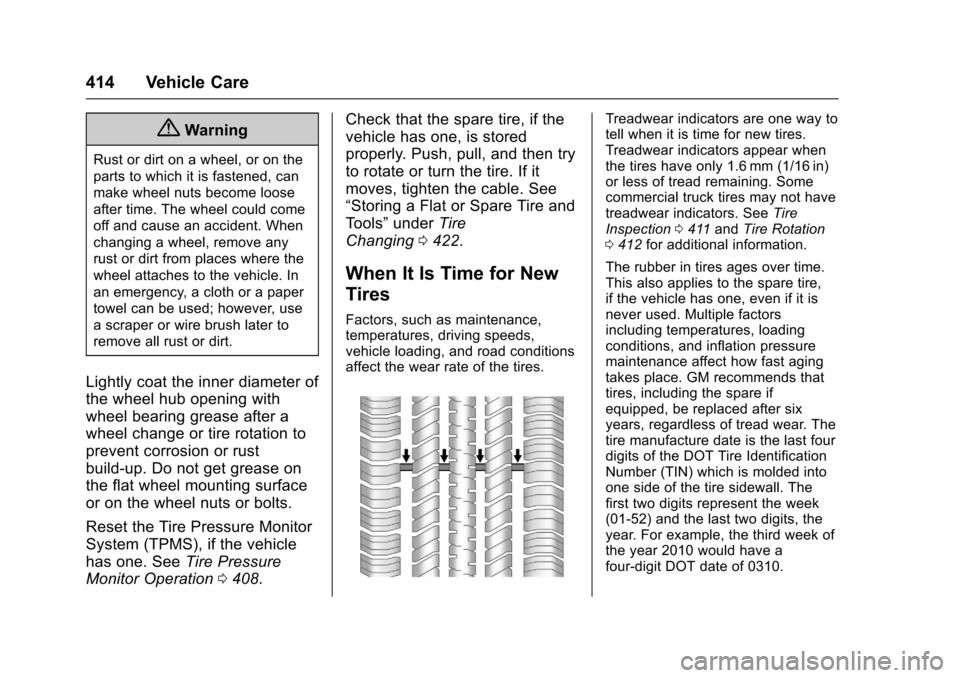
Treadwear indicators are one way totell when it is time for new tires.Treadwear indicators appear whenthe tires have only 1.6 mm (1/16 in)or less of tread remaining. Somecommercial truck tires may not havetreadwear indicators. SeeTireInspection0411andTire Rotation0412for additional information.
The rubber in tires ages over time.This also applies to the spare tire,if the vehicle has one, even if it isnever used. Multiple factorsincluding temperatures, loadingconditions, and inflation pressuremaintenance affect how fast agingtakes place. GM recommends thattires, including the spare ifequipped, be replaced after sixyears, regardless of tread wear. Thetire manufacture date is the last fourdigits of the DOT Tire IdentificationNumber (TIN) which is molded intoone side of the tire sidewall. Thefirst two digits represent the week(01-52) and the last two digits, theyear. For example, the third week ofthe year 2010 would have afour-digit DOT date of 0310.
Page 419 of 509
Chevrolet Silverado Owner Manual (GMNA-Localizing-U.S./Canada/Mexico-9956065) - 2017 - CRC - 4/29/16
418 Vehicle Care
norm due to variations in driving
habits, service practices and
differences in road
characteristics and climate.
Traction
The traction grades, from
highest to lowest, are AA, A, B,
and C. Those grades represent
the tire's ability to stop on wet
pavement as measured under
controlled conditions on
specified government test
surfaces of asphalt and
concrete. A tire marked C may
have poor traction performance.
Warning: The traction grade
assigned to this tire is based on
straight-ahead braking traction
tests, and does not include
acceleration, cornering,
hydroplaning, or peak traction
characteristics.
Temperature
The temperature grades are A
(the highest), B, and C,
representing the tire's resistance
to the generation of heat and its
ability to dissipate heat when
tested under controlled
conditions on a specified indoor
laboratory test wheel. Sustained
high temperature can cause the
material of the tire to degenerate
and reduce tire life, and
excessive temperature can lead
to sudden tire failure. The grade
Ccorrespondstoalevelof
performance which all
passenger car tires must meet
under the Federal Motor Safety
Standard No. 109. Grades B and
Arepresenthigherlevelsof
performance on the laboratory
test wheel than the minimum
required by law. Warning: The
temperature grade for this tire is
established for a tire that is
properly inflated and not
overloaded. Excessive speed,
underinflation, or excessive
loading, either separately or in
combination, can cause heat
buildup and possible tire failure.
Wheel Alignment and Tire
Balance
The tires and wheels were alignedand balanced at the factory toprovide the longest tire life and bestoverall performance. Adjustments towheel alignment and tire balancingare not necessary on a regularbasis. Consider an alignment checkif there is unusual tire wear or thevehicle is significantly pulling to oneside or the other. Some slight pull tothe left or right, depending on thecrown of the road and/or other roadsurface variations such as troughsor ruts, is normal. If the vehicle isvibrating when driving on a smoothroad, the tires and wheels may needto be rebalanced. See your dealerfor proper diagnosis.
Wheel Replacement
Replace any wheel that is bent,cracked, or badly rusted orcorroded. If wheel nuts keep comingloose, the wheel, wheel bolts andwheel nuts should be replaced.If the wheel leaks air, replace it.
Page 421 of 509
Chevrolet Silverado Owner Manual (GMNA-Localizing-U.S./Canada/Mexico-9956065) - 2017 - CRC - 4/29/16
420 Vehicle Care
Warning (Continued)
without the proper amount of
clearance can cause damage to
the brakes, suspension, or other
vehicle parts. The area damaged
by the tire chains could cause you
to lose control of the vehicle and
you or others may be injured in a
crash.
Use another type of traction
device only if its manufacturer
recommends it for use on the
vehicle and tire size combination
and road conditions. Follow that
manufacturer's instructions. To
help avoid damage to the vehicle,
drive slowly, readjust, or remove
the device if it is contacting the
vehicle, and do not spin the
vehicle's wheels.
If you do find traction devices that
will fit, install them on the rear
tires.
Caution
If the vehicle does not have dual
wheels and has a tire size other
than 265/65R18, P265/65R18,
P275/55R20, LT265/70R17,
LT 2 6 5 / 7 0 R 1 8 , LT 2 6 5 / 6 0 R 2 0 ,
LT 2 7 5 / 6 5 R 1 8 , P 2 8 5 / 5 0 R 2 0 ,
285/45R22, or P285/45R22, use
tire chains only where legal and
only when you must. Use chains
that are the proper size for the
tires. Install them on the tires of
the rear axle. Do not use chains
on the tires of the front axle.
Tighten them as tightly as
possible with the ends securely
fastened. Drive slowly and follow
the chain manufacturer's
instructions. If you can hear the
chains contacting the vehicle,
stop and retighten them. If the
contact continues, slow down
until it stops. Driving too fast or
spinning the wheels with chains
on will damage the vehicle.
If a Tire Goes Flat
It is unusual for a tire to blowoutwhile driving, especially if the tiresare maintained properly. If air goesout of a tire, it is much more likely toleak out slowly. But if there ever is ablowout, here are a few tips aboutwhat to expect and what to do:
If a front tire fails, the flat tirecreates a drag that pulls the vehicletoward that side. Take your foot offthe accelerator pedal and grip thesteering wheel firmly. Steer tomaintain lane position, and thengently brake to a stop, well off theroad, if possible.
Arearblowout,particularlyonacurve, acts much like a skid andmay require the same correction asused in a skid. Stop pressing theaccelerator pedal and steer tostraighten the vehicle. It may bevery bumpy and noisy. Gently braketo a stop, well off the road,if possible.
Page 425 of 509
Chevrolet Silverado Owner Manual (GMNA-Localizing-U.S./Canada/Mexico-9956065) - 2017 - CRC - 4/29/16
424 Vehicle Care
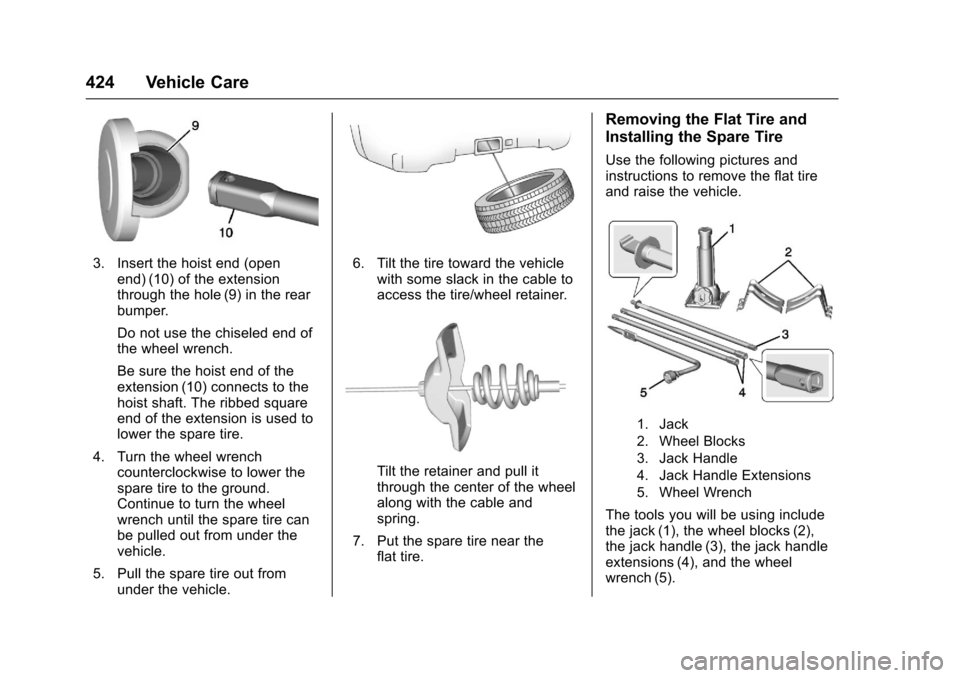
3. Insert the hoist end (openend) (10) of the extensionthrough the hole (9) in the rearbumper.
Do not use the chiseled end ofthe wheel wrench.
Be sure the hoist end of theextension (10) connects to thehoist shaft. The ribbed squareend of the extension is used tolower the spare tire.
4. Turn the wheel wrenchcounterclockwise to lower thespare tire to the ground.Continue to turn the wheelwrench until the spare tire canbe pulled out from under thevehicle.
5. Pull the spare tire out fromunder the vehicle.
6. Tilt the tire toward the vehiclewith some slack in the cable toaccess the tire/wheel retainer.
Tilt the retainer and pull itthrough the center of the wheelalong with the cable andspring.
7. Put the spare tire near theflat tire.
Removing the Flat Tire and
Installing the Spare Tire
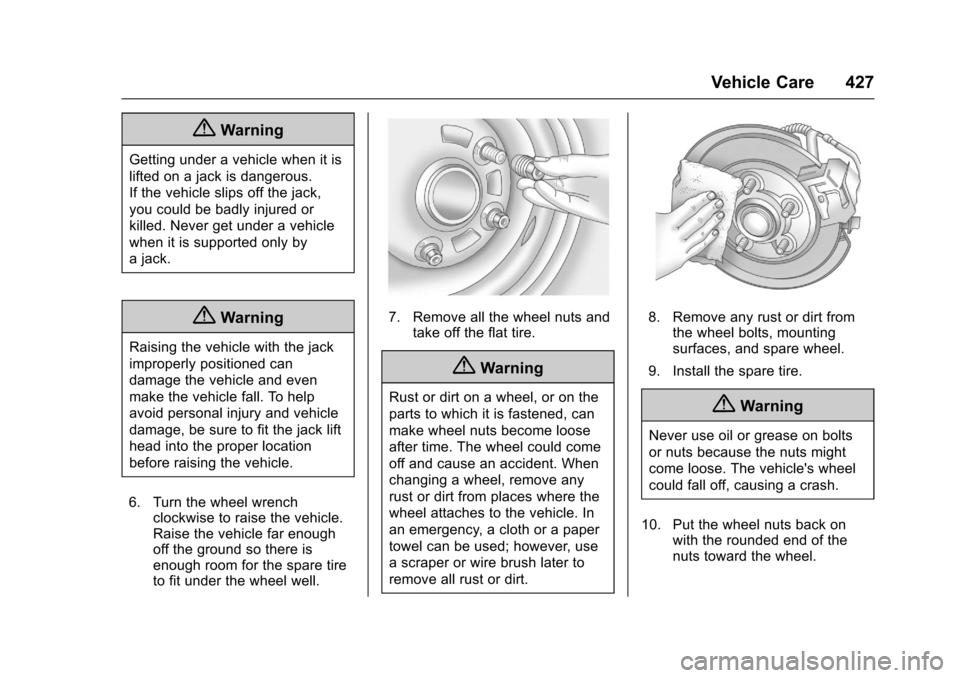
Use the following pictures andinstructions to remove the flat tireand raise the vehicle.
1. Jack
2. Wheel Blocks
3. Jack Handle
4. Jack Handle Extensions
5. Wheel Wrench
The tools you will be using includethe jack (1), the wheel blocks (2),the jack handle (3), the jack handleextensions (4), and the wheelwrench (5).
Page 428 of 509
Chevrolet Silverado Owner Manual (GMNA-Localizing-U.S./Canada/Mexico-9956065) - 2017 - CRC - 4/29/16
Vehicle Care 427
{Warning
Getting under a vehicle when it is
lifted on a jack is dangerous.
If the vehicle slips off the jack,
you could be badly injured or
killed. Never get under a vehicle
when it is supported only by
ajack.
{Warning
Raising the vehicle with the jack
improperly positioned can
damage the vehicle and even
make the vehicle fall. To help
avoid personal injury and vehicle
damage, be sure to fit the jack lift
head into the proper location
before raising the vehicle.
6. Turn the wheel wrenchclockwise to raise the vehicle.Raise the vehicle far enoughoff the ground so there isenough room for the spare tireto fit under the wheel well.
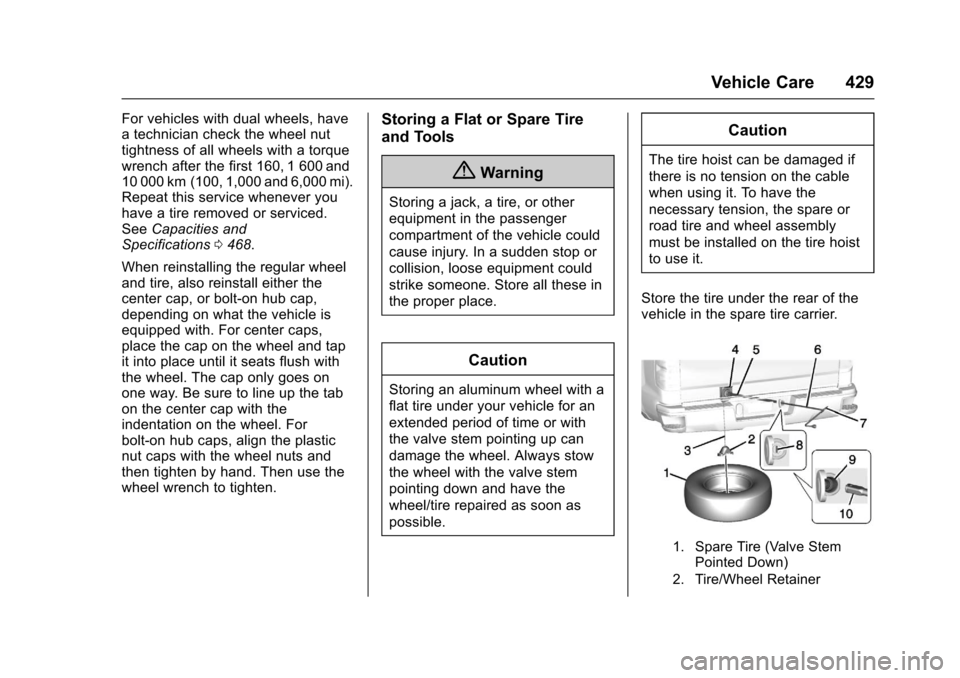
7. Remove all the wheel nuts andtake off the flat tire.
{Warning
Rust or dirt on a wheel, or on the
parts to which it is fastened, can
make wheel nuts become loose
after time. The wheel could come
off and cause an accident. When
changing a wheel, remove any
rust or dirt from places where the
wheel attaches to the vehicle. In
an emergency, a cloth or a paper
towel can be used; however, use
ascraperorwirebrushlaterto
remove all rust or dirt.
8. Remove any rust or dirt fromthe wheel bolts, mountingsurfaces, and spare wheel.
9. Install the spare tire.
{Warning
Never use oil or grease on bolts
or nuts because the nuts might
come loose. The vehicle's wheel
could fall off, causing a crash.
10. Put the wheel nuts back onwith the rounded end of thenuts toward the wheel.
Page 430 of 509
Chevrolet Silverado Owner Manual (GMNA-Localizing-U.S./Canada/Mexico-9956065) - 2017 - CRC - 4/29/16
Vehicle Care 429
For vehicles with dual wheels, haveatechniciancheckthewheelnuttightness of all wheels with a torquewrench after the first 160, 1 600 and10 000 km (100, 1,000 and 6,000 mi).Repeat this service whenever youhave a tire removed or serviced.SeeCapacities andSpecifications0468.
When reinstalling the regular wheeland tire, also reinstall either thecenter cap, or bolt-on hub cap,depending on what the vehicle isequipped with. For center caps,place the cap on the wheel and tapit into place until it seats flush withthe wheel. The cap only goes onone way. Be sure to line up the tabon the center cap with theindentation on the wheel. Forbolt-on hub caps, align the plasticnut caps with the wheel nuts andthen tighten by hand. Then use thewheel wrench to tighten.
Storing a Flat or Spare Tire
and Tools
{Warning
Storing a jack, a tire, or other
equipment in the passenger
compartment of the vehicle could
cause injury. In a sudden stop or
collision, loose equipment could
strike someone. Store all these in
the proper place.
Caution
Storing an aluminum wheel with a
flat tire under your vehicle for an
extended period of time or with
the valve stem pointing up can
damage the wheel. Always stow
the wheel with the valve stem
pointing down and have the
wheel/tire repaired as soon as
possible.
Caution
The tire hoist can be damaged if
there is no tension on the cable
when using it. To have the
necessary tension, the spare or
road tire and wheel assembly
must be installed on the tire hoist
to use it.
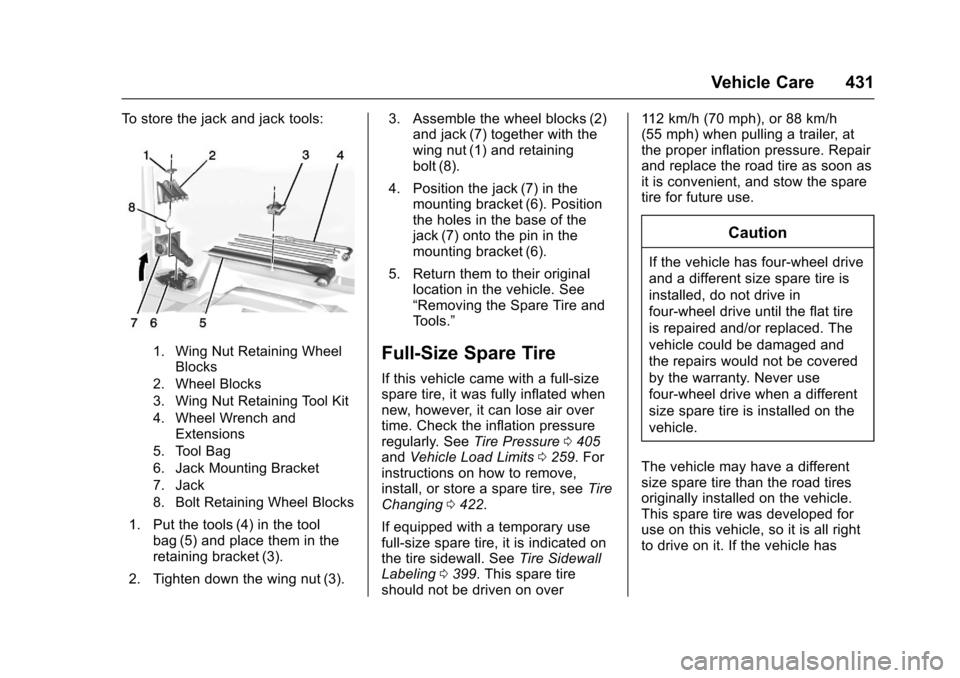
Store the tire under the rear of thevehicle in the spare tire carrier.
1. Spare Tire (Valve StemPointed Down)
2. Tire/Wheel Retainer
Page 432 of 509
Chevrolet Silverado Owner Manual (GMNA-Localizing-U.S./Canada/Mexico-9956065) - 2017 - CRC - 4/29/16
Vehicle Care 431
To s t o r e t h e j a c k a n d j a c k t o o l s :
1. Wing Nut Retaining WheelBlocks
2. Wheel Blocks
3. Wing Nut Retaining Tool Kit
4. Wheel Wrench andExtensions
5. Tool Bag
6. Jack Mounting Bracket
7. Jack
8. Bolt Retaining Wheel Blocks
1. Put the tools (4) in the toolbag (5) and place them in theretaining bracket (3).
2. Tighten down the wing nut (3).
3. Assemble the wheel blocks (2)and jack (7) together with thewing nut (1) and retainingbolt (8).
4. Position the jack (7) in themounting bracket (6). Positionthe holes in the base of thejack (7) onto the pin in themounting bracket (6).
5. Return them to their originallocation in the vehicle. See“Removing the Spare Tire andTo o l s .”
Full-Size Spare Tire
If this vehicle came with a full-sizespare tire, it was fully inflated whennew, however, it can lose air overtime. Check the inflation pressureregularly. SeeTire Pressure0405andVehicle Load Limits0259.Forinstructions on how to remove,install, or store a spare tire, seeTireChanging0422.
If equipped with a temporary usefull-size spare tire, it is indicated onthe tire sidewall. SeeTire SidewallLabeling0399.Thissparetireshould not be driven on over
11 2 k m / h ( 7 0 m p h ) , o r 8 8 k m / h(55 mph) when pulling a trailer, atthe proper inflation pressure. Repairand replace the road tire as soon asit is convenient, and stow the sparetire for future use.
Caution
If the vehicle has four-wheel drive
and a different size spare tire is
installed, do not drive in
four-wheel drive until the flat tire
is repaired and/or replaced. The
vehicle could be damaged and
the repairs would not be covered
by the warranty. Never use
four-wheel drive when a different
size spare tire is installed on the
vehicle.
The vehicle may have a differentsize spare tire than the road tiresoriginally installed on the vehicle.This spare tire was developed foruse on this vehicle, so it is all rightto drive on it. If the vehicle has
Page 437 of 509
Chevrolet Silverado Owner Manual (GMNA-Localizing-U.S./Canada/Mexico-9956065) - 2017 - CRC - 4/29/16
436 Vehicle Care
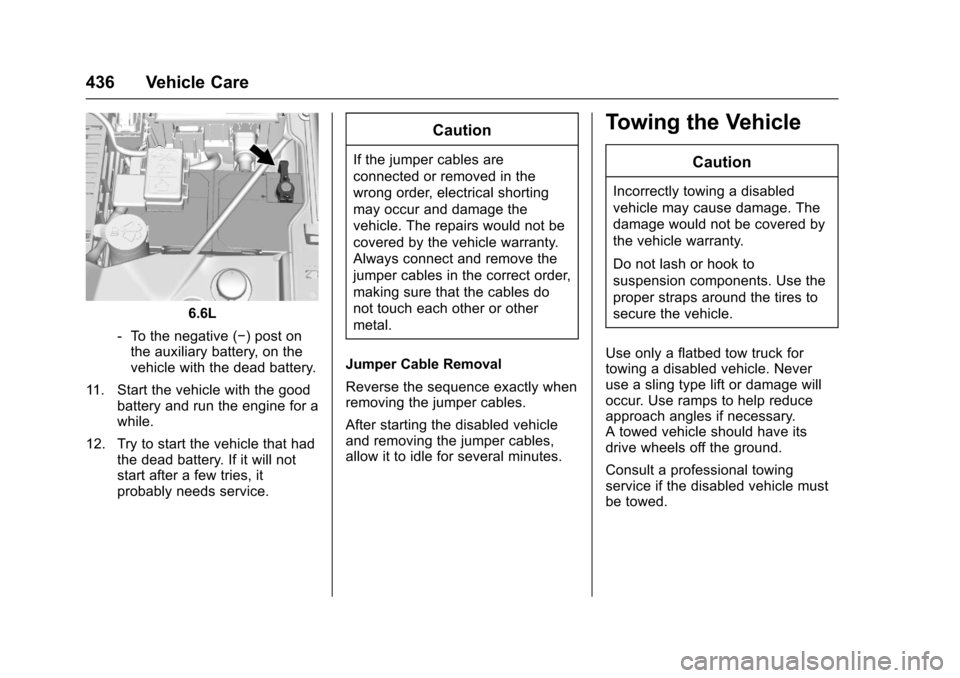
6.6L
⇣To t h e n e g a t i v e (✓)postonthe auxiliary battery, on thevehicle with the dead battery.
11 . S t a r t t h e v e h i c l e w i t h t h e g o o dbattery and run the engine for awhile.
12. Try to start the vehicle that hadthe dead battery. If it will notstart after a few tries, itprobably needs service.
Caution
If the jumper cables are
connected or removed in the
wrong order, electrical shorting
may occur and damage the
vehicle. The repairs would not be
covered by the vehicle warranty.
Always connect and remove the
jumper cables in the correct order,
making sure that the cables do
not touch each other or other
metal.
Jumper Cable Removal
Reverse the sequence exactly whenremoving the jumper cables.
After starting the disabled vehicleand removing the jumper cables,allow it to idle for several minutes.
Towing the Vehicle
Caution
Incorrectly towing a disabled
vehicle may cause damage. The
damage would not be covered by
the vehicle warranty.
Do not lash or hook to
suspension components. Use the
proper straps around the tires to
secure the vehicle.
Use only a flatbed tow truck fortowing a disabled vehicle. Neveruse a sling type lift or damage willoccur. Use ramps to help reduceapproach angles if necessary.Atowedvehicleshouldhaveitsdrive wheels off the ground.
Consult a professional towingservice if the disabled vehicle mustbe towed.
Page 438 of 509
Chevrolet Silverado Owner Manual (GMNA-Localizing-U.S./Canada/Mexico-9956065) - 2017 - CRC - 4/29/16
Vehicle Care 437
Recreational Vehicle
Towing
Recreational vehicle towing meanstowing the vehicle behind anothervehicle, such as a motor home. Thetwo most common types ofrecreational vehicle towing aredinghy and dolly towing. Dinghytowing is towing the vehicle with allfour wheels on the ground. Dollytowing is towing the vehicle with twowheels on the ground and twowheels on a dolly.
Follow the tow vehiclemanufacturer’sinstructions.Seeyour dealer or trailering professionalfor additional advice and equipmentrecommendations.
Caution
Use of a shield mounted in front
of the vehicle grille could restrict
airflow and cause damage to the
transmission. The repairs would
not be covered by the vehicle
(Continued)
Caution (Continued)
warranty. If using a shield, only
use one that attaches to the
towing vehicle.
Dinghy Towing
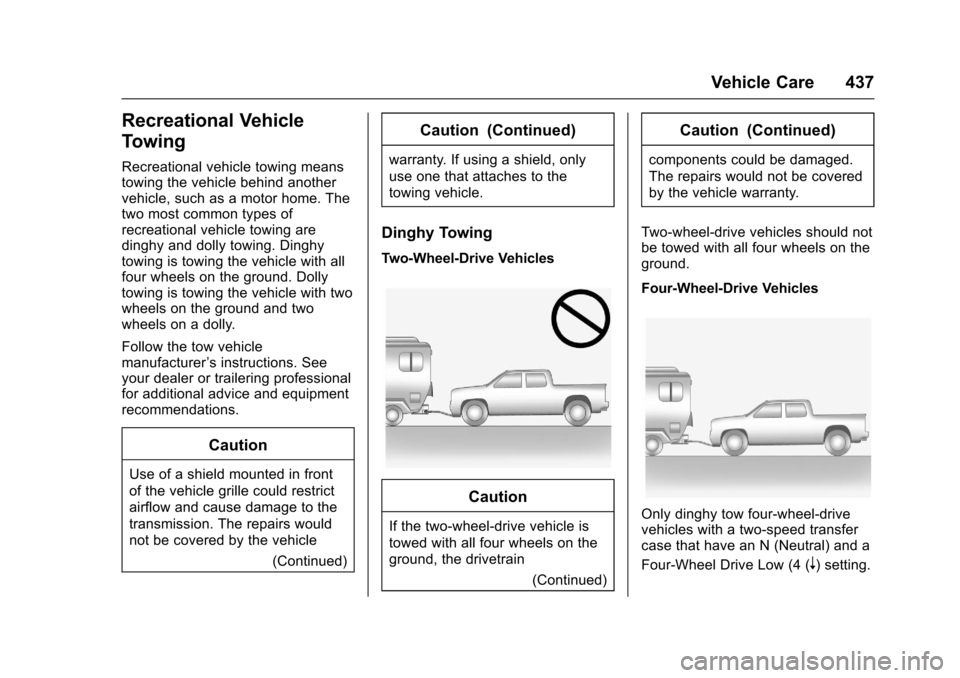
Two-Wheel-Drive Vehicles
Caution
If the two-wheel-drive vehicle is
towed with all four wheels on the
ground, the drivetrain
(Continued)
Caution (Continued)
components could be damaged.
The repairs would not be covered
by the vehicle warranty.
Tw o - w h e e l - d r i v e v e h i c l e s s h o u l d n o tbe towed with all four wheels on theground.
Four-Wheel-Drive Vehicles
Only dinghy tow four-wheel-drivevehicles with a two-speed transfercase that have an N (Neutral) and a
Four-Wheel Drive Low (4 (n)setting.