engine overheat CHEVROLET SILVERADO 2017 3.G User Guide
[x] Cancel search | Manufacturer: CHEVROLET, Model Year: 2017, Model line: SILVERADO, Model: CHEVROLET SILVERADO 2017 3.GPages: 509, PDF Size: 8.87 MB
Page 275 of 509
Chevrolet Silverado Owner Manual (GMNA-Localizing-U.S./Canada/Mexico-9956065) - 2017 - CRC - 4/29/16
274 Driving and Operating
1. Hold the brake pedal down,then set the parking brake.
SeeParking Brake0293.
2. Move the shift lever into theP(Park) position by pulling theshift lever toward you andmoving it up as far as it will go.
3. Be sure the transfer case (ifequipped) is in a drivegear—not in N (Neutral).
4. Turn the ignition key toLOCK/OFF.
5. Remove the key and take itwith you. If you can leave thevehicle with the ignition key inyour hand, the vehicle is inP(Park).
Leaving the Vehicle with the
Engine Running
{Warning
It can be dangerous to leave the
vehicle with the engine running.
The vehicle could move suddenly
(Continued)
Warning (Continued)
if the shift lever is not fully in
P(Park) with the parking brake
firmly set.
If you have four-wheel drive and
the transfer case is in N (Neutral),
the vehicle will be free to roll,
even if the shift lever is in
P(Park). So be sure the transfer
case is in a drive gear—not in
N(Neutral).
And, if you leave the vehicle with
the engine running, it could
overheat and even catch fire. You
or others could be injured. Do not
leave the vehicle with the engine
running unless you have to.
If you have to leave the vehicle withthe engine running, be sure thevehicle is in P (Park) and theparking brake is firmly set beforeyou leave it. After you move the shiftlever into P (Park), hold the regularbrake pedal down. Then, see if youcan move the shift lever away fromP(Park) without first pulling it toward
you. If you can, it means that theshift lever was not fully locked intoP(Park).
Torque Lock
If you are parking on a hill and youdo not shift the transmission intoP(Park) properly, the weight of thevehicle may put too much force onthe parking pawl in thetransmission. You may find it difficultto pull the shift lever out of P (Park).This is called torque lock. Toprevent torque lock, set the parkingbrake and then shift into P (Park)properly before you leave the driverseat. To find out how, seeShiftingInto Park0273.
When you are ready to drive, movethe shift lever out of P (Park) beforeyou release the parking brake.
If torque lock does occur, you mayneed to have another vehicle pushyours a little uphill to take some ofthe pressure from the parking pawlin the transmission. You will then beable to pull the shift lever out ofP(Park).
Page 318 of 509
Chevrolet Silverado Owner Manual (GMNA-Localizing-U.S./Canada/Mexico-9956065) - 2017 - CRC - 4/29/16
Driving and Operating 317
Passing
More passing distance is neededwhen towing a trailer. Thecombination will not accelerate asquickly and is longer so it isnecessary to go much fartherbeyond the passed vehicle beforereturning to the lane.
Backing Up
Hold the bottom of the steeringwheel with one hand. To move thetrailer to the left, move that hand tothe left. To move the trailer to theright, move your hand to the right.Always back up slowly and,if possible, have someoneguide you.
Making Turns
Caution
Making very sharp turns while
trailering could cause the trailer to
come in contact with the vehicle.
The vehicle could be damaged.
Avoid making very sharp turns
while trailering.
When turning with a trailer, makewider turns than normal. Do this sothe trailer will not strike softshoulders, curbs, road signs, trees,or other objects. Avoid jerky orsudden maneuvers. Signal well inadvance.
If the trailer turn signal bulbs burnout, the arrows on the instrumentcluster will still flash for turns. It isimportant to check occasionally tobe sure the trailer bulbs are stillworking.
Driving on Grades
Reduce speed and shift to a lowergearbeforestarting down a long orsteep downgrade. If thetransmission is not shifted down, thebrakes might get hot and no longerwork well.
Vehicles can tow in D (Drive). Shiftthe transmission to a lower gear ifthe transmission shifts too oftenunder heavy loads and/or hillyconditions.
The Tow/Haul Mode may be used ifthe transmission shifts too often.SeeTo w / H a u l M o d e0282.
When towing at high altitude onsteep uphill grades, consider thefollowing: Engine coolant will boil atalowertemperaturethanatnormalaltitudes. If the engine is turned offimmediately after towing at highaltitude on steep uphill grades, thevehicle may show signs similar toengine overheating. To avoid this,let the engine run while parked,preferably on level ground, with thetransmission in P (Park) for a fewminutes before turning the engineoff. If the overheat warning comeson, seeEngine Overheating0372.
Parking on Hills
{Warning
Parking the vehicle on a hill with
the trailer attached can be
dangerous. If something goes
wrong, the rig could start to move.
People can be injured, and both
the vehicle and the trailer can be
damaged. When possible, always
park the rig on a flat surface.
Page 346 of 509
Chevrolet Silverado Owner Manual (GMNA-Localizing-U.S./Canada/Mexico-9956065) - 2017 - CRC - 4/29/16
Driving and Operating 345
Conversions and
Add-Ons
Add-On Electrical
Equipment
{Warning
The Data Link Connector (DLC) is
used for vehicle service and
Emission Inspection/Maintenance
testing. SeeMalfunction Indicator
Lamp (Check Engine Light)
0138.Adeviceconnectedtothe
DLC—such as an aftermarket
fleet or driver-behavior tracking
device—may interfere with
vehicle systems. This could affect
vehicle operation and cause a
crash. Such devices may also
access information stored in the
vehicle’ssystems.
Caution
Some electrical equipment can
damage the vehicle or cause
components to not work and
would not be covered by the
vehicle warranty. Always check
with your dealer before adding
electrical equipment.
Add-on equipment can drain thevehicle's 12-volt battery, even if thevehicle is not operating.
The vehicle has an airbag system.Before attempting to add anythingelectrical to the vehicle, seeServicing the Airbag-EquippedVehicle086andAdding Equipmentto the Airbag-EquippedVehicle087.
For information on wiring auxiliaryswitches, see www.gmupfitter.comor contact your dealer.
Adding a Snow Plow or
Similar Equipment
Caution
Do not exceed 72 km/h (45 mph)
with a snow plow mounted to the
vehicle. The vehicle could
overheat and be damaged.
Before installing a snow plow on thevehicle, follow these guidelines:
Caution
If the vehicle does not have the
snow plow prep package, RPO
VYU, adding a plow can damage
the vehicle, and the repairs would
not be covered by the vehicle
warranty. Unless the vehicle was
built to carry a snow plow, do not
add one to the vehicle. If the
vehicle has RPO VYU, then the
payload the vehicle can carry will
be reduced when a snow plow is
installed. The vehicle can be
(Continued)
Page 347 of 509
Chevrolet Silverado Owner Manual (GMNA-Localizing-U.S./Canada/Mexico-9956065) - 2017 - CRC - 4/29/16
346 Driving and Operating
Caution (Continued)
damaged if either the front or rear
axle ratings or the Gross Vehicle
Weight Rating (GVWR) are
exceeded.
The plow the vehicle can carrydepends on many things, such as:
.The options the vehicle camewith, and the weight of thoseoptions.
.The weight and number ofpassengers to be carried.
.The weight of items added to thevehicle, like a tool box ortruck cap.
.The total weight of anyadditional cargo to be carried.
For example, if the snow plowweighs 318 kg (700 lb), the totalweight of all occupants and cargoinside the cab should not exceed135 kg (300 lb). This means that youmay only be able to carry onepassenger. Even this may be too
much if there is other equipmentalready adding to the weight of thevehicle.
To s a f e l y c a r r y a s n o w p l o w o n t h evehicle:
.Follow all aftermarket snow plowmanufacturer’sinstructionsforthe operation and transportationof the snow plow.
.With a snow plow attached, theengine coolant temperaturegauge may show a highertemperature than while drivingwithout one. The snow plowcould block the airflow to theradiator. This could be morenoticeable as vehicle speedincreases. At speeds above72 km (45 mph), this may causethe engine coolant to overheat.
.To i n c r e a s e t h e a i r f l o w, m o v e t h esnow plow blade postion.
.If driving more than 24 km(15 mi), angle the plow bladeposition.
.Make sure the weight on thefront and rear axles does notexceed the axle rating for each.
.For the front axle, if more cargoor passengers must be carried,appropriate counter ballast mustbe installed rear of the rear axle.Counter ballast must be properlysecured so it will not moveduring driving.
.Rear ballast may be required toensure a proper front and rearweight distribution ratio, eventhough the actual weight at thefront axle may be less than thefront axle rating.
.The snow plow manufacturer orinstaller can assist indetermining the amount of rearballast required, to help makesure the snow plow/vehiclecombination does not exceedthe GVW rating, the front andrear axle ratings, and the frontand rear weight distribution ratio.
.The total vehicle must notexceed the GVW rating.
Page 351 of 509
Chevrolet Silverado Owner Manual (GMNA-Localizing-U.S./Canada/Mexico-9956065) - 2017 - CRC - 4/29/16
350 Vehicle Care
Vehicle Care
General Information
General Information . . . . . . . . . . 351California Proposition65 Warning . . . . . . . . . . . . . . . . . 351California PerchlorateMaterials Requirements . . . . . 352Accessories andModifications . . . . . . . . . . . . . . . . 352
Vehicle Checks
Doing Your OwnService Work . . . . . . . . . . . . . . . 353Hood . . . . . . . . . . . . . . . . . . . . . . . . . 353Engine CompartmentOverview . . . . . . . . . . . . . . . . . . . . 354Engine Oil . . . . . . . . . . . . . . . . . . . . 359Engine Oil Life System . . . . . . . 362Automatic Transmission Fluid(6-Speed Transmission) . . . . . 363Automatic Transmission Fluid(8-Speed Transmission) . . . . . 366Manual Transmission Fluid . . . 366Hydraulic Clutch . . . . . . . . . . . . . . 366Engine Air Cleaner/Filter . . . . . . 367Cooling System . . . . . . . . . . . . . . 368Engine Coolant . . . . . . . . . . . . . . . 369Engine Overheating . . . . . . . . . . 372
Overheated Engine ProtectionOperating Mode . . . . . . . . . . . . . 374Engine Fan . . . . . . . . . . . . . . . . . . . 374Power Steering Fluid (1500Series) . . . . . . . . . . . . . . . . . . . . . . 375Power Steering Fluid (2500/3500 Series) . . . . . . . . . . . . . . . . 375Washer Fluid . . . . . . . . . . . . . . . . . 375Brakes . . . . . . . . . . . . . . . . . . . . . . . 376Brake Fluid . . . . . . . . . . . . . . . . . . . 377Battery - North America . . . . . . 378Four-Wheel Drive . . . . . . . . . . . . . 379Front Axle . . . . . . . . . . . . . . . . . . . . 380Rear Axle . . . . . . . . . . . . . . . . . . . . 380Noise Control System . . . . . . . . 382Starter Switch Check . . . . . . . . . 383Automatic Transmission ShiftLock Control FunctionCheck . . . . . . . . . . . . . . . . . . . . . . . 383Ignition Transmission LockCheck . . . . . . . . . . . . . . . . . . . . . . . 383Park Brake and P (Park)Mechanism Check . . . . . . . . . . 384Wiper Blade Replacement . . . . 384Glass Replacement . . . . . . . . . . 385
Headlamp Aiming
Headlamp Aiming . . . . . . . . . . . . 385
Bulb Replacement
Bulb Replacement . . . . . . . . . . . . 385
Halogen Bulbs . . . . . . . . . . . . . . . . 385High Intensity Discharge (HID)Lighting . . . . . . . . . . . . . . . . . . . . . 386LED Lighting . . . . . . . . . . . . . . . . . 386Headlamps, Front Turn Signal,Sidemarker, and ParkingLamps . . . . . . . . . . . . . . . . . . . . . . 386Fog Lamps . . . . . . . . . . . . . . . . . . . 387Ta i l l a m p s ( C h a s s i s C a bModels) . . . . . . . . . . . . . . . . . . . . . 387Ta i l l a m p s , T u r n S i g n a l ,Stoplamps, and Back-UpLamps . . . . . . . . . . . . . . . . . . . . . . 387Center High-MountedStoplamp (CHMSL) andCargo Lamp . . . . . . . . . . . . . . . . . 389Replacement Bulbs . . . . . . . . . . . 389
Electrical System
High Voltage Devices andWiring . . . . . . . . . . . . . . . . . . . . . . . 389Electrical System Overload . . . 389Fuses . . . . . . . . . . . . . . . . . . . . . . . . 390Engine Compartment FuseBlock . . . . . . . . . . . . . . . . . . . . . . . . 390Instrument Panel Fuse Block(Right) . . . . . . . . . . . . . . . . . . . . . . 393Instrument Panel FuseBlock (Left) . . . . . . . . . . . . . . . . . 395
Page 364 of 509
Chevrolet Silverado Owner Manual (GMNA-Localizing-U.S./Canada/Mexico-9956065) - 2017 - CRC - 4/29/16
Vehicle Care 363
3. Display the OIL LIFEREMAINING on the DIC. If thedisplay shows 100%, thesystem is reset.
If the vehicle has a CHANGEENGINE OIL SOON message and itcomes back on when the vehicle isstarted and/or the OIL LIFEREMAINING is near 0%, the engineoil life system has not been reset.Repeat the procedure.
Automatic Transmission
Fluid (6-Speed
Transmission)
When to Check and Change
Automatic Transmission Fluid
It is usually not necessary to checkthe transmission fluid level. The onlyreason for fluid loss is atransmission leak or overheatedtransmission. If a small leak issuspected, then use the followingchecking procedures to check thefluid level. However, if there is alarge leak, then it may be necessaryto have the vehicle towed to a
dealer service department and haveit repaired before driving the vehiclefurther.
Caution
Use of the incorrect automatic
transmission fluid may damage
the vehicle, and the damage may
not be covered by the vehicle
warranty. Always use the
automatic transmission fluid listed
inRecommended Fluids and
Lubricants0462.
Change the fluid and filter at thescheduled maintenance intervalslisted inMaintenance Schedule0452.Besuretousethetransmission fluid listed inRecommended Fluids andLubricants0462.
How to Check Automatic
Transmission Fluid
Caution
To o m u c h o r t o o l i t t l e f l u i d c a n
damage the transmission. Too
much can mean that some of the
fluid could come out and fall on
hot engine parts or exhaust
system parts, starting a fire. Too
little fluid could cause the
transmission to overheat. Be sure
to get an accurate reading if
checking the transmission fluid.
Before checking the fluid level,prepare the vehicle:
1. Start the engine and park thevehicle on a level surface.Keep the engine running.
2. Apply the parking brake andplace the shift lever in P (Park).
3. With your foot on the brakepedal, move the shift leverthrough each gear range,pausing for about
Page 370 of 509
Chevrolet Silverado Owner Manual (GMNA-Localizing-U.S./Canada/Mexico-9956065) - 2017 - CRC - 4/29/16
Vehicle Care 369
Warning (Continued)
keep hands, clothing, and tools
away from any engine
cooling fan.
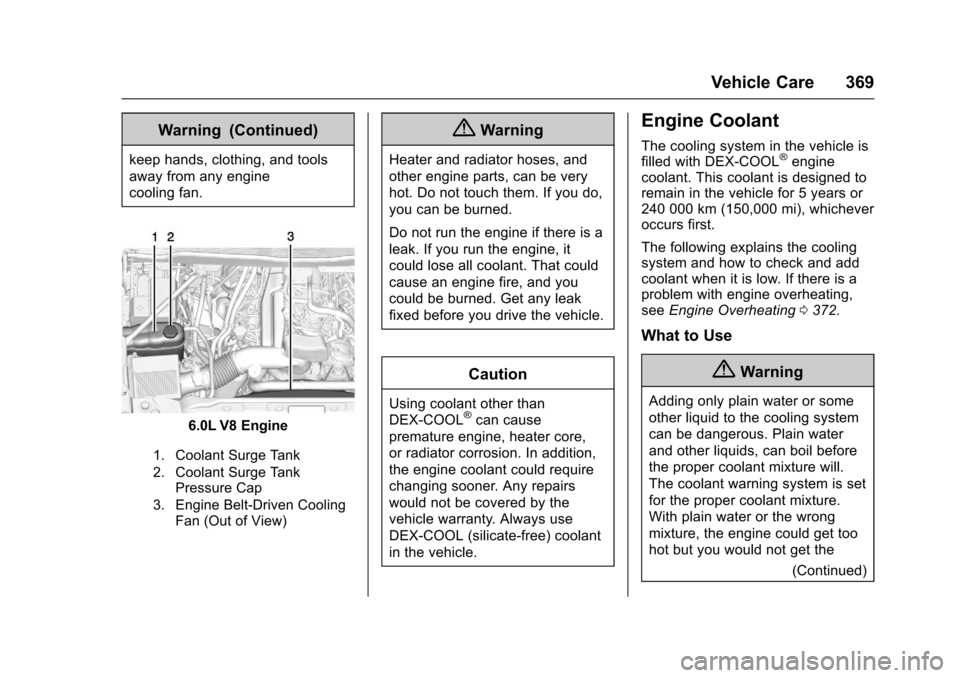
6.0L V8 Engine
1. Coolant Surge Tank
2. Coolant Surge TankPressure Cap
3. Engine Belt-Driven CoolingFan (Out of View)
{Warning
Heater and radiator hoses, and
other engine parts, can be very
hot. Do not touch them. If you do,
you can be burned.
Do not run the engine if there is a
leak. If you run the engine, it
could lose all coolant. That could
cause an engine fire, and you
could be burned. Get any leak
fixed before you drive the vehicle.
Caution
Using coolant other than
DEX-COOL®can cause
premature engine, heater core,
or radiator corrosion. In addition,
the engine coolant could require
changing sooner. Any repairs
would not be covered by the
vehicle warranty. Always use
DEX-COOL (silicate-free) coolant
in the vehicle.
Engine Coolant
The cooling system in the vehicle isfilled with DEX-COOL®enginecoolant. This coolant is designed toremain in the vehicle for 5 years or240 000 km (150,000 mi), whicheveroccurs first.
The following explains the coolingsystem and how to check and addcoolant when it is low. If there is aproblem with engine overheating,seeEngine Overheating0372.
What to Use
{Warning
Adding only plain water or some
other liquid to the cooling system
can be dangerous. Plain water
and other liquids, can boil before
the proper coolant mixture will.
The coolant warning system is set
for the proper coolant mixture.
With plain water or the wrong
mixture, the engine could get too
hot but you would not get the
(Continued)
Page 371 of 509
Chevrolet Silverado Owner Manual (GMNA-Localizing-U.S./Canada/Mexico-9956065) - 2017 - CRC - 4/29/16
370 Vehicle Care
Warning (Continued)
overheat warning. The engine
could catch fire and you or others
could be burned. Use a
50/50 mixture of clean, drinkable
water and DEX-COOL coolant.
Use a 50/50 mixture of clean,drinkable water and DEX-COOLcoolant. If using this mixture,nothing else needs to be added.This mixture:
.Gives freezing protection downto✓37 °C (✓34 °F), outsidetemperature.
.Gives boiling protection up to129 °C (265 °F), enginetemperature.
.Protects against rust andcorrosion.
.Will not damage aluminum parts.
.Helps keep the proper enginetemperature.
Caution
If improper coolant mixture,
inhibitors, or additives are used in
the vehicle cooling system, the
engine could overheat and be
damaged. Too much water in the
mixture can freeze and crack
engine cooling parts. The repairs
would not be covered by the
vehicle warranty. Use only the
proper mixture of engine coolant
for the cooling system. See
Recommended Fluids and
Lubricants0462.
Never dispose of engine coolant byputting it in the trash, or by pouringit on the ground, or into sewers,streams, or bodies of water. Havethe coolant changed by anauthorized service center, familiarwith legal requirements regardingused coolant disposal. This will helpprotect the environment and yourhealth.
Checking Coolant
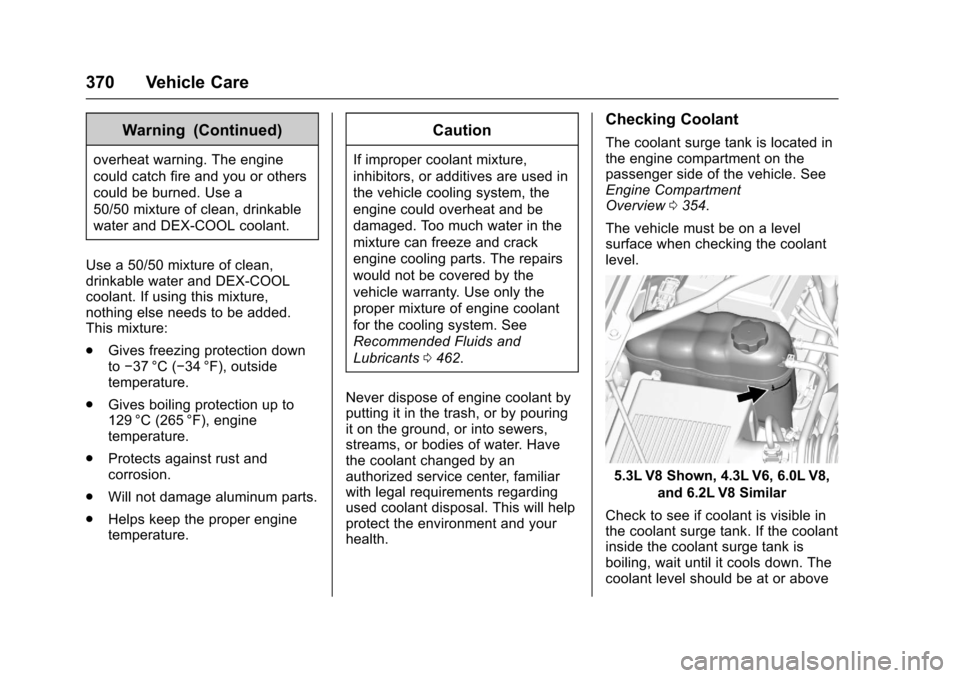
The coolant surge tank is located inthe engine compartment on thepassenger side of the vehicle. SeeEngine CompartmentOverview0354.
The vehicle must be on a levelsurface when checking the coolantlevel.
5.3L V8 Shown, 4.3L V6, 6.0L V8,
and 6.2L V8 Similar
Check to see if coolant is visible inthe coolant surge tank. If the coolantinside the coolant surge tank isboiling, wait until it cools down. Thecoolant level should be at or above
Page 372 of 509
Chevrolet Silverado Owner Manual (GMNA-Localizing-U.S./Canada/Mexico-9956065) - 2017 - CRC - 4/29/16
Vehicle Care 371
the FULL COLD mark. If it is not,there may be a leak in the coolingsystem.
If coolant is visible but the coolantlevel is not at or above the FULLCOLD mark, see“How to AddCoolant to the Coolant Surge Tankfor Gasoline Engines,”following.
How to Add Coolant to the
Coolant Surge Tank for
Gasoline Engines
If the vehicle has a diesel engine,see“Cooling System”in theDuramax diesel supplement for theproper coolant fill procedure.
{Warning
Yo u c a n b e b u r n e d i f y o u s p i l l
coolant on hot engine parts.
Coolant contains ethylene glycol
and it will burn if the engine parts
are hot enough. Do not spill
coolant on a hot engine.
Caution
This vehicle has a specific
coolant fill procedure. Failure to
follow this procedure could cause
the engine to overheat and be
severely damaged.
{Warning
Steam and scalding liquids from a
hot cooling system can blow out
and burn you badly. Never turn
the cap when the cooling system,
including the surge tank pressure
cap, is hot. Wait for the cooling
system and surge tank pressure
cap to cool.
If no coolant is visible in the surgetank, add coolant.
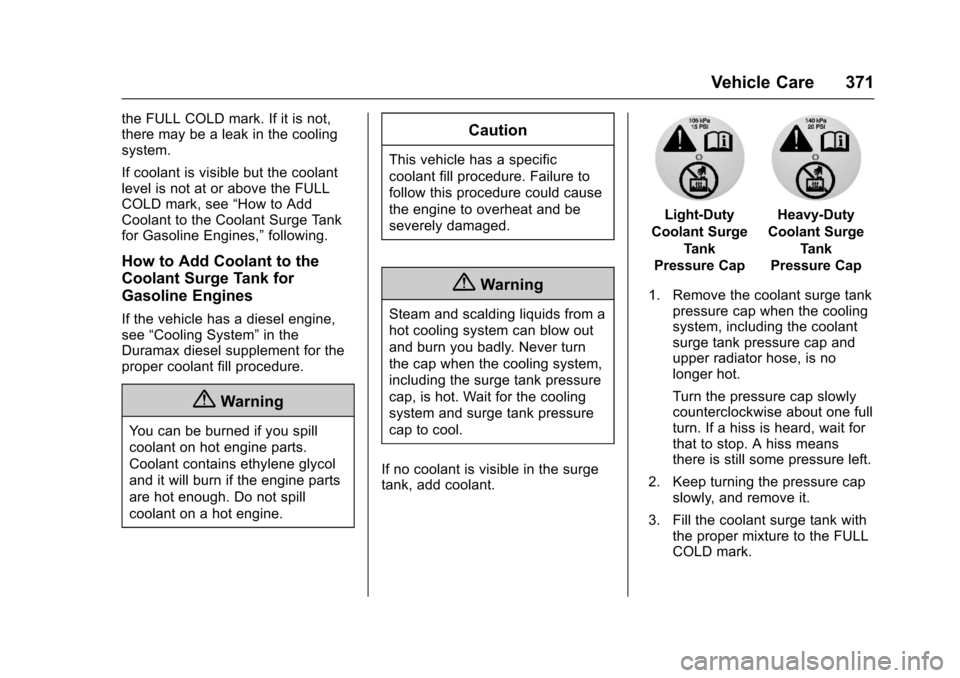
Light-Duty
Coolant Surge
Tank
Pressure Cap
Heavy-Duty
Coolant Surge
Tank
Pressure Cap
1. Remove the coolant surge tankpressure cap when the coolingsystem, including the coolantsurge tank pressure cap andupper radiator hose, is nolonger hot.
Turn the pressure cap slowlycounterclockwise about one fullturn. If a hiss is heard, wait forthat to stop. A hiss meansthere is still some pressure left.
2. Keep turning the pressure capslowly, and remove it.
3. Fill the coolant surge tank withthe proper mixture to the FULLCOLD mark.
Page 373 of 509
Chevrolet Silverado Owner Manual (GMNA-Localizing-U.S./Canada/Mexico-9956065) - 2017 - CRC - 4/29/16
372 Vehicle Care
4. With the coolant surge tankpressure cap off, start theengine and let it run until theengine coolant temperaturegauge indicates approximately90 °C (195 °F).
By this time, the coolant levelinside the coolant surge tankmay be lower. If the level islower, add more of the propermixture to the coolant surgetank until the level reaches theFULL COLD mark.
5. Replace the pressure captightly.
6. Verify coolant level after theengine is shut off and thecoolant is cold. If necessary,repeat coolant fill procedureSteps 1–6.
Caution
If the pressure cap is not tightly
installed, coolant loss and
possible engine damage may
occur. Be sure the cap is properly
and tightly secured.
Engine Overheating
If the vehicle has the Duramaxdiesel engine, see the Duramaxdiesel supplement.
Caution
Running the engine without
coolant may cause damage or a
fire. Vehicle damage would not be
covered by the vehicle warranty.
The vehicle has several indicatorsto warn of engine overheating.
There is a coolant temperaturegauge in the vehicle's instrumentcluster. SeeEngine CoolantTe m p e r a t u r e G a u g e0133.
In addition, there are ENGINEOVERHEATED STOP ENGINE,ENGINE OVERHEATED IDLEENGINE, and ENGINE POWER ISREDUCED messages in the DriverInformation Center (DIC). SeeEngine Cooling System Messages0152andEngine PowerMessages0153.
If the decision is made not to lift thehood when this warning appears,get service help right away. SeeRoadside AssistanceProgram0476.
If the decision is made to lift thehood, make sure the vehicle isparked on a level surface.
4.3L V6, 5.3L V8, and 6.2LV8 Engines
Check to see if the engine coolingfans are running. If the engine isoverheating, the fans should berunning. If they are not, do notcontinue to run the engine and havethe vehicle serviced.
If Steam is Coming from the
Engine Compartment
{Warning
Steam from an overheated engine
can burn you badly, even if you
just open the hood. Stay away
from the engine if you see or hear
steam coming from it. Just turn it
(Continued)