ECU CHEVROLET SILVERADO 2017 3.G Repair Manual
[x] Cancel search | Manufacturer: CHEVROLET, Model Year: 2017, Model line: SILVERADO, Model: CHEVROLET SILVERADO 2017 3.GPages: 509, PDF Size: 8.87 MB
Page 265 of 509
Chevrolet Silverado Owner Manual (GMNA-Localizing-U.S./Canada/Mexico-9956065) - 2017 - CRC - 4/29/16
264 Driving and Operating
There is also important loading
information for off-road driving in
this manual. See“Loading the
Vehicle for Off-Road Driving“
underOff-Road Driving0251.
Two-Tiered Loading
Depending on the model of the
pickup, an upper load platform
can be created by positioning
three or four 5 cm (2 in) by
15 cm (6 in) wooden planks
across the width of the pickup
box. The planks must be
inserted in the pickup box
depressions.
When using this upper load
platform, be sure the load is
securely tied down to prevent it
from shifting. The load's center
of gravity should be positioned
in a zone over the rear axle. The
zone is located in the area
between the front of each wheel
well and the rear of each wheel
well. The center of gravity height
must not extend above the top
of the pickup box flareboard.
Any load that extends beyond
the vehicle's taillamp area must
be properly marked according to
local laws and regulations.
Remember not to exceed the
Gross Axle Weight
Rating (GAWR) of the front or
rear axle.
Add-On Equipment
When carrying removable items,
alimitonhowmanypeople
carried inside the vehicle may
be necessary. Be sure to weigh
the vehicle before buying and
installing the new equipment.
Caution
Overloading the vehicle may
cause damage. Repairs would not
be covered by the vehicle
warranty. Do not overload the
vehicle.
Remember not to exceed the
Gross Axle Weight
Rating (GAWR) of the front or
rear axle.
*Equipment
Maximum
Weight
Ladder Rack
and Cargo
340 kg (750 lb)
Cross Toolbox
and Cargo
181 kg (400 lb)
Side Boxes
and Cargo
11 3 k g p e r
side (250 lb
per side)
*Thecombinedweightforall
rail-mounted equipment should
not exceed 454 kg (1,000 lb).
Page 267 of 509
Chevrolet Silverado Owner Manual (GMNA-Localizing-U.S./Canada/Mexico-9956065) - 2017 - CRC - 4/29/16
266 Driving and Operating
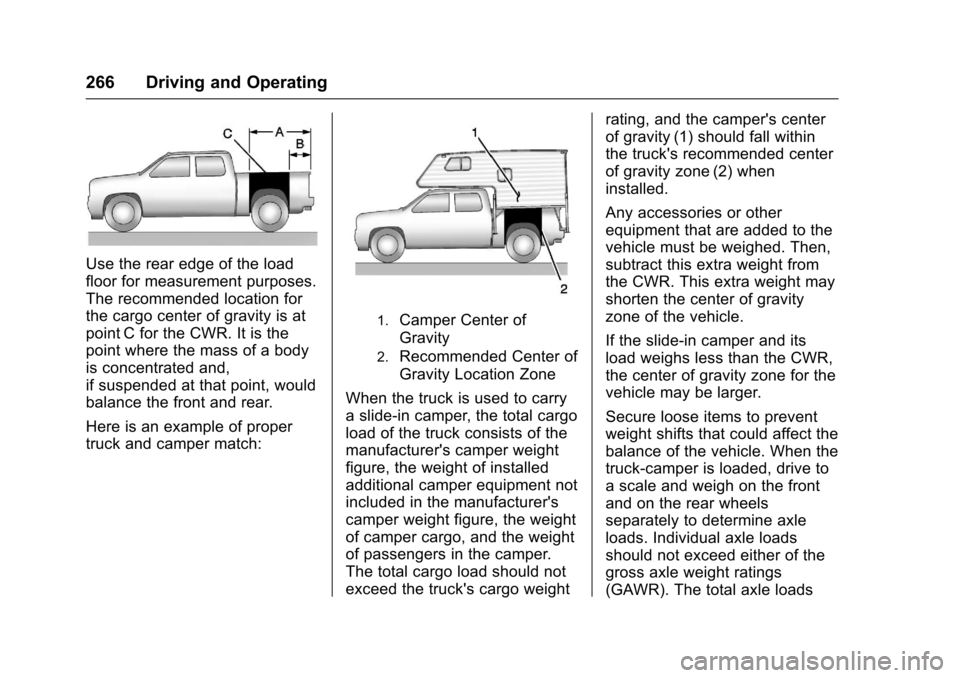
Use the rear edge of the load
floor for measurement purposes.
The recommended location for
the cargo center of gravity is at
point C for the CWR. It is the
point where the mass of a body
is concentrated and,
if suspended at that point, would
balance the front and rear.
Here is an example of proper
truck and camper match:
1.Camper Center of
Gravity
2.Recommended Center of
Gravity Location Zone
When the truck is used to carry
aslide-incamper,thetotalcargo
load of the truck consists of the
manufacturer's camper weight
figure, the weight of installed
additional camper equipment not
included in the manufacturer's
camper weight figure, the weight
of camper cargo, and the weight
of passengers in the camper.
The total cargo load should not
exceed the truck's cargo weight
rating, and the camper's center
of gravity (1) should fall within
the truck's recommended center
of gravity zone (2) when
installed.
Any accessories or other
equipment that are added to the
vehicle must be weighed. Then,
subtract this extra weight from
the CWR. This extra weight may
shorten the center of gravity
zone of the vehicle.
If the slide-in camper and its
load weighs less than the CWR,
the center of gravity zone for the
vehicle may be larger.
Secure loose items to prevent
weight shifts that could affect the
balance of the vehicle. When the
truck-camper is loaded, drive to
ascaleandweighonthefront
and on the rear wheels
separately to determine axle
loads. Individual axle loads
should not exceed either of the
gross axle weight ratings
(GAWR). The total axle loads
Page 273 of 509
Chevrolet Silverado Owner Manual (GMNA-Localizing-U.S./Canada/Mexico-9956065) - 2017 - CRC - 4/29/16
272 Driving and Operating
turned from ON/RUN to LOCK/OFF,the windows and sunroof continueto work up to 10 minutes or until anydoor is opened. The radio continuesto work for up to 10 minutes or untilthe driver door is opened.
Accessory Power Outlets (APOs)
The vehicle may have AccessoryPower Outlets (APOs) in severallocations. SeePower Outlets0124.
The APOs in the console or centerseat position are powered byRetained Accessory Power (RAP).They will continue to work for up to10 minutes after the key is turnedfrom ON/RUN to LOCK/OFF, or untilthe driver door is opened.
The APOs on the center stack comefrom the factory powered directlyfrom the vehicle battery, and supplyaccessory power at all times,regardless of ignition key position.
If electronic items are left pluggedinto these APOs for long periods oftime with the vehicle off, the vehiclebattery could be drained. Thevehicle may not start if the battery isallowed to drain for an extendedperiod of time.
Engine Coolant Heater
The engine heater can provideeasier starting and better fueleconomy during engine warm-up incold weather conditions at or below✓18 °C (0 °F). Vehicles with anengine heater should be plugged inat least four hours before starting.An internal thermostat in theplug-end of the cord may exist,which will prevent engine coolantheater operation at temperaturesabove✓18 °C (0 °F).
If the vehicle has a diesel engine,see the Duramax dieselsupplement.
To Use the Engine Coolant
Heater
1. Turn off the engine.
2. Open the hood and unwrap theelectrical cord. The cord issecured to the driver sidefender with a clip, next to theengine compartment fuseblock. Carefully remove thewire tie that bundles theelectrical plug. Do not cut theelectrical cord.
Check the heater cord fordamage. If it is damaged, donot use it. See your dealer forareplacement.Inspectthecord for damage yearly.
3. Plug the cord into a normal,grounded 110-volt AC outlet.
Page 274 of 509
Chevrolet Silverado Owner Manual (GMNA-Localizing-U.S./Canada/Mexico-9956065) - 2017 - CRC - 4/29/16
Driving and Operating 273
{Warning
Improper use of the heater cord
or an extension cord can damage
the cord and may result in
overheating and fire.
.Plug the cord into athree-prong electrical utilityreceptacle that is protectedby a ground fault detectionfunction. An ungroundedoutlet could cause anelectric shock.
.Use a weatherproof,heavy-duty, 15 amp-ratedextension cord if needed.Failure to use therecommended extensioncord in good operatingcondition, or using adamaged heater orextension cord, could makeit overheat and cause a fire,property damage, electricshock, and injury.
(Continued)
Warning (Continued)
.Do not operate the vehicle
with the heater cord
permanently attached to the
vehicle. Possible heater
cord and thermostat
damage could occur.
.While in use, do not let theheater cord touch vehicleparts or sharp edges. Neverclose the hood on theheater cord.
.Before starting the vehicle,unplug the cord, reattachthe cover to the plug, andsecurely fasten the cord.Keep the cord away fromany moving parts.
4. Before starting the engine, besure to unplug and store thecord as it was before to keep itaway from moving engineparts. If you do not, it could bedamaged.
The length of time the heater shouldremain plugged in depends onseveral factors. Ask a dealer in thearea where you will be parking thevehicle for the best advice on this.
Shifting Into Park
{Warning
It can be dangerous to get out of
the vehicle if the shift lever is not
fully in P (Park) with the parking
brake firmly set. The vehicle can
roll. If you have left the engine
running, the vehicle can move
suddenly. You or others could be
injured. To be sure the vehicle will
not move, even when you are on
fairly level ground, use the steps
that follow. With four-wheel drive,
if the transfer case is in
N(Neutral), the vehicle will be
free to roll, even if the shift lever
is in P (Park). Be sure the transfer
case is in a drive gear. If towing a
trailer, seeDriving Characteristics
and Towing Tips0315.
Page 317 of 509
Chevrolet Silverado Owner Manual (GMNA-Localizing-U.S./Canada/Mexico-9956065) - 2017 - CRC - 4/29/16
316 Driving and Operating
.The trailer must be equippedwith brakes adequate for theintended use. A loaded trailerweighing more than 900 kg(2,000 lb) must be equipped withits own brake system, withbrakes working on all axles.Trailer braking equipmentconforming to CanadianStandards Association (CSA)requirement CAN3-D313, or itsequivalent, is recommended.
.Do not tow a trailer during thefirst 800 km (500 mi) to preventdamage to the engine, axle,or other parts.
.Then during the first 800 km(500 mi) of trailer towing, do notdrive over 80 km/h (50 mph) anddo not make starts at full throttle.
.Vehicles can tow in D (Drive).The Tow/Haul Mode may beused if the transmission shiftstoo often. SeeTo w / H a u lMode0282.
.Turn off Park Assist whentowing.
{Warning
When towing a trailer, exhaust
gases may collect at the rear of
the vehicle and enter if the
liftgate, trunk/hatch, or rear-most
window is open.
When towing a trailer:
.Do not drive with theliftgate, trunk/hatch,or rear-most window open.
.Fully open the air outlets onor under the instrumentpanel.
.Also adjust the climatecontrol system to a settingthat brings in only outsideair. See“Climate ControlSystems”in the Index.
For more information about
carbon monoxide, seeEngine
Exhaust0276.
To w i n g a t r a i l e r r e q u i r e s a c e r t a i namount of experience. Thecombination you are driving islonger and not as responsive as the
vehicle itself. Get acquainted withthe handling and braking of the rigbefore setting out for the open road.
The structure, tires, and brakes ofthe trailer must be rated to carry theload. Inadequate trailer equipmentcan cause the combination tooperate in an unexpected or unsafemanner.
Before starting, check all trailer hitchparts and attachments, safetychains, electrical connectors, lamps,tires, and mirrors. Get familiar withthe handling and braking of the rig.If the trailer has electric brakes, startthe combination moving and thenapply the trailer brake controller byhand to be sure the brakes work.
During the trip, check occasionallyto be sure that the load is secureand the lamps and any trailerbrakes still work.
Following Distance
Stay at least twice as far behind thevehicle ahead as you would whendriving the vehicle without a trailer.This can help to avoid heavybraking and sudden turns.
Page 339 of 509
Chevrolet Silverado Owner Manual (GMNA-Localizing-U.S./Canada/Mexico-9956065) - 2017 - CRC - 5/6/16
338 Driving and Operating
Use only a round, seven-wireconnector with flat blade terminalsmeeting SAE J2863 specificationsfor proper electrical connectivity.
For vehicles not equipped withheavy-duty trailering, the harness issecured to the vehicle's framebehind the spare tire mount. Theharness requires the installation of atrailer connector, which is availablethrough your dealer.
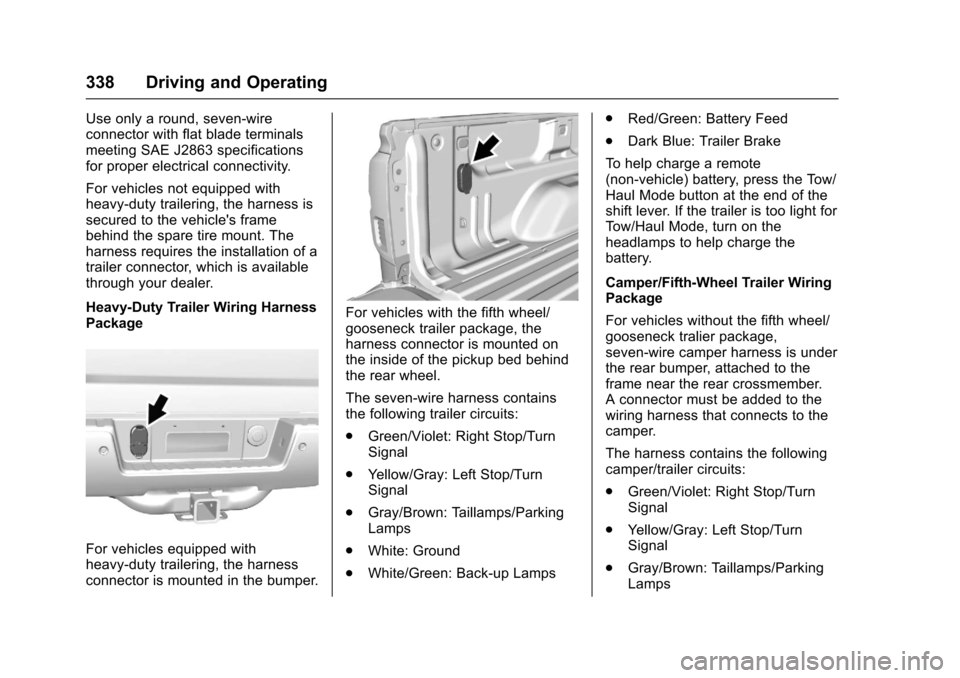
Heavy-Duty Trailer Wiring HarnessPackage
For vehicles equipped withheavy-duty trailering, the harnessconnector is mounted in the bumper.
For vehicles with the fifth wheel/gooseneck trailer package, theharness connector is mounted onthe inside of the pickup bed behindthe rear wheel.
The seven-wire harness containsthe following trailer circuits:
.Green/Violet: Right Stop/TurnSignal
.Ye l l o w / G r a y : L e f t S t o p / T u r nSignal
.Gray/Brown: Taillamps/ParkingLamps
.White: Ground
.White/Green: Back-up Lamps
.Red/Green: Battery Feed
.Dark Blue: Trailer Brake
To h e l p c h a r g e a r e m o t e(non-vehicle) battery, press the Tow/Haul Mode button at the end of theshift lever. If the trailer is too light forTo w / H a u l M o d e , t u r n o n t h eheadlamps to help charge thebattery.
Camper/Fifth-Wheel Trailer WiringPackage
For vehicles without the fifth wheel/gooseneck tralier package,seven-wire camper harness is underthe rear bumper, attached to theframe near the rear crossmember.Aconnectormustbeaddedtothewiring harness that connects to thecamper.
The harness contains the followingcamper/trailer circuits:
.Green/Violet: Right Stop/TurnSignal
.Ye l l o w / G r a y : L e f t S t o p / T u r nSignal
.Gray/Brown: Taillamps/ParkingLamps
Page 342 of 509
Chevrolet Silverado Owner Manual (GMNA-Localizing-U.S./Canada/Mexico-9956065) - 2017 - CRC - 4/29/16
Driving and Operating 341
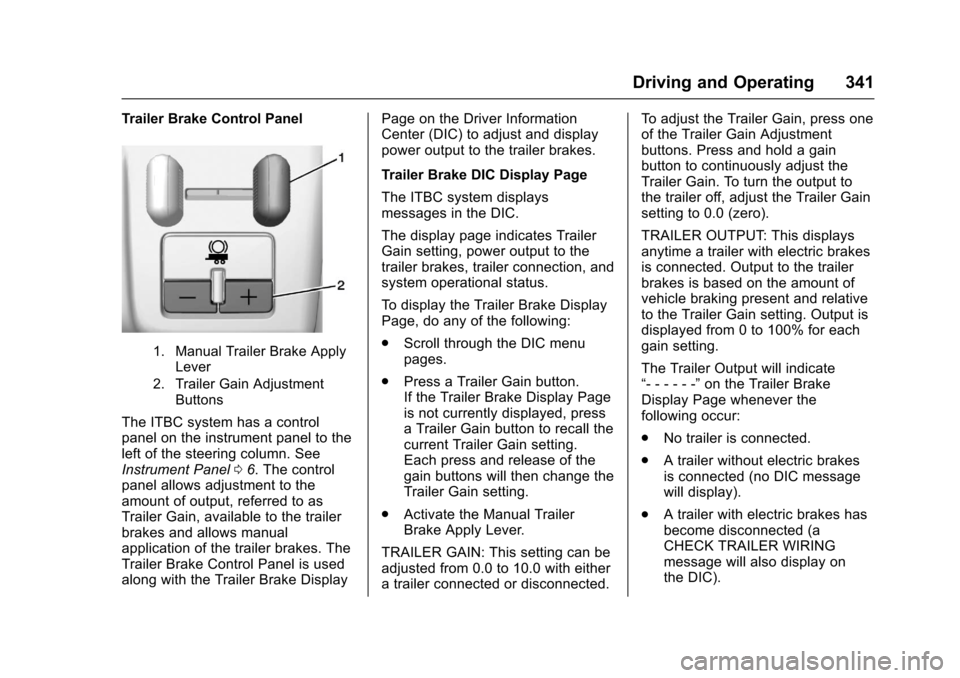
Trailer Brake Control Panel
1. Manual Trailer Brake ApplyLever
2. Trailer Gain AdjustmentButtons
The ITBC system has a controlpanel on the instrument panel to theleft of the steering column. SeeInstrument Panel06.Thecontrolpanel allows adjustment to theamount of output, referred to asTrailer Gain, available to the trailerbrakes and allows manualapplication of the trailer brakes. TheTrailer Brake Control Panel is usedalong with the Trailer Brake Display
Page on the Driver InformationCenter (DIC) to adjust and displaypower output to the trailer brakes.
Trailer Brake DIC Display Page
The ITBC system displaysmessages in the DIC.
The display page indicates TrailerGain setting, power output to thetrailer brakes, trailer connection, andsystem operational status.
To d i s p l a y t h e T r a i l e r B r a k e D i s p l a yPage, do any of the following:
.Scroll through the DIC menupages.
.Press a Trailer Gain button.If the Trailer Brake Display Pageis not currently displayed, pressaTrailerGainbuttontorecallthecurrent Trailer Gain setting.Each press and release of thegain buttons will then change theTrailer Gain setting.
.Activate the Manual TrailerBrake Apply Lever.
TRAILER GAIN: This setting can beadjusted from 0.0 to 10.0 with eitheratrailerconnectedordisconnected.
To a d j u s t t h e T r a i l e r G a i n , p r e s s o n eof the Trailer Gain Adjustmentbuttons. Press and hold a gainbutton to continuously adjust theTrailer Gain. To turn the output tothe trailer off, adjust the Trailer Gainsetting to 0.0 (zero).
TRAILER OUTPUT: This displaysanytime a trailer with electric brakesis connected. Output to the trailerbrakes is based on the amount ofvehicle braking present and relativeto the Trailer Gain setting. Output isdisplayed from 0 to 100% for eachgain setting.
The Trailer Output will indicate“------”on the Trailer BrakeDisplay Page whenever thefollowing occur:
.No trailer is connected.
.Atrailerwithoutelectricbrakesis connected (no DIC messagewill display).
.Atrailerwithelectricbrakeshasbecome disconnected (aCHECK TRAILER WIRINGmessage will also display onthe DIC).
Page 347 of 509
Chevrolet Silverado Owner Manual (GMNA-Localizing-U.S./Canada/Mexico-9956065) - 2017 - CRC - 4/29/16
346 Driving and Operating
Caution (Continued)
damaged if either the front or rear
axle ratings or the Gross Vehicle
Weight Rating (GVWR) are
exceeded.
The plow the vehicle can carrydepends on many things, such as:
.The options the vehicle camewith, and the weight of thoseoptions.
.The weight and number ofpassengers to be carried.
.The weight of items added to thevehicle, like a tool box ortruck cap.
.The total weight of anyadditional cargo to be carried.
For example, if the snow plowweighs 318 kg (700 lb), the totalweight of all occupants and cargoinside the cab should not exceed135 kg (300 lb). This means that youmay only be able to carry onepassenger. Even this may be too
much if there is other equipmentalready adding to the weight of thevehicle.
To s a f e l y c a r r y a s n o w p l o w o n t h evehicle:
.Follow all aftermarket snow plowmanufacturer’sinstructionsforthe operation and transportationof the snow plow.
.With a snow plow attached, theengine coolant temperaturegauge may show a highertemperature than while drivingwithout one. The snow plowcould block the airflow to theradiator. This could be morenoticeable as vehicle speedincreases. At speeds above72 km (45 mph), this may causethe engine coolant to overheat.
.To i n c r e a s e t h e a i r f l o w, m o v e t h esnow plow blade postion.
.If driving more than 24 km(15 mi), angle the plow bladeposition.
.Make sure the weight on thefront and rear axles does notexceed the axle rating for each.
.For the front axle, if more cargoor passengers must be carried,appropriate counter ballast mustbe installed rear of the rear axle.Counter ballast must be properlysecured so it will not moveduring driving.
.Rear ballast may be required toensure a proper front and rearweight distribution ratio, eventhough the actual weight at thefront axle may be less than thefront axle rating.
.The snow plow manufacturer orinstaller can assist indetermining the amount of rearballast required, to help makesure the snow plow/vehiclecombination does not exceedthe GVW rating, the front andrear axle ratings, and the frontand rear weight distribution ratio.
.The total vehicle must notexceed the GVW rating.
Page 373 of 509
Chevrolet Silverado Owner Manual (GMNA-Localizing-U.S./Canada/Mexico-9956065) - 2017 - CRC - 4/29/16
372 Vehicle Care
4. With the coolant surge tankpressure cap off, start theengine and let it run until theengine coolant temperaturegauge indicates approximately90 °C (195 °F).
By this time, the coolant levelinside the coolant surge tankmay be lower. If the level islower, add more of the propermixture to the coolant surgetank until the level reaches theFULL COLD mark.
5. Replace the pressure captightly.
6. Verify coolant level after theengine is shut off and thecoolant is cold. If necessary,repeat coolant fill procedureSteps 1–6.
Caution
If the pressure cap is not tightly
installed, coolant loss and
possible engine damage may
occur. Be sure the cap is properly
and tightly secured.
Engine Overheating
If the vehicle has the Duramaxdiesel engine, see the Duramaxdiesel supplement.
Caution
Running the engine without
coolant may cause damage or a
fire. Vehicle damage would not be
covered by the vehicle warranty.
The vehicle has several indicatorsto warn of engine overheating.
There is a coolant temperaturegauge in the vehicle's instrumentcluster. SeeEngine CoolantTe m p e r a t u r e G a u g e0133.
In addition, there are ENGINEOVERHEATED STOP ENGINE,ENGINE OVERHEATED IDLEENGINE, and ENGINE POWER ISREDUCED messages in the DriverInformation Center (DIC). SeeEngine Cooling System Messages0152andEngine PowerMessages0153.
If the decision is made not to lift thehood when this warning appears,get service help right away. SeeRoadside AssistanceProgram0476.
If the decision is made to lift thehood, make sure the vehicle isparked on a level surface.
4.3L V6, 5.3L V8, and 6.2LV8 Engines
Check to see if the engine coolingfans are running. If the engine isoverheating, the fans should berunning. If they are not, do notcontinue to run the engine and havethe vehicle serviced.
If Steam is Coming from the
Engine Compartment
{Warning
Steam from an overheated engine
can burn you badly, even if you
just open the hood. Stay away
from the engine if you see or hear
steam coming from it. Just turn it
(Continued)
Page 421 of 509
Chevrolet Silverado Owner Manual (GMNA-Localizing-U.S./Canada/Mexico-9956065) - 2017 - CRC - 4/29/16
420 Vehicle Care
Warning (Continued)
without the proper amount of
clearance can cause damage to
the brakes, suspension, or other
vehicle parts. The area damaged
by the tire chains could cause you
to lose control of the vehicle and
you or others may be injured in a
crash.
Use another type of traction
device only if its manufacturer
recommends it for use on the
vehicle and tire size combination
and road conditions. Follow that
manufacturer's instructions. To
help avoid damage to the vehicle,
drive slowly, readjust, or remove
the device if it is contacting the
vehicle, and do not spin the
vehicle's wheels.
If you do find traction devices that
will fit, install them on the rear
tires.
Caution
If the vehicle does not have dual
wheels and has a tire size other
than 265/65R18, P265/65R18,
P275/55R20, LT265/70R17,
LT 2 6 5 / 7 0 R 1 8 , LT 2 6 5 / 6 0 R 2 0 ,
LT 2 7 5 / 6 5 R 1 8 , P 2 8 5 / 5 0 R 2 0 ,
285/45R22, or P285/45R22, use
tire chains only where legal and
only when you must. Use chains
that are the proper size for the
tires. Install them on the tires of
the rear axle. Do not use chains
on the tires of the front axle.
Tighten them as tightly as
possible with the ends securely
fastened. Drive slowly and follow
the chain manufacturer's
instructions. If you can hear the
chains contacting the vehicle,
stop and retighten them. If the
contact continues, slow down
until it stops. Driving too fast or
spinning the wheels with chains
on will damage the vehicle.
If a Tire Goes Flat
It is unusual for a tire to blowoutwhile driving, especially if the tiresare maintained properly. If air goesout of a tire, it is much more likely toleak out slowly. But if there ever is ablowout, here are a few tips aboutwhat to expect and what to do:
If a front tire fails, the flat tirecreates a drag that pulls the vehicletoward that side. Take your foot offthe accelerator pedal and grip thesteering wheel firmly. Steer tomaintain lane position, and thengently brake to a stop, well off theroad, if possible.
Arearblowout,particularlyonacurve, acts much like a skid andmay require the same correction asused in a skid. Stop pressing theaccelerator pedal and steer tostraighten the vehicle. It may bevery bumpy and noisy. Gently braketo a stop, well off the road,if possible.