ABS CHEVROLET SILVERADO 2019 User Guide
[x] Cancel search | Manufacturer: CHEVROLET, Model Year: 2019, Model line: SILVERADO, Model: CHEVROLET SILVERADO 2019Pages: 474, PDF Size: 7.28 MB
Page 250 of 474
Chevrolet Silverado Owner Manual (GMNA-Localizing-U.S./Canada/Mexico-
1500-11698642) - 2019 - CRC - 2/20/19
Driving and Operating 249
Off-Road Mode
Use to improve driving at moderate
speeds, on grass, gravel, dirt,
unpaved roads, or snow-covered
roads that have not been groomed
or plowed.
The accelerator pedal will be more
sensitive to provide finer control of
the torque at the wheels. Electronic
Stability Control (ESC), the Antilock
Brake System (ABS), and the
Traction Control System (TCS) will
change for optimal off-road
performance. Use this mode for
public off-road recreational driving.
SeeOff-Road Driving 0201.
When selected, the Off-Road Mode
indicator light displays in the
instrument cluster.
Tow/Haul Mode
This feature assists when pulling a
heavy trailer or a large or heavy
load. See Tow/Haul Mode 0235.
Tow/Haul Mode is designed to be
most effective when the vehicle and
trailer combined weight is at least
75% of the vehicle’s Gross Combined Weight Rating (GCWR).
See
“Weight of the Trailer” under
Trailer Towing 0282.
Tow/Haul Mode is most useful when
pulling a heavy trailer or a large or
heavy load under the following
conditions:
. Through rolling terrain
. In stop-and-go traffic
. In busy parking lots where
improved low speed control of
the vehicle is desired
Operating the vehicle in Tow/Haul
Mode when lightly loaded or with no
trailer at all will not cause damage.
However, there is no benefit to
selecting Tow/Haul Mode when the
vehicle is unloaded. Such a
selection when unloaded may result
in unpleasant engine and
transmission driving characteristics
and reduced fuel economy.
When selected, the Tow/Haul Mode
light will display in the instrument
cluster. If the vehicle is turned off with Tow/
Haul Mode active, Tow/Haul Mode
will remain active after the vehicle
has been turned on if the vehicle
was turned off for less than four
hours. Otherwise, the vehicle will
start up in Tour Mode.
Terrain Mode
Use for finer control during low
speed, off-road driving. When using
this mode it will mimic the
characteristics of four-wheel-drive
low without the torque capabilities.
Use when:
.
Traveling on very rough roads at
very low speeds, such as a
two-track or heavily rutted road.
. Traveling slowly in grassy fields.
. Pulling a boat out of the water
on a trailer.
. Using the vehicle for public
off-road recreational driving. See
Off-Road Driving 0201 and
Hill and Mountain Roads 0207.
Page 281 of 474
Chevrolet Silverado Owner Manual (GMNA-Localizing-U.S./Canada/Mexico-
1500-11698642) - 2019 - CRC - 2/20/19
280 Driving and Operating
The vehicle can tow in D (Drive).
Shift the transmission to a lower
gear if the transmission shifts too
often under heavy loads and/or hilly
conditions.
When towing at higher altitudes,
engine coolant will boil at a lower
temperature than at lower altitudes.
If the engine is turned off
immediately after towing at high
altitude on steep uphill grades, the
vehicle could show signs similar to
engine overheating. To avoid this,
let the engine run, preferably on
level ground, with the transmission
in P (Park) for a few minutes before
turning the engine off. If the
overheat warning comes on, see
Engine Overheating0332.
Viewing Systems
If equipped, the viewing systems on
the vehicle can improve visibility
while hitching, backing, and driving
with a trailer. See Driver Assistance
Systems 0254.
Parking on Hills
{Warning
To prevent serious injury or death,
always park your vehicle and
trailer on a level surface when
possible.
When parking your vehicle and your
trailer on a hill: 1. Press the brake pedal, but do not shift into P (Park) yet. Turn
the wheels into the curb if
facing downhill or into traffic if
facing uphill.
2. Have someone place chocks under the trailer wheels.
3. When the wheel chocks are in place, gradually release the
brake pedal to allow the chocks
to absorb the load of the trailer.
4. Reapply the brake pedal. Then apply the parking brake and
shift into P (Park).
5. Release the brake pedal.
Leaving After Parking on a Hill
1. Apply and hold the brake pedal.
.Start the engine.
. Shift into a gear.
. Release the parking brake.
2. Let up on the brake pedal.
3. Drive slowly until the trailer is clear of the chocks.
4. Stop and have someone pick up and store the chocks.
Launching and Retrieving
a Boat
Backing the Trailer into the Water
{Warning
.Have all passengers get out
of the vehicle before
backing onto the sloped part
of the ramp. Lower the
driver and passenger side
windows before backing
onto the ramp. This will
(Continued)
Page 282 of 474
Chevrolet Silverado Owner Manual (GMNA-Localizing-U.S./Canada/Mexico-
1500-11698642) - 2019 - CRC - 2/20/19
Driving and Operating 281
Warning (Continued)
provide a means of escape
in the unlikely event the
vehicle slides into the water.
. If the boat launch surface is
slippery, have the driver
remain in the vehicle with
the brake pedal applied
while the boat is being
launched. The boat launch
can be especially slippery at
low tide when part of the
ramp was previously
submerged at high tide. Do
not back onto the ramp to
launch the boat if you are
not sure the vehicle can
maintain traction.
. Do not move the vehicle if
someone is in the path of
the trailer. Some parts of the
trailer might be underwater
and not visible to people
who are assisting in
launching the boat. Disconnect the wiring to the trailer
before backing the trailer into the
water to prevent damage to the
electrical circuits on the trailer.
Reconnect the wiring to the trailer
after removing the trailer from the
water. If the trailer has electric
brakes that can function when the
trailer is submerged, it might help to
leave the electrical trailer connector
attached to maintain trailer brake
functionality while on the boat ramp.
To back the trailer into the water:
1. If equipped, place the vehicle in four-wheel-drive high.
2. Slowly back down the boat ramp until the boat is floating,
but no further than necessary.
3. Press and hold the brake pedal, but do not shift into
P (Park) yet.
4. Have someone place chocks under the front wheels of the
vehicle.
5. Gradually release the brake pedal to allow the chocks to
absorb the load of the trailer. 6. Reapply the brake pedal. Then
apply the parking brake and
shift into P (Park).
7. Release the brake pedal.
Pulling the Trailer from the Water
To pull the trailer out of the water: 1. Press and hold the brake pedal and apply the Electric Parking
Brake.
2. Start the engine and shift into gear.
3. Release the parking brake.
4. Let up on the brake pedal.
5. Drive slowly until the tires are clear of the chocks.
6. Stop and have someone pick up and store the chocks.
7. Slowly pull the trailer from the water.
8. Once the vehicle and trailer have been driven from the
sloped part of the boat ramp,
the vehicle can be shifted from
four-wheel-drive high. Shift into
Page 339 of 474
Chevrolet Silverado Owner Manual (GMNA-Localizing-U.S./Canada/Mexico-
1500-11698642) - 2019 - CRC - 2/20/19
338 Vehicle Care
.A fluid leak in the brake
hydraulic system. Have the
brake hydraulic system fixed.
With a leak, the brakes will not
work well.
Always clean the brake fluid
reservoir cap and the area around
the cap before removing it.
Do not top off the brake fluid.
Adding fluid does not correct a leak.
If fluid is added when the linings are
worn, there will be too much fluid
when new brake linings are
installed. Add or remove fluid, as
necessary, only when work is done
on the brake hydraulic system.
{Warning
If too much brake fluid is added, it
can spill on the engine and burn,
if the engine is hot enough. You
or others could be burned, and
the vehicle could be damaged.
Add brake fluid only when work is
done on the brake hydraulic
system. When the brake fluid falls to a low
level, the brake warning light comes
on. See
Brake System Warning
Light 0152.
Brake fluid absorbs water over time
which degrades the effectiveness of
the brake fluid. Replace brake fluid
at the specified intervals to prevent
increased stopping distance. See
Maintenance Schedule 0417.
What to Add
Use only GM approved DOT 4
brake fluid from a clean, sealed
container. See Recommended
Fluids and Lubricants 0427.
{Warning
The wrong or contaminated brake
fluid could result in damage to the
brake system. This could result in
the loss of braking leading to a
possible injury. Always use the
proper GM approved brake fluid.
Caution
If brake fluid is spilled on the
vehicle's painted surfaces, the
paint finish can be damaged.
Immediately wash off any painted
surface.
Battery - North America
The original equipment battery is
maintenance free. Do not remove
the cap and do not add fluid.
Refer to the replacement number
shown on the original battery label
when a new battery is needed. See
Engine Compartment Overview
0317 for battery location.
Stop/Start System
Vehicles equipped with a 2.7L L3B,
3.0L LM2, 5.3L L84 or 6.2L L87 are
equipped with a Stop/Start system
to shut off the engine to help
conserve fuel. See Stop/Start
System 0223.
Page 340 of 474
Chevrolet Silverado Owner Manual (GMNA-Localizing-U.S./Canada/Mexico-
1500-11698642) - 2019 - CRC - 2/20/19
Vehicle Care 339
Vehicles with the Stop/Start system
have an Absorbed Glass Mat (AGM)
12-volt battery. Installation of a
standard 12-volt battery will result in
reduced 12-volt battery life. When
using a 12-volt battery charger on
the 12-volt AGM battery, some
chargers have an AGM battery
setting on the charger. If available,
use the AGM setting on the charger
to limit charge voltage to 14.8 volts.
Follow the charger manufacturer’s
instructions.
{Warning
WARNING: Battery posts,
terminals, and related
accessories contain lead and lead
compounds, chemicals known to
the State of California to cause
cancer and birth defects or other
reproductive harm. Batteries also
contain other chemicals known to
the State of California to cause
cancer. WASH HANDS AFTER
HANDLING. For more information
go to www.P65Warnings.ca.gov/
passenger-vehicle. See
California Proposition
65 Warning 0314 and the back
cover.
Vehicle Storage
{Warning
Batteries have acid that can burn
you and gas that can explode.
You can be badly hurt if you are
not careful. See Jump Starting -
North America 0396 for tips on
working around a battery without
getting hurt.
Infrequent Usage: Remove the
black, negative (−) cable from the
battery to keep the battery from
running down.
Extended Storage: Remove the
black, negative (−) cable from the
battery or use a battery trickle
charger.
Negative Battery Cable
Disconnection
{Warning
Before disconnecting the negative
battery cable, turn off all features,
turn the ignition off, and remove
the key, if equipped, from the
vehicle. If this is not done, you or
others could be injured, and the
vehicle could be damaged.
Caution
If the battery is disconnected with
the ignition on or the vehicle in
Retained Accessory Power
(RAP), the OnStar back-up
battery will be permanently
discharged and will need to be
replaced.
1. Make sure the lamps, features, and accessories are turned off.
2. Turn the ignition off and remove the key, if equipped.
Page 391 of 474
Chevrolet Silverado Owner Manual (GMNA-Localizing-U.S./Canada/Mexico-
1500-11698642) - 2019 - CRC - 2/20/19
390 Vehicle Care
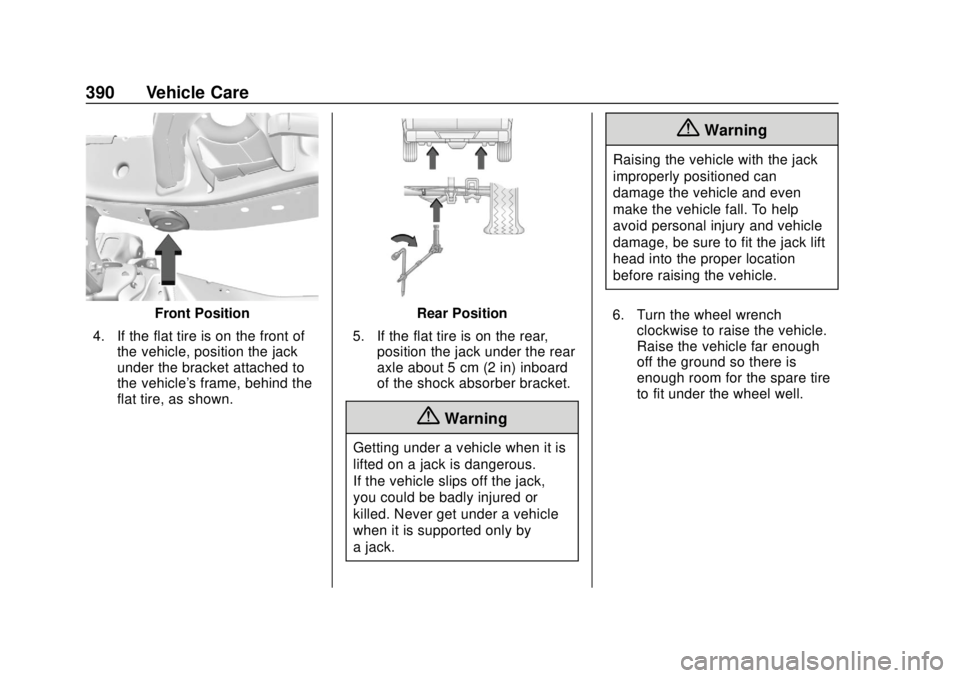
Front Position
4. If the flat tire is on the front of the vehicle, position the jack
under the bracket attached to
the vehicle's frame, behind the
flat tire, as shown.Rear Position
5. If the flat tire is on the rear, position the jack under the rear
axle about 5 cm (2 in) inboard
of the shock absorber bracket.
{Warning
Getting under a vehicle when it is
lifted on a jack is dangerous.
If the vehicle slips off the jack,
you could be badly injured or
killed. Never get under a vehicle
when it is supported only by
a jack.
{Warning
Raising the vehicle with the jack
improperly positioned can
damage the vehicle and even
make the vehicle fall. To help
avoid personal injury and vehicle
damage, be sure to fit the jack lift
head into the proper location
before raising the vehicle.
6. Turn the wheel wrench clockwise to raise the vehicle.
Raise the vehicle far enough
off the ground so there is
enough room for the spare tire
to fit under the wheel well.
Page 406 of 474
Chevrolet Silverado Owner Manual (GMNA-Localizing-U.S./Canada/Mexico-
1500-11698642) - 2019 - CRC - 2/20/19
Vehicle Care 405
Appearance Care
Exterior Care
Locks
Locks are lubricated at the factory.
Use a de-icing agent only when
absolutely necessary, and have the
locks greased after using. See
Recommended Fluids and
Lubricants0427.
Washing the Vehicle
To preserve the vehicle's finish,
wash it often and out of direct
sunlight.
{Warning
Do not power wash any part of
the vehicle’s interior, including the
vinyl floor covering. This could
damage safety and other systems
in the vehicle, which would not be
covered by the vehicle warranty.
Caution
Do not use petroleum-based,
acidic, or abrasive cleaning
agents as they can damage the
vehicle's paint, metal, or plastic
parts. If damage occurs, it would
not be covered by the vehicle
warranty. Approved cleaning
products can be obtained from
your dealer. Follow all
manufacturer directions regarding
correct product usage, necessary
safety precautions, and
appropriate disposal of any
vehicle care product.
Caution
Avoid using high-pressure
washes closer than 30 cm (12 in)
to the surface of the vehicle. Use
of power washers exceeding
8,274 kPa (1,200 psi) can result
in damage or removal of paint
and decals.
Caution
Do not power wash any
component under the hood that
has this
esymbol.
This could cause damage that
would not be covered by the
vehicle warranty.
If using an automatic car wash,
follow with the car wash
instructions. The windshield wiper
and rear window wiper, if equipped,
must be turned off. Remove any
accessories that may be damaged
or interfere with the car wash
equipment.
See Power Assist Steps 052 for
cleaning information.
Rinse the vehicle well, before
washing and after, to remove all
cleaning agents completely. If they
are allowed to dry on the surface,
they could stain.
Page 462 of 474

Chevrolet Silverado Owner Manual (GMNA-Localizing-U.S./Canada/Mexico-
1500-11698642) - 2019 - CRC - 2/20/19
Index 461
IndexA
Accessories andModifications . . . . . . . . . . . . . . . . . . 314
Accessory Power . . . . . . . . . . . . . . . 226
Active Fuel Management . . . . . . . 228
Add-On Electrical Equipment . . . 307
Adding a Snow Plow or Similar Equipment . . . . . . . . . . . . . 308
Additional Information OnStar . . . . . . . . . . . . . . . . . . . . . . . 451
Additional Maintenance and Care . . . . . . . . . . . . . . . . . . . . . . 424
Adjustments Lumbar, Front Seats . . . . . . . . . . . . 71
Air Cleaner/Filter, Engine . . . . . . . 327
Air Conditioning . . . . . . . . . . . 189, 191
Air Filter Life System . . . . . . . . . . . . . . . . . . . 326
Air Filter, Passenger
Compartment . . . . . . . . . . . . . . . . . 195
Air Vents . . . . . . . . . . . . . . . . . . . . . . . 195
Airbag System Check . . . . . . . . . . . . . . . . . . . . . . . . . . 98
How Does an AirbagRestrain? . . . . . . . . . . . . . . . . . . . . . 90
Passenger Sensing System . . . . 92
What Makes an Airbag Inflate? . . . . . . . . . . . . . . . . . . . . . . . . 90 Airbag System (cont'd)
What Will You See after an
Airbag Inflates? . . . . . . . . . . . . . . . 91
When Should an Airbag
Inflate? . . . . . . . . . . . . . . . . . . . . . . . . 89
Where Are the Airbags? . . . . . . . . 88
Airbags Adding Equipment to theVehicle . . . . . . . . . . . . . . . . . . . . . . . . 97
Passenger Status Indicator . . . 148
Readiness Light . . . . . . . . . . . . . . 148
Servicing Airbag-Equipped Vehicles . . . . . . . . . . . . . . . . . . . . . . . 96
System Check . . . . . . . . . . . . . . . . . . 86
Alarm Vehicle Security . . . . . . . . . . . . . . . . 53
Alert Lane Change . . . . . . . . . . . . . . . . . 268
Side Blind Zone (SBZA) . . . . . . 267
All-Season Tires . . . . . . . . . . . . . . . . 361
All-Terrain Tires . . . . . . . . . . . . . . . . . 362
Antilock Brake System (ABS) . . . 241 Warning Light . . . . . . . . . . . . . . . . . 153
Appearance Care Exterior . . . . . . . . . . . . . . . . . . . . . . . 405
Interior . . . . . . . . . . . . . . . . . . . . . . . . 410
Assistance Program, Roadside . . . . . . . . . . . . . . . . . . . . . . 439
Page 468 of 474

Chevrolet Silverado Owner Manual (GMNA-Localizing-U.S./Canada/Mexico-
1500-11698642) - 2019 - CRC - 2/20/19
Index 467
Lane Keep Assist Light . . . . . . . . . 154
Lap-Shoulder Belt . . . . . . . . . . . . . . . 82
LATCH SystemReplacing Parts after aCrash . . . . . . . . . . . . . . . . . . . . . . . .117
LATCH, Lower Anchors and Tethers for Children . . . . . . . . . . . 106
LED Lighting . . . . . . . . . . . . . . . . . . . . 348
Lighting Entry . . . . . . . . . . . . . . . . . . . . . . . . . 185
Exit . . . . . . . . . . . . . . . . . . . . . . . . . . . 185
Illumination Control . . . . . . . . . . . 184
LED . . . . . . . . . . . . . . . . . . . . . . . . . . 348
Task . . . . . . . . . . . . . . . . . . . . . . . . . . 183
Lights Airbag Readiness . . . . . . . . . . . . . 148
Antilock Brake System
(ABS) Warning . . . . . . . . . . . . . . 153
Brake System Warning . . . . . . . 152
Charging System . . . . . . . . . . . . . 149
Check Engine (Malfunction Indicator) . . . . . . . . . . . . . . . . . . . . 150
Cruise Control . . . . . . . . . . . . . . . . 159
Door Ajar . . . . . . . . . . . . . . . . . . . . . 159
Driver Mode Control . . . . . . . . . . 157
Electric Parking Brake . . . . . . . . 153
Electronic Stability Control (ESC), Off . . . . . . . . . . . . . . . . . . . 156 Lights (cont'd)
Engine Coolant
Temperature Warning . . . . . . . 156
Engine Oil Pressure . . . . . . . . . . 158
Flash-to-Pass . . . . . . . . . . . . . . . . . 180
Four-Wheel-Drive . . . . . . . . . . . . . 154
Front Fog Lamp . . . . . . . . . . . . . . 159
High-Beam On . . . . . . . . . . . . . . . . 158
High/Low Beam Changer . . . . . 179
Hill Descent Control . . . . . . . . . . 154
Lane Keep Assist . . . . . . . . . . . . . 154
Low Fuel Warning . . . . . . . . . . . . 158
Seat Belt Reminders . . . . . . . . . . 147
Security . . . . . . . . . . . . . . . . . . . . . . 158
Service Electric Parking
Brake . . . . . . . . . . . . . . . . . . . . . . . 153
Tire Pressure . . . . . . . . . . . . . . . . . 157
Tow/Haul Mode . . . . . . . . . . . . . . . 154
Traction Off . . . . . . . . . . . . . . . . . . . 155
Limited-Slip Differential . . . . . . . . . 251
Locking Rear Axle . . . . . . . . . . . . . . 251
Locks Automatic Door . . . . . . . . . . . . . . . . . 47
Delayed Locking . . . . . . . . . . . . . . . . 46
Door . . . . . . . . . . . . . . . . . . . . . . . . . . . . 45
Lockout Protection . . . . . . . . . . . . . . 47
Power Door . . . . . . . . . . . . . . . . . . . . . 46
Safety . . . . . . . . . . . . . . . . . . . . . . . . . . 47 Loss of Control . . . . . . . . . . . . . . . . . 201
Low Fuel Warning Light . . . . . . . . . 158
Low-Profile Tires . . . . . . . . . . . . . . . . 362
Lower Anchors and Tethers
for Children (LATCH
System) . . . . . . . . . . . . . . . . . . . . . . . 106
Lumbar Adjustment . . . . . . . . . . . . . . 71
Front Seats . . . . . . . . . . . . . . . . . . . . . 71
M
MaintenanceRecords . . . . . . . . . . . . . . . . . . . . . . 430
Maintenance and Care Additional . . . . . . . . . . . . . . . . . . . . . 424
Maintenance Schedule . . . . . . . . . 417 Recommended Fluids andLubricants . . . . . . . . . . . . . . . . . . . 427
Transfer Case . . . . . . . . . . . . . . . . 236
Malfunction Indicator Lamp . . . . . 150
Manual Mirrors . . . . . . . . . . . . . . . . . . 56
Manual Mode . . . . . . . . . . . . . . . . . . . 233
Manual Windows . . . . . . . . . . . . . . . . 62
Memory Features . . . . . . . . . . . . . . . . 13
Memory Seats . . . . . . . . . . . . . . . . . . . 73
Messages Engine Power . . . . . . . . . . . . . . . . 168
Vehicle . . . . . . . . . . . . . . . . . . . . . . . 167
Vehicle Speed . . . . . . . . . . . . . . . . 168