wheel CHEVROLET SILVERADO 2500 2019 Manual Online
[x] Cancel search | Manufacturer: CHEVROLET, Model Year: 2019, Model line: SILVERADO 2500, Model: CHEVROLET SILVERADO 2500 2019Pages: 489, PDF Size: 6.81 MB
Page 290 of 489
Chevrolet Silverado LD 1500 and Silverado 2500/3500 Owner Manual (GMNA-
Localizing-U.S./Canada-12162993) - 2019 - crc - 4/4/18
Driving and Operating 289
three times, on the right or left,
depending on the lane departure
direction.
Take Steering
The LKA system does not
continuously steer the vehicle.
If LKA does not detect active driver
steering, an alert, chime, or DIC
message may be provided. Move
the steering wheel to dismiss.
When the System Does Not
Seem to Work Properly
The system performance may be
affected by:
.Close vehicles ahead.
. Sudden lighting changes, such
as when driving through tunnels.
. Banked roads.
. Roads with poor lane markings,
such as two-lane roads.
If the LKA system is not functioning
properly when lane markings are
clearly visible, cleaning the
windshield may help. A camera blocked message may
display if the camera is blocked.
Cleaning the outside of the
windshield behind the rearview
mirror may correct the issue. Some
driver assistance systems may have
reduced performance or not work at
all. An LKA or LDW unavailable
message may display if the systems
are temporarily unavailable. This
message could be due to a blocked
camera. The LKA system does not
need service. Clean the outside of
the windshield behind the rearview
mirror.
LKA assistance and/or LDW alerts
may occur due to tar marks,
shadows, cracks in the road,
temporary or construction lane
markings, or other road
imperfections. This is normal system
operation; the vehicle does not need
service. Turn LKA off if these
conditions continue.
Fuel
Top Tier Fuel
GM recommends the use of TOP
TIER Detergent Gasoline to keep
the engine clean, reduce engine
deposits, and maintain optimal
vehicle performance. Look for the
TOP TIER Logo or see
www.toptiergas.com for a list of TOP
TIER Detergent Gasoline marketers
and applicable countries.
Page 297 of 489
Chevrolet Silverado LD 1500 and Silverado 2500/3500 Owner Manual (GMNA-
Localizing-U.S./Canada-12162993) - 2019 - crc - 4/4/18
296 Driving and Operating
tires, and mirrors. SeeTowing
Equipment 0306. If the trailer has
electric brakes, start the
combination moving and then
manually apply the trailer brake
controller to check the trailer brakes
work. During the trip, occasionally
check that the cargo and trailer are
secure and that the lamps and any
trailer brakes are working.
Towing with a Stability Control
System
When towing, the stability control
system might be heard. The system
reacts to vehicle movement caused
by the trailer, which mainly occurs
during cornering. This is normal
when towing heavier trailers.
Following Distance
Stay at least twice as far behind the
vehicle ahead as you would when
driving without a trailer. This can
help to avoid heavy braking and
sudden turns.
Passing
More passing distance is needed
when towing a trailer. The
combination of the vehicle and
trailer will not accelerate as quickly
and is much longer than the vehicle
alone. It is necessary to go much
farther beyond the passed vehicle
before returning to the lane. Pass
on level roadways. Avoid passing
on hills if possible.
Backing Up
Hold the bottom of the steering
wheel with one hand. To move the
trailer to the left, move that hand to
the left. To move the trailer to the
right, move that hand to the right.
Always back up slowly and,
if possible, have someone
guide you.
Making Turns
Caution
Turn more slowly and make wider
arcs when towing a trailer to
prevent damage to your vehicle.
Making very sharp turns could
cause the trailer to contact the
vehicle.
Make wider turns than normal when
towing, so trailer will not go over soft
shoulders, over curbs, or strike road
signs, trees, or other objects.
Always signal turns well in advance.
Do not steer or brake suddenly.
Driving on Grades
Reduce speed and shift to a lower
gear before starting down a long or
steep downhill grade. If the
transmission is not shifted down, the
brakes may overheat and result in
reduced braking efficiency.
Page 298 of 489
Chevrolet Silverado LD 1500 and Silverado 2500/3500 Owner Manual (GMNA-
Localizing-U.S./Canada-12162993) - 2019 - crc - 4/4/18
Driving and Operating 297
The vehicle can tow in D (Drive).
Shift the transmission to a lower
gear if the transmission shifts too
often under heavy loads and/or hilly
conditions.
When towing at higher altitudes,
engine coolant will boil at a lower
temperature than at lower altitudes.
If the engine is turned off
immediately after towing at high
altitude on steep uphill grades, the
vehicle could show signs similar to
engine overheating. To avoid this,
let the engine run, preferably on
level ground, with the transmission
in P (Park) for a few minutes before
turning the engine off. If the
overheat warning comes on, see
Engine Overheating0343.
Parking on Hills
{Warning
To prevent serious injury or death,
always park your vehicle and
trailer on a level surface when
possible. When parking your vehicle and your
trailer on a hill:
1. Press the brake pedal, but do not shift into P (Park) yet. Turn
the wheels into the curb if
facing downhill or into traffic if
facing uphill.
2. Have someone place chocks under the trailer wheels.
3. When the wheel chocks are in place, gradually release the
brake pedal to allow the chocks
to absorb the load of the trailer.
4. Reapply the brake pedal. Then apply the parking brake and
shift into P (Park).
5. Release the brake pedal.
Leaving After Parking on a Hill
1. Apply and hold the brake pedal.
.Start the engine.
. Shift into a gear.
. Release the parking brake.
2. Let up on the brake pedal. 3. Drive slowly until the trailer is
clear of the chocks.
4. Stop and have someone pick up and store the chocks.
Maintenance when Trailer
Towing
The vehicle needs service more
often when used to tow trailers. See
Maintenance Schedule 0430. It is
especially important to check the
automatic transmission fluid, engine
oil, axle lubricant, belts, cooling
system, and brake system before
and during each trip.
Check periodically that all nuts and
bolts on the trailer hitch are tight.
Engine Cooling When Trailer
Towing
The cooling system may temporarily
overheat during severe operating
conditions. See Engine Overheating
0 343.
Page 300 of 489
Chevrolet Silverado LD 1500 and Silverado 2500/3500 Owner Manual (GMNA-
Localizing-U.S./Canada-12162993) - 2019 - crc - 4/4/18
Driving and Operating 299
Gross Combined Weight
Rating (GCWR)
GCWR is the total allowable weight
of the completely loaded vehicle
and trailer including any fuel,
passengers, cargo, equipment, and
accessories. Do not exceed the
GCWR for your vehicle. The GCWR
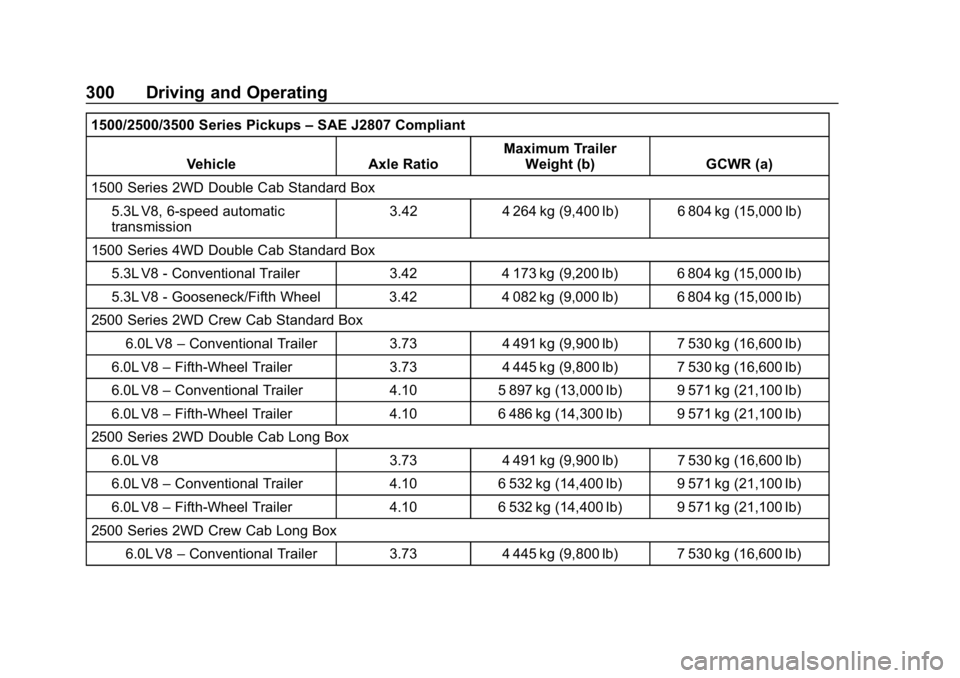
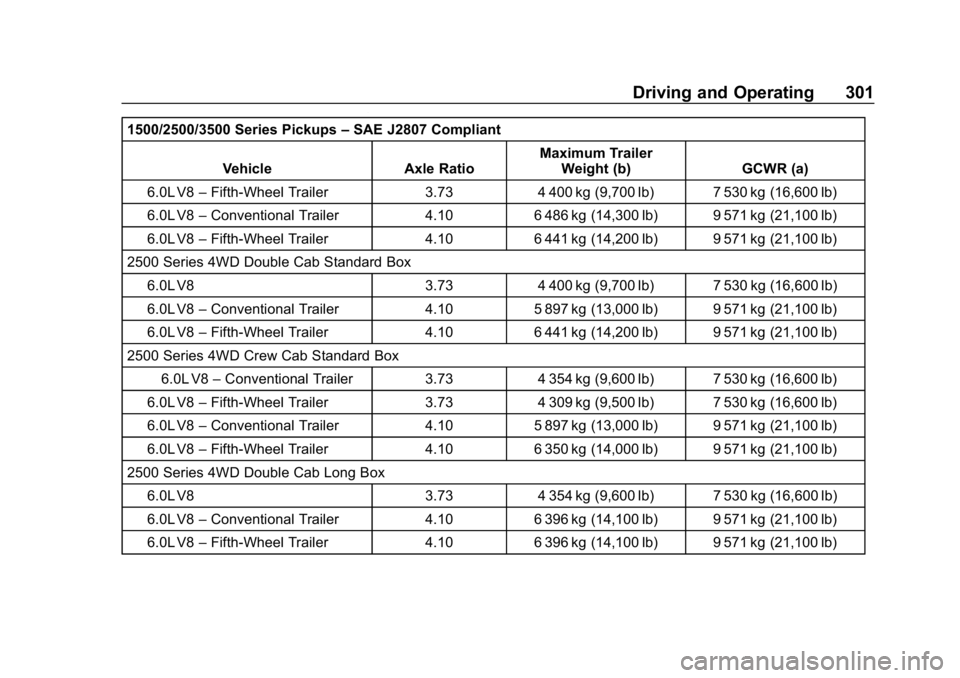
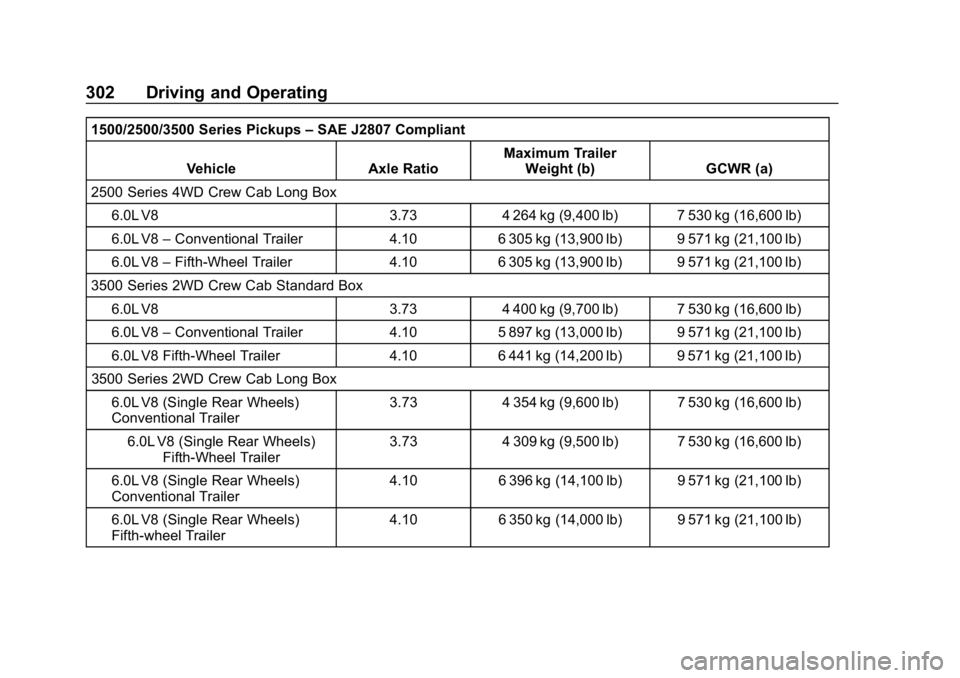
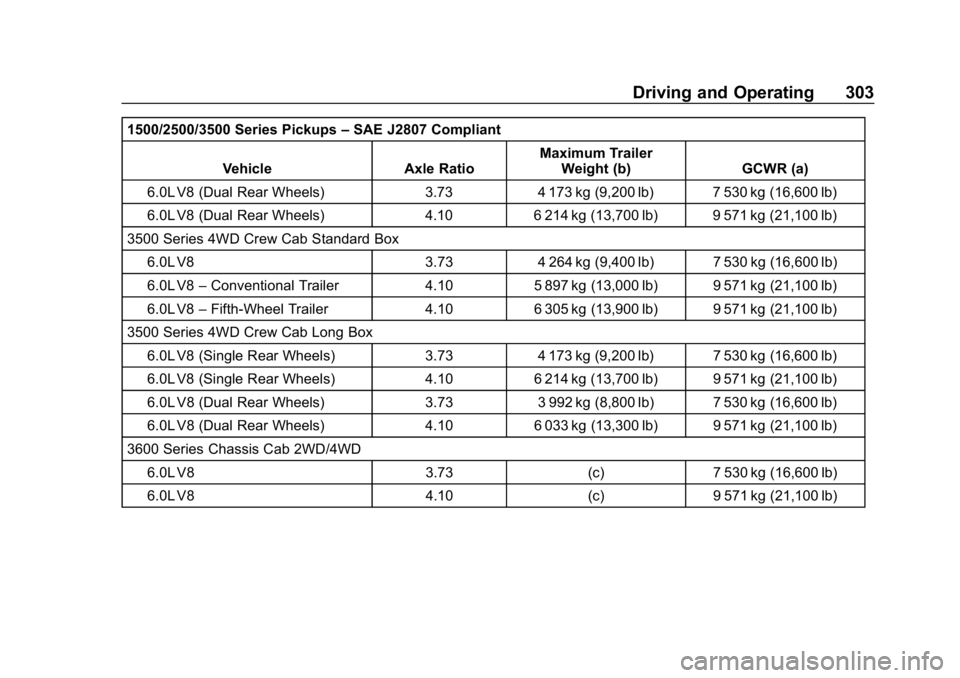
for the vehicle is on the Tow Rating
Chart following.
Gross Vehicle Weight
Rating (GVWR)
For information about the vehicle's
maximum load capacity, seeVehicle
Load Limits 0238. When calculating
the GVWR with a trailer attached,
the trailer tongue weight must be
included as part of the weight the
vehicle is carrying.
Maximum Trailer Weight
The maximum trailer weight rating is
calculated assuming the tow vehicle
has a driver, a front seat passenger,
and all required trailering
equipment. Weight of additional
optional equipment, passengers, and cargo in the tow vehicle must
be subtracted from the trailer weight
rating.
Use the tow rating chart to
determine how much the trailer can
weigh, based on the vehicle model
and options.
Weights listed apply for
conventional trailers and
gooseneck/fifth-wheel trailers unless
otherwise noted.
Page 301 of 489
Chevrolet Silverado LD 1500 and Silverado 2500/3500 Owner Manual (GMNA-
Localizing-U.S./Canada-12162993) - 2019 - crc - 4/4/18
300 Driving and Operating
1500/2500/3500 Series Pickups–SAE J2807 Compliant
Vehicle Axle Ratio Maximum Trailer
Weight (b) GCWR (a)
1500 Series 2WD Double Cab Standard Box 5.3L V8, 6-speed automatic
transmission 3.42
4 264 kg (9,400 lb) 6 804 kg (15,000 lb)
1500 Series 4WD Double Cab Standard Box 5.3L V8 - Conventional Trailer 3.424 173 kg (9,200 lb) 6 804 kg (15,000 lb)
5.3L V8 - Gooseneck/Fifth Wheel 3.42 4 082 kg (9,000 lb) 6 804 kg (15,000 lb)
2500 Series 2WD Crew Cab Standard Box
6.0L V8 –Conventional Trailer 3.734 491 kg (9,900 lb) 7 530 kg (16,600 lb)
6.0L V8 –Fifth-Wheel Trailer 3.734 445 kg (9,800 lb) 7 530 kg (16,600 lb)
6.0L V8 –Conventional Trailer 4.105 897 kg (13,000 lb) 9 571 kg (21,100 lb)
6.0L V8 –Fifth-Wheel Trailer 4.106 486 kg (14,300 lb) 9 571 kg (21,100 lb)
2500 Series 2WD Double Cab Long Box 6.0L V8 3.734 491 kg (9,900 lb) 7 530 kg (16,600 lb)
6.0L V8 –Conventional Trailer 4.106 532 kg (14,400 lb) 9 571 kg (21,100 lb)
6.0L V8 –Fifth-Wheel Trailer 4.106 532 kg (14,400 lb) 9 571 kg (21,100 lb)
2500 Series 2WD Crew Cab Long Box 6.0L V8 –Conventional Trailer 3.734 445 kg (9,800 lb) 7 530 kg (16,600 lb)
Page 302 of 489
Chevrolet Silverado LD 1500 and Silverado 2500/3500 Owner Manual (GMNA-
Localizing-U.S./Canada-12162993) - 2019 - crc - 4/4/18
Driving and Operating 301
1500/2500/3500 Series Pickups–SAE J2807 Compliant
Vehicle Axle Ratio Maximum Trailer
Weight (b) GCWR (a)
6.0L V8 –Fifth-Wheel Trailer 3.734 400 kg (9,700 lb) 7 530 kg (16,600 lb)
6.0L V8 –Conventional Trailer 4.106 486 kg (14,300 lb) 9 571 kg (21,100 lb)
6.0L V8 –Fifth-Wheel Trailer 4.106 441 kg (14,200 lb) 9 571 kg (21,100 lb)
2500 Series 4WD Double Cab Standard Box 6.0L V8 3.734 400 kg (9,700 lb) 7 530 kg (16,600 lb)
6.0L V8 –Conventional Trailer 4.105 897 kg (13,000 lb) 9 571 kg (21,100 lb)
6.0L V8 –Fifth-Wheel Trailer 4.106 441 kg (14,200 lb) 9 571 kg (21,100 lb)
2500 Series 4WD Crew Cab Standard Box 6.0L V8 –Conventional Trailer 3.734 354 kg (9,600 lb) 7 530 kg (16,600 lb)
6.0L V8 –Fifth-Wheel Trailer 3.734 309 kg (9,500 lb) 7 530 kg (16,600 lb)
6.0L V8 –Conventional Trailer 4.105 897 kg (13,000 lb) 9 571 kg (21,100 lb)
6.0L V8 –Fifth-Wheel Trailer 4.106 350 kg (14,000 lb) 9 571 kg (21,100 lb)
2500 Series 4WD Double Cab Long Box 6.0L V8 3.734 354 kg (9,600 lb) 7 530 kg (16,600 lb)
6.0L V8 –Conventional Trailer 4.106 396 kg (14,100 lb) 9 571 kg (21,100 lb)
6.0L V8 –Fifth-Wheel Trailer 4.106 396 kg (14,100 lb) 9 571 kg (21,100 lb)
Page 303 of 489
Chevrolet Silverado LD 1500 and Silverado 2500/3500 Owner Manual (GMNA-
Localizing-U.S./Canada-12162993) - 2019 - crc - 4/4/18
302 Driving and Operating
1500/2500/3500 Series Pickups–SAE J2807 Compliant
Vehicle Axle Ratio Maximum Trailer
Weight (b) GCWR (a)
2500 Series 4WD Crew Cab Long Box 6.0L V8 3.734 264 kg (9,400 lb) 7 530 kg (16,600 lb)
6.0L V8 –Conventional Trailer 4.106 305 kg (13,900 lb) 9 571 kg (21,100 lb)
6.0L V8 –Fifth-Wheel Trailer 4.106 305 kg (13,900 lb) 9 571 kg (21,100 lb)
3500 Series 2WD Crew Cab Standard Box 6.0L V8 3.734 400 kg (9,700 lb) 7 530 kg (16,600 lb)
6.0L V8 –Conventional Trailer 4.105 897 kg (13,000 lb) 9 571 kg (21,100 lb)
6.0L V8 Fifth-Wheel Trailer 4.106 441 kg (14,200 lb) 9 571 kg (21,100 lb)
3500 Series 2WD Crew Cab Long Box 6.0L V8 (Single Rear Wheels)
Conventional Trailer 3.73
4 354 kg (9,600 lb) 7 530 kg (16,600 lb)
6.0L V8 (Single Rear Wheels) Fifth-Wheel Trailer 3.73
4 309 kg (9,500 lb) 7 530 kg (16,600 lb)
6.0L V8 (Single Rear Wheels)
Conventional Trailer 4.10
6 396 kg (14,100 lb) 9 571 kg (21,100 lb)
6.0L V8 (Single Rear Wheels)
Fifth-wheel Trailer 4.10
6 350 kg (14,000 lb) 9 571 kg (21,100 lb)
Page 304 of 489
Chevrolet Silverado LD 1500 and Silverado 2500/3500 Owner Manual (GMNA-
Localizing-U.S./Canada-12162993) - 2019 - crc - 4/4/18
Driving and Operating 303
1500/2500/3500 Series Pickups–SAE J2807 Compliant
Vehicle Axle Ratio Maximum Trailer
Weight (b) GCWR (a)
6.0L V8 (Dual Rear Wheels) 3.73 4 173 kg (9,200 lb) 7 530 kg (16,600 lb)
6.0L V8 (Dual Rear Wheels) 4.10 6 214 kg (13,700 lb) 9 571 kg (21,100 lb)
3500 Series 4WD Crew Cab Standard Box
6.0L V8 3.73 4 264 kg (9,400 lb) 7 530 kg (16,600 lb)
6.0L V8 –Conventional Trailer 4.105 897 kg (13,000 lb) 9 571 kg (21,100 lb)
6.0L V8 –Fifth-Wheel Trailer 4.106 305 kg (13,900 lb) 9 571 kg (21,100 lb)
3500 Series 4WD Crew Cab Long Box
6.0L V8 (Single Rear Wheels) 3.734 173 kg (9,200 lb) 7 530 kg (16,600 lb)
6.0L V8 (Single Rear Wheels) 4.106 214 kg (13,700 lb) 9 571 kg (21,100 lb)
6.0L V8 (Dual Rear Wheels) 3.733 992 kg (8,800 lb) 7 530 kg (16,600 lb)
6.0L V8 (Dual Rear Wheels) 4.106 033 kg (13,300 lb) 9 571 kg (21,100 lb)
3600 Series Chassis Cab 2WD/4WD 6.0L V8 3.73(c)7 530 kg (16,600 lb)
6.0L V8 4.10(c)9 571 kg (21,100 lb)
Page 306 of 489
Chevrolet Silverado LD 1500 and Silverado 2500/3500 Owner Manual (GMNA-
Localizing-U.S./Canada-12162993) - 2019 - crc - 4/4/18
Driving and Operating 305
Vehicle Series Hitch TypeMaximum Tongue
Weight
1500 Weight-Carrying or Weight-Distributing 567 kg (1,250 lb)
2500/3500
Standard Box Weight-Carrying or
Weight-Distributing 680 kg (1,500 lb)
2500/
3500 Long Box Weight-Carrying or
Weight-Distributing 907 kg (2,000 lb)
2500 Fifth-Wheel Gooseneck 1 361 kg (3,000 lb)
3500 Single Rear
Wheels Fifth-Wheel Gooseneck 1 814 kg (4,000 lb)
3500 Dual Rear
Wheels Fifth-Wheel Gooseneck 2 495 kg (5,500 lb)
The trailer tongue weight contributes
to the Gross Vehicle Weight (GVW).
GVW includes the CURB WEIGHT
of your vehicle, any passengers,
cargo, equipment and the trailer
tongue weight. Vehicle options,
passengers, cargo, and equipment
reduce the maximum allowable
tongue weight the vehicle can carry,
which also reduces the maximum
allowable trailer weight.
Trailer Load Balance
The correct trailer load balance
must be maintained to ensure trailer
stability. Incorrect load balance is a
leading cause of trailer sway.
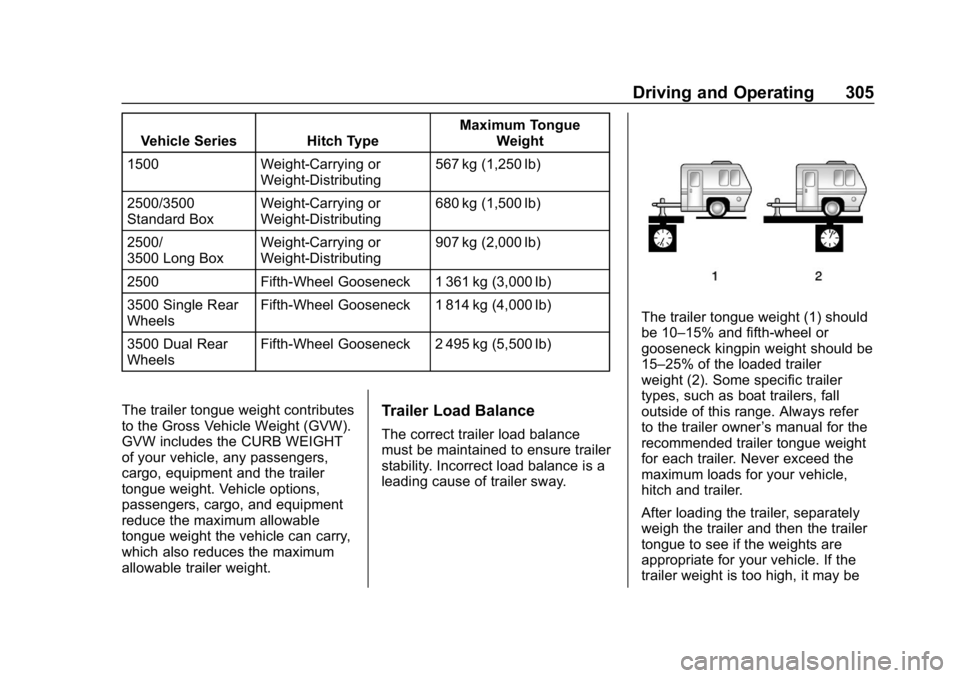
The trailer tongue weight (1) should
be 10–15% and fifth-wheel or
gooseneck kingpin weight should be
15–25% of the loaded trailer
weight (2). Some specific trailer
types, such as boat trailers, fall
outside of this range. Always refer
to the trailer owner ’s manual for the
recommended trailer tongue weight
for each trailer. Never exceed the
maximum loads for your vehicle,
hitch and trailer.
After loading the trailer, separately
weigh the trailer and then the trailer
tongue to see if the weights are
appropriate for your vehicle. If the
trailer weight is too high, it may be
Page 307 of 489
Chevrolet Silverado LD 1500 and Silverado 2500/3500 Owner Manual (GMNA-
Localizing-U.S./Canada-12162993) - 2019 - crc - 4/4/18
306 Driving and Operating
possible to trasfer some of the
cargo into your vehicle. If the trailer
tongue weight is too high or too low,
it may be possible to rearrange
some of the cargo inside of the
trailer.
Do not exceed the maximum
allowable tongue weight for your
vehicle. Use the shortest hitch
extension available to position the
hitch ball closer to your vehicle. This
will help reduce the effect of the
trailer tongue weight on the trailer
hitch and the rear axle.
If a cargo carrier is used in the
trailer hitch receiver, choose a
carrier that positions the load as
close to the vehicle as possible.
Make sure the total weight,
including the carrier, is no more than
half of the maximum allowable
tongue weight for the vehicle or
227 kg (500 lb), whichever is less.
Rear Gross Axle Weight Rating
(GAWR-RR)
The GAWR-RR is the total weight
that can be supported by the rear
axle of the vehicle. Do not exceedthe GAWR-RR for the vehicle, with
the tow vehicle and trailer fully
loaded for the trip including the
weight of the trailer tongue. If using
a weight-distributing hitch, do not
exceed the GAWR-RR before
applying the weight distribution
spring bars.
Ask your dealer for trailering
information or assistance.
Towing Equipment
Hitches
Always use the correct hitch
equipment for your vehicle.
Crosswinds, large trucks going by,
and rough roads can affect the
trailer and the hitch.
Proper hitch equipment for your
vehicle helps maintain control of the
vehicle-trailer combination. Many
trailers can be towed using a
weight-carrying hitch which has a
coupler latched to the hitch ball, or a
tow eye latched to a pintle hook.
Other trailers may require a
weight-distributing hitch that uses
spring bars to distribute the trailertongue weight between your vehicle
and trailer axles. Fifth-wheel and
gooseneck hitches may also be
used. See
“Trailer Tongue Weight”
under Trailer Towing 0298 for
weight limits with various hitch
types.
Avoid sharp turns when using a
step-bumper hitch to prevent
damage. Make wider turns to
prevent contact between your trailer
and your bumper.
Consider using mechanical sway
controls with any trailer. Ask a
trailering professional about sway
controls or refer to the trailer
manufacturer's recommendations
and instructions.
Weight-Distributing Hitch
Adjustment
A weight-distributing hitch may be
useful with some trailers. Use the
following guidelines to determine if a
weight-distributing hitch should
be used.